
ALTUVIIIO Antihemophilic Factor (Recombinant), Fc-VWF-XTEN Fusion Protein-ehtl Kit — NDC 71104-981-01 (Billing 71104-0981-01)
This is a package of ALTUVIIIO Antihemophilic Factor (Recombinant), Fc-VWF-XTEN Fusion Protein-ehtl Kit from Bioverativ Therapeutics Inc., marketed since Feb 2023 and currently FDA-listed. It is this product's only package size.
NDC database record
One package, one record: these facts belong to NDC 71104-981-01 alone.
- Record
- FDA NDC Directory package listing · Human prescription drug
- Code segments
- 71104 labeler · 981 product · 01 package
- Package marketed since
- Feb 22, 2023
- Sample package
- No — commercial package
- Listing certified through
- Dec 31, 2027
- Barcode (UPC-A, from the NDC)
- 3 7110498101 5
- Medicaid fills, this package
- 752 prescriptions in the last four reported quarters
- FDA record last changed
- Jul 24, 2026
Identity & classification
Regulatory identifiers FDA, NLM and CMS codes for this package
Drug-database identifiers Medi-Span GPI and First Databank GCN / HICL / AHFS classification
- GSN (GCN sequence number): 084452
- GCN: 53758
- GPI-14 (Medi-Span): 85100010312135
- HICL (First Databank): 048730
- AHFS class code: 20:28.16.00
- RxCUI (RxNorm): 2631088
Where does this data come from?
- FDA openFDA NDC Directory · synced Oct 1, 2026
- FDA label on DailyMed · label index refreshed Oct 6, 2026
- RxNorm (NLM RxNav) · catalog refreshed Oct 1, 2026
- Medi-Span GPI (licensed)
- First Databank (licensed) · refreshed Oct 1, 2026
Clinical
Patient education
Supplement & herbal interactions
Where does this data come from?
- MedlinePlus (NLM) · refreshed Oct 1, 2026
- FDA label on DailyMed · label index refreshed Oct 6, 2026
Ask a licensed pharmacist directly — free, answered by our team.
Pricing
A drug doesn't have one price. Each row is a different public payment system, and none is what you'd pay at the counter — that depends on your insurance. The ⓘ on each row explains what it measures.
| Price system | Per each | Per package |
|---|---|---|
| Retail pharmacies payNADAC · weekly | Not in the retail survey — common for institutional, discontinued, or low-volume packs. | |
| Medicaid paysCMS SDUD · 12 mo | $5.01 | — |
| Medicare drug plans payPart D · quarterly | No Part D plan price is available for this NDC in our data. | |
| Medicare Part B allowsASP · J7214 | $4.632 / J7214 unit | — |
Where does this data come from?
- CMS NADAC weekly file
- CMS ASP pricing files · refreshed Sep 20, 2026
- CMS Medicaid State Drug Utilization Data · through Q1 2026
- CMS Part D plan pricing files · refreshed Sep 24, 2026
- VA National Acquisition Center price file
Billing & reimbursement
Where does this data come from?
- CMS ASP NDC-HCPCS crosswalk · refreshed Sep 22, 2026
- DMEPDAC NDC-HCPCS crosswalk
- openFDA NSDE billing units · refreshed Sep 7, 2026
Packaging — all sizes for this product
| Package NDC | Description | Marketing start | Marketing end | Status |
|---|---|---|---|---|
| 71104-0981-01 You're viewing this Main listing | 1 KIT in 1 KIT * 3 mL in 1 VIAL * 3 mL in 1 SYRINGE | 2023-02-22 | — | Active |
Therapeutic equivalents
| Product | Labeler | Pack | NADAC/unit | TE | Status | Price vs. this |
|---|---|---|---|---|---|---|
| Altuviiio 71104-0978-01 | Bioverativ | 1 kit | — | — | FDA listed | — |
| Altuviiio 71104-0979-01 | Bioverativ | 1 kit | — | — | FDA listed | — |
| Altuviiiothis 71104-0981-01 | Bioverativ | 1 kit | — | — | FDA listed | — |
| Altuviiio 71104-0982-01 | Bioverativ | 1 kit | — | — | FDA listed | — |
| Altuviiio 71104-0983-01 | Bioverativ | 1 kit | — | — | FDA listed | — |
| Altuviiio 71104-0984-01 | Bioverativ | 1 kit | — | — | FDA listed | — |
Where does this data come from?
- FDA openFDA NDC Directory · synced Oct 1, 2026
- FDA Purple Book · refreshed Oct 5, 2026
- CMS NADAC weekly file
Availability & biosimilar status
Biologics have no small-molecule generics; biosimilar competition is tracked in the FDA Purple Book.
Why the date isn’t exact: Biosimilar timing can change because patents may be challenged, settled, licensed, added or removed, and litigation can move the real date earlier or later.
🛈 What do these terms mean?
- Biologic patent
- A patent the reference product’s maker has publicly listed. A biosimilar generally can’t launch until these expire — unless they’re invalidated or resolved in a settlement.
- Reference-product exclusivity
- A flat 12 years of FDA market protection from the biologic’s first licensure (the BPCIA). No biosimilar can be licensed before it ends, regardless of patents.
- Interchangeable exclusivity
- The first interchangeable biosimilar can earn a period as the only interchangeable version (pharmacists can substitute it without the prescriber).
- Earliest biosimilar (LOE)
- The latest of all the dates above — the soonest a biosimilar can realistically reach the market. Litigation and settlements can move it earlier.
Biologics have no small-molecule “generics” — competition comes from FDA-licensed biosimilars, tracked in the FDA Purple Book.
| Code | What it grants | Expires |
|---|---|---|
| RefProduct | Reference-product exclusivity (12-year, BPCIA) — no biosimilar can be licensed before this date | Feb 22, 2035 |
Is there a biosimilar for ALTUVIIIO 1,000 UNIT VIAL?
Why do different websites show different biosimilar dates?
Can a biosimilar launch before the last patent expires?
What does “current Purple Book estimate” mean?
What does “FDA listed” mean?
What does a patent or protection date mean here?
Where does this data come from?
- FDA Purple Book · refreshed Oct 5, 2026
Inactive Ingredients / Excipients
Inactive ingredients, also called excipients, are components of the drug product other than the active ingredient. They may include fillers, dyes, coatings, preservatives, flavors, or other formulation ingredients.
Where does this data come from?
IACT rows and label-wide narrative are kept separate; availability and product-level specificity depend on the submitted label.- FDA label on DailyMed · label index refreshed Oct 6, 2026
- FDA openFDA NDC Directory · synced Oct 1, 2026
Inactive ingredient FAQ
Are inactive ingredients the same for every manufacturer?
Why might an inactive ingredient be missing?
Can inactive ingredients matter?
Manufacturer & labeler
More NDCs from Bioverativ Therapeutics Inc. labeler code 71104
- ALPROLIX Coagulation Factor IX (Recombinant), Fc Fusion Protein Kit NDC 71104-933-01
- ALPROLIX Coagulation Factor IX (Recombinant), Fc Fusion Protein Kit NDC 71104-944-01
- ALPROLIX Coagulation Factor IX (Recombinant), Fc Fusion Protein Kit NDC 71104-966-01
- ALPROLIX Coagulation Factor IX (Recombinant), Fc Fusion Protein Kit NDC 71104-977-01
- ALTUVIIIO Antihemophilic Factor (Recombinant), Fc-VWF-XTEN Fusion Protein-ehtl Kit NDC 71104-978-01
- ALTUVIIIO Antihemophilic Factor (Recombinant), Fc-VWF-XTEN Fusion Protein-ehtl Kit NDC 71104-979-01
- ALTUVIIIO Antihemophilic Factor (Recombinant), Fc-VWF-XTEN Fusion Protein-ehtl Kit NDC 71104-982-01
- ALTUVIIIO Antihemophilic Factor (Recombinant), Fc-VWF-XTEN Fusion Protein-ehtl Kit NDC 71104-983-01
- ALTUVIIIO Antihemophilic Factor (Recombinant), Fc-VWF-XTEN Fusion Protein-ehtl Kit NDC 71104-984-01
Where does this data come from?
- FDA openFDA NDC Directory · synced Oct 1, 2026
- Drugs@FDA
Full prescribing information FDA SPL
🎯 Indications and Usage ▾
1 INDICATIONS AND USAGE ALTUVIIIO is indicated for use in adults and pediatric patients with hemophilia A (congenital factor VIII deficiency) for: Routine prophylaxis to reduce the frequency of bleeding episodes On-demand treatment and control of bleeding episodes Perioperative management of bleeding ALTUVIIIO [antihemophilic factor (recombinant), Fc-VWF-XTEN fusion protein-ehtl] is a recombinant DNA-derived, Factor VIII concentrate indicated for use in adults and children with hemophilia A (congenital factor VIII deficiency) for: Routine prophylaxis to reduce the frequency of bleeding episodes On-demand treatment & control of bleeding episodes Perioperative management of bleeding ( 1 ) Limitation of Use: ALTUVIIIO is not indicated for the treatment of von Willebrand disease.
( 1 ) Limitation of Use ALTUVIIIO is not indicated for the treatment of von Willebrand disease.
⏱️ Dosage and Administration ▾
2 DOSAGE AND ADMINISTRATION For intravenous use after reconstitution only. For intravenous use only. Each ALTUVIIIO vial label states Factor VIII activity in international units (IU or unit).
( 2.1 ) For routine prophylaxis: 50 IU/kg once weekly. ( 2.1 ) For on-demand treatment and control of bleeding episodes and perioperative management: 50 IU/kg ( 2.1 ) Estimated Increment of Factor VIII (IU/dL or % of normal) = 50 IU/kg × 2 (IU/dL per IU/kg) ( 2.1 ) To achieve a specific target Factor VIII activity level, use the following formula: Dosage (IU) = Body Weight (kg) × Desired Factor VIII Increase (IU/dL or % normal) × 0.5 (IU/kg per IU/dL). ( 2.1 )
2.1Dose Each ALTUVIIIO vial label states the Factor VIII potency in international units (IU). One IU corresponds to the Factor VIII activity contained in one milliliter of normal human plasma, as defined by the current World Health Organization (WHO) international standard for Factor VIII concentrate. Potency assignment for ALTUVIIIO is determined using an activated partial thromboplastin time (aPTT)-based one-stage clotting assay.
It is recommended to use a validated one-stage clotting assay to measure ALTUVIIIO Factor VIII activity in plasma. The ALTUVIIIO Factor VIII activity level is overestimated by the chromogenic assay and a specific ellagic acid based aPTT reagent in one-stage clotting assay by approximately 2.5-fold [see Warnings and Precautions (5.3) ]. For the dose of 50 IU/kg, the expected in vivo peak increase in Factor VIII level expressed as IU/dL (or % of normal) is estimated using the following formula: Estimated Increment of Factor VIII (IU/dL or % of normal) = 50 IU/kg × 2 (IU/dL per IU/kg) To achieve a specific target Factor VIII activity level, use the following formula: Dosage (IU) = Body Weight (kg) × Desired Factor VIII Increase (IU/dL or % normal) × 0.5 (IU/kg per IU/dL).
Routine Prophylaxis The recommended dosing for routine prophylaxis for adults and children is 50 IU/kg of ALTUVIIIO administered once weekly. On-demand Treatment and Control of Bleeding Episodes ALTUVIIIO dosing for the on-demand treatment and control of bleeding episodes is provided in Table 1. Table 1: Dosing for On-demand Treatment and Control of Bleeding Episodes Type of Bleeding Recommended Dose Additional Information Minor and Moderate For example: Uncomplicated joint bleeds, minor muscular bleeds, mucosal or subcutaneous bleeds Single dose of 50 IU/kg For minor and moderate bleeding episodes occurring within 2 to 3 days after a prophylactic dose, a lower dose of 30 IU/kg dose may be used.
Additional doses of 30 or 50 IU/kg every 2 to 3 days may be considered. Major For example: Intracranial, retroperitoneal, iliopsoas and neck bleeds, muscle bleeds with compartment syndrome and bleeds associated with a significant decrease in the hemoglobin level Single dose of 50 IU/kg Additional doses of 30 or 50 IU/kg every 2 to 3 days can be considered. For resumption of prophylaxis (if applicable) after treatment of a bleed, it is recommended to allow an interval of at least 72 hours between the last 50 IU/kg dose for treatment of a bleed and resuming prophylaxis dosing.
Thereafter, prophylaxis can be continued as usual on the patient's regular schedule. Perioperative Management ALTUVIIIO dosing for perioperative management is provided in Table 2. Table 2: Dosing for Perioperative Management Type of Surgery Pre-operative Dose Post-operative Dose Minor For example: Tooth extraction Single dose of 50 IU/kg An additional dose of 30 or 50 IU/kg after 2 to 3 days may be considered.
Major For example: Intracranial, intra-abdominal, joint replacement surgery, or complicated dental procedures. Single dose of 50 IU/kg Additional doses of 30 or 50 IU/kg every 2 to 3 days may be administered as clinically needed for perioperative management.
2.2Preparation and Reconstitution Use aseptic technique and a flat work surface during the reconstitution procedure. Allow the ALTUVIIIO vial, containing the white t… [Excerpted — this section continues on DailyMed.]
💊 Dosage Forms and Strengths ▾
3 DOSAGE FORMS AND STRENGTHS ALTUVIIIO is available as a white to off-white lyophilized powder for reconstitution in single-dose vials containing nominally 250, 500, 750, 1000, 2000, 3000, or 4000 international units (IU) per vial. For injection: nominally 250, 500, 750, 1000, 2000, 3000, or 4000 IU, lyophilized powder in single-dose vials for reconstitution. ( 3 )
⛔ Contraindications ▾
4 CONTRAINDICATIONS ALTUVIIIO is contraindicated in patients who have had severe hypersensitivity reactions, including anaphylaxis, to the product or its excipients [see Description (11) ] . Do not use in patients who have had severe hypersensitivity reactions, including anaphylaxis, to ALTUVIIIO or excipients of ALTUVIIIO. ( 4 )
⚠️ Warnings and Cautions ▾
5 WARNINGS AND PRECAUTIONS Hypersensitivity reactions, including anaphylaxis, have occurred with ALTUVIIIO. If symptoms occur, immediately discontinue ALTUVIIIO and initiate appropriate treatment. ( 5.1 ) Neutralizing antibodies (inhibitors) to Factor VIII have been reported.
If expected plasma Factor VIII activity levels are not attained, or if bleeding is not controlled with an appropriate dose, perform an assay that measures Factor VIII inhibitor concentration. ( 5.2 , 5.3 )
5.1Hypersensitivity Reactions Hypersensitivity reactions, including anaphylaxis, have occurred with ALTUVIIIO [see Postmarketing Experience (6.2) ] . Signs and symptoms include, but not limited to, hives, shortness of breath, chest tightness, wheezing, hypotension, nausea, vomiting, and itching. Discontinue ALTUVIIIO if hypersensitivity reaction occurs and manage symptoms as appropriate.
5.2Neutralizing Antibodies Formation of neutralizing antibodies (inhibitors) to Factor VIII has been reported following administration of ALTUVIIIO [see Postmarketing Experience (6.2) ] . Monitor all patients for the development of Factor VIII inhibitors by appropriate clinical observations and laboratory tests. If the patient's plasma Factor VIII level fails to increase as expected or if bleeding is not controlled after ALTUVIIIO administration, the presence of an inhibitor (neutralizing antibodies) should be suspected, and appropriate testing performed [see Warnings and Precautions (5.3) ] .
5.3Monitoring Laboratory Tests If assessment of plasma Factor VIII activity is needed, it is recommended to use a validated one-stage clotting assay [see Dosage and Administration (2) ] . The ALTUVIIIO Factor VIII activity level is overestimated by the chromogenic assay and a specific ellagic acid based aPTT reagent in one-stage clotting assay by approximately 2.5-fold. If these assays are used, divide the result by 2.5 to approximate the patient's ALTUVIIIO Factor VIII activity level.
Use of a reference laboratory is recommended when a qualified one-stage clotting assay or chromogenic assay is not available locally. Monitor for the development of Factor VIII inhibitors. If bleeding is not controlled with ALTUVIIIO and the expected factor VIII activity plasma levels are not attained, perform an assay to determine if Factor VIII inhibitors are present (use Bethesda Units to titer inhibitors).
🤒 Adverse Reactions ▾
6 ADVERSE REACTIONS Most common adverse reactions (incidence >10%) are headache and arthralgia. ( 6.1 ) To report SUSPECTED ADVERSE REACTIONS, contact Bioverativ Therapeutics Inc. (A SANOFI COMPANY) at 1-800-633-1610 or FDA at 1-800-FDA-1088 or www.fda.gov/medwatch.
6.1Clinical Trials Experience Because clinical trials are conducted under widely varying conditions, adverse reaction rates observed in the clinical trials of a drug cannot be directly compared to rates in the clinical trials of another drug and may not reflect the rates observed in practice. The safety data described in this section reflects exposure to ALTUVIIIO in two clinical studies, Study 1 and Study 2 and are pooled for analysis. In Study 1, a total of 159 previously treated patients (PTPs) (134 adults and 25 adolescents) with severe Hemophilia A) received at least one dose of ALTUVIIIO for either routine prophylaxis, on-demand treatment of bleeding episodes or perioperative management.
A total of 152 (96%) patients achieved at least 25 exposure days and 115 (72%) patients achieved at least 50 exposure days with a median of 53.0 (range 2–63) for both exposure days and injections per patient. Overall exposure was monitored for a total of 151.5 patient-years [see Clinical Studies (14) ] . In Study 2, the safety of ALTUVIIIO was evaluated in 74 male PTPs <12 years of age with severe hemophilia A who received at least one dose of ALTUVIIIO.
Sixty-six (89.2%) patients achieved at least 50 exposure days with a median of 53.0 (range 3–72). Adverse events were monitored for a total of 210.7 patient-years in 2 completed clinical studies in PTPs. Adverse drug reactions (ADRs) (summarized in Table 3) were reported in 79 (33.9%) of the 233 patients treated with routine prophylaxis or on-demand therapy.
The most common ADRs (>10%) in adults and adolescents were headache (20.1%) and arthralgia (16.4%). In children below 12 years, pyrexia (12.2%) was the most common ADR (>10%). In the studies, no inhibitors to FVIII were detected and no ADRs of anaphylaxis were reported.
The most common adverse reactions (>10% of patients) reported in clinical trials were headache and arthralgia. Table 3: Adverse Reactions with Frequency of ≥3% Reported in ALTUVIIIO Studies Pooled data from Study 1 and Study 2 including 233 patients across the adult and adolescent and pediatric studies. MedDRA System Organ Class Adverse Drug Reactions Number of Patients n (%) (N = 233) Nervous system disorders Headache 35 (15) Musculoskeletal and connective tissue disorders Arthralgia 31 (13) Pain in extremity 10 (4) Back pain 9 (4) General disorders and administration Pyrexia 10 (4) Gastrointestinal disorders Vomiting 7 (3) Thromboembolic events occurred in 1% (3/261) of patients in the long-term safety extension study; these three patients had pre-existing risk factors.
6.2Postmarketing Experience The following adverse reactions have been identified during the post approval use of ALTUVIIIO. Because these reactions are reported voluntarily from a population of uncertain size, it is not always possible to reliably estimate their frequency or establish a causal relationship to drug exposure. Blood and lymphatic system disorders: Factor VIII inhibitor development [see Warnings and Precautions (5.2) ].
Immune system disorders: Hypersensitivity reactions, including anaphylaxis [see Warnings and Precautions (5.1) ].
👥 Use in Specific Populations ▾
8 USE IN SPECIFIC POPULATIONS Pediatric Use: No dosing adjustment is needed in this population. ( 8.4 )
8.1Pregnancy Risk Summary There are no data with ALTUVIIIO use in pregnant women to inform a drug-associated risk. Animal developmental and reproductive studies have not been conducted with ALTUVIIIO. Therefore, it is not known whether ALTUVIIIO can affect reproductive capacity or cause fetal harm when given to pregnant women.
In the U.S. general population, the estimated background risk of major birth defects and miscarriage in clinically recognized pregnancies is 2–4% and 15–20%, respectively.
8.2Lactation Risk Summary There is no information regarding the presence of ALTUVIIIO in human milk, its effects on the breastfed infant, or its effects on milk production. The developmental and health benefits of breastfeeding should be considered along with the mother's clinical need for ALTUVIIIO and any potential adverse effects on the breastfed infant from ALTUVIIIO or from the underlying maternal condition.
8.4Pediatric Use The safety and effectiveness of ALTUVIIIO for routine prophylaxis, on-demand treatment, and perioperative management of bleeding episodes have been established in pediatric patients <18 years old. The use of ALTUVIIIO for these indications is supported by evidence from two clinical studies which enrolled 99 previously treated patients <18 years of age who received at least one dose of ALTUVIIIO as part of routine prophylaxis, treatment of bleeding episodes, or perioperative management. Thirty-eight patients (38.4%) were <6 years of age, 36 (36.4%) patients were 6 to <12 years of age, and 25 patients (25.2%) were adolescents (12 to <18 years of age).
Data from the pediatric study (74 patients) <12 years of age showed that no dosing adjustment was required [see Adverse Reactions (6.1) , Clinical Pharmacology (12) , and Clinical Studies (14) ] .
8.5Geriatric Use Clinical studies of ALTUVIIIO did not include sufficient numbers of patients 65 years of age and older to determine whether or not such patients respond differently from younger patients. However, clinical experience with other Factor VIII products has not identified differences between the elderly and younger patients.
🤰 Pregnancy ▾
8.1Pregnancy Risk Summary There are no data with ALTUVIIIO use in pregnant women to inform a drug-associated risk. Animal developmental and reproductive studies have not been conducted with ALTUVIIIO. Therefore, it is not known whether ALTUVIIIO can affect reproductive capacity or cause fetal harm when given to pregnant women.
In the U.S. general population, the estimated background risk of major birth defects and miscarriage in clinically recognized pregnancies is 2–4% and 15–20%, respectively.
🧒 Pediatric Use ▾
8.4Pediatric Use The safety and effectiveness of ALTUVIIIO for routine prophylaxis, on-demand treatment, and perioperative management of bleeding episodes have been established in pediatric patients <18 years old. The use of ALTUVIIIO for these indications is supported by evidence from two clinical studies which enrolled 99 previously treated patients <18 years of age who received at least one dose of ALTUVIIIO as part of routine prophylaxis, treatment of bleeding episodes, or perioperative management. Thirty-eight patients (38.4%) were <6 years of age, 36 (36.4%) patients were 6 to <12 years of age, and 25 patients (25.2%) were adolescents (12 to <18 years of age).
Data from the pediatric study (74 patients) <12 years of age showed that no dosing adjustment was required [see Adverse Reactions (6.1) , Clinical Pharmacology (12) , and Clinical Studies (14) ] .
🧓 Geriatric Use ▾
8.5Geriatric Use Clinical studies of ALTUVIIIO did not include sufficient numbers of patients 65 years of age and older to determine whether or not such patients respond differently from younger patients. However, clinical experience with other Factor VIII products has not identified differences between the elderly and younger patients.
🧬 Clinical Pharmacology ▾
12 CLINICAL PHARMACOLOGY
12.1Mechanism of Action ALTUVIIIO temporarily replaces the missing coagulation factor VIII needed for effective hemostasis. ALTUVIIIO has demonstrated 3- to 4-fold prolonged half-life relative to other standard and extended half-life FVIII products. Mechanism of Half-life Extension ALTUVIIIO is a recombinant FVIII analogue fusion protein that is independent of endogenous VWF in order to overcome the half-life limit imposed by FVIII-VWF interactions.
The D'D3 domain of VWF is the region that interacts with FVIII. Appending the D'D3 domain of VWF to a recombinant FVIII-Fc fusion protein provides protection and stability to FVIII, and prevents FVIII interaction with endogenous VWF, thus overcoming the limitation on FVIII half-life imposed by VWF clearance. The Fc region of human immunoglobulin G1 (IgG1) binds to the neonatal Fc receptor (FcRn).
FcRn is part of a naturally occurring pathway that delays lysosomal degradation of immunoglobulins by recycling them back into circulation, thus prolonging the plasma half-life of the fusion protein. ALTUVIIIO contains 2 XTEN polypeptides, which alter the hydrodynamic radius of the fusion protein, thus reducing rates of clearance and degradation, and improving pharmacokinetic properties. In ALTUVIIIO, the natural FVIII B domain (except 5 amino acids) is replaced with the first XTEN polypeptide, inserted in between FVIII N745 and E1649 amino acid residues; and the second XTEN polypeptide is inserted in between the D'D3 domain and Fc.
12.2Pharmacodynamics Hemophilia A is a bleeding disorder characterized by a deficiency of functional coagulation factor VIII (FVIII), which leads to a prolonged clotting time in the activated partial thromboplastin time (aPTT)-based one-stage clotting assay. Administration of ALTUVIIIO increases plasma levels of FVIII, temporarily correcting the coagulation defect in hemophilia A patients. Based on FVIII pharmacokinetic/pharmacodynamic analyses, the risk of bleeding is negatively correlated with FVIII activity.
Once weekly 50 IU/kg ALTUVIIIO provided factor VIII activity levels that were associated with a low bleed risk.
12.3Pharmacokinetics The PK of ALTUVIIIO were evaluated in prospective, open-label clinical studies, enrolling 159 adults and adolescents, and 74 children <12 years old, respectively, receiving weekly IV injections of 50 IU/kg. Among children <12 years old, 37 patients had ALTUVIIIO single dose PK profiles available. PK parameters following a single dose of ALTUVIIIO are presented in Table 4.
The PK parameters were based on plasma FVIII activity measured by the aPTT-based one-stage clotting assay. After a single dose of 50 IU/kg, ALTUVIIIO exhibited high sustained FVIII activity with prolonged half-life across age cohorts. There was a trend of increasing area under the curve (AUC), and decreasing clearance, with increasing age in the pediatric cohorts.
The PK profile at steady state (Week 26) was comparable with the PK profile obtained after the first dose. Table 4: Pharmacokinetic Parameters Following a Single Dose of ALTUVIIIO by age (one-stage clotting assay) PK Parameters (mean SD) Pediatric Study Pediatric Study Adult and Adolescent Study Adult and Adolescent Study 1 to <6 Years N = 18 6 to <12 Years N = 18 12 to <18 years N = 25 Adults N = 134 AUC 0–tau = area under the activity-time curve over the dosing interval, CL = clearance, MRT = mean residence time, SD = standard deviation, t 1/2z = terminal half-life, V ss = volume of distribution at steady state.
AUC (IU×h/dL) 6800 (1120) N = 17 7190 (1450) 8350 (1550) 9850 (2010) Calculation based on 128 profiles. t 1/2 (h) 38.0 (3.7) 42.4 (3.7) 44.6 (5.0) 48.2 (9.3) CL (mL/h/kg) 0.742 (0.121) 0.681 (0.139) 0.582 (0.115) 0.493 (0.121) V ss (mL/kg) 36.6 (5.6) 38.1 (6.8) 34.9 (7.4) 31.0 (7.3) MRT (hr) 49.6 (5.5) 56.3 (5.1) 60.0 (5.5) 63.9 (10.2) ALTUVIIIO at steady state maintained normal to near normal (>40 IU/dL) FVIII activity for a mean (SD) of 4.1 (0.7) days with… [Excerpted — this section continues on DailyMed.]
🧬 Mechanism of Action ▾
12.1Mechanism of Action ALTUVIIIO temporarily replaces the missing coagulation factor VIII needed for effective hemostasis. ALTUVIIIO has demonstrated 3- to 4-fold prolonged half-life relative to other standard and extended half-life FVIII products. Mechanism of Half-life Extension ALTUVIIIO is a recombinant FVIII analogue fusion protein that is independent of endogenous VWF in order to overcome the half-life limit imposed by FVIII-VWF interactions.
The D'D3 domain of VWF is the region that interacts with FVIII. Appending the D'D3 domain of VWF to a recombinant FVIII-Fc fusion protein provides protection and stability to FVIII, and prevents FVIII interaction with endogenous VWF, thus overcoming the limitation on FVIII half-life imposed by VWF clearance. The Fc region of human immunoglobulin G1 (IgG1) binds to the neonatal Fc receptor (FcRn).
FcRn is part of a naturally occurring pathway that delays lysosomal degradation of immunoglobulins by recycling them back into circulation, thus prolonging the plasma half-life of the fusion protein. ALTUVIIIO contains 2 XTEN polypeptides, which alter the hydrodynamic radius of the fusion protein, thus reducing rates of clearance and degradation, and improving pharmacokinetic properties. In ALTUVIIIO, the natural FVIII B domain (except 5 amino acids) is replaced with the first XTEN polypeptide, inserted in between FVIII N745 and E1649 amino acid residues; and the second XTEN polypeptide is inserted in between the D'D3 domain and Fc.
📦 How Supplied / Storage and Handling ▾
16 HOW SUPPLIED/STORAGE AND HANDLING How Supplied ALTUVIIIO is supplied in kits comprising a single-dose vial containing nominally, 250, 500, 750, 1000, 2000, 3000, or 4000 international units (IU) of Factor VIII potency, a prefilled syringe with 3 mL sterile water for injection, and a sterile vial adapter (reconstitution device). The actual amount of ALTUVIIIO in IU is stated on the label and carton of each vial. Not made with natural rubber latex.
Strength Potency Color Code Kit NDC Number 250 IU Yellow 71104-978-01 500 IU Red 71104-979-01 750 IU Garnet 71104-980-01 1000 IU Green 71104-981-01 2000 IU Royal Blue 71104-982-01 3000 IU Mist Grey 71104-983-01 4000 IU Orange 71104-984-01 Not all pack sizes may be marketed. Storage and Handling Prior to reconstitution: Store ALTUVIIIO in the original package to protect the ALTUVIIIO vials from light. Store ALTUVIIIO in powder form at 2°C to 8°C (36°F to 46°F).
Do not freeze to avoid damage to the prefilled diluent syringe. ALTUVIIIO may be stored at room temperature, not to exceed 30°C (86°F), for a single period of up to 6 months, within the expiration date printed on the label. If stored at room temperature, record the date that ALTUVIIIO is removed from refrigeration on the carton in the area provided.
After storage at room temperature, do not return the product to the refrigerator. Do not use beyond the expiration date printed on the vial or 6 months after the date that was written on the carton, whichever is earlier. After Reconstitution: The reconstituted product may be stored at room temperature, not to exceed 30°C (86°F), for up to 3 hours.
Protect from direct sunlight. After reconstitution, if the product is not used within 3 hours, it must be discarded. Do not use ALTUVIIIO if the reconstituted solution is cloudy or has particulate matter.
Discard any unused ALTUVIIIO.
📦 Storage and Handling ▾
Storage and Handling Prior to reconstitution: Store ALTUVIIIO in the original package to protect the ALTUVIIIO vials from light. Store ALTUVIIIO in powder form at 2°C to 8°C (36°F to 46°F). Do not freeze to avoid damage to the prefilled diluent syringe.
ALTUVIIIO may be stored at room temperature, not to exceed 30°C (86°F), for a single period of up to 6 months, within the expiration date printed on the label. If stored at room temperature, record the date that ALTUVIIIO is removed from refrigeration on the carton in the area provided. After storage at room temperature, do not return the product to the refrigerator.
Do not use beyond the expiration date printed on the vial or 6 months after the date that was written on the carton, whichever is earlier. After Reconstitution: The reconstituted product may be stored at room temperature, not to exceed 30°C (86°F), for up to 3 hours. Protect from direct sunlight.
After reconstitution, if the product is not used within 3 hours, it must be discarded. Do not use ALTUVIIIO if the reconstituted solution is cloudy or has particulate matter. Discard any unused ALTUVIIIO.
📋 Description ▾
11 DESCRIPTION ALTUVIIIO [antihemophilic factor (recombinant), Fc-VWF-XTEN fusion protein-ehtl] is a sterile, non-pyrogenic, white to off-white lyophilized powder for reconstitution for intravenous injection. The product is supplied in single-dose vials containing nominal potencies of 250, 500, 750, 1000, 2000, 3000, or 4000 international units (IU). Each vial of ALTUVIIIO is labeled with the actual Factor VIII activity content in IU.
The powder for injection is reconstituted with 3 mL sterile water for injection (sWFI) supplied in a sterile prefilled syringe. The reconstituted solution should be essentially free of particles. The final product contains the excipients: arginine hydrochloride (250 mM), calcium chloride dihydrate (5 mM), histidine (10 mM), polysorbate 80 (0.05% w/v), and sucrose (5% w/v).
The active ingredient in ALTUVIIIO is a fully recombinant fusion protein comprising a single chain B-domain deleted (BDD) analogue of human FVIII covalently fused to the Fc domain of human immunoglobulin G1 (IgG1), the FVIII-binding D'D3 domain of human von Willebrand factor (VWF), and 2 XTEN polypeptides. ALTUVIIIO contains 2829 amino acids with an apparent molecular weight of 312 kDa. ALTUVIIIO is synthesized as 2 polypeptide chains which are covalently linked by 2 Fc hinge disulfide bonds.
The first FVIII-XTEN-Fc polypeptide chain contains the A1A2 domain of FVIII along with 5 amino acids from B-domain (1–745 amino acids) fused to the 288-XTEN polypeptide (in place of the natural FVIII B-domain), the A3C1C2 domain of FVIII (1649–2332), and the Fc domain of human IgG1. The second VWF-XTEN-a2-Fc polypeptide chain contains the D'D3 domain of VWF (1–477 amino acids) fused to the 144-XTEN polypeptide, a thrombin cleavable acidic region 2 sequence from FVIII and the Fc domain of human IgG1. The Fc domain includes the hinge, CH 2 , and CH 3 domains of IgG1.
The Fc, VWF, and XTEN polypeptide portions of the molecule extend the half-life of ALTUVIIIO in plasma. ALTUVIIIO is produced by recombinant DNA technology in a human embryonic kidney (HEK) cell line, which has been extensively characterized. ALTUVIIIO is manufactured without addition of human- or animal-derived components and purified by a combination of multiple chromatography steps, a detergent or solvent/detergent viral inactivation step, a nano filtration step for viral clearance, and ultrafiltration steps.
💬 Information for Patients ▾
17 PATIENT COUNSELING INFORMATION Advise the patients to: Read the FDA-approved patient labeling (Patient Information and Instructions for Use). Call their healthcare provider or go to the emergency department right away if a hypersensitivity reaction occurs. Early signs of hypersensitivity reactions may include rash, hives, itching, facial swelling, tightness of the chest, and wheezing.
Contact their healthcare provider or treatment facility for further treatment and/or assessment if they experience a lack of a clinical response to Factor VIII therapy because this may be a sign of inhibitor development.
🧬 Pharmacokinetics ▾
12.3Pharmacokinetics The PK of ALTUVIIIO were evaluated in prospective, open-label clinical studies, enrolling 159 adults and adolescents, and 74 children <12 years old, respectively, receiving weekly IV injections of 50 IU/kg. Among children <12 years old, 37 patients had ALTUVIIIO single dose PK profiles available. PK parameters following a single dose of ALTUVIIIO are presented in Table 4.
The PK parameters were based on plasma FVIII activity measured by the aPTT-based one-stage clotting assay. After a single dose of 50 IU/kg, ALTUVIIIO exhibited high sustained FVIII activity with prolonged half-life across age cohorts. There was a trend of increasing area under the curve (AUC), and decreasing clearance, with increasing age in the pediatric cohorts.
The PK profile at steady state (Week 26) was comparable with the PK profile obtained after the first dose. Table 4: Pharmacokinetic Parameters Following a Single Dose of ALTUVIIIO by age (one-stage clotting assay) PK Parameters (mean SD) Pediatric Study Pediatric Study Adult and Adolescent Study Adult and Adolescent Study 1 to <6 Years N = 18 6 to <12 Years N = 18 12 to <18 years N = 25 Adults N = 134 AUC 0–tau = area under the activity-time curve over the dosing interval, CL = clearance, MRT = mean residence time, SD = standard deviation, t 1/2z = terminal half-life, V ss = volume of distribution at steady state.
AUC (IU×h/dL) 6800 (1120) N = 17 7190 (1450) 8350 (1550) 9850 (2010) Calculation based on 128 profiles. t 1/2 (h) 38.0 (3.7) 42.4 (3.7) 44.6 (5.0) 48.2 (9.3) CL (mL/h/kg) 0.742 (0.121) 0.681 (0.139) 0.582 (0.115) 0.493 (0.121) V ss (mL/kg) 36.6 (5.6) 38.1 (6.8) 34.9 (7.4) 31.0 (7.3) MRT (hr) 49.6 (5.5) 56.3 (5.1) 60.0 (5.5) 63.9 (10.2) ALTUVIIIO at steady state maintained normal to near normal (>40 IU/dL) FVIII activity for a mean (SD) of 4.1 (0.7) days with once weekly prophylaxis in adults. The FVIII activity over 10 IU/dL was maintained in 83.5% of adults and adolescent patients throughout the study.
In children <12 years ALTUVIIIO maintained normal to near normal (>40 IU/dL) FVIII activity for 2 to 3 days and >10 IU/dL FVIII activity for approximately 7 days (see Table 5 ). Table 5: Pharmacokinetic Parameters at Steady State of ALTUVIIIO by age (one-stage clotting assay) PK Parameters Mean (SD) Pediatric Study Steady state peak, trough and IR were computed using available measurements at week 52/End of study PK sampling visit. Pediatric Study Adult and Adolescent Study Adult and Adolescent Study 1 to <6 years N = 37 6 to <12 years N = 36 12 to <18 years N = 24 Adults N = 125 Peak = 15 min post dose at steady state, IR = incremental recovery, Trough – predose FVIII activity value at steady state, SD = standard deviation.
Peak (IU/dL) 136 (49) (N = 35) 131 (36) (N = 35) 124 (31) 150 (35) (N = 124) IR (kg×IU/dL/IU) 2.22 (0.83) (N = 35) 2.10 (0.73) (N = 35) 2.25 (0.61) (N = 22) 2.64 (0.61) (N = 120) Time to 40 IU/dL (h) 68.0 (10.5) Time to FVIII activity was predicted using population PK model for pediatric study. 80.6 (12.3) 81.5 (12.1) Time to FVIII activity was predicted using population PK model for adult study. 98.1 (20.1) Time to 20 IU/dL (h) 109 (14) 127 (15) 130 (16) 150 (28) Time to 10 IU/dL (h) 150 (18) 173 (17) 179 (20) 201 (36) Trough (IU/dL) 10.9 (19.7) (N = 36) 16.5 (23.7) 9.23 (4.77) (N = 22) 18.0 (16.6) (N = 123) Specific Populations The following factors have no clinically meaningful effect on the pharmacokinetics of ALTUVIIIO: age (1.4 to 72 years), sex, race (White, Asian), VWF activity (40 to 339 IU/dL), hematocrit level (28% to 57%), blood type, HCV status, or HIV status.
Body weight (12.5 to 133 kg) is expected to alter weight normalized clearance (dL/h/kg) by 79% to -18% compared to a typical patient.
🧬 Pharmacodynamics ▾
12.2Pharmacodynamics Hemophilia A is a bleeding disorder characterized by a deficiency of functional coagulation factor VIII (FVIII), which leads to a prolonged clotting time in the activated partial thromboplastin time (aPTT)-based one-stage clotting assay. Administration of ALTUVIIIO increases plasma levels of FVIII, temporarily correcting the coagulation defect in hemophilia A patients. Based on FVIII pharmacokinetic/pharmacodynamic analyses, the risk of bleeding is negatively correlated with FVIII activity.
Once weekly 50 IU/kg ALTUVIIIO provided factor VIII activity levels that were associated with a low bleed risk.
🔬 Clinical Studies ▾
14 CLINICAL STUDIES The safety, efficacy, and pharmacokinetics of ALTUVIIIO were evaluated in two multicenter, prospective, open-label clinical studies, Study 1 (NCT04161495) and Study 2 (NCT04759193), as described below. All studies evaluated the efficacy of routine prophylaxis with a weekly dose of 50 IU/kg and determined hemostatic efficacy in the treatment of bleeding episodes and during perioperative management in patients undergoing major or minor surgical procedures. Routine Prophylaxis to Reduce Bleeding Episodes Study 1 (Adult and Adolescent Study) Study 1 enrolled a total of 159 previously treated patients (PTPs) including 158 male and 1 female patients with severe hemophilia A (<1% endogenous Factor VIII activity or a documented genetic mutation).
Patients were aged 12 to 72 years and included 25 adolescent patients aged 12 to 17 years. All 159 enrolled patients received at least one dose of ALTUVIIIO and were evaluable for efficacy. A total of 149 patients (93.7%) completed the study.
The efficacy of weekly 50 IU/kg ALTUVIIIO as routine prophylaxis was evaluated as estimated by the mean annualized bleed rate (ABR) and by comparing the ABR during on-study prophylaxis vs. the ABR during pre-study FVIII prophylaxis. A total of 133 adults and adolescents, who were on pre-study FVIII prophylaxis, were assigned to receive ALTUVIIIO for routine prophylaxis at a dose of 50 IU/kg IV once weekly for 52 weeks (Arm A). An additional 26 patients, who were on pre-study episodic (on-demand) treatment with FVIII, received episodic (on-demand) treatment with ALTUVIIIO at doses of 50 IU/kg IV for 26 weeks, followed by routine prophylaxis at a dose of 50 IU/kg IV once weekly for 26 weeks (Arm B).
Overall, 115 patients received at least a total number of 50 exposure days (EDs) in Arm A and 17 patients completed at least 25 EDs of routine prophylaxis in Arm B. The ABR in patients evaluable for efficacy with at least 26 weeks of exposure are summarized in Table 6. Table 6: Summary of Annualized Bleeding Rate (ABR) with ALTUVIIIO Prophylaxis, ALTUVIIIO On-demand Treatment, and After Switch to ALTUVIIIO Prophylaxis in Patients ≥12 Years of Age (Study 1) Endpoint Reflects all bleeds reported by patients including those where no ALTUVIIIO was administered.
Arm A Prophylaxis Patients assigned to receive ALTUVIIIO prophylaxis for 52 weeks. Arm B On-demand Patients assigned to receive ALTUVIIIO for 26 weeks. Arm B Prophylaxis ABR = annualized bleed rate; CI = confidence interval; Q1 = 25th percentile, Q3 = 75th percentile.
N = 128 N = 26 N = 26 Treated bleeds Mean ABR (95% CI) Based on negative binomial model. 0.7 (0.5, 1.0) 21.4 (18.8, 24.4) 0.7 (0.3, 1.5) Median ABR (Q1, Q3) 0 (0, 1.0) 21.1 (15.1, 27.1) 0 (0, 0) % patients with zero bleeds, n (%) 82 (64.1) 0 20 (76.9) Treated spontaneous bleeds Mean ABR (95% CI) 0.3 (0.2, 0.4) 15.8 (12.3, 20.4) 0.4 (0.2, 1.2) Median ABR (Q1, Q3) 0 (0, 0) 16.7 (8.6, 23.8) 0 (0, 0) % patients with zero bleeds, n (%) 103 (80.5) 1 (3.8) 22 (84.6) Treated joint bleeds Mean ABR (95% CI) 0.5 (0.4, 0.7) 17.5 (14.9, 20.5) 0.6 (0.3, 1.5) Median ABR (Q1, Q3) 0 (0, 1.0) 18.4 (10.8, 23.9) 0 (0, 0) % patients with zero bleeds, n (%) 92 (71.9) 0 21 (80.8) All Bleeds (treated and untreated) Mean ABR (95% CI) 1.1 (0.8, 1.5) 22.2 (19.4, 25.4) 0.9 (0.4, 1.8) Median ABR (Q1, Q3) 0 (0, 1.2) 21.1 (16.8, 27.1) 0 (0, 1.9) % patients with zero bleeds, n (%) 71 (55.5) 0 19 (73.1) An intra - patient comparison (N = 78) between mean ABR during on-study prophylaxis with ALTUVIIIO and that during pre-study FVIII prophylaxis yielded a 77% reduction in treated bleeds (95% CI: 58%, 87%).
All patients with target joints at baseline (defined as ≥3 spontaneous bleeding episodes in a major joint which occurred in a consecutive 6-month period) achieved resolution of all target joints (45/45, 100%) with 12 months of prophylactic treatment with ALTUVIIIO (defined as ≤2 bleeding episodes in the target joint in 12 months). Study 2 (Pediatric Study)… [Excerpted — this section continues on DailyMed.]
🧪 Nonclinical Toxicology ▾
13 NONCLINICAL TOXICOLOGY
13.1Carcinogenesis, Mutagenesis, Impairment of Fertility No carcinogenicity or mutagenicity studies have been conducted with of ALTUVIIIO. No studies have been conducted to evaluate the effects of ALTUVIIIO on fertility.
📄 Carcinogenesis, Mutagenesis, Impairment of Fertility ▾
13.1Carcinogenesis, Mutagenesis, Impairment of Fertility No carcinogenicity or mutagenicity studies have been conducted with of ALTUVIIIO. No studies have been conducted to evaluate the effects of ALTUVIIIO on fertility.
📄 Patient Package Insert ▾
Patient Information ALTUVIIIO ® (al too'vee oh) [antihemophilic factor (recombinant), Fc-VWF-XTEN fusion protein-ehtl] for intravenous use after reconstitution only Single-dose vial Please read this Patient Information carefully before using ALTUVIIIO and each time you get a refill, as there may be new information. This Patient Information does not take the place of talking with your healthcare provider about your medical condition or your treatment. What is the most important information I need to know about ALTUVIIIO?
Do not attempt to give yourself an injection unless you have been taught how by your healthcare provider or hemophilia center. You must carefully follow your healthcare provider's instructions regarding the dose and schedule for injecting ALTUVIIIO so that your treatment will work best for you. What is ALTUVIIIO?
ALTUVIIIO is an injectable medicine that is used to control and reduce the number of bleeding episodes in people with Hemophilia A (congenital Factor VIII deficiency). Your healthcare provider may give you ALTUVIIIO when you have surgery. Who should not use ALTUVIIIO?
You should not use ALTUVIIIO if you had an allergic reaction to it in the past. What should I tell my healthcare provider before using ALTUVIIIO? Talk to your healthcare provider about: Any medical problems that you have or had.
All prescription and non-prescription medicines that you take, including over-the-counter medicines, supplements or herbal medicines. Pregnancy or if you are planning to become pregnant. It is not known if ALTUVIIIO may harm your unborn baby.
Breastfeeding. It is not known if ALTUVIIIO passes into the milk and if it can harm your baby. How should I use ALTUVIIIO?
You get ALTUVIIIO as an injection into your vein. Your healthcare provider will instruct you on how to do injections on your own and may watch you give yourself the first dose of ALTUVIIIO. Contact your healthcare provider right away if bleeding is not controlled after using ALTUVIIIO.
What are the possible side effects of ALTUVIIIO? You can have an allergic reaction to ALTUVIIIO. Call your healthcare provider or emergency department right away if you have any of the following symptoms: difficulty breathing, chest tightness, swelling of the face, rash or hives.
Your body can also make antibodies called "inhibitors" against ALTUVIIIO. This can stop ALTUVIIIO from working properly. Your healthcare provider may give you blood tests to check for inhibitors.
The common side effects of ALTUVIIIO are headache and joint pain. These are not the only possible side effects of ALTUVIIIO. Tell your healthcare provider about any side effect that bothers you or does not go away.
What are the ALTUVIIIO dosage strengths? ALTUVIIIO comes in seven different dosage strengths with 3 mL sterile water for injection (sWFI). The actual number of international units (IU) of Factor VIII activity in the vial will be imprinted on the label and on the box.
The seven different strengths are as follows: Strength Cap Color 250 IU Yellow 500 IU Red 750 IU Garnet 1000 IU Green 2000 IU Royal Blue 3000 IU Mist Grey 4000 IU Orange Always check the actual dosage strength printed on the label to make sure you are using the strength prescribed by your healthcare provider. How should I store ALTUVIIIO? Keep ALTUVIIIO in its original package.
Protect it from light. Do not freeze. Store refrigerated 2°C to 8°C (36°F to 46°F) up to 48 months or at room temperature [not to exceed 30°C (86°F)], for a single period up to 6 months.
Do not use ALTUVIIIO after the expiration date printed on the label and carton of each vial. When storing at room temperature: – Note on the carton the date on which the product is removed from refrigeration. – Use the product before the end of this 6-month period or discard it. – Do not return the product to the refrigerator. After mixing with the diluent: Do not use ALTUVIIIO if the mixed solution is not clear and colorless to slightly yellowish.
Use mixed product as soon a… [Excerpted — this section continues on DailyMed.]
📖 Instructions for Use ▾
INSTRUCTIONS FOR USE ALTUVIIIO ® (al too'vee oh) [antihemophilic factor (recombinant), Fc-VWF-XTEN fusion protein-ehtl] for intravenous use after reconstitution only Single-dose vial Read the Instructions for Use before you start using ALTUVIIIO and each time you get a refill. There may be new information. This information does not take the place of talking to your healthcare provider about your medical condition or your treatment.
Your healthcare provider should show you or your caregiver how to mix (reconstitute) and give ALTUVIIIO the first time ALTUVIIIO is used . Any further questions? Ask your healthcare provider or call 1-800-633-1610.
Important Information You Need to Know Before Injecting ALTUVIIIO It is important that you do not try to inject ALTUVIIIO unless you have received training from a healthcare provider. Read all of the instructions carefully before using the ALTUVIIIO. ALTUVIIIO is supplied as a single-dose vial of powder for mixing (reconstitution).
Before you inject ALTUVIIIO, you must mix (reconstitute) ALTUVIIIO powder with liquid (diluent) that comes in a prefilled diluent syringe. After the powder and diluent are mixed the medicine is given in the vein (intravenous injection). The vial and the diluent syringe are not made with natural rubber latex.
Do not use ALTUVIIIO if it has been dropped on a hard surface or damaged. Do not use if the syringe cap has been removed or is not securely attached. Do not use the mixed ALTUVIIIO if it contains visible particles or is cloudy.
Do not give mixed ALTUVIIIO in the same tubing or container with other medicines. Storing ALTUVIIIO Keep unused ALTUVIIIO kit in the original carton and store in the refrigerator between 2ºC and 8ºC (36ºF and 46ºF). The product may be stored at room temperature up to 30ºC (86ºF).
If stored at room temperature, the product (prior to mixing) expires after 6 months or after the expiration date on the product vial, whichever is earlier. Remove the product kit from the refrigerator and allow the ALTUVIIIO vial and the prefilled diluent syringe to come to room temperature prior to injection. Do not use external heat sources such as putting the vial or prefilled diluent syringe in hot water.
Do not return room temperature ALTUVIIIO to refrigerator. Keep away from direct sunlight. Do not freeze.
Storing of Mixed (Reconstituted) ALTUVIIIO ALTUVIIIO should be given within 3 hours after mixing. Keep away from direct sunlight. Do not refrigerate after mixing.
Keep ALTUVIIIO and all medicines out of the reach of children. Preparing to Inject ALTUVIIIO Mixing (Reconstitution) Step 1: Look at the ALTUVIIIO kit: Check that you have the correct medicine and dose. Check the expiration date.
Do not use ALTUVIIIO if the expiration date has passed. Step 2: Wash your hands with soap and water. Find a clean, flat work surface.
Remove the supplies from the carton: Vial adapter in its package Vial with powdered medicine Plunger rod Prefilled diluent syringe Also ensure you have the following supplies (not included in the carton): Infusion set Tourniquet 2 alcohol wipes 1 cotton ball or gauze pad 1 adhesive bandage, if required (See Step 22 ) 1 tape, if required (See Step 20 ) 1 larger luer lock syringe, if required (See Step 13 ) FDA-cleared sharps disposal container (See Step 23 ) Do not use ALTUVIIIO (vial or prefilled diluent syringe) if it has been dropped on a hard surface or damaged.
Step 3: Allow the ALTUVIIIO vial and the prefilled diluent syringe to come to room temperature before use. Do not use external heat sources such as putting the vial or prefilled diluent syringe in hot water. Do not put ALTUVIIIO in direct sunlight.
Do not return room temperature ALTUVIIIO to the refrigerator. Step 4: Remove the plastic cap from the ALTUVIIIO vial. Wipe the rubber stopper of the vial with an alcohol wipe and allow it to dry.
After cleaning, do not touch the rubber stopper with your hand or allow it to touch any surface. Step 5: Completely remove the backing… [Excerpted — this section continues on DailyMed.]
📄 Recent Major Changes ▾
Warnings and Precautions ( 5.2 ) 12/2025
📄 Package Label / Principal Display Panel ▾
PRINCIPAL DISPLAY PANEL - 250 IU Kit Carton 250 IU Nominal NDC 71104-978-01 ALTUVIIIO™ [Antihemophilic Factor (Recombinant), Fc-VWF-XTEN Fusion Protein-ehtl] For Intravenous Use This package contains: (1) Single-dose vial containing lyophilized powder for reconstitution for intravenous injection (1) Prefilled diluent syringe containing 3 mL sterile water for injection (sWFI) with plunger rod (1) Sterile vial adapter reconstitution device (1) Package Insert Rx Only Manufactured by: Bioverativ Therapeutics Inc. Waltham, MA 02451 A SANOFI COMPANY US License Number 2078 www.ALTUVIIIO.com 1-800-633-1610 Diluent origin Germany Plunger Rod origin France Vial Adapter origin Israel sanofi PRINCIPAL DISPLAY PANEL - 250 IU Kit Carton
PRINCIPAL DISPLAY PANEL - 500 IU Kit Carton 500 IU Nominal NDC 71104-979-01 ALTUVIIIO™ [Antihemophilic Factor (Recombinant), Fc-VWF-XTEN Fusion Protein-ehtl] For Intravenous Use This package contains: (1) Single-dose vial containing lyophilized powder for reconstitution for intravenous injection (1) Prefilled diluent syringe containing 3 mL sterile water for injection (sWFI) with plunger rod (1) Sterile vial adapter reconstitution device (1) Package Insert Rx Only Manufactured by: Bioverativ Therapeutics Inc. Waltham, MA 02451 A SANOFI COMPANY US License Number 2078 www.ALTUVIIIO.com 1-800-633-1610 Diluent origin Germany Plunger Rod origin France Vial Adapter origin Israel sanofi PRINCIPAL DISPLAY PANEL - 500 IU Kit Carton
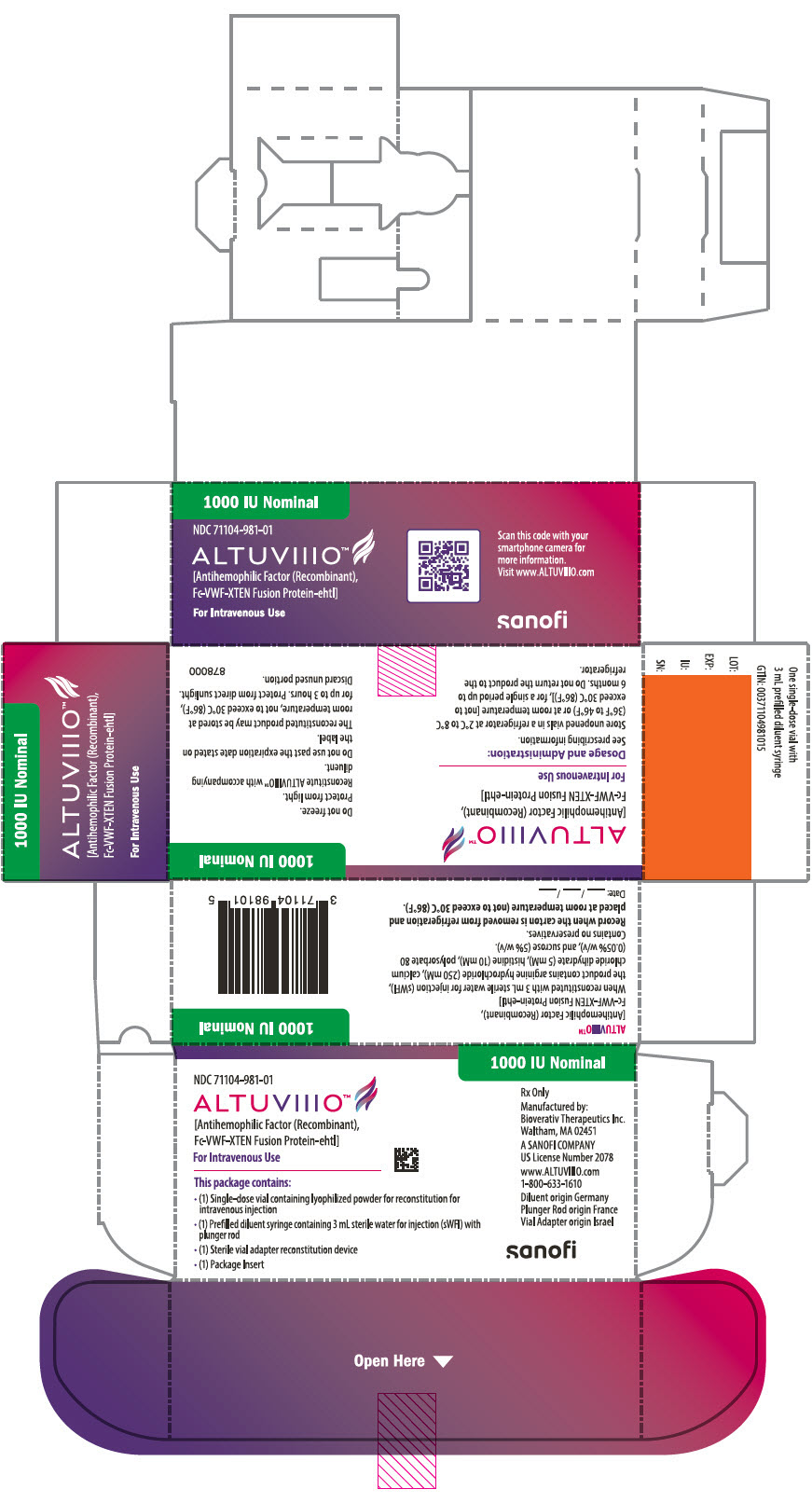
PRINCIPAL DISPLAY PANEL - 1000 IU Kit Carton 1000 IU Nominal NDC 71104-981-01 ALTUVIIIO™ [Antihemophilic Factor (Recombinant), Fc-VWF-XTEN Fusion Protein-ehtl] For Intravenous Use This package contains: (1) Single-dose vial containing lyophilized powder for reconstitution for intravenous injection (1) Prefilled diluent syringe containing 3 mL sterile water for injection (sWFI) with plunger rod (1) Sterile vial adapter reconstitution device (1) Package Insert Rx Only Manufactured by: Bioverativ Therapeutics Inc. Waltham, MA 02451 A SANOFI COMPANY US License Number 2078 www.ALTUVIIIO.com 1-800-633-1610 Diluent origin Germany Plunger Rod origin France Vial Adapter origin Israel sanofi PRINCIPAL DISPLAY PANEL - 1000 IU Kit Carton
PRINCIPAL DISPLAY PANEL - 2000 IU Kit Carton 2000 IU Nominal NDC 71104-982-01 ALTUVIIIO™ [Antihemophilic Factor (Recombinant), Fc-VWF-XTEN Fusion Protein-ehtl] For Intravenous Use This package contains: (1) Single-dose vial containing lyophilized powder for reconstitution for intravenous injection (1) Prefilled diluent syringe containing 3 mL sterile water for injection (sWFI) with plunger rod (1) Sterile vial adapter reconstitution device (1) Package Insert Rx Only Manufactured by: Bioverativ Therapeutics Inc. Waltham, MA 02451 A SANOFI COMPANY US License Number 2078 www.ALTUVIIIO.com 1-800-633-1610 Diluent origin Germany Plunger Rod origin France Vial Adapter origin Israel sanofi PRINCIPAL DISPLAY PANEL - 2000 IU Kit Carton
PRINCIPAL DISPLAY PANEL - 3000 IU Kit Carton 3000 IU Nominal NDC 71104-983-01 ALTUVIIIO™ [Antihemophilic Factor (Recombinant), Fc-VWF-XTEN Fusion Protein-ehtl] For Intravenous Use This package contains: (1) Single-dose vial containing lyophilized powder for reconstitution for intravenous injection (1) Prefilled diluent syringe containing 3 mL sterile water for injection (sWFI) with plunger rod (1) Sterile vial adapter reconstitution device (1) Package Insert Rx Only Manufactured by: Bioverativ Therapeutics Inc. Waltham, MA 02451 A SANOFI COMPANY US License Number 2078 www.ALTUVIIIO.com 1-800-633-1610 Diluent origin Germany Plunger Rod origin France Vial Adapter origin Israel sanofi PRINCIPAL DISPLAY PANEL - 3000 IU Kit Carton
PRINCIPAL DISPLAY PANEL - 4000 IU Kit Carton 4000 IU Nominal NDC 71104-984-01 ALTUVIIIO™ [Antihemophilic Factor (Recombinant), Fc-VWF-XTEN Fusion Protein-ehtl] For Intravenous Use This package contains: (1) Single-dose vial containing lyophilized powder for reconstitution for intravenous injection (1) Prefilled diluent… [Excerpted — this section continues on DailyMed.]
Medicaid utilization & spend
Reported adverse events (FAERS)
Top reported reactions
Age at onset
Reporter sex
Serious outcomes
Where does this data come from?
About this NDC listing & data coverage
Kit / multi-component package
This NDC identifies a kit — a package containing more than one component. Structured data (pricing, ingredients, equivalents) is often reported per component rather than for the kit NDC itself, which can make this page look thinner than the components' own pages.
What data is (and isn’t) available for this NDC — tap to expand
| NDC identity (package / product / labeler codes) | ✓ Available |
| Labeler | ✓ Available |
| Product & package description | ✓ Available |
| Marketing category & status | ✓ Available |
| Active ingredient / dosage form / route | ✓ Available |
| FDA label (SPL via DailyMed) | ✓ Available |
| Package photos | ✓ Available |
| Inactive ingredients (structured) | — Not published for this NDC The labeler did not submit a structured excipient list, or no SPL is available. |
| NADAC pharmacy acquisition price (CMS) | — Not published for this NDC CMS publishes NADAC only for NDCs reported in its retail-pharmacy survey. |
| Orange Book / therapeutic-equivalence data | ✓ Available |
| HCPCS J-code billing crosswalk | ✓ Available |
| Medicaid utilization (CMS SDUD) | ✓ Available |