
Humate-P antihemophilic factor/von willebrand factor complex (human) Kit
🆔 Identity & classification
Where does this data come from?
🏭 Manufacturer & labeler
Where does this data come from?
🩺 Clinical
Patient education
Supplement & herbal interactions
Where does this data come from?
Ask a licensed pharmacist directly — free, answered by our team.
🧪 Inactive Ingredients / Excipients
Inactive ingredients, also called excipients, are components of the drug product other than the active ingredient. They may include fillers, dyes, coatings, preservatives, flavors, or other formulation ingredients.
Where does this data come from?
IACT rows and label-wide narrative are kept separate; availability and product-level specificity depend on the submitted label.Inactive ingredient FAQ
Are inactive ingredients the same for every manufacturer?
Why might an inactive ingredient be missing?
Can inactive ingredients matter?
💲 Pricing
A drug doesn't have one price. Each row is a different public payment system, and none is what you'd pay at the counter — that depends on your insurance. The ⓘ on each row explains what it measures.
| Price system | Per each | Per package |
|---|---|---|
| Retail pharmacies payNADAC · weekly | Not in the retail survey — common for institutional, discontinued, or low-volume packs. | |
| Medicaid paysCMS SDUD · 12 mo | $1.48 | — |
| Medicare drug plans payPart D · quarterly | No Part D plan price is available for this NDC in our data. | |
| Medicare Part B allowsASP · J7187 | $1.535 / J7187 unit | — |
Where does this data come from?
🧾 Billing & reimbursement
Where does this data come from?
🔁 Therapeutic equivalents
| Product | Labeler | Pack | NADAC/unit | TE | Status | Price vs. this |
|---|---|---|---|---|---|---|
| Humate-Pthis 63833-0615-02 | CSL | 1 kit | — | — | FDA listed | — |
| Humate-P 63833-0616-02 | CSL | 1 kit | — | — | FDA listed | — |
| Humate-P 63833-0617-02 | CSL | 1 kit | — | — | FDA listed | — |
Where does this data come from?
⏳ Availability & biosimilar status
Biologics have no small-molecule generics; biosimilar competition is tracked in the FDA Purple Book.
Where does this data come from?
🗺️ Medicaid utilization & spend
📦 Packaging — all sizes for this product
| Package NDC | Description | Marketing start | Status |
|---|---|---|---|
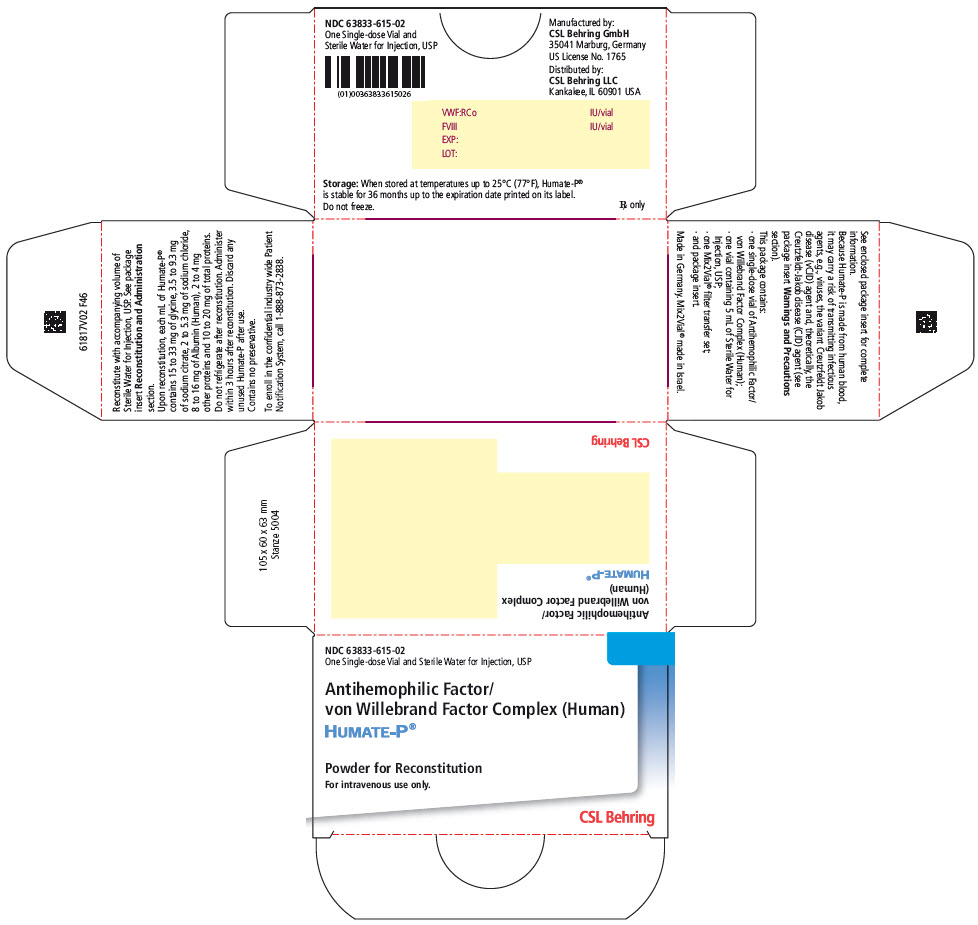
| 63833-0615-02 You're viewing this | 1 KIT in 1 CARTON (63833-615-02) * 5 mL in 1 VIAL (63833-625-01) * 5 mL in 1 VIAL, SINGLE-DOSE (63833-765-53) | 1986-05-01 | Active |
🧭 About this NDC listing & data coverage
Kit / multi-component package
This NDC identifies a kit — a package containing more than one component. Structured data (pricing, ingredients, equivalents) is often reported per component rather than for the kit NDC itself, which can make this page look thinner than the components' own pages.
What data is (and isn’t) available for this NDC — tap to expand
| NDC identity (package / product / labeler codes) | ✓ Available |
| Labeler | ✓ Available |
| Product & package description | ✓ Available |
| Marketing category & status | ✓ Available |
| Active ingredient / dosage form / route | ✓ Available |
| FDA label (SPL via DailyMed) | ✓ Available |
| Package photos | ✓ Available |
| Inactive ingredients (structured) | — Not published for this NDC The labeler did not submit a structured excipient list, or no SPL is available. |
| NADAC pharmacy acquisition price (CMS) | — Not published for this NDC CMS publishes NADAC only for NDCs reported in its retail-pharmacy survey. |
| Orange Book / therapeutic-equivalence data | — Not published for this NDC Applies only to products approved under an NDA/ANDA; many listings are out of scope. |
| HCPCS J-code billing crosswalk | ✓ Available |
| Medicaid utilization (CMS SDUD) | ✓ Available |
Questions about this listing
Why is there no price listed?
Is the NDC printed on the package the same as the 11-digit billing NDC?
What do the three segments of this NDC mean?
Is this package still being marketed?
Who lists this product with the FDA?
Does this product have a billing J-code?
Where does this data come from?
📄 Full FDA label FDA SPL
🎯 Indications and Usage ▾
1 INDICATIONS AND USAGE Humate-P is an Antihemophilic Factor/von Willebrand Factor (VWF) Complex (Human) indicated for: Hemophilia A – Treatment and prevention of bleeding in adults ( 1.1 ). Von Willebrand disease (VWD) – in adults and pediatric patients in the (1) Treatment of spontaneous and trauma-induced bleeding episodes, and (2) Prevention of excessive bleeding during and after surgery. This applies to patients with severe VWD as well as patients with mild to moderate VWD where the use of desmospressin is known or suspected to be inadequate ( 1.2 ).
Humate-P is not indicated for the prophylaxis of spontaneous bleeding episodes in VWD.
1.1Hemophilia A Humate-P, Antihemophilic Factor/von Willebrand Factor Complex (Human), is indicated for treatment and prevention of bleeding in adults with hemophilia A (classical hemophilia).
1.2Von Willebrand Disease (VWD) Humate-P is also indicated in adult and pediatric patients with von Willebrand disease (VWD) for: (1) treatment of spontaneous and trauma-induced bleeding episodes, and (2) prevention of excessive bleeding during and after surgery. This applies to patients with severe VWD as well as patients with mild to moderate VWD where use of desmopressin (DDAVP) is known or suspected to be inadequate. Controlled clinical trials to evaluate the safety and efficacy of prophylactic dosing with Humate-P to prevent spontaneous bleeding have not been conducted in VWD subjects (see Clinical Studies [14] ) .
⏱️ Dosage and Administration ▾
2 DOSAGE AND ADMINISTRATION For intravenous use only. Hemophilia A One IU of factor VIII (FVIII) activity per kg body weight increases the circulating FVIII level by approximately
2.0IU/dL. Individualize dosage based on the patient's weight, type and severity of hemorrhage, FVIII level, and presence of inhibitors (see Table 1 for dosing recommendations) ( 2.1 ). VWD Treatment of bleeding episodes – Administer 40-80 IU VWF:Ristocetin Cofactor (RCo) per kg body weight every 8-12 hours ( 2.2 ).
Prevention of excessive bleeding during and after surgery for all types of VWD ( 2.3 ). Type of Surgery (see Table 3 for complete surgical dosing) Calculation of Loading Dose Initial maintenance dose should be half the loading dose (see Table 4 for monitoring recommendations). IU = International Units.
BW = body weight. Major Surgery ( 2.3 ) Δ Δ = Target peak plasma VWF:RCo level – baseline plasma VWF:RCo level. VWF:RCo × BW (kg) IVR IVR = in vivo recovery as measured in the patient.
If the IVR is unknown, use
2.0IU/dL per IU/kg. = IU VWF:RCo required Minor/Oral Surgery Oral surgery is defined as extraction of fewer than three teeth, if the teeth are non-molars and have no bony involvement. ( 2.3 ) Δ VWF:RCo × BW (kg) IVR = IU VWF:RCo required Emergency Surgery ( 2.3 ) Administer a dose of 50-60 IU VWF:RCo/kg BW
2.1Therapy for Hemophilia A One IU of Factor VIII (FVIII) activity per kg body weight will increase the circulating FVIII level by approximately
2.0International Units (IU)/dL. Dosage must be individualized based on the patient's weight, type and severity of hemorrhage, FVIII level, and presence of inhibitors. Judge the adequacy of treatment by clinical effects and, in all cases, adjust doses as needed based on clinical judgment and on frequent monitoring of the patient's FVIII level.
Table 1 provides dosing recommendations for the treatment of hemophilia A in adults. Table 1: Dosing Recommendations for the Treatment of Hemophilia A in Adults 1 Hemorrhagic Event Dosage (IU FVIII:C/kg Body Weight) IU = International Units. Minor hemorrhage: Early joint or muscle bleed Severe epistaxis Loading dose 15 IU FVIII:C/kg to achieve a FVIII:C plasma level of approximately 30% of normal; one infusion may be sufficient.
If needed, half of the loading dose may be given once or twice daily for 1-2 days. Moderate hemorrhage: Advanced joint or muscle bleed Neck, tongue, or pharyngeal hematoma (without airway compromise) Tooth extraction Severe abdominal pain Loading dose 25 IU FVIII:C/kg to achieve a FVIII:C plasma level of approximately 50% of normal, followed by 15 IU FVIII:C/kg every 8-12 hours for the first 1-2 days to maintain the FVIII:C plasma level at 30% of normal. Continue the same dose once or twice daily for up to 7 days or until adequate wound healing is achieved.
Life-threatening hemorrhage: Major surgery Gastrointestinal bleeding Neck, tongue, or pharyngeal hematoma (with potential for airway compromise) Intracranial, intraabdominal, or intrathoracic bleeding Fractures Initially 40-50 IU FVIII:C/kg, followed by 20-25 IU FVIII:C/kg every 8 hours to maintain the FVIII:C plasma level at 80-100% of normal for 7 days. Continue the same dose once or twice daily for another 7 days to maintain the FVIII:C level at 30-50% of normal.
2.2Treatment of Bleeding Episodes in VWD Administer 40 to 80 International Units (IU) VWF:RCo (corresponding to 17 to 33 International Units (IU) FVIII in Humate-P) per kg body weight every 8 to 12 hours. Adjust the dosage based on the extent and location of bleeding. Administer repeat doses as long as needed based on monitoring of appropriate clinical and laboratory measures ( see Warnings and Precautions [5.2 and 5.3] ).
Expected levels of VWF:RCo are based on an expected in vivo recovery (IVR) of
2.0International Units (IU)/dL rise per International Unit (IU)/kg VWF:RCo administered. The administration of 1 International Unit (IU) of FVIII per kg body weight can be expected to lead to a rise in circulat…
💊 Dosage Forms and Strengths ▾
3 DOSAGE FORMS AND STRENGTHS Humate-P is a sterile, lyophilized powder for intravenous administration. Each vial of Humate-P contains the labeled amount of VWF:RCo and FVIII activity expressed in International Units (IU). The average ratio of VWF:RCo to FVIII is 2.4:1.
Approximate potencies are shown below; check each carton/vial for the actual potency prior to reconstitution: VWF:RCo/vial FVIII/vial Diluent * IU = International Units. 600 IU 250 IU 5 mL 1200 IU 500 IU 10 mL 2400 IU 1000 IU 15 mL Each vial of Humate-P lyophilized powder contains the labeled amount of VWF:RCo and FVIII activity expressed in IU IU = International Units. . The average ratio of VWF:RCo to FVIII is 2.4:1.
Approximate potencies are shown below; check each carton/vial for the actual potency prior to reconstitution ( 3 ): VWF:RCo/vial FVIII/vial Diluent * IU = International Units. 600 IU 250 IU 5 mL 1200 IU 500 IU 10 mL 2400 IU 1000 IU 15 mL
⛔ Contraindications ▾
4 CONTRAINDICATIONS Humate-P is contraindicated in individuals who have had an anaphylactic or severe systemic reaction to antihemophilic factor or von Willebrand factor preparations. Anaphylactic or severe systemic reaction to antihemophilic factor or VWF preparations ( 4 ).
⚠️ Warnings and Cautions ▾
5 WARNINGS AND PRECAUTIONS VWD patients receiving Humate-P may be at risk of developing thromboembolic events ( 5.1 ). Monitor for intravascular hemolysis and decreasing hematocrit values in patients with A, B, and AB blood groups who are receiving large or frequent doses ( 5.2 ). Monitor VWF:RCo and FVIII levels in VWD patients, especially those undergoing surgery ( 5.3 ).
Products made from human plasma may contain infectious agents (e.g., viruses, and, theoretically, the Creutzfeldt-Jakob disease (CJD) agent ( 5.4 ).
5.1Thromboembolic Events (VWD Patients) Thromboembolic events have been reported in VWD patients receiving Antihemophilic Factor/von Willebrand Factor Complex replacement therapy, especially in the setting of known risk factors for thrombosis. 3,4 Early reports indicate a higher incidence may occur in females. Endogenous high levels of FVIII have also been associated with thrombosis, but no causal relationship has been established.
Exercise caution and consider antithrombotic measures in all at-risk VWD patients who are receiving coagulation factor replacement therapy.
5.2Monitoring for Intravascular Hemolysis Humate-P contains blood group isoagglutinins (anti-A and anti-B). When doses are very large or need to be repeated frequently (for example, when inhibitors are present or when pre- and post-surgical care is involved), monitor patients of blood groups A, B, and AB for signs of intravascular hemolysis and decreasing hematocrit values and treat appropriately.
5.3Monitoring VWF:RCo and FVIII Levels Monitor the VWF:RCo and FVIII levels of VWD patients receiving Humate-P using standard coagulation tests, especially in cases of surgery. It is advisable to monitor trough VWF:RCo and FVIII:C levels at least once a day in order to adjust the dosage of Humate-P as needed to avoid excessive accumulation of coagulation factors (s ee Dosage and Administration [2.2 , 2.3] ).
5.4Transmission of Infectious Agents Humate-P is made from human plasma. Products made from human plasma may contain infectious agents (e.g., viruses and theoretically, the Creutzfeldt-Jakob disease [CJD] agent) that can cause disease ( see Description [11] and Patient Counseling Information [17.1] ). The risk that such products will transmit an infectious agent has been reduced by screening plasma donors for prior exposure to certain viruses, by testing for the presence of certain current virus infections, and by inactivating and/or removing certain viruses during manufacturing ( see Description [11.1] for virus reduction measures ).
Despite these measures, such products can still potentially transmit disease. There is also the possibility that unknown infectious agents may be present in such products. Thus the risk of transmission of infectious agents cannot be eliminated completely.
Report all infections thought by a physician possibly to have been transmitted by this product to CSL Behring Pharmacovigilance at 1-866-915-6958 or FDA at 1-800-FDA-1088 or www.fda.gov/medwatch . Some viruses, such as Parvovirus B19 virus (B19V) or hepatitis A (HAV), are particularly difficult to remove or inactivate. B19V may most seriously affect pregnant women and immune-compromised individuals.
Although the overwhelming number of B19V and HAV cases are community acquired, reports of these infections have been associated with the use of some plasma-derived products. Therefore, physicians should be alert to the potential symptoms of B19V and HAV infections ( see Patient Counseling Information [17.1] ). Symptoms of B19V may include low-grade fever, rash, arthralgias, and transient symmetric, nondestructive arthritis.
Diagnosis is often established by measuring B19V-specific IgM and IgG antibodies. Symptoms of HAV include low-grade fever, anorexia, nausea, vomiting, fatigue, and jaundice. A diagnosis may be established by measuring specific IgM antibodies.
Physicians should strongly consider administration of hepatitis A and hepatitis B vaccines to individuals re…
🤒 Adverse Reactions ▾
6 ADVERSE REACTIONS The most serious adverse reaction observed in patients receiving Humate-P is anaphylaxis. Thromboembolic events have also been observed in patients receiving Humate-P for the treatment of VWD ( see Warnings and Precautions [5.1] ). Reports of thromboembolic events in VWD patients with other thrombotic risk factors receiving coagulation factor replacement therapy have been obtained from spontaneous reports, published literature, and a European clinical study.
In some cases, inhibitors to coagulation factors may occur. However, no inhibitor formation was observed in any of the clinical studies. In patients receiving Humate-P in clinical studies for treatment of VWD, the most commonly reported adverse reactions observed by >5% of subjects are allergic-anaphylactic reactions (including urticaria, chest tightness, rash, pruritus, and edema).
For patients undergoing surgery, the most common adverse reactions are postoperative wound and injection-site bleeding, and epistaxis. Most common adverse reactions observed by >5% of subjects after receiving Humate-P are allergic-anaphylactic reactions (e.g., urticaria, chest tightness, rash, pruritus, edema) and, in patients undergoing surgery, postoperative wound and injection-site bleeding, and epistaxis ( 6 ). To report SUSPECTED ADVERSE REACTIONS, contact CSL Behring Pharmacovigilance at 1-866-915-6958 or FDA at 1-800-FDA-1088 or www.fda.gov/medwatch.
6.1Clinical Studies Experience Because clinical studies are conducted under widely varying conditions, the adverse reaction rates observed cannot be directly compared to rates in other clinical trials and may not reflect the rates observed in practice. Treatment of Bleeding Episodes in VWD Allergic symptoms, including allergic reaction, urticaria, chest tightness, rash, pruritus, and edema, were reported in 6 of 97 (6%) subjects in a Canadian retrospective study ( see Clinical Studies [14.1] ). Four of 97 (4%) subjects experienced seven adverse events that were considered to have a possible or probable relationship to Humate-P.
These included chills, phlebitis, vasodilation, paresthesia, pruritus, rash, and urticaria. All were mild in intensity with the exception of a moderate case of pruritus. In a prospective, open-label safety and efficacy study of Humate-P in VWD subjects with serious life- or limb-threatening bleeding or undergoing emergency surgery, seven of 71 (10%) subjects experienced nine adverse reactions.
These were one occurrence each of mild vasodilation and mild pruritis; two occurrences of mild paresthesia; and one occurrence each of moderate peripheral edema and extremity pain and severe pseudothrombocytopenia (platelet clumping with a false low reading). Humate-P was discontinued in the subject who experienced the peripheral edema and extremity pain. Prevention of Excessive Bleeding During and After Surgery in VWD Among the 63 VWD subjects who received Humate-P for prevention of excessive bleeding during and after surgery, including one subject who underwent colonoscopy without the planned polypectomy, the most common adverse events were postoperative hemorrhage (35 events in 19 subjects with five subjects experiencing bleeding at up to three different sites), postoperative nausea (15 subjects), and postoperative pain (11 subjects).
Table 5 presents the postoperative hemorrhagic adverse events. Table 5: Hemorrhagic Adverse Events in 63 Surgical Subjects Adverse Event Surgical Procedure Category Number of Subjects/Events Onset On = on-therapy; onset while receiving Humate-P or within 1 day of completing Humate-P administration. Post = post-therapy; onset at least one day after completing Humate-P administration.
(Number of Events) Severity (Number of Events) On Post Mild Mod Severe Wound/injection site bleeding Major 8/11 7 4 9 – 2 Minor 2/2 2 – 1 1 – Oral 2/6 – 6 3 3 – Epistaxis Major 4/4 2 2 3 1 – Minor 1/1 1 – 1 – – Cerebral hemorrhage/ subdural hematoma Major 1/2 2 Reported as serious adverse events…
🔄 Drug Interactions ▾
7 DRUG INTERACTIONS None reported.
👥 Use in Specific Populations ▾
8 USE IN SPECIFIC POPULATIONS Pregnancy: No human or animal data. Use only if clearly needed ( 8.1 ). The hemostatic efficacy of Humate-P has been studied in 34 pediatric subjects with VWD ( 8.4 ). Based on the data from a subset of these subjects, age had no effect on the pharmacokinetics of VWF:RCo ( 12.3 ).
8.1Pregnancy Pregnancy Category C. Animal reproduction studies have not been conducted with Humate-P. It is also not known whether Humate-P can cause fetal harm when administered to a pregnant woman or can affect reproduction capacity. Humate-P should be given to a pregnant woman only if clearly needed.
8.2Labor and Delivery It is not known whether Humate-P can cause harm to the mother or the fetus when administered during labor and delivery. Humate-P should be given during labor and delivery only if clearly needed.
8.3Nursing Mothers It is not know whether this drug is excreted in human milk. Because many drugs are excreted in human milk, caution should be exercised when Humate-P is administered to a nursing woman.
8.4Pediatric Use Hemophilia A Adequate and well-controlled studies with long-term evaluation of joint damage have not been done in pediatric subjects. Joint damage may result from suboptimal treatment of hemarthroses. VWD The safety and effectiveness of Humate-P for the treatment of VWD was demonstrated in 26 pediatric subjects, including infants, children, and adolescents, but have not been evaluated in neonates.
The safety of Humate-P for the prevention of excessive bleeding during and after surgery was demonstrated in eight pediatric subjects (ages 3 to 15) with VWD. Of the 34 pediatric subjects studied for either treatment of bleeding episodes in VWD or prevention of excessive bleeding during and after surgery, four were infants (1 month to under 2 years of age), 23 were children (2 through 12 years), and seven were adolescents (13 through 15 years). As in adults, pediatric patients should be dosed based on body weight (kg) ( see Dosage and Administration [2.2 , 2.3] ).
8.5Geriatric Use Clinical studies of Humate-P did not include sufficient numbers of subjects 65 years of age and older to determine whether they respond differently from younger subjects. As for all patients, dosing for geriatric patients should be appropriate to their overall situation.
🤰 Pregnancy ▾
8.1Pregnancy Pregnancy Category C. Animal reproduction studies have not been conducted with Humate-P. It is also not known whether Humate-P can cause fetal harm when administered to a pregnant woman or can affect reproduction capacity. Humate-P should be given to a pregnant woman only if clearly needed.
🧒 Pediatric Use ▾
8.4Pediatric Use Hemophilia A Adequate and well-controlled studies with long-term evaluation of joint damage have not been done in pediatric subjects. Joint damage may result from suboptimal treatment of hemarthroses. VWD The safety and effectiveness of Humate-P for the treatment of VWD was demonstrated in 26 pediatric subjects, including infants, children, and adolescents, but have not been evaluated in neonates.
The safety of Humate-P for the prevention of excessive bleeding during and after surgery was demonstrated in eight pediatric subjects (ages 3 to 15) with VWD. Of the 34 pediatric subjects studied for either treatment of bleeding episodes in VWD or prevention of excessive bleeding during and after surgery, four were infants (1 month to under 2 years of age), 23 were children (2 through 12 years), and seven were adolescents (13 through 15 years). As in adults, pediatric patients should be dosed based on body weight (kg) ( see Dosage and Administration [2.2 , 2.3] ).
🧓 Geriatric Use ▾
8.5Geriatric Use Clinical studies of Humate-P did not include sufficient numbers of subjects 65 years of age and older to determine whether they respond differently from younger subjects. As for all patients, dosing for geriatric patients should be appropriate to their overall situation.
🧬 Clinical Pharmacology ▾
12 CLINICAL PHARMACOLOGY
12.1Mechanism of Action The active components of Humate-P consist of two different noncovalently bound proteins (FVIII and VWF). FVIII is an essential cofactor in activation of factor X, leading ultimately to the formation of thrombin and, subsequently, fibrin. VWF promotes platelet aggregation and platelet adhesion on damaged vascular endothelium; activated platelets interact with clotting proteins to form a clot.
VWF also serves as a stabilizing carrier protein for the procoagulant protein FVIII. 7,8 The activity of VWF is measured as VWF:RCo.
12.3Pharmacokinetics Hemophilia A After infusion of Humate-P, a rapid increase of plasma FVIII:C is followed by a rapid decrease in activity and, subsequently, a slower rate of decrease in activity. Studies with Humate-P in subjects with hemophilia A have demonstrated a mean half-life of 12.2 (range: 8.4 to 17.4) hours. VWD The pharmacokinetics of Humate-P were studied in 41 subjects in a US study and in 28 subjects in a European study ( see Clinical Studies [14.2] ).
In both studies, subjects were evaluated in the nonbleeding state prior to a surgical procedure. Table 8 summarizes the pharmacokinetics of Humate-P based on these studies. Wide inter-subject variability was observed in pharmacokinetic values obtained from these studies.
Table 8: Pharmacokinetics of Humate-P in Two Studies of Subjects in the Non-Bleeding State Prior to Surgery US Study European Study IU = International Units. BW = body weight. Number of subjects Type 1 VWD Type 2A VWD Type 2B VWD Type 2M VWD Type 3 VWD 41 16 2 4 6 13 28 10 10 -- 1 7 Dosage of Humate-P 60 IU VWF:RCo/kg BW 80 IU VWF:RCo/kg BW Median terminal half-life of VWF:RCo (range) 11 hours Excluding 5 subjects with a half-life exceeding the blood sampling time of 24 or 48 hours.
(3.5-33.6) 10 hours Excluding 1 subject with a half-life exceeding the blood sampling time of 48 hours. (2.8-28.3) Median clearance (range) 3.1 mL/hr/kg (1-16.6) 4.8 mL/hr/kg (2.1-53) Volume of distribution at steady state (range) 53 mL/kg (29-141) 59 mL/kg (32-290) Median IVR for VWF:RCo activity (range)
2.4IU/dL per IU/kg (1.1-4.2)
1.9IU/dL per IU/kg (0.6-4.5) The multimeric patterns of Humate-P in the US study, were measured in 13 subjects with type 3 VWD; 11 had absent or barely detectable multimers at baseline. Of those 11 subjects, all had some high molecular weight multimers present 24 hours after infusion of Humate-P. In the European study, infusion of Humate-P corrected the defect of the multimer pattern in subjects with types 2A and 3 VWD.
High molecular weight multimers were detectable until at least 8 hours after infusion. Based on the small sample size evaluation, it appears that age, sex, and type of VWD have no impact on the pharmacokinetics of VWF:RCo.
🧬 Mechanism of Action ▾
12.1Mechanism of Action The active components of Humate-P consist of two different noncovalently bound proteins (FVIII and VWF). FVIII is an essential cofactor in activation of factor X, leading ultimately to the formation of thrombin and, subsequently, fibrin. VWF promotes platelet aggregation and platelet adhesion on damaged vascular endothelium; activated platelets interact with clotting proteins to form a clot.
VWF also serves as a stabilizing carrier protein for the procoagulant protein FVIII. 7,8 The activity of VWF is measured as VWF:RCo.
📦 How Supplied / Storage and Handling ▾
16 HOW SUPPLIED/STORAGE AND HANDLING Humate-P is supplied in a single-dose vial containing the labeled amount of VWF:RCo and FVIII activity expressed in International Units (IU). Each package contains a vial of Humate-P, a vial of diluent containing sterile water (meets USP chemistry requirements Sterile Water for Injection, except for pH), a Mix2Vial filter transfer set, and two alcohol swabs. The components used in the packaging for Humate-P contain no latex.
Approximate potencies are shown below; check each carton/vial for the actual potency prior to reconstitution: NDC Number VWF:RCo/vial FVIII/vial Diluent IU = International Units. 63833-615-02 600 IU 250 IU 5 mL 63833-616-02 1200 IU 500 IU 10 mL 63833-617-02 2400 IU 1000 IU 15 mL When stored at temperatures up to 25°C (77°F), Humate-P is stable for 24 months up to the expiration date printed on its label. Do not freeze.
This product does not contain a preservative and should be used within 3 hours after reconstitution.
📦 Storage and Handling ▾
When stored at temperatures up to 25°C (77°F), Humate-P is stable for 24 months up to the expiration date printed on its label. Do not freeze. This product does not contain a preservative and should be used within 3 hours after reconstitution.
📋 Description ▾
11 DESCRIPTION Humate-P, Antihemophilic Factor/von Willebrand Factor Complex (Human), is a purified, sterile, lyophilized concentrate of Factor VIII (FVIII) and von Willebrand Factor (VWF) (Human) to be administered by the intravenous route in the treatment of patients with classical hemophilia (hemophilia A) and VWD ( see Clinical Pharmacology [12] ). Humate-P is purified from the cold insoluble fraction of pooled human plasma and contains purified and concentrated FVIII/VWF Complex (Human). Fibrinogen content is less than or equal to 0.2 mg/mL.
Each vial of Humate-P contains the labeled amount of von Willebrand Factor:Ristocetin Cofactor (VWF:RCo) and FVIII activity expressed in International Units (IU) ( see Dosage Forms and Strengths [3] ). An International Unit (IU) is defined by the current international standard established by the World Health Organization. One International Unit (IU) of VWF:RCo or FVIII is approximately equal to the amount of VWF:RCo or FVIII in 1.0 mL of fresh-pooled human plasma.
The average ratio of VWF:RCo to FVIII is 2.4:1. When reconstituted with the volume of diluent (sterile water) provided, each mL of Humate-P contains 72 to 224 International Units (IU) VWF:RCo activity This correlates to a VWF:RCo to FVIII activity average ratio of 2.4:1, which is used to calculate the nominal values of VWF:RCo activity and is the average VWF:RCo activity. , 40 to 80 International Units (IU) FVIII activity, 15 to 33 mg of glycine, 3.5 to 9.3 mg of sodium citrate, 2 to 5.3 mg of sodium chloride, 8 to 16 mg of Albumin (Human), 2 to 14 mg of other proteins, and 10 to 20 mg of total proteins.
Humate-P contains no preservative. Humate-P has been demonstrated in several studies to contain the high molecular weight multimers of VWF. This component is considered to be important for correcting the coagulation defect in patients with VWD.
5 When administered to patients with VWD (types 1, 2, or 3), bleeding time decreased. This outcome was correlated with the presence of a multimeric composition of VWF similar to that found in normal plasma. 6 Humate-P contains anti-A and anti-B blood group isoagglutinins ( see Warnings and Precautions [5.2] ).
The pooled human plasma used to produce Humate-P is collected from licensed facilities in the US. All source plasma used in the manufacture of Humate-P is tested by FDA-licensed Nucleic Acid Tests (NAT) for hepatitis C virus (HCV) and human immunodeficiency virus-1 (HIV-1) and found to be nonreactive (negative). The source plasma is also tested by an investigational NAT for hepatitis B virus (HBV) and found to be nonreactive (negative).
The purpose of the HBV test is to detect low levels of viral material; however, the significance of a nonreactive (negative) result has not been established.
11.1Virus Reduction Capacity The manufacturing procedure for Humate-P includes multiple processing steps that reduce the risk of virus transmission. The manufacturing process has been demonstrated to reduce the risk of virus transmission in an additive manner: 1) cryoprecipitation; 2) Al(OH) 3 adsorption, glycine precipitation, and NaCl precipitation, studied in combination; and 3) pasteurization in aqueous solution at 60°C for 10 hours. Total mean cumulative virus reductions ranged from 6.0 to ≥11.3 log 10 as shown in Table 7.
Table 7: Mean Virus Reduction Factors Virus Studied Cryoprecipitation Al(OH) 3 Adsorption / Glycine Precipitation / NaCl Precipitation Pasteurization Mean Cumulative Virus Reduction [log 10 ] [log 10 ] [log 10 ] [log 10 ] ND, not determined; NA, not applicable; HIV-1, human immunodeficiency virus type 1, model for HIV types 1 and 2; BVDV, bovine viral diarrhea virus, model for HCV and WNV; PRV, pseudorabies virus, model for large enveloped DNA viruses (e.g., herpes virus); WNV, West Nile virus; HAV, hepatitis A virus; and CPV, canine parvovirus, model for Parvovirus B19 virus (B19V).
Enveloped Viruses HIV-1 ND 3.6 ≥6.4 ≥10.0 BVDV ND 2.4 ≥8.9 ≥11.3 PRV 1.6 3.7 4.6 9.9…
💬 Information for Patients ▾
17 PATIENT COUNSELING INFORMATION Inform patients that Humate-P is made from human plasma (part of the blood) and may contain infectious agents that can cause disease (e.g., viruses and, theoretically, the CJD agent). Explain that the risk that Humate-P may transmit an infectious agent has been reduced by screening plasma donors, by testing the donated plasma for certain virus infections, and by inactivating and/or removing certain viruses during manufacturing ( see Warnings and Precautions [5.4] ). Inform patients that some viruses, such as B19V and HAV, may be particularly difficult to remove or inactivate.
Advise patients, especially pregnant women and immune-compromised individuals, to report low-grade fever, rash, joint pain, anorexia, nausea, vomiting, fatigue, and jaundice ( see Warnings and Precautions [5.4] ).