
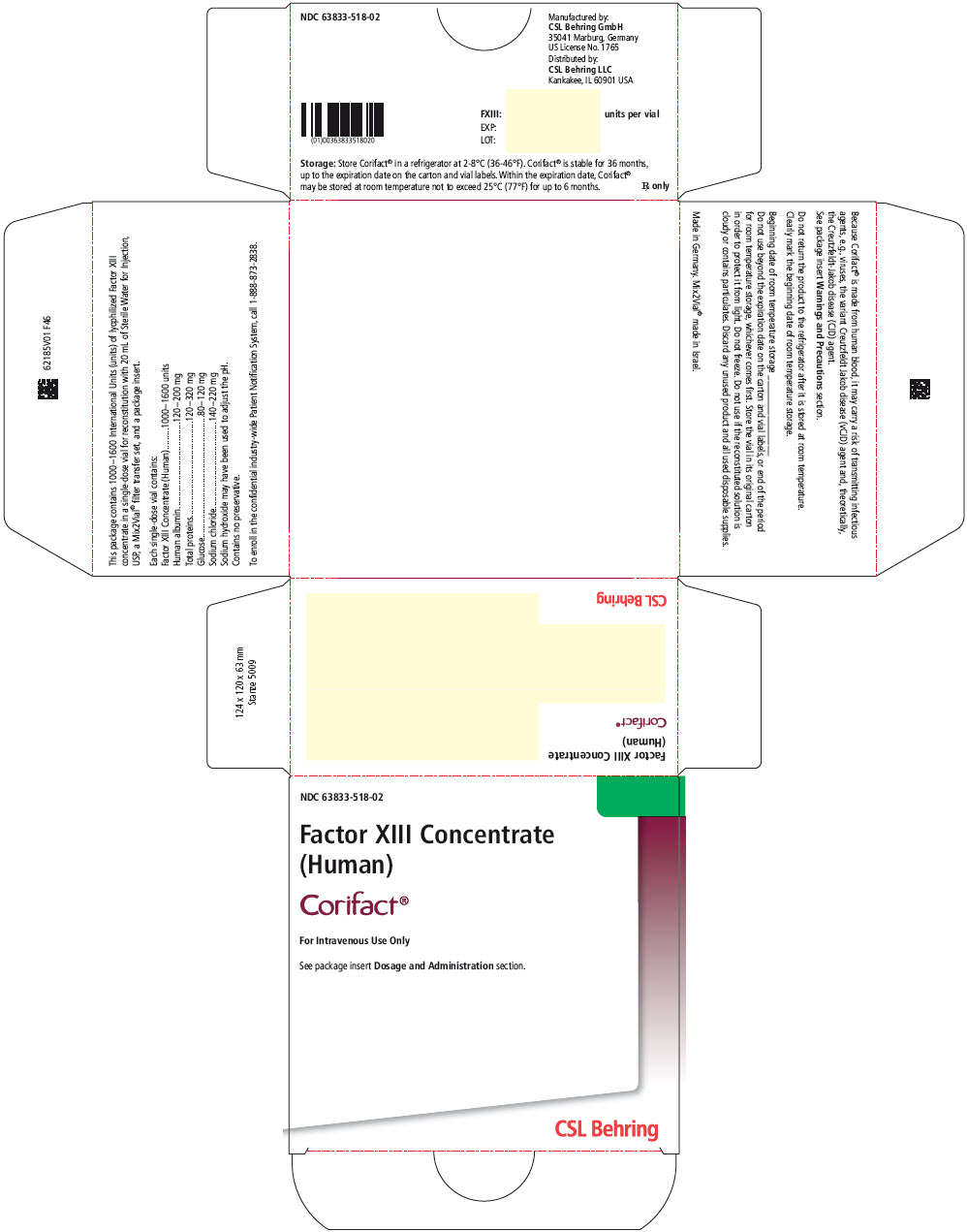
Corifact Factor XIII Concentrate (Human) Kit — NDC 63833-518-02 (Billing 63833-0518-02)
This is a package of Corifact Factor XIII Concentrate (Human) Kit from CSL Behring GmbH, marketed since Feb 2011 and currently FDA-listed. It is this product's only package size.
NDC database record
One package, one record: these facts belong to NDC 63833-518-02 alone.
- Record
- FDA NDC Directory package listing · Plasma derivative
- Code segments
- 63833 labeler · 518 product · 02 package
- Package marketed since
- Feb 17, 2011
- Sample package
- No — commercial package
- Listing certified through
- Dec 31, 2026
- Barcode (UPC-A, from the NDC)
- 3 6383351802 0
- Medicaid fills, this package
- 33 prescriptions in the last four reported quarters
- FDA record last changed
- Oct 8, 2026
Identity & classification
Regulatory identifiers FDA, NLM and CMS codes for this package
Drug-database identifiers Medi-Span GPI and First Databank GCN / HICL / AHFS classification
- GSN (GCN sequence number): 067103
- GCN: 29584
- GPI-14 (Medi-Span): 85100033006440
- HICL (First Databank): 017973
- AHFS class code: 20:28.16.00
Where does this data come from?
- FDA openFDA NDC Directory · synced Oct 8, 2026
- FDA label on DailyMed · label index refreshed Oct 8, 2026
- RxNorm (NLM RxNav) · catalog refreshed Oct 8, 2026
- Medi-Span GPI (licensed)
- First Databank (licensed) · refreshed Oct 8, 2026
Clinical
Patient education
Supplement & herbal interactions
Where does this data come from?
- MedlinePlus (NLM) · refreshed Oct 8, 2026
- FDA label on DailyMed · label index refreshed Oct 8, 2026
Ask a licensed pharmacist directly — free, answered by our team.
Pricing
A drug doesn't have one price. Each row is a different public payment system, and none is what you'd pay at the counter — that depends on your insurance. The ⓘ on each row explains what it measures.
| Price system | Per each | Per package |
|---|---|---|
| Retail pharmacies payNADAC · weekly | Not in the retail survey — common for institutional, discontinued, or low-volume packs. | |
| Medicaid paysCMS SDUD · 12 mo | $10.60 | — |
| Medicare drug plans payPart D · quarterly | No Part D plan price is available for this NDC in our data. | |
| Medicare Part B allowsASP · J7180 | $11.235 / J7180 unit | — |
Where does this data come from?
- CMS NADAC weekly file
- CMS ASP pricing files · refreshed Sep 20, 2026
- CMS Medicaid State Drug Utilization Data · through Q1 2026
- CMS Part D plan pricing files · refreshed Sep 24, 2026
- VA National Acquisition Center price file
Billing & reimbursement
Where does this data come from?
- CMS ASP NDC-HCPCS crosswalk · refreshed Sep 22, 2026
- DMEPDAC NDC-HCPCS crosswalk
- openFDA NSDE billing units · refreshed Oct 7, 2026
Packaging — all sizes for this product
| Package NDC | Description | Marketing start | Marketing end | Status |
|---|---|---|---|---|
| 63833-0518-02 You're viewing this Main listing | 1 KIT in 1 CARTON * 20 mL in 1 VIAL, SINGLE-USE * 20 mL in 1 VIAL, SINGLE-USE | 2011-02-17 | — | Active |
Therapeutic equivalents
| Product | Labeler | Pack | NADAC/unit | TE | Status | Price vs. this |
|---|---|---|---|---|---|---|
| Corifactthis 63833-0518-02 | CSL | 1 kit | — | — | FDA listed | — |
Where does this data come from?
- FDA openFDA NDC Directory · synced Oct 8, 2026
- FDA Purple Book · refreshed Oct 5, 2026
- CMS NADAC weekly file
Availability & biosimilar status
Biologics have no small-molecule generics; biosimilar competition is tracked in the FDA Purple Book.
Why the date isn’t exact: Biosimilar timing can change because patents may be challenged, settled, licensed, added or removed, and litigation can move the real date earlier or later.
🛈 What do these terms mean?
- Biologic patent
- A patent the reference product’s maker has publicly listed. A biosimilar generally can’t launch until these expire — unless they’re invalidated or resolved in a settlement.
- Reference-product exclusivity
- A flat 12 years of FDA market protection from the biologic’s first licensure (the BPCIA). No biosimilar can be licensed before it ends, regardless of patents.
- Interchangeable exclusivity
- The first interchangeable biosimilar can earn a period as the only interchangeable version (pharmacists can substitute it without the prescriber).
- Earliest biosimilar (LOE)
- The latest of all the dates above — the soonest a biosimilar can realistically reach the market. Litigation and settlements can move it earlier.
Biologics have no small-molecule “generics” — competition comes from FDA-licensed biosimilars, tracked in the FDA Purple Book.
| Code | What it grants | Expires |
|---|---|---|
| RefProduct | Reference-product exclusivity (12-year, BPCIA) — no biosimilar can be licensed before this date | Feb 17, 2023 |
Is there a biosimilar for CORIFACT KIT?
Why do different websites show different biosimilar dates?
Can a biosimilar launch before the last patent expires?
What does “current Purple Book estimate” mean?
What does “FDA listed” mean?
What does a patent or protection date mean here?
Where does this data come from?
- FDA Purple Book · refreshed Oct 5, 2026
Inactive Ingredients / Excipients
Inactive ingredients, also called excipients, are components of the drug product other than the active ingredient. They may include fillers, dyes, coatings, preservatives, flavors, or other formulation ingredients.
Where does this data come from?
IACT rows and label-wide narrative are kept separate; availability and product-level specificity depend on the submitted label.- FDA label on DailyMed · label index refreshed Oct 8, 2026
- FDA openFDA NDC Directory · synced Oct 8, 2026
Inactive ingredient FAQ
Are inactive ingredients the same for every manufacturer?
Why might an inactive ingredient be missing?
Can inactive ingredients matter?
Manufacturer & labeler
More NDCs from CSL Behring GmbH labeler code 63833
- Kcentra PROTHROMBIN, COAGULATION FACTOR VII HUMAN, COAGULATION FACTOR IX HUMAN, COAGULATION FACTOR X HUMAN, Protein C, Protein S Human, and Water Kit NDC 63833-386-02
- Kcentra PROTHROMBIN, COAGULATION FACTOR VII HUMAN, COAGULATION FACTOR IX HUMAN, COAGULATION FACTOR X HUMAN, Protein C, Protein S Human, and Water Kit NDC 63833-387-02
- Humate-P antihemophilic factor/von willebrand factor complex (human) Kit NDC 63833-615-02
- Humate-P antihemophilic factor/von willebrand factor complex (human) Kit NDC 63833-616-02
- Humate-P antihemophilic factor/von willebrand factor complex (human) Kit NDC 63833-617-02
- Berinert HUMAN C1-ESTERASE INHIBITOR Kit NDC 63833-825-02
- HAEGARDA C1 Esterase Inhibitor Subcutaneous (Human) Kit NDC 63833-828-02
- HAEGARDA C1 Esterase Inhibitor Subcutaneous (Human) Kit NDC 63833-829-02
Where does this data come from?
- FDA openFDA NDC Directory · synced Oct 8, 2026
- Drugs@FDA
Full FDA label FDA SPL
🎯 Indications and Usage ▾
1 INDICATIONS AND USAGE Corifact, Factor XIII (FXIII) Concentrate (Human) is indicated for routine prophylactic treatment of congenital FXIII deficiency. The effectiveness of Corifact is based on maintaining a trough FXIII activity level of approximately 5% to 20%. There are no controlled trials demonstrating a direct benefit on treatment of bleeding episodes with Corifact.
Corifact is indicated for routine prophylactic treatment of congenital Factor XIII (FXIII) deficiency. The effectiveness of Corifact is based on maintaining a trough FXIII activity level of approximately 5% to 20%. There are no controlled trials demonstrating a direct benefit on treatment of bleeding episodes with Corifact ( 1 ).
⏱️ Dosage and Administration ▾
2 DOSAGE AND ADMINISTRATION For intravenous use only. Reconstitute prior to use. Initial Dose ( 2.2 ) 40 International Units (units) per kg body weight Administer at a rate not to exceed 4 mL per minute Subsequent Dosing ( 2.2 ) Dosing should be guided by the most recent trough FXIII activity level, with dosing every 28 days (4 weeks) to maintain a trough level of approximately 5% to 20%.
Recommended dosing adjustments of ±5 units per kg should be based on trough FXIII activity levels of <5% or >20%, and the patient's clinical condition. Dosing adjustments should be guided based on a specific assay used to determine FXIII levels. An example of dose adjustment using the Berichrom ® activity assay is outlined in Table 1 below.
Dose Adjustment Using the Berichrom Activity Assay ( 2.2 , Table 1) FXIII Activity Trough Level (%) Dosage Change One trough level of <5% Increase by 5 units per kg Trough level of 5% to 20% No change Two trough levels of >20% Decrease by 5 units per kg One trough level of >25% Decrease by 5 units per kg Preparation and Reconstitution ( 2.3 ) Store vial in original carton and in a refrigerator at 2-8°C (36-46°F). Do not freeze. Reconstitute Corifact prior to use with 20 mL of Sterile Water for Injection, USP.
Administration ( 2.4 ) Do not mix with other medicinal products. Administer through a separate infusion line.
2.1Dosage Corifact dosing regimen should be individualized based on body weight, laboratory values, and the patient's clinical condition.
2.2Dosing Schedule Initial dose 40 International Units (units) per kg body weight The injection rate should not exceed 4 mL per minute. Subsequent dosing Dosing should be guided by the most recent trough FXIII activity level, with dosing every 28 days (4 weeks) to maintain a trough FXIII activity level of approximately 5% to 20%. 1 Recommended dosing adjustments of ±5 units per kg should be based on trough FXIII activity levels as shown in Table 1 and the patient's clinical condition ( see Pharmacokinetics [12.3] ).
Dosing adjustments should be guided based on a specific assay used to determine FXIII levels. An example of dose adjustment using the Berichrom activity assay is outlined in Table 1 below. Table 1: Dose Adjustment Using the Berichrom Activity Assay Factor XIII Activity Trough Level (%) Dosage Change One trough level of <5% Increase by 5 units per kg Trough level of 5% to 20% No change Two trough levels of >20% Decrease by 5 units per kg One trough level of >25% Decrease by 5 units per kg The potency expressed in units is determined using the Berichrom activity assay, referenced to the current International Standard for Blood Coagulation Factor XIII, Plasma.
Therefore, a unit herein is equivalent to an International Unit.
2.3Preparation and Reconstitution For intravenous use only. Reconstitute, using aseptic techniques, prior to use. Do not use Corifact beyond the expiration date on the vial label and carton.
Perform a visual inspection of the reconstituted solution. It should be colorless to slightly yellowish, slightly opalescent, and free from visible particles. Administer Corifact using aseptic techniques to maintain product sterility.
Corifact is for single use only. Contains no preservatives. The product must be used within 4 hours after reconstitution.
Do not refrigerate or freeze the reconstituted solution. Discard partially used vials. The procedures below are provided as general guidelines for the preparation and reconstitution of Corifact.
Reconstitute Corifact at room temperature as follows: 1. Ensure that the Corifact vial and diluent vial are at room temperature. Prepare and administer using aseptic techniques.
2. Place the Corifact vial, diluent vial, and Mix2Vial™ transfer set on a flat surface. 3.
Remove Corifact and diluent vial flip caps and treat the stoppers with the alcohol swab provided, and allow to dry prior to opening the Mix2Vial transfer set package. 4. Open the Mix2Vial transfer set package by peeling away the lid (… [Excerpted — this section continues on DailyMed.]
💊 Dosage Forms and Strengths ▾
3 DOSAGE FORMS AND STRENGTHS Corifact is available as a single-use vial containing 1000-1600 units of FXIII as a lyophilized concentrate. A 20 mL vial of Sterile Water for Injection, USP, is provided for reconstitution. The actual units of potency of FXIII are stated on each Corifact vial label and carton. Corifact is available as a single-use vial containing 1000-1600 units of FXIII as a lyophilized concentrate for reconstitution ( 3 ).
⛔ Contraindications ▾
4 CONTRAINDICATIONS Corifact is contraindicated in patients with known anaphylactic or severe systemic reactions to human plasma-derived products or to any components in Corifact ( see Description [11] ). Corifact is contraindicated in patients with known anaphylactic or severe systemic reactions to human plasma-derived products or to any components in Corifact ( 4 ).
⚠️ Warnings and Cautions ▾
5 WARNINGS AND PRECAUTIONS Hypersensitivity reactions may occur. If necessary, discontinue administration and institute appropriate treatment ( 5.1 ). Inhibitory antibodies have been detected in patients receiving Corifact.
If expected FXIII activity levels are not attained, or if breakthrough bleeding occurs while receiving prophylaxis treatment, an assay that measures FXIII inhibitory antibody concentrations should be performed ( 5.2 ). Thrombotic events have been reported in patients receiving Corifact. Weigh the benefits of the administration versus the risks of thrombosis ( 5.3 ).
Corifact is made from human blood and may carry a risk of transmitting infectious agents, e.g., viruses, and theoretically, the Creutzfeldt-Jakob disease (CJD) agent ( 5.4 ).
5.1Hypersensitivity Hypersensitivity reactions (including allergy, rash, pruritus, and erythema) have been observed with Corifact. If signs or symptoms of anaphylaxis or hypersensitivity reactions (including urticaria, rash, tightness of the chest, wheezing, hypotension) occur, immediately discontinue administration ( see Patient Counseling Information [17] ) and institute appropriate treatment.
5.2Immunogenicity Development of inhibitory antibodies against FXIII has been detected in patients receiving Corifact. Monitor patients for possible development of inhibitory antibodies. Presence of inhibitory antibodies may manifest as an inadequate response to treatment.
If expected plasma FXIII activity levels are not attained, or if breakthrough bleeding occurs while receiving prophylaxis, an assay that measures FXIII inhibitory antibody concentrations should be performed. One case of inhibitory antibodies against FXIII has been reported in the clinical studies (see Clinical Trials Experience [6.1] ). Cases of inhibitory antibodies against FXIII in patients with congenital FXIII deficiency have also been reported in postmarketing surveillance.
5.3Thromboembolic Risk Thromboembolic complications have been reported in postmarketing surveillance ( see Postmarketing Experience [6.2] ). Benefits and risks should be carefully assessed in pregnant women because of their hypercoagulable state and potential for increased risk of thromboembolic events.
5.4Transmission of Infectious Agents Corifact is made from human plasma. Because this product is made from human blood, it may carry a risk of transmitting infectious agents, e.g., viruses, and theoretically, the Creutzfeldt-Jakob disease (CJD) agent. There is also the possibility that unknown infectious agents may be present in such products.
The risk that such products could transmit viruses has been reduced by screening plasma donors for prior exposure to certain viruses, by testing for the presence of certain current virus infections, and by inactivating and removing certain viruses during manufacture ( see Description [11] ). Despite these measures, such products may still potentially transmit disease. Consider appropriate vaccination (against hepatitis A and B virus) for patients in regular/repeated receipt of Corifact.
All infections thought by a physician to have been possibly transmitted by this product should be reported by the physician or other healthcare provider to the CSL Behring Pharmacovigilance Department at 1-866-915-6958 or FDA at 1-800-FDA-1088 or www.fda.gov/medwatch .
5.5Monitoring Laboratory Tests Monitoring of patient's trough FXIII activity level ( see Dosing Schedule [2.2] ) is recommended during treatment with Corifact. If breakthrough bleeding occurs, or if expected peak plasma FXIII activity levels are not attained ( see Pharmacokinetics [12.3] ), an investigation to determine the presence of FXIII inhibitory antibodies should be performed.
🤒 Adverse Reactions ▾
6 ADVERSE REACTIONS The most common adverse reactions reported in clinical trials in greater than one subject (frequency >1%) following Corifact treatment are hypersensitivity reactions (including allergy, rash, pruritus, and erythema), chills/rise in temperature, arthralgia, headache, elevated thrombin-antithrombin levels, and an increase in hepatic enzymes. Adverse reactions are those adverse events (AEs) considered to be "at least possibly related" to the infusion of Corifact. The most common adverse reactions reported in Corifact clinical studies, in greater than one subject (frequency >1%), are hypersensitivity reactions (including allergy, rash, pruritus, and erythema), chills/rise in temperature, arthralgia, headache, elevated thrombin-antithrombin levels, and an increase in hepatic enzymes ( 6 ).
Neutralizing antibodies against FXIII were reported in a clinical study ( 6.1 ). To report SUSPECTED ADVERSE REACTIONS, contact the CSL Behring Pharmacovigilance Department at 1-866-915-6958 or FDA at 1-800-FDA-1088 or www.fda.gov/medwatch .
6.1Clinical Trials Experience Because clinical studies are conducted under widely varying conditions, adverse reaction rates observed in the clinical trials of a drug cannot be directly compared to rates in the clinical trials of another drug and may not reflect the rates observed in practice. Twelve clinical studies were conducted and included 187 unique subjects, 90 subjects were <16 years of age ( see Pediatric Use [8.4] ). These 187 subjects received a total of approximately 3930 infusions of Corifact.
The most common adverse events reported in clinical trials in greater than three subjects (frequency >2%) are flu-like syndrome, abdominal pain, diarrhea, contusion, joint injury, limb injury, road traffic accident, upper respiratory tract infection, arthralgia, headache, epistaxis, vomiting, fever, hematoma, head injury, and rash. Adverse events (AEs) are defined as treatment-emergent AEs that started after the first Corifact study infusion. In the 12-week prospective, open-label, multicenter, pharmacokinetic and safety study conducted in 7 females and 7 males with congenital FXIII deficiency, ranging in age from 5 to 42 years (3 children, 2 adolescents, and 9 adults), there were no reports of deaths, life-threatening events, or adverse events that led to discontinuation or withdrawal from the study.
No breakthrough bleeding episodes were reported in this study. A case of neutralizing antibodies against FXIII was reported in the ongoing postmarketing clinical study. The patient received prophylactic treatment with Corifact for ten years.
Concomitant medications included interferon for hepatitis C infection. This patient presented with bruising, and post-infusion FXIII levels were found to be lower than expected. Over several weeks, FXIII recovery values decreased, so the dose and frequency of treatments were increased.
Neutralizing antibodies to FXIII were detected, interferon treatment was discontinued, and the subject underwent plasmapheresis. Within a month, neutralizing antibodies were no longer detectable, FXIII recovery levels improved, and the previous prophylactic regimen was resumed.
6.2Postmarketing Experience Because postmarketing reporting of adverse reactions is voluntary and from a population of uncertain size, it is not always possible to reliably estimate the frequency of these reactions or establish a causal relationship to product exposure. The adverse reactions spontaneously reported after administration of Corifact during postmarketing surveillance outside the US since 1993, identified by system organ class are provided in Table 2. Table 2: Postmarketing Adverse Reactions MedDRA System Organ Class MedDRA Preferred Term/Symptoms Immune system disorders Allergic/anaphylactic reaction (including cutaneous reactions, alteration in blood pressure, nausea, dyspnea, fever, and chills) General disorders and administration site conditions Pyrexia Blood and lymphatic system… [Excerpted — this section continues on DailyMed.]
👥 Use in Specific Populations ▾
8 USE IN SPECIFIC POPULATIONS Pediatric: Shorter half-life and faster clearance (after adjusting for per kg body weight) than in adults have been observed. These results are difficult to interpret because of the limited number of subjects (n=5) ( 8.4 ).
8.1Pregnancy Pregnancy Category C. Animal reproduction studies have not been conducted with Corifact. Safety and effectiveness in pregnancy have not been established. Corifact should be given to a pregnant woman only if clearly needed ( see WARNINGS AND PRECAUTIONS/Thromboembolic Risk [5.3] ).
8.2Labor and Delivery Corifact has not been studied for use during labor and delivery. Safety and effectiveness in labor and delivery have not been established.
8.3Nursing Mothers It is not known whether Corifact is excreted in human milk. Use Corifact only if clearly needed when treating nursing women.
8.4Pediatric Use Of the 187 unique subjects in the Corifact clinical studies, 90 were subjects <16 years of age at the time of enrollment (<1 month, n=2; 1 month to <2 years, n=14; 2 to 11 years, n=52; 12 to <16 years, n=22). In the pharmacokinetic study ( see Pharmacokinetics [12.3] ), 5 of the 14 subjects ranged in age from 2 to <16 years. Subjects less than 16 years had a shorter half-life (5.7 ± 1.00 days) and faster clearance (0.29 ± 0.12 mL/hr/kg) compared to adults (half-life: 7.1 ± 2.74 days, clearance: 0.22 ± 0.07 mL/hr/kg).
The number of subjects less than 16 years of age limits the statistical interpretation. There were no apparent differences in the safety profile in children as compared to adults. All pediatric subjects were treated for congenital Factor XIII deficiency.
8.5Geriatric Use The safety and efficacy of Corifact in the geriatric population have not been established due to an insufficient number of subjects.
🤰 Pregnancy ▾
8.1Pregnancy Pregnancy Category C. Animal reproduction studies have not been conducted with Corifact. Safety and effectiveness in pregnancy have not been established. Corifact should be given to a pregnant woman only if clearly needed ( see WARNINGS AND PRECAUTIONS/Thromboembolic Risk [5.3] ).
🧒 Pediatric Use ▾
8.4Pediatric Use Of the 187 unique subjects in the Corifact clinical studies, 90 were subjects <16 years of age at the time of enrollment (<1 month, n=2; 1 month to <2 years, n=14; 2 to 11 years, n=52; 12 to <16 years, n=22). In the pharmacokinetic study ( see Pharmacokinetics [12.3] ), 5 of the 14 subjects ranged in age from 2 to <16 years. Subjects less than 16 years had a shorter half-life (5.7 ± 1.00 days) and faster clearance (0.29 ± 0.12 mL/hr/kg) compared to adults (half-life: 7.1 ± 2.74 days, clearance: 0.22 ± 0.07 mL/hr/kg).
The number of subjects less than 16 years of age limits the statistical interpretation. There were no apparent differences in the safety profile in children as compared to adults. All pediatric subjects were treated for congenital Factor XIII deficiency.
🧓 Geriatric Use ▾
8.5Geriatric Use The safety and efficacy of Corifact in the geriatric population have not been established due to an insufficient number of subjects.
🧬 Clinical Pharmacology ▾
12 CLINICAL PHARMACOLOGY
12.1Mechanism of Action Corifact (FXIII) is an endogenous plasma glycoprotein consisting of two A-subunits and two B-subunits. FXIII circulates in blood and is present in platelets, monocytes, and macrophages. FXIII appears in 2 forms, a heterotetrameric (A 2 B 2 ) plasma protein with a molecular weight of about 320 kilodaltons and a homodimeric (A 2 ) cellular form.
FXIII is a proenzyme that is activated, in the presence of calcium ion, by thrombin cleavage of the A-subunit to become activated FXIII (FXIIIa). Intracellularly, the homodimeric form of only the A-subunits (A 2 ) is found. The B-subunits in plasma have no enzymatic activity, and function as carrier molecules for the A-subunits.
They stabilize the structure of the A-subunits and protect them from proteolysis. FXIIIa promotes cross-linking of fibrin during coagulation and is essential to the physiological protection of the clot against fibrinolysis. FXIIIa is a transglutaminase enzyme that catalyzes the cross-linking of the fibrin α- and γ-chains for fibrin stabilization and renders the fibrin clot more elastic and resistant to fibrinolysis.
2,3 FXIIIa also cross-links α 2 -plasmin inhibitor to the α-chain of fibrin, resulting in protection of the fibrin clot from degradation by plasmin. Cross-linked fibrin is the end result of the coagulation cascade, and provides tensile strength to a primary hemostatic platelet plug. 3
12.2Pharmacodynamics In clinical studies, the intravenous administration of Corifact demonstrated an increase in plasma levels of FXIII lasting approximately 28 days. In the pharmacokinetic study, after the third 40 units per kg dose (steady state), the mean increase in FXIII activity levels was 83% with a range of 48 to 114% over the baseline ( see Pharmacokinetics [12.3] ).
12.3Pharmacokinetics A 12-week prospective, open-label, multicenter pharmacokinetic and safety study was conducted in 7 females and 7 males with congenital FXIII deficiency, ranging in age from 5 to 42 years (3 children, 2 adolescents, 9 adults). One adult male did not complete the pharmacokinetic study. Each subject received 40 units per kg Corifact intravenously every 28 days for a total of three doses administered at approximately 250 units per min.
Blood samples for doses 1 and 2 were drawn from patients to determine the FXIII activity level at baseline and 30 and 60 minutes after the infusion. Following the infusion of the third dose of Corifact, blood samples were drawn at regular intervals up to 28 days to determine the pharmacokinetic parameters. The pharmacokinetic parameters based on baseline adjusted FXIII activity (Berichrom assay) are shown in Table 4.
Table 4: Pharmacokinetic Parameters (n=13) by Berichrom Assay Method - Baseline Adjusted Values Parameters Mean ±SD AUC ss (0-inf) = Area under the plasma concentration curve from time 0 to infinity at steady state C ss, max : Peak concentration at steady state C ss, min : Trough concentration at steady state T max : Time to peak concentration CL: Clearance V ss : Volume of distribution at steady state MRT = Mean residence time SD = Standard deviation AUC ss, 0-inf (units∙hr/mL) 184.0 ±65.78 C ss, max (units/mL) 100% activity corresponds to 1 unit/mL 0.9 ±0.20 C ss, min (units/mL) 0.05 ±0.05 T max (hr) 1.7 ±1.44 Half-life [days] 6.6 ±2.29 CL [mL/hr/kg] 0.25 ±0.09 V ss [mL/kg] 51.1 ±12.61 MRT [days] 10.0 ±3.45 Due to the small sample size, the impact of age, gender, and race on the pharmacokinetics of Corifact could not be reliably evaluated.
🧬 Mechanism of Action ▾
12.1Mechanism of Action Corifact (FXIII) is an endogenous plasma glycoprotein consisting of two A-subunits and two B-subunits. FXIII circulates in blood and is present in platelets, monocytes, and macrophages. FXIII appears in 2 forms, a heterotetrameric (A 2 B 2 ) plasma protein with a molecular weight of about 320 kilodaltons and a homodimeric (A 2 ) cellular form.
FXIII is a proenzyme that is activated, in the presence of calcium ion, by thrombin cleavage of the A-subunit to become activated FXIII (FXIIIa). Intracellularly, the homodimeric form of only the A-subunits (A 2 ) is found. The B-subunits in plasma have no enzymatic activity, and function as carrier molecules for the A-subunits.
They stabilize the structure of the A-subunits and protect them from proteolysis. FXIIIa promotes cross-linking of fibrin during coagulation and is essential to the physiological protection of the clot against fibrinolysis. FXIIIa is a transglutaminase enzyme that catalyzes the cross-linking of the fibrin α- and γ-chains for fibrin stabilization and renders the fibrin clot more elastic and resistant to fibrinolysis.
2,3 FXIIIa also cross-links α 2 -plasmin inhibitor to the α-chain of fibrin, resulting in protection of the fibrin clot from degradation by plasmin. Cross-linked fibrin is the end result of the coagulation cascade, and provides tensile strength to a primary hemostatic platelet plug. 3
📦 How Supplied / Storage and Handling ▾
16 HOW SUPPLIED/STORAGE AND HANDLING
16.1How Supplied Corifact is supplied in a single-use vial. Each carton (kit) contains one single-use vial of Corifact for reconstitution with 20 mL of Sterile Water for Injection, USP, a Mix2Vial filter transfer set, and one alcohol swab. The actual units of potency of FXIII Concentrate (Human) are stated on each Corifact vial label and carton.
The Corifact packaging components are not made with natural rubber latex. Each product package consists of the following: NDC Number Component 63833-518-02 Carton (kit) contains one 1000-1600 units Corifact in a single-use vial [NDC 63833-528-01], one 20 mL vial of Sterile Water for Injection, USP [NDC 63833-734-65], one Mix2Vial filter transfer set, and one alcohol swab.
16.2Storage and Handling Store Corifact in a refrigerator at 2 - 8°C (36 - 46°F). Corifact is stable for 24 months, up to the expiration date on the carton and vial labels. Within the expiration date, Corifact may be stored at room temperature not to exceed 25°C (77°F) for up to 6 months.
Do not return the product to the refrigerator after it is stored at room temperature. Clearly mark the beginning date of room temperature storage on the carton flap. Do not use beyond the expiration date on the carton and vial labels, or end of the period for room temperature storage, whichever comes first.
Store the vial in the original carton in order to protect it from light. Do not freeze. Administer promptly after reconstitution.
This product does not contain a preservative. The product must be used within 4 hours after reconstitution. Do not refrigerate or freeze the reconstituted solution.
📦 Storage and Handling ▾
16.2Storage and Handling Store Corifact in a refrigerator at 2 - 8°C (36 - 46°F). Corifact is stable for 24 months, up to the expiration date on the carton and vial labels. Within the expiration date, Corifact may be stored at room temperature not to exceed 25°C (77°F) for up to 6 months.
Do not return the product to the refrigerator after it is stored at room temperature. Clearly mark the beginning date of room temperature storage on the carton flap. Do not use beyond the expiration date on the carton and vial labels, or end of the period for room temperature storage, whichever comes first.
Store the vial in the original carton in order to protect it from light. Do not freeze. Administer promptly after reconstitution.
This product does not contain a preservative. The product must be used within 4 hours after reconstitution. Do not refrigerate or freeze the reconstituted solution.
📋 Description ▾
11 DESCRIPTION Corifact is a heat-treated, lyophilized FXIII (coagulation factor XIII) concentrate made from pooled human plasma. Each vial contains 1000-1600 units FXIII, 120 to 200 mg human albumin, 120 to 320 mg total protein, 80 to 120 mg glucose and 140 to 220 mg sodium chloride. Sodium hydroxide may have been used to adjust the pH.
All plasma used in the manufacture of Corifact is obtained from US donors and is tested using serological assays for hepatitis B surface antigen and antibodies to HIV-1/2 and HCV. The plasma is tested with Nucleic Acid Testing (NAT) for HCV, HIV-1, HAV and HBV and found to be non-reactive (negative), and the plasma is also tested by NAT for Human Parvovirus B19. Only plasma that passed virus screening is used for production, and the limit for Parvovirus B19 in the fractionation pool is set not to exceed 10 4 International Units of Parvovirus B19 DNA per mL.
Corifact is manufactured from cryo-depleted plasma into an ethanol precipitate, which is then purified by precipitation/adsorption, ion exchange chromatography and heat-treatment (+60°C for 10 hours in an aqueous solution) steps. The sterile filtered final bulk solution is filled into vials and lyophilized. Three manufacturing steps were independently validated in a series of in vitro experiments for their capacity to inactivate or remove both enveloped and non-enveloped viruses.
Table 3 shows the virus clearance capacity of the Corifact manufacturing process, expressed as mean log 10 reduction factor. Table 3: Cumulative (log 10 ) Virus Inactivation/Removal in Corifact Manufacturing Step Virus Reduction Factor (log 10 ) Enveloped Viruses Non-Enveloped Viruses HIV BVDV WNV HSV-1 HAV CPV HIV, Human immunodeficiency virus type 1, model for HIV-1 and HIV-2 BVDV, bovine viral diarrhea virus, model for HCV WNV, West Nile virus HSV-1, herpes simplex virus type 1, model for large enveloped DNA viruses HAV, Hepatitis A virus CPV, canine parvovirus, model for B19V n.d., not done Al(OH) 3 Adsorption / Vitacel ® Defibrination ≥5.8 2.8 n.d. ≥7.6 1.3 [0.4] Not included in the calculation of the cumulative virus reduction factor.
Ion Exchange Chromatography 5.0 3.4 n.d. n.d. 3.4
3.7Heat Treatment ≥5.8 ≥8.1 ≥7.4 ≥7.6 4.3
1.0Studies using human parvovirus B19, which are considered experimental in nature, have demonstrated a virus reduction factor of ≥4.0 log 10 by heat treatment. Cumulative Virus Reduction (log 10 ) ≥16.6 ≥14.3 ≥7.4 ≥15.2 9.0 4.7
💬 Information for Patients ▾
17 PATIENT COUNSELING INFORMATION Inform patients of the signs and symptoms of allergic hypersensitivity reactions, such as urticaria, rash, tightness of the chest, wheezing, hypotension and/or anaphylaxis experienced during or after injection of Corifact ( see WARNINGS AND PRECAUTIONS/Hypersensitivity [5.1] ). Inform patients of the signs and symptoms of immunogenicity such as breakthrough bleeding ( see WARNINGS AND PRECAUTIONS/Immunogenicity [5.2] ) . Inform patients of signs and symptoms of thrombosis, such as limb or abdomen swelling and/or pain, chest pain, shortness of breath, loss of sensation or motor power, altered consciousness, vision, or speech ( see WARNINGS AND PRECAUTIONS/Thromboembolic Risk [5.3] ) .
Inform patients that because Corifact is made from human blood, it may carry a risk of transmitting infectious agents, e.g., viruses, and theoretically, the Creutzfeldt-Jakob disease (CJD) agent ( see WARNINGS AND PRECAUTIONS/Transmission of Infectious Agents [5.4] and Description [11] ). FDA-Approved Patient Labeling – Patient Product Information (PPI) is provided following this section.
🍼 Nursing Mothers ▾
8.3Nursing Mothers It is not known whether Corifact is excreted in human milk. Use Corifact only if clearly needed when treating nursing women.
🧬 Pharmacokinetics ▾
12.3Pharmacokinetics A 12-week prospective, open-label, multicenter pharmacokinetic and safety study was conducted in 7 females and 7 males with congenital FXIII deficiency, ranging in age from 5 to 42 years (3 children, 2 adolescents, 9 adults). One adult male did not complete the pharmacokinetic study. Each subject received 40 units per kg Corifact intravenously every 28 days for a total of three doses administered at approximately 250 units per min.
Blood samples for doses 1 and 2 were drawn from patients to determine the FXIII activity level at baseline and 30 and 60 minutes after the infusion. Following the infusion of the third dose of Corifact, blood samples were drawn at regular intervals up to 28 days to determine the pharmacokinetic parameters. The pharmacokinetic parameters based on baseline adjusted FXIII activity (Berichrom assay) are shown in Table 4.
Table 4: Pharmacokinetic Parameters (n=13) by Berichrom Assay Method - Baseline Adjusted Values Parameters Mean ±SD AUC ss (0-inf) = Area under the plasma concentration curve from time 0 to infinity at steady state C ss, max : Peak concentration at steady state C ss, min : Trough concentration at steady state T max : Time to peak concentration CL: Clearance V ss : Volume of distribution at steady state MRT = Mean residence time SD = Standard deviation AUC ss, 0-inf (units∙hr/mL) 184.0 ±65.78 C ss, max (units/mL) 100% activity corresponds to 1 unit/mL 0.9 ±0.20 C ss, min (units/mL) 0.05 ±0.05 T max (hr) 1.7 ±1.44 Half-life [days] 6.6 ±2.29 CL [mL/hr/kg] 0.25 ±0.09 V ss [mL/kg] 51.1 ±12.61 MRT [days] 10.0 ±3.45 Due to the small sample size, the impact of age, gender, and race on the pharmacokinetics of Corifact could not be reliably evaluated.
🧬 Pharmacodynamics ▾
12.2Pharmacodynamics In clinical studies, the intravenous administration of Corifact demonstrated an increase in plasma levels of FXIII lasting approximately 28 days. In the pharmacokinetic study, after the third 40 units per kg dose (steady state), the mean increase in FXIII activity levels was 83% with a range of 48 to 114% over the baseline ( see Pharmacokinetics [12.3] ).
🔬 Clinical Studies ▾
14 CLINICAL STUDIES The pharmacokinetic study evaluated three doses at 40 units per kg every 28 days for each subject ( see Pharmacokinetics [12.3] ) . Blood sampling before and after infusion for the first two doses was to determine FXIII activity and a complete PK analysis was conducted after the third dose (steady state). FXIII activity levels were determined by the Berichrom activity assay.
Maintaining the FXIII activity trough level between 5% and 20% is predicted to provide a clinical benefit. The clinical benefit will be verified in a post-marketing study to measure the prevention of spontaneous bleeding episodes with routine prophylactic treatment for patients with congenital FXIII deficiency. Dosing will be individualized and adjusted with the objective to maintain FXIII activity trough levels of 5% to 20%.
🧪 Nonclinical Toxicology ▾
13 NONCLINICAL TOXICOLOGY
13.2Animal Toxicology and/or Pharmacology Corifact was studied in an acute toxicity study in mice and rats at doses up to 3550 units per kg and 1420 units per kg, respectively. Repeat dose toxicity was studied in rats at daily doses up to 350 units per kg for a period of 14 days. No signs of toxicity were observed in the single dose and repeat dose studies.
A local tolerance study demonstrated no clinical or histopathological changes at the injection site after intravenous, intra-arterial or para-venous administration of Corifact to rabbits. A thrombogenicity test was performed in rabbits at doses up to 350 units per kg. Corifact showed no thrombogenic potential at the doses tested.
📚 References ▾
15 REFERENCES Hsieh L, Nugent D. Factor XIII deficiency. Haemophilia 2008; 14:1190-1200. Lauer P, Metzner HJ, Zettlmeißl G, Li M, et al. Targeted Inactivation of the Mouse Locus Encoding Coagulation Factor XIII-A: Hemostatic Abnormalities in Mutant Mice and Characterization of the Coagulation Deficit. Thromb Haemost . 2002;88:967-74. Dardik R, Loscalzo J, Inbal A. Factor XIII (FXIII) and Angiogenesis. J Thromb Haemost . 2006;4:19-25.
📄 Patient Package Insert ▾
Corifact Factor XIII Concentrate (Human) FDA-Approved Patient Labeling – Patient Product Information (PPI) This leaflet summarizes important information about Corifact. Please read it carefully before using Corifact and each time you get a refill. There may be new information provided.
This information does not take the place of talking with your healthcare provider, and it does not include all of the important information about Corifact. If you have any questions after reading this, ask your healthcare provider. What is CORIFACT?
Corifact is an injectable medicine used for routine prophylactic treatment of congenital Factor XIII (FXIII) deficiency in adults and pediatric patients. Corifact is a coagulation FXIII concentrate made from human plasma, and has important functions in hemostasis (stopping of bleeding). Who should not use CORIFACT?
You should not use Corifact if you have experienced hypersensitivity reactions, including anaphylactic or severe systemic reactions to human plasma-derived products. What should I tell my healthcare provider before CORIFACT is given? Tell your healthcare provider about all of your medical conditions, including: If you are pregnant or planning to become pregnant.
It has not been established if Corifact can harm your unborn baby. Labor and Delivery: Safety and effectiveness in labor and delivery have not been established. Breast feeding: It has not been established if Corifact passes into your milk.
Tell your healthcare provider and pharmacist about all of the medicines you take, including all prescription and non-prescription medicines such as over-the-counter medicines, supplements, or herbal remedies. How is CORIFACT given? Corifact is administered into your vein (intravenous injection).
Before infusing, Corifact is dissolved using sterile water provided in the package. Your healthcare provider will prescribe the dose that you receive. What could be the possible side effects of CORIFACT?
Call your healthcare provider or the emergency department right away if you have any of the following symptoms after using Corifact : shortness of breath rash pruritus (itching) erythema (redness of the skin) fainting/dizziness chest pain signs of a blood clot including pain, swelling, warmth, redness, or a lump in your legs or arms. Other possible side effects may include: chills/rise in temperature arthralgia (joint pain) headache increase in liver enzymes breakthrough bleeding and pain resulting from formation of antibodies against Corifact.
Because Corifact is made from human blood, it may carry a risk of transmitting infectious agents, e.g., viruses, and, theoretically, the Creutzfeldt-Jakob (CJD) agent. These are not all the possible side effects of Corifact. Tell your healthcare provider about any side effect that bothers you or that does not go away.
You can also report side effects to the FDA at 1-800-FDA-1088. What else should I know about CORIFACT? Medicines are sometimes prescribed for purposes other than those listed here.
Do not use Corifact for a condition for which it is not prescribed. Do not share Corifact with other people, even if they have the same symptoms that you have. This leaflet summarizes the most important information about Corifact.
If you would like more information, talk to your healthcare provider. You can ask your healthcare provider or pharmacist for information about Corifact that was written for healthcare professionals. Talk to your healthcare provider before traveling.
This Patient Package Insert has been approved by the US Food and Drug Administration.
📄 Package Label / Principal Display Panel ▾
PRINCIPAL DISPLAY PANEL - 1000-1600 iU Kit NDC 63833-518-02 FXIII Concentrate (Human) Corifact ™ For Intravenous Use Only Rx only FXIII units per vial EXP: LOT: CSL Behring PRINCIPAL DISPLAY PANEL - 1000-1600 iU Kit
Medicaid utilization & spend
About this NDC listing & data coverage
Kit / multi-component package
This NDC identifies a kit — a package containing more than one component. Structured data (pricing, ingredients, equivalents) is often reported per component rather than for the kit NDC itself, which can make this page look thinner than the components' own pages.
What data is (and isn’t) available for this NDC — tap to expand
| NDC identity (package / product / labeler codes) | ✓ Available |
| Labeler | ✓ Available |
| Product & package description | ✓ Available |
| Marketing category & status | ✓ Available |
| Active ingredient / dosage form / route | ✓ Available |
| FDA label (SPL via DailyMed) | ✓ Available |
| Package photos | ✓ Available |
| Inactive ingredients (structured) | — Not published for this NDC The labeler did not submit a structured excipient list, or no SPL is available. |
| NADAC pharmacy acquisition price (CMS) | — Not published for this NDC CMS publishes NADAC only for NDCs reported in its retail-pharmacy survey. |
| Orange Book / therapeutic-equivalence data | ✓ Available |
| HCPCS J-code billing crosswalk | ✓ Available |
| Medicaid utilization (CMS SDUD) | ✓ Available |