
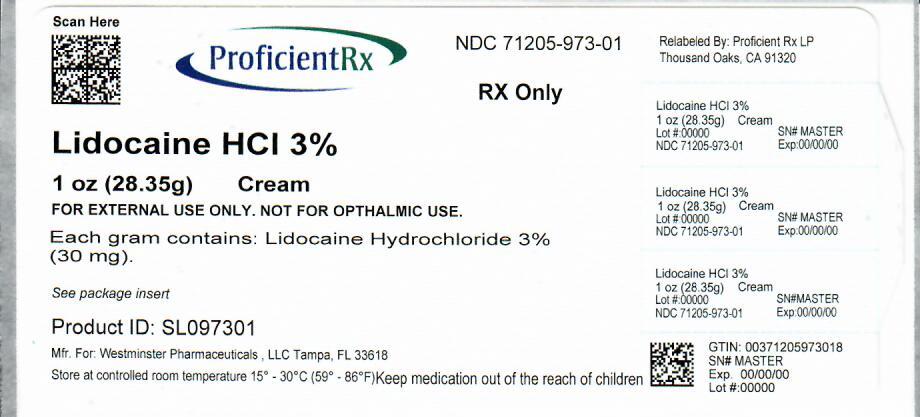
Lidocaine hydrochloride 30 mg/g Cream — NDC 71205-973-03 (Billing 71205-0973-03)
This is a package of Lidocaine hydrochloride 30 mg/g Cream from Proficient Rx LP, marketed since Aug 2019 and currently FDA-listed.
Other active recalls for Lidocaine Hydrochloride (different manufacturers) — 6 · tap to view
Identity & classification
Regulatory identifiers FDA, NLM and CMS codes for this package
Drug-database identifiers Medi-Span GPI and First Databank GCN / HICL / AHFS classification
- GSN (GCN sequence number): 007407
- GCN: 30480
- HICL (First Databank): 001478
- AHFS class code: 72:00.00.00
- RxCUI (RxNorm): 1010835
Where does this data come from?
- FDA openFDA NDC Directory · synced Oct 1, 2026
- FDA label on DailyMed · label index refreshed Oct 1, 2026
- RxNorm (NLM RxNav) · catalog refreshed Oct 1, 2026
- Medi-Span GPI (licensed)
- First Databank (licensed) · refreshed Oct 1, 2026
RxNorm drug class
This medicine belongs to the Antiarrhythmic class.
Where does this data come from?
- RxClass (NLM) · catalog refreshed Oct 1, 2026
Clinical
- Lidocaine numbs the area where it is used. Clinicians inject it for procedures. Skin products are used for pain, itching, minor burns, insect bites, hemorrhoid discomfort, and in s...
- Clean and dry the skin first, then apply as your product’s directions say. Wash your hands afterward. Don’t exceed the number of uses on the label. Ask a doctor before using a prod...
- No. Heat can increase how much lidocaine your body absorbs. Don’t bandage tightly either. Also avoid using other topical pain products at the same time.
- Can I use a heating pad with a lidocaine patch?
Patient education
Supplement & herbal interactions
Where does this data come from?
- MedlinePlus (NLM) · refreshed Oct 1, 2026
- FDA label on DailyMed · label index refreshed Oct 1, 2026
Ask a licensed pharmacist directly — free, answered by our team.
Pricing
A drug doesn't have one price. Each row is a different public payment system, and none is what you'd pay at the counter — that depends on your insurance. The ⓘ on each row explains what it measures.
| Price system | Per g | Per package |
|---|---|---|
| Retail pharmacies payNADAC · weekly | Not in the retail survey — common for institutional, discontinued, or low-volume packs. | |
| Medicaid paysCMS SDUD · 12 mo | No recent Medicaid claims on file for this NDC — rare and low-volume NDCs are suppressed in the public data. | |
| Medicare drug plans payPart D · quarterly | No Part D plan price is available for this NDC in our data. | |
Where does this data come from?
- CMS NADAC weekly file
- CMS ASP pricing files · refreshed Sep 20, 2026
- CMS Medicaid State Drug Utilization Data · refreshed Oct 3, 2026
- CMS Part D plan pricing files · refreshed Sep 24, 2026
- VA National Acquisition Center price file
Packaging — all sizes for this product
| Package NDC | Description | Marketing start | Marketing end | Status |
|---|---|---|---|---|
| 71205-0973-01 71205-973-01 Main listing | 1 TUBE in 1 CARTON / 28.35 g in 1 TUBE | 2020-05-11 | — | Active |
| 71205-0973-03 You're viewing this | 1 TUBE in 1 CARTON / 85 g in 1 TUBE | 2020-05-11 | — | Active |
Pack size FAQ
What quantity is in this package?
What NDC number is used to bill for this package of Lidocaine hydrochloride 30 mg/g Cream?
Therapeutic equivalents
| Product | Labeler | Pack | NADAC/unit | TE | Status | Price vs. this |
|---|---|---|---|---|---|---|
| Lidocaine hydrochloride 30 mg/g 69367-0202-01 | Westminster | 1 tube | $0.559 | — | Availability likely | — |
| Lidocaine Hydrochloride 30 mg/g 13925-0159-01 | Seton | 1 tube | $0.596 | — | Availability likely | — |
| Lidocaine 3% 30 mg/g 59088-0241-07 | PureTek | 85 g | — | — | FDA listed | — |
| Lidocaine hydrochloride 30 mg/gthis 71205-0973-03 | Proficient | 1 tube | — | — | FDA listed | — |
Where does this data come from?
- FDA openFDA NDC Directory · synced Oct 1, 2026
- FDA Orange Book · refreshed Sep 3, 2026
- CMS NADAC weekly file
Availability & generic status
FDA-approved generic versions are listed, and recent pricing/market data suggests they may be available — see Therapeutic equivalents.
Where does this data come from?
- FDA Orange Book · refreshed Sep 3, 2026
Inactive Ingredients / Excipients
Inactive ingredients, also called excipients, are components of the drug product other than the active ingredient. They may include fillers, dyes, coatings, preservatives, flavors, or other formulation ingredients.
💡 Tap an ingredient (hover on desktop) to see what it is and why it’s used.
-
UNII 34S289N54E
Aluminum sulfate is a salt compound used in medicines as an astringent and buffering agent. It helps regulate acidity and can be used in topical or oral formulations to reduce moisture and control pH levels.
-
UNII Y882YXF34X
Calcium acetate is a mineral salt made from calcium and acetic acid. In medicines, it acts as a binder to hold ingredients together and can help control the acidity level of the formulation.
-
UNII 936JST6JCN
Cetyl alcohol is a waxy, fatty substance derived from plant or animal sources. It acts as an emulsifier and thickener in medicines, helping blend oil and water components and giving products a smooth, creamy texture.
-
UNII A2I8C7HI9T
Methylparaben is a preservative derived from benzoic acid that prevents growth of bacteria, fungi, and mold in medicines. It extends the product's shelf life and maintains safety during storage.
-
UNII T5L8T28FGP
Mineral oil is a clear, odorless liquid derived from crude oil. It acts as a lubricant and emollient in medications, helping pills slide smoothly during manufacturing and aiding moisture retention in topical products.
-
UNII 4T6H12BN9U
Petrolatum is a purified mineral oil-based jelly derived from petroleum. In medicines, it acts as an emollient, lubricant, and moisture barrier to soften skin, reduce friction, and help prevent water loss from formulations.
-
UNII 6OZP39ZG8H
Polysorbate 80 is a synthetic emulsifier derived from sorbitol and oleic acid. It helps mix oil and water-based ingredients together in medications and improves how the product disperses in the body.
-
UNII 6DC9Q167V3
Propylene glycol is a clear liquid derived from petroleum or vegetable sources. It acts as a solvent, humectant, and preservative in medicines, helping dissolve active ingredients and maintain product stability.
-
UNII Z8IX2SC1OH
Propylparaben is a chemical preservative used to prevent bacterial and fungal growth in medicines and personal care products. It helps extend shelf life and maintain product safety during storage.
-
UNII 55X04QC32I
A strong alkaline chemical used to adjust and maintain the pH balance of liquid medicines. It helps keep the medicine stable and ensures it stays effective during storage.
-
UNII NVZ4I0H58X
A waxy substance made from sorbitol and stearic acid. It acts as an emulsifier and stabilizer, helping keep oil and water mixed together and preventing separation in the medicine.
-
UNII 4ELV7Z65AP
Stearic acid is a fatty acid derived from plant or animal sources. It acts as a binder and lubricant in tablets and capsules, helping them hold together and flow smoothly during manufacturing.
-
UNII 2KR89I4H1Y
Stearyl alcohol is a waxy, fatty substance derived from natural oils or made synthetically. It acts as an emulsifier and thickener in medicines, helping mix ingredients together and give the product the right texture.
-
UNII 059QF0KO0R
Water is a liquid solvent that dissolves and mixes ingredients together in liquid medicines, syrups, and injections. It helps distribute the active drug evenly throughout the product.
14 inactive ingredients listed in the exact product block matched to this NDC.
Where does this data come from?
ingredient classCode="IACT" elements from the exact product block matched by this NDC. Label-section narrative from DailyMed / the openFDA label index is shown separately when available.- FDA label on DailyMed · label index refreshed Oct 1, 2026
- FDA openFDA NDC Directory · synced Oct 1, 2026
Inactive ingredient FAQ
Are inactive ingredients the same for every manufacturer?
Why might an inactive ingredient be missing?
Can inactive ingredients matter?
Manufacturer & labeler
Where does this data come from?
- FDA openFDA NDC Directory · synced Oct 1, 2026
- Drugs@FDA
Full prescribing information FDA SPL
🎯 Indications and Usage ▾
INDICATIONS Indications For the temporary relief of pain and itching associated with minor burns, sunburn, minor cuts, scrapes, insect bites, minor skin irritation, and discomfort due to pruritus ani, pruritus vulvae, hemorrhoids, anal fissures, and similar conditions of the skin and mucous membranes.
⏱️ Dosage and Administration ▾
DOSAGE AND ADMINISTRATION Apply a thin film to the affected area two or three times daily or as directed by a physician.
⛔ Contraindications ▾
CONTRAINDICATIONS Tuberculous or fungal lesions of skin vaccinia, varicella and acute herpes simplex and in persons who have shown hypersensitivity to any of its components. Lidocaine is contraindicated in patients with a known history of hypersensitivity to local anesthetics of the amide type.
⚠️ Warnings ▾
WARNINGS For external use only. Not for ophthalmic use. Keep out of reach of children.
🤒 Adverse Reactions ▾
ADVERSE REACTIONS During or immediately after treatment, the skin at the site of treatment may develop erythema or edema or may be the locus of abnormal sensation.
🤰 Pregnancy ▾
USE IN PREGNANCY Teratogenic Effects Teratogenic Effects; Pregnancy Category B Reproduction studies have been performed for lidocaine in rats at doses up to 6.6 times the human dose and have revealed no evidence of harm to the fetus caused by lidocaine. There are, however, no adequate and well-controlled studies in pregnant women. Animal reproduction studies are not always predictive of human response.
General consideration should be given to this fact before administering lidocaine to women of childbearing potential, especially during early pregnancy when maximum organogenesis takes place.
🧒 Pediatric Use ▾
PEDIATRIC USE Dosage in pediatric patients would be reduced commensurate with age, body weight and physical condition.
🧬 Clinical Pharmacology ▾
CLINICAL PHARMACOLOGY MECHANISM OF ACTION Westminster Pharmaceuticals Lidocaine HCl 3% Cream releases lidocaine from a mild acidic vehicle to stabilize the neuronal membrane by inhibiting the ionic fluxes required for initiation and conduction of impulses, thereby effecting local anesthetic action. A mild acidic vehicle lowers pH to increase protection against alkaline irritations and to provide a favorable environment for healing. PHARMACOKINETICS Lidocaine may be absorbed following topical administration to mucous membranes, its rate and extent of absorption depending upon the specific site of application, duration of exposure, concentration, and total dosage.
In general, the rate of absorption of local anesthetic agents following topical application occurs most rapidly after intratracheal administration. Lidocaine is also well-absorbed from the gastrointestinal tract, but little intact drug appears in the circulation because of biotransformation of the liver. Lidocaine is metabolized rapidly by the liver, and metabolites and unchanged drug are excreted by the kidneys.
Biotransformation includes oxidative N-dealkylation, ring hydroxylation, cleavage of the amide linkage, and conjungation. N-dealkylation, a major pathway of biotransformation, yields the metabolites monoethylglycinexylidide and glycinexlidide. The pharmacological/toxicological actions of these metabolites are similar to, but less potent than, those of lidocaine.
Approximately 90% of lidocaine administered is excreted in the form of various metabolites, and less than 10% is excreted unchanged. The primary metabolite in urine is a conjugate of 4-hydroxy-2, 6-dimethylaniline. The plasma binding of lidocaine is dependent on drug concentration, and the fraction bound decreases with increasing concentration.
At concentration of 1 to 4 g of free base per mL, 60 to 80 percent of lidocaine is protein bound. Binding is also dependent on the plasma concentration of the alpha-1-acid-glycoprotein. Lidocaine crosses the blood-brain and placental barriers, presumably by passive diffusion.
Studies of lidocaine metabolism following intravenous bolus injections have shown that the elimination half-life of this agent is typically 1.5 to 2 hours. Because of the rapid rate at which lidocaine is metabolized, any condition that affects liver function may alter lidocaine kinetics. The half-life may be prolonged two-fold or more in patients with liver dysfunction.
Renal dysfunction does not affect lidocaine kinetics but may increase the accumulation of metabolites. Factors such as acidosis and the use of CNS stimulants and depressants affect the CNS levels of lidocaine required to produce overt systemic effects. Objective adverse manifestations become increasingly apparent with increasing venous plasma levels above 6 g free base per mL.
In the rhesus monkey arterial blood levels of 18-21 g/mL have been shown to be threshold for convulsive activity.
🧬 Mechanism of Action ▾
MECHANISM OF ACTION Westminster Pharmaceuticals Lidocaine HCl 3% Cream releases lidocaine from a mild acidic vehicle to stabilize the neuronal membrane by inhibiting the ionic fluxes required for initiation and conduction of impulses, thereby effecting local anesthetic action. A mild acidic vehicle lowers pH to increase protection against alkaline irritations and to provide a favorable environment for healing.
📦 How Supplied / Storage and Handling ▾
HOW SUPPLIED Westminster Pharmaceuticals Lidocaine HCl 3% Cream 1 oz (28.35g) tube - NDC- 71205-973-01 3 oz (85 g) tube – NDC- 71205-973-03 STORAGE AND HANDLING Store at controlled room temperature 15° - 30°C (59° - 86°F). Avoid excessive heat and cold, Protect from sunlight and freezing.
📦 Storage and Handling ▾
STORAGE AND HANDLING Store at controlled room temperature 15° - 30°C (59° - 86°F). Avoid excessive heat and cold, Protect from sunlight and freezing.
📋 Description ▾
DESCRIPTION Contains lidocaine HCl 3% in a mild acidic vehicle. Lidocaine is chemically designated as acetamide, 2-(diethylamino)-N-(2,6-dimethylphenyl). C14H22N2O Mol. wt.
234.34 INGREDIENTS: Each gram of Westminster Pharmaceuticals Lidocaine HCl 3% Cream contains Lidocaine HCl USP 3%, Inactive ingredients include: Aluminum Sulfate, Calcium Acetate, Cetyl Alcohol, Methylparaben, Mineral Oil, Petrolatum, Polysorbate 80, Propylene Glycol, Propylparaben, Purified Water, Sodium Hydroxide, Sorbitan Monostearate, Stearic Acid, Stearyl Alcohol. Chemical Structure
⚠️ Precautions ▾
PRECAUTIONS If irritation or sensitivity occurs or infection appears, discontinue use and institute appropriate therapy. Westminster Pharmaceuticals Lidocaine HCl 3% Cream should be used with caution in ill, elderly, debilitated patients and children who may be more sensitive to the systemic effects of lidocaine. CARCINOGENESIS, MUTAGENESIS, AND IMPAIRMENT OF FERTILITY Studies of lidocaine in animals to evaluate the carcinogenic potential of the effect on fertility have not been conducted.
USE IN PREGNANCY Teratogenic Effects Teratogenic Effects; Pregnancy Category B Reproduction studies have been performed for lidocaine in rats at doses up to 6.6 times the human dose and have revealed no evidence of harm to the fetus caused by lidocaine. There are, however, no adequate and well-controlled studies in pregnant women. Animal reproduction studies are not always predictive of human response.
General consideration should be given to this fact before administering lidocaine to women of childbearing potential, especially during early pregnancy when maximum organogenesis takes place. NURSING MOTHERS It is not known whether this drug is excreted in human milk. Because many drugs are excreted in human milk, caution should be exercised when this drug is administered to a nursing mother.
PEDIATRIC USE Dosage in pediatric patients would be reduced commensurate with age, body weight and physical condition.
🍼 Nursing Mothers ▾
NURSING MOTHERS It is not known whether this drug is excreted in human milk. Because many drugs are excreted in human milk, caution should be exercised when this drug is administered to a nursing mother.
🧬 Pharmacokinetics ▾
PHARMACOKINETICS Lidocaine may be absorbed following topical administration to mucous membranes, its rate and extent of absorption depending upon the specific site of application, duration of exposure, concentration, and total dosage. In general, the rate of absorption of local anesthetic agents following topical application occurs most rapidly after intratracheal administration. Lidocaine is also well-absorbed from the gastrointestinal tract, but little intact drug appears in the circulation because of biotransformation of the liver.
Lidocaine is metabolized rapidly by the liver, and metabolites and unchanged drug are excreted by the kidneys. Biotransformation includes oxidative N-dealkylation, ring hydroxylation, cleavage of the amide linkage, and conjungation. N-dealkylation, a major pathway of biotransformation, yields the metabolites monoethylglycinexylidide and glycinexlidide.
The pharmacological/toxicological actions of these metabolites are similar to, but less potent than, those of lidocaine. Approximately 90% of lidocaine administered is excreted in the form of various metabolites, and less than 10% is excreted unchanged. The primary metabolite in urine is a conjugate of 4-hydroxy-2, 6-dimethylaniline.
The plasma binding of lidocaine is dependent on drug concentration, and the fraction bound decreases with increasing concentration. At concentration of 1 to 4 g of free base per mL, 60 to 80 percent of lidocaine is protein bound. Binding is also dependent on the plasma concentration of the alpha-1-acid-glycoprotein.
Lidocaine crosses the blood-brain and placental barriers, presumably by passive diffusion. Studies of lidocaine metabolism following intravenous bolus injections have shown that the elimination half-life of this agent is typically 1.5 to 2 hours. Because of the rapid rate at which lidocaine is metabolized, any condition that affects liver function may alter lidocaine kinetics.
The half-life may be prolonged two-fold or more in patients with liver dysfunction. Renal dysfunction does not affect lidocaine kinetics but may increase the accumulation of metabolites. Factors such as acidosis and the use of CNS stimulants and depressants affect the CNS levels of lidocaine required to produce overt systemic effects.
Objective adverse manifestations become increasingly apparent with increasing venous plasma levels above 6 g free base per mL. In the rhesus monkey arterial blood levels of 18-21 g/mL have been shown to be threshold for convulsive activity.
📄 Carcinogenesis, Mutagenesis, Impairment of Fertility ▾
CARCINOGENESIS, MUTAGENESIS, AND IMPAIRMENT OF FERTILITY Studies of lidocaine in animals to evaluate the carcinogenic potential of the effect on fertility have not been conducted.
📄 Package Label / Principal Display Panel ▾
PRINCIPAL DISPLAY PANEL - 85 g Tube Carton NDC 71205-973-01 Rx Only Lidocaine HCl 3% Cream Topical Anesthetic FOR EXTERNAL USE ONLY. NOT FOR OPTHALMIC USE. Net Wt 3 oz (28.35g) 71205-973-01
About this NDC listing & data coverage
Listed without an FDA application
This product's marketing category indicates it is marketed without an approved FDA application (no NDA, ANDA, or BLA on file). Having an NDC does not by itself establish FDA approval — the NDC Directory is a listing system, not an approval decision. Approval-linked data such as Orange Book therapeutic-equivalence ratings therefore does not apply.
What data is (and isn’t) available for this NDC — tap to expand
| NDC identity (package / product / labeler codes) | ✓ Available |
| Labeler | ✓ Available |
| Product & package description | ✓ Available |
| Marketing category & status | ✓ Available |
| Active ingredient / dosage form / route | ✓ Available |
| FDA label (SPL via DailyMed) | ✓ Available |
| Package photos | ✓ Available |
| Inactive ingredients (structured) | ✓ Available |
| NADAC pharmacy acquisition price (CMS) | — Not published for this NDC CMS publishes NADAC only for NDCs reported in its retail-pharmacy survey. |
| Orange Book / therapeutic-equivalence data | — Not published for this NDC Applies only to products approved under an NDA/ANDA; many listings are out of scope. |
| HCPCS J-code billing crosswalk | — Not published for this NDC Most self-administered / retail products have no J-code — that is normal. |
| Medicaid utilization (CMS SDUD) | — Not published for this NDC CMS reports utilization only for NDCs with Medicaid claims above its privacy threshold. |