
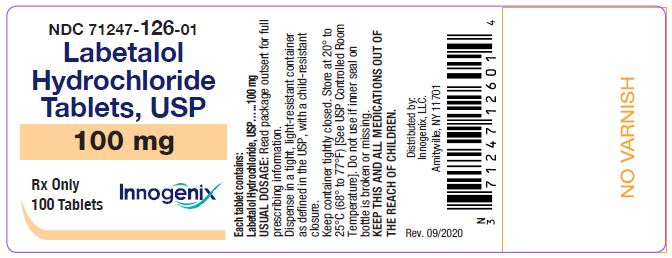
Labetalol Hydrochloride 100 mg Tablet, Film Coated, 100-count — NDC 71247-126-01 (Billing 71247-0126-01)
This is a package of 100 tablets of Labetalol Hydrochloride 100 mg Tablet, Film Coated from Innogenix, Inc., marketed since Feb 2021 and currently FDA-listed; retail pharmacies pay about $0.0830 per tablet (NADAC). It is the main listing for this product, which comes in 2 package sizes.
NDC database record
One package, one record: these facts belong to NDC 71247-126-01 alone.
- Record
- FDA NDC Directory package listing · Human prescription drug
- Code segments
- 71247 labeler · 126 product · 01 package
- Package marketed since
- Feb 8, 2021
- Sample package
- No — commercial package
- Listing certified through
- Dec 31, 2026
- Billing quantity
- 100 EA per package
- Barcode (UPC)
- 0371247126014, 0371247127011, 0371247130011
- Medicaid fills, this package
- 29 prescriptions in the last four reported quarters
- FDA record last changed
- Jul 24, 2026
Other active recalls for Labetalol Hydrochloride (different manufacturers) — 1 · tap to view
Identity & classification
Regulatory identifiers FDA, NLM and CMS codes for this package
Drug-database identifiers Medi-Span GPI and First Databank GCN / HICL / AHFS classification
- GSN (GCN sequence number): 005098
- GCN: 10342
- GPI-14 (Medi-Span): 33300010100305
- HICL (First Databank): 002095
- AHFS class code: 12:16.04.12
- RxCUI (RxNorm): 896758
Where does this data come from?
- FDA openFDA NDC Directory · synced Oct 8, 2026
- FDA label on DailyMed · label index refreshed Oct 8, 2026
- RxNorm (NLM RxNav) · catalog refreshed Oct 8, 2026
- Medi-Span GPI (licensed)
- First Databank (licensed) · refreshed Oct 8, 2026
RxNorm drug class
This medicine belongs to the beta-Adrenergic Blocker class.
Where does this data come from?
- RxClass (NLM) · catalog refreshed Oct 8, 2026
Clinical
- Labetalol lowers blood pressure. The tablets are used for high blood pressure, and the IV form is used in the hospital for severe high blood pressure. Keeping blood pressure down r...
- Take them by mouth, usually twice a day, as your prescriber directs. Food increases how much of the drug your body absorbs, so try to be consistent about taking it with or without...
- Dizziness, nausea, tiredness and headache are the most common, and they often fade early in treatment. Standing up slowly helps with lightheadedness. Call your doctor if you get it...
- Please don't stop suddenly. Stopping a beta blocker abruptly can worsen chest pain and, in some cases, lead to a heart attack. If you need to stop, your prescriber will lower the d...
Patient education
Supplement & herbal interactions
Labetalol may be associated with lower levels of 1 nutrient — worth a chat with your pharmacist, not a cause for alarm.
Where does this data come from?
- MedlinePlus (NLM) · refreshed Oct 8, 2026
- FDA label on DailyMed · label index refreshed Oct 8, 2026
Ask a licensed pharmacist directly — free, answered by our team.
Pricing
A drug doesn't have one price. Each row is a different public payment system, and none is what you'd pay at the counter — that depends on your insurance. The ⓘ on each row explains what it measures.
| Price system | Per ea | Per package |
|---|---|---|
| Retail pharmacies payNADAC · weekly | $0.083 | $8.30 / 100 tablets |
| Medicaid paysCMS SDUD · 12 mo | $0.2174 | $21.74 / 100 tablets |
| Medicare drug plans payPart D · Q2 2026 | $0.1818 | $18.18 / 100 tablets |
Where does this data come from?
- CMS NADAC weekly file · file of Feb 18, 2026
- CMS ASP pricing files · refreshed Sep 20, 2026
- CMS Medicaid State Drug Utilization Data · through Q1 2026
- CMS Part D plan pricing files · refreshed Sep 24, 2026
- VA National Acquisition Center price file
Packaging — all sizes for this product
| Package NDC | Description | Per unit | Per pack | Marketing start | Marketing end | Status |
|---|---|---|---|---|---|---|
| 71247-0126-01 You're viewing this Main listing | 100 TABLET, FILM COATED in 1 BOTTLE | $0.0830 / ea | $8.30 | 2021-02-08 | — | Active |
| 71247-0126-05 71247-126-05 | 500 TABLET, FILM COATED in 1 BOTTLE | $0.0830 / ea | $41.49 | 2021-02-08 | — | Active |
You're viewing the smallest of 2 pack sizes for this product.
This pack has the lowest per-ea cost of the 2 priced pack sizes ($0.0830 NADAC).
Pack size FAQ
What quantity is in this package?
How does this package differ from NDC 71247-0126-05?
What NDC number is used to bill for this package of Labetalol Hydrochloride 100 mg Tablet, Film Coated?
Prices are the latest CMS NADAC pharmacy acquisition cost per NDC; per-pack figures are per-unit × pack quantity, shown only when the pack is denominated in the same measure NADAC prices.
Therapeutic equivalents
| Product | Labeler | Pack | NADAC/unit | TE | Status | Price vs. this |
|---|---|---|---|---|---|---|
| Labetalol Hydrochloride 100 mgthis 71247-0126-01 | Innogenix, | 100 tablets | $0.083 | AB | FDA listed | — |
| Labetalol hydrochloride 100 mg 00591-0605-01 | Actavis | 100 tablets | $0.084 | AB | Discontinued | +1% |
| Labetalol Hydrochloride 100 mg 00904-7451-61 | Major | 1 tablet | $0.084 | AB | Availability likely | +1% |
| Labetalol Hydrochloride 100 mg 23155-0723-01 | Heritage | 100 tablets | $0.084 | AB | Availability likely | +1% |
| Labetalol Hydrochloride 100 mg 29300-0252-01 | Unichem | 100 tablets | $0.084 | — | Availability likely | +1% |
| Labetalol Hydrochloride 100 mg 58657-0602-01 | Method | 100 tablets | $0.084 | AB | Availability likely | +1% |
| Labetalol Hydrochloride 100 mg 58657-0906-01 | Method | 1 tablet | $0.084 | AB | Availability likely | +1% |
| Labetalol Hydrochloride 100 mg 60687-0439-01 | American | 1 tablet | $0.084 | AB | Availability likely | +1% |
| Labetalol Hydrochloride 100 mg 62135-0791-60 | Chartwell | 60 tablets | $0.084 | AB | Availability likely | +1% |
| Labetalol Hydrochloride 100 mg 68001-0381-00 | BluePoint | 100 tablets | $0.084 | AB | Availability likely | +1% |
| Labetalol Hydrochloride 100 mg 68001-0700-00 | BluePoint | 100 tablets | $0.084 | AB | Availability likely | +1% |
| Labetalol Hydrochloride 100 mg 68382-0798-01 | Zydus | 100 tablets | $0.084 | AB | Availability likely | +1% |
| Labetalol Hydrochloride 100 mg 72603-0902-01 | NorthStar | 100 tablets | $0.084 | AB | Availability likely | +1% |
| Labetalol Hydrochloride 100 mg 72888-0120-01 | Advagen | 100 tablets | $0.084 | AB | Availability likely | +1% |
| Labetalol Hydrochloride 100 mg 00615-8512-39 | NCS | 30 tablets | — | AB | FDA listed | — |
| Labetalol Hydrochloride 100 mg 10135-0711-01 | Marlex | 100 tablets | — | AB | FDA listed | — |
| Labetalol Hydrochloride 100 mg 33342-0515-11 | Macleods | 100 tablets | — | AB | FDA listed | — |
| Labetalol Hydrochloride 100 mg 42806-0327-01 | Epic | 100 tablets | — | AB | FDA listed | — |
| Labetalol Hydrochloride 100 mg 50090-6741-00 | A-S | 60 tablets | — | AB | FDA listed | — |
| Labetalol Hydrochloride 100 mg 50090-7457-00 | A-S | 60 tablets | — | AB | FDA listed | — |
| Labetalol Hydrochloride 100 mg 50090-7458-00 | A-S | 90 tablets | — | AB | FDA listed | — |
| Labetalol Hydrochloride 100 mg 51407-0614-01 | Golden | 100 tablets | — | AB | FDA listed | — |
| Labetalol Hydrochloride 100 mg 51655-0322-25 | Northwind | 60 tablets | — | AB | FDA listed | — |
| Labetalol Hydrochloride 100 mg 55154-0181-00 | Cardinal | 1 tablet | — | AB | FDA listed | — |
| Labetalol Hydrochloride 100 mg 55154-8192-00 | Cardinal | 1 tablet | — | AB | FDA listed | — |
| Labetalol Hydrochloride 100 mg 60760-0784-90 | St. | 90 tablets | — | AB | FDA listed | — |
| Labetalol Hydrochloride 100 mg 60760-0991-90 | St. | 90 tablets | — | AB | FDA listed | — |
| Labetalol Hydrochloride 100 mg 63629-1161-01 | Bryant | 100 tablets | — | AB | FDA listed | — |
| Labetalol Hydrochloride 100 mg 63629-1162-01 | Bryant | 500 tablets | — | AB | FDA listed | — |
| Labetalol Hydrochloride 100 mg 67296-2156-01 | Redpharm | 15 tablets | — | AB | FDA listed | — |
| Labetalol Hydrochloride 100 mg 70377-0060-11 | Biocon | 30 tablets | — | AB | FDA listed | — |
| Labetalol Hydrochloride 100 mg 70518-3499-00 | REMEDYREPACK | 30 tablets | — | AB | FDA listed | — |
| Labetalol Hydrochloride 100 mg 70518-4201-00 | REMEDYREPACK | 180 tablets | — | AB | FDA listed | — |
| Labetalol Hydrochloride 100 mg 70771-1163-01 | Zydus | 100 tablets | — | AB | FDA listed | — |
| Labetalol hydrochloride 100 mg 71205-0095-30 | Proficient | 30 tablets | — | AB | FDA listed | — |
| Labetalol Hydrochloride 100 mg 71209-0083-03 | Cadila | 60 tablets | — | AB | FDA listed | — |
| Labetalol HCL 100 mg 71335-2145-01 | Bryant | 30 tablets | — | — | Discontinued | — |
| Labetalol Hydrochloride 100 mg 71335-2475-01 | Bryant | 30 tablets | — | AB | FDA listed | — |
| Labetalol Hydrochloride 100 mg 71335-3065-01 | Bryant | 30 tablets | — | AB | FDA listed | — |
| Labetalol Hydrochloride 100 mg 72162-1675-01 | Bryant | 100 tablets | — | AB | FDA listed | — |
| Labetalol Hydrochloride 100 mg 82804-0289-90 | Proficient | 90 tablets | — | AB | FDA listed | — |
| Labetalol Hydrochloride 100 mg 67046-1693-03 | Coupler | 30 tablets | — | AB | FDA listed | — |
Where does this data come from?
- FDA openFDA NDC Directory · synced Oct 8, 2026
- FDA Orange Book · refreshed Oct 3, 2026
- CMS NADAC weekly file · file of Feb 18, 2026
Availability & generic status
This product is an FDA-approved generic. Other versions of the same drug are listed under Therapeutic equivalents, least expensive first.
Where does this data come from?
- FDA Orange Book · refreshed Oct 3, 2026
What it looks like
Where does this data come from?
- FDA label on DailyMed · label index refreshed Oct 8, 2026
Inactive Ingredients / Excipients
Inactive ingredients, also called excipients, are components of the drug product other than the active ingredient. They may include fillers, dyes, coatings, preservatives, flavors, or other formulation ingredients.
🧪 Avoiding an ingredient? See Labetalol inactive ingredients by manufacturer: every current product's list side by side, so you can ask your pharmacy for the version that does not list it.
💡 Tap an ingredient (hover on desktop) to see what it is and why it’s used.
-
UNII 3SY5LH9PMK
Anhydrous lactose is a milk sugar with no water content. It acts as a filler and binder in tablets and capsules, adding bulk and helping ingredients stick together.
-
UNII R12CBM0EIZ
A natural wax derived from a Brazilian palm tree, used as a coating and polish on tablets and capsules. It creates a smooth, shiny finish that protects the medicine and improves appearance.
-
UNII 1K09F3G675
Ferric oxide red is an inorganic iron compound used as a colorant in medicines. It gives tablets, capsules, or other dosage forms a red or reddish tint for identification and appearance.
-
UNII EX438O2MRT
Ferric oxide yellow is a naturally occurring iron compound used as a colorant in medications. It gives tablets, capsules, and other forms a yellow or golden hue for identification and appearance.
-
UNII 3NXW29V3WO
Hypromellose is a plant-based thickener made from cellulose. It's used in medicines as a binder to hold ingredients together, a coating for tablets, and a thickener for liquids.
-
UNII 70097M6I30
Magnesium stearate is a salt made from magnesium and stearic acid, a fatty substance. It's used in tablets and capsules as a lubricant and glidant to help ingredients flow smoothly during manufacturing and prevent sticking.
-
UNII 3WJQ0SDW1A
Polyethylene glycol is a synthetic liquid or solid polymer used in medicines as a solvent, lubricant, and humectant. It helps dissolve active ingredients, reduces friction during manufacturing, and retains moisture in the final product.
-
UNII 6OZP39ZG8H
Polysorbate 80 is a synthetic emulsifier derived from sorbitol and oleic acid. It helps mix oil and water-based ingredients together in medications and improves how the product disperses in the body.
-
UNII O8232NY3SJ
A plant-based carbohydrate derived from corn kernels. It acts as a filler to add bulk, a binder to hold ingredients together, and a disintegrant to help the tablet break apart in your stomach for absorption.
-
UNII 15FIX9V2JP
Titanium dioxide is a bright white mineral powder commonly used as a colorant and opacifying agent. It makes pills and tablets white or lighter in color and helps make coatings non-transparent.
10 inactive ingredients listed in the exact product block matched to this NDC.
Where does this data come from?
ingredient classCode="IACT" elements from the exact product block matched by this NDC. Label-section narrative from DailyMed / the openFDA label index is shown separately when available.- FDA label on DailyMed · label index refreshed Oct 8, 2026
- FDA openFDA NDC Directory · synced Oct 8, 2026
Inactive ingredient FAQ
Are inactive ingredients the same for every manufacturer?
Why might an inactive ingredient be missing?
Can inactive ingredients matter?
Manufacturer & labeler
More NDCs from Innogenix, Inc. labeler code 71247
- Labetalol Hydrochloride 200 mg Tablet, Film Coated NDC 71247-127-01
- Labetalol Hydrochloride 300 mg Tablet, Film Coated NDC 71247-130-01
- Haloperidol .5 mg Tablet NDC 71247-150-01
- Haloperidol 1 mg Tablet NDC 71247-151-01
- Haloperidol 2 mg Tablet NDC 71247-152-01
- Haloperidol 5 mg Tablet NDC 71247-153-01
Where does this data come from?
- FDA openFDA NDC Directory · synced Oct 8, 2026
- Drugs@FDA
Full prescribing information FDA SPL
🎯 Indications and Usage ▾
1 INDICATIONS AND USAGE Labetalol Hydrochloride is indicated in the management of hypertension, to lower blood pressure. Lowering blood pressure reduces the risk of fatal and nonfatal cardiovascular events, primarily strokes and myocardial infarctions. These benefits have been seen in controlled trials of antihypertensive drugs from a wide variety of pharmacologic classes including beta adrenergic blockers.
Control of high blood pressure should be part of comprehensive cardiovascular risk management, including, as appropriate, lipid control, diabetes management, antithrombotic therapy, smoking cessation, exercise, and limited sodium intake. Many patients will require more than one drug to achieve blood pressure goals. For specific advice on goals and management, see published guidelines, such as those of the National High Blood Pressure Education Program’s Joint National Committee on Prevention, Detection, Evaluation, and Treatment of High Blood Pressure (JNC).
Numerous antihypertensive drugs, from a variety of pharmacologic classes and with different mechanisms of action, have been shown in randomized controlled trials to reduce cardiovascular morbidity and mortality, and it can be concluded that it is blood pressure reduction, and not some other pharmacologic property of the drugs, that is largely responsible for those benefits. The largest and most consistent cardiovascular outcome benefit has been a reduction in the risk of stroke, but reductions in myocardial infarction and cardiovascular mortality also have been seen regularly.
Elevated systolic or diastolic pressure causes increased cardiovascular risk, and the absolute risk increase per mmHg is greater at higher blood pressures, so that even modest reductions of severe hypertension can provide substantial benefit. Relative risk reduction from blood pressure reduction is similar across populations with varying absolute risk, so the absolute benefit is greater in patients who are at higher risk independent of their hypertension (for example, patients with diabetes or hyperlipidemia), and such patients would be expected to benefit from more aggressive treatment to a lower blood pressure goal.
Some antihypertensive drugs have smaller blood pressure effects (as monotherapy) in black patients, and many antihypertensive drugs have additional approved indications and effects (e.g., on angina, heart failure, or diabetic kidney disease). These considerations may guide selection of therapy. Labetalol Hydrochloride Tablets may be used alone or in combination with other antihypertensive agents, especially thiazide and loop diuretics.
Labetalol Hydrochloride Tablets are a beta adrenergic blocker indicated for the treatment of hypertension, to lower blood pressure. Lowering blood pressure reduces the risk of fatal and nonfatal cardiovascular events, primarily strokes and myocardial infarctions. ( 1 )
⏱️ Dosage and Administration ▾
2 DOSAGE AND ADMINISTRATION The recommended initial dosage is 100 mg twice daily, alone or added to a diuretic regimen. Titrate in increments of 100 mg twice daily every 2 or 3 days. Maintenance dosage is between 200 and 400 mg twice daily.
( 2.1 ) Severe Hypertension: May require from 1,200 to 2,400mg per day, with or without thiazide diuretics. Titrate in increments not to exceed 200 mg twice daily. ( 2.2 ) Elderly patients: Initiate at 100 mg twice daily.
Titrate in increments of 100 mg twice daily as required for blood pressure control. Many elderly patients will require between 100 and 200 mg twice daily. ( 2.3 )
2.1Recommended Dosage Labetalol Hydrochloride dosage must be individualized. The recommended initial dosage of labetalol hydrochloride is 100 mg twice daily. Adjust dosage in increments of 100 mg twice daily at 2- to 3-day intervals based on response. The recommended maintenance dosage of labetalol hydrochloride is between 200 and 400 mg twice daily.
2.1Recommended Dosage Labetalol Hydrochloride dosage must be individualized. The recommended initial dosage of labetalol hydrochloride is 100 mg twice daily. Adjust dosage in increments of 100 mg twice daily at 2- to 3-day intervals based on response. The recommended maintenance dosage of labetalol hydrochloride is between 200 and 400 mg twice daily.
💊 Dosage Forms and Strengths ▾
3 DOSAGE FORMS AND STRENGTHS Labetalol Hydrochloride Tablets are available in the following strengths: 100 mg - Round, beige, film-coated tablets, plain on one side, scored and debossed with “I/126” on the other side. 200 mg - Round, white, film-coated tablets, plain on one side, scored and debossed with “I/127” on the other side. 300 mg - Round, blue, film-coated tablets, plain on one side and debossed with “I/130” on the other side.
Tablets: 100 mg, 200 mg, and 300 mg tablets ( 3 )
⛔ Contraindications ▾
4 CONTRAINDICATIONS Labetalol Hydrochloride Tablets are contraindicated in patients with: bronchial asthma or obstructive airway disease decompensated heart failure greater than first degree heart block cardiogenic shock severe bradycardia Hypersensitivity reactions, including anaphylaxis, to labetalol non-dihydropyridine calcium-channel antagonists Bronchial asthma or obstructive airway disease ( 4 ) Overt cardiac failure ( 4 ) Greater‑than‑first‑degree heart block ( 4 ) Cardiogenic shock ( 4 ) Severe bradycardia ( 4 ) Non-dihydropyridine calcium-channel antagonists ( 4 )
⚠️ Warnings and Cautions ▾
5 WARNINGS AND PRECAUTIONS Monitor patients for symptomatic postural hypotension and syncope after initial dosing or dose increments. ( 5.1 ) Monitor heart rate and rhythm for bradycardia, including sinus pause, heart block, severe bradycardia, and cardiac arrest in patients receiving Labetalol Hydrochloride Tablets. ( 5.2 ) Beta-blockade can depress myocardial contractility and precipitating more severe failure.
Avoid use in patients with overt heart failure. ( 5.3 ). Monitor heart rate and rhythm for bradycardia, including sinus pause, heart block, severe bradycardia, and cardiac arrest in patients receiving Labetalol Hydrochloride Tablets.
( 5.2 ) Beta-blockade can depress myocardial contractility and precipitating more severe failure. Avoid use in patients with overt heart failure. ( 5.3 ) Acute exacerbation of coronary artery disease upon cessation of therapy.
Do not abruptly discontinue. ( 5.4 ) Avoid use in patients with bronchospastic disease. ( 5.5 ) Beta‑adrenergic blockade may prevent the appearance of premonitory signs and symptoms (e.g., tachycardia) of acute hypoglycemia.
( 5.6 ) Exacerbation of pheochromocytoma: Paradoxical increases in blood pressure may occur. ( 5.7 ) Hepatic necrosis and death have been reported. If the patient develops signs or symptoms of liver injury, institute appropriate treatment and investigate the probable cause.
( 5.8 ) Do not routinely withdraw chronic beta blocker therapy prior to surgery. ( 5.10 )
5.1Hypotension Monitor patients for symptomatic postural hypotension and syncope after initial dosing or dose increments with Labetalol Hydrochloride Tablets. Elderly patients are generally more likely than younger patients to experience orthostatic symptoms [see Dosage and Administration (2.1) , Use in Specific Populations (8.5) , Clinical Pharmacology (12.2) ].
5.2Bradycardia Bradycardia, including sinus pause, heart block, severe bradycardia, and cardiac arrest have occurred with the use of beta blockers. Monitor heart rate and rhythm in patients receiving Labetalol Hydrochloride Tablets.
5.3Cardiac Failure Sympathetic stimulation is a vital component supporting circulatory function in congestive heart failure. Beta‑blockade carries a potential hazard of further depressing myocardial contractility and precipitating more severe failure. Avoid Labetalol Hydrochloride Tablets in patients with overt congestive heart failure.
If patients develop signs or symptoms of heart failure during administration, discontinue Labetalol Hydrochloride Tablets and treat appropriately.
5.4Ischemic Heart Disease Abrupt cessation of therapy with beta blocking agents in patients with coronary artery disease can cause exacerbations of angina pectoris and, in some cases, myocardial infarction has been reported. Therefore, even in the absence of overt angina pectoris, after the discontinuation of Labetalol Hydrochloride Tablets observe patients for development or worsening of angina. If patient experiences angina or angina markedly worsens or if acute coronary insufficiency develops, promptly reinstitute Labetalol Hydrochloride Tablets and manage as unstable angina.
5.5Reactive Airway Disease and Nonallergic Bronchospasm Avoid use in patients with reactive airways disease. If Labetalol Hydrochloride Tablets are used, use the smallest effective dose, to minimize inhibition of endogenous or exogenous beta agonists.
5.6Hypoglycemia Beta-blockers may prevent early warning signs of hypoglycemia, such as tachycardia, and increase the risk for severe or prolonged hypoglycemia at any time during treatment, especially in patients with diabetes mellitus or children and patients who are fasting (i.e., surgery, not eating regularly, or are vomiting). If severe hypoglycemia occurs, patients should be instructed to seek emergency treatment.
5.7Use in Patients with Pheochromocytoma Labetalol hydrochloride has been shown to be effective in lowering blood pressure and relieving symptoms in patients with pheochromocytoma;… [Excerpted — this section continues on DailyMed.]
🤒 Adverse Reactions ▾
6 ADVERSE REACTIONS Hypotension [see Warnings and Precautions (5.1) Bradycardia [see Warnings and Precautions (5.2) ] Cardiac failure [see Warnings and Precautions (5.3) ] Ischemic heart disease [see Warnings and Precautions (5.4) ] Nonallergic bronchospasm [see Warnings and Precautions (5.5) )] Use in patients with pheochromocytoma [see Warnings and Precautions (5.7) ] Hepatic injury [see Warnings and Precautions (5.8) ] Risk of severe acute hypersensitivity reaction [see Warnings and Precautions (5.9) ] Most commonly observed adverse reactions: fatigue, nausea, dizziness ( 6.1 ) To report SUSPECTED ADVERSE REACTIONS, contact Innogenix, LLC at 1-844-466-6469 or FDA at 1-800-FDA-1088 or www.fda.gov/medwatch.
6.1Clinical Trials Experience Adverse Reactions Resulting in Discontinuation of Treatment Because clinical trials are conducted under widely varying conditions, adverse reaction rates observed in the clinical trials of a drug cannot be directly compared to rates in the clinical trials of another drug and may not reflect the rates observed in practice. In controlled clinical trials of 3 to 4 months' duration, discontinuation of Labetalol Hydrochloride Tablets due to one or more adverse effects was required in 7% of all patients.
The incidence rates of adverse reactions listed in Table 1 were derived from multicenter, controlled clinical trials comparing labetalol hydrochloride and placebo over treatment periods of 3 and 4 months. Table 1: Adverse Reactions Occurring in at Least 2% of Patients and More Frequent on Labetalol Labetalol HCl (n=227) Placebo (n=98) Body as a whole Fatigue 5% 0% Headache 2% 1% Gastrointestinal Nausea 6% 1% Dyspepsia 3% 1% Central and Peripheral Nervous Systems Dizziness 11% 3% Autonomic Nervous System Nasal stuffiness 3% 0% Respiratory Dyspnea 2% 0% Special Senses Vertigo 2% 1% The adverse effects were reported spontaneously and are representative of the incidence of adverse effects that may be observed in a properly selected hypertensive patient population, i.e., a group excluding patients with bronchospastic disease, overt congestive heart failure, or other contraindications to beta‑blocker therapy.
Clinical trials also included studies utilizing daily doses up to 2,400 mg in more severely hypertensive patients. Certain of the side effects increased with increasing dose, as shown in Table 2 that depicts the entire US therapeutic trials data base for adverse reactions that are clearly or possibly dose related.
🔄 Drug Interactions ▾
7 DRUG INTERACTIONS Concomitant use with negative chronotropes can increase risk of bradycardia ( 7.1 ) Beta blockers antagonize the bronchodilator effect of beta-receptor agonists. ( 7.2 ) Increase hypotension may occur with halothane anesthesia. ( 7.3 ) Nitroglycerin may result in additional hypotensive effects. ( 7.4 )
7.1Negative Chronotopes Digitalis glycosides, diltiazem, verapamil, and beta-blockers slow atrioventricular conduction and decrease heart rate. Concomitant use with negative chronotropes can increase the risk of bradycardia or hypotension [see Warnings and Precautions (5.2) ]. Coadministration of labetalol HCl with non-dihydropyridine calcium-channel antagonists (e.g., verapamil) is contraindicated [see Contraindications (4) ].
7.2Bronchodilators Labetalol HCl antagonizes the bronchodilatory effect of beta-receptor agonist drugs; therefore, labetalol HCl is contraindicated in patients with bronchial asthma [see Contraindications (4) ].
7.3Anesthesia Synergism has been shown between halothane anesthesia and intravenously administered labetalol. During controlled hypotensive anesthesia using labetalol in association with halothane, high concentrations (3% or above) of halothane should not be used because the degree of hypotension will be increased and because of the possibility of a large reduction in cardiac output and an increase in central venous pressure.
7.4Nitroglycerin Coadministration of labetalol HCl and nitroglycerine will have an additive effect in lowering blood pressure. Additionally, labetalol HCl blunts the reflex tachycardia produced by nitroglycerin. If labetalol HCl is used in patients with angina pectoris on nitroglycerin, monitor patients’ blood pressure and adjust labetalol dose as needed. In these patients, avoid initiating Labetalol Hydrochloride Tablets.
7.5Drug/Laboratory Test Interactions The presence of labetalol metabolites in the urine may result in falsely elevated levels of urinary catecholamines, metanephrine, normetanephrine, and vanillylmandelic acid (VMA) when measured by fluorimetric or photometric methods. In screening patients suspected of having a pheochromocytoma and being treated with labetalol, a specific method, such as a high-performance liquid chromatographic assay with solid phase extraction should be employed in determining levels of catecholamines.
Labetalol has also been reported to produce a false positive test for amphetamine when screening urine for the presence of drugs using the commercially available assay methods. When patients being treated with labetalol have a positive urine test for amphetamine using these techniques, confirm using more specific methods, such as a gas chromatographic mass spectrometer technique.
7.1Negative Chronotopes Digitalis glycosides, diltiazem, verapamil, and beta-blockers slow atrioventricular conduction and decrease heart rate. Concomitant use with negative chronotropes can increase the risk of bradycardia or hypotension [see Warnings and Precautions (5.2) ]. Coadministration of labetalol HCl with non-dihydropyridine calcium-channel antagonists (e.g., verapamil) is contraindicated [see Contraindications (4) ].
7.2Bronchodilators Labetalol HCl antagonizes the bronchodilatory effect of beta-receptor agonist drugs; therefore, labetalol HCl is contraindicated in patients with bronchial asthma [see Contraindications (4) ].
7.3Anesthesia Synergism has been shown between halothane anesthesia and intravenously administered labetalol. During controlled hypotensive anesthesia using labetalol in association with halothane, high concentrations (3% or above) of halothane should not be used because the degree of hypotension will be increased and because of the possibility of a large reduction in cardiac output and an increase in central venous pressure.
7.4Nitroglycerin Coadministration of labetalol HCl and nitroglycerine will have an additive effect in lowering blood pressure. Additionally, labetalol HCl blunts the reflex tach… [Excerpted — this section continues on DailyMed.]
👥 Use in Specific Populations ▾
8 USE IN SPECIFIC POPULATIONS
8.1Pregnancy Risk Summary The extensive experience with use of labetalol in pregnant women, based on published interventional and observational studies, has not identified a drug-associated risk for major birth defects, miscarriage, or adverse maternal or fetal outcomes (see Data). Untreated hypertension during pregnancy can lead to serious adverse outcomes for the mother and the fetus (see Clinical Considerations). In animal reproductive studies, oral administration of labetalol to pregnant rats and rabbits during organogenesis at doses up to approximately six and four times the maximum recommended human dose (MRHD), respectively, resulted in no fetal malformations; however, increased fetal resorptions were seen in both species at doses approximating the MRHD (see Data).
In the U.S. general population, the estimated background risk of major birth defects and miscarriage in clinically recognized pregnancies is 2% to 4% and 15% to 20%, respectively. Clinical Consideration Disease-Associated Maternal and/or Embryo/Fetal Risk Hypertension in pregnancy increase the maternal risk for pre-eclampsia, gestational diabetes, premature delivery, and delivery complications (e.g., need for cesarean section, and post-partum hemorrhage). Hypertension increases the fetal risk for intrauterine growth restriction and intrauterine death.
Pregnant women with hypertension should be carefully monitored and managed accordingly. Fetal/Neonatal Adverse Reactions Labetalol crosses the placenta. Newonates born to mothers who are receiving labetalol during pregnancy, may be at risk for hypotension, bradycardia, hypoglycemia, and respiratory depression.
Neonates should be monitored for symptoms of hypotension, bradycardia, hypoglycemia and respiratly depression and mange accordingly. Data Human Data Data from published interventional and observational studies did not demonstrate an association between major congenital malformations and the use of labetalol in pregnancy, however, most studies reported the maternal use of intravenous labetalol occurring after 20 weeks gestation. The published literature has reported inconsistent findings of intrauterine growth retardation, preterm birth and perinatal mortality with maternal use of labetalol during pregnancy; however, these studies have methodological limitations hindering interpretation.
These studies cannot definitively establish the absence of risk during pregnancy. Animal Data Teratogenic studies were performed with labetalol in rats and rabbits at oral doses up to approximately six and four times the maximum recommended human dose (MRHD), respectively. No reproducible evidence of fetal malformations was observed.
Increased fetal resorptions were seen in both species at doses approximating the MRHD. A teratology study performed with labetalol in rabbits at intravenous doses up to 1.7 times the MRHD revealed no evidence of drug-related harm to the fetus. Oral administration of labetalol to rats during late gestation through weaning at doses of two to four times the MRHD caused a decrease in neonatal survival.
8.2Lactation Risk Summary Available published data report the presence of labetalol in human milk at low levels. There are no data on the effects on the breastfed infant and on milk production. The developmental and health benefits of breastfeeding should be considered along with the mother's clinical need for labetalol and any potential adverse effects on the breastfed infant from labetalol or from the underlying maternal condition.
8.4Pediatric Use Safety and effectiveness in pediatric patients have not been established.
8.5Geriatric Use Pharmacokinetic studies indicate that the elimination of labetalol is reduced in elderly patients. Although elderly patients may initiate therapy at the currently recommended dosage of 100 mg twice daily, elderly patients will generally require lower maintenance dosages than nonelderly patients.
🤰 Pregnancy ▾
8.1Pregnancy Risk Summary The extensive experience with use of labetalol in pregnant women, based on published interventional and observational studies, has not identified a drug-associated risk for major birth defects, miscarriage, or adverse maternal or fetal outcomes (see Data). Untreated hypertension during pregnancy can lead to serious adverse outcomes for the mother and the fetus (see Clinical Considerations). In animal reproductive studies, oral administration of labetalol to pregnant rats and rabbits during organogenesis at doses up to approximately six and four times the maximum recommended human dose (MRHD), respectively, resulted in no fetal malformations; however, increased fetal resorptions were seen in both species at doses approximating the MRHD (see Data).
In the U.S. general population, the estimated background risk of major birth defects and miscarriage in clinically recognized pregnancies is 2% to 4% and 15% to 20%, respectively. Clinical Consideration Disease-Associated Maternal and/or Embryo/Fetal Risk Hypertension in pregnancy increase the maternal risk for pre-eclampsia, gestational diabetes, premature delivery, and delivery complications (e.g., need for cesarean section, and post-partum hemorrhage). Hypertension increases the fetal risk for intrauterine growth restriction and intrauterine death.
Pregnant women with hypertension should be carefully monitored and managed accordingly. Fetal/Neonatal Adverse Reactions Labetalol crosses the placenta. Newonates born to mothers who are receiving labetalol during pregnancy, may be at risk for hypotension, bradycardia, hypoglycemia, and respiratory depression.
Neonates should be monitored for symptoms of hypotension, bradycardia, hypoglycemia and respiratly depression and mange accordingly. Data Human Data Data from published interventional and observational studies did not demonstrate an association between major congenital malformations and the use of labetalol in pregnancy, however, most studies reported the maternal use of intravenous labetalol occurring after 20 weeks gestation. The published literature has reported inconsistent findings of intrauterine growth retardation, preterm birth and perinatal mortality with maternal use of labetalol during pregnancy; however, these studies have methodological limitations hindering interpretation.
These studies cannot definitively establish the absence of risk during pregnancy. Animal Data Teratogenic studies were performed with labetalol in rats and rabbits at oral doses up to approximately six and four times the maximum recommended human dose (MRHD), respectively. No reproducible evidence of fetal malformations was observed.
Increased fetal resorptions were seen in both species at doses approximating the MRHD. A teratology study performed with labetalol in rabbits at intravenous doses up to 1.7 times the MRHD revealed no evidence of drug-related harm to the fetus. Oral administration of labetalol to rats during late gestation through weaning at doses of two to four times the MRHD caused a decrease in neonatal survival.
🧒 Pediatric Use ▾
8.4Pediatric Use Safety and effectiveness in pediatric patients have not been established.
🧓 Geriatric Use ▾
8.5Geriatric Use Pharmacokinetic studies indicate that the elimination of labetalol is reduced in elderly patients. Although elderly patients may initiate therapy at the currently recommended dosage of 100 mg twice daily, elderly patients will generally require lower maintenance dosages than nonelderly patients.
🆘 Overdosage ▾
10 OVERDOSAGE Overdosage with labetalol hydrochloride causes excessive hypotension that is posture sensitive and, sometimes, excessive bradycardia. Patients should be placed supine and their legs raised if necessary to improve the blood supply to the brain. Treat symptoms of overdose with standard supportive care.
If overdosage with labetalol hydrochloride follows oral ingestion, gastric lavage or pharmacologically induced emesis (using syrup of ipecac) may be useful for removal of the drug shortly after ingestion. Treat symptoms of overdose with standard supportive care. Neither hemodialysis nor peritoneal dialysis removes a significant amount of labetalol hydrochloride from the general circulation (<1%).
The oral LD50 value of labetalol hydrochloride in the mouse is approximately 600 mg/kg and in the rat is >2 g/kg. The IV LD50in these species is 50 mg/kg to 60 mg/kg.
🧬 Clinical Pharmacology ▾
12 CLINICAL PHARMACOLOGY
12.1Mechanism of Action Labetalol hydrochloride combines both selective, competitive, alpha1‑adrenergic blocking and nonselective, competitive, beta‑adrenergic blocking activity. The ratios of alpha- to beta‑blockade have been estimated to be approximately 1:3 and 1:7 following oral and intravenous (IV) administration, respectively.
12.2Pharmacodynamics The capacity of labetalol hydrochloride to block alpha receptors in man has been demonstrated by attenuation of the pressor effect of phenylephrine and by a significant reduction of the pressor response caused by immersing the hand in ice cold water ("cold pressor test"). Labetalol hydrochloride's beta1 receptor blockade in man was demonstrated by a small decrease in the resting heart rate, attenuation of tachycardia produced by isoproterenol or exercise, and by attenuation of the reflex tachycardia to the hypotension produced by amyl nitrite.
Beta2 receptor blockade was demonstrated by inhibition of the isoproterenol induced fall in diastolic blood pressure. Both the alpha- and beta blocking actions of orally administered labetalol hydrochloride contribute to a decrease in blood pressure in hypertensive patients. Labetalol hydrochloride consistently, in dose related fashion, blunted increases in exercise induced blood pressure and heart rate, and in their double product.
The pulmonary circulation during exercise was not affected by labetalol hydrochloride dosing. The effects on A‑V nodal refractoriness were inconsistent. Single oral doses of labetalol hydrochloride administered to patients with coronary artery disease had no significant effect on sinus rate, intraventricular conduction, or QRS duration.
The atrioventricular (A‑V) conduction time was modestly prolonged in two of seven patients. In another study, IV labetalol hydrochloride slightly prolonged A‑V nodal conduction time and atrial effective refractory period with only small changes in heart rate. Labetalol hydrochloride produces dose‑related falls in blood pressure without reflex tachycardia and without significant reduction in heart rate, presumably through a mixture of its alpha- and beta‑blocking effects.
Hemodynamic effects are variable, with small, nonsignificant changes in cardiac output seen in some studies but not others, and small decreases in total peripheral resistance. Elevated plasma renins are reduced. Due to the alpha1‑receptor blocking activity of labetalol hydrochloride, blood pressure is lowered more in the standing than in the supine position, and symptoms of postural hypotension (2%), including rare instances of syncope, can occur.
Following oral administration, when postural hypotension has occurred, it has been transient and is uncommon when the recommended starting dose and titration increments are closely followed [see Dosage and Administration (2.1) ]. Symptomatic postural hypotension is most likely to occur 2 to 4 hours after a dose, especially following the use of large initial doses or upon large changes in dose. The peak effects of single oral doses of labetalol hydrochloride occur within 2 to 4 hours.
The duration of effect depends upon dose, lasting at least 8 hours following single oral doses of 100 mg and more than 12 hours following single oral doses of 300 mg. The maximum, steady‑state blood pressure response upon oral, twice‑a‑day dosing occurs within 24 to 72 hours. The antihypertensive effect of labetalol has a linear correlation with the logarithm of labetalol plasma concentration, and there is also a linear correlation between the reduction in exercise induced tachycardia occurring at 2 hours after oral administration of labetalol hydrochloride and the logarithm of the plasma concentration.
About 70% of the maximum beta‑blocking effect is present for 5 hours after the administration of a single oral dose of 400 mg with suggestion that about 40% remains at 8 hours.
12.3Pharmacokinetics and Metabolism Absorption Labetalol hydrochloride is absorbed wi… [Excerpted — this section continues on DailyMed.]
🧬 Mechanism of Action ▾
12.1Mechanism of Action Labetalol hydrochloride combines both selective, competitive, alpha1‑adrenergic blocking and nonselective, competitive, beta‑adrenergic blocking activity. The ratios of alpha- to beta‑blockade have been estimated to be approximately 1:3 and 1:7 following oral and intravenous (IV) administration, respectively.
📦 How Supplied / Storage and Handling ▾
16 HOW SUPPLIED/STORAGE AND HANDLING Labetalol Hydrochloride Tablets, USP 100 mg: Round, beige, film-coated tablets, plain on one side, scored and debossed with “I/126” on the other side. NDC 71247-126-01 bottles of 100 NDC 71247-126-05 bottles of 500 Labetalol Hydrochloride Tablets, USP 200 mg: Round, white, film-coated tablets, plain on one side, scored and debossed with “I/127” on the other side. NDC 71247-127-01 bottles of 100 NDC 71247-127-05 bottles of 500 Labetalol Hydrochloride Tablets, USP 300 mg: Round, blue, film-coated tablets, plain on one side and debossed with “I/130” on the other side: NDC 71247-130-01 bottles of 100 NDC 71247-130-05 bottles of 500 Storage Store Labetalol Hydrochloride Tablets at 20° to 25°C (68° to 77°F) [See USP Controlled Room Temperature].
Dispense in a tight, light-resistant container as defined in the USP with a child-resistant closure as required. To report SUSPECTED ADVERSE REACTIONS, contact Innogenix, LLC. at 1-844-466-6469 or FDA at 1-800-FDA-1088 or www.fda.gov/medwatch. Distributed by: Innogenix, LLC.
Amityville, NY 11701 Rev. 09/2025
📋 Description ▾
11 DESCRIPTION Labetalol hydrochloride tablets, USP are an adrenergic receptor blocking agent that has both selective alpha 1 -adrenergic and nonselective beta-adrenergic receptor blocking actions in a single substance. Labetalol hydrochloride, USP is a racemate, chemically designated as 2-hydroxy-5-[1-hydroxy-2-[(1-methyl-3-phenylpropyl)amino]ethyl] benzamide monohydrochloride, and it has the following structure: Labetalol hydrochloride, USP has the molecular formula C 19 H 24 N 2 O 3 •HCl and a molecular weight of 364.87.
It has two asymmetric centers and therefore exists as a molecular complex of two diastereoisomeric pairs. Dilevalol, the R,R’ stereoisomer, makes up 25% of racemic labetalol. Labetalol hydrochloride, USP is a white or off-white crystalline powder, soluble in water.
Labetalol hydrochloride tablets, USP, for oral administration, contain 100 mg, 200 mg or 300 mg labetalol hydrochloride, USP. In addition, each 100 mg tablet contains the following inactive ingredients: anhydrous lactose, carnauba wax, hypromellose, magnesium stearate, polyethylene glycol, polysorbate 80, pregelatinized starch (corn), red iron oxide, titanium dioxide and yellow iron oxide. In addition, each 200 mg tablet contains the following inactive ingredients: anhydrous lactose, carnauba wax, hypromellose, magnesium stearate, polydextrose, polyethylene glycol, pregelatinized starch (corn), titanium dioxide and triacetin.
In addition, each 300 mg tablet contains the following inactive ingredients: anhydrous lactose, carnauba wax, FD&C Blue #2, hypromellose, magnesium stearate, polyethylene glycol, polysorbate 80, pregelatinized starch (corn), titanium dioxide. labetalol-structure
🧬 Pharmacodynamics ▾
12.2Pharmacodynamics The capacity of labetalol hydrochloride to block alpha receptors in man has been demonstrated by attenuation of the pressor effect of phenylephrine and by a significant reduction of the pressor response caused by immersing the hand in ice cold water ("cold pressor test"). Labetalol hydrochloride's beta1 receptor blockade in man was demonstrated by a small decrease in the resting heart rate, attenuation of tachycardia produced by isoproterenol or exercise, and by attenuation of the reflex tachycardia to the hypotension produced by amyl nitrite.
Beta2 receptor blockade was demonstrated by inhibition of the isoproterenol induced fall in diastolic blood pressure. Both the alpha- and beta blocking actions of orally administered labetalol hydrochloride contribute to a decrease in blood pressure in hypertensive patients. Labetalol hydrochloride consistently, in dose related fashion, blunted increases in exercise induced blood pressure and heart rate, and in their double product.
The pulmonary circulation during exercise was not affected by labetalol hydrochloride dosing. The effects on A‑V nodal refractoriness were inconsistent. Single oral doses of labetalol hydrochloride administered to patients with coronary artery disease had no significant effect on sinus rate, intraventricular conduction, or QRS duration.
The atrioventricular (A‑V) conduction time was modestly prolonged in two of seven patients. In another study, IV labetalol hydrochloride slightly prolonged A‑V nodal conduction time and atrial effective refractory period with only small changes in heart rate. Labetalol hydrochloride produces dose‑related falls in blood pressure without reflex tachycardia and without significant reduction in heart rate, presumably through a mixture of its alpha- and beta‑blocking effects.
Hemodynamic effects are variable, with small, nonsignificant changes in cardiac output seen in some studies but not others, and small decreases in total peripheral resistance. Elevated plasma renins are reduced. Due to the alpha1‑receptor blocking activity of labetalol hydrochloride, blood pressure is lowered more in the standing than in the supine position, and symptoms of postural hypotension (2%), including rare instances of syncope, can occur.
Following oral administration, when postural hypotension has occurred, it has been transient and is uncommon when the recommended starting dose and titration increments are closely followed [see Dosage and Administration (2.1) ]. Symptomatic postural hypotension is most likely to occur 2 to 4 hours after a dose, especially following the use of large initial doses or upon large changes in dose. The peak effects of single oral doses of labetalol hydrochloride occur within 2 to 4 hours.
The duration of effect depends upon dose, lasting at least 8 hours following single oral doses of 100 mg and more than 12 hours following single oral doses of 300 mg. The maximum, steady‑state blood pressure response upon oral, twice‑a‑day dosing occurs within 24 to 72 hours. The antihypertensive effect of labetalol has a linear correlation with the logarithm of labetalol plasma concentration, and there is also a linear correlation between the reduction in exercise induced tachycardia occurring at 2 hours after oral administration of labetalol hydrochloride and the logarithm of the plasma concentration.
About 70% of the maximum beta‑blocking effect is present for 5 hours after the administration of a single oral dose of 400 mg with suggestion that about 40% remains at 8 hours.
🧪 Nonclinical Toxicology ▾
13 NONCLINICAL TOXICOLOGY Carcinogenesis Long‑term oral dosing studies with labetalol hydrochloride for 18 months in mice and for 2 years in rats showed no evidence of carcinogenesis. Studies with labetalol hydrochloride using dominant lethal assays in rats and mice and exposing microorganisms according to modified Ames tests showed no evidence of mutagenesis.
📄 Carcinogenesis, Mutagenesis, Impairment of Fertility ▾
Carcinogenesis Long‑term oral dosing studies with labetalol hydrochloride for 18 months in mice and for 2 years in rats showed no evidence of carcinogenesis. Studies with labetalol hydrochloride using dominant lethal assays in rats and mice and exposing microorganisms according to modified Ames tests showed no evidence of mutagenesis.
📄 Package Label / Principal Display Panel ▾
PACKAGE LABEL.PRINCIPAL DISPLAY PANEL NDC 71247-126-01 Labetalol Hydrochloride Tablets USP, 100 mg 100 Tablets Rx Only Innogenix, LLC. Labetalol Hydrochloride Tablets USP, 100 mg
PACKAGE LABEL.PRINCIPAL DISPLAY PANEL NDC 71247-127-01 Labetalol Hydrochloride Tablets USP, 200 mg 100 Tablets Rx Only Innogenix, LLC. Labetalol Hydrochloride Tablets USP, 200 mg
PACKAGE LABEL.PRINCIPAL DISPLAY PANEL NDC 71247-130-01 Labetalol Hydrochloride Tablets USP, 300 mg 100 Tablets Rx Only Innogenix, LLC. Labetalol Hydrochloride Tablets USP, 300 mg