
Meclizine Hydrochloride 25 mg Tablet, 25-count — NDC 71335-1825-3 (Billing 71335-1825-03)
This is a package of 25 tablets of Meclizine Hydrochloride 25 mg Tablet from Bryant Ranch Prepack, marketed since Jan 2020 and currently FDA-listed.
NDC database record
One package, one record: these facts belong to NDC 71335-1825-3 alone.
- Record
- FDA NDC Directory package listing · Human prescription drug
- Code segments
- 71335 labeler · 1825 product · 3 package
- Package marketed since
- Feb 24, 2022
- Sample package
- No — commercial package
- Listing certified through
- Dec 31, 2026
- Barcode (UPC-A, from the NDC)
- 3 7133518253 3
- FDA record last changed
- Jul 24, 2026
Other active recalls for Meclizine Hydrochloride (different manufacturers) — 1 · tap to view
Identity & classification
Regulatory identifiers FDA, NLM and CMS codes for this package
Drug-database identifiers Medi-Span GPI and First Databank GCN / HICL / AHFS classification
- GSN (GCN sequence number): 004732
- GCN: 18302
- HICL (First Databank): 001975
- AHFS class code: 04:04.16.00
- RxCUI (RxNorm): 995666
Where does this data come from?
- FDA openFDA NDC Directory · synced Oct 8, 2026
- FDA label on DailyMed · label index refreshed Oct 8, 2026
- RxNorm (NLM RxNav) · catalog refreshed Oct 8, 2026
- Medi-Span GPI (licensed)
- First Databank (licensed) · refreshed Oct 8, 2026
RxNorm drug class
This medicine belongs to the Antiemetic class.
Where does this data come from?
- RxClass (NLM) · catalog refreshed Oct 8, 2026
Clinical
Meclizine is used to prevent and treat nausea, vomiting, and dizziness caused by motion sickness. It is most effective if taken before symptoms appear.
Read the full MedlinePlus article ↗- Meclizine is mainly used to prevent and treat the nausea, vomiting, and dizziness that comes with motion sickness — whether you're on a boat, in a car, or on a plane. It's also use...
- For the best chance of preventing motion sickness, take meclizine about one hour before you start traveling. After that first dose, you can take it once every 24 hours as needed fo...
- Yes, drowsiness is the most common side effect — it's actually worth planning around. Avoid driving or operating heavy machinery until you know how it affects you. And definitely s...
- This one requires a conversation with your doctor. Human studies haven't clearly linked meclizine to birth defects, but animal studies did show fetal harm at doses similar to what...
Patient education
Supplement & herbal interactions
Where does this data come from?
- MedlinePlus (NLM) · refreshed Oct 8, 2026
- FDA label on DailyMed · label index refreshed Oct 8, 2026
Ask a licensed pharmacist directly — free, answered by our team.
Pricing
A drug doesn't have one price. Each row is a different public payment system, and none is what you'd pay at the counter — that depends on your insurance. The ⓘ on each row explains what it measures.
| Price system | Per each | Per package |
|---|---|---|
| Retail pharmacies payNADAC · weekly | Not in the retail survey — common for institutional, discontinued, or low-volume packs. | |
| Medicaid paysCMS SDUD · 12 mo | No recent Medicaid claims on file for this NDC — rare and low-volume NDCs are suppressed in the public data. | |
| Medicare drug plans payPart D · Q2 2026 | $0.1825 | $4.56 / 25 tablets |
Where does this data come from?
- CMS NADAC weekly file
- CMS ASP pricing files · refreshed Sep 20, 2026
- CMS Medicaid State Drug Utilization Data · refreshed Oct 9, 2026
- CMS Part D plan pricing files · refreshed Sep 24, 2026
- VA National Acquisition Center price file
Packaging — all sizes for this product
| Package NDC | Description | Marketing start | Marketing end | Status |
|---|---|---|---|---|
| 71335-1825-00 71335-1825-0 Main listing | 14 TABLET in 1 BOTTLE | 2022-02-24 | — | Active |
| 71335-1825-01 71335-1825-1 | 90 TABLET in 1 BOTTLE | 2022-02-24 | — | Active |
| 71335-1825-02 71335-1825-2 | 30 TABLET in 1 BOTTLE | 2022-02-24 | — | Active |
| 71335-1825-03 You're viewing this | 25 TABLET in 1 BOTTLE | 2022-02-24 | — | Active |
| 71335-1825-04 71335-1825-4 | 20 TABLET in 1 BOTTLE | 2022-02-24 | — | Active |
| 71335-1825-05 71335-1825-5 | 40 TABLET in 1 BOTTLE | 2022-02-24 | — | Active |
| 71335-1825-06 71335-1825-6 | 60 TABLET in 1 BOTTLE | 2022-02-24 | — | Active |
| 71335-1825-07 71335-1825-7 | 120 TABLET in 1 BOTTLE | 2022-02-24 | — | Active |
| 71335-1825-08 71335-1825-8 | 10 TABLET in 1 BOTTLE | 2022-02-24 | — | Active |
| 71335-1825-09 71335-1825-9 | 100 TABLET in 1 BOTTLE | 2022-02-24 | — | Active |
You're viewing one of 10 pack sizes for this product.
Pack size FAQ
What quantity is in this package?
How does this package differ from NDC 71335-1825-08?
What NDC number is used to bill for this package of Meclizine Hydrochloride 25 mg Tablet?
Therapeutic equivalents
| Product | Labeler | Pack | NADAC/unit | TE | Status | Price vs. this |
|---|---|---|---|---|---|---|
| Meclizine Hydrochloride 25 mg 00904-7376-61 | Major | 100 tablets | $0.076 | AA | Availability likely | — |
| Meclizine Hydrochloride 25 mg 16571-0661-01 | Rising | 100 tablets | $0.076 | — | Availability likely | — |
| Meclizine Hydrochloride 25 mg 50268-0523-15 | AvPAK | 50 tablets | $0.076 | AA | Availability likely | — |
| Meclizine Hydrochloride 25 mg 53746-0442-01 | Amneal | 100 tablets | $0.076 | AA | Availability likely | — |
| Meclizine Hydrochloride 25 mg 59651-0808-01 | Aurobindo | 100 tablets | $0.076 | AA | Availability likely | — |
| Meclizine Hydrochloride 25 mg 60687-0730-01 | American | 100 tablets | $0.076 | AA | Availability likely | — |
| Meclizine Hydrochloride 25 mg 62135-0953-90 | Chartwell | 90 tablets | $0.076 | AA | Availability likely | — |
| Meclizine Hydrochloride 25 mg 70710-1162-00 | Zydus | 1000 tablets | $0.076 | AA | Availability likely | — |
| Meclizine Hydrochloride 25 mg 42806-0014-01 | Epic | 100 tablets | $0.078 | AA | Availability likely | — |
| Meclizine Hydrochloride 25 mg 59746-0121-06 | Jubilant | 100 tablets | $0.080 | AA | Availability likely | — |
| Meclizine Hydrochloride 25 mg 24689-0139-01 | APNAR | 100 tablets | $0.128 | — | Availability likely | — |
| Meclizine Hydrochloride 25 mg 24689-0146-01 | APNAR | 100 tablets | $0.128 | — | Availability likely | — |
| Motion Sickness Relief 25 mg 46122-0535-51 | Amerisource | 8 tablets | $0.128 | — | Availability likely | — |
| Motion Sickness Relief 25 mg 70000-0097-01 | Cardinal | 32 tablets | $0.128 | — | Availability likely | — |
| Motion Sickness 25 mg 70677-1088-01 | Strategic | 8 tablets | $0.128 | — | Availability likely | — |
| Motion Sickness Relief 25 mg 00363-4030-21 | Walgreen | 16 tablets | — | — | FDA listed | — |
| Meclizine Hydrochloride 25 mg 00615-8515-39 | NCS | 30 tablets | — | AA | FDA listed | — |
| PhysiciansCare Motion Sickness 25 mg 00924-1008-00 | Acme | 2 tablets | — | — | FDA listed | — |
| Motion Sickness Relief 25 mg 11673-0356-08 | TARGET | 8 tablets | — | — | FDA listed | — |
| Less Drowsy Motion Sickness Relief 25 mg 11822-0775-09 | Rite | 8 tablets | — | — | FDA listed | — |
| Motion Sickness Relief Less Drowsy 25 mg 21130-0778-02 | Better | 12 tablets | — | — | FDA listed | — |
| Motion Sickness Relief 25 mg 30142-0943-19 | Kroger | 8 tablets | — | — | FDA listed | — |
| Motion Sickness Relief 25 mg 36800-0943-19 | Topco | 8 tablets | — | — | FDA listed | — |
| Motion Sickness 25 mg 37808-0903-12 | H | 100 tablets | — | — | FDA listed | — |
| Motion Sickness Relief 25 mg 41163-0304-02 | United | 12 tablets | — | — | FDA listed | — |
| Motion Sickness Relief 25 mg 41250-0930-19 | Meijer | 8 tablets | — | — | FDA listed | — |
| Meclizine Hydrocloride 25 mg 42708-0102-30 | QPharma | 30 tablets | — | AA | FDA listed | — |
| Meclizine Hydrochloride 25 mg 42708-0127-30 | QPharma | 30 tablets | — | AA | FDA listed | — |
| Meclizine Hydrochloride 25 mg 42708-0189-30 | QPharma | 30 tablets | — | AA | FDA listed | — |
| Medique Medi-Meclizine 25 mg 47682-0481-15 | Unifirst | 1000 tablets | — | — | FDA listed | — |
| Less Drowsy Motion Sickness Relief 25 mg 49035-0403-19 | Wal-Mart | 8 tablets | — | — | FDA listed | — |
| Meclizine Hydrochloride 25 mg 50090-5727-02 | A-S | 12 tablets | — | AA | FDA listed | — |
| Meclizine Hydrochloride 25 mg 50090-5728-00 | A-S | 20 tablets | — | AA | FDA listed | — |
| Meclizine Hydrochloride 25 mg 50090-7416-02 | A-S | 12 tablets | — | AA | FDA listed | — |
| Meclizine Hydrochloride 25 mg 50090-7417-00 | A-S | 20 tablets | — | AA | FDA listed | — |
| Dramamine Less Drowsy Meclizine Hydrochloride 25 mg 50269-0526-00 | JC | 40 tablets | — | — | FDA listed | — |
| Motion Sickness Relief 25 mg 50844-0403-19 | L.N.K. | 8 tablets | — | — | FDA listed | — |
| Meclizine Hydrochloride 25 mg 51655-0107-20 | Northwind | 20 tablets | — | AA | FDA listed | — |
| Meclizine Hydrochloride 25 mg 51655-0175-52 | Northwind | 30 tablets | — | AA | FDA listed | — |
| Motion Sickness 25 mg 55301-0403-21 | ARMY | 16 tablets | — | — | FDA listed | — |
| Motion Sickness Relief 25 mg 55319-0903-19 | Family | 8 tablets | — | — | FDA listed | — |
| Motion Sickness Relief 25 mg 55910-0943-19 | DOLGENCORP, | 8 tablets | — | — | FDA listed | — |
| Less Drowsy Formula Motion Sickness Relief 25 mg 57243-0403-02 | Salado | 12 tablets | — | — | FDA listed | — |
| Travel-Ease 25 mg 57896-0378-01 | Geri-Care | 100 tablets | — | — | FDA listed | — |
| Meclizine Hydrochloride 25 mg 60760-0661-30 | St. | 30 tablets | — | — | FDA listed | — |
| Dramamine Less Drowsy 25 mg 63029-0903-01 | Medtech | 8 tablets | — | — | FDA listed | — |
| Dramamine - N 25 mg 63029-0905-10 | Medtech | 10 tablets | — | — | FDA listed | — |
| Meclizine Hydrochloride 25 mg 63187-0258-10 | Proficient | 10 tablets | — | AA | FDA listed | — |
| Meclizine Hydrochloride 25 mg 63187-0996-10 | Proficient | 10 tablets | — | AA | FDA listed | — |
| Meclizine Hydrochloride 25 mg 65162-0442-03 | Amneal | 30 tablets | — | AA | FDA listed | — |
| Dramamine Less Drowsy, Lil Drug Store 25 mg 66715-9734-01 | Lil' | 2 tablets | — | — | FDA listed | — |
| Meclizine Hydrochloride 25 mg 67296-2138-02 | Redpharm | 21 tablets | — | AA | FDA listed | — |
| Meclizine Hydrochloride 25 mg 67296-2205-02 | Redpharm | 21 tablets | — | AA | FDA listed | — |
| Dramamine Less Drowsy 25 mg 67751-0242-02 | Navajo | 2 tablets | — | — | FDA listed | — |
| Meclizine Hydrochloride 25 mg 68071-2380-02 | NuCare | 20 tablets | — | — | FDA listed | — |
| Meclizine Hydrochloride 25 mg 68071-2416-06 | NuCare | 6 tablets | — | — | FDA listed | — |
| Meclizine Hydrochloride 25 mg 68071-3017-01 | NuCare | 12 tablets | — | AA | FDA listed | — |
| Meclizine Hydrochloride 25 mg 68071-3748-04 | NuCare | 4 tablets | — | AA | FDA listed | — |
| Meclizine Hydrochloride 25 mg 68071-3791-02 | NuCare | 20 tablets | — | AA | FDA listed | — |
| Meclizine Hydrochloride 25 mg 69842-0857-05 | CVS | 16 tablets | — | — | FDA listed | — |
| Meclizine Hydrochloride 25 mg 70518-1308-00 | REMEDYREPACK | 90 tablets | — | AA | FDA listed | — |
| Meclizine Hydrochloride 25 mg 70518-3815-00 | REMEDYREPACK | 21 tablets | — | — | Discontinued | — |
| Meclizine Hydrochloride 25 mg 70771-1540-00 | Zydus | 1000 tablets | — | AA | FDA listed | — |
| Meclizine Hydrochloride 25 mg 71205-0786-10 | Proficient | 10 tablets | — | — | FDA listed | — |
| Meclizine Hydrochloride 25 mg 71335-0503-00 | Bryant | 14 tablets | — | AA | FDA listed | — |
| Meclizine Hydrochloride 25 mgthis 71335-1825-03 | Bryant | 25 tablets | — | — | FDA listed | — |
| Meclizine Hydrochloride 25 mg 72189-0237-30 | Direct_Rx | 30 tablets | — | — | Discontinued | — |
| Meclizine Hydrochloride 25 mg 76420-0130-10 | Asclemed | 10 tablets | — | AA | FDA listed | — |
| Meclizine Hydrochloride 25 mg 76420-0798-01 | Asclemed | 100 tablets | — | — | FDA listed | — |
| Nausea Relief 25 mg 79903-0177-10 | WALMART | 10 tablets | — | — | FDA listed | — |
| Meclizine Hydrochloride 25 mg 80425-0494-01 | Advanced | 30 tablets | — | — | FDA listed | — |
| Meclizine Hydrochloride 25 mg 82868-0058-20 | Northwind | 20 tablets | — | AA | FDA listed | — |
| Motion Sickness Relief 25 mg 83059-0007-01 | Shield | 15 tablets | — | — | FDA listed | — |
| Pepto Nausea Motion Sickness 25 mg 84126-0340-01 | THE | 10 tablets | — | — | FDA listed | — |
| Medique Medi-Meclizine 25 mg 85766-0175-00 | Sportpharm | 1000 tablets | — | — | FDA listed | — |
| ZenTrip Motion Sickness 25 mg 49873-0805-01 | Sato | 12 tablets | — | — | FDA listed | — |
| Meclizine Hydrochloride 25 mg 67046-0869-03 | Coupler | 30 tablets | — | — | FDA listed | — |
Where does this data come from?
- FDA openFDA NDC Directory · synced Oct 8, 2026
- FDA Orange Book · refreshed Oct 9, 2026
- CMS NADAC weekly file
Availability & generic status
FDA-approved generic versions are listed, and recent pricing/market data suggests they may be available — see Therapeutic equivalents.
Where does this data come from?
- FDA Orange Book · refreshed Oct 9, 2026
What it looks like
Where does this data come from?
- FDA label on DailyMed · label index refreshed Oct 8, 2026
Inactive Ingredients / Excipients
Inactive ingredients, also called excipients, are components of the drug product other than the active ingredient. They may include fillers, dyes, coatings, preservatives, flavors, or other formulation ingredients.
🧪 Avoiding an ingredient? See Meclizine inactive ingredients by manufacturer: every current product's list side by side, so you can ask your pharmacy for the version that does not list it.
💡 Tap an ingredient (hover on desktop) to see what it is and why it’s used.
-
UNII L11K75P92J
A mineral salt made from calcium and phosphate. It acts as a filler and binder in tablets to add bulk and help hold the medicine together in solid form.
-
UNII 35SW5USQ3G
A synthetic yellow dye used to color medicines. It helps make tablets, capsules, and liquids visually distinct so patients can easily identify their medication.
-
UNII H77VEI93A8
A synthetic yellow dye used to color medications. It helps identify the drug and make it visually distinctive, with no effect on how the medicine works.
-
UNII 70097M6I30
Magnesium stearate is a salt made from magnesium and stearic acid, a fatty substance. It's used in tablets and capsules as a lubricant and glidant to help ingredients flow smoothly during manufacturing and prevent sticking.
-
UNII 3WJQ0SDW1A
Polyethylene glycol is a synthetic liquid or solid polymer used in medicines as a solvent, lubricant, and humectant. It helps dissolve active ingredients, reduces friction during manufacturing, and retains moisture in the final product.
-
UNII O8232NY3SJ
A plant-based carbohydrate derived from corn kernels. It acts as a filler to add bulk, a binder to hold ingredients together, and a disintegrant to help the tablet break apart in your stomach for absorption.
-
UNII C151H8M554
A natural sugar derived from sugar cane or sugar beets. It's used as a sweetener, filler, and binder to improve taste, add bulk, and help hold tablet or capsule ingredients together.
-
UNII 059QF0KO0R
Water is a liquid solvent that dissolves and mixes ingredients together in liquid medicines, syrups, and injections. It helps distribute the active drug evenly throughout the product.
8 inactive ingredients listed in the exact product block matched to this NDC.
Where does this data come from?
ingredient classCode="IACT" elements from the exact product block matched by this NDC. Label-section narrative from DailyMed / the openFDA label index is shown separately when available.- FDA label on DailyMed · label index refreshed Oct 8, 2026
- FDA openFDA NDC Directory · synced Oct 8, 2026
Inactive ingredient FAQ
Are inactive ingredients the same for every manufacturer?
Why might an inactive ingredient be missing?
Can inactive ingredients matter?
Manufacturer & labeler
More NDCs from Bryant Ranch Prepack labeler code 71335
- Acetaminophen and Codeine Phosphate 300 mg; 30 mg Tablet NDC 71335-1818-0
- Rizatriptan Benzoate 10 mg Tablet, Orally Disintegrating NDC 71335-1819-1
- Lansoprazole 30 mg Capsule, Delayed Release NDC 71335-1820-1
- Pregabalin 200 mg Capsule NDC 71335-1822-1
- Tadalafil 2.5 mg Tablet NDC 71335-1823-1
- Warfarin Sodium 2.5 mg Tablet NDC 71335-1824-1
- Irbesartan 300 mg Tablet NDC 71335-1826-1
- Levothyroxine sodium 75 ug Tablet NDC 71335-1827-1
- Levothyroxine sodium 175 ug Tablet NDC 71335-1828-1
- Chlorthalidone 25 mg Tablet NDC 71335-1829-1
- Aripiprazole 5 mg Tablet NDC 71335-1832-1
- Metformin Hydrochloride 1000 mg Tablet NDC 71335-1833-0
Where does this data come from?
- FDA openFDA NDC Directory · synced Oct 8, 2026
- Drugs@FDA
Full prescribing information FDA SPL
🎯 Indications and Usage ▾
1 INDICATIONS AND USAGE Meclizine hydrochloride is indicated for the treatment of vertigo associated with diseases affecting the vestibular system in adults. Meclizine hydrochloride is indicated for the treatment of vertigo associated with diseases affecting the vestibular system in adults.
⏱️ Dosage and Administration ▾
2 DOSAGE AND ADMINISTRATION Recommended dosage: 25 mg to 100 mg daily, in divided doses ( 2.1 ). Tablets: Swallow whole ( 2.2 ). Chewable Tablets: Must be chewed or crushed before swallowing; do not swallow whole ( 2.2 ).
2.1Recommended Dosage The recommended dosage is 25 mg to 100 mg daily administered orally, in divided doses, depending upon clinical response.
2.2Administration Instructions Tablets Meclizine hydrochloride tablets must be swallowed whole. Chewable Tablets Meclizine hydrochloride chewable tablets must be chewed or crushed completely before swallowing. Do not swallow chewable tablets whole.
💊 Dosage Forms and Strengths ▾
3 DOSAGE FORMS AND STRENGTHS Tablets 12.5 mg: oval-shaped, biconvex, two-layered tablet, one blue to pale blue layer debossed with “34” and one white to off white layer debossed with “L”. 25 mg: oval-shaped, biconvex, two-layered tablet, one yellow to pale yellow layer debossed with “49” and one white to off white layer debossed with “L”. 50 mg: oval-shaped, biconvex, two-layered tablet, one blue to pale blue layer debossed with “50” and one yellow to pale yellow layer and debossed with “L”.
Chewable Tablets 25 mg: pink colored round tablets debossed with “M 25” on one side and break line on other side. Tablets: 12.5 mg, 25 mg, and 50 mg ( 3 ). Chewable Tablets: 25 mg ( 3 ).
⛔ Contraindications ▾
4 CONTRAINDICATIONS Meclizine hydrochloride is contraindicated in patients with a hypersensitivity to meclizine or any of the inactive ingredients [see Adverse Reactions (6) and Description (11) ] . Meclizine hydrochloride is contraindicated in patients with hypersensitivity to meclizine or any of the inactive ingredients.
⚠️ Warnings and Cautions ▾
5 WARNINGS AND PRECAUTIONS May cause drowsiness: Use caution when driving a car or operating dangerous machinery ( 5.1 ). Potential anticholinergic action: this drug should be prescribed with care to patients with a history of asthma, glaucoma, or enlargement of the prostate gland ( 5.2 ).
5.1Drowsiness Since drowsiness may occur with use of meclizine hydrochloride, patients should be warned of this possibility and cautioned against driving a car or operating dangerous machinery. Patients should avoid alcoholic beverages while taking meclizine hydrochloride [see Drug Interactions (7.1) ] .
5.2Concurrent Medical Conditions Because of its potential anticholinergic action, meclizine hydrochloride should be used with caution in patients with asthma, glaucoma, or enlargement of the prostate gland.
🤒 Adverse Reactions ▾
6 ADVERSE REACTIONS The following adverse reactions associated with the use of meclizine hydrochloride were identified in clinical studies or postmarketing reports. Because some of these reactions were reported voluntarily from a population of uncertain size, it is not always possible to reliably estimate their frequency or establish a causal relationship to drug exposure. Anaphylactic reaction, drowsiness, dry mouth, headache, fatigue, and vomiting.
On rare occasions blurred vision has been reported. Common adverse reactions are anaphylactic reaction, drowsiness, dry mouth, headache, fatigue, and vomiting. On rare occasions blurred vision has been reported ( 6 ).
To report SUSPECTED ADVERSE REACTIONS, contact Rising Pharmaceuticals, Inc. at 1-866-562-4597 or FDA at 1-800-FDA-1088 or www.fda.gov/medwatch.
🔄 Drug Interactions ▾
7 DRUG INTERACTIONS Coadministration of meclizine hydrochloride with other CNS depressants, including alcohol, may result in increased CNS depression ( 7.1 ). CYP2D6 inhibitors: As meclizine is metabolized by CYP2D6, there is a potential for drug-drug interactions between meclizine hydrochloride and CYP2D6 inhibitors ( 7.2 ).
7.1CNS Depressants There may be increased CNS depression when meclizine hydrochloride is administered concurrently with other CNS depressants, including alcohol [see Warnings and Precautions (5.1) ] .
7.2CYP2D6 Inhibitors Based on in-vitro evaluation, meclizine is metabolized by CYP2D6. Therefore, there is a possibility for a drug interaction between meclizine hydrochloride and CYP2D6 inhibitors. Therefore, monitor for adverse reactions and clinical effect accordingly.
👥 Use in Specific Populations ▾
8 USE IN SPECIFIC POPULATIONS
8.1Pregnancy Risk Summary Data from epidemiological studies have not generally indicated a drug-associated risk of major birth defects with meclizine during pregnancy. However, in a published study, an increased incidence of fetal malformations was observed following oral administration of meclizine to pregnant rats during the period of organogenesis, at doses similar to those used clinically. In the U.S. general population, the estimated background risk of major birth defects and miscarriage in clinically recognized pregnancies is 2-4% and 15-20%, respectively.
The background risk of major birth defects and miscarriage for the indicated population is unknown. Data Human Data Epidemiological studies reporting on pregnancies exposed to meclizine have not identified an association between the use of meclizine during pregnancy and an increased risk of major birth defects. Animal Data In a published study, oral administration of meclizine (25-250 mg/kg) to pregnant rats during the period of organogenesis resulted in a high incidence of fetal malformations.
These effects occurred at doses as low as 25 mg/kg, which is approximately 2 times the maximum recommended human dose (100 mg) on a body surface area (mg/m2) basis.
8.2Lactation Risk Summary There are no data on the presence of meclizine in human milk, the effects on the breastfed infant, or the effects on milk production. The developmental and health benefits of breastfeeding should be considered along with the mother’s clinical need for meclizine hydrochloride and any potential adverse effects on the breastfed infant from meclizine hydrochloride or from the underlying maternal condition.
8.4Pediatric Use Safety and effectiveness in pediatric patients have not been established.
8.5Geriatric Use In general, dose selection for an elderly patient should be cautious, usually starting at the low end of the dosing range, reflecting the greater frequency of decreased hepatic, renal, or cardiac function, and of concomitant disease or other drug therapy.
8.6Hepatic Impairment The effect of hepatic impairment on the pharmacokinetics of meclizine has not been evaluated. As meclizine hydrochloride undergoes metabolism, hepatic impairment may result in increased systemic exposure of meclizine. Treatment with meclizine hydrochloride should be administered with caution in patients with hepatic impairment.
8.7Renal Impairment The effect of renal impairment on the pharmacokinetics of meclizine has not been evaluated. Because of a potential for drug/metabolite accumulation, meclizine hydrochloride should be administered with caution in patients with renal impairment and in the elderly, as renal function generally declines with age.
8.8Genetic CYP2D6 Polymorphism The genetic polymorphism of CYP2D6 that results in poor-, intermediate-, extensive-, and ultrarapid metabolizer phenotypes could contribute to large inter-individual variability in meclizine exposure. Therefore, when meclizine hydrochloride is administered to patients with CYP2D6 polymorphism, monitor for adverse reactions and clinical effect accordingly.
🤰 Pregnancy ▾
8.1Pregnancy Risk Summary Data from epidemiological studies have not generally indicated a drug-associated risk of major birth defects with meclizine during pregnancy. However, in a published study, an increased incidence of fetal malformations was observed following oral administration of meclizine to pregnant rats during the period of organogenesis, at doses similar to those used clinically. In the U.S. general population, the estimated background risk of major birth defects and miscarriage in clinically recognized pregnancies is 2-4% and 15-20%, respectively.
The background risk of major birth defects and miscarriage for the indicated population is unknown. Data Human Data Epidemiological studies reporting on pregnancies exposed to meclizine have not identified an association between the use of meclizine during pregnancy and an increased risk of major birth defects. Animal Data In a published study, oral administration of meclizine (25-250 mg/kg) to pregnant rats during the period of organogenesis resulted in a high incidence of fetal malformations.
These effects occurred at doses as low as 25 mg/kg, which is approximately 2 times the maximum recommended human dose (100 mg) on a body surface area (mg/m2) basis.
🧒 Pediatric Use ▾
8.4Pediatric Use Safety and effectiveness in pediatric patients have not been established.
🧓 Geriatric Use ▾
8.5Geriatric Use In general, dose selection for an elderly patient should be cautious, usually starting at the low end of the dosing range, reflecting the greater frequency of decreased hepatic, renal, or cardiac function, and of concomitant disease or other drug therapy.
🧬 Clinical Pharmacology ▾
12 CLINICAL PHARMACOLOGY
12.1Mechanism of Action The precise mechanism by which meclizine exerts its therapeutic effect is unknown but is presumed to involve antagonism of the histamine H1 receptor.
12.2Pharmacodynamics There are no relevant pharmacodynamic data regarding meclizine.
12.3Pharmacokinetics The available pharmacokinetic information for meclizine following oral administration has been summarized from published literature. Absorption Meclizine is absorbed after oral administration with maximum plasma concentrations reaching at a median T max value of 3 hours post-dose (range: 1.5 to 6 hours) for the tablet dosage form. Distribution Drug distribution characteristics for meclizine in humans are unknown.
Elimination Meclizine has a plasma elimination half-life of about 5-6 hours in humans. Metabolism In an in vitro metabolic study using human hepatic microsome and recombinant CYP enzyme, CYP2D6 was found to be the dominant enzyme for metabolism of meclizine.
🧬 Mechanism of Action ▾
12.1Mechanism of Action The precise mechanism by which meclizine exerts its therapeutic effect is unknown but is presumed to involve antagonism of the histamine H1 receptor.
📦 How Supplied / Storage and Handling ▾
16 HOW SUPPLIED/STORAGE AND HANDLING Meclizine hydrochloride 25 mg tablets are oval shaped, biconvex, two-layered tablet, one yellow to pale yellow layer debossed with “49” and one white to off white layer debossed with “L”. NDC: 71335-1825-1: 90 Tablets in a BOTTLE NDC: 71335-1825-2: 30 Tablets in a BOTTLE NDC: 71335-1825-3: 25 Tablets in a BOTTLE NDC: 71335-1825-4: 20 Tablets in a BOTTLE NDC: 71335-1825-5: 40 Tablets in a BOTTLE NDC: 71335-1825-6: 60 Tablets in a BOTTLE NDC: 71335-1825-7: 120 Tablets in a BOTTLE NDC: 71335-1825-8: 10 Tablets in a BOTTLE NDC: 71335-1825-9: 100 Tablets in a BOTTLE NDC: 71335-1825-0: 14 Tablets in a BOTTLE Store at 20oC to 25oC (68oF to 77oF) [See USP Controlled Room Temperature].
Dispense in a tight, light-resistant container (USP). Repackaged/Relabeled by: Bryant Ranch Prepack, Inc. Burbank, CA 91504
📋 Description ▾
11 DESCRIPTION Meclizine hydrochloride, a histamine (H1) receptor antagonist, is a white or slightly yellowish, crystalline powder. It has the following structural formula: Chemically, meclizine hydrochloride is 1-(p-chloro-α-phenylbenzyl)-4-(m-methylbenzyl) piperazine dihydrochloride monohydrate. Tablets Inactive ingredients for the tablets are: corn starch; dibasic calcium phosphate; magnesium stearate; polyethylene glycol; sucrose.
The 12.5 mg tablets also contain: FD&C Blue # 1. The 25 mg tablets also contain: FD&C Yellow # 6 and D&C Yellow # 10. The 50 mg tablets also contain: FD&C Blue # 1, FD&C Yellow # 6 and D&C Yellow # 10.
Each meclizine hydrochloride 12.5 mg tablet contains 12.5 mg of meclizine dihydrochloride equivalent to 10.53 mg of meclizine free base. Each meclizine hydrochloride 25 mg tablet contains 25 mg of meclizine dihydrochloride equivalent to 21.07 mg of meclizine free base. Each meclizine hydrochloride 50 mg tablet contains 50 mg of meclizine dihydrochloride equivalent to 42.14 mg of meclizine free base.
Chewable Tablets Inactive ingredients for the chewable tablets are: corn starch, colloidal silicon dioxide, FD&C Red # 40, lactose monohydrate, magnesium stearate, raspberry flavor, saccharin sodium, and talc. Each meclizine hydrochloride 25 mg chewable tablet contains 25 mg of meclizine dihydrochloride equivalent to 21.07 mg of meclizine free base.
💬 Information for Patients ▾
17 PATIENT COUNSELING INFORMATION Administration Instructions Advise patients that the tablets must be swallowed whole, but chewable tablets must be chewed or crushed completely before swallowing [see Dosage and Administration (2.1) ] . Adverse Reactions Advise patients that meclizine hydrochloride may cause anaphylactic reaction, drowsiness, dry mouth, headache, fatigue, vomiting and, on rare occasions, blurred vision [see Warnings and Precautions (5.1) , Adverse Reactions (6) ] . Inform patients that meclizine hydrochloride may impair their ability to engage in potentially dangerous activities, such as operating machinery or vehicles.
Concomitant Drug Interactions Advise patients regarding medications that should not be taken in combination with meclizine hydrochloride or that may necessitate increased monitoring [see Drug Interactions (7.1, 7.2) ] . Inform patients that alcohol may increase adverse reactions. Concurrent Medical Conditions Advise patients to notify their healthcare provider about all of their medical conditions, including if they are pregnant or plan to become pregnant or if they are breastfeeding [see Warnings and Precautions (5.2) , Use in Specific Populations (8.1, 8.2) ] .
PIA66201-00 Distributed by: Rising Pharmaceuticals, Inc. Saddle Brook, NJ 07663 Issued: 08/2019
🧬 Pharmacokinetics ▾
12.3Pharmacokinetics The available pharmacokinetic information for meclizine following oral administration has been summarized from published literature. Absorption Meclizine is absorbed after oral administration with maximum plasma concentrations reaching at a median T max value of 3 hours post-dose (range: 1.5 to 6 hours) for the tablet dosage form. Distribution Drug distribution characteristics for meclizine in humans are unknown.
Elimination Meclizine has a plasma elimination half-life of about 5-6 hours in humans. Metabolism In an in vitro metabolic study using human hepatic microsome and recombinant CYP enzyme, CYP2D6 was found to be the dominant enzyme for metabolism of meclizine.
🧬 Pharmacodynamics ▾
12.2Pharmacodynamics There are no relevant pharmacodynamic data regarding meclizine.
🧪 Nonclinical Toxicology ▾
13 NONCLINICAL TOXICOLOGY
13.1Carcinogenesis, Mutagenesis, Impairment of Fertility Carcinogenesis Animal studies to assess the carcinogenic potential of meclizine have not been conducted. Mutagenesis Genetic toxicology studies of meclizine have not been conducted. Impairment of Fertility Animal studies to assess the effects of meclizine on fertility and early embryonic development have not been conducted.
📄 Carcinogenesis, Mutagenesis, Impairment of Fertility ▾
13.1Carcinogenesis, Mutagenesis, Impairment of Fertility Carcinogenesis Animal studies to assess the carcinogenic potential of meclizine have not been conducted. Mutagenesis Genetic toxicology studies of meclizine have not been conducted. Impairment of Fertility Animal studies to assess the effects of meclizine on fertility and early embryonic development have not been conducted.
📄 Package Label / Principal Display Panel ▾
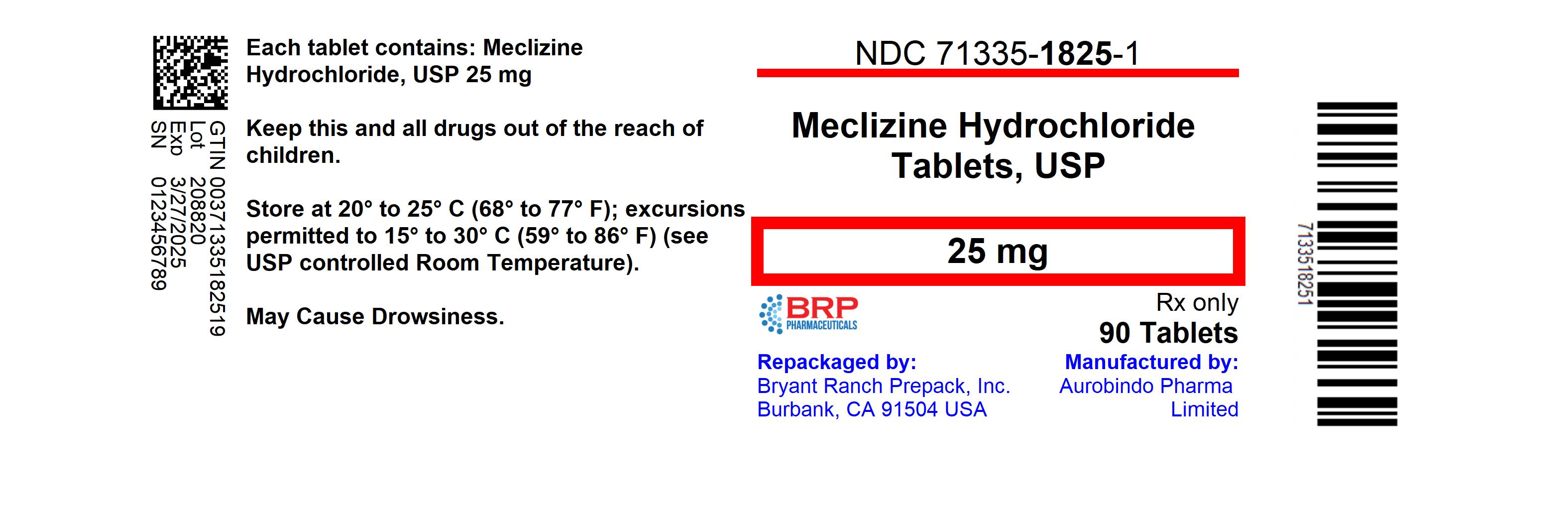
Meclizine HCL 25mg Label
About this NDC listing & data coverage
What data is (and isn’t) available for this NDC — tap to expand
| NDC identity (package / product / labeler codes) | ✓ Available |
| Labeler | ✓ Available |
| Product & package description | ✓ Available |
| Marketing category & status | ✓ Available |
| Active ingredient / dosage form / route | ✓ Available |
| FDA label (SPL via DailyMed) | ✓ Available |
| Package photos | ✓ Available |
| Inactive ingredients (structured) | ✓ Available |
| NADAC pharmacy acquisition price (CMS) | — Not published for this NDC CMS publishes NADAC only for NDCs reported in its retail-pharmacy survey. |
| Orange Book / therapeutic-equivalence data | — Not published for this NDC Applies only to products approved under an NDA/ANDA; many listings are out of scope. |
| HCPCS J-code billing crosswalk | — Not published for this NDC Most self-administered / retail products have no J-code — that is normal. |
| Medicaid utilization (CMS SDUD) | — Not published for this NDC CMS reports utilization only for NDCs with Medicaid claims above its privacy threshold. |