
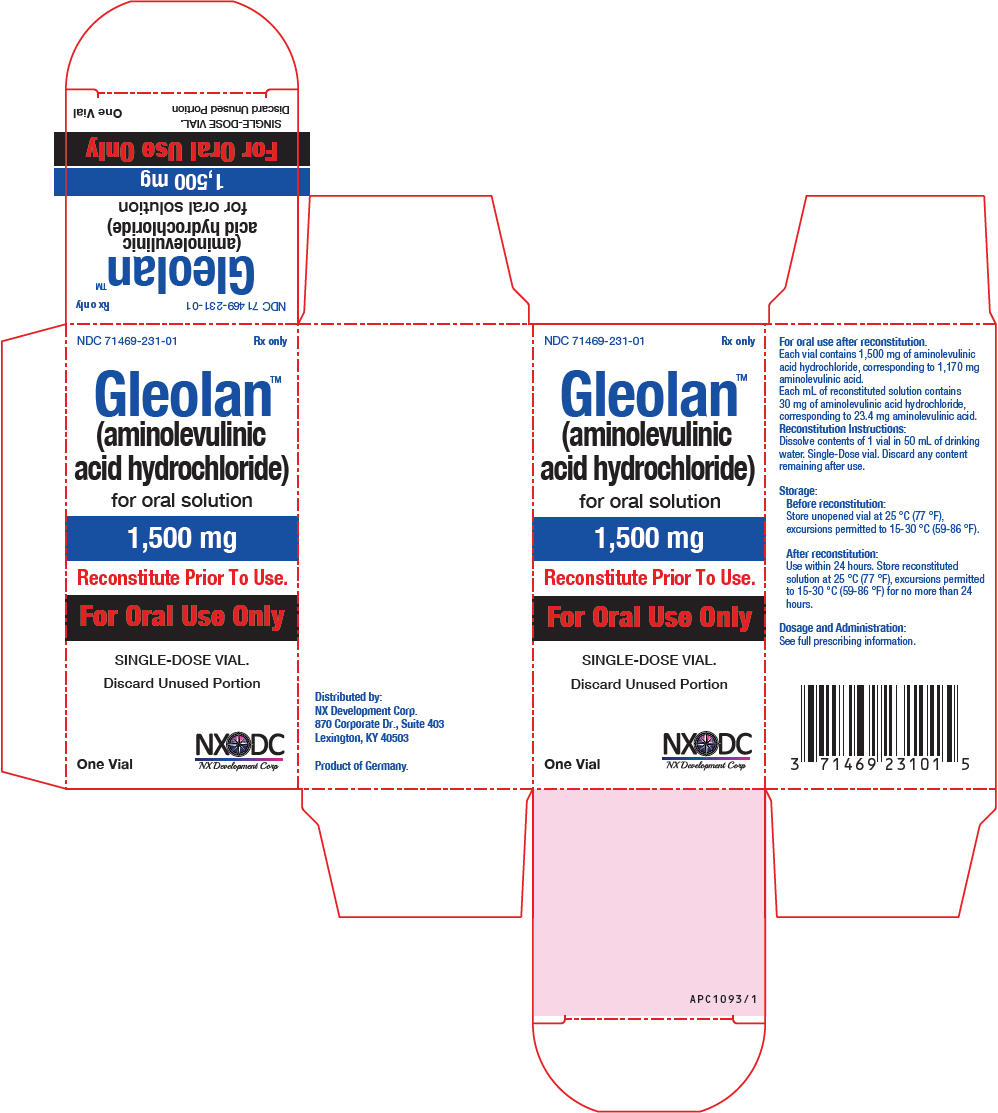
Gleolan Aminolevulinic Acid Hydrochloride 1500 mg Powder, For Solution, 1 vial — NDC 71469-231-01 (Billing 71469-0231-01)
This is a package of 1 vial of Gleolan Aminolevulinic Acid Hydrochloride 1500 mg Powder, For Solution from NX DEVELOPMENT CORP, marketed since Mar 2018 and currently FDA-listed. It is this product's only package size.
NDC database record
One package, one record: these facts belong to NDC 71469-231-01 alone.
- Record
- FDA NDC Directory package listing · Human prescription drug
- Code segments
- 71469 labeler · 231 product · 01 package
- Package marketed since
- Mar 14, 2018
- Sample package
- No — commercial package
- Listing certified through
- Dec 31, 2027
- Billing quantity
- 1 EA per package
- Barcode (UPC)
- 0371469231015
- FDA record last changed
- Jul 24, 2026
Identity & classification
Regulatory identifiers FDA, NLM and CMS codes for this package
Drug-database identifiers Medi-Span GPI and First Databank GCN / HICL / AHFS classification
- GSN (GCN sequence number): 068320
- GCN: 31083
- GPI-14 (Medi-Span): 94200009102110
- HICL (First Databank): 021920
- AHFS class code: 36:68.00.00
Where does this data come from?
- FDA openFDA NDC Directory · synced Oct 8, 2026
- FDA label on DailyMed · label index refreshed Oct 8, 2026
- RxNorm (NLM RxNav) · catalog refreshed Oct 8, 2026
- Medi-Span GPI (licensed)
- First Databank (licensed) · refreshed Oct 8, 2026
Clinical
Patient education
Supplement & herbal interactions
Some supplements/herbs that may interact with Aminolevulinic Acid Hydrochloride — tap one for details:
Where does this data come from?
- MedlinePlus (NLM) · refreshed Oct 8, 2026
- FDA label on DailyMed · label index refreshed Oct 8, 2026
Ask a licensed pharmacist directly — free, answered by our team.
Pricing
A drug doesn't have one price. Each row is a different public payment system, and none is what you'd pay at the counter — that depends on your insurance. The ⓘ on each row explains what it measures.
| Price system | Per mL | Per package |
|---|---|---|
| Retail pharmacies payNADAC · weekly | Not in the retail survey — common for institutional, discontinued, or low-volume packs. | |
| Medicaid paysCMS SDUD · 12 mo | No recent Medicaid claims on file for this NDC — rare and low-volume NDCs are suppressed in the public data. | |
| Medicare drug plans payPart D · quarterly | No Part D plan price is available for this NDC in our data. | |
Where does this data come from?
- CMS NADAC weekly file
- CMS ASP pricing files · refreshed Sep 20, 2026
- CMS Medicaid State Drug Utilization Data · refreshed Oct 9, 2026
- CMS Part D plan pricing files · refreshed Sep 24, 2026
- VA National Acquisition Center price file
Packaging — all sizes for this product
| Package NDC | Description | Marketing start | Marketing end | Status |
|---|---|---|---|---|
| 71469-0231-01 You're viewing this Main listing | 1 VIAL, SINGLE-DOSE in 1 CARTON / 1 POWDER, FOR SOLUTION in 1 VIAL, SINGLE-DOSE | 2018-03-14 | — | Active |
Therapeutic equivalents
| Product | Labeler | Pack | NADAC/unit | TE | Status | Price vs. this |
|---|---|---|---|---|---|---|
| Gleolan 1500 mgthis 71469-0231-01 | NX | 1 vial | — | — | FDA listed | — |
| Gleolan 1500 mg 59137-0231-01 | Medexus | 1 vial | — | — | Discontinued | — |
Where does this data come from?
- FDA openFDA NDC Directory · synced Oct 8, 2026
- FDA Orange Book · refreshed Oct 9, 2026
- CMS NADAC weekly file
Availability & generic status
We did not find an FDA-approved generic match for this exact strength, form and route.
Where does this data come from?
- FDA Orange Book · refreshed Oct 9, 2026
What it looks like
Where does this data come from?
- FDA label on DailyMed · label index refreshed Oct 8, 2026
Inactive Ingredients / Excipients
Inactive ingredients, also called excipients, are components of the drug product other than the active ingredient. They may include fillers, dyes, coatings, preservatives, flavors, or other formulation ingredients.
Where does this data come from?
IACT rows and label-wide narrative are kept separate; availability and product-level specificity depend on the submitted label.- FDA label on DailyMed · label index refreshed Oct 8, 2026
- FDA openFDA NDC Directory · synced Oct 8, 2026
Inactive ingredient FAQ
Are inactive ingredients the same for every manufacturer?
Why might an inactive ingredient be missing?
Can inactive ingredients matter?
Manufacturer & labeler
Where does this data come from?
- FDA openFDA NDC Directory · synced Oct 8, 2026
- Drugs@FDA
Full prescribing information FDA SPL
🎯 Indications and Usage ▾
1 INDICATIONS AND USAGE Gleolan is indicated in patients with glioma [suspected World Health Organization (WHO) Grades III or IV on preoperative imaging] as an adjunct for the visualization of malignant tissue during surgery. Gleolan is an optical imaging agent indicated in patients with glioma (suspected World Health Organization Grades III or IV on preoperative imaging) as an adjunct for the visualization of malignant tissue during surgery. ( 1 )
⏱️ Dosage and Administration ▾
2 DOSAGE AND ADMINISTRATION For oral use only ( 2.1 ) Recommended reconstituted oral dose of Gleolan is 20 mg/kg. ( 2.1 ) Administer Gleolan to patient orally 3 hours (range 2 to 4 hours) before anesthesia. ( 2.1 ) See Full Prescribing Information for reconstitution information. ( 2.2 ) Use appropriate visualization techniques with appropriate surgical microscopes and light source filters. ( 2.4 )
2.1Recommended Dose For oral use only The recommended oral dose of reconstituted Gleolan is 20 mg / kg body weight. More than 1 vial may be required.
2.2Reconstitution of Gleolan Gleolan powder must be reconstituted prior to administration by a healthcare provider according to the following instructions: Determine the total number of vials needed to achieve the intended dose for the patient according to the equation below (rounded up to the nearest whole vial): # of vials = Patient Body Weight (kg) 75 kg / vial Completely remove the white cap and aluminum crimp seal from each vial. Remove and retain the rubber stopper from the vial. Using an appropriate volumetric measuring device (e.g., flask, graduated cylinder, dosing syringe), measure 50 mL of drinking water and add to each vial containing 1,500 mg of Gleolan.
Gently swirl the vial to completely dissolve the powder. The resulting reconstituted solution (30 mg of Gleolan per mL) is clear and colorless to slightly yellowish. If required, replace the stopper and store reconstituted solution for up to 24 hours at room temperature prior to administration.
2.3Gleolan Administration Gleolan is for ORAL USE ONLY. The reconstituted Gleolan solution is administered according to the following steps: Calculate the administration volume, in mL, to achieve the intended dose according to the following equation: Administration Volume (mL) = Patient Body Weight (kg) * 20 mg/kg 30 mg/mL Transfer the entire contents of the prepared vial(s) into an appropriate dosing container (e.g., oral medicine bottle); ensure the entire contents of the vials are transferred. After transfer, discard the empty vial(s).
Using a disposable volumetric syringe, remove the administration volume of reconstituted Gleolan solution from the dosing container and transfer to a separate oral dosing container. Discard unneeded volume of Gleolan solution. Administer orally 3 hours (range 2 to 4 hours) prior to induction of anesthesia.
2.4Imaging Instructions Gleolan should be used with a standard surgical operating microscope adapted with a blue light emitting light source (power density 40-80 mW/cm 2 ) and ancillary excitation and emission filters to visualize fluorescence excitation in the wavelength of 375 to 440 nm and for observation from 620 to 710 nm. Filters transmit porphyrin fluorescence as red-violet, as well as a fraction of backscattered blue excitation light necessary for distinguishing nonfluorescing tissue. Gleolan should only be used by neurosurgeons who have completed a training program on use of fluorescence in surgery.
Training is provided by the distributor.
💊 Dosage Forms and Strengths ▾
3 DOSAGE FORMS AND STRENGTHS For oral solution: 1,500 mg aminolevulinic acid hydrochloride (ALA HCl) lyophilized powder, equivalent to 1,170 mg aminolevulinic acid (ALA) , in a 50 mL single-dose clear, colorless, glass vial with rubber stopper. After reconstitution with 50 mL drinking water, the solution contains 30 mg per mL of aminolevulinic acid hydrochloride (equivalent to 23.4 mg per mL of aminolevulinic acid) and is clear and colorless to slightly yellowish in color. For oral solution: 1,500 mg aminolevulinic acid hydrochloride lyophilized powder, equivalent to 1,170 mg aminolevulinic acid per vial.
The reconstituted aminolevulinic acid hydrochloride solution contains 30 mg per mL and is clear and colorless to slightly yellowish in color. ( 3 )
⛔ Contraindications ▾
4 CONTRAINDICATIONS Hypersensitivity to the aminolevulinic acid (ALA) or porphyrins. [see Warnings and Precautions (5.3) ] Acute or chronic types of porphyria, due to potential ineffectiveness of the drug in these patients. Hypersensitivity to aminolevulinic acid (ALA) or porphyrins. ( 4 , 5.3 , 6.2 ) Acute or chronic types of porphyria. ( 4 )
⚠️ Warnings and Cautions ▾
5 WARNINGS AND PRECAUTIONS Phototoxic reactions: Do not administer phototoxic drugs (St. John's wort, griseofulvin, thiazide diuretics, sulfonylureas, phenothiazines, sulphonamides, quinolones and tetracyclines), and topical preparations containing ALA for 24 hours during the perioperative period. Reduce exposure to sunlight or room lights for 48 hours after oral administration of Gleolan.
( 5.1 , 7 ) Risk of misinterpretation: Non-fluorescing tissue in the surgical field does not rule out the presence of tumor. ( 5.2 , 14 )
5.1Risk of Phototoxic Reaction Due to the risk of phototoxic reactions, do not administer phototoxic drugs (St. John's wort, griseofulvin, thiazide diuretics, sulfonylureas, phenothiazines, sulphonamides, quinolones and tetracyclines), and topical preparations containing ALA for 24 hours during the perioperative period [see Drug Interactions (7) ] . Reduce exposure to sunlight or room lights for 48 hours after administration of Gleolan.
5.2Risk of Misinterpretation Errors may occur with the use of Gleolan for intraoperative visualization of malignant glioma, including false negatives and false positives. Non-fluorescing tissue in the surgical field does not rule out the presence of tumor in patients with glioma [see Clinical Studies (14) ] . Fluorescence may be seen in areas of inflammation or metastases from other tumor types.
5.3Hypersensitivity Reactions Hypersensitivity reactions, including serious hypersensitivity reactions have occurred; these reactions include anaphylactic shock, swelling, and urticaria [see Contraindications (4) , Adverse Reactions (6.2) ] . Always have cardiopulmonary resuscitation personnel and equipment readily available and monitor all patients for hypersensitivity reactions.
🤒 Adverse Reactions ▾
6 ADVERSE REACTIONS Adverse reactions occurring in >1% of patients in the week following surgery were pyrexia, hypotension, nausea, and vomiting. ( 6.1 ) Adverse reactions occurring in < 1% of patients in the first 6 weeks after surgery were: chills, photosensitivity reaction, solar dermatitis, hypotension, abnormal liver function test, and diarrhea. ( 6.1 ) Neurologic events related to the surgical procedure occurred in 29% of patients and included: aphasia, hemiparesis, hemianopia, headache, seizure, hemiplegia, monoparesis, hypoesthesia, and brain edema.
( 6.1 ) Elevated liver enzymes occurred in clinical studies. There were no cases of liver failure. ( 6.1 ) To report SUSPECTED ADVERSE REACTIONS, contact NXDC toll-free at (844) 517-5252 and [email protected] or FDA at 1-800-FDA-1088 or www.fda.gov/medwatch.
6.1Clinical Trial Experience Because clinical trials are conducted under widely varying conditions, adverse reaction rates observed in the clinical trials of a drug cannot be directly compared to rates in the clinical trials of another drug and may not reflect the rates observed in practice. The safety of Gleolan is supported by data from 5 open label clinical studies, which included 527 patients with glioma who received ALA HCl. Adverse reactions that occurred in > 1% of patients in the week following surgery were pyrexia, hypotension, nausea, and vomiting.
Adverse reactions occurring in the first 6 weeks after surgery in < 1% of patients were: chills, photosensitivity reaction, solar dermatitis, hypotension, abnormal liver function test, and diarrhea. One patient experienced respiratory failure due to drug overdose [see Overdosage (10) ] . Neurologic Events Nervous system disorders occurred in 29% of patients within the first week after surgery.
Events occurring in > 1% of patients included aphasia (8%), hemiparesis (7.8%), hemianopsia (3.2%), headache (2.7%), seizure (1.9%), hemiplegia (1.9%), monoparesis (1.3%) and hypoesthesia (1.1%). Brain edema occurred in < 1 % of patients in the first 6 weeks after surgery. In a randomized clinical trial (Study 3), the numbers of serious neurologic adverse events in the post operative period were higher in patients randomized to ALA fluorescence arm compared to the control arm.
An imbalance was notable for the adverse events aphasia, ataxia, convulsion and hemianopsia, and is likely related to the higher amount of brain resection performed in the ALA arm. At longer follow up periods, the numbers between the two arms appeared similar [see Clinical Trials (14) ] . Elevated Liver Enzymes Worsening of ≥ 2 Common Toxicity Criteria (CTC) grades in alanine aminotransferase (ALT) and gamma-glutamyl transferase (GGT) occurred in (15.8% and 11.6%, respectively) within the first week after surgery.
Absolute levels ranged from 2 times to greater than 10 times the upper limit of normal (ULN) for each parameter. At 6 weeks, ALT remained elevated in 2.9% of patients (range 2 to greater than 5 X ULN), and GGT was elevated in 7.5% of patients (range 2 to greater than 10 X ULN). No cases of liver failure occurred.
6.2Post Marketing Experience The following adverse reactions are among those that have been identified during post-approval use of Gleolan outside of the United States. Because these reactions are reported voluntarily from a population of uncertain size, it is not always possible to reliably estimate their frequency or establish a causal relationship to drug exposure. Immune Disorders : anaphylactic shock, angioedema, drug eruption, urticaria, erythema.
Metabolism and Nutrition Disorders : metabolic acidosis.
🔄 Drug Interactions ▾
7 DRUG INTERACTIONS Phototoxic Drugs Patients exposed to a photosensitizing agent may experience a phototoxic skin reaction (severe sunburn). Due to the risk of possible phototoxic reactions, avoid administering phototoxic drugs such as St. John's wort, griseofulvin, thiazide diuretics, sulfonylureas, phenothiazines, sulphonamides, quinolones and tetracyclines, and topical preparations containing ALA for 24 hours before and after administration of Gleolan.
👥 Use in Specific Populations ▾
8 USE IN SPECIFIC POPULATIONS
8.1Pregnancy Risk Summary There are no available human data on Gleolan in pregnant women to inform a drug associated risk of adverse developmental outcomes. In animal reproduction studies, no adverse developmental effects were observed with oral ALA HCl administration to pregnant rabbits during organogenesis at doses 3 times the maximum recommended human oral dose (see Data) . The estimated background risk of major birth defects and miscarriage for the indicated populations are unknown.
All pregnancies have a background risk of birth defect, loss, or other adverse outcomes. In the U.S. general population, the estimated background risk of major birth defects and miscarriage in clinically recognized pregnancies is 2-4% and 15-20%, respectively. Animal data ALA HCl was administered to rabbits at oral doses of 15, 50 and 150 mg/kg/day [approximately 0.1, 0.6, and 3 times the maximum human recommended dose (MHRD), respectively based on AUC comparisons] from gestation days 6-18.
The no-observed-adverse-effect level (NOAEL) for maternal toxicity was 50 mg/kg/day and the NOAEL for embryo-fetal developmental toxicity was 150 mg/kg/day.
8.2Lactation Risk summary There are no data on the presence of ALA HCl in either human or animal milk, the effects on the breastfed infant, or the effects on milk production. The developmental and health benefits of breastfeeding should be considered along with the mother's clinical need for Gleolan and any potential adverse effects on the breastfed infant from Gleolan or from the underlying maternal condition. Clinical Considerations To decrease exposure to Gleolan to the breastfed infant, advise a lactating woman to pump and discard breast milk after the administration of Gleolan for 24 hours (i.e., 5 to 6 half-lives).
8.4Pediatric Use The safety and effectiveness of Gleolan in pediatric patients have not been established.
8.5Geriatric Use Of 527 subjects in clinical studies of Gleolan, 182 were 65 to < 75 years of age and 7 were ≥ 75 years of age. No overall differences in safety or effectiveness were observed between these subjects and younger subjects, and other reported clinical experience has not identified differences in responses between the elderly and younger patients, but greater sensitivity of some older individuals cannot be ruled out. No dose adjustment is required in elderly patients.
8.6Patients with Renal Impairment Because approximately one third of the ALA dose is excreted in urine as parent drug, ALA clearance may be reduced in patients with renal impairment; it is not known if dose adjustment is needed [see Clinical Pharmacology (12.3) ] .
8.7Patients with Hepatic Impairment The contribution of the liver to the elimination of ALA following Gleolan dosing is unknown. ALA clearance may be reduced in patients with hepatic impairment; it is not known if dose adjustment is needed [see Clinical Pharmacology (12.3) ] .
🤰 Pregnancy ▾
8.1Pregnancy Risk Summary There are no available human data on Gleolan in pregnant women to inform a drug associated risk of adverse developmental outcomes. In animal reproduction studies, no adverse developmental effects were observed with oral ALA HCl administration to pregnant rabbits during organogenesis at doses 3 times the maximum recommended human oral dose (see Data) . The estimated background risk of major birth defects and miscarriage for the indicated populations are unknown.
All pregnancies have a background risk of birth defect, loss, or other adverse outcomes. In the U.S. general population, the estimated background risk of major birth defects and miscarriage in clinically recognized pregnancies is 2-4% and 15-20%, respectively. Animal data ALA HCl was administered to rabbits at oral doses of 15, 50 and 150 mg/kg/day [approximately 0.1, 0.6, and 3 times the maximum human recommended dose (MHRD), respectively based on AUC comparisons] from gestation days 6-18.
The no-observed-adverse-effect level (NOAEL) for maternal toxicity was 50 mg/kg/day and the NOAEL for embryo-fetal developmental toxicity was 150 mg/kg/day.
🧒 Pediatric Use ▾
8.4Pediatric Use The safety and effectiveness of Gleolan in pediatric patients have not been established.
🧓 Geriatric Use ▾
8.5Geriatric Use Of 527 subjects in clinical studies of Gleolan, 182 were 65 to < 75 years of age and 7 were ≥ 75 years of age. No overall differences in safety or effectiveness were observed between these subjects and younger subjects, and other reported clinical experience has not identified differences in responses between the elderly and younger patients, but greater sensitivity of some older individuals cannot be ruled out. No dose adjustment is required in elderly patients.
🆘 Overdosage ▾
10 OVERDOSAGE Overdosage has been associated with respiratory insufficiency and erythema. In the event of overdose, supportive measures should be provided as necessary, including protection from strong light sources.
🧬 Clinical Pharmacology ▾
12 CLINICAL PHARMACOLOGY
12.1Mechanism of Action ALA occurs endogenously as a metabolite that is formed in the mitochondria from succinyl-CoA and glycine. Exogenous administration of ALA leads to accumulation of the ALA metabolite PpIX in tumor cells. The reason for the accumulation of PpIX in neoplastic brain tissue is not known.
During glioma surgery, Gleolan is used with an operating microscope adapted with a blue emitting light source (power density 40-80 mW/cm 2 ) and filters for excitation light of wavelength 375 to 440 nm, and observation at wavelengths of 620 to 710 nm. This allows tumor tissue to be visualized as red fluorescence. Tissue lacking sufficient PpIX concentrations appears blue.
12.2Pharmacodynamics The effect of the timing of the Gleolan dosing on fluorescence intensity in brain tissue is unknown. The relationship between systemic ALA plasma concentrations at the time of visualization and fluorescence intensity in brain is also unknown. The dose of 20 mg / kg provided stronger ALA-induced fluorescence in glioma tissue by both visual and spectrophotometric assessment compared to lower doses tested.
Cardiac Electrophysiology Administration of the approved recommended dose of Gleolan did not prolong the QT interval to any clinically relevant extent.
12.3Pharmacokinetics In 12 healthy subjects, the mean half-life of ALA following the recommended dose of Gleolan solution was 0.9 ± 1.2 hours (mean ± std dev) with a range of 0.8 to 1.3 hours. Maximum concentrations of the PpIX metabolite (T max for PpIX) occurred with a median of 4 hours and a range of 1.2 to 7.8 hours. The elimination half-life of PpIX was 3.6 ± 1.8 hours (mean ± std dev) with a range of 1.2 to 7.8 hours.
Absorption In 12 healthy subjects, the absolute bioavailability of ALA following the recommended dose of Gleolan solution was 100.0% ± 1.1 with a range of 78.5% to 131.2%. Maximum ALA plasma concentrations were reached with a median of 0.8 hour (range 0.5 – 1.0 hour). Distribution In in vitro experiments using ALA concentrations up to approximately 25% of the maximal concentration that occurs in plasma following the recommended dose of Gleolan solution, the mean protein binding of ALA was 12%.
Elimination Metabolism Exogenous ALA is metabolized to PpIX, but the fraction of administered ALA that is metabolized to PpIX is unknown. The average plasma AUC of PpIX is less than 6% of that of ALA. Excretion In 12 healthy subjects, excretion of parent ALA in urine in the 12 hours following administration of the recommended dose of Gleolan solution was 34 ± 8% (mean ± std dev) with a range of 27% to 57%.
Specific Populations The effect of renal or hepatic impairment on the pharmacokinetics of ALA following Gleolan administration is unknown. Drug Interaction Studies In vitro studies suggest that phenytoin and other anti-convulsants may decrease cellular PpIX accumulation following Gleolan dosing. ALA is not an inhibitor of CYP1A2, 2B6, 2C8, 2C9, 2C19, 2D6, or 3A.
🧬 Mechanism of Action ▾
12.1Mechanism of Action ALA occurs endogenously as a metabolite that is formed in the mitochondria from succinyl-CoA and glycine. Exogenous administration of ALA leads to accumulation of the ALA metabolite PpIX in tumor cells. The reason for the accumulation of PpIX in neoplastic brain tissue is not known.
During glioma surgery, Gleolan is used with an operating microscope adapted with a blue emitting light source (power density 40-80 mW/cm 2 ) and filters for excitation light of wavelength 375 to 440 nm, and observation at wavelengths of 620 to 710 nm. This allows tumor tissue to be visualized as red fluorescence. Tissue lacking sufficient PpIX concentrations appears blue.
📦 How Supplied / Storage and Handling ▾
16 HOW SUPPLIED/STORAGE AND HANDLING
16.1How Supplied Gleolan (NDC 71469 -231- 01) is supplied as 1,500 mg of lyophilized aminolevulinic acid hydrochloride powder (equivalent to 1,170 mg aminolevulinic acid), for oral solution in a 50-mL clear, colorless, glass vial with a rubber stopper and an aluminum crimp seal.
16.2Storage and Handling Store at 25 °C (77 °F); excursions permitted to 15-30 °C (59-86 °F).
📦 Storage and Handling ▾
16.2Storage and Handling Store at 25 °C (77 °F); excursions permitted to 15-30 °C (59-86 °F).
📋 Description ▾
11 DESCRIPTION
11.1Chemical Properties Gleolan (aminolevulinic acid hydrochloride) is an optical imaging agent for oral solution. The 50-mL, clear vial contains 1,500 mg of lyophilized aminolevulinic acid hydrochloride powder (equivalent to 1,170 mg aminolevulinic acid). After reconstitution, the product has a concentration of 30 mg aminolevulinic acid hydrochloride per mL (equivalent to 23.4 mg aminolevulinic acid per mL).
The chemical name is 5-amino-4-oxo-pentanoic acid hydrochloride. The chemical formula for aminolevulinic acid hydrochloride is C 5 H 10 ClNO 3 . Its molecular weight is 167.59 g/mol with the following structural formula: Chemical Structure
💬 Information for Patients ▾
17 PATIENT COUNSELING INFORMATION Advise patients that they may experience elevated liver enzymes (ALT and GGT) within the first week after surgery. This elevation may persist after 6 weeks. Advise patients to reduce exposure to sunlight or room lights for 48 hours after administration of Gleolan due to risk of phototoxic reactions.
🧬 Pharmacokinetics ▾
12.3Pharmacokinetics In 12 healthy subjects, the mean half-life of ALA following the recommended dose of Gleolan solution was 0.9 ± 1.2 hours (mean ± std dev) with a range of 0.8 to 1.3 hours. Maximum concentrations of the PpIX metabolite (T max for PpIX) occurred with a median of 4 hours and a range of 1.2 to 7.8 hours. The elimination half-life of PpIX was 3.6 ± 1.8 hours (mean ± std dev) with a range of 1.2 to 7.8 hours.
Absorption In 12 healthy subjects, the absolute bioavailability of ALA following the recommended dose of Gleolan solution was 100.0% ± 1.1 with a range of 78.5% to 131.2%. Maximum ALA plasma concentrations were reached with a median of 0.8 hour (range 0.5 – 1.0 hour). Distribution In in vitro experiments using ALA concentrations up to approximately 25% of the maximal concentration that occurs in plasma following the recommended dose of Gleolan solution, the mean protein binding of ALA was 12%.
Elimination Metabolism Exogenous ALA is metabolized to PpIX, but the fraction of administered ALA that is metabolized to PpIX is unknown. The average plasma AUC of PpIX is less than 6% of that of ALA. Excretion In 12 healthy subjects, excretion of parent ALA in urine in the 12 hours following administration of the recommended dose of Gleolan solution was 34 ± 8% (mean ± std dev) with a range of 27% to 57%.
Specific Populations The effect of renal or hepatic impairment on the pharmacokinetics of ALA following Gleolan administration is unknown. Drug Interaction Studies In vitro studies suggest that phenytoin and other anti-convulsants may decrease cellular PpIX accumulation following Gleolan dosing. ALA is not an inhibitor of CYP1A2, 2B6, 2C8, 2C9, 2C19, 2D6, or 3A.
🧬 Pharmacodynamics ▾
12.2Pharmacodynamics The effect of the timing of the Gleolan dosing on fluorescence intensity in brain tissue is unknown. The relationship between systemic ALA plasma concentrations at the time of visualization and fluorescence intensity in brain is also unknown. The dose of 20 mg / kg provided stronger ALA-induced fluorescence in glioma tissue by both visual and spectrophotometric assessment compared to lower doses tested.
Cardiac Electrophysiology Administration of the approved recommended dose of Gleolan did not prolong the QT interval to any clinically relevant extent.
🔬 Clinical Studies ▾
14 CLINICAL STUDIES The efficacy of 20 mg / kg ALA HCl was evaluated in 3 clinical studies (Study 1-3) involving patients, ages 18 to 75 years old, who had a preoperative MRI compatible with high-grade glioma (WHO Grade III or IV) and were undergoing surgical resection. Study 1 was an open-label study of 33 patients with newly diagnosed high-grade glioma and Study 2 was an open-label study of 36 patients with recurrent high-grade glioma. In Studies 1 and 2, after initial debulking was carried out under white light, biopsies were obtained under fluorescent light from fluorescent and nonfluorescent sites.
Presence of fluorescence (positive/negative) was compared to tumor status (true/false) using histopathology as the reference standard. True positives and false positives among fluorescent biopsies and true negatives and false negatives among nonfluorescent biopsies are provided in Table 1. Study 3 was a randomized, multicenter study in 415 patients with a preoperative diagnosis of high-grade glioma by MRI.
Patients were randomized in 1:1 ratio to ALA fluorescence arm or to white light control arm. Biopsies were obtained from tumor-core, tumor-margin and regions just distant to the tumor margins. In 349 patients high grade glioma was confirmed by a blinded central read and histopathology.
The remaining patients were diagnosed with metastatic disease, abscess, low-grade glioma or other conditions. In patients with confirmed high-grade glioma randomized to the ALA fluorescence arm, presence of fluorescence at a biopsy level was compared to tumor status using histopathology as the reference standard (Table 1). In 4 patients with low-grade glioma (WHO Grade I or II) who received ALA HCl, 9 out of 10 biopsies were false negative.
The extent of resection among patients with confirmed high-grade glioma in the ALA fluorescence arm was compared to that among patient in the control arm, with the "completeness" of resection being determined by a central blinded read of early post-surgical MRI. Percentage of patients who had "completeness" of resection was 64% in the ALA arm and 38% in the control arm, with the difference of 26% [95% CI: (16%, 36%)]. Table 1.
Presence of Fluorescence Compared to Histopathology (biopsy level) Study 1 (N=297) N is Number of total (fluorescent and non-fluorescent) biopsies Study 2 (N=370) Study 3 (N=479) Number of Fluorescent Biopsies 185 354 319 True Positive 178 342 312 False Positive 7 12 7 Number of Nonfluorescent Biopsies 112 16 160 True Negative 27 3 30 False Negative 85 13 130
🧪 Nonclinical Toxicology ▾
13 NONCLINICAL TOXICOLOGY
13.1Carcinogenesis, Mutagenesis, Impairment of Fertility Carcinogenesis No carcinogenicity studies have been conducted with Gleolan. Mutagenesis ALA HCl was not mutagenic in the Ames assay, HPRT-V79 mammalian cell mutagenicity test, the peripheral human lymphocyte chromosomal aberration assay and the in vivo mouse micronucleus test when studies were performed in the dark or under subdued lighting. Impairment of Fertility No fertility studies have been conducted with Gleolan.
📄 Carcinogenesis, Mutagenesis, Impairment of Fertility ▾
13.1Carcinogenesis, Mutagenesis, Impairment of Fertility Carcinogenesis No carcinogenicity studies have been conducted with Gleolan. Mutagenesis ALA HCl was not mutagenic in the Ames assay, HPRT-V79 mammalian cell mutagenicity test, the peripheral human lymphocyte chromosomal aberration assay and the in vivo mouse micronucleus test when studies were performed in the dark or under subdued lighting. Impairment of Fertility No fertility studies have been conducted with Gleolan.
📄 Package Label / Principal Display Panel ▾
PRINCIPAL DISPLAY PANEL - 1,500 mg Vial Carton NDC 71469-231-01 Rx only Gleolan ® (aminolevulinic acid hydrochloride) for oral solution 1,500 mg Reconstitute Prior To Use. For Oral Use Only SINGLE-DOSE VIAL. Discard Unused Portion One Vial NX Development Corp. PRINCIPAL DISPLAY PANEL - 1,500 mg Vial Carton
About this NDC listing & data coverage
What data is (and isn’t) available for this NDC — tap to expand
| NDC identity (package / product / labeler codes) | ✓ Available |
| Labeler | ✓ Available |
| Product & package description | ✓ Available |
| Marketing category & status | ✓ Available |
| Active ingredient / dosage form / route | ✓ Available |
| FDA label (SPL via DailyMed) | ✓ Available |
| Package photos | ✓ Available |
| Inactive ingredients (structured) | — Not published for this NDC The labeler did not submit a structured excipient list, or no SPL is available. |
| NADAC pharmacy acquisition price (CMS) | — Not published for this NDC CMS publishes NADAC only for NDCs reported in its retail-pharmacy survey. |
| Orange Book / therapeutic-equivalence data | — Not published for this NDC Applies only to products approved under an NDA/ANDA; many listings are out of scope. |
| HCPCS J-code billing crosswalk | — Not published for this NDC Most self-administered / retail products have no J-code — that is normal. |
| Medicaid utilization (CMS SDUD) | — Not published for this NDC CMS reports utilization only for NDCs with Medicaid claims above its privacy threshold. |