
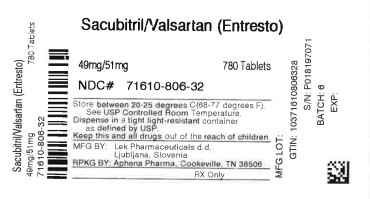
ENTRESTO Sacubitril and Valsartan 49 mg; 51 mg Tablet, Film Coated, 780-count — NDC 71610-806-32 (Billing 71610-0806-32)
This is a package of 780 tablets of ENTRESTO Sacubitril and Valsartan 49 mg; 51 mg Tablet, Film Coated from Aphena Pharma Solutions - Tennessee, LLC, marketed since Jul 2015 and currently FDA-listed. It is this product's only package size.
NDC database record
One package, one record: these facts belong to NDC 71610-806-32 alone.
- Record
- FDA NDC Directory package listing · Human prescription drug
- Code segments
- 71610 labeler · 806 product · 32 package
- Package marketed since
- Mar 22, 2024
- Sample package
- No — commercial package
- Listing certified through
- Dec 31, 2026
- Billing quantity
- 780 EA per package
- Barcode (UPC-A, from the NDC)
- 3 7161080632 1
- FDA record last changed
- Jul 24, 2026
Identity & classification
Regulatory identifiers FDA, NLM and CMS codes for this package
Drug-database identifiers Medi-Span GPI and First Databank GCN / HICL / AHFS classification
- GSN (GCN sequence number): 074409
- GCN: 39047
- HICL (First Databank): 042256
- AHFS class code: 24:32.12.00
- RxCUI (RxNorm): 1656349
Where does this data come from?
- FDA openFDA NDC Directory · synced Oct 8, 2026
- FDA label on DailyMed · label index refreshed Oct 6, 2026
- RxNorm (NLM RxNav) · catalog refreshed Oct 1, 2026
- Medi-Span GPI (licensed)
- First Databank (licensed) · refreshed Oct 8, 2026
RxNorm drug class
This medicine belongs to the Angiotensin II receptor blockers (ARBs), other combinations class.
Where does this data come from?
- RxClass (NLM) · catalog refreshed Oct 1, 2026
Clinical
The combination of valsartan and sacubitril is usually used in combination with other medications to lower the risk of death and hospitalization in adults with certain types of heart failure. The combination of valsartan and sacubitril is also used to treat certain types of heart failure in children 1 year of age and older. Valsartan is in a class of medications called angiotensin II receptor antagonists. It works by blocking the action of certain natural substances that tighten the blood vessels, allowing the blood to flow more smoothly and the heart to pump more efficiently. Sacubitril is in...
Read the full MedlinePlus article ↗- It treats heart failure. In adults with chronic heart failure, it lowers the chance of dying from heart causes and of being hospitalized for heart failure. It is also used in child...
- What is valsartan and sacubitril used for?
- You take it by mouth twice a day, with or without food. Your doctor will usually start low and raise the dose every few weeks as you tolerate it. Take it exactly as prescribed.
- No. Taking the two together raises the risk of serious swelling (angioedema). If you are switching, you need to wait 36 hours between the two drugs. Make sure your prescriber and p...
Patient education
Supplement & herbal interactions
Where does this data come from?
- MedlinePlus (NLM) · refreshed Oct 1, 2026
- FDA label on DailyMed · label index refreshed Oct 6, 2026
Ask a licensed pharmacist directly — free, answered by our team.
Pricing
A drug doesn't have one price. Each row is a different public payment system, and none is what you'd pay at the counter — that depends on your insurance. The ⓘ on each row explains what it measures.
| Price system | Per each | Per package |
|---|---|---|
| Retail pharmacies payNADAC · weekly | Not in the retail survey — common for institutional, discontinued, or low-volume packs. | |
| Medicaid paysCMS SDUD · 12 mo | No recent Medicaid claims on file for this NDC — rare and low-volume NDCs are suppressed in the public data. | |
| Medicare drug plans payPart D · Q2 2026 | $1.23 | $958.78 / 780 tablets |
Where does this data come from?
- CMS NADAC weekly file
- CMS ASP pricing files · refreshed Sep 20, 2026
- CMS Medicaid State Drug Utilization Data · refreshed Oct 8, 2026
- CMS Part D plan pricing files · refreshed Sep 24, 2026
- VA National Acquisition Center price file
Packaging — all sizes for this product
| Package NDC | Description | Marketing start | Marketing end | Status |
|---|---|---|---|---|
| 71610-0806-32 You're viewing this Main listing | 780 TABLET, FILM COATED in 1 BOTTLE | 2024-03-22 | — | Active |
Therapeutic equivalents
| Product | Labeler | Pack | NADAC/unit | TE | Status | Price vs. this |
|---|---|---|---|---|---|---|
| Sacubitril and Valsartan 49 mg/1; 51 mg 00904-7582-04 | Major | 1 tablet | $0.533 | AB | Availability likely | — |
| Sacubitril and valsartan 49 mg/1; 51 mg 31722-0674-18 | Camber | 180 tablets | $0.533 | AB | Availability likely | — |
| Sacubitril and Valsartan 49 mg/1; 51 mg 33342-0571-09 | Macleods | 60 tablets | $0.533 | AB | Availability likely | — |
| Sacubitril and Valsartan Sacubitril and Valsartan 49 mg/1; 51 mg 43598-0644-18 | Dr. | 180 tablets | $0.533 | AB | Availability likely | — |
| Sacubitril and Valsartan 49 mg/1; 51 mg 50268-0607-15 | AvPAK | 1 tablet | $0.533 | AB | Availability likely | — |
| Sacubitril and Valsartan 49 mg/1; 51 mg 60687-0966-57 | American | 1 tablet | $0.533 | AB | Availability likely | — |
| Sacubitril and Valsartan 49 mg/1; 51 mg 69238-2732-01 | Amneal | 60 tablets | $0.533 | AB | Availability likely | — |
| sacubitril and valsartan 49 mg/1; 51 mg 70748-0196-07 | Lupin | 60 tablets | $0.533 | AB | Availability likely | — |
| Sacubitril and Valsartan 49 mg/1; 51 mg 70954-0976-20 | ANI | 60 tablets | $0.533 | AB | Availability likely | — |
| Sacubitril and Valsartan 49 mg/1; 51 mg 72205-0281-18 | Novadoz | 180 tablets | $0.533 | AB | Availability likely | — |
| Sacubitril and Valsartan 49 mg/1; 51 mg 82293-0028-10 | Novugen | 60 tablets | $0.533 | AB | Availability likely | — |
| Entresto 49 mg/1; 51 mg 00078-0777-20 | Novartis | 60 tablets | $11.561 | AB | Availability likely | — |
| Entresto 49 mg/1; 51 mg 00078-9777-50 | Novartis | 28 tablets | — | AB | FDA listed | — |
| sacubitril and valsartan 49 mg/1; 51 mg 13668-0635-05 | Torrent | 500 tablets | — | AB | FDA listed | — |
| sacubitril and valsartan 49 mg/1; 51 mg 13668-0746-05 | Torrent | 500 tablets | — | AB | FDA listed | — |
| Sacubitril and Valsartan 49 mg/1; 51 mg 42385-0931-18 | Laurus | 180 tablets | — | AB | FDA listed | — |
| sacubitril and valsartan 49 mg/1; 51 mg 46708-0557-10 | Alembic | 10 tablets | — | AB | FDA listed | — |
| sacubitril and valsartan 49 mg/1; 51 mg 51407-0936-10 | Golden | 1000 tablets | — | AB | FDA listed | — |
| sacubitril and valsartan 49 mg/1; 51 mg 62332-0557-10 | Alembic | 10 tablets | — | AB | FDA listed | — |
| Sacubitril and Valsartan 49 mg/1; 51 mg 67877-0708-51 | Ascend | 180 tablets | — | AB | FDA listed | — |
| Sacubitril and Valsartan 49 mg/1; 51 mg 67877-0949-33 | Ascend | 10 tablets | — | AB | FDA listed | — |
| Sacubitril and Valsartan 49 mg/1; 51 mg 70069-0854-60 | Somerset | 60 tablets | — | AB | FDA listed | — |
| Sacubitril and Valsartan 49 mg/1; 51 mg 70377-0032-11 | Biocon | 30 tablets | — | AB | FDA listed | — |
| sacubitril and valsartan 49 mg/1; 51 mg 70710-1273-04 | Zydus | 100 tablets | — | AB | FDA listed | — |
| sacubitril and valsartan 49 mg/1; 51 mg 70771-1922-04 | Zydus | 100 tablets | — | AB | FDA listed | — |
| Entresto 49 mg/1; 51 mgthis 71610-0806-32 | Aphena | 780 tablets | — | AB | FDA listed | — |
| Sacubitril and Valsartan 49 mg/1; 51 mg 71610-0939-32 | Aphena | 780 tablets | — | AB | FDA listed | — |
| Sacubitril and Valsartan 49 mg/1; 51 mg 71610-0982-89 | Aphena | 720 tablets | — | AB | FDA listed | — |
| Sacubitril and Valsartan 49 mg/1; 51 mg 72865-0311-10 | XLCare | 1000 tablets | — | AB | FDA listed | — |
| Sacubitril and Valsartan 49 mg/1; 51 mg 73190-0006-10 | AvKARE | 1000 tablets | — | AB | FDA listed | — |
| Sacubitril and Valsartan 51 mg/1; 49 mg 73190-0018-18 | AvKARE | 180 tablets | — | AB | FDA listed | — |
| Sacubitril and Valsartan 49 mg/1; 51 mg 72603-0881-01 | NorthStar | 60 tablets | — | AB | FDA listed | — |
| Sacubitril and Valsartan 49 mg/1; 51 mg 60290-0086-01 | Umedica | 60 tablets | — | AB | FDA listed | — |
Where does this data come from?
- FDA openFDA NDC Directory · synced Oct 8, 2026
- FDA Orange Book · refreshed Oct 3, 2026
- CMS NADAC weekly file
Availability & generic status
FDA-approved generic versions are listed, and recent pricing/market data suggests they may be available — see Therapeutic equivalents.
Why the date isn’t exact: Generic timing can change because patents may be challenged, settled, licensed, added, removed, or worked around with a narrower label — and FDA approval does not always mean a pharmacy can get the generic today.
🛈 What do these terms mean?
- Patent
- Legal protection listed in the Orange Book that may delay generic approval or launch. Issued by the U.S. Patent & Trademark Office.
- Substance patent
- Covers the active drug molecule itself — the hardest to design around. A generic generally can’t launch until it expires.
- Formulation (product) patent
- Covers a specific formulation or dosage form. A generic can sometimes work around it with a different formulation.
- Method-of-use patent
- A patent covering one specific approved use of the drug — not necessarily the whole molecule. A generic can sometimes launch with a “skinny label” that carves out the protected use and keeps the others.
- Skinny label
- A generic label that omits a still-patented use when the FDA allows it — letting a generic reach the market for the unprotected uses.
- Exclusivity
- FDA-granted marketing protection, separate from patents — e.g. 5-yr new chemical entity, 7-yr orphan drug, or a +6-month pediatric extension.
- Paragraph IV
- A generic applicant’s formal challenge to a listed patent. It can potentially lead to earlier generic entry, but often involves litigation or a settlement.
- RLD / RS
- Reference Listed Drug — the brand product the FDA uses as the reference for generic applications. Reference Standard — the product the FDA expects generics to compare against in bioequivalence testing.
- TE / AB rating
- FDA therapeutic-equivalence rating. An AB rating generally means the FDA considers a generic therapeutically equivalent to — and substitutable for — the brand.
- LOE (loss of exclusivity)
- The latest patent or exclusivity currently listed — the loss-of-exclusivity / latest-listed-protection date shown on this page. Paragraph-IV challenges and settlements can move the real date earlier; FDA approval and a manufacturer’s decision to market can move it later.
Built from the FDA Orange Book. The bars above are scaled to each protection’s expiry; the red LOE marker is the last one to lapse.
| Patent | Type | Use code | Expires |
|---|---|---|---|
| US 9388134 ↗ | Method of use | U-1723 | Nov 8, 2026 |
| US 9388134 ↗ | Method of use | U-1723 | Nov 8, 2026 |
| US 11135192 ↗ | Method of use | U-3084 | Aug 22, 2033 |
| US 11135192 ↗ | Method of use | U-3084 | Aug 22, 2033 |
| US 11135192 ↗ | Method of use | U-3084 | Aug 22, 2033 |
| US 9517226 ↗ | Method of use | U-3084 | Aug 22, 2033 |
| US 9937143 ↗ | Method of use | U-3084 | Aug 22, 2033 |
| US 9517226 ↗ | Method of use | U-3084 | Aug 22, 2033 |
| US 9937143 ↗ | Method of use | U-3084 | Aug 22, 2033 |
| US 9517226 ↗ | Method of use | U-3084 | Aug 22, 2033 |
| US 9937143 ↗ | Method of use | U-3084 | Aug 22, 2033 |
| US 9388134 ↗ | Method of use | U-1723 | Nov 8, 2026 |
| US 11058667 ↗ | Method of use | U-3170 | May 9, 2036 |
| US 11058667 ↗ | Method of use | U-3170 | May 9, 2036 |
| US 11058667 ↗ | Method of use | U-3170 | May 9, 2036 |
| US 8877938 ↗ | Drug substance | — | May 27, 2027 |
| US 8877938 ↗ | Drug substance | — | May 27, 2027 |
| US 8877938 ↗ | Drug substance | — | May 27, 2027 |
| US 8877938*PED ↗ | Drug product | — | Nov 27, 2027 |
| US 8877938*PED ↗ | Drug product | — | Nov 27, 2027 |
| US 8877938*PED ↗ | Drug product | — | Nov 27, 2027 |
| US 9388134*PED ↗ | Drug product | — | May 8, 2027 |
| US 9388134*PED ↗ | Drug product | — | May 8, 2027 |
| US 9388134*PED ↗ | Drug product | — | May 8, 2027 |
Is there a generic version of ENTRESTO 49 MG-51 MG TABLET?
The FDA approved a generic — why can’t I get it at my pharmacy yet?
Why do different websites show different generic release dates?
What does “FDA listed” mean?
What does a patent or protection date mean here?
What does “current Orange Book estimate” mean?
Can a generic come out before the last patent expires?
Can a generic come out after the listed dates?
What is the difference between patents and exclusivity?
Why are there multiple patent dates?
Where does this data come from?
- FDA Orange Book · refreshed Oct 3, 2026
What it looks like
Where does this data come from?
- FDA label on DailyMed · label index refreshed Oct 6, 2026
Inactive Ingredients / Excipients
Inactive ingredients, also called excipients, are components of the drug product other than the active ingredient. They may include fillers, dyes, coatings, preservatives, flavors, or other formulation ingredients.
🧪 Avoiding an ingredient? See Valsartan and Sacubitril inactive ingredients by manufacturer: every current product's list side by side, so you can ask your pharmacy for the version that does not list it.
💡 Tap an ingredient (hover on desktop) to see what it is and why it’s used.
-
UNII OP1R32D61U
Microcrystalline cellulose is a purified form of cellulose, a natural fiber from plant sources. It acts as a binder and filler in tablets and capsules, helping hold ingredients together and give the medicine its shape and size.
-
UNII 68401960MK
Crospovidone is a synthetic polymer made from polyvinylpyrrolidone. It acts as a disintegrant, helping tablets break apart quickly in the stomach so the medicine dissolves and absorbs into the body.
-
UNII 1K09F3G675
Ferric oxide red is an inorganic iron compound used as a colorant in medicines. It gives tablets, capsules, or other dosage forms a red or reddish tint for identification and appearance.
-
UNII EX438O2MRT
Ferric oxide yellow is a naturally occurring iron compound used as a colorant in medications. It gives tablets, capsules, and other forms a yellow or golden hue for identification and appearance.
-
UNII 2165RE0K14
A plant-based thickener made from cellulose that helps control how quickly the medicine dissolves and releases its active ingredient. It also binds ingredients together and improves the tablet's texture and handling during manufacturing.
-
UNII 3NXW29V3WO
Hypromellose is a plant-based thickener made from cellulose. It's used in medicines as a binder to hold ingredients together, a coating for tablets, and a thickener for liquids.
-
UNII 70097M6I30
Magnesium stearate is a salt made from magnesium and stearic acid, a fatty substance. It's used in tablets and capsules as a lubricant and glidant to help ingredients flow smoothly during manufacturing and prevent sticking.
-
UNII 4R4HFI6D95
Polyethylene glycol 4000 is a synthetic polymer derived from petroleum. It serves as a binder, filler, and lubricant in solid dosage forms, and helps control how quickly the medicine dissolves.
-
UNII ETJ7Z6XBU4
Silicon dioxide is a naturally occurring mineral used as a glidant and anti-caking agent. It helps powder ingredients flow smoothly and prevents clumping during manufacturing and storage.
-
UNII 7SEV7J4R1U
A powder made from a naturally occurring mineral. In medicines, talc works as a glidant and anti-caking agent, helping tablets and capsules flow smoothly during manufacturing and preventing clumping.
-
UNII 15FIX9V2JP
Titanium dioxide is a bright white mineral powder commonly used as a colorant and opacifying agent. It makes pills and tablets white or lighter in color and helps make coatings non-transparent.
11 inactive ingredients listed in the exact product block matched to this NDC.
Where does this data come from?
ingredient classCode="IACT" elements from the exact product block matched by this NDC. Label-section narrative from DailyMed / the openFDA label index is shown separately when available.- FDA label on DailyMed · label index refreshed Oct 6, 2026
- FDA openFDA NDC Directory · synced Oct 8, 2026
Inactive ingredient FAQ
Are inactive ingredients the same for every manufacturer?
Why might an inactive ingredient be missing?
Can inactive ingredients matter?
Manufacturer & labeler
More NDCs from Aphena Pharma Solutions - Tennessee, LLC labeler code 71610
- Pregabalin 300 mg Capsule NDC 71610-800-30
- Rosuvastatin Calcium 10 mg Tablet NDC 71610-801-45
- Amlodipine Besylate 2.5 mg 2.5 mg Tablet NDC 71610-802-60
- Folic Acid 1 mg Tablet NDC 71610-803-30
- Etodolac 400 mg Tablet, Film Coated NDC 71610-804-30
- Alli orlistat 60 mg Capsule NDC 71610-805-34
- ENTRESTO Sacubitril and Valsartan 97 mg; 103 mg Tablet, Film Coated NDC 71610-807-37
- Pregabalin 100 mg Capsule NDC 71610-808-30
- Diphenoxylate Hydrochloride and Atropine Sulfate 2.5 mg; .025 mg Tablet NDC 71610-809-53
- ENTRESTO Sacubitril and Valsartan 24 mg; 26 mg Tablet, Film Coated NDC 71610-810-32
- Eliquis apixaban 2.5 mg Tablet, Film Coated NDC 71610-811-42
- Trospium Chloride 20 mg Tablet, Film Coated NDC 71610-812-87
Where does this data come from?
- FDA openFDA NDC Directory · synced Oct 8, 2026
- Drugs@FDA
Full prescribing information FDA SPL
🚨 Boxed Warning ▾
WARNING: FETAL TOXICITY When pregnancy is detected, discontinue ENTRESTO as soon as possible (5.1) Drugs that act directly on the renin-angiotensin system can cause injury and death to the developing fetus (5.1) WARNING: FETAL TOXICITY See full prescribing information for complete boxed warning. When pregnancy is detected, discontinue ENTRESTO as soon as possible. ( 5.1 ) Drugs that act directly on the renin-angiotensin system can cause injury and death to the developing fetus.
( 5.1 )
🎯 Indications and Usage ▾
1 INDICATIONS AND USAGE ENTRESTO is indicated: to reduce the risk of cardiovascular death and hospitalization for heart failure in adult patients with chronic heart failure. Benefits are most clearly evident in patients with left ventricular ejection fraction (LVEF) below normal. ( 1.1 ) for the treatment of symptomatic heart failure with systemic left ventricular systolic dysfunction in pediatric patients aged one year and older.
ENTRESTO reduces NT-proBNP and is expected to improve cardiovascular outcomes. ( 1.2 )
1.1Adult Heart Failure ENTRESTO is indicated to reduce the risk of cardiovascular death and hospitalization for heart failure in adult patients with chronic heart failure. Benefits are most clearly evident in patients with left ventricular ejection fraction (LVEF) below normal. LVEF is a variable measure, so use clinical judgment in deciding whom to treat [see Clinical Studies (14.1)] .
1.2Pediatric Heart Failure ENTRESTO is indicated for the treatment of symptomatic heart failure with systemic left ventricular systolic dysfunction in pediatric patients aged one year and older. ENTRESTO reduces NT-proBNP and is expected to improve cardiovascular outcomes.
⏱️ Dosage and Administration ▾
2 DOSAGE AND ADMINISTRATION Indication Titration Step Dose (twice daily) Starting Second Final Adult Heart Failure 49/51 mg 97/103 mg Pediatric Heart Failure Patients less than 40 kg 1.6 mg/kg 2.3 mg/kg 3.1 mg/kg Pediatric Heart Failure Patients at least 40 kg, less than 50 kg 24/26 mg 49/51 mg 72/78 mg Pediatric Heart Failure Patients at least 50 kg 49/51 mg 72/78 mg 97/103 mg Adjust adult doses every 2 to 4 weeks and pediatric doses every 2 weeks to the target maintenance dose, as tolerated by the patient. ( 2.2 , 2.3 ) Reduce starting dose to half the usually recommended starting dosage for: - patients not currently taking an ACE inhibitor or ARB or previously taking a low dose of these agents ( 2.5 ) - patients with severe renal impairment ( 2.6 ) - patients with moderate hepatic impairment ( 2.7 )
2.1General Considerations ENTRESTO is contraindicated with concomitant use of an angiotensin-converting enzyme (ACE) inhibitor. If switching from an ACE inhibitor to ENTRESTO allow a washout period of 36 hours between administration of the two drugs [see Contraindications (4) and Drug Interactions (7.1)] .
2.2Adult Heart Failure The recommended starting dose of ENTRESTO is 49/51 mg orally twice-daily. Double the dose of ENTRESTO after 2 to 4 weeks to the target maintenance dose of 97/103 mg twice daily, as tolerated by the patient.
2.3Pediatric Heart Failure Refer to Table 1 for the recommended dose for pediatric patients aged one year and older. Take the recommended dose orally twice daily. Adjust pediatric patient doses every 2 weeks, as tolerated by the patient.
Table 1: Recommended Dose Titration † Use of the Oral Suspension recommended in these patients. Recommended mg/kg doses are of the combined amount of both sacubitril and valsartan [see Dosage and Administration (2.4)] . ‡ Doses of 72/78 mg can be achieved using three 24/26 mg tablets [see Dosage Forms and Strengths (3)] . Titration Step Dose (twice daily) Starting Second Final Pediatric Patients Less than 40 kg † 1.6 mg/kg 2.3 mg/kg 3.1 mg/kg Pediatric Patients At least 40 kg, less than 50 kg 24/26 mg 49/51 mg 72/78 mg ‡ Pediatric Patients At least 50 kg 49/51 mg 72/78 mg ‡ 97/103 mg
2.4Preparation of Oral Suspension ENTRESTO oral suspension can be substituted at the recommended tablet dosage in patients unable to swallow tablets. ENTRESTO 800 mg/200 mL oral suspension can be prepared in a concentration of 4 mg/mL (sacubitril/valsartan 1.96/2.04 mg/mL). Use ENTRESTO 49/51 mg tablets in the preparation of the suspension.
To make an 800 mg/200 mL (4 mg/mL) oral suspension, transfer eight tablets of ENTRESTO 49/51 mg film-coated tablets into a mortar. Crush the tablets into a fine powder using a pestle. Add 60 mL of Ora-Plus ® into the mortar and triturate gently with pestle for 10 minutes, to form a uniform suspension.
Add 140 mL of Ora-Sweet ® SF into mortar and triturate with pestle for another 10 minutes, to form a uniform suspension. Transfer the entire contents from the mortar into a clean 200 mL amber colored PET or glass bottle. Place a press-in bottle adapter and close the bottle with a child resistant cap.
The oral suspension can be stored for up to 15 days. Do not store above 25°C (77°F) and do not refrigerate. Shake before each use. * Ora-Sweet SF ® and Ora-Plus ® are registered trademarks of Paddock Laboratories, Inc.
2.5Dose Adjustment for Patients Not Taking an ACE inhibitor or ARB or Previously Taking Low Doses of These Agents In patients not currently taking an ACE inhibitor or an angiotensin II receptor blocker (ARB) and for patients previously taking low doses of these agents, start ENTRESTO at half the usually recommended starting dose. After initiation, increase the dose every 2 to 4 weeks in adults and every 2 weeks in pediatric patients to follow the recommended dose escalation thereafter [see Dosage and Administration (2.2, 2.3)] .
Note: Initiate pediatric patients weighing 40 to 50 kg who meet this criterion at 0.8 mg/kg twice daily using th… [Excerpted — this section continues on DailyMed.]
💊 Dosage Forms and Strengths ▾
3 DOSAGE FORMS AND STRENGTHS ENTRESTO is supplied as unscored, ovaloid, film-coated tablets in the following strengths: ENTRESTO 24/26 mg, (sacubitril 24 mg and valsartan 26 mg) are violet white and debossed with “NVR” on one side and “LZ” on the other side. ENTRESTO 49/51 mg, (sacubitril 49 mg and valsartan 51 mg) are pale yellow and debossed with “NVR” on one side and “L1” on the other side. ENTRESTO 97/103 mg, (sacubitril 97 mg and valsartan 103 mg) are light pink and debossed with “NVR” on one side and “L11” on the other side.
Film-coated tablets: 24/26 mg; 49/51 mg; 97/103 mg ( 3 )
⛔ Contraindications ▾
4 CONTRAINDICATIONS ENTRESTO is contraindicated: in patients with hypersensitivity to any component in patients with a history of angioedema related to previous ACE inhibitor or ARB therapy [see Warnings and Precautions (5.2)] with concomitant use of ACE inhibitors. Do not administer within 36 hours of switching from or to an ACE inhibitor [see Drug Interactions (7.1)] with concomitant use of aliskiren in patients with diabetes [see Drug Interactions (7.1)] Hypersensitivity to any component. ( 4 ) History of angioedema related to previous ACEi or ARB therapy.
( 4 ) Concomitant use with ACE inhibitors. ( 4 , 7.1 ) Concomitant use with aliskiren in patients with diabetes. ( 4 , 7.1 )
⚠️ Warnings and Cautions ▾
5 WARNINGS AND PRECAUTIONS Observe for signs and symptoms of angioedema and hypotension. ( 5.2 , 5.3 ) Monitor renal function and potassium in susceptible patients. ( 5.4 , 5.5 )
5.1Fetal Toxicity ENTRESTO can cause fetal harm when administered to a pregnant woman. Use of drugs that act on the renin-angiotensin system during the second and third trimesters of pregnancy reduces fetal renal function and increases fetal and neonatal morbidity and death. When pregnancy is detected, consider alternative drug treatment and discontinue ENTRESTO.
However, if there is no appropriate alternative to therapy with drugs affecting the renin-angiotensin system, and if the drug is considered lifesaving for the mother, advise a pregnant woman of the potential risk to the fetus [see Use in Specific Populations (8.1)] .
5.2Angioedema ENTRESTO may cause angioedema [see Adverse Reactions (6.1)] . If angioedema occurs, discontinue ENTRESTO immediately, provide appropriate therapy, and monitor for airway compromise. ENTRESTO must not be re-administered.
In cases of confirmed angioedema where swelling has been confined to the face and lips, the condition has generally resolved without treatment, although antihistamines have been useful in relieving symptoms. Angioedema associated with laryngeal edema may be fatal. Where there is involvement of the tongue, glottis or larynx, likely to cause airway obstruction, administer appropriate therapy, e.g., subcutaneous epinephrine/adrenaline solution 1:1000 (0.3 mL to 0.5 mL) and take measures necessary to ensure maintenance of a patent airway.
ENTRESTO has been associated with a higher rate of angioedema in Black than in non-Black patients. Patients with a prior history of angioedema may be at increased risk of angioedema with ENTRESTO [see Adverse Reactions (6.1)] . ENTRESTO must not be used in patients with a known history of angioedema related to previous ACE inhibitor or ARB therapy [see Contraindications (4)] .
ENTRESTO should not be used in patients with hereditary angioedema.
5.3Hypotension ENTRESTO lowers blood pressure and may cause symptomatic hypotension [see Adverse Reactions (6.1)] . Patients with an activated renin-angiotensin system, such as volume- and/or salt-depleted patients (e.g., those being treated with high doses of diuretics), are at greater risk. Correct volume or salt depletion prior to administration of ENTRESTO or start at a lower dose.
If hypotension occurs, consider dose adjustment of diuretics, concomitant antihypertensive drugs, and treatment of other causes of hypotension (e.g., hypovolemia). If hypotension persists despite such measures, reduce the dosage or temporarily discontinue ENTRESTO. Permanent discontinuation of therapy is usually not required.
5.4Impaired Renal Function As a consequence of inhibiting the renin-angiotensin-aldosterone system (RAAS), decreases in renal function may be anticipated in susceptible individuals treated with ENTRESTO [see Adverse Reactions (6.1)] . In patients whose renal function depends upon the activity of the renin-angiotensin-aldosterone system (e.g., patients with severe congestive heart failure), treatment with ACE inhibitors and angiotensin receptor antagonists has been associated with oliguria, progressive azotemia and, rarely, acute renal failure and death.
Closely monitor serum creatinine, and down-titrate or interrupt ENTRESTO in patients who develop a clinically significant decrease in renal function [see Use in Specific Populations (8.7) and Clinical Pharmacology (12.3)] . As with all drugs that affect the RAAS, ENTRESTO may increase blood urea and serum creatinine levels in patients with bilateral or unilateral renal artery stenosis. In patients with renal artery stenosis, monitor renal function.
5.5Hyperkalemia Through its actions on the RAAS, hyperkalemia may occur with ENTRESTO [see Adverse Reactions (6.1)] . Monitor serum potassium periodically and treat appropriately, especially in patients with risk factors for hype… [Excerpted — this section continues on DailyMed.]
🤒 Adverse Reactions ▾
6 ADVERSE REACTIONS Clinically significant adverse reactions that appear in other sections of the labeling include: Angioedema [see Warnings and Precautions (5.2)] Hypotension [see Warnings and Precautions (5.3)] Impaired Renal Function [see Warnings and Precautions (5.4)] Hyperkalemia [see Warnings and Precautions (5.5)] Adverse reactions occurring ≥ 5% are hypotension, hyperkalemia, cough, dizziness, and renal failure. ( 6.1 ) To report SUSPECTED ADVERSE REACTIONS, contact Novartis Pharmaceuticals Corporation at 1-888-669-6682 or FDA at 1-800-FDA-1088 or www.fda.gov/medwatch .
6.1Clinical Trials Experience Because clinical trials are conducted under widely varying conditions, adverse reaction rates observed in the clinical trials of a drug cannot be directly compared to rates in the clinical trials of another drug and may not reflect the rates observed in practice. A total of 6,622 heart failure patients were treated with ENTRESTO in the PARADIGM-HF (vs. enalapril) and PARAGON-HF (vs. valsartan) clinical trials. Of these, 5,085 were exposed for at least 1 year.
Adult Heart Failure In PARADIGM-HF, patients were required to complete sequential enalapril and ENTRESTO run-in periods of (median) 15 and 29 days, respectively, prior to entering the randomized double-blind period comparing ENTRESTO and enalapril. During the enalapril run-in period, 1,102 patients (10.5%) were permanently discontinued from the study, 5.6% because of an adverse event, most commonly renal dysfunction (1.7%), hyperkalemia (1.7%) and hypotension (1.4%). During the ENTRESTO run-in period, an additional 10.4% of patients permanently discontinued treatment, 5.9% because of an adverse event, most commonly renal dysfunction (1.8%), hypotension (1.7%) and hyperkalemia (1.3%).
Because of this run-in design, the adverse reaction rates described below are lower than expected in practice. In the double-blind period, safety was evaluated in 4,203 patients treated with ENTRESTO and 4,229 treated with enalapril. In PARADIGM-HF, patients randomized to ENTRESTO received treatment for up to 4.3 years, with a median duration of exposure of 24 months; 3,271 patients were treated for more than one year.
Discontinuation of therapy because of an adverse event during the double-blind period occurred in 450 (10.7%) of ENTRESTO treated patients and 516 (12.2%) of patients receiving enalapril. Adverse reactions occurring at an incidence of ≥ 5% in patients who were treated with ENTRESTO in the double-blind period of PARADIGM-HF are shown in Table 2. In PARADIGM-HF, the incidence of angioedema was 0.1% in both the enalapril and ENTRESTO run-in periods.
In the double-blind period, the incidence of angioedema was higher in patients treated with ENTRESTO than enalapril (0.5% and 0.2%, respectively). The incidence of angioedema in Black patients was 2.4% with ENTRESTO and 0.5% with enalapril [see Warnings and Precautions (5.2)] . Orthostasis was reported in 2.1% of patients treated with ENTRESTO compared to 1.1% of patients treated with enalapril during the double-blind period of PARADIGM-HF.
Falls were reported in 1.9% of patients treated with ENTRESTO compared to 1.3% of patients treated with enalapril. Table 2: Adverse Reactions Reported in ≥ 5% of Patients Treated with ENTRESTO in the Double-Blind Period of PARADIGM-HF ENTRESTO (n = 4,203) % Enalapril (n = 4,229) % Hypotension 18 12 Hyperkalemia 12 14 Cough 9 13 Dizziness 6 5 Renal failure/acute renal failure 5 5 In PARAGON-HF, no new adverse reactions were identified. Pediatric Heart Failure The adverse reactions observed in pediatric patients 1 to < 18 years old who received treatment with ENTRESTO were consistent with those observed in adult patients.
Laboratory Abnormalities Hemoglobin and Hematocrit Decreases in hemoglobin/hematocrit of > 20% were observed in approximately 5% of both ENTRESTO- and enalapril-treated patients in the double-blind period in PARADIGM-HF. Decreases in hemoglobin/hematocrit of >20% were observed i… [Excerpted — this section continues on DailyMed.]
🔄 Drug Interactions ▾
7 DRUG INTERACTIONS Avoid concomitant use with aliskiren in patients with eGFR < 60. ( 7.1 ) Potassium-sparing diuretics: May lead to increased serum potassium. ( 7.2 ) NSAIDs: May lead to increased risk of renal impairment. ( 7.3 ) Lithium: Increased risk of lithium toxicity. ( 7.4 )
7.1Dual Blockade of the Renin-Angiotensin-Aldosterone System Concomitant use of ENTRESTO with an ACE inhibitor is contraindicated because of the increased risk of angioedema [see Contraindications (4)] . Avoid use of ENTRESTO with an ARB, because ENTRESTO contains the angiotensin II receptor blocker valsartan. The concomitant use of ENTRESTO with aliskiren is contraindicated in patients with diabetes [see Contraindications (4)] .
Avoid use with aliskiren in patients with renal impairment (eGFR < 60 mL/min/1.73 m 2 ).
7.2Potassium-Sparing Diuretics As with other drugs that block angiotensin II or its effects, concomitant use of potassium-sparing diuretics (e.g., spironolactone, triamterene, amiloride), potassium supplements, or salt substitutes containing potassium may lead to increases in serum potassium [see Warnings and Precautions (5.5)] .
7.3Nonsteroidal Anti-Inflammatory Drugs (NSAIDs) Including Selective Cyclooxygenase-2 Inhibitors (COX-2 Inhibitors) In patients who are elderly, volume-depleted (including those on diuretic therapy), or with compromised renal function, concomitant use of NSAIDs, including COX-2 inhibitors, with ENTRESTO may result in worsening of renal function, including possible acute renal failure. These effects are usually reversible. Monitor renal function periodically.
7.4Lithium Increases in serum lithium concentrations and lithium toxicity have been reported during concomitant administration of lithium with angiotensin II receptor antagonists. Monitor serum lithium levels during concomitant use with ENTRESTO.
👥 Use in Specific Populations ▾
8 USE IN SPECIFIC POPULATIONS Lactation: Breastfeeding or drug should be discontinued. ( 8.2 ) Severe Hepatic Impairment: Use not recommended. ( 2.7 , 8.6 )
8.1Pregnancy Risk Summary ENTRESTO can cause fetal harm when administered to a pregnant woman. Use of drugs that act on the renin-angiotensin system during the second and third trimesters of pregnancy reduces fetal renal function and increases fetal and neonatal morbidity and death. Most epidemiologic studies examining fetal abnormalities after exposure to antihypertensive use in the first trimester have not distinguished drugs affecting the renin-angiotensin system from other antihypertensive agents.
In animal reproduction studies, ENTRESTO treatment during organogenesis resulted in increased embryo-fetal lethality in rats and rabbits and teratogenicity in rabbits. When pregnancy is detected, consider alternative drug treatment and discontinue ENTRESTO. However, if there is no appropriate alternative to therapy with drugs affecting the renin-angiotensin system, and if the drug is considered lifesaving for the mother, advise a pregnant woman of the potential risk to the fetus.
The estimated background risk of major birth defects and miscarriage for the indicated population is unknown. In the U.S. general population, the estimated background risk of major birth defects and miscarriage in clinically recognized pregnancies is 2-4% and 15-20%, respectively. Clinical Considerations Fetal/Neonatal Adverse Reactions Oligohydramnios in pregnant women who use drugs affecting the renin-angiotensin system in the second and third trimesters of pregnancy can result in the following: reduced fetal renal function leading to anuria and renal failure, fetal lung hypoplasia, skeletal deformations, including skull hypoplasia, hypotension, and death.
Perform serial ultrasound examinations to assess the intra-amniotic environment. Fetal testing may be appropriate, based on the week of gestation. Patients and physicians should be aware, however, that oligohydramnios may not appear until after the fetus has sustained irreversible injury.
If oligohydramnios is observed, consider alternative drug treatment. Closely observe neonates with histories of in utero exposure to ENTRESTO for hypotension, oliguria, and hyperkalemia. In neonates with a history of in utero exposure to ENTRESTO, if oliguria or hypotension occurs, support blood pressure and renal perfusion.
Exchange transfusions or dialysis may be required as a means of reversing hypotension and replacing renal function. Data Animal Data ENTRESTO treatment during organogenesis resulted in increased embryo-fetal lethality in rats at doses ≥ 49 mg sacubitril/51 mg valsartan/kg/day (≤ 0.06 [LBQ657, the active metabolite] and 0.72 [valsartan]-fold the maximum recommended human dose [MRHD] of 97/103 mg twice-daily on the basis of the area under the plasma drug concentration-time curve [AUC]) and rabbits at doses ≥ 5 mg sacubitril/5 mg valsartan/kg/day (2-fold and 0.03-fold the MRHD on the basis of valsartan and LBQ657 AUC, respectively).
ENTRESTO is teratogenic based on a low incidence of fetal hydrocephaly, associated with maternally toxic doses, which was observed in rabbits at an ENTRESTO dose of ≥ 5 mg sacubitril/5 mg valsartan/kg/day. The adverse embryo-fetal effects of ENTRESTO are attributed to the angiotensin receptor antagonist activity. Pre- and postnatal development studies in rats at sacubitril doses up to 750 mg/kg/day (2.2-fold the MRHD on the basis of LBQ657 AUC) and valsartan at doses up to 600 mg/kg/day (0.86-fold the MRHD on the basis of AUC) indicate that treatment with ENTRESTO during organogenesis, gestation and lactation may affect pup development and survival.
8.2Lactation Risk Summary There is no information regarding the presence of sacubitril/valsartan in human milk, the effects on the breastfed infant, or the effects on milk production. Sacubitril/valsartan is present in rat milk. Because of the potential for serious adv… [Excerpted — this section continues on DailyMed.]
🤰 Pregnancy ▾
8.1Pregnancy Risk Summary ENTRESTO can cause fetal harm when administered to a pregnant woman. Use of drugs that act on the renin-angiotensin system during the second and third trimesters of pregnancy reduces fetal renal function and increases fetal and neonatal morbidity and death. Most epidemiologic studies examining fetal abnormalities after exposure to antihypertensive use in the first trimester have not distinguished drugs affecting the renin-angiotensin system from other antihypertensive agents.
In animal reproduction studies, ENTRESTO treatment during organogenesis resulted in increased embryo-fetal lethality in rats and rabbits and teratogenicity in rabbits. When pregnancy is detected, consider alternative drug treatment and discontinue ENTRESTO. However, if there is no appropriate alternative to therapy with drugs affecting the renin-angiotensin system, and if the drug is considered lifesaving for the mother, advise a pregnant woman of the potential risk to the fetus.
The estimated background risk of major birth defects and miscarriage for the indicated population is unknown. In the U.S. general population, the estimated background risk of major birth defects and miscarriage in clinically recognized pregnancies is 2-4% and 15-20%, respectively. Clinical Considerations Fetal/Neonatal Adverse Reactions Oligohydramnios in pregnant women who use drugs affecting the renin-angiotensin system in the second and third trimesters of pregnancy can result in the following: reduced fetal renal function leading to anuria and renal failure, fetal lung hypoplasia, skeletal deformations, including skull hypoplasia, hypotension, and death.
Perform serial ultrasound examinations to assess the intra-amniotic environment. Fetal testing may be appropriate, based on the week of gestation. Patients and physicians should be aware, however, that oligohydramnios may not appear until after the fetus has sustained irreversible injury.
If oligohydramnios is observed, consider alternative drug treatment. Closely observe neonates with histories of in utero exposure to ENTRESTO for hypotension, oliguria, and hyperkalemia. In neonates with a history of in utero exposure to ENTRESTO, if oliguria or hypotension occurs, support blood pressure and renal perfusion.
Exchange transfusions or dialysis may be required as a means of reversing hypotension and replacing renal function. Data Animal Data ENTRESTO treatment during organogenesis resulted in increased embryo-fetal lethality in rats at doses ≥ 49 mg sacubitril/51 mg valsartan/kg/day (≤ 0.06 [LBQ657, the active metabolite] and 0.72 [valsartan]-fold the maximum recommended human dose [MRHD] of 97/103 mg twice-daily on the basis of the area under the plasma drug concentration-time curve [AUC]) and rabbits at doses ≥ 5 mg sacubitril/5 mg valsartan/kg/day (2-fold and 0.03-fold the MRHD on the basis of valsartan and LBQ657 AUC, respectively).
ENTRESTO is teratogenic based on a low incidence of fetal hydrocephaly, associated with maternally toxic doses, which was observed in rabbits at an ENTRESTO dose of ≥ 5 mg sacubitril/5 mg valsartan/kg/day. The adverse embryo-fetal effects of ENTRESTO are attributed to the angiotensin receptor antagonist activity. Pre- and postnatal development studies in rats at sacubitril doses up to 750 mg/kg/day (2.2-fold the MRHD on the basis of LBQ657 AUC) and valsartan at doses up to 600 mg/kg/day (0.86-fold the MRHD on the basis of AUC) indicate that treatment with ENTRESTO during organogenesis, gestation and lactation may affect pup development and survival.
🧒 Pediatric Use ▾
8.4Pediatric Use The safety and effectiveness of ENTRESTO in pediatric heart failure patients 1 to < 18 years old are supported by the reduction from baseline to 12 weeks in NT-proBNP in a randomized, double-blind clinical study [see Clinical Studies (14.2)] . The analysis of NT-proBNP included 90 patients age 6 to 18 years and 20 patients age 1 to 6 years. Safety and effectiveness have not been established in pediatric patients less than 1 year of age.
Animal Data Sacubitril given orally to juvenile rats from postnatal day (PND) 7 to PND 35 or PND 70 (an age approximately equivalent to neonatal through pre-pubertal development or adulthood in humans) at doses ≥ 400 mg/kg/day (approximately 2-fold the AUC exposure to the active metabolite of sacubitril, LBQ657, at an ENTRESTO pediatric clinical dose of 3.1 mg/kg twice daily) resulted in decreases in body weight, bone length, and bone mass. The decrease in body weight was transient from PND 10 to PND 20 and the effects for most bone parameters were reversible after treatment stopped.
Exposure at the No-Observed-Adverse-Effect-Level (NOAEL) of 100 mg/kg/day was approximately 0.5-fold the AUC exposure to LBQ657 at the 3.1 mg/kg twice daily dose of ENTRESTO. The mechanism underlying bone effects in rats and the translatability to pediatric patients are unknown. Valsartan given orally to juvenile rats from PND 7 to PND 70 (an age approximately equivalent to neonatal through adulthood in humans) produced persistent, irreversible kidney damage at all dose levels.
Exposure at the lowest tested dose of 1 mg/kg/day was approximately 0.2-fold the exposure at 3.1 mg/kg twice daily dose of ENTRESTO based on AUC. These kidney effects in neonatal rats represent expected exaggerated pharmacological effects that are observed if rats are treated during the first 13 days of life.
🧓 Geriatric Use ▾
8.5Geriatric Use No relevant pharmacokinetic differences have been observed in elderly (≥ 65 years) or very elderly (≥ 75 years) patients compared to the overall population [see Clinical Pharmacology (12.3)] .
🆘 Overdosage ▾
10 OVERDOSAGE Limited data are available with regard to overdosage in human subjects with ENTRESTO. In healthy volunteers, a single dose of ENTRESTO 583 mg sacubitril/617 mg valsartan, and multiple doses of 437 mg sacubitril/463 mg valsartan (14 days) have been studied and were well tolerated. Hypotension is the most likely result of overdosage due to the blood pressure lowering effects of ENTRESTO.
Symptomatic treatment should be provided. ENTRESTO is unlikely to be removed by hemodialysis because of high protein binding.
🧬 Clinical Pharmacology ▾
12 CLINICAL PHARMACOLOGY
12.1Mechanism of Action ENTRESTO contains a neprilysin inhibitor, sacubitril, and an angiotensin receptor blocker, valsartan. ENTRESTO inhibits neprilysin (neutral endopeptidase; NEP) via LBQ657, the active metabolite of the prodrug sacubitril, and blocks the angiotensin II type-1 (AT 1 ) receptor via valsartan. The cardiovascular and renal effects of ENTRESTO in heart failure patients are attributed to the increased levels of peptides that are degraded by neprilysin, such as natriuretic peptides, by LBQ657, and the simultaneous inhibition of the effects of angiotensin II by valsartan.
Valsartan inhibits the effects of angiotensin II by selectively blocking the AT 1 receptor, and also inhibits angiotensin II-dependent aldosterone release.
12.2Pharmacodynamics The pharmacodynamic effects of ENTRESTO were evaluated after single and multiple dose administrations in healthy subjects and in patients with heart failure, and are consistent with simultaneous neprilysin inhibition and renin-angiotensin system blockade. In a 7-day valsartan-controlled study in patients with reduced ejection fraction (HFrEF), administration of ENTRESTO resulted in a significant non-sustained increase in natriuresis, increased urine cGMP, and decreased plasma MR-proANP and NT-proBNP compared to valsartan.
In a 21-day study in HFrEF patients, ENTRESTO significantly increased urine ANP and cGMP and plasma cGMP, and decreased plasma NT-proBNP, aldosterone and endothelin-1. ENTRESTO also blocked the AT 1 -receptor as evidenced by increased plasma renin activity and plasma renin concentrations. In PARADIGM-HF, ENTRESTO decreased plasma NT-proBNP (not a neprilysin substrate) and increased plasma BNP (a neprilysin substrate) and urine cGMP compared with enalapril.
In PARAMOUNT, a randomized, double-blind, 36-week study in patients with heart failure with LVEF ≥ 45% comparing 97/103 mg of ENTRESTO (n=149) to 160 mg of valsartan (n =152) twice-daily, ENTRESTO decreased NT-proBNP by 17% while valsartan increased NT-proBNP by 8% at Week 12 (p = 0.005). In PARAGON-HF, ENTRESTO decreased NT-proBNP by 24% (Week 16) and 19% (Week 48) compared to 6% and 3% reductions on valsartan, respectively. QT Prolongation: In a thorough QTc clinical study in healthy male subjects, single doses of ENTRESTO 194 mg sacubitril/206 mg valsartan and 583 mg sacubitril/617 mg valsartan had no effect on cardiac repolarization.
Amyloid-β: Neprilysin is one of multiple enzymes involved in the clearance of amyloid-β (Aβ) from the brain and cerebrospinal fluid (CSF). Administration of ENTRESTO 194 mg sacubitril/206 mg valsartan once-daily for 2 weeks to healthy subjects was associated with an increase in CSF Aβ 1-38 compared to placebo; there were no changes in concentrations of CSF Aβ 1-40 or CSF Aβ 1-42 . The clinical relevance of this finding is unknown [see Nonclinical Toxicology (13)] .
Blood Pressure: Addition of a 50 mg single dose of sildenafil to ENTRESTO at steady state (194 mg sacubitril/206 mg valsartan once daily for 5 days) in patients with hypertension was associated with additional blood pressure (BP) reduction (~ 5/4 mmHg, systolic/diastolic BP) compared to administration of ENTRESTO alone. Co-administration of ENTRESTO did not significantly alter the BP effect of intravenous nitroglycerin.
12.3Pharmacokinetics Absorption Following oral administration, ENTRESTO dissociates into sacubitril and valsartan. Sacubitril is further metabolized to LBQ657. The peak plasma concentrations of sacubitril, LBQ657, and valsartan are reached in 0.5 hours, 2 hours, and 1.5 hours, respectively.
The oral absolute bioavailability of sacubitril is estimated to be ≥ 60%. The valsartan in ENTRESTO is more bioavailable than the valsartan in other marketed tablet formulations; 26 mg, 51 mg, and 103 mg of valsartan in ENTRESTO is equivalent to 40 mg, 80 mg, and 160 mg of valsartan in other marketed tablet formulations, respectively. Following twice-daily dosing of ENTRESTO, st… [Excerpted — this section continues on DailyMed.]
🧬 Mechanism of Action ▾
12.1Mechanism of Action ENTRESTO contains a neprilysin inhibitor, sacubitril, and an angiotensin receptor blocker, valsartan. ENTRESTO inhibits neprilysin (neutral endopeptidase; NEP) via LBQ657, the active metabolite of the prodrug sacubitril, and blocks the angiotensin II type-1 (AT 1 ) receptor via valsartan. The cardiovascular and renal effects of ENTRESTO in heart failure patients are attributed to the increased levels of peptides that are degraded by neprilysin, such as natriuretic peptides, by LBQ657, and the simultaneous inhibition of the effects of angiotensin II by valsartan.
Valsartan inhibits the effects of angiotensin II by selectively blocking the AT 1 receptor, and also inhibits angiotensin II-dependent aldosterone release.
📦 How Supplied / Storage and Handling ▾
16 HOW SUPPLIED/STORAGE AND HANDLING ENTRESTO (sacubitril/valsartan) is available as unscored, ovaloid, biconvex, film-coated tablets, containing 24 mg of sacubitril and 26 mg of valsartan; 49 mg of sacubitril and 51 mg of valsartan; and 97 mg of sacubitril and 103 mg of valsartan. All strengths are packaged in bottles as described below. Tablet Color Debossment NDC # 0078-XXXX-XX Sacubitril/Valsartan “NVR” and Bottle of 60 Bottle of 180 24 mg/26 mg Violet white LZ 0659-20 0659-67 49 mg/51 mg Pale yellow L1 0777-20 0777-67 97 mg/103 mg Light pink L11 0696-20 0696-67 Store at 20°C to 25°C (68°F to 77°F), excursions permitted between 15°C and 30°C (59°F and 86°F) [see USP Controlled Room Temperature].
Protect from moisture.
📦 Storage and Handling ▾
Store at 20°C to 25°C (68°F to 77°F), excursions permitted between 15°C and 30°C (59°F and 86°F) [see USP Controlled Room Temperature]. Protect from moisture.
📋 Description ▾
11 DESCRIPTION ENTRESTO (sacubitril and valsartan) is a combination of a neprilysin inhibitor and an angiotensin II receptor blocker. ENTRESTO contains a complex comprised of anionic forms of sacubitril and valsartan, sodium cations, and water molecules in the molar ratio of 1:1:3:2.5, respectively. Following oral administration, the complex dissociates into sacubitril (which is further metabolized to LBQ657) and valsartan.
The complex is chemically described as Octadecasodiumhexakis(4-{[(1S,3R)-1-([1,1´-biphenyl]-4-ylmethyl)-4-ethoxy-3-methyl-4-oxobutyl]amino}-4-oxobutanoate)hexakis(N-pentanoyl-N-{[2´-(1H-tetrazol-1-id-5-yl)[1,1´-biphenyl]-4-yl]methyl}-L-valinate)—water (1/15). Its empirical formula (hemipentahydrate) is C 48 H 55 N 6 O 8 Na 3
2.5H 2 O. Its molecular mass is 957.99 and its schematic structural formula is: ENTRESTO is available as film-coated tablets for oral administration, containing 24 mg of sacubitril and 26 mg of valsartan; 49 mg of sacubitril and 51 mg of valsartan; and 97 mg of sacubitril and 103 mg of valsartan. The tablet inactive ingredients are microcrystalline cellulose, low-substituted hydroxypropylcellulose, crospovidone, magnesium stearate (vegetable origin), talc, and colloidal silicon dioxide.
The film-coat inactive ingredients are hypromellose, titanium dioxide (E 171), Macrogol 4000, talc, and iron oxide red (E 172). The film-coat for the 24 mg of sacubitril and 26 mg of valsartan tablet and the 97 mg of sacubitril and 103 mg of valsartan tablet also contains iron oxide black (E 172). The film-coat for the 49 mg of sacubitril and 51 mg of valsartan tablet contains iron oxide yellow (E 172).
Valsartan structural formula
💬 Information for Patients ▾
17 PATIENT COUNSELING INFORMATION Advise patients to read the FDA-approved patient labeling (Patient Information). Pregnancy: Advise female patients of childbearing age about the consequences of exposure to ENTRESTO during pregnancy. Discuss treatment options with women planning to become pregnant.
Ask patients to report pregnancies to their physicians as soon as possible [see Warnings and Precautions (5.1) and Use in Specific Populations (8.1)] . Angioedema: Advise patients to discontinue use of their previous ACE inhibitor or ARB. Advise patients to allow a 36 hour wash-out period if switching from or to an ACE inhibitor [see Contraindications (4) and Warnings and Precautions (5.2)] .
T2021-08
🧬 Pharmacokinetics ▾
12.3Pharmacokinetics Absorption Following oral administration, ENTRESTO dissociates into sacubitril and valsartan. Sacubitril is further metabolized to LBQ657. The peak plasma concentrations of sacubitril, LBQ657, and valsartan are reached in 0.5 hours, 2 hours, and 1.5 hours, respectively.
The oral absolute bioavailability of sacubitril is estimated to be ≥ 60%. The valsartan in ENTRESTO is more bioavailable than the valsartan in other marketed tablet formulations; 26 mg, 51 mg, and 103 mg of valsartan in ENTRESTO is equivalent to 40 mg, 80 mg, and 160 mg of valsartan in other marketed tablet formulations, respectively. Following twice-daily dosing of ENTRESTO, steady state levels of sacubitril, LBQ657, and valsartan are reached in 3 days.
At steady state, sacubitril and valsartan do not accumulate significantly, whereas LBQ657 accumulates by 1.6-fold. ENTRESTO administration with food has no clinically significant effect on the systemic exposures of sacubitril, LBQ657, or valsartan. Although there is a decrease in exposure to valsartan when ENTRESTO is administered with food, this decrease is not accompanied by a clinically significant reduction in the therapeutic effect.
ENTRESTO can therefore be administered with or without food. Distribution Sacubitril, LBQ657 and valsartan are highly bound to plasma proteins (94% to 97%). Based on the comparison of plasma and CSF exposures, LBQ657 crosses the blood brain barrier to a limited extent (0.28%).
The average apparent volumes of distribution of valsartan and sacubitril are 75 and 103 L, respectively. Metabolism Sacubitril is readily converted to LBQ657 by esterases; LBQ657 is not further metabolized to a significant extent. Valsartan is minimally metabolized; only about 20% of the dose is recovered as metabolites.
A hydroxyl metabolite has been identified in plasma at low concentrations (< 10%). Elimination Following oral administration, 52% to 68% of sacubitril (primarily as LBQ657) and ~ 13% of valsartan and its metabolites are excreted in urine; 37% to 48% of sacubitril (primarily as LBQ657), and 86% of valsartan and its metabolites are excreted in feces. Sacubitril, LBQ657, and valsartan are eliminated from plasma with a mean elimination half-life (T 1/2 ) of approximately 1.4 hours, 11.5 hours, and 9.9 hours, respectively.
Linearity/Nonlinearity The pharmacokinetics of sacubitril, LBQ657, and valsartan were linear over an ENTRESTO dose range of 24 mg sacubitril/26 mg valsartan to 194 mg sacubitril/206 mg valsartan. Drug Interactions: Effect of Co-administered Drugs on ENTRESTO: Because CYP450 enzyme-mediated metabolism of sacubitril and valsartan is minimal, coadministration with drugs that impact CYP450 enzymes is not expected to affect the pharmacokinetics of ENTRESTO. Dedicated drug interaction studies demonstrated that coadministration of furosemide, warfarin, digoxin, carvedilol, a combination of levonorgestrel/ethinyl estradiol, amlodipine, omeprazole, hydrochlorothiazide (HCTZ), metformin, atorvastatin, and sildenafil, did not alter the systemic exposure to sacubitril, LBQ657 or valsartan.
Effect of ENTRESTO on Co-administered Drugs: In vitro data indicate that sacubitril inhibits OATP1B1 and OATP1B3 transporters. The effects of ENTRESTO on the pharmacokinetics of coadministered drugs are summarized in Figure 1. Figure 1: Effect of ENTRESTO on Pharmacokinetics of Coadministered Drugs Specific Populations Effect of specific populations on the pharmacokinetics of LBQ657 and valsartan are shown in Figure 2.
Figure 2: Pharmacokinetics of ENTRESTO in Specific Populations Note: Child-Pugh Classification was used for hepatic impairment. Pediatric Patients: The pharmacokinetics of ENTRESTO were evaluated in pediatric heart failure patients 1 to < 18 years old administered oral doses of 0.8 mg/kg and 3.1 mg/kg of ENTRESTO. Pharmacokinetic data indicated that exposure to ENTRESTO in pediatric and adult patients is similar.
Figure 1: Effect of ENTRESTO on Pharmacokinetics of… [Excerpted — this section continues on DailyMed.]
🧬 Pharmacodynamics ▾
12.2Pharmacodynamics The pharmacodynamic effects of ENTRESTO were evaluated after single and multiple dose administrations in healthy subjects and in patients with heart failure, and are consistent with simultaneous neprilysin inhibition and renin-angiotensin system blockade. In a 7-day valsartan-controlled study in patients with reduced ejection fraction (HFrEF), administration of ENTRESTO resulted in a significant non-sustained increase in natriuresis, increased urine cGMP, and decreased plasma MR-proANP and NT-proBNP compared to valsartan.
In a 21-day study in HFrEF patients, ENTRESTO significantly increased urine ANP and cGMP and plasma cGMP, and decreased plasma NT-proBNP, aldosterone and endothelin-1. ENTRESTO also blocked the AT 1 -receptor as evidenced by increased plasma renin activity and plasma renin concentrations. In PARADIGM-HF, ENTRESTO decreased plasma NT-proBNP (not a neprilysin substrate) and increased plasma BNP (a neprilysin substrate) and urine cGMP compared with enalapril.
In PARAMOUNT, a randomized, double-blind, 36-week study in patients with heart failure with LVEF ≥ 45% comparing 97/103 mg of ENTRESTO (n=149) to 160 mg of valsartan (n =152) twice-daily, ENTRESTO decreased NT-proBNP by 17% while valsartan increased NT-proBNP by 8% at Week 12 (p = 0.005). In PARAGON-HF, ENTRESTO decreased NT-proBNP by 24% (Week 16) and 19% (Week 48) compared to 6% and 3% reductions on valsartan, respectively. QT Prolongation: In a thorough QTc clinical study in healthy male subjects, single doses of ENTRESTO 194 mg sacubitril/206 mg valsartan and 583 mg sacubitril/617 mg valsartan had no effect on cardiac repolarization.
Amyloid-β: Neprilysin is one of multiple enzymes involved in the clearance of amyloid-β (Aβ) from the brain and cerebrospinal fluid (CSF). Administration of ENTRESTO 194 mg sacubitril/206 mg valsartan once-daily for 2 weeks to healthy subjects was associated with an increase in CSF Aβ 1-38 compared to placebo; there were no changes in concentrations of CSF Aβ 1-40 or CSF Aβ 1-42 . The clinical relevance of this finding is unknown [see Nonclinical Toxicology (13)] .
Blood Pressure: Addition of a 50 mg single dose of sildenafil to ENTRESTO at steady state (194 mg sacubitril/206 mg valsartan once daily for 5 days) in patients with hypertension was associated with additional blood pressure (BP) reduction (~ 5/4 mmHg, systolic/diastolic BP) compared to administration of ENTRESTO alone. Co-administration of ENTRESTO did not significantly alter the BP effect of intravenous nitroglycerin.
🔬 Clinical Studies ▾
14 CLINICAL STUDIES Dosing in clinical trials was based on the total amount of both components of ENTRESTO, i.e., 24/26 mg, 49/51 mg, and 97/103 mg were referred to as 50 mg, 100 mg, and 200 mg, respectively.
14.1Adult Heart Failure PARADIGM-HF PARADIGM-HF was a multinational, randomized, double-blind trial comparing ENTRESTO and enalapril in 8,442 adult patients with symptomatic chronic heart failure (NYHA class II–IV) and systolic dysfunction (left ventricular ejection fraction ≤ 40%). Patients had to have been on an ACE inhibitor or ARB for at least four weeks and on maximally tolerated doses of beta-blockers. Patients with a systolic blood pressure of < 100 mmHg at screening were excluded.
The primary objective of PARADIGM-HF was to determine whether ENTRESTO, a combination of sacubitril and a RAS inhibitor (valsartan), was superior to a RAS inhibitor (enalapril) alone in reducing the risk of the combined endpoint of cardiovascular (CV) death or hospitalization for heart failure (HF). After discontinuing their existing ACE inhibitor or ARB therapy, patients entered sequential single-blind run-in periods during which they received enalapril 10 mg twice-daily, followed by ENTRESTO 100 mg twice-daily, increasing to 200 mg twice-daily.
Patients who successfully completed the sequential run-in periods were randomized to receive either ENTRESTO 200 mg (N = 4,209) twice-daily or enalapril 10 mg (N = 4,233) twice-daily. The primary endpoint was the first event in the composite of CV death or hospitalization for HF. The median follow-up duration was 27 months and patients were treated for up to 4.3 years.
The population was 66% Caucasian, 18% Asian, and 5% Black; the mean age was 64 years and 78% were male. At randomization, 70% of patients were NYHA Class II, 24% were NYHA Class III, and 0.7% were NYHA Class IV. The mean left ventricular ejection fraction was 29%.
The underlying cause of heart failure was coronary artery disease in 60% of patients; 71% had a history of hypertension, 43% had a history of myocardial infarction, 37% had an eGFR < 60 mL/min/1.73m 2 , and 35% had diabetes mellitus. Most patients were taking beta-blockers (94%), mineralocorticoid antagonists (58%), and diuretics (82%). Few patients had an implantable cardioverter-defibrillator (ICD) or cardiac resynchronization therapy-defibrillator (CRT-D) (15%).
PARADIGM-HF demonstrated that ENTRESTO, a combination of sacubitril and a RAS inhibitor (valsartan), was superior to a RAS inhibitor (enalapril), in reducing the risk of the combined endpoint of cardiovascular death or hospitalization for heart failure, based on a time-to-event analysis (hazard ratio [HR] 0.80; 95% confidence interval [CI], 0.73, 0.87, p < 0.0001). The treatment effect reflected a reduction in both cardiovascular death and heart failure hospitalization; see Table 3 and Figure 3. Sudden death accounted for 45% of cardiovascular deaths, followed by pump failure, which accounted for 26%.
ENTRESTO also improved overall survival (HR 0.84; 95% CI [0.76, 0.93], p = 0.0009) (Table 3). This finding was driven entirely by a lower incidence of cardiovascular mortality on ENTRESTO. Table 3: Treatment Effect for the Primary Composite Endpoint, its Components, and All-cause Mortality in PARADIGM-HF * Analyses of the components of the primary composite endpoint were not prospectively planned to be adjusted for multiplicity. ** Includes patients who had heart failure hospitalization prior to death.
ENTRESTO N = 4,187 n (%) Enalapril N = 4,212 n (%) Hazard Ratio (95% CI) p -value Primary composite endpoint of cardiovascular death or heart failure hospitalization 914 (21.8) 1,117 (26.5) 0.80 (0.73, 0.87) < 0.0001 Cardiovascular death as first event 377 (9.0) 459 (10.9) Heart failure hospitalization as first event 537 (12.8) 658 (15.6) Number of patients with events: * Cardiovascular death ** 558 (13.3) 693 (16.5) 0.80 (0.71, 0.89) Heart failure hospitalizations 537 (12.8) 658 (15.6) 0.79 (0.71, 0.89) All-cause… [Excerpted — this section continues on DailyMed.]
🧪 Nonclinical Toxicology ▾
13 NONCLINICAL TOXICOLOGY
13.1Carcinogenesis, Mutagenesis, Impairment of Fertility Carcinogenesis and Mutagenesis Carcinogenicity studies conducted in mice and rats with sacubitril and valsartan did not identify any carcinogenic potential for ENTRESTO. The LBQ657 C max at the high dose (HD) of 1200 mg/kg/day in male and female mice was, respectively, 14 and 16 times that in humans at the MRHD. The LBQ657 C max in male and female rats at the HD of 400 mg/kg/day was, respectively, 1.7 and 3.5 times that at the MRHD.
The doses of valsartan studied (high dose of 160 and 200 mg/kg/day in mice and rats, respectively) were about 4 and 10 times, respectively, the MRHD on a mg/m 2 basis. Mutagenicity and clastogenicity studies conducted with ENTRESTO, sacubitril, and valsartan did not reveal any effects at either the gene or chromosome level. Impairment of Fertility ENTRESTO did not show any effects on fertility in rats up to a dose of 73 mg sacubitril/77 mg valsartan/kg/day (≤ 1.0-fold and ≤ 0.18-fold the MRHD on the basis of the AUCs of valsartan and LBQ657, respectively).
13.2Animal Toxicology and/or Pharmacology The effects of ENTRESTO on amyloid-β concentrations in CSF and brain tissue were assessed in young (2 to 4 years old) cynomolgus monkeys treated with ENTRESTO (24 mg sacubitril/26 mg valsartan/kg/day) for 2 weeks. In this study, ENTRESTO affected CSF Aβ clearance, increasing CSF Aβ 1-40, 1-42, and 1-38 levels in CSF; there was no corresponding increase in Aβ levels in the brain. In addition, in a toxicology study in cynomolgus monkeys treated with ENTRESTO at 146 mg sacubitril/154 mg valsartan/kg/day for 39-weeks, there was no amyloid-β accumulation in the brain.
📄 Carcinogenesis, Mutagenesis, Impairment of Fertility ▾
13.1Carcinogenesis, Mutagenesis, Impairment of Fertility Carcinogenesis and Mutagenesis Carcinogenicity studies conducted in mice and rats with sacubitril and valsartan did not identify any carcinogenic potential for ENTRESTO. The LBQ657 C max at the high dose (HD) of 1200 mg/kg/day in male and female mice was, respectively, 14 and 16 times that in humans at the MRHD. The LBQ657 C max in male and female rats at the HD of 400 mg/kg/day was, respectively, 1.7 and 3.5 times that at the MRHD.
The doses of valsartan studied (high dose of 160 and 200 mg/kg/day in mice and rats, respectively) were about 4 and 10 times, respectively, the MRHD on a mg/m 2 basis. Mutagenicity and clastogenicity studies conducted with ENTRESTO, sacubitril, and valsartan did not reveal any effects at either the gene or chromosome level. Impairment of Fertility ENTRESTO did not show any effects on fertility in rats up to a dose of 73 mg sacubitril/77 mg valsartan/kg/day (≤ 1.0-fold and ≤ 0.18-fold the MRHD on the basis of the AUCs of valsartan and LBQ657, respectively).
📄 Patient Package Insert ▾
This Patient Information has been approved by the U.S. Food and Drug Administration. Revised: February 2021 Patient Information ENTRESTO (en-TRESS-toh) (sacubitril and valsartan) tablets What is the most important information I should know about ENTRESTO?
ENTRESTO can harm or cause death to your unborn baby. Talk to your doctor about other ways to treat heart failure if you plan to become pregnant. If you get pregnant during treatment with ENTRESTO, tell your doctor right away.
What is ENTRESTO? ENTRESTO is a prescription medicine used to treat: adults with long-lasting (chronic) heart failure to help reduce the risk of death and hospitalization. ENTRESTO works better when the heart cannot pump a normal amount of blood to the body. certain children 1 year of age and older who have symptomatic heart failure.
It is not known if ENTRESTO is safe and effective in children under 1 year of age. Do not take ENTRESTO if you: are allergic to any of the ingredients in ENTRESTO. See the end of this Patient Information leaflet for a complete list of ingredients in ENTRESTO. have had an allergic reaction including swelling of your face, lips, tongue, throat, or trouble breathing while taking a type of medicine called an angiotensin-converting enzyme (ACE) inhibitor or angiotensin II receptor blocker (ARB). take an ACE inhibitor medicine.
Do not take ENTRESTO for at least 36 hours before or after you take an ACE inhibitor medicine . Talk with your doctor or pharmacist before taking ENTRESTO if you are not sure if you take an ACE inhibitor medicine. have diabetes and take a medicine that contains aliskiren. Before taking ENTRESTO, tell your doctor about all of your medical conditions, including if you: have a history of hereditary angioedema have kidney or liver problems are pregnant or plan to become pregnant.
See “What is the most important information I should know about ENTRESTO?” are breastfeeding or plan to breastfeed. It is not known if ENTRESTO passes into your breast milk. You and your doctor should decide if you will take ENTRESTO or breastfeed.
You should not do both. Tell your doctor about all the medicines you take, including prescription and over-the-counter medicines, vitamins, and herbal supplements. Using ENTRESTO with certain other medicines may affect each other.
Using ENTRESTO with other medicines can cause serious side effects. Especially tell your doctor if you take: potassium supplements or a salt substitute nonsteroidal anti-inflammatory drugs (NSAIDs) lithium other medicines for high blood pressure or heart problems such as an ACE inhibitor, ARB, or aliskiren Keep a list of your medicines to show your doctor and pharmacist when you get a new medicine. How should I take ENTRESTO?
Take ENTRESTO exactly as your doctor tells you to take it. Take ENTRESTO 2 times each day. Your doctor may change your dose of ENTRESTO during treatment.
If your child cannot swallow tablets, or if tablets are not available in the prescribed strength, your pharmacist will prepare ENTRESTO as a liquid suspension for your child. If your child switches between taking the tablet and the suspension, your doctor will adjust the dose as needed. Shake the bottle of suspension well before measuring the dose of medicine to give to your child.
If you miss a dose, take it as soon as you remember. If it is close to your next dose, do not take the missed dose. Take the next dose at your regular time.
If you take too much ENTRESTO, call your doctor right away. What are the possible side effects of ENTRESTO? ENTRESTO may cause serious side effects including: See “What is the most important information I should know about ENTRESTO?” Serious allergic reactions causing swelling of your face, lips, tongue, and throat (angioedema) that may cause trouble breathing and death.
Get emergency medical help right away if you have symptoms of angioedema or trouble breathing. Do not take ENTRESTO again if you have had angioedema during treatment with ENTRESTO. People who… [Excerpted — this section continues on DailyMed.]
📄 Recent Major Changes ▾
Indications and Usage, Adult Heart Failure ( 1.1 ) 2/2021
📄 Package Label / Principal Display Panel ▾
PRINCIPAL DISPLAY PANEL - 49mg/51mg NDC 71610-806 - Sacubitril/Valsartan (Entresto) 49mg/51mg Tablets - Rx Only 71610-806-32
Medicare Part D spend CMS · PART D · 2026 (Q1)
Reported adverse events (FAERS)
Top reported reactions
Age at onset
Reporter sex
Serious outcomes
Where does this data come from?
About this NDC listing & data coverage
What data is (and isn’t) available for this NDC — tap to expand
| NDC identity (package / product / labeler codes) | ✓ Available |
| Labeler | ✓ Available |
| Product & package description | ✓ Available |
| Marketing category & status | ✓ Available |
| Active ingredient / dosage form / route | ✓ Available |
| FDA label (SPL via DailyMed) | ✓ Available |
| Package photos | ✓ Available |
| Inactive ingredients (structured) | ✓ Available |
| NADAC pharmacy acquisition price (CMS) | — Not published for this NDC CMS publishes NADAC only for NDCs reported in its retail-pharmacy survey. |
| Orange Book / therapeutic-equivalence data | ✓ Available |
| HCPCS J-code billing crosswalk | — Not published for this NDC Most self-administered / retail products have no J-code — that is normal. |
| Medicaid utilization (CMS SDUD) | — Not published for this NDC CMS reports utilization only for NDCs with Medicaid claims above its privacy threshold. |