
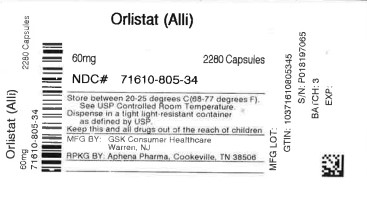
ALLI orlistat 60 mg Capsule, 2,280-count
🆔 Identity & classification
Where does this data come from?
🏷️ RxNorm drug class
This medicine belongs to the Intestinal Lipase Inhibitor class.
Where does this data come from?
🏭 Manufacturer & labeler
Where does this data come from?
🩺 Clinical
Orlistat (prescription and nonprescription) is used with an individualized low-calorie, low-fat diet and exercise program to help people lose weight. Prescription orlistat is used in overweight people who may also have high blood pressure, diabetes, high cholesterol, or heart disease. Orlistat is also used after weight-loss to help people keep from gaining back that weight. Orlistat is in a class of medications called lipase inhibitors. It works by preventing some of the fat in foods eaten from being absorbed in the intestines. This unabsorbed fat is then removed from the body in the stool.
Read the full MedlinePlus article ↗- Orlistat works by blocking some of the fat-digesting enzymes in your stomach and intestines. About 30% of the fat you eat at each meal doesn't get absorbed — it just passes out of...
- What exactly does orlistat do — and will it really help me lose weight?
- The oily stools, gas with discharge, and urgent or hard-to-control bowel movements happen because undigested fat has to go somewhere — and it exits in your stool. The more fat you...
- Why does orlistat cause those embarrassing bathroom side effects, and how do I prevent them?
Patient education
Supplement & herbal interactions
Some supplements/herbs that may interact with Orlistat — tap one for details:
Orlistat may be associated with lower levels of 5 nutrients — worth a chat with your pharmacist, not a cause for alarm.
Where does this data come from?
Ask a licensed pharmacist directly — free, answered by our team.
💊 What it looks like
Where does this data come from?
🧪 Inactive Ingredients / Excipients
Inactive ingredients, also called excipients, are components of the drug product other than the active ingredient. They may include fillers, dyes, coatings, preservatives, flavors, or other formulation ingredients.
💡 Tap an ingredient (hover on desktop) to see what it is and why it’s used.
-
UNII L06K8R7DQK
A synthetic blue dye approved by the FDA for use in medications and foods. It serves as a colorant to make pills and liquids visually distinct and easier to identify.
-
UNII G7036X8B5H
A dark iron compound that gives medicine its color. Used as a colorant in tablets and capsules to help identify the medication and make it visually distinctive.
-
UNII 2G86QN327L
Gelatin is a protein derived from animal collagen, commonly used in medicines as a gelling agent and capsule material. It helps create soft or hard capsule shells that hold and release medication, and can also thicken liquid formulations.
-
UNII OP1R32D61U
Microcrystalline cellulose is a purified form of cellulose, a natural fiber from plant sources. It acts as a binder and filler in tablets and capsules, helping hold ingredients together and give the medicine its shape and size.
-
UNII FZ989GH94E
Povidone is a synthetic polymer made from a plastic-like material. It acts as a binder to hold tablet ingredients together and as a disintegrant to help the tablet break apart in your stomach so the medicine can be absorbed.
-
UNII 368GB5141J
A detergent and foaming agent derived from coconut or palm oil. In medications, it helps break down and mix oil and water-based ingredients, aids in tablet disintegration, and improves how the drug dissolves and spreads in the mouth or digestive system.
-
UNII H8AV0SQX4D
A modified starch derived from potato or corn starch. It absorbs water quickly and helps tablets or capsules break apart and dissolve in the stomach, acting as a disintegrant to ensure the medicine releases its active ingredients properly.
-
UNII 7SEV7J4R1U
A powder made from a naturally occurring mineral. In medicines, talc works as a glidant and anti-caking agent, helping tablets and capsules flow smoothly during manufacturing and preventing clumping.
-
UNII 15FIX9V2JP
Titanium dioxide is a bright white mineral powder commonly used as a colorant and opacifying agent. It makes pills and tablets white or lighter in color and helps make coatings non-transparent.
9 inactive ingredients listed in the exact product block matched to this NDC.
Label-section wording can be broader than the structured product block and may mention additional formulation ingredients.
Where does this data come from?
ingredient classCode="IACT" elements from the exact product block matched by this NDC. Label-section narrative from DailyMed / the openFDA label index is shown separately when available.Inactive ingredient FAQ
Are inactive ingredients the same for every manufacturer?
Why might an inactive ingredient be missing?
Can inactive ingredients matter?
💲 Pricing
A drug doesn't have one price. Each row is a different public payment system, and none is what you'd pay at the counter — that depends on your insurance. The ⓘ on each row explains what it measures.
| Price system | Per each | Per package |
|---|---|---|
| Retail pharmacies payNADAC · weekly | Not in the retail survey — common for institutional, discontinued, or low-volume packs. | |
| Medicaid paysCMS SDUD · 12 mo | No recent Medicaid claims on file for this NDC — rare and low-volume NDCs are suppressed in the public data. | |
| Medicare drug plans payPart D · quarterly | No Part D plan price is available for this NDC in our data. | |
Where does this data come from?
🔁 Therapeutic equivalents
| Product | Labeler | Pack | NADAC/unit | TE | Status | Price vs. this |
|---|---|---|---|---|---|---|
| Alli 60 mg 00135-0461-01 | Haleon | 60 capsules | — | — | FDA listed | — |
| Alli 60 mgthis 71610-0805-34 | Aphena | 2280 capsules | — | — | FDA listed | — |
Where does this data come from?
⏳ Availability & generic status
We did not find an FDA-approved generic match for this exact strength, form and route.
Where does this data come from?
📊 Medicare Part D spend CMS · PART D · 2026 (Q1)
🔬 Reported adverse events (FAERS)
Top reported reactions
Age at onset
Reporter sex
Serious outcomes
Where does this data come from?
📦 Packaging — all sizes for this product
| Package NDC | Description | Marketing start | Status |
|---|---|---|---|
| 71610-0805-34 You're viewing this | 2280 CAPSULE in 1 BOTTLE (71610-805-34) | 2024-03-22 | Active |
🧭 About this NDC listing & data coverage
What data is (and isn’t) available for this NDC — tap to expand
| NDC identity (package / product / labeler codes) | ✓ Available |
| Labeler | ✓ Available |
| Product & package description | ✓ Available |
| Marketing category & status | ✓ Available |
| Active ingredient / dosage form / route | ✓ Available |
| FDA label (SPL via DailyMed) | ✓ Available |
| Package photos | ✓ Available |
| Inactive ingredients (structured) | ✓ Available |
| NADAC pharmacy acquisition price (CMS) | — Not published for this NDC CMS publishes NADAC only for NDCs reported in its retail-pharmacy survey. |
| Orange Book / therapeutic-equivalence data | — Not published for this NDC Applies only to products approved under an NDA/ANDA; many listings are out of scope. |
| HCPCS J-code billing crosswalk | — Not published for this NDC Most self-administered / retail products have no J-code — that is normal. |
| Medicaid utilization (CMS SDUD) | — Not published for this NDC CMS reports utilization only for NDCs with Medicaid claims above its privacy threshold. |
Questions about this listing
Why is there no price listed?
Is the NDC printed on the package the same as the 11-digit billing NDC?
What do the three segments of this NDC mean?
Is this package still being marketed?
Who lists this product with the FDA?
Do I need a prescription for this product?
Where does this data come from?
📄 FDA label — Drug Facts FDA SPL
🎯 Indications and Usage ▾
Use for weight loss in overweight adults, 18 years and older, when used along with a reduced-calorie and low-fat diet
⏱️ Dosage and Administration ▾
Directions read the enclosed brochure for other important information diet and exercise are the starting points for any weight loss program. Try these first before adding orlistat. Check with your doctor before starting any exercise program. to see if orlistat capsules are right for you, find your height on the chart to the right.
You may consider starting a weight loss program with orlistat if your weight is the same or more than the weight shown for your height. for overweight adults 18 years and older: take 1 capsule with each meal containing fat do not take more than 3 capsules daily use with a reduced-calorie, low-fat diet and exercise program until you reach your weight loss goal. Most weight loss occurs in the first 6 months. if you stop taking orlistat, continue with your diet and exercise program if you start to regain weight after you stop taking orlistat, you may need to start taking orlistat again along with your diet and exercise program take a multivitamin once a day, at bedtime, when using orlistat Ht. / Wt.
4’10” 129 lbs. 4’11” 133 lbs. 5’0” 138 lbs.
5’1” 143 lbs. 5’2” 147 lbs. 5’3” 152 lbs.
5’4” 157 lbs. 5’5” 162 lbs. 5’6” 167 lbs.
5’7” 172 lbs. 5’8” 177 lbs. 5’9” 182 lbs.
5’10” 188 lbs. 5’11” 193 lbs. 6’0” 199 lbs.
6’1” 204 lbs. 6’2” 210 lbs. 6’3” 216 lbs.
6’4” 221 lbs. 6’5” 227 lbs.
⚠️ Warnings ▾
Warnings Organ transplant alert: do not use if you have had an organ transplant. Orlistat interferes with the medicines used to prevent transplant rejection. Allergy alert: do not use if you are allergic to any of the ingredients in orlistat capsules Do not use if you are taking cyclosporine if you have been diagnosed with problems absorbing food if you are not overweight Ask a doctor before use if you have ever had gallbladder problems kidney stones pancreatitis Ask a doctor or pharmacist before use if you are taking any of the following prescription medications.
Some prescription doses may need to be adjusted, or some medications may not work as well when used with orlistat. anticoagulants (blood thinning medicine) amiodarone (heart medicine) diabetes medicine thyroid disease medicine seizure medicine antiretrovirals (HIV medicine) taking any other weight loss products When using this product take a multivitamin once a day, at bedtime . Orlistat can reduce the absorption of some vitamins. follow a well-balanced, reduced-calorie, low-fat diet. Try starting this diet before taking orlistat. orlistat works by preventing the absorption of some of the fat you eat.
The fat passes out of your body, so you may have bowel changes. You may get: gas with oily spotting loose stools more frequent stools that may be hard to control eating a low-fat diet lowers the chance of having these bowel changes for every 5 pounds you lose from diet alone, orlistat can help you lose 2-3 pounds more. In studies, most people lost 5-10 pounds over 6 months.
Stop use and ask a doctor if you develop itching, yellow eyes or skin, dark urine or loss of appetite. There have been rare reports of liver injury in people taking orlistat. severe or continuous abdominal pain occurs. This may be a sign of a serious medical condition. you are taking medicine for seizures and your seizures happen more often or get worse If pregnant or breast-feeding, do not use.
Keep out of reach of children. In case of overdose, get medical help or contact a Poison Control Center right away.
📦 Storage and Handling ▾
Other information store at 20 - 25 o C (68 - 77 o F) protect drug from excessive light, humidity and temperatures over 30 o C (86 o F)
🧪 Active Ingredient ▾
Active ingredient (in each sealed capsule) Orlistat 60 mg
🧪 Inactive Ingredients ▾
Inactive ingredients FD&C Blue No. 2, edible ink, gelatin, iron oxide, microcrystalline cellulose, povidone, sodium lauryl sulfate, sodium starch glycolate, talc, titanium dioxide
🎯 Purpose ▾
Purpose Weight loss aid