
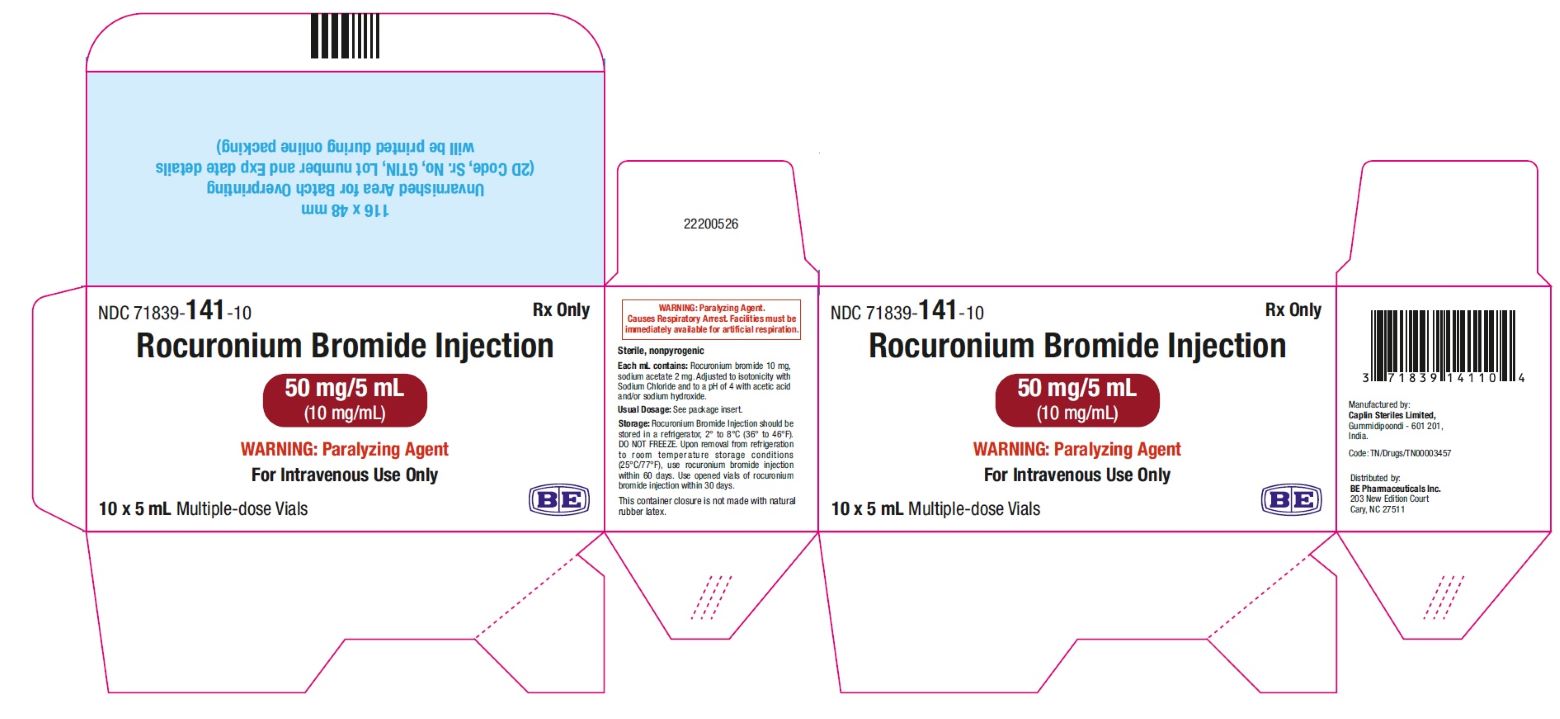
Rocuronium Bromide 10 mg/mL Injection, Solution — NDC 71839-141-10 (Billing 71839-0141-10)
This is a package of Rocuronium Bromide 10 mg/mL Injection, Solution from BE Pharmaceuticals Inc., marketed since Jul 2023 and currently FDA-listed; retail pharmacies pay about $0.3942 per mL (NADAC). It is this product's only package size.
NDC database record
One package, one record: these facts belong to NDC 71839-141-10 alone.
- Record
- FDA NDC Directory package listing · Human prescription drug
- Code segments
- 71839 labeler · 141 product · 10 package
- Package marketed since
- Jul 12, 2023
- Sample package
- No — commercial package
- Listing certified through
- Dec 31, 2026
- Barcode (UPC)
- 0371839142019, 0371839141012
- Medicaid fills, this package
- 16 prescriptions in the last four reported quarters
- FDA record last changed
- Jul 24, 2026
Identity & classification
Regulatory identifiers FDA, NLM and CMS codes for this package
Drug-database identifiers Medi-Span GPI and First Databank GCN / HICL / AHFS classification
- GSN (GCN sequence number): 021727
- GCN: 37201
- HICL (First Databank): 008963
- AHFS class code: 12:20.20.00
- RxCUI (RxNorm): 1234995
Where does this data come from?
- FDA openFDA NDC Directory · synced Oct 8, 2026
- FDA label on DailyMed · label index refreshed Oct 6, 2026
- RxNorm (NLM RxNav) · catalog refreshed Oct 1, 2026
- Medi-Span GPI (licensed)
- First Databank (licensed) · refreshed Oct 8, 2026
RxNorm drug class
This medicine belongs to the Nondepolarizing Neuromuscular Blocker class.
Where does this data come from?
- RxClass (NLM) · catalog refreshed Oct 1, 2026
Clinical
- It relaxes your muscles during general anesthesia. That helps the team place a breathing tube and keeps you still during surgery or while you are on a ventilator. You will also be...
- Only through an IV by trained anesthesia staff in a hospital or surgical setting. You won't take it yourself. They adjust the dose for you and use a nerve stimulator to track how i...
- Most people notice little. Temporary changes in blood pressure are the most common effect. Less often, people have a fast heartbeat, nausea, vomiting, rash, itching or hiccups. You...
- Tell them about any past allergic reaction to a muscle relaxant. Also mention myasthenia gravis, liver disease, heart or lung blood vessel problems, and any medicines you take, suc...
Patient education
Supplement & herbal interactions
Where does this data come from?
- MedlinePlus (NLM) · refreshed Oct 1, 2026
- FDA label on DailyMed · label index refreshed Oct 6, 2026
Ask a licensed pharmacist directly — free, answered by our team.
Pricing
A drug doesn't have one price. Each row is a different public payment system, and none is what you'd pay at the counter — that depends on your insurance. The ⓘ on each row explains what it measures.
| Price system | Per mL | Per package |
|---|---|---|
| Retail pharmacies payNADAC · weekly | $0.394 | $19.71 / 50 ml |
| Medicaid paysCMS SDUD · 12 mo | No recent Medicaid claims on file for this NDC — rare and low-volume NDCs are suppressed in the public data. | |
| Medicare drug plans payPart D · quarterly | No Part D plan price is available for this NDC in our data. | |
Where does this data come from?
- CMS NADAC weekly file · file of May 13, 2026
- CMS ASP pricing files · refreshed Sep 20, 2026
- CMS Medicaid State Drug Utilization Data · through Q1 2026
- CMS Part D plan pricing files · refreshed Sep 24, 2026
- VA National Acquisition Center price file
Packaging — all sizes for this product
| Package NDC | Description | Marketing start | Marketing end | Status |
|---|---|---|---|---|
| 71839-0141-10 You're viewing this Main listing | 10 VIAL, MULTI-DOSE in 1 CARTON / 5 mL in 1 VIAL, MULTI-DOSE | 2023-07-12 | — | Active |
Therapeutic equivalents
| Product | Labeler | Pack | NADAC/unit | TE | Status | Price vs. this |
|---|---|---|---|---|---|---|
| Rocuronium Bromide 10 mg/mL 00143-9250-10 | Hikma | 10 vials | $0.394 | AP | Availability likely | — |
| rocuronium bromide 10 mg/mL 00409-1403-10 | Hospira, | 10 vials | $0.394 | AP | Availability likely | — |
| rocuronium bromide 10 mg/mL 00409-3189-10 | Hospira, | 10 vials | $0.394 | AP | Availability likely | — |
| Rocuronium Bromide 10 mg/mL 00409-9558-49 | Hospira, | 10 vials | $0.394 | AP | Availability likely | — |
| Rocuronium Bromide 10 mg/mL 25021-0687-05 | Sagent | 10 vials | $0.394 | AP | Availability likely | — |
| rocuronium bromide 10 mg/mL 39822-4200-02 | XGen | 10 vials | $0.394 | AP | Availability likely | — |
| Rocuronium Bromide 50 mg/5mL 43066-0007-10 | Baxter | 10 vials | $0.394 | AP | Availability likely | — |
| Rocuronium Bromide 50 mg/5mL 43547-0530-10 | Solco | 10 vials | $0.394 | AP | Availability likely | — |
| Rocuronium Bromide 50 mg/5mL 55150-0225-05 | Eugia | 10 vials | $0.394 | AP | Availability likely | — |
| Rocuronium 10 mg/mL 63323-0426-05 | Fresenius | 10 vials | $0.394 | AP | Availability likely | — |
| Rocuronium Bromide 10 mg/mL 65145-0130-10 | Caplin | 10 vials | $0.394 | AP | Availability likely | — |
| Rocuronium 10 mg/mL 65219-0065-05 | Fresenius | 10 vials | $0.394 | AP | Availability likely | — |
| Rocuronium 50 mg/5mL 66794-0228-41 | Piramal | 10 vials | $0.394 | AP | Availability likely | — |
| Rocuronium Bromide 10 mg/mL 67457-0228-05 | Mylan | 10 vials | $0.394 | AP | Availability likely | — |
| Rocuronium Bromide 50 mg/5mL 70756-0669-10 | Lifestar | 10 vials | $0.394 | AP | Availability likely | — |
| Rocuronium Bromide 10 mg/mL 71288-0700-06 | Meitheal | 10 vials | $0.394 | AP | Availability likely | — |
| Rocuronium Bromide 10 mg/mLthis 71839-0141-10 | BE | 10 vials | $0.394 | AP | Availability likely | — |
| Rocuronium Bromide 10 mg/mL 72572-0650-10 | Civica, | 10 vials | $0.394 | AP | Availability likely | — |
| Rocuronium 10 mg/mL 81565-0204-02 | Phlow | 10 vials | $0.394 | AP | Availability likely | — |
| Rocuronium 10 mg/mL 65219-0442-05 | Fresenius | 10 vials | $0.394 | — | Availability likely | — |
| Rocuronium 10 mg/mL 65219-0695-05 | Fresenius | 10 vials | $0.394 | — | Availability likely | — |
| Rocuronium Bromide 10 mg/mL 00143-9251-10 | Hikma | 10 vials | — | AP | FDA listed | — |
| rocuronium bromide 10 mg/mL 00409-5160-10 | Hospira, | 10 vials | — | AP | FDA listed | — |
| rocuronium bromide 10 mg/mL 00409-7037-10 | Hospira, | 10 vials | — | AP | FDA listed | — |
| Rocuronium Bromide 10 mg/mL 00781-3220-92 | Sandoz | 10 vials | — | AP | FDA listed | — |
| Rocuronium Bromide 50 mg/5mL 42677-0309-10 | Shandong | 10 vials | — | AP | FDA listed | — |
| Rocuronium Bromide 100 mg/10mL 42677-0310-10 | Shandong | 10 vials | — | AP | FDA listed | — |
| Rocuronium Bromide 100 mg/10mL 43066-0013-10 | Baxter | 10 vials | — | AP | FDA listed | — |
| Rocuronium Bromide 100 mg/10mL 43547-0531-10 | Solco | 10 vials | — | AP | FDA listed | — |
| Rocuronium Bromide 10 mg/mL 51662-1354-01 | HF | 5 ml | — | AP | FDA listed | — |
| Rocuronium Bromide 10 mg/mL 51662-1355-01 | HF | 10 ml | — | AP | FDA listed | — |
| Rocuronium Bromide 100 mg/10mL 51662-1545-01 | HF | 10 ml | — | AP | FDA listed | — |
| Rocuronium Bromide 50 mg/5mL 51662-1546-01 | HF | 5 ml | — | AP | FDA listed | — |
| Rocuronium Bromide 10 mg/mL 51662-1640-01 | HF | 5 ml | — | AP | FDA listed | — |
| Rocuronium Bromide 100 mg/10mL 55150-0226-10 | Eugia | 10 vials | — | AP | FDA listed | — |
| Rocuronium Bromide 10 mg/mL 65145-0131-10 | Caplin | 10 vials | — | AP | FDA listed | — |
| Rocuronium 100 mg/10mL 66794-0229-41 | Piramal | 10 vials | — | AP | FDA listed | — |
| Rocuronium Bromide 10 mg/mL 68083-0364-10 | Gland | 10 vials | — | AP | FDA listed | — |
| Rocuronium Bromide 10 mg/mL 68083-0365-10 | Gland | 10 vials | — | AP | FDA listed | — |
| Rocuronium Bromide 100 mg/10mL 70756-0670-10 | Lifestar | 10 vials | — | AP | FDA listed | — |
| Rocuronium Bromide 10 mg/mL 71288-0718-11 | Meitheal | 10 vials | — | AP | FDA listed | — |
| Rocuronium Bromide 10 mg/mL 71839-0142-10 | BE | 10 vials | — | AP | FDA listed | — |
| rocuronium bromide 10 mg/mL 71872-7036-01 | Medical | 1 vial | — | AP | FDA listed | — |
| Rocuronium Bromide 10 mg/mL 71872-7207-01 | Medical | 1 vial | — | AP | FDA listed | — |
| Rocuronium Bromide 50 mg/5mL 71872-7262-01 | Medical | 1 vial | — | AP | FDA listed | — |
| rocuronium bromide 10 mg/mL 71872-7309-01 | Medical | 1 vial | — | AP | FDA listed | — |
| Rocuronium Bromide 10 mg/mL 71872-7317-01 | Medical | 1 vial | — | AP | FDA listed | — |
| Rocuronium Bromide 10 mg/mL 71872-7344-01 | Medical | 1 vial | — | AP | FDA listed | — |
| Rocuronium 100 mg/10mL 71872-7349-01 | Medical | 1 vial | — | AP | FDA listed | — |
| Rocuronium Bromide 10 mg/mL 71872-7372-01 | Medical | 1 vial | — | AP | FDA listed | — |
| Rocuronium 50 mg/5mL 72162-2263-02 | Bryant | 10 vials | — | AP | FDA listed | — |
| Rocuronium Bromide 10 mg/mL 72572-0651-10 | Civica, | 10 vials | — | AP | FDA listed | — |
| Rocuronium Bromide 50 mg/5mL 82449-0001-02 | STERISCIENCE | 10 vials | — | AP | FDA listed | — |
| Rocuronium Bromide 10 mg/mL 84549-0131-10 | ProPharma | 10 ml | — | AP | FDA listed | — |
| Rocuronium Bromide 10 mg/mL 84549-0141-10 | ProPharma | 5 ml | — | AP | FDA listed | — |
| Rocuronium 10 mg/mL 65219-0697-10 | Fresenius | 10 vials | — | — | FDA listed | — |
| Rocuronium Bromide 10 mg/mL 51662-1641-01 | HF | 10 ml | — | AP | FDA listed | — |
| Rocuronium 10 mg/mL 65219-0444-10 | Fresenius | 10 vials | — | — | FDA listed | — |
| Rocuronium Bromide 10 mg/mL 84549-0687-05 | ProPharma | 5 ml | — | AP | FDA listed | — |
| Rocuronium 10 mg/mL 76045-0221-50 | Fresenius | 10 syringes | — | — | FDA listed | — |
| Rocuronium Bromide 10 mg/mL 51662-1710-01 | HF | 10 ml | — | AP | FDA listed | — |
| Rocuronium Bromide 10 mg/mL 51662-1711-01 | HF | 5 ml | — | AP | FDA listed | — |
| Rocuronium 10 mg/mL 76045-0220-50 | Fresenius | 10 syringes | — | — | FDA listed | — |
Where does this data come from?
- FDA openFDA NDC Directory · synced Oct 8, 2026
- FDA Orange Book · refreshed Oct 3, 2026
- CMS NADAC weekly file · file of May 13, 2026
Availability & generic status
This product is an FDA-approved generic. Other versions of the same drug are listed under Therapeutic equivalents, least expensive first.
Where does this data come from?
- FDA Orange Book · refreshed Oct 3, 2026
Inactive Ingredients / Excipients
Inactive ingredients, also called excipients, are components of the drug product other than the active ingredient. They may include fillers, dyes, coatings, preservatives, flavors, or other formulation ingredients.
🧪 Avoiding an ingredient? See Rocuronium inactive ingredients by manufacturer: every current product's list side by side, so you can ask your pharmacy for the version that does not list it.
💡 Tap an ingredient (hover on desktop) to see what it is and why it’s used.
-
UNII Q40Q9N063P
Acetic acid is a weak organic acid commonly used in medicines as a buffer and pH adjuster. It helps maintain the proper acidity level to ensure the drug remains stable and effective in its formulation.
-
UNII 4550K0SC9B
Sodium acetate is a salt derived from acetic acid. It acts as a buffer to help maintain the medicine's pH stability and may serve as a preservative or solubilizer in liquid formulations.
-
UNII 451W47IQ8X
Sodium chloride is common table salt. It's used in medicines as a buffer to maintain proper pH, as a filler to add bulk, or to adjust the osmotic balance in liquid formulations.
-
UNII 55X04QC32I
A strong alkaline chemical used to adjust and maintain the pH balance of liquid medicines. It helps keep the medicine stable and ensures it stays effective during storage.
4 inactive ingredients listed in the exact product block matched to this NDC.
Where does this data come from?
ingredient classCode="IACT" elements from the exact product block matched by this NDC. Label-section narrative from DailyMed / the openFDA label index is shown separately when available.- FDA label on DailyMed · label index refreshed Oct 6, 2026
- FDA openFDA NDC Directory · synced Oct 8, 2026
Inactive ingredient FAQ
Are inactive ingredients the same for every manufacturer?
Why might an inactive ingredient be missing?
Can inactive ingredients matter?
Manufacturer & labeler
More NDCs from BE Pharmaceuticals Inc. labeler code 71839
- glycopyrrolate 1 mg/5mL Injection NDC 71839-125-25
- glycopyrrolate 4 mg/20mL Injection NDC 71839-126-25
- Phenylephrine Hydrochloride 10 mg/mL Injection NDC 71839-127-25
- Phenylephrine Hydrochloride 10 mg/mL Injection NDC 71839-128-10
- Phenylephrine Hydrochloride 10 mg/mL Injection NDC 71839-129-10
- CARBOPROST TROMETHAMINE 250 ug/mL Injection, Solution NDC 71839-137-10
- Rocuronium Bromide 10 mg/mL Injection, Solution NDC 71839-142-10
- Norepinephrine Bitartrate 1 mg/mL Injection NDC 71839-143-10
- Dalbavancin 500 mg/25mL Injection, Powder, Lyophilized, For Solution NDC 71839-144-01
Where does this data come from?
- FDA openFDA NDC Directory · synced Oct 8, 2026
- Drugs@FDA
Full prescribing information FDA SPL
🎯 Indications and Usage ▾
1 INDICATIONS AND USAGE Rocuronium bromide injection is indicated for inpatients and outpatients as an adjunct to general anesthesia to facilitate both rapid sequence and routine tracheal intubation, and to provide skeletal muscle relaxation during surgery or mechanical ventilation. Rocuronium bromide injection is a nondepolarizing neuromuscular blocking agent indicated as an adjunct to general anesthesia to facilitate both rapid sequence and routine tracheal intubation, and to provide skeletal muscle relaxation during surgery or mechanical ventilation ( 1 ).
⏱️ Dosage and Administration ▾
2 DOSAGE AND ADMINISTRATION To be administered only by experienced clinicians or adequately trained individuals supervised by an experienced clinician familiar with the use, actions, characteristics, and complications of neuromuscular blocking agents ( 2.1 ) Individualize the dose for each patient ( 2.1 ) Peripheral nerve stimulator recommended for determination of drug response and need for additional doses, and to evaluate recovery ( 2.1 ) Store rocuronium bromide injection with cap and ferrule intact and in a manner that minimizes the possibility of selecting the wrong product ( 2.1 ) Tracheal intubation : Recommended initial dose is 0.6 mg/kg ( 2.2 ) Rapid sequence intubation : 0.6 to 1.2 mg/kg ( 2.3 ) Maintenance doses : Guided by response to prior dose, not administered until recovery is evident ( 2.4 ) Continuous infusion : Initial rate of 10 to 12 mcg/kg/min.
Start only after early evidence of spontaneous recovery from an intubating dose ( 2.5 )
2.1Important Dosing and Administration Information Rocuronium bromide injection is for intravenous use only. This drug should only be administered by experienced clinicians or trained individuals supervised by an experienced clinician familiar with the use, actions, characteristics and complications of neuromuscular blocking agents. Doses of rocuronium bromide injection should be individualized and a peripheral nerve stimulator should be used to monitor drug effect, need for additional doses, adequacy of spontaneous recovery or antagonism, and to decrease the complications of overdosage if additional doses are administered.
The dosage information which follows is derived from studies based upon units of drug per unit of body weight. It is intended to serve as an initial guide to clinicians familiar with other neuromuscular blocking agents to acquire experience with rocuronium bromide. In patients in whom potentiation of, or resistance to, neuromuscular block is anticipated, a dose adjustment should be considered [see Dosage and Administration (2.6) , Warnings and Precautions (5.10 , 5.13) , Drug Interactions (7.2 , 7.3 , 7.4 , 7.5 , 7.6 , 7.8 , 7.10) , and Use in Specific Populations (8.6) ].
Risk of Medication Errors Accidental administration of neuromuscular blocking agents may be fatal. Store rocuronium bromide injection with the cap and ferrule intact and in a manner that minimizes the possibility of selecting the wrong product [see Warnings and Precautions (5.3) ].
2.2Dose for Tracheal Intubation The recommended initial dose of rocuronium bromide, regardless of anesthetic technique, is 0.6 mg/kg. Neuromuscular block sufficient for intubation (80% block or greater) is attained in a median (range) time of 1 (0.4 to 6) minute(s) and most patients have intubation completed within 2 minutes. Maximum blockade is achieved in most patients in less than 3 minutes.
This dose may be expected to provide 31 (15 to 85) minutes of clinical relaxation under opioid/nitrous oxide/oxygen anesthesia. Under halothane, isoflurane, and enflurane anesthesia, some extension of the period of clinical relaxation should be expected [see Drug Interactions (7.3) ]. A lower dose of rocuronium bromide (0.45 mg/kg) may be used.
Neuromuscular block sufficient for intubation (80% block or greater) is attained in a median (range) time of 1.3 (0.8 to 6.2) minute(s) and most patients have intubation completed within 2 minutes. Maximum blockade is achieved in most patients in less than 4 minutes. This dose may be expected to provide 22 (12 to 31) minutes of clinical relaxation under opioid/nitrous oxide/oxygen anesthesia.
Patients receiving this low dose of 0.45 mg/kg who achieve less than 90% block (about 16% of these patients) may have a more rapid time to 25% recovery, 12 to 15 minutes. A large bolus dose of 0.9 or 1.2 mg/kg can be administered under opioid/nitrous oxide/oxygen anesthesia without adverse effects to the cardiovascular system [see Clinical Pharmacology (12.2) ].
2.3Rapid Sequence Intubation… [Excerpted — this section continues on DailyMed.]
💊 Dosage Forms and Strengths ▾
3 DOSAGE FORMS AND STRENGTHS Rocuronium bromide injection is available as: 5 mL multiple-dose vials containing 50 mg rocuronium bromide injection (10 mg/mL) 10 mL multiple-dose vials containing 100 mg rocuronium bromide injection (10 mg/mL) 5 mL multiple-dose vials containing 50 mg rocuronium bromide injection (10 mg/mL) ( 3 ) 10 mL multiple-dose vials containing 100 mg rocuronium bromide injection (10 mg/mL) ( 3 )
⛔ Contraindications ▾
4 CONTRAINDICATIONS Rocuronium bromide is contraindicated in patients known to have hypersensitivity (e.g., anaphylaxis) to rocuronium bromide or other neuromuscular blocking agents [see Warnings and Precautions (5.2) ]. Hypersensitivity (e.g., anaphylaxis) to rocuronium bromide or other neuromuscular blocking agents ( 4 )
⚠️ Warnings and Cautions ▾
5 WARNINGS AND PRECAUTIONS Appropriate Administration and Monitoring : Use only if facilitates for intubation, mechanical ventilation, oxygen therapy, and an antagonist are immediately available ( 5.1 ) Anaphylaxis : Severe anaphylaxis has been reported. Consider cross–reactivity among neuromuscular blocking agents ( 5.2 ) Risk of Death due to Medication Errors : Accidental administration can cause death ( 5.3 ) Need for Adequate Anesthesia : Must be accompanied by adequate anesthesia or sedation ( 5.4 ) Residual Paralysis : Consider using a reversal agent in cases where residual paralysis is more likely to occur ( 5.5 )
5.1Appropriate Administration and Monitoring Rocuronium bromide should be administered in carefully adjusted dosages by or under the supervision of experienced clinicians who are familiar with the drug’s actions and the possible complications of its use. The drug should not be administered unless facilities for intubation, mechanical ventilation, oxygen therapy, and an antagonist are immediately available. It is recommended that clinicians administering neuromuscular blocking agents such as rocuronium bromide employ a peripheral nerve stimulator to monitor drug effect, need for additional doses, adequacy of spontaneous recovery or antagonism, and to decrease the complications of overdosage if additional doses are administered.
5.2Anaphylaxis Severe anaphylactic reactions to neuromuscular blocking agents, including rocuronium bromide, have been reported. These reactions have, in some cases (including cases with rocuronium bromide) been life threatening and fatal. Due to the potential severity of these reactions, the necessary precautions, such as the immediate availability of appropriate emergency treatment, should be taken.
Precautions should also be taken in those patients who have had previous anaphylactic reactions to other neuromuscular blocking agents, since cross-reactivity between neuromuscular blocking agents, both depolarizing and nondepolarizing, has been reported.
5.3Risk of Death due to Medication Errors Administration of rocuronium bromide injection results in paralysis, which may lead to respiratory arrest and death, a progression that may be more likely to occur in a patient for whom it is not intended. Confirm proper selection of intended product and avoid confusion with other injectable solutions that are present in critical care and other clinical settings. If another healthcare provider is administering the product, ensure that the intended dose is clearly labeled and communicated.
5.4Need for Adequate Anesthesia Rocuronium bromide has no known effect on consciousness, pain threshold, or cerebration. Therefore, its administration must be accompanied by adequate anesthesia or sedation.
5.5Residual Paralysis In order to prevent complications resulting from residual paralysis, it is recommended to extubate only after the patient has recovered sufficiently from neuromuscular block. Geriatric patients (65 years or older) may be at increased risk for residual neuromuscular block. Other factors which could cause residual paralysis after extubation in the post-operative phase (such as drug interactions or patient condition) should also be considered.
If not used as part of standard clinical practice the use of a reversal agent should be considered, especially in those cases where residual paralysis is more likely to occur.
5.6Long-Term use in an Intensive Care Unit Rocuronium bromide has not been studied for long-term use in the intensive care unit (ICU). As with other nondepolarizing neuromuscular blocking drugs, apparent tolerance to rocuronium bromide may develop during chronic administration in the ICU. While the mechanism for development of this resistance is not known, receptor up-regulation may be a contributing factor.
It is strongly recommended that neuromuscular transmission be monitored continuously during administration and recovery with the help of a nerve stimulator. Additional d… [Excerpted — this section continues on DailyMed.]
🤒 Adverse Reactions ▾
6 ADVERSE REACTIONS In clinical trials, the most common adverse reactions (2%) are transient hypotension and hypertension. The following adverse reactions are described, or described in greater detail, in other sections: Anaphylaxis [see Warnings and Precautions (5.2) ] Residual paralysis [see Warnings and Precautions (5.5) ] Myopathy [see Warnings and Precautions (5.6) ] Increased pulmonary vascular resistance [see Warnings and Precautions (5.12) ] Most common adverse reactions (2%) are transient hypotension and hypertension ( 6 ) To report SUSPECTED ADVERSE REACTIONS, contact Caplin Steriles Limited at 1-866-978-6111 or FDA at 1-800-FDA-1088 or www.fda.gov/medwatch.
6.1Clinical Trials Experience Because clinical trials are conducted under widely varying conditions, adverse reaction rates observed in the clinical trials of a drug cannot be directly compared to rates in the clinical trials of another drug and may not reflect the rates observed in practice. Clinical studies in the U.S. (n=1137) and Europe (n=1394) totaled 2531 patients.
The patients exposed in the U.S. clinical studies provide the basis for calculation of adverse reaction rates. The following adverse reactions were reported in patients administered rocuronium bromide (all events judged by investigators during the clinical trials to have a possible causal relationship): Adverse reactions in greater than 1% of patients: None Adverse reactions in less than 1% of patients (probably related or relationship unknown): Cardiovascular: arrhythmia, abnormal electrocardiogram, tachycardia Digestive: nausea, vomiting Respiratory: asthma (bronchospasm, wheezing, or rhonchi), hiccup Skin and Appendages: rash, injection site edema, pruritus In the European studies, the most commonly reported reactions were transient hypotension (2%) and hypertension (2%); these are in greater frequency than the U.S. studies (0.1% and 0.1%).
Changes in heart rate and blood pressure were defined differently from in the U.S. studies in which changes in cardiovascular parameters were not considered as adverse events unless judged by the investigator as unexpected, clinically significant, or thought to be histamine related. In a clinical study in patients with clinically significant cardiovascular disease undergoing coronary artery bypass graft, hypertension and tachycardia were reported in some patients, but these occurrences were less frequent in patients receiving beta or calcium channel-blocking drugs.
In some patients, rocuronium bromide was associated with transient increases (30% or greater) in pulmonary vascular resistance. In another clinical study of patients undergoing abdominal aortic surgery, transient increases (30% or greater) in pulmonary vascular resistance were observed in about 24% of patients receiving rocuronium bromide 0.6 or 0.9 mg/kg. In pediatric patient studies worldwide (n=704), tachycardia occurred at an incidence of 5.3% (n=37) and it was judged by the investigator as related in 10 cases (1.4%).
6.2Post-Marketing Experience The following adverse reactions have been identified during post-approval use of rocuronium bromide. Because these reactions are reported voluntarily from a population of uncertain size, it is not always possible to reliably estimate their frequency or establish a causal relationship to drug exposure. Immune system disorders In clinical practice, there have been reports of severe allergic reactions (anaphylactic and anaphylactoid reactions and shock) with rocuronium bromide, including some that have been life-threatening and fatal [see Warnings and Precautions (5.2) ].
General disorders and administration site conditions There have been reports of malignant hyperthermia with the use of rocuronium bromide injection [see Warnings and Precautions (5.7) ].
🔄 Drug Interactions ▾
7 DRUG INTERACTIONS Succinylcholine: Use before succinylcholine has not been studied ( 7.11 ) Nondepolarizing muscle relaxants: Interactions have been observed ( 7.7 ) Enhanced rocuronium bromide activity possible: Inhalation anesthetics ( 7.3 ), certain antibiotics ( 7.1 ), quinidine ( 7.10 ), magnesium ( 7.6 ), lithium ( 7.4 ), local anesthetics ( 7.5 ), procainamide ( 7.8 ) Reduced rocuronium bromide activity possible: Anticonvulsants ( 7.2 )
7.1Antibiotics Drugs which may enhance the neuromuscular blocking action of nondepolarizing agents such as rocuronium bromide include certain antibiotics (e.g., aminoglycosides; vancomycin; tetracyclines; bacitracin; polymyxins; colistin; and sodium colistimethate). If these antibiotics are used in conjunction with rocuronium bromide, prolongation of neuromuscular block may occur.
7.2Anticonvulsants In 2 of 4 patients receiving chronic anticonvulsant therapy, apparent resistance to the effects of rocuronium bromide was observed in the form of diminished magnitude of neuromuscular block, or shortened clinical duration. As with other nondepolarizing neuromuscular blocking drugs, if rocuronium bromide is administered to patients chronically receiving anticonvulsant agents such as carbamazepine or phenytoin, shorter durations of neuromuscular block may occur and infusion rates may be higher due to the development of resistance to nondepolarizing muscle relaxants.
While the mechanism for development of this resistance is not known, receptor up-regulation may be a contributing factor [see Warnings and Precautions (5.10) ].
7.3Inhalation Anesthetics Use of inhalation anesthetics has been shown to enhance the activity of other neuromuscular blocking agents (enflurane > isoflurane > halothane). Isoflurane and enflurane may also prolong the duration of action of initial and maintenance doses of rocuronium bromide and decrease the average infusion requirement of rocuronium bromide by 40% compared to opioid/nitrous oxide/oxygen anesthesia. No definite interaction between rocuronium bromide and halothane has been demonstrated.
In one study, use of enflurane in 10 patients resulted in a 20% increase in mean clinical duration of the initial intubating dose, and a 37% increase in the duration of subsequent maintenance doses, when compared in the same study to 10 patients under opioid/nitrous oxide/oxygen anesthesia. The clinical duration of initial doses of rocuronium bromide of 0.57 to 0.85 mg/kg under enflurane or isoflurane anesthesia, as used clinically, was increased by 11% and 23%, respectively. The duration of maintenance doses was affected to a greater extent, increasing by 30% to 50% under either enflurane or isoflurane anesthesia.
Potentiation by these agents is also observed with respect to the infusion rates of rocuronium bromide required to maintain approximately 95% neuromuscular block. Under isoflurane and enflurane anesthesia, the infusion rates are decreased by approximately 40% compared to opioid/nitrous oxide/oxygen anesthesia. The median spontaneous recovery time (from 25% to 75% of control T 1 ) is not affected by halothane, but is prolonged by enflurane (15% longer) and isoflurane (62% longer).
Reversal-induced recovery of rocuronium bromide neuromuscular block is minimally affected by anesthetic technique [see Dosage and Administration (2.6) and Warnings and Precautions (5.10) ].
7.4Lithium Carbonate Lithium has been shown to increase the duration of neuromuscular block and decrease infusion requirements of neuromuscular blocking agents [see Warnings and Precautions (5.10) ].
7.5Local Anesthetics Local anesthetics have been shown to increase the duration of neuromuscular block and decrease infusion requirements of neuromuscular blocking agents [see Warnings and Precautions (5.10) ].
7.6Magnesium Magnesium salts administered for the management of toxemia of pregnancy may enhance neuromuscular blockade [see Warnings and Precautions (5.10) ].
7.7Nondepolarizing Muscle Relaxa… [Excerpted — this section continues on DailyMed.]
👥 Use in Specific Populations ▾
8 USE IN SPECIFIC POPULATIONS Labor and Delivery : Not recommended for rapid sequence induction in patients undergoing Cesarean section ( 8.2 ) Pediatric Use : Onset time and duration will vary with dose, age, and anesthetic technique. Not recommended for rapid sequence intubation in pediatric patients ( 8.4 )
8.1Pregnancy Developmental toxicology studies have been performed with rocuronium bromide in pregnant, conscious, nonventilated rabbits and rats. Inhibition of neuromuscular function was the endpoint for high-dose selection. The maximum tolerated dose served as the high dose and was administered intravenously 3 times a day to rats (0.3 mg/kg, 15% to 30% of human intubation dose of 0.6 to 1.2 mg/kg based on the body surface unit of mg/m 2 ) from Day 6 to 17 and to rabbits (0.02 mg/kg, 25% human dose) from Day 6 to 18 of pregnancy.
High-dose treatment caused acute symptoms of respiratory dysfunction due to the pharmacological activity of the drug. Teratogenicity was not observed in these animal species. The incidence of late embryonic death was increased at the high dose in rats, most likely due to oxygen deficiency.
Therefore, this finding probably has no relevance for humans because immediate mechanical ventilation of the intubated patient will effectively prevent embryo-fetal hypoxia. However, there are no adequate and well-controlled studies in pregnant women. Rocuronium bromide should be used during pregnancy only if the potential benefit justifies the potential risk to the fetus.
8.2Labor and Delivery The use of rocuronium bromide in Cesarean section has been studied in a limited number of patients [see Clinical Studies (14.1) ]. Rocuronium bromide is not recommended for rapid sequence induction in Cesarean section patients.
8.4Pediatric Use The use of rocuronium bromide has been studied in pediatric patients 3 months to 14 years of age under halothane anesthesia. Of the pediatric patients anesthetized with halothane who did not receive atropine for induction, about 80% experienced a transient increase (30% or greater) in heart rate after intubation. One of the 19 infants anesthetized with halothane and fentanyl who received atropine for induction experienced this magnitude of change [see Dosage and Administration (2.6) and Clinical Studies (14.3) ].
Rocuronium bromide was also studied in pediatric patients up to 17 years of age, including neonates, under sevoflurane (induction) and isoflurane/nitrous oxide (maintenance) anesthesia. Onset time and clinical duration varied with dose, the age of the patient, and anesthetic technique. The overall analysis of ECG data in pediatric patients indicates that the concomitant use of rocuronium bromide with general anesthetic agents can prolong the QTc interval.
The data also suggest that rocuronium bromide may increase heart rate. However, it was not possible to conclusively identify an effect of rocuronium bromide independent of that of anesthesia and other factors. Additionally, when examining plasma levels of rocuronium bromide in correlation to QTc interval prolongation, no relationship was observed [see Dosage and Administration (2.6) , Warnings and Precautions (5.9) and Clinical Studies (14.3) ].
Rocuronium bromide is not recommended for rapid sequence intubation in pediatric patients. Recommendations for use in pediatric patients are discussed in other sections [see Dosage and Administration (2.6) and Clinical Pharmacology (12.2) ].
8.5Geriatric Use Rocuronium bromide was administered to 140 geriatric patients (65 years or greater) in U.S. clinical trials and 128 geriatric patients in European clinical trials. The observed pharmacokinetic profile for geriatric patients (n=20) was similar to that for other adult surgical patients [see Clinical Pharmacology (12.3) ]. Onset time and duration of action were slightly longer for geriatric patients (n=43) in clinical trials.
Clinical experiences and recommendations for use in geriatric patients are discussed in other secti… [Excerpted — this section continues on DailyMed.]
🤰 Pregnancy ▾
8.1Pregnancy Developmental toxicology studies have been performed with rocuronium bromide in pregnant, conscious, nonventilated rabbits and rats. Inhibition of neuromuscular function was the endpoint for high-dose selection. The maximum tolerated dose served as the high dose and was administered intravenously 3 times a day to rats (0.3 mg/kg, 15% to 30% of human intubation dose of 0.6 to 1.2 mg/kg based on the body surface unit of mg/m 2 ) from Day 6 to 17 and to rabbits (0.02 mg/kg, 25% human dose) from Day 6 to 18 of pregnancy.
High-dose treatment caused acute symptoms of respiratory dysfunction due to the pharmacological activity of the drug. Teratogenicity was not observed in these animal species. The incidence of late embryonic death was increased at the high dose in rats, most likely due to oxygen deficiency.
Therefore, this finding probably has no relevance for humans because immediate mechanical ventilation of the intubated patient will effectively prevent embryo-fetal hypoxia. However, there are no adequate and well-controlled studies in pregnant women. Rocuronium bromide should be used during pregnancy only if the potential benefit justifies the potential risk to the fetus.
🧒 Pediatric Use ▾
8.4Pediatric Use The use of rocuronium bromide has been studied in pediatric patients 3 months to 14 years of age under halothane anesthesia. Of the pediatric patients anesthetized with halothane who did not receive atropine for induction, about 80% experienced a transient increase (30% or greater) in heart rate after intubation. One of the 19 infants anesthetized with halothane and fentanyl who received atropine for induction experienced this magnitude of change [see Dosage and Administration (2.6) and Clinical Studies (14.3) ].
Rocuronium bromide was also studied in pediatric patients up to 17 years of age, including neonates, under sevoflurane (induction) and isoflurane/nitrous oxide (maintenance) anesthesia. Onset time and clinical duration varied with dose, the age of the patient, and anesthetic technique. The overall analysis of ECG data in pediatric patients indicates that the concomitant use of rocuronium bromide with general anesthetic agents can prolong the QTc interval.
The data also suggest that rocuronium bromide may increase heart rate. However, it was not possible to conclusively identify an effect of rocuronium bromide independent of that of anesthesia and other factors. Additionally, when examining plasma levels of rocuronium bromide in correlation to QTc interval prolongation, no relationship was observed [see Dosage and Administration (2.6) , Warnings and Precautions (5.9) and Clinical Studies (14.3) ].
Rocuronium bromide is not recommended for rapid sequence intubation in pediatric patients. Recommendations for use in pediatric patients are discussed in other sections [see Dosage and Administration (2.6) and Clinical Pharmacology (12.2) ].
🧓 Geriatric Use ▾
8.5Geriatric Use Rocuronium bromide was administered to 140 geriatric patients (65 years or greater) in U.S. clinical trials and 128 geriatric patients in European clinical trials. The observed pharmacokinetic profile for geriatric patients (n=20) was similar to that for other adult surgical patients [see Clinical Pharmacology (12.3) ]. Onset time and duration of action were slightly longer for geriatric patients (n=43) in clinical trials.
Clinical experiences and recommendations for use in geriatric patients are discussed in other sections [see Dosage and Administration (2.6) , Warnings and Precautions (5.5) , Clinical Pharmacology (12.2) , and Clinical Studies (14.2) ].
🆘 Overdosage ▾
10 OVERDOSAGE Overdosage with neuromuscular blocking agents may result in neuromuscular block beyond the time needed for surgery and anesthesia. The primary treatment is maintenance of a patent airway, controlled ventilation, and adequate sedation until recovery of normal neuromuscular function is assured. Once evidence of recovery from neuromuscular block is observed, further recovery may be facilitated by administration of an anticholinesterase agent in conjunction with an appropriate anticholinergic agent.
Reversal of Neuromuscular Blockade: Anticholinesterase agents should not be administered prior to the demonstration of some spontaneous recovery from neuromuscular blockade. The use of a nerve stimulator to document recovery is recommended. Patients should be evaluated for adequate clinical evidence of neuromuscular recovery, e.g., 5-second head lift, adequate phonation, ventilation, and upper airway patency.
Ventilation must be supported while patients exhibit any signs of muscle weakness. Recovery may be delayed in the presence of debilitation, carcinomatosis, and concomitant use of certain drugs which enhance neuromuscular blockade or separately cause respiratory depression. Under such circumstances the management is the same as that of prolonged neuromuscular blockade.
🧬 Clinical Pharmacology ▾
12 CLINICAL PHARMACOLOGY
12.1Mechanism of Action Rocuronium bromide is a nondepolarizing neuromuscular blocking agent with a rapid to intermediate onset depending on dose and intermediate duration. It acts by competing for cholinergic receptors at the motor end-plate. This action is antagonized by acetylcholinesterase inhibitors, such as neostigmine and edrophonium.
12.2Pharmacodynamics The ED 95 (dose required to produce 95% suppression of the first [T 1 ] mechanomyographic [MMG] response of the adductor pollicis muscle [thumb] to indirect supramaximal train-of-four stimulation of the ulnar nerve) during opioid/nitrous oxide/oxygen anesthesia is approximately 0.3 mg/kg. Patient variability around the ED 95 dose suggests that 50% of patients will exhibit T 1 depression of 91% to 97%. Table 4 presents intubating conditions in patients with intubation initiated at 60 to 70 seconds.
Table 4. Percent of Excellent or Good Intubating Conditions and Median (Range) Time to Completion of Intubation in Patients with Intubation Initiated at 60 to 70 Seconds Rocuronium Bromide Dose (mg/kg) Administered over 5 sec Percent of Patients with Excellent or Good Intubating Conditions Time to Completion of Intubation (min) Adults* 18 to 64 yrs 0.45 (n=43) 0.6 (n=51) 86% 96% 1.6 (1.0-7.0) 1.6 (1.0-3.2) Infants † 3 mo to 1 yr 0.6 (n=18) Pediatric † 1 to 12 yrs 0.6 (n=12) 100% 100% 1.0 (1.0-1.5) 1.0 (0.5-2.3) * Excludes patients undergoing Cesarean section. † Pediatric patients were under halothane anesthesia.
Excellent intubating conditions = jaw relaxed, vocal cords apart and immobile, no diaphragmatic movement. Good intubating conditions = same as excellent but with some diaphragmatic movement. Table 5 presents the time to onset and clinical duration for the initial dose of rocuronium bromide injection under opioid/nitrous oxide/oxygen anesthesia in adults and geriatric patients, and under halothane anesthesia in pediatric patients.
Table 5. Median (Range) Time to Onset and Clinical Duration Following Initial (Intubating) Dose during Opioid/Nitrous Oxide/Oxygen Anesthesia (Adults) and Halothane Anesthesia (Pediatric Patients) Rocuronium Bromide Dose (mg/kg) Administered over 5 sec Time to ≥ 80% Block (min) Time to Maximum Block (min) Clinical Duration (min) Adults 18 to 64 yrs 0.45 (n=50) 0.6 (n=142) 0.9 (n=20) 1.2 (n=18) 1.3 (0.8-6.2) 1.0 (0.4-6.0) 1.1 (0.3-3.8) 0.7 (0.4-1.7) 3.0 (1.3-8.2) 1.8 (0.6-13.0) 1.4 (0.8-6.2) 1.0 (0.6-4.7) 22 (12-31) 31 (15-85) 58 (27-111) 67 (38-160) Geriatric ≥ 65 yrs 0.6 (n=31) 0.9 (n=5) 1.2 (n=7) 2.3 (1.0-8.3) 2.0 (1.0-3.0) 1.0 (0.8-3.5) 3.7 (1.3-11.3) 2.5 (1.2-5.0) 1.3 (1.2-4.7) 46 (22-73) 62 (49-75) 94 (64-138) Infants 3 mo to 1 yr 0.6 (n=17) 0.8 (n=9) - - 0.8 (0.3-3.0) 0.7 (0.5-0.8) 41 (24-68) 40 (27-70) Pediatric 1 to 12 yrs 0.6 (n=27) 0.8 (n=18) 0.8 (0.4-2.0) - 1.0 (0.5-3.3) 0.5 (0.3-1.0) 26 (17-39) 30 (17-56) n = the number of patients who had time to maximum block recorded.
Clinical duration = time until return to 25% of control T 1 . Patients receiving doses of 0.45 mg/kg who achieved less than 90% block (16% of these patients) had about 12 to 15 minutes to 25% recovery. Table 6 presents the time to onset and clinical duration for the initial dose of rocuronium bromide injection under sevoflurane (induction) and isoflurane/nitrous oxide (maintenance) anesthesia in pediatric patients.
Table 6. Median (Range) Time to Onset and Clinical Duration Following Initial (Intubating) Dose During Sevoflurane (induction) and Isoflurane/Nitrous Oxide (maintenance) Anesthesia (Pediatric Patients) Rocuronium Bromide Dose (mg/kg) Administered over 5 sec Time to Maximum Block (min) Time to Reappearance T 3 (min) Neonates birth to <28 days 0.45 (n=5) 0.6 (n=10) 1 (n=6) 1.1 (0.6-2.2) 1.0 (0.2-2.1) 0.6 (0.3-1.8) 40.3 (32.5-62.6) 49.7 (16.6-119.0) 114.4 (92.6-136.3) Infants 28 days to ≤3 mo 0.45 (n=9) 0.6 (n=11) 1 (n=5) 0.5 (0.4-1.3) 0.4 (0.2-0.8) 0.3 (0.2-0.7) 49.1 (13.5-79.9) 59.8 (32.3-87.8) 103.3 (90.8-155.4) Toddlers >3 mo… [Excerpted — this section continues on DailyMed.]
🧬 Mechanism of Action ▾
12.1Mechanism of Action Rocuronium bromide is a nondepolarizing neuromuscular blocking agent with a rapid to intermediate onset depending on dose and intermediate duration. It acts by competing for cholinergic receptors at the motor end-plate. This action is antagonized by acetylcholinesterase inhibitors, such as neostigmine and edrophonium.
📦 How Supplied / Storage and Handling ▾
16 HOW SUPPLIED/STORAGE AND HANDLING Rocuronium bromide injection is a sterile, nonpyrogenic, isotonic solution, clear colorless to yellow or orange solution, free from visible particles and is supplied as follows: 50 mg/5 mL (10 mg/mL) NDC 71839-141-10 Multiple-dose vials of 5 mL in boxes of 10 100 mg/10 mL (10 mg/mL) NDC 71839-142-10 Multiple-dose vials of 10 mL in boxes of 10 Rocuronium bromide should be stored in a refrigerator, 2° to 8°C (36° to 46°F). DO NOT FREEZE. Upon removal from refrigeration to room temperature storage conditions (25°C/77°F), use rocuronium bromide within 60 days.
Use opened vials of rocuronium bromide within 30 days. Safety and Handling There is no specific work exposure limit for rocuronium bromide injection. In case of eye contact, flush with water for at least 10 minutes.
📋 Description ▾
11 DESCRIPTION Rocuronium bromide injection is a nondepolarizing neuromuscular blocking agent with a rapid to intermediate onset depending on dose and intermediate duration. Rocuronium bromide is chemically designated as 1-[17β-(acetyloxy)-3α-hydroxy-2β-(4-morpholinyl)-5α-androstan-16β-yl]-1-(2-propenyl) pyrrolidinium bromide. The structural formula is: The chemical formula is C 32 H 53 BrN 2 O 4 with a molecular weight of 609.70.
The partition coefficient of rocuronium bromide in n-octanol/water is 0.5 at 20°C. Rocuronium bromide is supplied as a sterile, nonpyrogenic, isotonic solution that is clear, colorless to yellow or orange, for intravenous injection only. Each mL contains 10 mg rocuronium bromide and 2 mg sodium acetate.
The aqueous solution is adjusted to isotonicity with sodium chloride and to a pH of 4 with acetic acid and/or sodium hydroxide. structure
💬 Information for Patients ▾
17 PATIENT COUNSELING INFORMATION Obtain information about your patient’s medical history, current medications, any history of hypersensitivity to rocuronium bromide or other neuromuscular blocking agents. If applicable, inform your patients that certain medical conditions and medications might influence how rocuronium bromide injection works. In addition, inform your patient that severe anaphylactic reactions to neuromuscular blocking agents, including rocuronium bromide injection, have been reported.
Since allergic cross-reactivity has been reported in this class, request information from your patients about previous anaphylactic reactions to other neuromuscular blocking agents. Manufactured by Caplin Steriles Limited, Gummidipoondi – 601 201, India. Distributed by: BE Pharmaceuticals Inc.
203 New Edition Court Cary, NC 27511 April 2023
🧬 Pharmacokinetics ▾
12.3Pharmacokinetics Adult and Geriatric Patients In an effort to maximize the information gathered in the in vivo pharmacokinetic studies, the data from the studies was used to develop population estimates of the parameters for the subpopulations represented (e.g., geriatric, pediatric, renal and hepatic impairment). These population-based estimates and a measure of the estimate variability are contained in the following section. Following intravenous administration of rocuronium bromide, plasma levels of rocuronium follow a three-compartment open model.
The rapid distribution half-life is 1 to 2 minutes and the slower distribution half-life is 14 to 18 minutes. Rocuronium is approximately 30% bound to human plasma proteins. In geriatric and other adult surgical patients undergoing either opioid/nitrous oxide/oxygen or inhalational anesthesia, the observed pharmacokinetic profile was essentially unchanged [see Dosage and Administration (2.6) ].
Table 7. Mean (SD) Pharmacokinetic Parameters in Adults (n=22; ages 27 to 58 yrs) and Geriatric (n=20; 65 yrs or greater) During Opioid/Nitrous Oxide/Oxygen Anesthesia PK Parameters Adults (Ages 27 to 58 yrs) Geriatrics (≥65 yrs) Clearance (L/kg/hr) 0.25 (0.08) 0.21 (0.06) Volume of Distribution at Steady State (L/kg) 0.25 (0.04) 0.22 (0.03) t 1/2 β Elimination (hr) 1.4 (0.4) 1.5 (0.4) In general, studies with normal adult subjects did not reveal any differences in the pharmacokinetics of rocuronium due to gender. Studies of distribution, metabolism, and excretion in cats and dogs indicate that rocuronium is eliminated primarily by the liver.
The rocuronium analog 17-desacetyl-rocuronium, a metabolite, has been rarely observed in the plasma or urine of humans administered single doses of 0.5 to 1 mg/kg with or without a subsequent infusion (for up to 12 hr) of rocuronium. In the cat, 17-desacetyl-rocuronium has approximately one-twentieth the neuromuscular blocking potency of rocuronium. The effects of renal failure and hepatic disease on the pharmacokinetics and pharmacodynamics of rocuronium in humans are consistent with these findings.
In general, patients undergoing cadaver kidney transplant have a small reduction in clearance which is offset pharmacokinetically by a corresponding increase in volume, such that the net effect is an unchanged plasma half-life. Patients with demonstrated liver cirrhosis have a marked increase in their volume of distribution resulting in a plasma half-life approximately twice that of patients with normal hepatic function. Table 8 shows the pharmacokinetic parameters in subjects with either impaired renal or hepatic function.
Table 8. Mean (SD) Pharmacokinetic Parameters in Adults with Normal Renal and Hepatic Function (n=10, ages 23 to 65), Renal Transplant Patients (n=10, ages 21 to 45) and Hepatic Dysfunction Patients (n=9, ages 31 to 67) During Isoflurane Anesthesia PK Parameters Normal Renal and Hepatic Function Renal Transplant Patients Hepatic Dysfunction Patients Clearance (L/kg/hr) 0.16 (0.05) * 0.13 (0.04) 0.13 (0.06) Volume of Distribution at Steady State (L/kg) 0.26 (0.03) 0.34 (0.11) 0.53 (0.14) t 1/2 β Elimination (hr) 2.4 (0.8) * 2.4 (1.1) 4.3 (2.6) * Differences in the calculated t 1/2 β and CI between this study and the study in young adults vs. geriatrics (≥65 years) is related to the different sample populations and anesthetic techniques.
The net result of these findings is that subjects with renal failure have clinical durations that are similar to but somewhat more variable than the duration that one would expect in subjects with normal renal function. Hepatically impaired patients, due to the large increase in volume, may demonstrate clinical durations approaching 1.5 times that of subjects with normal hepatic function. In both populations the clinician should individualize the dose to the needs of the patient [see Dosage and Administration (2.6) ].
Tissue redistribution accounts for most (about 80%) of the initial amount of rocur… [Excerpted — this section continues on DailyMed.]
🧬 Pharmacodynamics ▾
12.2Pharmacodynamics The ED 95 (dose required to produce 95% suppression of the first [T 1 ] mechanomyographic [MMG] response of the adductor pollicis muscle [thumb] to indirect supramaximal train-of-four stimulation of the ulnar nerve) during opioid/nitrous oxide/oxygen anesthesia is approximately 0.3 mg/kg. Patient variability around the ED 95 dose suggests that 50% of patients will exhibit T 1 depression of 91% to 97%. Table 4 presents intubating conditions in patients with intubation initiated at 60 to 70 seconds.
Table 4. Percent of Excellent or Good Intubating Conditions and Median (Range) Time to Completion of Intubation in Patients with Intubation Initiated at 60 to 70 Seconds Rocuronium Bromide Dose (mg/kg) Administered over 5 sec Percent of Patients with Excellent or Good Intubating Conditions Time to Completion of Intubation (min) Adults* 18 to 64 yrs 0.45 (n=43) 0.6 (n=51) 86% 96% 1.6 (1.0-7.0) 1.6 (1.0-3.2) Infants † 3 mo to 1 yr 0.6 (n=18) Pediatric † 1 to 12 yrs 0.6 (n=12) 100% 100% 1.0 (1.0-1.5) 1.0 (0.5-2.3) * Excludes patients undergoing Cesarean section. † Pediatric patients were under halothane anesthesia.
Excellent intubating conditions = jaw relaxed, vocal cords apart and immobile, no diaphragmatic movement. Good intubating conditions = same as excellent but with some diaphragmatic movement. Table 5 presents the time to onset and clinical duration for the initial dose of rocuronium bromide injection under opioid/nitrous oxide/oxygen anesthesia in adults and geriatric patients, and under halothane anesthesia in pediatric patients.
Table 5. Median (Range) Time to Onset and Clinical Duration Following Initial (Intubating) Dose during Opioid/Nitrous Oxide/Oxygen Anesthesia (Adults) and Halothane Anesthesia (Pediatric Patients) Rocuronium Bromide Dose (mg/kg) Administered over 5 sec Time to ≥ 80% Block (min) Time to Maximum Block (min) Clinical Duration (min) Adults 18 to 64 yrs 0.45 (n=50) 0.6 (n=142) 0.9 (n=20) 1.2 (n=18) 1.3 (0.8-6.2) 1.0 (0.4-6.0) 1.1 (0.3-3.8) 0.7 (0.4-1.7) 3.0 (1.3-8.2) 1.8 (0.6-13.0) 1.4 (0.8-6.2) 1.0 (0.6-4.7) 22 (12-31) 31 (15-85) 58 (27-111) 67 (38-160) Geriatric ≥ 65 yrs 0.6 (n=31) 0.9 (n=5) 1.2 (n=7) 2.3 (1.0-8.3) 2.0 (1.0-3.0) 1.0 (0.8-3.5) 3.7 (1.3-11.3) 2.5 (1.2-5.0) 1.3 (1.2-4.7) 46 (22-73) 62 (49-75) 94 (64-138) Infants 3 mo to 1 yr 0.6 (n=17) 0.8 (n=9) - - 0.8 (0.3-3.0) 0.7 (0.5-0.8) 41 (24-68) 40 (27-70) Pediatric 1 to 12 yrs 0.6 (n=27) 0.8 (n=18) 0.8 (0.4-2.0) - 1.0 (0.5-3.3) 0.5 (0.3-1.0) 26 (17-39) 30 (17-56) n = the number of patients who had time to maximum block recorded.
Clinical duration = time until return to 25% of control T 1 . Patients receiving doses of 0.45 mg/kg who achieved less than 90% block (16% of these patients) had about 12 to 15 minutes to 25% recovery. Table 6 presents the time to onset and clinical duration for the initial dose of rocuronium bromide injection under sevoflurane (induction) and isoflurane/nitrous oxide (maintenance) anesthesia in pediatric patients.
Table 6. Median (Range) Time to Onset and Clinical Duration Following Initial (Intubating) Dose During Sevoflurane (induction) and Isoflurane/Nitrous Oxide (maintenance) Anesthesia (Pediatric Patients) Rocuronium Bromide Dose (mg/kg) Administered over 5 sec Time to Maximum Block (min) Time to Reappearance T 3 (min) Neonates birth to <28 days 0.45 (n=5) 0.6 (n=10) 1 (n=6) 1.1 (0.6-2.2) 1.0 (0.2-2.1) 0.6 (0.3-1.8) 40.3 (32.5-62.6) 49.7 (16.6-119.0) 114.4 (92.6-136.3) Infants 28 days to ≤3 mo 0.45 (n=9) 0.6 (n=11) 1 (n=5) 0.5 (0.4-1.3) 0.4 (0.2-0.8) 0.3 (0.2-0.7) 49.1 (13.5-79.9) 59.8 (32.3-87.8) 103.3 (90.8-155.4) Toddlers >3 mo to ≤2 yrs 0.45 (n=17) 0.6 (n=29) 1 (n=15) 0.8 (0.3-1.9) 0.6 (0.2-1.6) 0.5 (0.2-1.5) 39.2 (16.9-59.4) 44.2 (18.9-68.8) 72.0 (36.2-128.2) Children >2 yrs to ≤11 yrs 0.45 (n=14) 0.6 (n=37) 1 (n=16) 0.9 (0.4-1.9) 0.8 (0.3-1.7) 0.7 (0.4-1.2) 21.5 (17.5-38.0) 36.7 (20.1-65.9) 53.1 (31.2-89.9) Adolescents >11 to ≤17 yrs 0.45 (n=18) 0.6 (n=31) 1 (n=14) 1.0 (0.5-1.7) 0.9 (0.2… [Excerpted — this section continues on DailyMed.]
🔬 Clinical Studies ▾
14 CLINICAL STUDIES In U.S. clinical studies, a total of 1137 patients received rocuronium bromide injection, including 176 pediatric, 140 geriatric, 55 obstetric, and 766 other adults. Most patients (90%) were ASA physical status I or II, about 9% were ASA III, and 10 patients (undergoing coronary artery bypass grafting or valvular surgery) were ASA IV. In European clinical studies, a total of 1394 patients received rocuronium bromide injection, including 52 pediatric, 128 geriatric (65 years or greater) and 1214 other adults.
14.1Adult Patients Intubation using doses of rocuronium bromide 0.6 to 0.85 mg/kg was evaluated in 203 adults in 11 clinical studies. Excellent to good intubating conditions were generally achieved within 2 minutes and maximum block occurred within 3 minutes in most patients. Doses within this range provide clinical relaxation for a median (range) time of 33 (14 to 85) minutes under opioid/nitrous oxide/oxygen anesthesia.
Larger doses (0.9 and 1.2 mg/kg) were evaluated in 2 studies with 19 and 16 patients under opioid/nitrous oxide/oxygen anesthesia and provided 58 (27 to 111) and 67 (38 to 160) minutes of clinical relaxation, respectively. Cardiovascular Disease In 1 clinical study, 10 patients with clinically significant cardiovascular disease undergoing coronary artery bypass graft received an initial dose of 0.6 mg/kg rocuronium bromide. Neuromuscular block was maintained during surgery with bolus maintenance doses of 0.3 mg/kg.
Following induction, continuous 8 mcg/kg/min infusion of rocuronium bromide produced relaxation sufficient to support mechanical ventilation for 6 to 12 hours in the surgical intensive care unit (SICU) while the patients were recovering from surgery. Rapid Sequence Intubation Intubation was assessed in patients in 6 clinical studies where anesthesia was induced with either thiopental (3 to 6 mg/kg) or propofol (1.5 to 2.5 mg/kg) in combination with either fentanyl (2 to 5 mcg/kg) or alfentanil (1 mg). Most of the patients also received a premedication such as midazolam or temazepam.
Most patients had intubation attempted within 60 to 90 seconds of administration of rocuronium bromide 0.6 mg/kg or succinylcholine 1 to 1.5 mg/kg. Excellent or good intubating conditions were achieved in 119/120 (99% [95% confidence interval 95% to 99.9%]) patients receiving rocuronium bromide and in 108/110 (98% [94% to 99.8%]) patients receiving succinylcholine. The duration of action of rocuronium bromide 0.6 mg/kg is longer than succinylcholine and at this dose is approximately equivalent to the duration of other intermediate-acting neuromuscular blocking drugs.
Obese Patients Rocuronium bromide was dosed according to actual body weight (ABW) in most clinical studies. The administration of rocuronium bromide in the 47 of 330 (14%) patients who were at least 30% or more above their ideal body weight (IBW) was not associated with clinically significant differences in the onset, duration, recovery, or reversal of rocuronium bromide-induced neuromuscular block. In 1 clinical study in obese patients, rocuronium bromide 0.6 mg/kg was dosed according to ABW (n=12) or IBW (n=11).
Obese patients dosed according to IBW had a longer time to maximum block, a shorter median (range) clinical duration of 25 (14 to 29) minutes, and did not achieve intubating conditions comparable to those dosed based on ABW. These results support the recommendation that obese patients be dosed based on actual body weight [see Dosage and Administration (2.6) ]. Obstetric Patients Rocuronium bromide 0.6 mg/kg was administered with thiopental, 3 to 4 mg/kg (n=13) or 4 to 6 mg/kg (n=42), for rapid sequence induction of anesthesia for Cesarean section.
No neonate had APGAR scores greater than 7 at 5 minutes. The umbilical venous plasma concentrations were 18% of maternal concentrations at delivery. Intubating conditions were poor or inadequate in 5 of 13 women receiving 3 to 4 mg/kg thiopental when intubation was attempted 60 s… [Excerpted — this section continues on DailyMed.]
🧪 Nonclinical Toxicology ▾
13 NONCLINICAL TOXICOLOGY
13.1Carcinogenesis, Mutagenesis, Impairment of Fertility Studies in animals have not been performed with rocuronium bromide to evaluate carcinogenic potential or impairment of fertility. Mutagenicity studies (Ames test, analysis of chromosomal aberrations in mammalian cells, and micronucleus test) conducted with rocuronium bromide did not suggest mutagenic potential.
📄 Carcinogenesis, Mutagenesis, Impairment of Fertility ▾
13.1Carcinogenesis, Mutagenesis, Impairment of Fertility Studies in animals have not been performed with rocuronium bromide to evaluate carcinogenic potential or impairment of fertility. Mutagenicity studies (Ames test, analysis of chromosomal aberrations in mammalian cells, and micronucleus test) conducted with rocuronium bromide did not suggest mutagenic potential.
📄 Package Label / Principal Display Panel ▾
PACKAGE LABEL.PRINCIPAL DISPLAY PANEL Rocuronium Bromide Injection, 50 mg/5 mL (10 mg/mL) - Vial Label NDC 71839- 141 -01 R x Only Rocuronium Bromide Injection, 50 mg/5 mL (10 mg/mL) For Intravenous Use Only WARNING: Paralyzing Agent 5 mL Multiple-dose vial Rocuronium Bromide Injection, 50 mg/5 mL (10 mg/mL) - Carton Label NDC 71839- 141 -10 R x Only Rocuronium Bromide Injection, 50 mg/5 mL (10 mg/mL) WARNING: Paralyzing Agent For Intravenous Use Only 10 x 5 mL Multiple-dose vial Rocuronium Bromide Injection, 100 mg/10 mL (10 mg/mL) - Vial Label NDC 71839- 142 -01 R x Only Rocuronium Bromide Injection, 100 mg/10 mL (10 mg/mL) For Intravenous Use Only WARNING: Paralyzing Agent 10 mL Multiple-dose vial Rocuronium Bromide Injection, 100 mg/10 mL (10 mg/mL) - Carton Label NDC 71839- 142 -10 R x Only Rocuronium Bromide Injection, 100 mg/10 mL (10 mg/mL) WARNING: Paralyzing Agent For Intravenous Use Only 10 x 10 mL Multiple-dose vial vial carton vial carton