
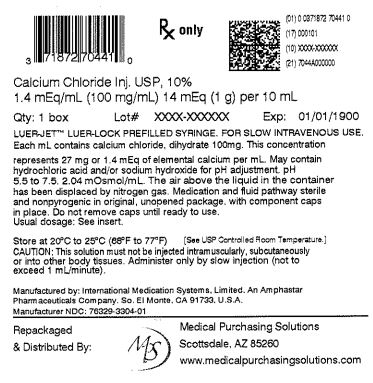
Calcium Chloride 100 mg/mL Injection
🆔 Identity & classification
Where does this data come from?
🏷️ RxNorm drug class
This medicine belongs to the Calcium class.
Where does this data come from?
🏭 Manufacturer & labeler
Where does this data come from?
🩺 Clinical
- When your calcium level drops to a dangerous level very quickly, your body needs calcium delivered directly into the bloodstream right away — there's no time to wait for a pill to...
- Why am I getting calcium chloride through an IV instead of just taking a calcium pill?
- Many people feel a warm or flushing sensation, a tingling (especially if it goes in a little fast), or notice a chalky or metallic taste. Some feel mild pressure or a burning sensa...
- This is a really important thing for your care team to know. Calcium chloride and digoxin together can cause dangerous heart rhythm problems, so your team will generally try to avo...
Patient education
Supplement & herbal interactions
Where does this data come from?
Ask a licensed pharmacist directly — free, answered by our team.
🧪 Inactive Ingredients / Excipients
Inactive ingredients, also called excipients, are components of the drug product other than the active ingredient. They may include fillers, dyes, coatings, preservatives, flavors, or other formulation ingredients.
💡 Tap an ingredient (hover on desktop) to see what it is and why it’s used.
-
UNII PF5DZW74VN
Calcium hydroxide is a white powder made from limestone. It's used in medicines as a buffer to adjust acidity and as a disintegrant to help tablets break apart in the stomach.
-
UNII QTT17582CB
A strong acid used to adjust and maintain the proper pH level in liquid medicines, ensuring stability and preventing breakdown of active ingredients.
2 inactive ingredients listed in the exact product block matched to this NDC.
Where does this data come from?
ingredient classCode="IACT" elements from the exact product block matched by this NDC. Label-section narrative from DailyMed / the openFDA label index is shown separately when available.Inactive ingredient FAQ
Are inactive ingredients the same for every manufacturer?
Why might an inactive ingredient be missing?
Can inactive ingredients matter?
💲 Pricing
A drug doesn't have one price. Each row is a different public payment system, and none is what you'd pay at the counter — that depends on your insurance. The ⓘ on each row explains what it measures.
| Price system | Per each | Per package |
|---|---|---|
| Retail pharmacies payNADAC · weekly | Not in the retail survey — common for institutional, discontinued, or low-volume packs. | |
| Medicaid paysCMS SDUD · 12 mo | No recent Medicaid claims on file for this NDC — rare and low-volume NDCs are suppressed in the public data. | |
| Medicare drug plans payPart D · quarterly | No Part D plan price is available for this NDC in our data. | |
Where does this data come from?
🔁 Therapeutic equivalents
| Product | Labeler | Pack | NADAC/unit | TE | Status | Price vs. this |
|---|---|---|---|---|---|---|
| Calcium Chloride 100 mg/mL 00409-1631-10 | Hospira, | 1 syringe | — | AP | FDA listed | — |
| Calcium Chloride 100 mg/mL 51662-1209-01 | HF | 1 syringe | — | — | FDA listed | — |
| Calcium Chloride 100 mg/mL 51662-1379-01 | HF | 1 syringe | — | AP | FDA listed | — |
| Calcium Chloride 100 mg/mL 51662-1452-01 | HF | 1 syringe | — | AP | FDA listed | — |
| Calcium Chloride 100 mg/mL 64253-0900-36 | Medefil, | 60 syringes | — | AP | FDA listed | — |
| calcium chloride 100 mg/mL 70121-2308-04 | Amneal | 1 syringe | — | AP | FDA listed | — |
| Calcium Chloride 100 mg/mL 70518-4180-00 | REMEDYREPACK | 10 syringes | — | AP | FDA listed | — |
| Calcium Chloride 100 mg/mLthis 71872-7044-01 | Medical | 1 syringe | — | — | FDA listed | — |
| Calcium Chloride 100 mg/mL 71872-7045-01 | Medical | 1 syringe | — | AP | FDA listed | — |
| Calcium Chloride 100 mg/mL 71872-7193-01 | Medical | 1 syringe | — | AP | FDA listed | — |
| Calcium Chloride 100 mg/mL 76329-3304-01 | International | 10 syringes | — | AP | FDA listed | — |
| Calcium Chloride 100 mg/mL 84549-0304-01 | ProPharma | 10 ml | — | AP | FDA listed | — |
Where does this data come from?
⏳ Availability & generic status
The FDA lists approved generic versions of this medicine, but that does not always mean a pharmacy can get one today. Patent rules, launch agreements, supply and pricing can affect when generics actually arrive.
Where does this data come from?
🔬 Reported adverse events (FAERS)
Top reported reactions
Age at onset
Reporter sex
Serious outcomes
Where does this data come from?
📦 Packaging — all sizes for this product
| Package NDC | Description | Marketing start | Status |
|---|---|---|---|
| 71872-7044-01 You're viewing this | 1 CARTON in 1 BAG (71872-7044-1) / 1 SYRINGE in 1 CARTON / 10 mL in 1 SYRINGE | 2018-03-15 | Active |
🧭 About this NDC listing & data coverage
Listed without an FDA application
This product's marketing category indicates it is marketed without an approved FDA application (no NDA, ANDA, or BLA on file). Having an NDC does not by itself establish FDA approval — the NDC Directory is a listing system, not an approval decision. Approval-linked data such as Orange Book therapeutic-equivalence ratings therefore does not apply.
What data is (and isn’t) available for this NDC — tap to expand
| NDC identity (package / product / labeler codes) | ✓ Available |
| Labeler | ✓ Available |
| Product & package description | ✓ Available |
| Marketing category & status | ✓ Available |
| Active ingredient / dosage form / route | ✓ Available |
| FDA label (SPL via DailyMed) | ✓ Available |
| Package photos | ✓ Available |
| Inactive ingredients (structured) | ✓ Available |
| NADAC pharmacy acquisition price (CMS) | — Not published for this NDC CMS publishes NADAC only for NDCs reported in its retail-pharmacy survey. |
| Orange Book / therapeutic-equivalence data | — Not published for this NDC Applies only to products approved under an NDA/ANDA; many listings are out of scope. |
| HCPCS J-code billing crosswalk | — Not published for this NDC Most self-administered / retail products have no J-code — that is normal. |
| Medicaid utilization (CMS SDUD) | — Not published for this NDC CMS reports utilization only for NDCs with Medicaid claims above its privacy threshold. |
Questions about this listing
Is this NDC FDA-approved?
Why is there no price listed?
Is the NDC printed on the package the same as the 11-digit billing NDC?
What do the three segments of this NDC mean?
Is this package still being marketed?
Who lists this product with the FDA?
Do I need a prescription for this product?
Where does this data come from?
📄 Full prescribing information FDA SPL
🎯 Indications and Usage ▾
INDICATIONS AND USAGE Calcium Chloride Injection, USP, 10% is indicated: In the treatment of hypocalcemia in conditions requiring a prompt increase in plasma calcium levels (e.g., neonatal tetany and tetany due to parathyroid deficiency, vitamin D deficiency and alkalosis) and for prevention of hypocalcemia during exchange transfusions. As adjunctive therapy in the management of acute symptoms in lead colic. In the treatment of magnesium intoxication due to overdosage of magnesium sulfate.
In severe hyperkalemia, to combat deleterious effects on electrocardiographic (ECG) function, pending correction of the potassium level in the extracellular fluid. In cardiac resuscitation, particularly after open heart surgery, when epinephrine fails to improve weak or ineffective myocardial contractions.
⏱️ Dosage and Administration ▾
DOSAGE AND ADMINISTRATION FOR INTRACARDIAC OR INTRAVENOUS USE ONLY INJECT SLOWLY Calcium Chloride Injection, USP, 10%, is administered only by slow intravenous injection (not to exceed 1 mL/min) and / or in cardiac resuscitation, by injection into the ventricular cavity. It must not be injected into the myocardium. The usual precautions for intravenous therapy should be observed.
If time permits, the solution should be warmed to body temperature. The injection should be halted if the patient complains of any discomfort; it may be resumed when symptoms disappear. Following injection, the patient should remain recumbent for a short time.
INTRACARDIAC USE For cardiac resuscitation, inject into the ventricular cavity, not into the heart muscle. Usual Adult Dosage: 200 to 800 mg (2 to 8 mL) when injected into the ventricular cavity. Pediatric Dosage: 0.2 mL/kg of body weight.
INTRAVENOUS USE Hypocalcemic Disorders Usual Adult Dosage: 500 mg to 1 g (5 to 10 mL) at intervals of 1 to 3 days, depending on the response of the patient and / or results of serum calcium determinations. Repeated injections may be required because of rapid excretion of calcium. Pediatric Dosage: 0.2 mL /kg of body weight.
Maximum 1-10 mL/day. Magnesium Intoxication Initial Adult Dose: 500 mg (5 mL) administered promptly and the patient observed for signs of recovery before further doses are given. Hyperkalemic ECG Disturbances of Cardiac Function Dosage should be adjusted by constant monitoring of ECG changes during administration.
⛔ Contraindications ▾
CONTRAINDICATIONS Calcium chloride is contraindicated for cardiac resuscitation in the presence of ventricular fibrillation.
⚠️ Warnings ▾
WARNINGS Calcium chloride should be injected into a large vein very slowly, as it may cause peripheral vasodilatation and a cutaneous burning sensation. A moderate fall in blood pressure due to vasodilatation may attend the injection. Since calcium chloride is an acidifying salt, it is usually undesirable in the treatment of hypocalcemia or renal insufficiency.
🤒 Adverse Reactions ▾
ADVERSE REACTIONS Rapid I.V. injection may cause the patient to complain of tingling sensations, a calcium taste, a sense of oppression or “heat wave.” Injections of calcium chloride are accompanied by peripheral vasodilation as well as a local “burning” sensation, and there may be a moderate fall in blood pressure.
🔄 Drug Interactions ▾
Drug Interactions Because of the danger involved in the simultaneous use of calcium salts and drugs of the digitalis group, a digitalized patient should not receive an intravenous injection of a calcium compound unless the indications are clearly defined. Calcium salts should not generally be mixed with carbonates, phosphates, sulfates or tartrates in parenteral admixtures.
🧬 Clinical Pharmacology ▾
CLINICAL PHARMACOLOGY Calcium is the fifth most abundant element in the body, the major fraction of which is found in the bony structure. Calcium plays important physiological roles; it is essential for the functional integrity of the nervous and muscular systems; it is necessary for normal cardiac function; and it is one of the factors involved in the mechanism of blood coagulation.
📦 How Supplied / Storage and Handling ▾
HOW SUPPLIED CALCIUM CHLORIDE INJECTION, USP, 10% In unit-use packages containing a Luer-Jet™ Luer-Lock Prefilled Syringe. Stock No. 3304 NDC 76329-3304-1 10 mL Ten cartons per package.
Syringe Assembly Directions: USE ASEPTIC TECHNIQUE Do not assemble until ready to use. *CAUTION: IMPROPER ENGAGING MAY CAUSE GLASS BREAKAGE AND SUBSEQUENT INJURY. Store at controlled room temperature 15° to 30°C (59° to 86°F). Rx Only INTERNATIONAL MEDICATION SYSTEMS, LIMITED So.
El Monte, CA 91733, U.S.A. Rev. 2-13 An Amphastar Pharmaceuticals Company © INTERNATIONAL MEDICATION SYSTEMS, LIMITED 2013 Instructions
📋 Description ▾
DESCRIPTION Calcium Chloride Injection, USP, 10%, is a sterile aqueous solution containing, in each mL, 100 mg (1.36 mEq) calcium chloride. The pH of the solution may have been adjusted with hydrochloric acid and / or calcium hydroxide, when necessary. The air above the liquid in the individual containers has been displaced by flushing with nitrogen during the filling operation.
The preparation contains no antimicrobial preservatives and is intended as a single-dose vial; once the unit is assembled and used, any remaining portion of the solution must be discarded with the entire unit. Calcium Chloride, USP, contains two molecules of water of hydration and is chemically designated as CaCl 2 • 2H 2 0.