
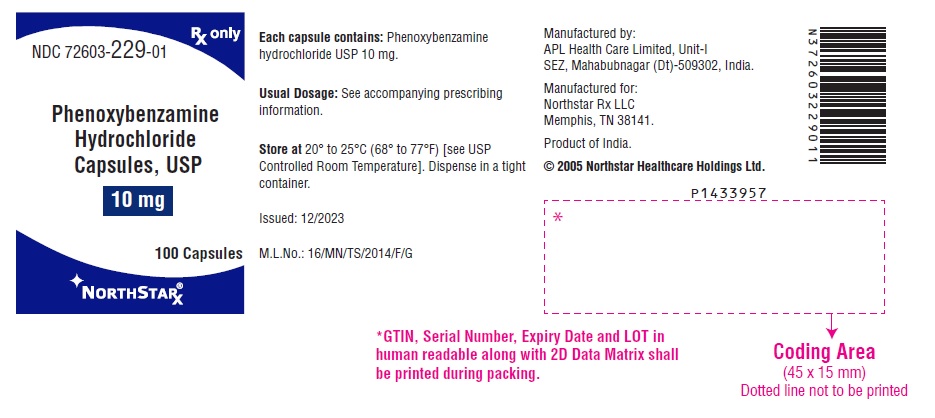
Phenoxybenzamine Hydrochloride 10 mg Capsule, 100-count — NDC 72603-229-01 (Billing 72603-0229-01)
This is a package of 100 capsules of Phenoxybenzamine Hydrochloride 10 mg Capsule from NorthStar Rx LLC, no longer marketed (first marketed Oct 2024), no longer in the FDA NDC Directory, this package's marketing ended Sep 2026. It is this product's only package size.
NDC database record
One package, one record: these facts belong to NDC 72603-229-01 alone.
- Record
- FDA NDC Directory package listing · Human prescription drug
- Code segments
- 72603 labeler · 229 product · 01 package
- Package marketed since
- Oct 1, 2024
- Package marketing ended
- Sep 30, 2026
- Sample package
- No — commercial package
- Billing quantity
- 100 EA per package
- Barcode (UPC-A, from the NDC)
- 3 7260322901 1
- FDA record last changed
- Jul 24, 2026
Identity & classification
Regulatory identifiers FDA, NLM and CMS codes for this package
Drug-database identifiers Medi-Span GPI and First Databank GCN / HICL / AHFS classification
- GSN (GCN sequence number): 005108
- GCN: 20540
- GPI-14 (Medi-Span): 36300010100105
- HICL (First Databank): 002098
- AHFS class code: 12:16.04.04
- RxCUI (RxNorm): 861402
Where does this data come from?
- FDA openFDA NDC Directory · synced Oct 1, 2026
- FDA label on DailyMed · label index refreshed Oct 3, 2026
- RxNorm (NLM RxNav) · catalog refreshed Oct 1, 2026
- Medi-Span GPI (licensed)
- First Databank (licensed) · refreshed Oct 1, 2026
RxNorm drug class
This medicine belongs to the alpha-Adrenergic Blocker class.
Where does this data come from?
- RxClass (NLM) · catalog refreshed Oct 1, 2026
Clinical
Phenoxybenzamine is used to treat episodes of high blood pressure and sweating related to pheochromocytoma. This medication is sometimes prescribed for other uses; ask your doctor or pharmacist for more information.
Read the full MedlinePlus article ↗- It's used to treat a rare condition called pheochromocytoma — a tumor of the adrenal gland that releases sudden surges of stress hormones. Those surges can cause dangerous spikes i...
- What exactly is phenoxybenzamine used for?
- Yes, dizziness when standing — called postural hypotension — is one of the most common effects of this medication, and it's actually a sign that the drug is working. To reduce it,...
- Will I feel dizzy when I stand up? What can I do about it?
Patient education
Supplement & herbal interactions
Phenoxybenzamine may be associated with lower levels of 1 nutrient — worth a chat with your pharmacist, not a cause for alarm.
Where does this data come from?
- MedlinePlus (NLM) · refreshed Oct 1, 2026
- FDA label on DailyMed · label index refreshed Oct 3, 2026
Ask a licensed pharmacist directly — free, answered by our team.
Pricing
A drug doesn't have one price. Each row is a different public payment system, and none is what you'd pay at the counter — that depends on your insurance. The ⓘ on each row explains what it measures.
| Price system | Per each | Per package |
|---|---|---|
| Retail pharmacies payNADAC · weekly | Not in the retail survey — common for institutional, discontinued, or low-volume packs. | |
| Medicaid paysCMS SDUD · 12 mo | No recent Medicaid claims on file for this NDC — rare and low-volume NDCs are suppressed in the public data. | |
| Medicare drug plans payPart D · quarterly | No Part D plan price is available for this NDC in our data. | |
Where does this data come from?
- CMS NADAC weekly file
- CMS ASP pricing files · refreshed Sep 20, 2026
- CMS Medicaid State Drug Utilization Data · refreshed Oct 4, 2026
- CMS Part D plan pricing files · refreshed Sep 24, 2026
- VA National Acquisition Center price file
Packaging — all sizes for this product
| Package NDC | Description | Marketing start | Marketing end | Status |
|---|---|---|---|---|
| 72603-0229-01 You're viewing this Main listing | 100 CAPSULE in 1 BOTTLE | 2024-10-01 | Sep 30, 2026 | Discontinued by firm |
Therapeutic equivalents
| Product | Labeler | Pack | NADAC/unit | TE | Status | Price vs. this |
|---|---|---|---|---|---|---|
| Phenoxybenzamine Hydrochloride 10 mg 35573-0473-02 | Burel | 100 capsules | — | AB | FDA listed | — |
| Phenoxybenzamine Hydrochloride 10 mg 59651-0327-01 | Aurobindo | 100 capsules | — | — | FDA listed | — |
| Phenoxybenzamine hydrochloride 10 mg 60219-1502-01 | Amneal | 100 capsules | — | AB | FDA listed | — |
| Phenoxybenzamine Hydrochloride 10 mg 70954-0365-10 | Novitium | 100 capsules | — | AB | FDA listed | — |
| Phenoxybenzamine Hydrochloride 10 mgthis 72603-0229-01 | NorthStar | 100 capsules | — | AB | Discontinued | — |
| phenoxybenzamine hydrochloride 10 mg 16571-0874-01 | Rising | 100 capsules | — | AB | FDA listed | — |
Where does this data come from?
- FDA openFDA NDC Directory · synced Oct 1, 2026
- FDA Orange Book · refreshed Oct 3, 2026
- CMS NADAC weekly file
Availability & generic status
This product is an FDA-approved generic. Other versions of the same drug are listed under Therapeutic equivalents, least expensive first.
Where does this data come from?
- FDA Orange Book · refreshed Oct 3, 2026
What it looks like
Where does this data come from?
- FDA label on DailyMed · label index refreshed Oct 3, 2026
Inactive Ingredients / Excipients
Inactive ingredients, also called excipients, are components of the drug product other than the active ingredient. They may include fillers, dyes, coatings, preservatives, flavors, or other formulation ingredients.
💡 Tap an ingredient (hover on desktop) to see what it is and why it’s used.
-
UNII 3SY5LH9PMK
Anhydrous lactose is a milk sugar with no water content. It acts as a filler and binder in tablets and capsules, adding bulk and helping ingredients stick together.
-
UNII XM0M87F357
A dark iron oxide compound that gives medicines their black or dark color. It's used as a colorant in tablets and capsules to help identify the product and make it visually distinctive.
-
UNII 2G86QN327L
Gelatin is a protein derived from animal collagen, commonly used in medicines as a gelling agent and capsule material. It helps create soft or hard capsule shells that hold and release medication, and can also thicken liquid formulations.
-
UNII WZH3C48M4T
Potassium hydroxide is a strong alkaline chemical used in medicines to adjust and maintain the pH level of liquid formulations, helping keep the product stable and the active ingredients effective.
-
UNII 6DC9Q167V3
Propylene glycol is a clear liquid derived from petroleum or vegetable sources. It acts as a solvent, humectant, and preservative in medicines, helping dissolve active ingredients and maintain product stability.
-
UNII 46N107B71O
Shellac is a natural resin secreted by the lac beetle. It's used as a coating on tablets and capsules to control how quickly the medicine dissolves and to improve appearance and stability.
-
UNII 7SEV7J4R1U
A powder made from a naturally occurring mineral. In medicines, talc works as a glidant and anti-caking agent, helping tablets and capsules flow smoothly during manufacturing and preventing clumping.
-
UNII 15FIX9V2JP
Titanium dioxide is a bright white mineral powder commonly used as a colorant and opacifying agent. It makes pills and tablets white or lighter in color and helps make coatings non-transparent.
8 inactive ingredients listed in the exact product block matched to this NDC.
Where does this data come from?
ingredient classCode="IACT" elements from the exact product block matched by this NDC. Label-section narrative from DailyMed / the openFDA label index is shown separately when available.- FDA label on DailyMed · label index refreshed Oct 3, 2026
- FDA openFDA NDC Directory · synced Oct 1, 2026
Inactive ingredient FAQ
Are inactive ingredients the same for every manufacturer?
Why might an inactive ingredient be missing?
Can inactive ingredients matter?
Manufacturer & labeler
More NDCs from NorthStar Rx LLC labeler code 72603
- Ampicillin and Sulbactam 1 g; .5 g Injection, Powder, For Solution NDC 72603-220-01
- Ampicillin 500 mg Injection, Powder, For Solution NDC 72603-221-10
- Doxepin 3 mg Tablet, Film Coated NDC 72603-222-01
- Doxepin 6 mg Tablet, Film Coated NDC 72603-223-01
- Heparin Sodium 20000 [USP'U]/mL Injection NDC 72603-224-25
- Enoxaparin Sodium 150 mg/mL Injection, Solution NDC 72603-225-10
- Haloperidol Decanoate 100 mg/mL Injection NDC 72603-230-01
- Deferasirox 90 mg Tablet, Film Coated NDC 72603-231-01
- Deferasirox 180 mg Tablet, Film Coated NDC 72603-232-01
- Deferasirox 360 mg Tablet, Film Coated NDC 72603-233-01
- Heparin Sodium 1000 [USP'U]/mL Injection NDC 72603-234-25
- Dabigatran Etexilate 150 mg Capsule NDC 72603-239-01
Where does this data come from?
- FDA openFDA NDC Directory · synced Oct 1, 2026
- Drugs@FDA
Full prescribing information FDA SPL
🎯 Indications and Usage ▾
INDICATION AND USAGE Phenoxybenzamine hydrochloride capsules are indicated in the treatment of pheochromocytoma, to control episodes of hypertension and sweating. If tachycardia is excessive, it may be necessary to use a beta -blocking agent concomitantly.
⏱️ Dosage and Administration ▾
DOSAGE AND ADMINISTRATION The dosage should be adjusted to fit the needs of each patient. Small initial doses should be slowly increased until the desired effect is obtained or the side effects from blockade become troublesome. After each increase, the patient should be observed on that level before instituting another increase .
The dosage should be carried to a point where symptomatic relief and/or objective improvement are obtained, but not so high that the side effects from blockade become troublesome. Initially, 10 mg of phenoxybenzamine hydrochloride twice a day. Dosage should be increased every other day, usually to 20 to 40 mg 2 or 3 times a day, until an optimal dosage is obtained, as judged by blood pressure control.
Long-term use of phenoxybenzamine is not recommended (see PRECAUTIONS Carcinogenesis and Mutagenesis ). STORAGE Store at 20° to 25°C (68° to 77°F) [see USP Controlled Room Temperature]. Dispense in a tight container.
⛔ Contraindications ▾
CONTRAINDICATIONS Conditions where a fall in blood pressure may be undesirable; hypersensitivity to the drug or any of its components.
⚠️ Warnings ▾
WARNING Phenoxybenzamine hydrochloride-induced alpha -adrenergic blockade leaves beta -adrenergic receptors unopposed. Compounds that stimulate both types of receptors may, therefore, produce an exaggerated hypotensive response and tachycardia.
🤒 Adverse Reactions ▾
ADVERSE REACTIONS The following adverse reactions have been observed, but there are insufficient data to support an estimate of their frequency. Autonomic Nervous System*: Postural hypotension, tachycardia, inhibition of ejaculation, nasal congestion, miosis. *These so-called “side effects” are actually evidence of adrenergic blockade and vary according to the degree of blockade. Miscellaneous: Gastrointestinal irritation, drowsiness, fatigue.
To report SUSPECTED ADVERSE REACTIONS, contact Northstar Rx LLC at 1-800-206-7821 or FDA at 1-800-FDA-1088 or www.fda.gov/medwatch.
🤰 Pregnancy ▾
Pregnancy - Teratogenic Effects Adequate reproductive studies in animals have not been performed with phenoxybenzamine hydrochloride. It is also not known whether phenoxybenzamine hydrochloride can cause fetal harm when administered to a pregnant woman. Phenoxybenzamine hydrochloride should be given to a pregnant woman only if clearly needed.
🧒 Pediatric Use ▾
Pediatric Use Safety and effectiveness in pediatric patients have not been established.
🆘 Overdosage ▾
OVERDOSAGE SYMPTOMS - These are largely the result of blocking of the sympathetic nervous system and of the circulating epinephrine. They may include postural hypotension, resulting in dizziness or fainting; tachycardia, particularly postural; vomiting; lethargy; shock.
🧬 Clinical Pharmacology ▾
CLINICAL PHARMACOLOGY Phenoxybenzamine hydrochloride is a long-acting, adrenergic, alpha -receptor-blocking agent, which can produce and maintain “chemical sympathectomy” by oral administration. It increases blood flow to the skin, mucosa and abdominal viscera, and lowers both supine and erect blood pressures. It has no effect on the parasympathetic system.
Twenty to 30 percent of orally administered phenoxybenzamine appears to be absorbed in the active form. 1 The half-life of orally administered phenoxybenzamine hydrochloride is not known; however, the half-life of intravenously administered drug is approximately 24 hours. Demonstrable effects with intravenous administration persist for at least 3 to 4 days, and the effects of daily administration are cumulative for nearly a week.
1
📦 How Supplied / Storage and Handling ▾
HOW SUPPLIED PhenoxybenzamineHydrochloride Capsules USP, 10 mg are white opaque colored cap and white opaque colored body hard gelatin capsules, imprinted with “PHEH” on cap and “10” on body, filled with white to off-white powder. Bottle of 100 NDC 72603-229-01
📋 Description ▾
DESCRIPTION Each phenoxybenzamine hydrochloride capsule, USP with white opaque cap and body, is imprinted "PHEH" on cap and "10" on body, and contains 10 mg of phenoxybenzamine hydrochloride USP. Inactive ingredients consist of anhydrous lactose and talc. The capsule shell contains gelatin and titanium dioxide.
The imprinting ink contains black iron oxide, potassium hydroxide, propylene glycol, and shellac. Phenoxybenzamine hydrochloride is N -(2-Chloroethyl)- N -(1-methyl-2-phenoxyethyl)benzylamine hydrochloride: Phenoxybenzamine hydrochloride USP is white or almost white crystalline powder with a molecular weight of 340.3, which melts between 136° and 141°C. It is freely soluble in ethanol, sparingly soluble in water. str
⚠️ Precautions ▾
PRECAUTIONS General–Administer with caution in patients with marked cerebral or coronary arteriosclerosis or renal damage. Adrenergic blocking effect may aggravate symptoms of respiratory infections. Drug Interactions 2 – Phenoxybenzamine hydrochloride may interact with compounds that stimulate both alpha- and beta- adrenergic receptors (i.e., epinephrine) to produce an exaggerated hypotensive response and tachycardia.
(See WARNING .) Phenoxybenzamine hydrochloride blocks hyperthermia production by levarterenol, and blocks hypothermia production by reserpine. Carcinogenesis and Mutagenesis Case reports of carcinoma in humans after long-term treatment with phenoxybenzamine have been reported. Hence long-term use of phenoxybenzamine is not recommended.
3, 4 Carefully weigh the benefits and risks before prescribing this drug. Phenoxybenzamine hydrochloride showed in vitro mutagenic activity in the Ames test and mouse lymphoma assay; it did not show mutagenic activity in vivo in the micronucleus test in mice. In rats and mice, repeated intraperitoneal administration of phenoxybenzamine hydrochloride (three times per week for up to 52 weeks) resulted in peritoneal sarcomas.
Chronic oral dosing in rats (for up to 2 years) produced malignant tumors of the small intestine and non-glandular stomach, as well as ulcerative and/or erosive gastritis of the glandular stomach. Whereas squamous cell carcinomas of the non-glandular stomach were observed at all tested doses of phenoxybenzamine hydrochloride, there was a no-observed-effect-level of 10 mg/kg for tumors (carcinomas and sarcomas) of the small intestine. This dose is, on a body surface area basis, about twice the maximum recommended human dosage of 20 mg b.i.d.
Pregnancy - Teratogenic Effects Adequate reproductive studies in animals have not been performed with phenoxybenzamine hydrochloride. It is also not known whether phenoxybenzamine hydrochloride can cause fetal harm when administered to a pregnant woman. Phenoxybenzamine hydrochloride should be given to a pregnant woman only if clearly needed.
Nursing Mothers It is not known whether this drug is excreted in human milk. Because many drugs are excreted in human milk, and because of the potential for serious adverse reactions from phenoxybenzamine hydrochloride, a decision should be made whether to discontinue nursing or to discontinue the drug, taking into account the importance of the drug to the mother. Pediatric Use Safety and effectiveness in pediatric patients have not been established.
🍼 Nursing Mothers ▾
Nursing Mothers It is not known whether this drug is excreted in human milk. Because many drugs are excreted in human milk, and because of the potential for serious adverse reactions from phenoxybenzamine hydrochloride, a decision should be made whether to discontinue nursing or to discontinue the drug, taking into account the importance of the drug to the mother.
📄 Carcinogenesis, Mutagenesis, Impairment of Fertility ▾
Carcinogenesis and Mutagenesis Case reports of carcinoma in humans after long-term treatment with phenoxybenzamine have been reported. Hence long-term use of phenoxybenzamine is not recommended. 3, 4 Carefully weigh the benefits and risks before prescribing this drug.
Phenoxybenzamine hydrochloride showed in vitro mutagenic activity in the Ames test and mouse lymphoma assay; it did not show mutagenic activity in vivo in the micronucleus test in mice. In rats and mice, repeated intraperitoneal administration of phenoxybenzamine hydrochloride (three times per week for up to 52 weeks) resulted in peritoneal sarcomas. Chronic oral dosing in rats (for up to 2 years) produced malignant tumors of the small intestine and non-glandular stomach, as well as ulcerative and/or erosive gastritis of the glandular stomach.
Whereas squamous cell carcinomas of the non-glandular stomach were observed at all tested doses of phenoxybenzamine hydrochloride, there was a no-observed-effect-level of 10 mg/kg for tumors (carcinomas and sarcomas) of the small intestine. This dose is, on a body surface area basis, about twice the maximum recommended human dosage of 20 mg b.i.d.
📚 References ▾
REFERENCES 1. Weiner, N.: Drugs That Inhibit Adrenergic Nerves and Block Adrenergic Receptors, in Goodman, L., and Gilman, A., The Pharmacological Basis of Therapeutics , ed. 6, New York, Macmillan Publishing Co., 1980, p.
179; p. 182. 2.
Martin, E.W.: Drug Interactions Index 1978/1979, Philadelphia, J.B. Lippincott Co., 1978, pp. 209-210.
3. Nettesheim O, Hoffken G, Gahr M, Breidert M: Haematemesis and dysphagia in a 20-year-old woman with congenital spine malformation and situs inversus partialis [German]. Zeitschrift fur Gastroenterologie.
2003;41(4):319-24. 4. Vaidyanathan S, Mansour P, Soni BM, Hughes PL, Singh G: Chronic lymphocytic leukaemia, synchronous small cell carcinoma and squamous neoplasia of the urinary bladder in a paraplegic man following long-term phenoxybenzamine therapy.
Spinal Cord. 2006;44(3):188-91. ** Available as Levophed ® Bitartrate (brand of norepinephrine bitartrate) from Abbott Laboratories. Manufactured for: Northstar Rx LLC Memphis, TN 38141.
Manufactured by: APL Health Care Limited, Unit-I SEZ, Mahabubnagar (Dt)-509302 India. M.L.No.: 16/MN/TS/2014/F/G Issued: 12/2023
📄 Package Label / Principal Display Panel ▾
PACKAGE LABEL-PRINCIPAL DISPLAY PANEL - 10 mg (100 Capsule Bottle) Rx only NDC 72603-229-01 Phenoxybenzamine Hydrochloride Capsules, USP 10 mg 100 Capsules NORTHSTAR ® fig1
About this NDC listing & data coverage
What data is (and isn’t) available for this NDC — tap to expand
| NDC identity (package / product / labeler codes) | ✓ Available |
| Labeler | ✓ Available |
| Product & package description | ✓ Available |
| Marketing category & status | ✓ Available |
| Active ingredient / dosage form / route | ✓ Available |
| FDA label (SPL via DailyMed) | ✓ Available |
| Package photos | ✓ Available |
| Inactive ingredients (structured) | ✓ Available |
| NADAC pharmacy acquisition price (CMS) | — Not published for this NDC CMS publishes NADAC only for NDCs reported in its retail-pharmacy survey. |
| Orange Book / therapeutic-equivalence data | ✓ Available |
| HCPCS J-code billing crosswalk | — Not published for this NDC Most self-administered / retail products have no J-code — that is normal. |
| Medicaid utilization (CMS SDUD) | — Not published for this NDC CMS reports utilization only for NDCs with Medicaid claims above its privacy threshold. |