
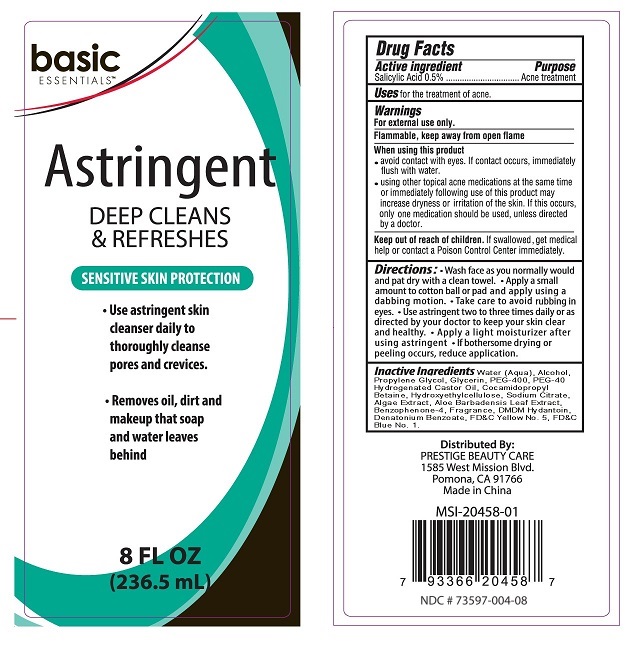
Basic Essentials Astringent Salicylic Acid .05 g/100mL Liquid, 236.5 mL — NDC 73597-004-08 (Billing 73597-0004-08)
This is a package of 236.5 mL of Basic Essentials Astringent Salicylic Acid .05 g/100mL Liquid from Mission Series Inc. dpa Prestige Beauty Care, marketed since Jul 2020 and currently FDA-listed. It is this product's only package size.
NDC database record
One package, one record: these facts belong to NDC 73597-004-08 alone.
- Record
- FDA NDC Directory package listing · Human OTC drug
- Code segments
- 73597 labeler · 004 product · 08 package
- Package marketed since
- Jul 30, 2020
- Sample package
- No — commercial package
- Listing certified through
- Dec 31, 2026
- Barcode (UPC)
- 0793366204587
- FDA record last changed
- Jul 24, 2026
Identity & classification
Regulatory identifiers FDA, NLM and CMS codes for this package
Where does this data come from?
- FDA openFDA NDC Directory · synced Oct 8, 2026
- FDA label on DailyMed · label index refreshed Oct 8, 2026
- RxNorm (NLM RxNav) · catalog refreshed Oct 8, 2026
- Medi-Span GPI (licensed)
- First Databank (licensed) · refreshed Oct 8, 2026
Clinical
This is an over-the-counter topical liquid containing salicylic acid, marketed under FDA's monograph rules for astringent products. Salicylic acid is commonly used in skincare products to help exfoliate the outer layer of skin and is typically included in formulations intended for oily or acne-prone skin. The product is applied directly to the skin surface as a liquid astringent.
Patient education
Supplement & herbal interactions
Where does this data come from?
- MedlinePlus (NLM) · refreshed Oct 8, 2026
- FDA label on DailyMed · label index refreshed Oct 8, 2026
Ask a licensed pharmacist directly — free, answered by our team.
Pricing
A drug doesn't have one price. Each row is a different public payment system, and none is what you'd pay at the counter — that depends on your insurance. The ⓘ on each row explains what it measures.
| Price system | Per mL | Per package |
|---|---|---|
| Retail pharmacies payNADAC · weekly | Not in the retail survey — common for institutional, discontinued, or low-volume packs. | |
| Medicaid paysCMS SDUD · 12 mo | No recent Medicaid claims on file for this NDC — rare and low-volume NDCs are suppressed in the public data. | |
| Medicare drug plans payPart D · quarterly | No Part D plan price is available for this NDC in our data. | |
Where does this data come from?
- CMS NADAC weekly file
- CMS ASP pricing files · refreshed Sep 20, 2026
- CMS Medicaid State Drug Utilization Data · refreshed Oct 9, 2026
- CMS Part D plan pricing files · refreshed Sep 24, 2026
- VA National Acquisition Center price file
Packaging — all sizes for this product
| Package NDC | Description | Marketing start | Marketing end | Status |
|---|---|---|---|---|
| 73597-0004-08 You're viewing this Main listing | 236.5 mL in 1 BOTTLE | 2020-07-30 | — | Active |
Therapeutic equivalents
| Product | Labeler | Pack | NADAC/unit | TE | Status | Price vs. this |
|---|---|---|---|---|---|---|
| Basic Essentials Astringent .05 g/100mL 73597-0021-08 | Mission | 236.5 ml | — | — | Discontinued | — |
| Basic Essentials Astringent .05 g/100mLthis 73597-0004-08 | Mission | 236.5 ml | — | — | FDA listed | — |
Where does this data come from?
- FDA openFDA NDC Directory · synced Oct 8, 2026
- FDA Orange Book · refreshed Oct 3, 2026
- CMS NADAC weekly file
Availability & generic status
We did not find an FDA-approved generic match for this exact strength, form and route.
Where does this data come from?
- FDA Orange Book · refreshed Oct 3, 2026
Inactive Ingredients / Excipients
Inactive ingredients, also called excipients, are components of the drug product other than the active ingredient. They may include fillers, dyes, coatings, preservatives, flavors, or other formulation ingredients.
💡 Tap an ingredient (hover on desktop) to see what it is and why it’s used.
-
UNII 3K9958V90M
A liquid solvent derived from fermentation or chemical synthesis. In medicines, alcohol dissolves active ingredients, helps preserve the product, and improves how the body absorbs certain drugs.
-
UNII ZY81Z83H0X
Aloe vera leaf is a plant extract derived from the aloe plant. It is used in medicines as a natural moisturizer and skin-soothing agent in topical formulations.
-
UNII 5OCF3O11KX
A plant-derived surfactant made from coconut oil. It helps mix oil and water ingredients together in the formulation and can improve how the medicine spreads or feels on the skin.
-
UNII 4YK5Z54AT2
Denatonium benzoate is a bitter-tasting chemical compound added to medicines to discourage accidental ingestion, especially by children. It serves as a bittering agent with no therapeutic effect on the body.
-
UNII BYR0546TOW
DMDM hydantoin is a preservative chemical used to prevent the growth of bacteria and fungi in medicines. It helps keep the product safe and stable throughout its shelf life.
-
UNII H3R47K3TBD
FD&C Blue No. 1 is a synthetic blue dye approved for use in foods and medicines. It serves as a colorant to give the medication its distinctive appearance and help with product identification.
-
UNII I753WB2F1M
FD&C Yellow No. 5 is a synthetic yellow colorant approved by the FDA. It is added to medicines to make pills, tablets, or liquids visually distinct and easier to identify.
-
UNII PDC6A3C0OX
Glycerin is a clear, thick liquid derived from plant oils or fats. It acts as a humectant to retain moisture, a sweetener, and a solvent in medications.
-
UNII T4V6TWG28D
A plant-derived thickening agent made from cellulose. It increases viscosity and helps form a gel or paste consistency in medications, and may serve as a binder or coating material in various formulations.
-
UNII 6J1M3WA0ZK
A red algae-derived mineral rich in calcium carbonate. Used as a filler and buffer to add bulk to the tablet or capsule and help maintain stable pH levels in the formulation.
-
UNII B697894SGQ
Polyethylene glycol 400 is a clear, thick liquid made from petroleum-derived polymers. It acts as a solvent and humectant in medicines, helping dissolve active ingredients and retain moisture in the formulation.
-
UNII 7YC686GQ8F
A synthetic oily substance made from castor oil. It works as a solubilizer and emulsifier to help mix oily and water-based ingredients together in the medicine.
-
UNII 6DC9Q167V3
Propylene glycol is a clear liquid derived from petroleum or vegetable sources. It acts as a solvent, humectant, and preservative in medicines, helping dissolve active ingredients and maintain product stability.
-
UNII 1Q73Q2JULR
Sodium citrate is a salt derived from citric acid. It works as a buffer to maintain the medicine's pH level and may also help improve taste or act as a preservative in the formulation.
-
UNII 1W6L629B4K
Sulisobenzone is a chemical UV filter used in some topical products to help protect against sun damage. It works as a sunscreen ingredient that absorbs ultraviolet light before it reaches the skin.
-
UNII 059QF0KO0R
Water is a liquid solvent that dissolves and mixes ingredients together in liquid medicines, syrups, and injections. It helps distribute the active drug evenly throughout the product.
16 inactive ingredients listed in the exact product block matched to this NDC.
Label-section wording can be broader than the structured product block and may mention additional formulation ingredients.
Where does this data come from?
ingredient classCode="IACT" elements from the exact product block matched by this NDC. Label-section narrative from DailyMed / the openFDA label index is shown separately when available.- FDA label on DailyMed · label index refreshed Oct 8, 2026
- FDA openFDA NDC Directory · synced Oct 8, 2026
Inactive ingredient FAQ
Are inactive ingredients the same for every manufacturer?
Why might an inactive ingredient be missing?
Can inactive ingredients matter?
Manufacturer & labeler
More NDCs from Mission Series Inc. dpa Prestige Beauty Care labeler code 73597
- Royal Creamy Petroleum Jelly Petrolatum 30 g/100g Jelly NDC 73597-012-07
- Royal Creamy Petroleum Jelly Cocoa Butter Petrolatum 30 g/100g Jelly NDC 73597-014-07
- Royal Dandruff Dry Scalp Pyrithione Zinc 1 g/100g Shampoo NDC 73597-020-10
- Basic Essentials Astringent Salicylic Acid .05 g/100mL Solution NDC 73597-021-08
- Royal Creamy Petroleum Jelly Petrolatum 30 g/100g Jelly NDC 73597-028-07
- Royal Creamy Petroleum Jelly Cocoa Butter Petrolatum 30 g/100g Jelly NDC 73597-029-07
Where does this data come from?
- FDA openFDA NDC Directory · synced Oct 8, 2026
- Drugs@FDA
FDA label — Drug Facts FDA SPL
🎯 Indications and Usage ▾
Indications & Usage Uses: for the treatment of acne.
⏱️ Dosage and Administration ▾
Directions Directions: • Wash face as you normally would and pat dry with a clean towel. • Apply a small amount to cotton ball or pad and apply using a dabbing motion. • Take care to avoid rubbing in eyes. • Use astringent two to three times daily or as directed by your doctor to keep your skin clear and healthy. • Apply a light moisturizer after using astringent. • If bothersome drying or peeling occurs, reduce application.
⚠️ Warnings ▾
Warnings Warnings For external use only. Flammable, keep away from open flame.
🧪 Active Ingredient ▾
Active Ingredient Active Ingredients Salicylic Acid 0.5%
🧪 Inactive Ingredients ▾
Inactive Ingredients Inactive ingredients Water (Aqua), Alcohol, Propylene Glycol, Glycerin, PEG-400, PEG-40 Hydrogenated Castor Oil, Cocamidopropyl Betaine, Hydroxyethylcellulose, Sodium Citrate, Algae Extract, Aloe Barbadensis Leaf Extract, Benzophenone-4, Fragrance, DMDM Hydantoin, Denatonium Benzoate, FD&C Yellow No. 5, FD&C Blue No. 1.
🎯 Purpose ▾
Purpose Purpose Acne Treatment
📄 Ask a Doctor Before Use If ▾
Ask a doctor • using other topical acne medications at the same time or immediately following use of this product may increase dryness or irritation of the skin. If this occurs, only one medication should be used, unless directed by a doctor.
📄 Keep Out of Reach of Children ▾
Keep out of reach of children Keep out of reach of children. If swallowed, get medical help or contact a Poison Control Center immediately.
📄 Package Label / Principal Display Panel ▾
Package Label Basic Essentials Astringent
Medicare Part D spend CMS · PART D · 2026 (Q1)
About this NDC listing & data coverage
What data is (and isn’t) available for this NDC — tap to expand
| NDC identity (package / product / labeler codes) | ✓ Available |
| Labeler | ✓ Available |
| Product & package description | ✓ Available |
| Marketing category & status | ✓ Available |
| Active ingredient / dosage form / route | ✓ Available |
| FDA label (SPL via DailyMed) | ✓ Available |
| Package photos | ✓ Available |
| Inactive ingredients (structured) | ✓ Available |
| NADAC pharmacy acquisition price (CMS) | — Not published for this NDC CMS publishes NADAC only for NDCs reported in its retail-pharmacy survey. |
| Orange Book / therapeutic-equivalence data | — Not published for this NDC Applies only to products approved under an NDA/ANDA; many listings are out of scope. |
| HCPCS J-code billing crosswalk | — Not published for this NDC Most self-administered / retail products have no J-code — that is normal. |
| Medicaid utilization (CMS SDUD) | — Not published for this NDC CMS reports utilization only for NDCs with Medicaid claims above its privacy threshold. |