
Phenohytro PHENOBARBITAL, HYOSCYAMINE SULFATE, ATROPINE SULFATE, SCOPOLAMINE HYDROBROMIDE 16.2 mg; .1037 mg; .0194 mg; .0065 mg Tablet, 1,000-count — NDC 75826-118-00 (Billing 75826-0118-00)
This is a package of 1,000 tablets of Phenohytro PHENOBARBITAL, HYOSCYAMINE SULFATE, ATROPINE SULFATE, SCOPOLAMINE HYDROBROMIDE 16.2 mg; .1037 mg; .0194 mg; .0065 mg Tablet from Winder Laboratories, LLC, marketed since Feb 2016 and currently FDA-listed.
Identity & classification
Regulatory identifiers FDA, NLM and CMS codes for this package
Drug-database identifiers Medi-Span GPI and First Databank GCN / HICL / AHFS classification
- GSN (GCN sequence number): 004777
- GCN: 74070
- GPI-14 (Medi-Span): 49109904050320
- HICL (First Databank): 035019
- AHFS class code: 12:08.08.00
- RxCUI (RxNorm): 1046815
Where does this data come from?
- FDA openFDA NDC Directory · synced Oct 1, 2026
- FDA label on DailyMed · label index refreshed Oct 1, 2026
- RxNorm (NLM RxNav) · catalog refreshed Oct 1, 2026
- Medi-Span GPI (licensed)
- First Databank (licensed) · refreshed Oct 1, 2026
RxNorm drug class
This medicine belongs to the Anticholinergic class.
Where does this data come from?
- RxClass (NLM) · catalog refreshed Oct 1, 2026
Clinical
Belladonna alkaloid combinations and phenobarbital are used to relieve cramping pains in conditions such as irritable bowel syndrome and spastic colon. They also are used with other medicine to treat ulcers. These medicines decrease the motion of the stomach and intestines and the secretion of stomach fluids, including acid. This medication is sometimes prescribed for other uses; ask your doctor or pharmacist for more information.
Read the full MedlinePlus article ↗Phenohytro is an oral tablet containing four active ingredients: phenobarbital (a barbiturate sedative), hyoscyamine sulfate, atropine sulfate, and scopolamine hydrobromide (all anticholinergic agents). The anticholinergic ingredients are typically used to reduce muscle spasms and secretions, while phenobarbital is typically used as a sedative or to reduce nervous system activity. This product is marketed without an approved FDA application.
Patient education
Supplement & herbal interactions
Where does this data come from?
- MedlinePlus (NLM) · refreshed Oct 1, 2026
- FDA label on DailyMed · label index refreshed Oct 1, 2026
Ask a licensed pharmacist directly — free, answered by our team.
Pricing
A drug doesn't have one price. Each row is a different public payment system, and none is what you'd pay at the counter — that depends on your insurance. The ⓘ on each row explains what it measures.
| Price system | Per each | Per package |
|---|---|---|
| Retail pharmacies payNADAC · weekly | Not in the retail survey — common for institutional, discontinued, or low-volume packs. | |
| Medicaid paysCMS SDUD · 12 mo | No recent Medicaid claims on file for this NDC — rare and low-volume NDCs are suppressed in the public data. | |
| Medicare drug plans payPart D · quarterly | No Part D plan price is available for this NDC in our data. | |
Where does this data come from?
- CMS NADAC weekly file
- CMS ASP pricing files · refreshed Sep 20, 2026
- CMS Medicaid State Drug Utilization Data · refreshed Oct 3, 2026
- CMS Part D plan pricing files · refreshed Sep 24, 2026
- VA National Acquisition Center price file
Packaging — all sizes for this product
| Package NDC | Description | Per unit | Per pack | Marketing start | Marketing end | Status |
|---|---|---|---|---|---|---|
| 75826-0118-00 You're viewing this | 1000 TABLET in 1 BOTTLE, PLASTIC | — | — | 2016-02-29 | — | Active |
| 75826-0118-10 75826-118-10 Main listing | 100 TABLET in 1 BOTTLE, PLASTIC | $1.25 / ea | $125.48 | 2016-02-29 | — | Active |
You're viewing the largest of 2 pack sizes for this product.
Pack size FAQ
What quantity is in this package?
How does this package differ from NDC 75826-0118-10?
What NDC number is used to bill for this package of Phenohytro PHENOBARBITAL, HYOSCYAMINE SULFATE, ATROPINE SULFATE, SCOPOLAMINE HYDROBROMIDE 16.2 mg; .1037 mg; .0194 mg; .0065 mg Tablet?
Prices are the latest CMS NADAC pharmacy acquisition cost per NDC; per-pack figures are per-unit × pack quantity, shown only when the pack is denominated in the same measure NADAC prices.
Therapeutic equivalents
| Product | Labeler | Pack | NADAC/unit | TE | Status | Price vs. this |
|---|---|---|---|---|---|---|
| Phenobarbital, Hyoscyamine Sulfate, Atropine Sulfate and Scopolamine Hydrobromide 16.2 mg/1; .1037 mg/1; .0194 mg/1; .0065 mg 50742-0667-01 | Ingenus | 100 tablets | — | — | FDA listed | — |
| Donnatal 16.2 mg/1; .1037 mg/1; .0194 mg/1; .0065 mg 59212-0425-04 | Advanz | 4 tablets | — | — | FDA listed | — |
| Phenohytro 16.2 mg/1; .1037 mg/1; .0194 mg/1; .0065 mgthis 75826-0118-00 | Winder | 1000 tablets | — | — | FDA listed | — |
Where does this data come from?
- FDA openFDA NDC Directory · synced Oct 1, 2026
- FDA Orange Book · refreshed Oct 3, 2026
- CMS NADAC weekly file
Availability & generic status
We did not find an FDA-approved generic match for this exact strength, form and route.
Where does this data come from?
- FDA Orange Book · refreshed Oct 3, 2026
What it looks like
Where does this data come from?
- FDA label on DailyMed · label index refreshed Oct 1, 2026
Inactive Ingredients / Excipients
Inactive ingredients, also called excipients, are components of the drug product other than the active ingredient. They may include fillers, dyes, coatings, preservatives, flavors, or other formulation ingredients.
💡 Tap an ingredient (hover on desktop) to see what it is and why it’s used.
-
UNII 3SY5LH9PMK
Anhydrous lactose is a milk sugar with no water content. It acts as a filler and binder in tablets and capsules, adding bulk and helping ingredients stick together.
-
UNII 776XM7047L
Calcium stearate is a white powder derived from stearic acid and calcium. It works as a lubricant and glidant to help the medicine flow smoothly during manufacturing and prevent ingredients from sticking to equipment.
-
UNII OP1R32D61U
Microcrystalline cellulose is a purified form of cellulose, a natural fiber from plant sources. It acts as a binder and filler in tablets and capsules, helping hold ingredients together and give the medicine its shape and size.
-
UNII ETJ7Z6XBU4
Silicon dioxide is a naturally occurring mineral used as a glidant and anti-caking agent. It helps powder ingredients flow smoothly and prevents clumping during manufacturing and storage.
-
UNII O8232NY3SJ
A plant-based carbohydrate derived from corn kernels. It acts as a filler to add bulk, a binder to hold ingredients together, and a disintegrant to help the tablet break apart in your stomach for absorption.
5 inactive ingredients listed in the exact product block matched to this NDC.
Where does this data come from?
ingredient classCode="IACT" elements from the exact product block matched by this NDC. Label-section narrative from DailyMed / the openFDA label index is shown separately when available.- FDA label on DailyMed · label index refreshed Oct 1, 2026
- FDA openFDA NDC Directory · synced Oct 1, 2026
Inactive ingredient FAQ
Are inactive ingredients the same for every manufacturer?
Why might an inactive ingredient be missing?
Can inactive ingredients matter?
Manufacturer & labeler
Where does this data come from?
- FDA openFDA NDC Directory · synced Oct 1, 2026
- Drugs@FDA
Full prescribing information FDA SPL
🎯 Indications and Usage ▾
INDICATIONS AND USAGE Based on a review of this drug by the National Academy of Sciences–National Research Council and/or other information, FDA has classified the indications as follows: “Possibly” effective: For use as adjunctive therapy in the treatment of irritable bowel syndrome (irritable colon, spastic colon, mucous colitis) and acute enterocolitis. May also be useful as adjunctive therapy in the treatment of duodenal ulcer. Final classification of the less-than-effective indications requires further investigation.
IT HAS NOT BEEN SHOWN CONCLUSIVELY WHETHER ANTICHOLINERGIC/ANTISPASMODIC DRUGS AID IN THE HEALING OF A DUODENAL ULCER, DECREASE THE RATE OF RECURRENCES OR PREVENT COMPLICATIONS.
⏱️ Dosage and Administration ▾
DOSAGE AND ADMINISTRATION The dosage of Phenohytro™ should be adjusted to the needs of the individual patient to assure symptomatic control with a minimum of adverse effects. Phenohytro™ Tablets - Adults: One or two Phenohytro™ Tablets three or four times a day according to condition and severity of symptoms.
⛔ Contraindications ▾
CONTRAINDICATIONS Phenohytro™ Tablets are contraindicated in patients with glaucoma; obstructive uropathy (for example, bladder neck obstruction due to prostatic hypertrophy); obstructive disease of the gastrointestinal tract (as in achalasia, pyloroduodenal stenosis, etc.); paralytic ileus, intestinal atony of the elderly or debilitated patient; unstable cardiovascular status in acute hemorrhage; severe ulcerative colitis especially if complicated by toxic megacolon; myasthenia gravis; hiatal hernia associated with reflux esophagitis.
Phenohytro™ Tablets are contraindicated in patients with known hypersensitivity to any of the ingredients. Phenobarbital is contraindicated in acute intermittent porphyria and in those patients in whom phenobarbital produces restlessness and/or excitement.
⚠️ Warnings ▾
WARNINGS Phenohytro™ Tablets can cause fetal harm when administered to a pregnant woman. Animal reproduction studies have not been conducted with Phenohytro™. If this drug is used during pregnancy, or if the patient becomes pregnant while taking this drug, the patient should be apprised of the potential hazard to the fetus.
In the presence of a high environmental temperature, heat prostration (fever and heatstroke due to decreased sweating) can occur with belladonna alkaloids. Diarrhea may be an early symptom of incomplete intestinal obstruction, especially in patients with ileostomy or colostomy. Administration of Phenohytro™ Tablets to a patient exhibiting diarrhea would be inappropriate and possibly harmful.
Phenohytro™ Tablets may produce drowsiness or blurred vision. Should these occur, the patient should be warned not to engage in activities requiring mental alertness, such as operating a motor vehicle or other machinery, and not to perform hazardous work. Phenobarbital may decrease the effect of anticoagulants, and necessitate larger doses of the anticoagulant for optimal effect.
When the phenobarbital is discontinued, the dose of the anticoagulant may have to be decreased. Phenobarbital may be habit forming and should not be administered to individuals known to be addiction prone or to those with a history of physical and/or psychological dependence upon drugs. Since barbiturates are metabolized in the liver, they should be used with caution and initial doses should be small in patients with hepatic dysfunction.
🤒 Adverse Reactions ▾
ADVERSE REACTIONS Adverse reactions may include xerostomia; urinary hesitancy and retention; blurred vision; tachycardia; palpitation; mydriasis; cycloplegia; increased ocular tension; loss of taste sense; headache; nervousness; drowsiness; weakness; dizziness; insomnia; nausea; vomiting; impotence; suppression of lactation; constipation; bloated feeling; musculoskeletal pain; severe allergic reaction or drug idiosyncrasies, including anaphylaxis, urticaria and other dermal manifestations; and decreased sweating. Acquired hypersensitivity to barbiturates consists chiefly in allergic reactions that occur especially in persons who tend to have asthma, urticaria, angioedema and similar conditions.
Hypersensitivity reactions in this category include localized swelling, particularly of the eyelids, cheeks, or lips, and erythematous dermatitis. Rarely, exfoliative dermatitis (e.g. Stevens-Johnson syndrome and toxic epidermal necrolysis) may be caused by phenobarbital and can prove fatal.
The skin eruption may be associated with fever, delirium, and marked degenerative changes in the liver and other parenchymatous organs. In a few cases, megaloblastic anemia has been associated with the chronic use of phenobarbital. Phenobarbital may produce excitement in some patients, rather than a sedative effect.
In patients habituated to barbiturates, abrupt withdrawal may produce delirium or convulsions. To report SUSPECTED ADVERSE REACTIONS, contact Winder Laboratories, LLC at 1-770-307-0702 or the FDA at 1-800-FDA-1088 or www.fda.gov/medwatch.
👥 Use in Specific Populations ▾
USE IN SPECIAL PATIENT POPULATIONS PREGNANCY PREGNANCY CATEGORY D Animal reproduction studies have not been conducted with Phenohytro™. There is positive evidence of human fetal risk based on adverse reaction data from investigational or marketing experience or studies in humans, but potential benefits may warrant use of the drug in pregnant women despite potential risks (see WARNINGS ). NURSING MOTHERS It is not known whether this drug is excreted in human milk.
Because many drugs are excreted in human milk, caution should be exercised when Phenohytro™ Tablets are administered to a nursing woman. GERIATRIC USE Elderly patients may react with symptoms of excitement, agitation, drowsiness, and other untoward manifestations to even small doses of the drug.
🤰 Pregnancy ▾
PREGNANCY PREGNANCY CATEGORY D Animal reproduction studies have not been conducted with Phenohytro™. There is positive evidence of human fetal risk based on adverse reaction data from investigational or marketing experience or studies in humans, but potential benefits may warrant use of the drug in pregnant women despite potential risks (see WARNINGS ).
🧓 Geriatric Use ▾
GERIATRIC USE Elderly patients may react with symptoms of excitement, agitation, drowsiness, and other untoward manifestations to even small doses of the drug.
🆘 Overdosage ▾
OVERDOSAGE The signs and symptoms of overdose are headache, nausea, vomiting, blurred vision, dilated pupils, hot and dry skin, dizziness, dryness of the mouth, difficulty in swallowing, and CNS stimulation. Treatment should consist of gastric lavage, emetics, and activated charcoal. If indicated, parenteral cholinergic agents such as physostigmine or bethanechol chloride should be used.
🧬 Clinical Pharmacology ▾
CLINICAL PHARMACOLOGY Phenohytro™ Tablets combine natural belladonna alkaloids in a specific, fixed ratio with phenobarbital to provide peripheral anticholinergic/antispasmodic action and mild sedation.
📦 How Supplied / Storage and Handling ▾
HOW SUPPLIED / STORAGE AND HANDLING Phenohytro™ Tablets are supplied as: white, round tablets debossed “112” on one side and plain on the other side. Bottles of 100 tablets, NDC 75826-118-10 Bottles of 1000 tablets, NDC 75826-118-00 Store at 20°-25°C (68°-77°F) [see USP Controlled Room Temperature]. Protect from light and moisture.
Dispense in a tight, light-resistant container as defined in the USP using a child-resistant closure. Use safety closures when dispensing this product unless otherwise directed by a physician or requested by purchaser. Manufactured by: Winder Laboratories, LLC Winder, GA 30680 www.phenohytro.com Rev.
03/16
📋 Description ▾
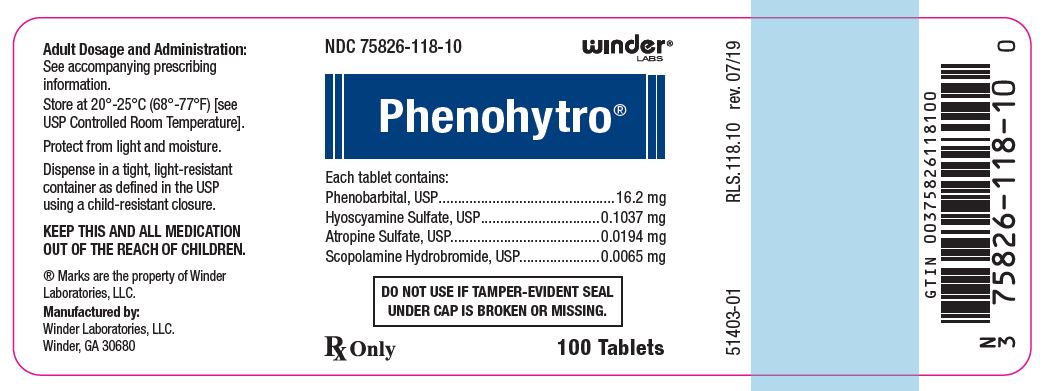
DESCRIPTION Each Phenohytro™ Tablet contains: Phenobarbital, USP..................................... 16.2 mg Hyoscyamine Sulfate, USP...................... 0.1037 mg Atropine Sulfate, USP .............................0.0194 mg Scopolamine Hydrobromide, USP ...........0.0065 mg Inactive Ingredients: Anhydrous Lactose, Calcium Stearate, Colloidal Silicon Dioxide, Corn Starch, and Microcrystalline Cellulose.
⚠️ Precautions ▾
PRECAUTIONS GENERAL Phenohytro™ Tablets should be used with caution in patients with: autonomic neuropathy, hepatic or renal disease, hyperthyroidism, coronary heart disease, congestive heart failure, cardiac arrhythmias, tachycardia, and hypertension. Belladonna alkaloids may produce a delay in gastric emptying (antral stasis) which would complicate the management of gastric ulcer. Phenohytro™ Tablets should not be used in the presence of complication of biliary tract disease.
In the event of overdosage of Phenohytro™ Tablets, a curare-like action may occur. CARCINOGENESIS, MUTAGENESIS, IMPAIRMENT OF FERTILITY Long-term studies in animals have not been performed to evaluate carcinogenic potential of Phenohytro™ Tablets.
🍼 Nursing Mothers ▾
NURSING MOTHERS It is not known whether this drug is excreted in human milk. Because many drugs are excreted in human milk, caution should be exercised when Phenohytro™ Tablets are administered to a nursing woman.
📄 Carcinogenesis, Mutagenesis, Impairment of Fertility ▾
CARCINOGENESIS, MUTAGENESIS, IMPAIRMENT OF FERTILITY Long-term studies in animals have not been performed to evaluate carcinogenic potential of Phenohytro™ Tablets.
📄 Package Label / Principal Display Panel ▾
Phenohytro™ - 100 Tablets Rev. 07/19
Medicaid utilization by pack size
Reported adverse events (FAERS)
Top reported reactions
Age at onset
Reporter sex
Serious outcomes
Where does this data come from?
About this NDC listing & data coverage
Listed without an FDA application
This product's marketing category indicates it is marketed without an approved FDA application (no NDA, ANDA, or BLA on file). Having an NDC does not by itself establish FDA approval — the NDC Directory is a listing system, not an approval decision. Approval-linked data such as Orange Book therapeutic-equivalence ratings therefore does not apply.
What data is (and isn’t) available for this NDC — tap to expand
| NDC identity (package / product / labeler codes) | ✓ Available |
| Labeler | ✓ Available |
| Product & package description | ✓ Available |
| Marketing category & status | ✓ Available |
| Active ingredient / dosage form / route | ✓ Available |
| FDA label (SPL via DailyMed) | ✓ Available |
| Package photos | ✓ Available |
| Inactive ingredients (structured) | ✓ Available |
| NADAC pharmacy acquisition price (CMS) | — Not published for this NDC CMS publishes NADAC only for NDCs reported in its retail-pharmacy survey. |
| Orange Book / therapeutic-equivalence data | — Not published for this NDC Applies only to products approved under an NDA/ANDA; many listings are out of scope. |
| HCPCS J-code billing crosswalk | — Not published for this NDC Most self-administered / retail products have no J-code — that is normal. |
| Medicaid utilization (CMS SDUD) | — Not published for this NDC CMS reports utilization only for NDCs with Medicaid claims above its privacy threshold. |