
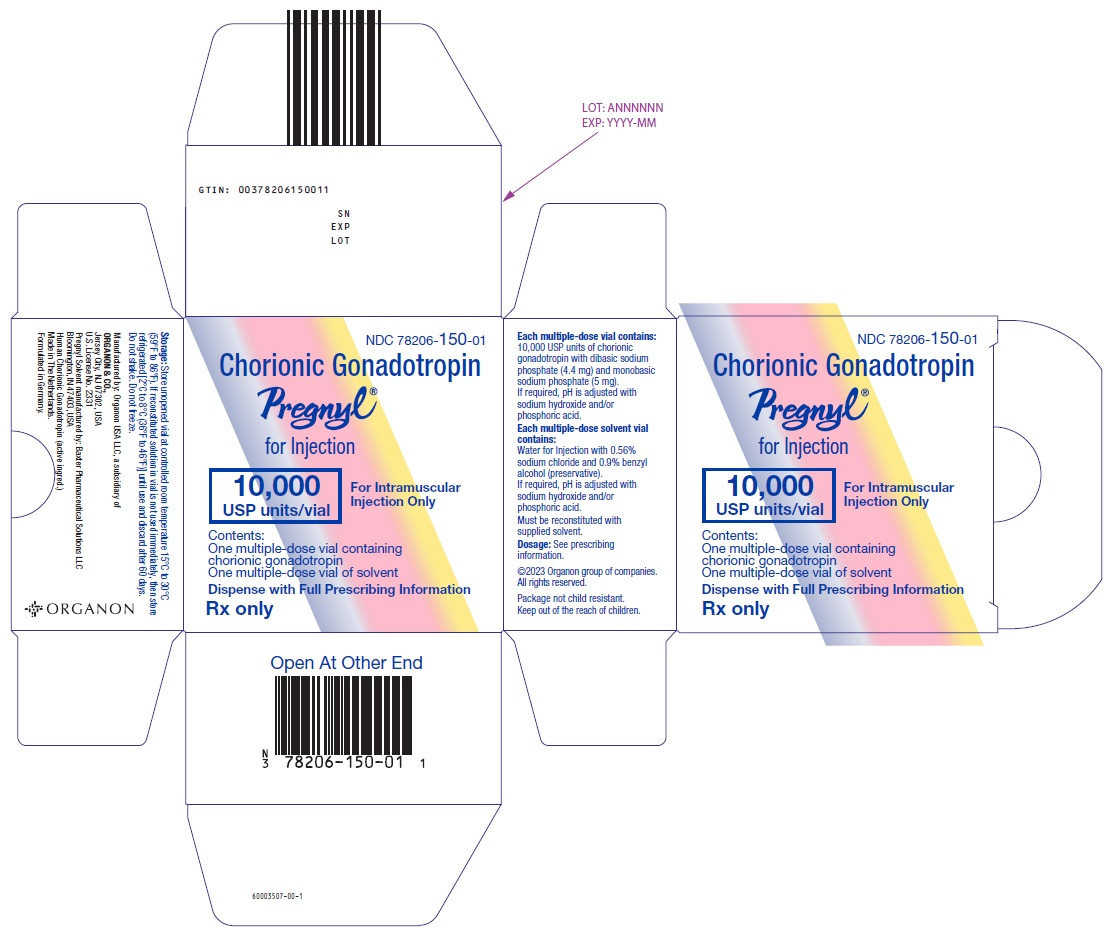
Pregnyl CHORIOGONADOTROPIN ALFA Kit — NDC 78206-150-01 (Billing 78206-0150-01)
This is a package of Pregnyl CHORIOGONADOTROPIN ALFA Kit from Organon LLC, marketed since Jun 2023 and currently FDA-listed; retail pharmacies pay about $171.53 per unit (NADAC). It is this product's only package size.
NDC database record
One package, one record: these facts belong to NDC 78206-150-01 alone.
- Record
- FDA NDC Directory package listing · Human prescription drug
- Code segments
- 78206 labeler · 150 product · 01 package
- Package marketed since
- Jun 2, 2023
- Sample package
- No — commercial package
- Listing certified through
- Dec 31, 2026
- Barcode (UPC-A, from the NDC)
- 3 7820615001 1
- Medicaid fills, this package
- 910 prescriptions in the last four reported quarters
- FDA record last changed
- Jul 24, 2026
Identity & classification
Regulatory identifiers FDA, NLM and CMS codes for this package
Drug-database identifiers Medi-Span GPI and First Databank GCN / HICL / AHFS classification
- GSN (GCN sequence number): 003173
- GCN: 10490
- HICL (First Databank): 001408
- AHFS class code: 68:18.08.00
- RxCUI (RxNorm): 896854
Where does this data come from?
- FDA openFDA NDC Directory · synced Oct 8, 2026
- FDA label on DailyMed · label index refreshed Oct 8, 2026
- RxNorm (NLM RxNav) · catalog refreshed Oct 1, 2026
- Medi-Span GPI (licensed)
- First Databank (licensed) · refreshed Oct 8, 2026
RxNorm drug class
This medicine belongs to the Gonadotropin class.
Where does this data come from?
- RxClass (NLM) · catalog refreshed Oct 1, 2026
Clinical
Patient education
Supplement & herbal interactions
Where does this data come from?
- MedlinePlus (NLM) · refreshed Oct 8, 2026
- FDA label on DailyMed · label index refreshed Oct 8, 2026
Ask a licensed pharmacist directly — free, answered by our team.
Pricing
A drug doesn't have one price. Each row is a different public payment system, and none is what you'd pay at the counter — that depends on your insurance. The ⓘ on each row explains what it measures.
| Price system | Per ea | Per package |
|---|---|---|
| Retail pharmacies payNADAC · weekly | $171.530 | — |
| Medicaid paysCMS SDUD · 12 mo | $179.31 | — |
| Medicare drug plans payPart D · quarterly | No Part D plan price is available for this NDC in our data. | |
| Medicare Part B allowsASP · J0725 | $15.069 / J0725 unit | — |
Where does this data come from?
- CMS NADAC weekly file · file of Oct 7, 2026
- CMS ASP pricing files · refreshed Sep 20, 2026
- CMS Medicaid State Drug Utilization Data · through Q1 2026
- CMS Part D plan pricing files · refreshed Sep 24, 2026
- VA National Acquisition Center price file
Billing & reimbursement
Where does this data come from?
- CMS ASP NDC-HCPCS crosswalk · refreshed Sep 22, 2026
- DMEPDAC NDC-HCPCS crosswalk
- openFDA NSDE billing units · refreshed Oct 7, 2026
Packaging — all sizes for this product
| Package NDC | Description | Marketing start | Marketing end | Status |
|---|---|---|---|---|
| 78206-0150-01 You're viewing this Main listing | 1 KIT in 1 CARTON * 10 mL in 1 VIAL, MULTI-DOSE * 10 mL in 1 VIAL | 2023-06-02 | — | Active |
Therapeutic equivalents
| Product | Labeler | Pack | NADAC/unit | TE | Status | Price vs. this |
|---|---|---|---|---|---|---|
| Pregnylthis 78206-0150-01 | Organon | 1 kit | $171.530 | — | Availability likely | — |
| Chorionic Gonadotropin 63323-0030-11 | Fresenius | 1 kit | $253.048 | — | Availability likely | +48% |
| Pregnyl 50090-7089-00 | A-S | 1 kit | — | — | FDA listed | — |
| Chorionic Gonadotropin 68071-3815-01 | NuCare | 1 kit | — | — | FDA listed | — |
Where does this data come from?
- FDA openFDA NDC Directory · synced Oct 8, 2026
- FDA Purple Book · refreshed Oct 5, 2026
- CMS NADAC weekly file · file of Oct 7, 2026
Availability & biosimilar status
Biologics have no small-molecule generics; biosimilar competition is tracked in the FDA Purple Book.
Where does this data come from?
- FDA Purple Book · refreshed Oct 5, 2026
Inactive Ingredients / Excipients
Inactive ingredients, also called excipients, are components of the drug product other than the active ingredient. They may include fillers, dyes, coatings, preservatives, flavors, or other formulation ingredients.
Where does this data come from?
IACT rows and label-wide narrative are kept separate; availability and product-level specificity depend on the submitted label.- FDA label on DailyMed · label index refreshed Oct 8, 2026
- FDA openFDA NDC Directory · synced Oct 8, 2026
Inactive ingredient FAQ
Are inactive ingredients the same for every manufacturer?
Why might an inactive ingredient be missing?
Can inactive ingredients matter?
Manufacturer & labeler
More NDCs from Organon LLC labeler code 78206
- Maxalt rizatriptan benzoate 10 mg Tablet NDC 78206-142-01
- Maxalt-Mlt rizatriptan benzoate 10 mg Tablet, Orally Disintegrating NDC 78206-143-01
- Nexplanon etonogestrel 68 mg Implant NDC 78206-145-01
- NuvaRing etonogestrel and ethinyl estradiol .12 mg/d; .015 mg/d Insert, Extended Release NDC 78206-146-03
- Ontruzant trastuzumab 150 mg Injection, Powder, Lyophilized, For Solution NDC 78206-147-01
- Ontruzant Kit NDC 78206-148-01
- Propecia finasteride 1 mg Tablet, Film Coated NDC 78206-152-01
- Proscar Finasteride 5 mg Tablet, Film Coated NDC 78206-153-01
- Remeronsoltab Mirtazapine 15 mg Tablet, Orally Disintegrating NDC 78206-156-01
- Remeronsoltab Mirtazapine 30 mg Tablet, Orally Disintegrating NDC 78206-158-01
- Remeronsoltab Mirtazapine 45 mg Tablet, Orally Disintegrating NDC 78206-159-01
- Remeron Mirtazapine 15 mg Tablet, Film Coated NDC 78206-160-01
Where does this data come from?
- FDA openFDA NDC Directory · synced Oct 8, 2026
- Drugs@FDA
Full prescribing information FDA SPL
🎯 Indications and Usage ▾
INDICATIONS AND USAGE HCG HAS NOT BEEN DEMONSTRATED TO BE EFFECTIVE ADJUNCTIVE THERAPY IN THE TREATMENT OF OBESITY. THERE IS NO SUBSTANTIAL EVIDENCE THAT IT INCREASES WEIGHT LOSS BEYOND THAT RESULTING FROM CALORIC RESTRICTION, THAT IT CAUSES A MORE ATTRACTIVE OR “NORMAL” DISTRIBUTION OF FAT, OR THAT IT DECREASES THE HUNGER AND DISCOMFORT ASSOCIATED WITH CALORIE-RESTRICTED DIETS. Prepubertal cryptorchidism not due to anatomical obstruction.
In general, hCG is thought to induce testicular descent in situations when descent would have occurred at puberty. hCG thus may help predict whether or not orchiopexy will be needed in the future. Although, in some cases, descent following hCG administration is permanent, in most cases, the response is temporary. Therapy is usually instituted in children between the ages of 4 and 9.
Selected cases of hypogonadotropic hypogonadism (hypogonadism secondary to a pituitary deficiency) in males. Induction of ovulation and pregnancy in the anovulatory, infertile woman in whom the cause of anovulation is secondary and not due to primary ovarian failure, and who has been appropriately treated with human gonadotropins.
⏱️ Dosage and Administration ▾
DOSAGE AND ADMINISTRATION For intramuscular use only. Each multiple-dose vial is to be used for one patient. The dosage regimen employed in any particular case will depend upon the indication for the use, the age and weight of the patient, and the physician’s preference.
The following regimens have been advocated by various authorities: Prepubertal cryptorchidism not due to anatomical obstruction. Generally, institute therapy in children between the ages of 4 and 9. 4000 USP units 3 times weekly for 3 weeks.
5000 USP units every second day for 4 injections. 15 injections for 500 to 1000 USP units over a period of 6 weeks. 500 USP units 3 times weekly for 4 to 6 weeks.
If this course of treatment is not successful, another series is begun 1 month later, giving 1000 USP units per injection. Selected cases of hypogonadotropic hypogonadism in males. 500 to 1000 USP units 3 times a week for 3 weeks, followed by the same dose twice a week for 3 weeks.
4000 USP units 3 times weekly for 6 to 9 months, following which the dosage may be reduced to 2000 USP units 3 times weekly for an additional 3 months. Induction of ovulation and pregnancy in the anovulatory, infertile woman in whom the cause of anovulation is secondary and not due to primary ovarian failure and who has been appropriately treated with gonadotropins. (See also prescribing information for gonadotropins for dosage and administration for that drug product .) 5000 to 10,000 USP units 1 day following the last dose of gonadotropins.
(A dosage of 10,000 USP units is recommended in the labeling for gonadotropins.) Directions for Reconstitution Withdraw sterile air from vial with lyophilized powder and inject into vial with solvent. Remove 1 to 10 mL of solvent and add to vial with lyophilized powder; agitate gently until powder is completely dissolved in solution. Do not shake.
PREGNYL is a white, dry powder / cake. The solvent is a clear and colorless aqueous solution. Visually inspect parenteral drug products for particulate matter and discoloration prior to administration, whenever solution and container permit.
If there is a discoloration or particulates, do not use. IMPORTANT: IF NEEDED, THE RECONSTITUTED SOLUTION IS STABLE FOR 60 DAYS WHEN REFRIGERATED. DO NOT FREEZE.
USE THE RECONSTITUTED SOLUTION WITHIN 60 DAYS OF RECONSTITUTION. IF THE RECONSTITUTED SOLUTION IS NO LONGER NEEDED, DISCARD UNUSED PORTION.
⛔ Contraindications ▾
CONTRAINDICATIONS Prior hypersensitivity reactions to human gonadotropins, including hCG, or any of the excipients (see ADVERSE REACTIONS ). High serum FSH, indicating primary gonadal failure in women. Presence of uncontrolled non-gonadal endocrinopathies (e.g., thyroid, adrenal, or pituitary disorders).
Tumors of the hypothalamus or pituitary gland and ovary, breast, or uterus in females and breast or prostate in males. Malformations of the reproductive organs incompatible with pregnancy. Fibroid tumors of the uterus incompatible with pregnancy.
Abnormal vaginal bleeding of undetermined origin.
⚠️ Warnings ▾
WARNINGS Use hCG in conjunction with gonadotropin therapy only if the physician is experienced with infertility problems and is familiar with the criteria for patient selection, contraindications, warnings, precautions, and adverse reactions described in the package insert for gonadotropins. Gonadotropin therapy, including hCG, requires a certain time commitment by physicians and supportive health professionals, and requires the availability of appropriate monitoring facilities (see PRECAUTIONS/Laboratory Tests ). Safe and effective induction of ovulation with use of PREGNYL requires monitoring of ovarian response with serum estradiol and transvaginal ultrasound on a regular basis.
Anaphylaxis Anaphylaxis has been reported with urinary-derived hCG products. Ovarian Hyperstimulation Syndrome (OHSS) Ovarian Hyperstimulation Syndrome (OHSS) is a medical event distinct from uncomplicated ovarian enlargement and may progress rapidly to become a serious medical event. OHSS is characterized by a dramatic increase in vascular permeability, which can result in a rapid accumulation of fluid in the peritoneal cavity, thorax, and potentially, the pericardium.
The early warning signs of the development of OHSS are severe pelvic pain, nausea, vomiting, and weight gain. Abdominal pain, abdominal distension, gastrointestinal symptoms including nausea, vomiting and diarrhea, severe ovarian enlargement, weight gain, dyspnea, and oliguria have been reported with OHSS. Clinical evaluation may reveal hypovolemia, hemoconcentration, electrolyte imbalances, ascites, hemoperitoneum, pleural effusions, hydrothorax, acute pulmonary distress, and thromboembolic reactions.
Transient liver function test abnormalities suggestive of hepatic dysfunction with or without morphologic changes on liver biopsy, have been reported in association with OHSS. OHSS occurs after gonadotropin treatment has been discontinued and it can develop rapidly, reaching its maximum about seven to ten days following treatment. Usually, OHSS resolves spontaneously with the onset of menses.
If there is evidence that OHSS may be developing prior to hCG administration, withhold hCG. Cases of OHSS are more common, more severe, and more protracted if pregnancy occurs; therefore, assess women for the development of OHSS for at least two weeks after hCG administration. Severe OHSS may be life-threatening.
Monitor women undergoing ovarian stimulation for early signs and symptoms of OHSS. Women with known risk factors for a high ovarian response may be especially prone to the development of OHSS during or following treatment with PREGNYL. Adherence to the recommended PREGNYL dose and treatment regimen and careful monitoring of ovarian response is important to reduce the risk of OHSS.
If serious OHSS occurs, stop gonadotropins, including hCG, and consider whether the woman should be hospitalized. Treatment is primarily symptomatic and overall consists of bed rest, fluid and electrolyte management, and analgesics (if needed). Because the use of diuretics can accentuate the diminished intravascular volume, avoid diuretics except in the late phase of resolution.
Initiate early consultation with a physician experienced in the management of OHSS and fluid and electrolyte imbalances. Pulmonary and Vascular Complications Serious pulmonary conditions (e.g., atelectasis, acute respiratory distress syndrome) have been reported in women treated with gonadotropins. In addition, thromboembolic reactions both in association with, and separate from OHSS have been reported following gonadotropin therapy.
Intravascular thrombosis, which may originate in venous or arterial vessels, can result in reduced blood flow to vital organs or the extremities. Women with generally recognized risk factors for thrombosis, such as a personal or family history, severe obesity, or thrombophilia, may have an increased risk of venous or arterial thromboembolic events, during or following treatment with gonadotropins. Sequelae o… [Excerpted — this section continues on DailyMed.]
🤒 Adverse Reactions ▾
ADVERSE REACTIONS For males and females: Immune system disorders Hypersensitivity reactions, both localized and systemic in nature, including anaphylaxis have been reported. In rare cases, generalized rash or fever may occur (see CONTRAINDICATIONS and WARNINGS ). If a hypersensitivity reaction is suspected, discontinue PREGNYL and assess for other potential causes for the event.
Psychiatric disorders Irritability Restlessness Depression Nervous system disorders Headache General disorders and administration site conditions PREGNYL may cause reactions at the site of injection, such as bruising, pain, redness, swelling and itching. Occasionally, allergic reactions have been reported, mostly manifesting as pain and/or rash at the injection site (see CONTRAINDICATIONS and WARNINGS ). Edema Fatigue In the female: Vascular disorders In rare instances, thromboembolism has been associated with FSH/hCG therapy, usually associated with severe OHSS (see WARNINGS ).
Respiratory, thoracic and mediastinal disorders Hydrothorax, as a complication of severe OHSS (see WARNINGS ). Gastrointestinal disorders Abdominal pain and gastrointestinal symptoms such as nausea and diarrhea, related to mild OHSS. Ascites, as a complication of severe OHSS (see WARNINGS ).
Reproductive system and breast disorders Unwanted ovarian hyperstimulation, mild or severe Ovarian Hyperstimulation Syndrome (see WARNINGS ). Mild to moderate enlargement of ovaries and ovarian cysts related to mild OHSS. Large ovarian cysts (prone to rupture), usually associated with severe OHSS (see WARNINGS ).
Painful breasts Investigations Weight gain as a characteristic of severe OHSS (see WARNINGS ). In the male: Metabolism and nutrition disorders Water and sodium retention is occasionally seen after administration of high dosages; this is regarded as a result of excessive androgen production. Reproductive system and breast disorders HCG treatment may sporadically cause gynecomastia.
Precocious puberty
🤰 Pregnancy ▾
Pregnancy PREGNYL is not indicated in pregnancy. PREGNYL may be used for luteal phase support, but is discontinued upon confirmation of pregnancy. There are no data on the use of hCG in pregnancy. In the U.S. general population, the estimated background risk of major birth defects and miscarriage in clinically recognized pregnancies is 2% to 4% and 15% to 20%, respectively.
🧒 Pediatric Use ▾
Pediatric Use Induction of androgen secretion by hCG may induce precocious puberty in pediatric patients treated for cryptorchidism. Discontinue therapy if signs of precocious puberty occur.
🧓 Geriatric Use ▾
Geriatric Use Clinical studies of PREGNYL (chorionic gonadotropin) for injection did not include subjects aged 65 and over.
🧬 Clinical Pharmacology ▾
CLINICAL PHARMACOLOGY The action of human chorionic gonadotropin (hCG) is virtually identical to that of pituitary LH, although hCG appears to have a small degree of FSH activity as well. It stimulates production of gonadal steroid hormones by stimulating the interstitial cells (Leydig cells) of the testis to produce androgens and the corpus luteum of the ovary to produce progesterone. Androgen stimulation in the male leads to the development of secondary sex characteristics and may stimulate testicular descent when no anatomical impediment to descent is present.
This descent is usually reversible when hCG is discontinued. During the normal menstrual cycle, LH participates with FSH in the development and maturation of the normal ovarian follicle, and the mid-cycle LH surge triggers ovulation. hCG can substitute for LH in this function. During a normal pregnancy, hCG secreted by the placenta maintains the corpus luteum after LH secretion decreases, supporting continued secretion of estrogen and progesterone and preventing menstruation.
HCG HAS NO KNOWN EFFECT ON FAT MOBILIZATION, APPETITE OR SENSE OF HUNGER, OR BODY FAT DISTRIBUTION.
📦 How Supplied / Storage and Handling ▾
HOW SUPPLIED Two-vial package containing: One 10 mL multiple-dose vial for administration by one patient, containing lyophilized powder of 10,000 USP units of chorionic gonadotropin per vial, NDC 78206-150-01. One 10 mL multiple-dose vial of solvent containing: water for injection with sodium chloride 0.56% and benzyl alcohol (preservative) 0.9%, NDC 78206-151-89. Storage: Store unopened vial at controlled room temperature 15°C to 25°C (59°F to 77°F).
If reconstituted solution in vial is not used immediately, then store refrigerated [2°C to 8°C (36°F to 46°F)] until use and discard after 60 days. Do not shake. Do not freeze.
📦 Storage and Handling ▾
Storage: Store unopened vial at controlled room temperature 15°C to 25°C (59°F to 77°F). If reconstituted solution in vial is not used immediately, then store refrigerated [2°C to 8°C (36°F to 46°F)] until use and discard after 60 days. Do not shake. Do not freeze.
📋 Description ▾
DESCRIPTION Chorionic gonadotropin, a gonadotropin, is a polypeptide hormone produced by the human placenta and obtained from the urine of pregnant persons. Chorionic gonadotropin is a purified preparation composed of an alpha and a beta subunit. The alpha subunit is essentially identical to the alpha subunits of the human pituitary gonadotropins, luteinizing hormone (LH) and follicle-stimulating hormone (FSH), as well as to the alpha subunit of human thyroid-stimulating hormone (TSH).
The beta subunits of these hormones differ in amino acid sequence. PREGNYL ® (chorionic gonadotropin) for injection is a sterile, dried powder for intramuscular injection after reconstitution. Each multiple-dose vial is only for use in one patient and contains 10,000 USP units of chorionic gonadotropin with dibasic sodium phosphate (4.4 mg) and monobasic sodium phosphate (5 mg).
If required, pH is adjusted with sodium hydroxide and/or phosphoric acid. Each package also contains a 10-mL vial of solvent containing: water for injection with 0.56% sodium chloride and 0.9% BENZYL ALCOHOL (preservative), WHICH IS NOT FOR USE IN NEWBORNS. If required, pH is adjusted with sodium hydroxide and/or hydrochloric acid.
⚠️ Precautions ▾
PRECAUTIONS General Induction of androgen secretion by hCG may cause fluid retention. Use hCG with caution in patients with cardiac or renal disease, hypertension, epilepsy, migraine, or asthma. Careful attention should be given to the diagnosis of infertility in candidates for hCG therapy (see INDICATIONS AND USAGE ).
Evaluate patients for uncontrolled non-gonadal endocrinopathies (e.g., thyroid, adrenal or pituitary disorders) and provide the appropriate specific treatment. Information for Patients Prior to therapy with hCG, patients should be informed of the duration of treatment and monitoring of their condition that will be required. The risks of Ovarian Hyperstimulation Syndrome and multiple births in women (see WARNINGS ) and other possible adverse reactions (see ADVERSE REACTIONS ) should also be discussed.
Laboratory Tests In most instances, treatment of women with FSH results only in follicular recruitment and development. In the absence of an endogenous LH surge, hCG is given when monitoring of the patient indicates that sufficient follicular development has occurred. This may be estimated by pelvic ultrasound alone or in combination with measurement of serum estradiol levels.
The combination of both pelvic ultrasound and serum estradiol measurement are useful for monitoring the development of follicles, for timing of the ovulatory trigger, as well as for detecting ovarian enlargement and minimizing the risk of the Ovarian Hyperstimulation Syndrome and multiple gestation. Confirm the number of growing follicles using ultrasonography because serum estrogens do not give an indication of the size or number of follicles. Human chorionic gonadotropins can crossreact in the radioimmunoassay of gonadotropins, especially luteinizing hormone.
Each individual laboratory should establish the degree of crossreactivity with their gonadotropin assay. Make the laboratory aware that the patient is on hCG, if gonadotropin levels are requested. The clinical confirmation of ovulation, with the exception of pregnancy, is obtained by direct and indirect indices of progesterone production as well as sonographic evidence of ovulation.
The indices most generally used are as follows: A rise in basal body temperature Increase in serum progesterone and Menstruation following a shift in basal body temperature Urinary or serum luteinizing hormone (LH) rise When used in conjunction with the indices of progesterone production, sonographic visualization of the ovaries will assist in determining if ovulation has occurred. Sonographic evidence of ovulation may include the following: Fluid in the cul-de-sac Collapsed follicle Features consistent with corpus luteum formation (e.g., ovarian stigmata, secretory endometrium) Accurate interpretation of the indices of ovulation requires a physician who is experienced in the interpretation of these tests.
Sonographic evaluation of the early pregnancy is also important to rule out ectopic pregnancy. Carcinogenesis, Mutagenesis, Impairment of Fertility Long-term studies in animals have not been performed to evaluate the carcinogenic or mutagenic potential of chorionic gonadotropin. Pregnancy PREGNYL is not indicated in pregnancy.
PREGNYL may be used for luteal phase support, but is discontinued upon confirmation of pregnancy. There are no data on the use of hCG in pregnancy. In the U.S. general population, the estimated background risk of major birth defects and miscarriage in clinically recognized pregnancies is 2% to 4% and 15% to 20%, respectively.
Pediatric Use Induction of androgen secretion by hCG may induce precocious puberty in pediatric patients treated for cryptorchidism. Discontinue therapy if signs of precocious puberty occur. Lactation It is not known whether this drug is excreted in human milk.
Because many drugs are excreted in human milk, caution should be exercised if hCG is administered to a nursing woman. The developmental and health benefits of breastfeeding should be considered along with… [Excerpted — this section continues on DailyMed.]
📄 Carcinogenesis, Mutagenesis, Impairment of Fertility ▾
Carcinogenesis, Mutagenesis, Impairment of Fertility Long-term studies in animals have not been performed to evaluate the carcinogenic or mutagenic potential of chorionic gonadotropin.
📄 Package Label / Principal Display Panel ▾
PRINCIPAL DISPLAY PANEL - Kit Carton NDC 78206-150-01 Chorionic Gonadotropin Pregnyl ® for Injection 10,000 USP units/vial For Intramuscular Injection Only Contents: One multiple-dose vial containing chorionic gonadotropin One multiple-dose vial of solvent Dispense with Full Prescribing Information Rx only PRINCIPAL DISPLAY PANEL - Kit Carton
Medicaid utilization & spend
Medicare Part D spend CMS · PART D · 2026 (Q1)
Reported adverse events (FAERS)
Top reported reactions
Age at onset
Reporter sex
Serious outcomes
Where does this data come from?
About this NDC listing & data coverage
Kit / multi-component package
This NDC identifies a kit — a package containing more than one component. Structured data (pricing, ingredients, equivalents) is often reported per component rather than for the kit NDC itself, which can make this page look thinner than the components' own pages.
What data is (and isn’t) available for this NDC — tap to expand
| NDC identity (package / product / labeler codes) | ✓ Available |
| Labeler | ✓ Available |
| Product & package description | ✓ Available |
| Marketing category & status | ✓ Available |
| Active ingredient / dosage form / route | ✓ Available |
| FDA label (SPL via DailyMed) | ✓ Available |
| Package photos | ✓ Available |
| Inactive ingredients (structured) | — Not published for this NDC The labeler did not submit a structured excipient list, or no SPL is available. |
| NADAC pharmacy acquisition price (CMS) | ✓ Available |
| Orange Book / therapeutic-equivalence data | — Not published for this NDC Applies only to products approved under an NDA/ANDA; many listings are out of scope. |
| HCPCS J-code billing crosswalk | ✓ Available |
| Medicaid utilization (CMS SDUD) | ✓ Available |