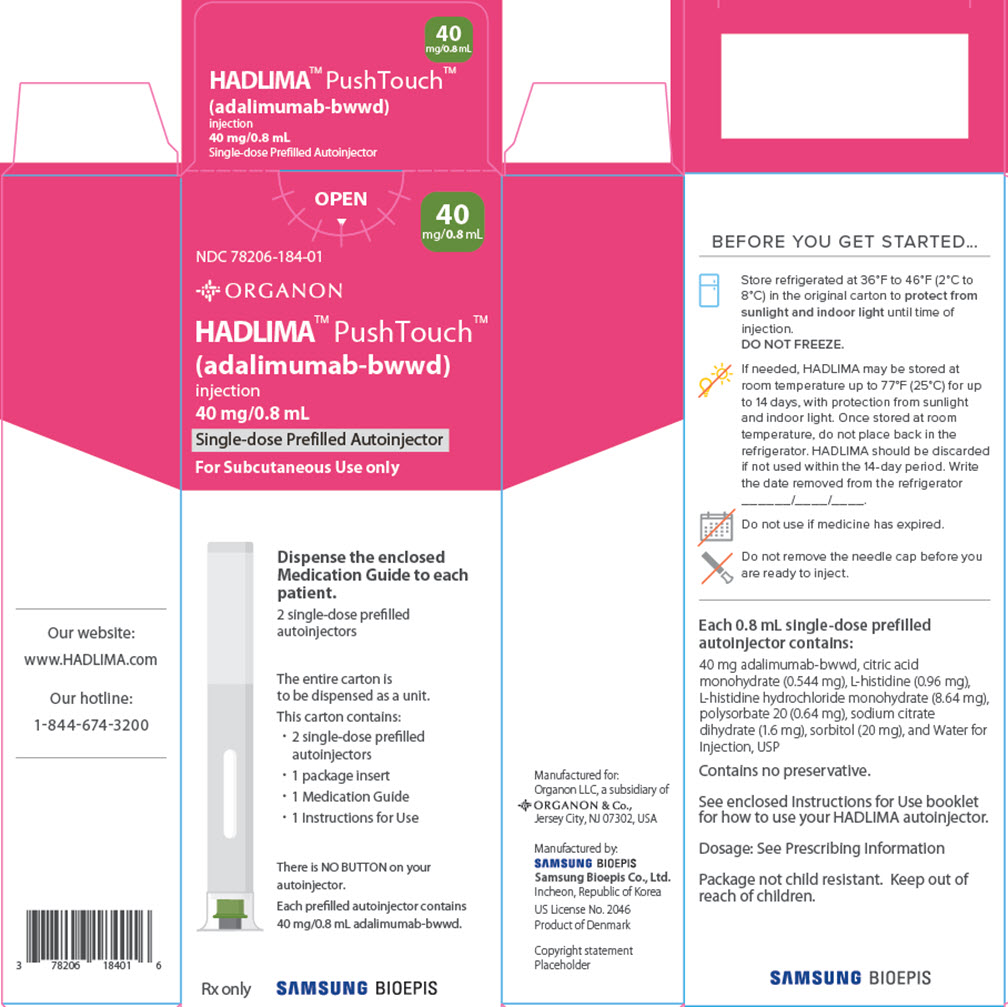
by Organon LLC · 2 CARTON in 1 CARTON / 1 SYRINGE in 1 CARTON / .8 mL in 1 SYRINGE
This is a package of Hadlima adalimumab-bwwd 40 mg/.8mL Solution from Organon LLC, marketed since Jul 2023 and currently FDA-listed; retail pharmacies pay about $623.49 per mL (NADAC). It is this product's only package size.
NDC 78206-0184-01
🏷️ FDA NDC (as labeled)78206-184-01billing pads the product segment with a zero
🗂️ FDA directory synced Oct 1, 2026 · this listing last changed Sep 24, 2026 · sources: openFDA · FDA label (DailyMed) · FDA Orange & Purple Book · First Databank · CMS NADAC, ASP, Medicare & Medicaid · RxNorm
Drug-database identifiers Medi-Span GPI and First Databank GCN / HICL / AHFS classification
GPI-146627001520D520
GCN Seq No080049
GCN46717
HICL code045894
Ingredient (HICL)Adalimumab-Bwwd
HIC1 codeS
Therapeutic class — broad (HIC1)Locomotor System
HIC2 codeS2
Therapeutic class — intermediate (HIC2)Drugs Acting Principally On Joints
HIC3 codeS2J
Therapeutic class — specific (HIC3)Anti-Inflammatory Tumor Necrosis Factor Inhibitor
AHFS code90:24.16.92
AHFS classTumor Necrosis Factor Inhibitors, Misc
FDB label nameHADLIMA PUSHTOUCH 40 MG/0.8 ML
FDB brand nameHadlima Pushtouch
Legend statusF — Federal legend — prescription drug or device
Quick answers
GSN (GCN sequence number):080049
GCN:46717
GPI-14 (Medi-Span):6627001520D520
HICL (First Databank):045894
AHFS class code:90:24.16.92
Why two NDCs?
The FDA registers this code as 78206-184-01 — a 5-3-2 layout, and that's what's printed on the package and shown on DailyMed. For insurance claims, every NDC is standardized to a uniform 11-digit 5-4-2 format by adding a zero to the product segment → 78206-0184-01. Same drug, same package — only the format differs.
Where does this data come from?
Identifiers from the FDA openFDA NDC Directory and Structured Product Labeling; RxCUI from RxNorm (NLM); GPI from Medi-Span; GCN / HIC / AHFS / legend from First Databank.
Label name HADLIMA PUSHTOUCH 40 MG/0.8 MLIngredient Adalimumab-Bwwd
📗 Our plain-language guide HelloPharmacist
It calms inflammation in conditions like rheumatoid arthritis, psoriatic arthritis, Crohn's disease, ulcerative colitis, plaque psoriasis, hidradenitis suppurativa and uveitis. Whi...
It goes under the skin of your thigh or abdomen. Rotate sites and avoid tender, bruised or red skin. You can let it warm up for 15 to 30 minutes first, with the cap on. If you miss...
Injection site redness, itching or pain is the most common. Colds, sinus infections, headache and rash are also common. These are usually mild.
Call right away for fever, chills, cough or any sign of infection, since serious infections can happen. Also call for signs of allergic reaction, new nerve or vision problems, unus...
Plain-language summary from MedlinePlus (U.S. National Library of Medicine); supplement & herbal interactions and nutrient depletion data from the Natural Medicines database; our full guide is HelloPharmacist editorial content.
A drug doesn't have one price. Each row is a different public payment system, and none is what you'd pay at the counter — that depends on your insurance. The ⓘ on each row explains what it measures.
Price system
Per mL
Per package
Retail pharmacies payNADAC · weekly
$623.493
$997.59 / 1.6 ml
Medicaid paysCMS SDUD · 12 mo
$646.42
$1,034.27 / 1.6 ml
Medicare drug plans payPart D · Q2 2026
$638.38
$1,021.40 / 1.6 ml
NADAC price history (per mL) — tap or hover for the price & month
▼ Down 1% over the last 8 months.
Where does this data come from?
NADAC (National Average Drug Acquisition Cost) is the CMS weekly pharmacy-acquisition-cost survey — what pharmacies pay. ASP (Average Sales Price) is the CMS Medicare Part B drug-payment file, published quarterly. Medicaid pays is computed by us from CMS State Drug Utilization Data (total reimbursed ÷ units, trailing 12 months) — gross of rebates and inclusive of dispensing fees, so it reflects what Medicaid paid, not an acquisition cost. Medicare drug plans pay is the median negotiated point-of-sale unit cost across plans listing this NDC in the CMS quarterly Prescription Drug Plan pricing files, before rebates. The VA pays is the federal contract price (FSS, and the statutory Big 4 ceiling where listed) from the VA National Acquisition Center pharmaceutical price file. All are free public government data; each measures a different payer, so the figures are not directly comparable.
About this product: this is a biologic. Biologics don't have small-molecule generics — competition comes from FDA-licensed biosimilars (shown above), not generics.
Where does this data come from?
Equivalents are other NDCs of the same ingredient, form and route from the openFDA NDC Directory, ranked least-expensive-first by NADAC. Therapeutic-equivalence (AB) ratings come from the FDA Orange Book; biologics use the FDA Purple Book for biosimilar & interchangeable status.
2 biosimilars and 8 interchangeables are FDA-licensed for this reference biologic — see the list below. (Biologics have no small-molecule generics.)
🛡️ Latest patent/protection date listed: Biosimilars are already FDA-licensed for this product — the last listed patent runs to Jul 2031.
📅 FDA approved Jul 23, 2019
Why the date isn’t exact: Biosimilar timing can change because patents may be challenged, settled, licensed, added or removed, and litigation can move the real date earlier or later.
FDA Purple Book — biosimilars & interchangeables
ⓘ
Source: FDA Purple Book (purplebooksearch.fda.gov), matched on the reference product’s active ingredient.
Patents & exclusivity — FDA Purple Book
Exclusivity RefProduct
2019202120232025202720292031
Today
LOE
Biologic patentExclusivity
🏛️Reference-product exclusivity
A flat 12 years of FDA market protection from first licensure. No biosimilar can be licensed before it ends — regardless of patents.
🧪Listed biologic patents
Patents the reference maker lists covering the molecule, formulation, or manufacturing. A biosimilar generally can’t launch until these resolve.
🔁Interchangeability
An interchangeable biosimilar may be substituted at the pharmacy (state laws vary). The first one can earn its own exclusivity period.
🛈 What do these terms mean?
Biologic patent
A patent the reference product’s maker has publicly listed. A biosimilar generally can’t launch until these expire — unless they’re invalidated or resolved in a settlement.
Reference-product exclusivity
A flat 12 years of FDA market protection from the biologic’s first licensure (the BPCIA). No biosimilar can be licensed before it ends, regardless of patents.
Interchangeable exclusivity
The first interchangeable biosimilar can earn a period as the only interchangeable version (pharmacists can substitute it without the prescriber).
Earliest biosimilar (LOE)
The latest of all the dates above — the soonest a biosimilar can realistically reach the market. Litigation and settlements can move it earlier.
Biologics have no small-molecule “generics” — competition comes from FDA-licensed biosimilars, tracked in the FDA Purple Book.
FDA exclusivity
Code
What it grants
Expires
RefProduct
Reference-product exclusivity (12-year, BPCIA) — no biosimilar can be licensed before this date
Jul 23, 2031
Common questions
Is there a biosimilar for HADLIMA PUSHTOUCH 40 MG/0.8 ML?
Yes — at least one FDA-licensed biosimilar is listed for this biologic. See the Purple Book family above for the available products.
Why do different websites show different biosimilar dates?
Biosimilar availability isn’t based on one single date. Some sources use the reference-product exclusivity, some use the last listed patent, and patent litigation, settlements, and licenses can all change the real-world launch date. This page shows the underlying Purple Book dates so you can see why estimates differ.
Can a biosimilar launch before the last patent expires?
Sometimes. A biosimilar maker may settle with the reference manufacturer or receive a license to launch earlier. In other cases, the last listed protection delays competition.
What does “current Purple Book estimate” mean?
It means we’re using the latest patent and exclusivity dates currently listed in the FDA Purple Book. It is not a guaranteed launch date.
What does “FDA listed” mean?
It means the product appears in the FDA’s official directory. That’s a good sign a product exists for the U.S. market, but on its own it does not confirm a pharmacy can get it today. Where we have recent retail pricing data, we label it “Availability likely” instead.
What does a patent or protection date mean here?
It’s the latest date currently listed in the FDA Purple Book for a patent or exclusivity on the reference biologic. It can affect when a biosimilar becomes widely available — but it is not a guaranteed launch date. Settlements and licenses can move the real date earlier or later.
Built from the FDA Purple Book Patent List (patents the reference-product sponsor has publicly listed under the BPCIA) plus reference-product exclusivity. Biosimilars cannot launch until these clear; patent litigation and settlements can shift the real date. Biologics have no small-molecule generics — competition comes from FDA-licensed biosimilars, not the Orange Book.
Where does this data come from?
Patents and exclusivity from the FDA Purple Book (biologics), refreshed from public FDA data. Biosimilar launch timing is an estimate, not a guarantee.
Inactive ingredients, also called excipients, are components of the drug product
other than the active ingredient. They may include fillers, dyes, coatings, preservatives, flavors,
or other formulation ingredients.
💡 Tap an ingredient (hover on desktop) to see what it is and why it’s used.
UNII 2968PHW8QP
A weak organic acid derived from citrus fruits or made through fermentation. It works as a buffer to control pH, a preservative to extend shelf life, and a flavoring agent in medications.
UNII 4QD397987E
An amino acid used as a buffer and stabilizer in medications. It helps maintain the pH balance and protects the active drug from breaking down during storage and use.
UNII X573657P6P
Histidine monohydrochloride monohydrate is an amino acid salt used as a buffer in medicines. It helps maintain the proper acidity level of liquid formulations to keep the drug stable and effective.
UNII 7T1F30V5YH
A synthetic emulsifier derived from sorbitol and oleic acid. It helps mix oil and water-based ingredients together and keeps them from separating in liquid formulations.
UNII 506T60A25R
Sorbitol is a natural sugar alcohol derived from glucose. It serves as a sweetener, humectant, and bulking agent in medications to improve taste and help maintain moisture in the product.
UNII B22547B95K
A salt derived from citric acid that helps maintain the proper acid-base balance in the medicine. It's used as a buffer to keep the product stable and at the right pH level.
6 inactive ingredients listed in the exact product block matched to this NDC.
Where does this data come from?
Data sourced from official FDA Structured Product Labeling (SPL) via DailyMed — ingredient classCode="IACT" elements from the exact product block matched by this NDC. Label-section narrative from DailyMed / the openFDA label index is shown separately when available.
Are inactive ingredients the same for every manufacturer?
No. Inactive ingredients can differ by manufacturer, dosage form, strength, and package / product version.
Why might an inactive ingredient be missing?
Some SPLs do not provide a complete structured inactive-ingredient list, and older or unusual labels may only include the information in narrative text.
Can inactive ingredients matter?
Yes. They can matter for allergies, intolerances, dyes, gluten / lactose concerns, preservatives, and formulation differences — but confirm with a pharmacist or the manufacturer when it’s clinically important.
The labeler markets the product; the application holder owns the FDA approval. They’re often the same company but can differ (e.g. a repackager or an authorized generic). A mailing address / phone appears here when the manufacturer includes it in the product’s FDA label (not all do).
Where does this data come from?
Labeler, application holder and registered establishment from the FDA openFDA NDC Directory and Drugs@FDA; address/contact from the product’s FDA label.
The complete FDA label for this product — the official prescribing information, verbatim, section by section. Jump with a chip, search within the label, or expand everything.
No FDA label is on file for this product yet. Labels load from openFDA / DailyMed and refresh weekly.
No label section mentions that — try another word, or open the full label on DailyMed below.
Source: FDA Structured Product Labeling, mirrored from DailyMed / openFDA.
Prefer the government’s original formatting? View this label on DailyMed ↗
Medicaid utilization & spend
📍 This exact package only: Medicaid data is reported per full 11-digit NDC — labeler, product and pack size — so every number here is for this package alone, not the drug overall. Other pack sizes report separately.
💊 Pharmacy benefit only: These are Medicaid outpatient pharmacy claims, billed by NDC. They exclude the medical benefit — clinic- or hospital-administered drugs billed under HCPCS J-codes — so drugs used mostly that way (e.g. Avastin, Lucentis, Keytruda) can look low or missing here. That’s expected, not an error.
📅 Q1 2025 – Q1 2026 · 5 quarters of data
ⓘ The newest quarter is usually incomplete when first published; states restate recent quarters in later CMS releases, so the latest figures typically revise upward. State coverage-policy changes can also shift quarter-to-quarter totals.
Prescriptions last 4 qtrs
4.3K
Units reimbursed last 4 qtrs
8.6K
Gross reimbursed last 4 qtrs
$5.53M
Avg / prescription
$1,297.23
Avg / unit
$646.42
Latest quarter Q1 2026
1.3KRx
Medicaid pays / mL
$646.42
gross reimbursed
vs
NADAC / mL
$623.49
acquisition cost
=
Spread
+$22.9235
+4% vs cost
What Medicaid paid per mL (before rebates; includes the pharmacy’s dispensing fee) compared with NADAC — the average price pharmacies pay to buy the drug. A positive spread means Medicaid reimbursed more than the purchase price, before manufacturer rebates.
Fee-for-service vs managed care ⓘ
91% MCO
Fee-for-service · 392 Rx Managed care · 3,873 Rx
State Medicaid map
Units reimbursed · per 100k residents
0.424.7
gray = no data reported ⓘ
Colors are per 100,000 residents, so big states don’t automatically dominate. Tap or hover a state for its actual totals.
Tap or hover a state
…for its Medicaid breakdown
Prescriptions—
Units—
Reimbursed—
🏆 Top states by units · per 100k residents
1D.C.24.7 /100k
2Rhode Island23.7 /100k
3Arizona22.7 /100k
4New Jersey16.9 /100k
5Nevada15.4 /100k
6Maryland10.6 /100k
7Utah8.8 /100k
8New Mexico8.7 /100k
National units — by quarter
💵 About the dollar figures: “reimbursed” is what Medicaid paid pharmacies before confidential manufacturer rebates, so the program’s real net cost is lower than these numbers. Fee-for-service and managed-care claims are combined unless split above. Source: CMS State Drug Utilization Data; per-100k rates use 2023 Census population estimates.
Medicare Part D spend CMS · PART D · 2026 (Q1)
Medicare Part D (outpatient prescription) spending for Hadlima — the program that covers self-administered drugs. 1 manufacturer.
⚠️ Drug-level data: CMS publishes Part D spending by drug, not by NDC — these figures combine every manufacturer, strength and package size sold under the name Hadlima. That’s a different level of aggregation than the Medicaid card above, which is specific to this exact 11-digit NDC (pack size included), so the two aren’t directly comparable.
Period
Total Part D spend
$663.1K
Claims incl. refills
529
Beneficiaries
273
Spend / beneficiary
$2,429.10
Spend / claim
$1,253.58
Trend by period
💵 About the dollar figures: spending is what Part D plans paid before confidential manufacturer rebates, so the program’s real net cost is lower. A blank patient count means fewer than 11 people — CMS hides counts that small to protect privacy. Source: CMS Medicare Quarterly Part D Spending by Drug (data.cms.gov), updated quarterly.
For educational and professional reference only — not medical advice. Pricing reflects published
NADAC and CMS ASP (free public data) and may differ from your acquisition cost; always verify before billing or dispensing.