
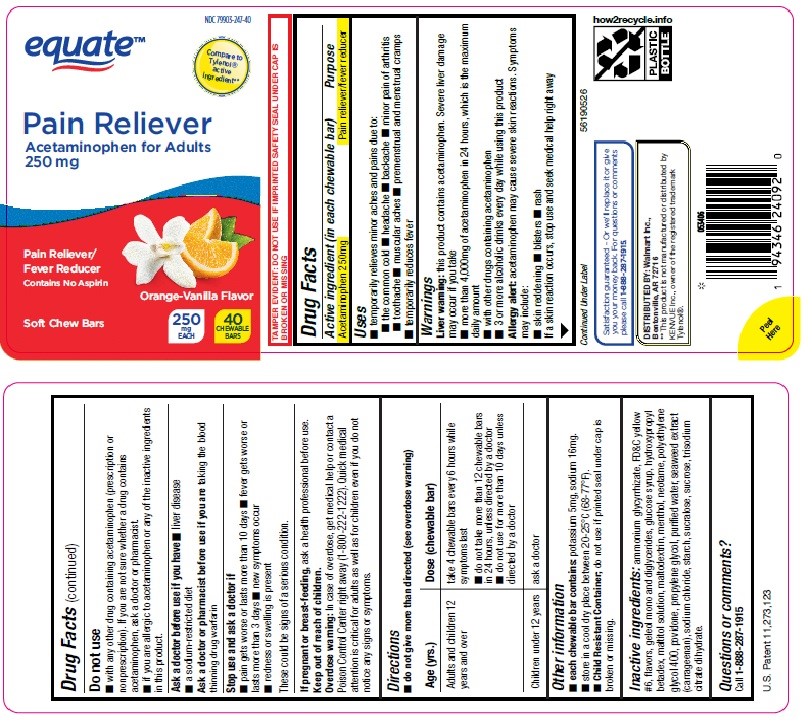
Equate Pain Reliever Acetaminophen for Adults 250 mg 250 mg Bar, Chewable, 40-count — NDC 79903-247-40 (Billing 79903-0247-40)
This is a package of 40 bars of Equate Pain Reliever Acetaminophen for Adults 250 mg 250 mg Bar, Chewable from Walmart Inc, marketed since Jun 2024 and currently FDA-listed. It is this product's only package size.
Other active recalls for Acetaminophen (different manufacturers) — 6 · tap to view
Identity & classification
Regulatory identifiers FDA, NLM and CMS codes for this package
- RxCUI (RxNorm): 2683419
Where does this data come from?
- FDA openFDA NDC Directory · synced Oct 1, 2026
- FDA label on DailyMed · label index refreshed Oct 1, 2026
- RxNorm (NLM RxNav) · catalog refreshed Oct 1, 2026
- Medi-Span GPI (licensed)
- First Databank (licensed) · refreshed Oct 1, 2026
RxNorm drug class
This medicine belongs to the Anilides class.
Where does this data come from?
- RxClass (NLM) · catalog refreshed Oct 1, 2026
Clinical
Acetaminophen is used to relieve mild to moderate pain and to reduce fever. Acetaminophen is in a class of medications called analgesics (pain relievers) and antipyretics (fever reducers). It works by changing the way the body senses pain and by cooling the body.
Read the full MedlinePlus article ↗- It temporarily relieves minor aches and pains, like headache, backache, toothache, muscle aches, cold aches, minor arthritis pain and menstrual cramps. It also reduces fever.
- Follow your product label or prescriber exactly and never exceed the maximum daily amount. Remember that the limit counts every product with acetaminophen. Too much can seriously d...
- Check the label first. Many combination products also contain acetaminophen, and you shouldn't use two together. If you aren't sure, ask me or your pharmacist.
- Having 3 or more alcoholic drinks every day while using it raises the risk of liver damage. If you take warfarin, talk with your doctor or pharmacist first, since regular high dail...
Patient education
Supplement & herbal interactions
Some supplements/herbs that may interact with Acetaminophen — tap one for details:
Acetaminophen may be associated with lower levels of 1 nutrient — worth a chat with your pharmacist, not a cause for alarm.
Where does this data come from?
- MedlinePlus (NLM) · refreshed Oct 1, 2026
- FDA label on DailyMed · label index refreshed Oct 1, 2026
Ask a licensed pharmacist directly — free, answered by our team.
Pricing
A drug doesn't have one price. Each row is a different public payment system, and none is what you'd pay at the counter — that depends on your insurance. The ⓘ on each row explains what it measures.
| Price system | Per each | Per package |
|---|---|---|
| Retail pharmacies payNADAC · weekly | Not in the retail survey — common for institutional, discontinued, or low-volume packs. | |
| Medicaid paysCMS SDUD · 12 mo | No recent Medicaid claims on file for this NDC — rare and low-volume NDCs are suppressed in the public data. | |
| Medicare drug plans payPart D · quarterly | No Part D plan price is available for this NDC in our data. | |
Where does this data come from?
- CMS NADAC weekly file
- CMS ASP pricing files · refreshed Sep 20, 2026
- CMS Medicaid State Drug Utilization Data · refreshed Oct 3, 2026
- CMS Part D plan pricing files · refreshed Sep 24, 2026
- VA National Acquisition Center price file
Packaging — all sizes for this product
| Package NDC | Description | Marketing start | Marketing end | Status |
|---|---|---|---|---|
| 79903-0247-40 You're viewing this Main listing | 40 BAR, CHEWABLE in 1 BOTTLE | 2024-06-01 | — | Active |
Therapeutic equivalents
| Product | Labeler | Pack | NADAC/unit | TE | Status | Price vs. this |
|---|---|---|---|---|---|---|
| Equate Pain Reliever Acetaminophen for Adults 250 mg 79903-0238-40 | Walmart | 40 bars | — | — | FDA listed | — |
| Equate Pain Reliever Acetaminophen for Adults 250 mgthis 79903-0247-40 | Walmart | 40 bars | — | — | FDA listed | — |
Where does this data come from?
- FDA openFDA NDC Directory · synced Oct 1, 2026
- FDA Orange Book · refreshed Sep 3, 2026
- CMS NADAC weekly file
Availability & generic status
We did not find an FDA-approved generic match for this exact strength, form and route.
Where does this data come from?
- FDA Orange Book · refreshed Sep 3, 2026
What it looks like
Where does this data come from?
- FDA label on DailyMed · label index refreshed Oct 1, 2026
Inactive Ingredients / Excipients
Inactive ingredients, also called excipients, are components of the drug product other than the active ingredient. They may include fillers, dyes, coatings, preservatives, flavors, or other formulation ingredients.
💡 Tap an ingredient (hover on desktop) to see what it is and why it’s used.
-
UNII 3VRD35U26C
A natural extract from licorice root, ammonium glycyrrhizate is used as a flavoring agent and sweetener in medicines. It may also help soothe irritated tissues in the mouth or throat.
-
UNII 5C69YCD2YJ
Carrageenan is a natural thickener and stabilizer extracted from red seaweed. It's used in medicines to create gel-like textures, improve consistency, and help keep ingredients from separating during storage.
-
UNII 9G5L16BK6N
A thick, sweet liquid made from corn starch. It acts as a sweetener, thickener, and binder in medicines, helping create the right texture and taste while holding ingredients together.
-
UNII H77VEI93A8
A synthetic yellow dye used to color medications. It helps identify the drug and make it visually distinctive, with no effect on how the medicine works.
-
UNII KC98RO82HJ
A waxy substance made from glycerin and fatty acids. It acts as an emulsifier to help mix oil and water components, and as a thickener to give the medicine proper texture and consistency.
-
UNII 1I96OHX6EK
A cyclic carbohydrate derived from plant starch that acts as a solubilizer and stabilizer. It helps dissolve poorly water-soluble drugs and protects active ingredients from degradation in the formulation.
-
UNII BZ1R15MTK7
Levomenthol is the left-handed form of menthol, a natural cooling compound from mint plants. It's used in medicines as a flavoring agent and to provide a cooling sensation on the skin or mucous membranes.
-
UNII D65DG142WK
Maltitol is a sugar alcohol made by hydrogenating maltose. It's used as a sweetener and filler in medicines to improve taste and add bulk to tablets and capsules.
-
UNII 7CVR7L4A2D
A starch-derived carbohydrate produced by breaking down corn, potato, or tapioca starch. It functions as a filler and binder to give the medicine bulk and texture, and sometimes as a mild sweetener or texture enhancer in powders and tablets.
-
UNII VJ597D52EX
Neotame is a synthetic sweetener made from aspartame. It's used in medicines to improve taste, making bitter or unpleasant-tasting drugs easier to take.
-
UNII B697894SGQ
Polyethylene glycol 400 is a clear, thick liquid made from petroleum-derived polymers. It acts as a solvent and humectant in medicines, helping dissolve active ingredients and retain moisture in the formulation.
-
UNII U725QWY32X
Povidone K30 is a synthetic polymer made from petroleum. It acts as a binder to hold tablet ingredients together and as a disintegrant to help the tablet break apart in the stomach so the medicine can be absorbed.
-
UNII 6DC9Q167V3
Propylene glycol is a clear liquid derived from petroleum or vegetable sources. It acts as a solvent, humectant, and preservative in medicines, helping dissolve active ingredients and maintain product stability.
-
UNII 451W47IQ8X
Sodium chloride is common table salt. It's used in medicines as a buffer to maintain proper pH, as a filler to add bulk, or to adjust the osmotic balance in liquid formulations.
-
UNII O8232NY3SJ
A plant-based carbohydrate derived from corn kernels. It acts as a filler to add bulk, a binder to hold ingredients together, and a disintegrant to help the tablet break apart in your stomach for absorption.
-
UNII 96K6UQ3ZD4
Sucralose is a synthetic sweetener made from sugar. It's added to medicines to improve taste without adding calories, helping make bitter or unpleasant-tasting drugs easier to take.
-
UNII C151H8M554
A natural sugar derived from sugar cane or sugar beets. It's used as a sweetener, filler, and binder to improve taste, add bulk, and help hold tablet or capsule ingredients together.
-
UNII B22547B95K
A salt derived from citric acid that helps maintain the proper acid-base balance in the medicine. It's used as a buffer to keep the product stable and at the right pH level.
-
UNII 059QF0KO0R
Water is a liquid solvent that dissolves and mixes ingredients together in liquid medicines, syrups, and injections. It helps distribute the active drug evenly throughout the product.
19 inactive ingredients listed in the exact product block matched to this NDC.
Label-section wording can be broader than the structured product block and may mention additional formulation ingredients.
Where does this data come from?
ingredient classCode="IACT" elements from the exact product block matched by this NDC. Label-section narrative from DailyMed / the openFDA label index is shown separately when available.- FDA label on DailyMed · label index refreshed Oct 1, 2026
- FDA openFDA NDC Directory · synced Oct 1, 2026
Inactive ingredient FAQ
Are inactive ingredients the same for every manufacturer?
Why might an inactive ingredient be missing?
Can inactive ingredients matter?
Manufacturer & labeler
Where does this data come from?
- FDA openFDA NDC Directory · synced Oct 1, 2026
- Drugs@FDA
FDA label — Drug Facts FDA SPL
🎯 Indications and Usage ▾
Uses temporarily relieves minor aches and pains due to: the common cold headache backache minor pain of arthritis toothache muscular aches premenstrual and menstrual cramps temporarily reduces fever
⏱️ Dosage and Administration ▾
Directions do not give more than directed (see overdose warning) Age (yrs.) Dose (chewable bar) Adults and children 12 years and over take 4 chewable bars every 6 hours while symptoms last do not take more than 12 chewable bars in 24 hours, unless directed by a doctor do not use for more than 10 days unless directed by a doctor Children under 12 years ask a doctor
⚠️ Warnings ▾
Warnings Liver warning: this product contains acetaminophen. Severe liver damage may occur if you take more than 4,000mg of acetaminophen in 24 hours, which is the maximum daily amount with other drugs containing acetaminophen 3 or more alcoholic drinks every day while using this product. Allergy alert : acetaminophen may cause severe skin reactions.
Symptoms may include: skin reddening blisters rash If a skin reaction occurs, stop use and seek medical help right away Do not Use with any other drug containing acetaminophen (prescription or nonprescription). If you are not sure whether a drug contains acetaminophen, ask a doctor or pharmacist. if you are allergic to acetaminophen or any of the inactive ingredients in this product. Ask a doctor before use if you have liver disease a sodium-restricted diet Ask a doctor or pharmacist before use if you are taking the blood thinning drug warfarin Stop use and ask a doctor if pain gets worse or lasts more than 10 days fever gets worse or lasts more than 3 days new symptoms occur redness or swelling is present These could be signs of a serious condition.
If pregnant or breast-feeding, ask a health professional before use. Keep out of reach of children. Overdose warning: In case of overdose, get medical help or contact a Poison Control Center right away (1-800-222-1222).
Quick medical attention is critical for adults as well as for children even if you do not notice any signs or symptoms.
🆘 Overdosage ▾
Overdose warning: In case of overdose, get medical help or contact a Poison Control Center right away (1-800-222-1222). Quick medical attention is critical for adults as well as for children even if you do not notice any signs or symptoms.
🧪 Active Ingredient ▾
Active ingredient (in each chewable bar) Acetaminophen 250mg
🧪 Inactive Ingredients ▾
Inactive ingredients: ammonium glycyrrhizate, FD & C yellow #6, flavors, geleol mono and diglycerides, glucose syrup, hydroxypropyl betadex, maltitol solution, maltodextrin, menthol, neotame, polyethylene glycol 400, povidone, propylene glycol, purified water, seaweed extract (carrageenan), sodium chloride, starch, sucralose, sucrose, trisodium citrate dihydrate.
🎯 Purpose ▾
Purpose Pain reliever/fever reducer
📄 Do Not Use ▾
Do not Use with any other drug containing acetaminophen (prescription or nonprescription). If you are not sure whether a drug contains acetaminophen, ask a doctor or pharmacist. if you are allergic to acetaminophen or any of the inactive ingredients in this product.
📄 Ask a Doctor Before Use If ▾
Ask a doctor before use if you have liver disease a sodium-restricted diet
📄 Ask a Doctor or Pharmacist Before Use If ▾
Ask a doctor or pharmacist before use if you are taking the blood thinning drug warfarin
📄 Stop Use and Ask a Doctor If ▾
Stop use and ask a doctor if pain gets worse or lasts more than 10 days fever gets worse or lasts more than 3 days new symptoms occur redness or swelling is present These could be signs of a serious condition.
🤰 If Pregnant or Breast-Feeding ▾
If pregnant or breast-feeding, ask a health professional before use.
📄 Keep Out of Reach of Children ▾
Keep out of reach of children.
📄 Questions or Comments ▾
Questions or comments? Call 1-888-287-1915
📄 Package Label / Principal Display Panel ▾
Principal Display Panel - Equate Pain Reliever Acetaminophen for Adults 250 mg-Orange Vanilla Flavor NDC 79903-247-40 equate™ Compare to Tylenol ® active ingredient** Pain Reliever Acetaminophen for Adults 250 mg Pain Reliever/Fever Reducer Contains No Aspirin Soft Chew Bars Orange Vanilla Flavor 250 mg EACH 40 CHEWABLE BARS TAMPER EVIDENT: DO NOT USE IF IMPRINTED SAFETY SEAL UNDER CAP IS BROKEN OR MISSING. Equate Pain Reliever Acetaminophen for Adults 250 mg
Medicare Part D spend CMS · PART D · 2026 (Q1)
Reported adverse events (FAERS)
Top reported reactions
Age at onset
Reporter sex
Serious outcomes
Where does this data come from?
About this NDC listing & data coverage
What data is (and isn’t) available for this NDC — tap to expand
| NDC identity (package / product / labeler codes) | ✓ Available |
| Labeler | ✓ Available |
| Product & package description | ✓ Available |
| Marketing category & status | ✓ Available |
| Active ingredient / dosage form / route | ✓ Available |
| FDA label (SPL via DailyMed) | ✓ Available |
| Package photos | ✓ Available |
| Inactive ingredients (structured) | ✓ Available |
| NADAC pharmacy acquisition price (CMS) | — Not published for this NDC CMS publishes NADAC only for NDCs reported in its retail-pharmacy survey. |
| Orange Book / therapeutic-equivalence data | — Not published for this NDC Applies only to products approved under an NDA/ANDA; many listings are out of scope. |
| HCPCS J-code billing crosswalk | — Not published for this NDC Most self-administered / retail products have no J-code — that is normal. |
| Medicaid utilization (CMS SDUD) | — Not published for this NDC CMS reports utilization only for NDCs with Medicaid claims above its privacy threshold. |