
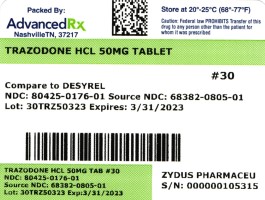
Trazodone HCl 50 mg Tablet, 60-count — NDC 80425-0176-2 (Billing 80425-0176-02)
This is a package of 60 tablets of Trazodone HCl 50 mg Tablet from Advanced Rx Pharmacy of Tennessee, LLC, marketed since Dec 2017 and currently FDA-listed.
NDC database record
One package, one record: these facts belong to NDC 80425-0176-2 alone.
- Record
- FDA NDC Directory package listing · Human prescription drug
- Code segments
- 80425 labeler · 0176 product · 2 package
- Package marketed since
- Mar 31, 2023
- Sample package
- No — commercial package
- Listing certified through
- Dec 31, 2026
- Billing quantity
- 60 EA per package
- Barcode (UPC-A, from the NDC)
- 3 8042501762 4
- FDA record last changed
- Jul 24, 2026
Identity & classification
Regulatory identifiers FDA, NLM and CMS codes for this package
Drug-database identifiers Medi-Span GPI and First Databank GCN / HICL / AHFS classification
- GSN (GCN sequence number): 046241
- GCN: 16391
- HICL (First Databank): 001652
- AHFS class code: 28:16.04.24
- RxCUI (RxNorm): 856377
Where does this data come from?
- FDA openFDA NDC Directory · synced Oct 8, 2026
- FDA label on DailyMed · label index refreshed Oct 8, 2026
- RxNorm (NLM RxNav) · catalog refreshed Oct 1, 2026
- Medi-Span GPI (licensed)
- First Databank (licensed) · refreshed Oct 8, 2026
RxNorm drug class
This medicine belongs to the Serotonin Reuptake Inhibitor class.
Where does this data come from?
- RxClass (NLM) · catalog refreshed Oct 1, 2026
Clinical
- It treats major depressive disorder in adults. It comes as tablets and as Raldesy oral solution. Your prescriber will decide if it's right for you.
- Take it by mouth shortly after a meal or light snack, in divided doses as directed. If it makes you drowsy, your prescriber may have you take most of the dose at bedtime. Follow th...
- Please don't stop suddenly. The dose should be lowered gradually, and your prescriber will guide you.
- Drowsiness, dizziness, dry mouth, blurred vision, fatigue, headache and nausea are common. Stand up slowly, and use caution driving until you know how it affects you. Call your doc...
Patient education
Supplement & herbal interactions
Some supplements/herbs that may interact with Trazodone HCl — tap one for details:
Trazodone HCl may be associated with lower levels of 1 nutrient — worth a chat with your pharmacist, not a cause for alarm.
Where does this data come from?
- MedlinePlus (NLM) · refreshed Oct 8, 2026
- FDA label on DailyMed · label index refreshed Oct 8, 2026
Ask a licensed pharmacist directly — free, answered by our team.
Pricing
A drug doesn't have one price. Each row is a different public payment system, and none is what you'd pay at the counter — that depends on your insurance. The ⓘ on each row explains what it measures.
| Price system | Per each | Per package |
|---|---|---|
| Retail pharmacies payNADAC · weekly | Not in the retail survey — common for institutional, discontinued, or low-volume packs. | |
| Medicaid paysCMS SDUD · 12 mo | No recent Medicaid claims on file for this NDC — rare and low-volume NDCs are suppressed in the public data. | |
| Medicare drug plans payPart D · Q2 2026 | $0.2383 | $14.30 / 60 tablets |
Where does this data come from?
- CMS NADAC weekly file
- CMS ASP pricing files · refreshed Sep 20, 2026
- CMS Medicaid State Drug Utilization Data · refreshed Oct 8, 2026
- CMS Part D plan pricing files · refreshed Sep 24, 2026
- VA National Acquisition Center price file
Packaging — all sizes for this product
| Package NDC | Description | Marketing start | Marketing end | Status |
|---|---|---|---|---|
| 80425-0176-01 80425-0176-1 Main listing | 30 TABLET in 1 BOTTLE | 2017-12-11 | — | Active |
| 80425-0176-02 You're viewing this | 60 TABLET in 1 BOTTLE | 2023-03-31 | — | Active |
You're viewing the largest of 2 pack sizes for this product.
Pack size FAQ
What quantity is in this package?
How does this package differ from NDC 80425-0176-01?
What NDC number is used to bill for this package of Trazodone HCl 50 mg Tablet?
Therapeutic equivalents
| Product | Labeler | Pack | NADAC/unit | TE | Status | Price vs. this |
|---|---|---|---|---|---|---|
| Trazodone Hydrochloride 50 mg 00904-6868-61 | Major | 100 tablets | $0.031 | AB | Availability likely | — |
| Trazodone Hydrochloride 50 mg 13107-0079-01 | Aurolife | 100 tablets | $0.031 | AB | Availability likely | — |
| Trazodone Hydrochloride 50 mg 13668-0330-01 | Torrent | 100 tablets | $0.031 | AB | Availability likely | — |
| Trazodone Hydrochloride 50 mg 50111-0560-01 | Teva | 100 tablets | $0.031 | AB | Availability likely | — |
| Trazodone Hydrochloride 50 mg 57664-0014-72 | Sun | 100 tablets | $0.031 | AB | Availability likely | — |
| Trazodone Hydrochloride 50 mg 60687-0443-01 | American | 100 tablets | $0.031 | AB | Availability likely | — |
| Trazodone Hydrochloride 50 mg 64980-0672-01 | Rising | 100 tablets | $0.031 | AB | Availability likely | — |
| Trazodone Hydrochloride 50 mg 68382-0609-01 | Zydus | 100 tablets | $0.031 | AB | Availability likely | — |
| Trazodone Hydrochloride 50 mg 68382-0805-01 | Zydus | 100 tablets | $0.031 | AB | Availability likely | — |
| Trazodone Hydrochloride 50 mg 70010-0231-01 | Granules | 100 tablets | $0.031 | AB | Availability likely | — |
| Trazodone Hydrochloride 50 mg 16729-0299-01 | Accord | 100 tablets | $0.033 | AB | Availability likely | — |
| Trazodone Hydrochloride 50 mg 00615-8371-05 | NCS | 15 tablets | — | AB | Discontinued | — |
| Trazodone Hydrochloride 50 mg 42291-0868-10 | AvKARE | 1000 tablets | — | AB | FDA listed | — |
| Trazodone Hydrochloride 50 mg 45865-0167-30 | Medsource | 30 tablets | — | AB | FDA listed | — |
| Trazodone Hydrochloride 50 mg 50090-5218-00 | A-S | 30 tablets | — | AB | FDA listed | — |
| Trazodone Hydrochloride 50 mg 50090-6603-00 | A-S | 90 tablets | — | AB | FDA listed | — |
| Trazodone Hydrochloride 50 mg 50090-7943-00 | A-S | 30 tablets | — | AB | FDA listed | — |
| Trazodone Hydrochloride 50 mg 50090-7944-00 | A-S | 90 tablets | — | AB | FDA listed | — |
| Trazodone Hydrochloride 50 mg 51407-0946-01 | Golden | 100 tablets | — | AB | FDA listed | — |
| Trazodone Hydrochloride 50 mg 51655-0366-26 | Northwind | 90 tablets | — | AB | FDA listed | — |
| Trazodone Hydrochloride 50 mg 55154-8087-00 | Cardinal | 10 tablets | — | AB | FDA listed | — |
| Trazodone Hydrochloride 50 mg 60505-2653-00 | Apotex | 100 tablets | — | AB | FDA listed | — |
| Trazodone Hydrochloride 50 mg 67046-1506-03 | Coupler | 30 tablets | — | AB | FDA listed | — |
| Trazodone Hydrochloride 50 mg 68071-2996-09 | NuCare | 90 tablets | — | AB | FDA listed | — |
| Trazodone Hydrochloride 50 mg 68071-4410-02 | NuCare | 20 tablets | — | AB | FDA listed | — |
| Trazodone Hydrochloride 50 mg 68788-7118-01 | Preferred | 100 tablets | — | AB | FDA listed | — |
| Trazodone Hydrochloride 50 mg 69584-0884-10 | Oxford | 100 tablets | — | AB | FDA listed | — |
| Trazodone Hydrochloride 50 mg 70518-2929-00 | REMEDYREPACK | 30 tablets | — | AB | FDA listed | — |
| Trazodone Hydrochloride 50 mg 70518-3290-01 | REMEDYREPACK | 30 tablets | — | AB | Discontinued | — |
| Trazodone Hydrochloride 50 mg 70518-4363-00 | REMEDYREPACK | 60 tablets | — | AB | FDA listed | — |
| Trazodone Hydrochloride 50 mg 70518-4441-00 | REMEDYREPACK | 30 tablets | — | AB | FDA listed | — |
| Trazodone Hydrochloride 50 mg 70771-1128-00 | Zydus | 1000 tablets | — | AB | FDA listed | — |
| Trazodone Hydrochloride 50 mg 70771-1938-00 | Zydus | 1000 tablets | — | AB | FDA listed | — |
| Trazodone Hydrochloride 50 mg 71205-0505-30 | Proficient | 30 tablets | — | AB | FDA listed | — |
| Trazodone Hydrochloride 50 mg 71205-0551-30 | Proficient | 30 tablets | — | AB | FDA listed | — |
| Trazodone Hydrochloride 50 mg 71205-0568-30 | Proficient | 30 tablets | — | AB | FDA listed | — |
| Trazodone Hydrochloride 50 mg 71335-0705-00 | Bryant | 14 tablets | — | AB | FDA listed | — |
| Trazodone Hydrochloride 50 mg 71335-1575-00 | Bryant | 14 tablets | — | AB | Discontinued | — |
| Trazodone Hydrochloride 50 mg 71335-2651-00 | Bryant | 14 tablets | — | AB | FDA listed | — |
| Trazodone Hydrochloride 50 mg 71610-0514-30 | Aphena | 30 tablets | — | AB | FDA listed | — |
| Trazodone Hydrochloride 50 mg 71610-0525-15 | Aphena | 15 tablets | — | AB | FDA listed | — |
| Trazodone Hydrochloride 50 mg 71610-0529-30 | Aphena | 30 tablets | — | AB | FDA listed | — |
| Trazodone Hydrochloride 50 mg 71610-0874-30 | Aphena | 30 tablets | — | AB | FDA listed | — |
| Trazodone Hydrochloride 50 mg 72789-0154-30 | PD-Rx | 30 tablets | — | AB | FDA listed | — |
| Trazodone Hydrochloride 50 mg 76420-0672-01 | Asclemed | 100 tablets | — | AB | FDA listed | — |
| Trazodone Hcl 50 mgthis 80425-0176-02 | Advanced | 60 tablets | — | AB | FDA listed | — |
| Trazodone Hydrochloride 50 mg 80425-0326-01 | Advanced | 30 tablets | — | AB | FDA listed | — |
| Trazodone Hydrochloride 50 mg 80425-0502-01 | Advanced | 30 tablets | — | AB | FDA listed | — |
Where does this data come from?
- FDA openFDA NDC Directory · synced Oct 8, 2026
- FDA Orange Book · refreshed Oct 3, 2026
- CMS NADAC weekly file
Availability & generic status
This product is an FDA-approved generic. Other versions of the same drug are listed under Therapeutic equivalents, least expensive first.
Where does this data come from?
- FDA Orange Book · refreshed Oct 3, 2026
Inactive Ingredients / Excipients
Inactive ingredients, also called excipients, are components of the drug product other than the active ingredient. They may include fillers, dyes, coatings, preservatives, flavors, or other formulation ingredients.
🧪 Avoiding an ingredient? See Trazodone inactive ingredients by manufacturer: every current product's list side by side, so you can ask your pharmacy for the version that does not list it.
Where does this data come from?
IACT rows and label-wide narrative are kept separate; availability and product-level specificity depend on the submitted label.- FDA label on DailyMed · label index refreshed Oct 8, 2026
- FDA openFDA NDC Directory · synced Oct 8, 2026
Inactive ingredient FAQ
Are inactive ingredients the same for every manufacturer?
Why might an inactive ingredient be missing?
Can inactive ingredients matter?
Manufacturer & labeler
More NDCs from Advanced Rx Pharmacy of Tennessee, LLC labeler code 80425
- Pregabalin 100 mg Capsule NDC 80425-0170-3
- Methocarbamol 750 mg Tablet, Film Coated NDC 80425-0171-1
- Amitriptyline HCL 10 mg Tablet, Film Coated NDC 80425-0172-1
- Hydroxyzine HCL 50 mg Tablet, Film Coated NDC 80425-0173-1
- Lansoprazole DR 30 mg Capsule, Delayed Release NDC 80425-0174-1
- Naproxen 375 mg Tablet NDC 80425-0175-2
- Pregabalin 300 mg Capsule NDC 80425-0177-1
- Pregabalin 150 mg Capsule NDC 80425-0178-1
- Pantoprazole Sodium DR 20 mg Tablet, Delayed Release NDC 80425-0179-2
- Amoxicillin and Clavulanate Potassium 125 mg; 875 mg Tablet, Film Coated NDC 80425-0180-1
- Etodolac ER 600 mg Tablet, Extended Release NDC 80425-0181-1
- Gabapentin 300 mg Capsule NDC 80425-0182-1
Where does this data come from?
- FDA openFDA NDC Directory · synced Oct 8, 2026
- Drugs@FDA
Full prescribing information FDA SPL
🚨 Boxed Warning ▾
Boxed Warning WARNING: SUICIDAL THOUGHTS AND BEHAVIORS Antidepressants increased the risk of suicidal thoughts and behaviors in pediatric and young adult patients in short-term studies. Closely monitor all antidepressant-treated patients for clinical worsening, and for emergence of suicidal thoughts and behaviors [see Warnings and Precautions (5.1)]. Trazodone is not approved for use in pediatric patients [see Use in Specific Populations (8.4)].
🎯 Indications and Usage ▾
1. Indications and Usage Trazodone hydrochloride tablets are indicated for the treatment of major depressive disorder (MDD) in adults.
⏱️ Dosage and Administration ▾
2. Dosage and Administration
2.1Dose Selection An initial dose of 150 mg/day in divided doses is suggested. The dosage should be initiated at a low-dose and increased gradually, noting the clinical response and any evidence of intolerance. Occurrence of drowsiness may require the administration of a major portion of the daily dose at bedtime or a reduction of dosage.
The dose may be increased by 50 mg/day every 3 to 4 days. The maximum dose for outpatients usually should not exceed 400 mg/day in divided doses. Inpatients (i.e., more severely depressed patients) may be given up to but not in excess of 600 mg/day in divided doses.
Once an adequate response has been achieved, dosage may be gradually reduced, with subsequent adjustment depending on therapeutic response.
2.2Improtant Administration Instructions Trazodone hydrochloride tablets can be swallowed whole or administered as a half tablet by breaking the tablet along the score line. Trazodone hydrochloride tablets should be taken shortly after a meal or light snack.
2.3Screen for Bipolar Disorder Prior to Starting Trazodone Prior to initiating treatment with trazodone hydrochloride tablets or another antidepressant, screen patients for a personal or family history of bipolar disorder, mania, or hypomania [see Warnings and Precautions (5.7)].
2.4Switchning to or from Monoamine Oxidase Inhibitor Antidepressant At least 14 days must elapse between discontinuation of a monoamine oxidase inhibitor (MAOI) antidepressant and initiation of trazodone hydrochloride tablets. In addition, at least 14 days must elapse after stopping trazodone hydrochloride tablets before starting an MAOI antidepressant [see Contraindications (4), Warnings and Precautions (5.2)].
2.5Dosage Recommendations for Concomitant Use with Strong CYP3A4 Inhibitors or Inducers Coadministration with Strong CYP3A4 Inhibitors Consider reducing trazodone dose based on tolerability when trazodone is coadministered with a strong CYP3A4 inhibitor [see Drug Interactions (7.1)]. Coadministration with Strong CYP3A4 Inducers Consider increasing trazodone dose based on therapeutic response when trazodone is coadministered with a strong CYP3A4 inducer [see Drug Interactions (7.1)].
2.6Discontinuation of Treatment with Trazodone Adverse reactions may occur upon discontinuation of trazodone [See Warnings and Precautions (5.8)]. Gradually reduce the dosage rather than stopping trazodone abruptly whenever possible.
💊 Dosage Forms and Strengths ▾
3. Dosage Forms and Strengths Trazodone hydrochloride tablets, USP are available in the following strengths: Trazodone hydrochloride tablets USP, 50 mg are white to off-white, round-shape, biconvex beveled tablets, bisect on one side and plain on other side. The bisected side of tablet is debossed with '8' on upper side of bisect and '05' on lower side of bisect.
Trazodone hydrochloride tablets USP, 100 mg are white to off-white, round-shape, biconvex beveled tablets, bisect on one side and plain on other side. The bisected side of tablet is debossed with '8' on upper side of bisect and '06' on lower side of bisect. Trazodone hydrochloride tablets USP, 150 mg are white to off-white, oval-shape, flat faced beveled tablets having one full bisect and two trisect notches on one side and two trisects on other side.
The full bisected side of tablet is debossed with '8' on one side of bisect and '07' on other bisect segments. Trazodone hydrochloride tablets USP, 300 mg are white to off-white, oval-shape, flat faced beveled tablets having one full bisect and two trisect notches on one side and two trisects on other side. The full bisected side of tablet is debossed with '8' on one side of bisect and '08' on other bisect segment.
⛔ Contraindications ▾
4. Contraindications Trazodone hydrochloride tablets are contraindicated in: Patients taking, or within 14 days of stopping, monoamine oxidase inhibitors (MAOIs), including MAOIs such as linezolid or intravenous methylene blue, because of an increased risk of serotonin syndrome [see Warnings and Precautions (5.2), Drug Interactions (7.1)].
⚠️ Warnings and Cautions ▾
5. Warnings and Precautions
5.1Suicidal Thoughts and Behaviors in Pediatric and Young Adult Patients In pooled analyses of placebo-controlled trials of antidepressant drugs (SSRIs and other antidepressant classes) that included approximately 77,000 adult patients and over 4,400 pediatric patients, the incidence of suicidal thoughts and behaviors in pediatric and young adult patients was greater in antidepressant-treated patients than in placebo-treated patients. The drug-placebo differences in the number of cases of suicidal thoughts and behaviors per 1,000 patients treated are provided in Table 1.
No suicides occurred in any of the pediatric studies. There were suicides in the adult studies, but the number was not sufficient to reach any conclusion about antidepressant drug effect on suicide. Table 1 Risk Differences of the Number of Cases of Suicidal Thoughts or Behaviors in the Pooled Placebo-Controlled Trials of Antidepressants in Pediatric and Adult Patients Age Range (years) Drug-Placebo Difference in Number of Patients of Suicidal Thoughts or Behaviors per 1,000 Patients Treated Increases Compared to Placebo < 18 14 additional patients 18 to 24 5 additional patients Decreases Compared to Placebo 25 to 64 1 fewer patient ≥ 65 6 fewer patients It is unknown whether the risk of suicidal thoughts and behaviors in pediatric and young adult patients extends to longer-term use, i.e., beyond four months.
However, there is substantial evidence from placebo-controlled maintenance trials in adults with MDD that antidepressants delay the recurrence of depression. Monitor all antidepressant-treated patients for clinical worsening and emergence of suicidal thoughts and behaviors, especially during the initial few months of drug therapy and at times of dosage changes. Counsel family members or caregivers of patients to monitor for changes in behavior and to alert the healthcare provider.
Consider changing the therapeutic regimen, including possibly discontinuing trazodone, in patients whose depression is persistently worse, or who are experiencing emergent suicidal thoughts or behaviors.
5.2Serotonin Syndrome Serotonin-norepinephrine reuptake inhibitors (SNRIs) and SSRIs, including trazodone, can precipitate serotonin syndrome, a potentially life-threatening condition. The risk is increased with concomitant use of other serotonergic drugs (including triptans, tricyclic antidepressants, fentanyl, lithium, tramadol, tryptophan, buspirone, and St. John's Wort) and with drugs that impair metabolism of serotonin, i.e., MAOIs [see Contraindications (4), Drug Interactions (7.1)].
Serotonin syndrome can also occur when these drugs are used alone. Serotonin syndrome signs and symptoms may include mental status changes (e.g., agitation, hallucinations, delirium, and coma), autonomic instability (e.g., tachycardia, labile blood pressure, dizziness, diaphoresis, flushing, hyperthermia), neuromuscular symptoms (e.g., tremor, rigidity, myoclonus, hyperreflexia, incoordination), seizures, and gastrointestinal symptoms (e.g., nausea, vomiting, diarrhea). The concomitant use of trazodone with MAOIs is contraindicated.
In addition, do not initiate trazodone in a patient being treated with MAOIs such as linezolid or intravenous methylene blue. No reports involved the administration of methylene blue by other routes (such as oral tablets or local tissue injection). If it is necessary to initiate treatment with an MAOI such as linezolid or intravenous methylene blue in a patient taking trazodone, discontinue trazodone before initiating treatment with the MAOI [see Contraindications (4), Drug Interactions (7.1)].
Monitor all patients taking trazodone for the emergence of serotonin syndrome. Discontinue treatment with trazodone and any concomitant serotonergic agents immediately if the above symptoms occur, and initiate supportive symptomatic treatment. If concomitant use of trazodone with other serotonergic drugs is clinically warranted, inform patients… [Excerpted — this section continues on DailyMed.]
🤒 Adverse Reactions ▾
6. Adverse Reactions The following serious adverse reactions are described elsewhere in the labeling: Suicidal Thoughts and Behavior in Children, Adolescents and Young Adults [see Boxed Warning and Warnings and Precautions (5.1)] Serotonin Syndrome [see Warnings and Precautions (5.2)] Cardiac Arrythmias (see Warnings and Precautions (5.3)] Orthostatic Hypotension and Syncope [see Warnings and Precautions (5.4)] Increased Risk of Bleeding [see Warnings and Precautions (5.5)] Priapism [see Warnings and Precautions (5.6)] Activation of Mania or Hypomania [see Warnings and Precautions (5.7)] Discontinuation Syndrome [see Warnings and Precautions (5.8)] Potential for Cognitive and Motor Impairment [see Warnings and Precautions (5.9)] Angle-Closure Glaucoma [see Warnings and Precautions (5.10)] Hyponatremia [see Warnings and Precautions (5.11)]
6.1Clinical Trials Experience Because clinical trials are conducted under widely varying conditions, adverse reaction rates observed in the clinical trials of a drug cannot be directly compared to rates in the clinical trials of another drug and may not reflect the rates observed in practice. Table 2 Common Adverse Reactions Occurring in ≥ 2% of Trazodone-treated Patients and Greater than the Rate of Placebo-Treated Patients as Observed in Controlled Clinical Studies Inpatients Outpatients Trazodone Placebo Trazodone Placebo N=142 N=95 N=157 N=158 Allergic Skin Condition/Edema 3% 1% 7% 1% Autonomic Blurred Vision 6% 4% 15% 4% Constipation 7% 4% 8% 6% Dry Mouth 15% 8% 34% 20% Cardiovascular Hypertension 20% 1% 1% * Hypotension 7% 1% 4% 0 Syncope 3% 2% 5% 1% CNS Confusion 5% 0 6% 8% Decreased Concentration 3% 2% 1% 0 Disorientation 2% 0 * 0 Dizziness/Light-Headedness 20% 5% 28% 15% Drowsiness 24% 6% 41% 20% Fatigue 11% 4% 6% 3% Headache 10% 5% 20% 16% Nervousness 15% 11% 6% 8% Gastrointestinal Abdominal/Gastric Disorder 4% 4% 6% 4% Diarrhea 0 1% 5% 1% Nausea/Vomiting 10% 1% 13% 10% Musculoskeletal Aches/Pains 6% 3% 5% 3% Neurological Incoordination 5% 0 2% * Tremors 3% 1% 5% 4% Other Eyes Red/Tired/Itching 3% 0 0 0 Head Full-Heavy 3% 0 0 0 Malaise 3% 0 0 0 Nasal/Sinus Congestion 3% 0 6% 3% Weight Gain 1% 0 5% 2% Weight Loss * 3% 6% 3% Other adverse reactions occurring at an incidence of <2% with the use of trazodone hydrochloride in the controlled clinical studies: akathisia, allergic reaction, anemia, chest pain, delayed urine flow, early menses, flatulence, hallucinations/delusions, hematuria, hypersalivation, hypomania, impaired memory, impaired speech, impotence, increased appetite, increased libido, increased urinary frequency, missed periods, muscle twitches, numbness, paresthesia, retrograde ejaculation, shortness of breath, and tachycardia/palpitations.
Occasional sinus bradycardia has occurred in long-term studies.
6.2Postmarketing Experience The following adverse reactions have been identified during post-approval use of trazodone. Because these reactions are reported voluntarily from a population of uncertain size, it is not always possible to estimate their frequency or establish a causal relationship to drug exposure: Blood and lymphatic system disorders: hemolytic anemia, leukocytosis Cardiac disorders: cardiospasm, congestive heart failure, conduction block, orthostatic hypotension and syncope, palpitations, bradycardia, atrial fibrillation, myocardial infarction, cardiac arrest, arrhythmia, ventricular ectopic activity, including ventricular tachycardia and QT prolongation.
Prolonged QT interval, torsade de pointes, and ventricular tachycardia have been reported at doses of 100 mg per day or less [see Warnings and Precautions (5.3)]. Endocrine disorders: inappropriate ADH syndrome Eye disorders: diplopia Gastrointestinal disorders: increased salivation, nausea/vomiting General disorders and administration site conditions: chills, edema, unexplained death, weakness Hepatobiliary disorders: cholestasis, jaundice, hyperbilirubinemia, liver enzyme alterations Investigations: incre… [Excerpted — this section continues on DailyMed.]
🔄 Drug Interactions ▾
7. Drug Interactions MAOIs MAOIs should not be used within 14 days of trazodone [see Warnings and Precautions (5.8)]. Central Nervous System (CNS) Depressants Trazodone may enhance the response to alcohol, barbiturates, and other CNS depressants.
Cytochrome P450 3A4 Inhibitors In vitro drug metabolism studies suggest that there is a potential for drug interactions when trazodone is given with cytochrome P450 3A4 (CYP3A4) inhibitors. The effect of short-term administration of ritonavir (200 mg twice daily, 4 doses) on the pharmacokinetics of a single dose of trazodone (50 mg) has been studied in 10 healthy subjects. The Cmax of trazodone increased by 34%, the AUC increased 2.4 fold, the half-life increased by 2.2 fold, and the clearance decreased by 52%.
Adverse effects including nausea, hypotension, and syncope were observed when ritonavir and trazodone were coadministered. It is likely that ketoconazole, indinavir, and other CYP3A4 inhibitors such as itraconazole may lead to substantial increases in trazodone plasma concentrations with the potential for adverse effects. If trazodone is used with a potent CYP3A4 inhibitor, the risk of cardiac arrhythmia may be increased [see Warnings and Precautions (5.4)] and a lower dose of trazodone should be considered.
Cytochrome P450 Inducers (e.g., Carbamazepine) Carbamazepine induces CYP3A4. Following coadministration of carbamazepine 400 mg per day with trazodone 100 mg to 300 mg daily, carbamazepine reduced plasma concentrations of trazodone and m-chlorophenlypiperazine (an active metabolite) by 76% and 60% respectively, compared to pre-carbamazepine values. Patients should be closely monitored to see if there is a need for an increased dose of trazodone when taking both drugs.
Digoxin and Phenytoin Increased serum digoxin or phenytoin levels have been reported in patients receiving trazodone concurrently with either of these drugs. Monitor serum levels and adjust dosages as needed. Serotonergic Drugs Based on the mechanism of action of trazodone and the potential for serotonin syndrome, caution is advised when trazodone is coadministered with other drugs that may affect the neurotransmitter systems [see Warnings and Precautions (5.2)].
NSAIDs, Aspirin, or Other Drugs Affecting Coagulation or Bleeding Due to a possible association between serotonin modulating drugs and gastrointestinal bleeding, patients should be monitored for and cautioned about the potential risk of bleeding associated with the concomitant use of trazodone and NSAIDs, aspirin, or other drugs that affect coagulation or bleeding [see Warnings and Precautions (5.7)]. Warfarin There have been reports of altered (either increased or decreased) prothrombin times in taking both warfarin and trazodone.
7.1Drugs Having Clinically Important Interactions with Trazodone Table 3 Clinically Important Drug Interactions with Trazodone Monoamine Oxidase Inhibitors (MAOIs) Clinical Impact: The concomitant use of MAOIs and serotonergic drugs including trazodone increases the risk of serotonin syndrome. Intervention: Trazodone is contraindicated in patients taking MAOIs, including MAOIs such as linezolid or intravenous methylene blue [see Contraindications (4), Dosage and Administration (2.3, 2.4), and Warnings and Precautions (5.2)].
Examples: isocarboxazid, moclobemide, phenelzine, selegiline, tranylcypromine Other Serotonergic Drugs Clinical Impact: The concomitant use of serotonergic drugs including trazodone and other serotonergic drugs increases the risk of serotonin syndrome. Intervention: Monitor patients for signs and symptoms of serotonin syndrome, particularly during trazodone initiation. If serotonin syndrome occurs, consider discontinuation of trazodone and/or concomitant serotonergic drugs [see Warnings and Precautions (5.2)].
Examples: triptans, antidepressants (tricyclic and serotonin uptake inhibitors), fentanyl, lithium, tramadol, tryptophan, buspirone, and St. John's Wort Antiplatelet Agents and Anticoagulants Cli… [Excerpted — this section continues on DailyMed.]
👥 Use in Specific Populations ▾
8. Use in Specific Populations
8.1Pregnancy Pregnancy Exposure Registry There is a pregnancy exposure registry that monitors pregnancy outcomes in women exposed to antidepressants during pregnancy. Healthcare providers are encouraged to register patients by calling the National Pregnancy Registry for Antidepressants at 1-844-405-6185 or visiting online at https://womensmentalhealth.org/clinical-and-research-programs/ pregnancyregistry/ antidepressants/ Risk Summary Published prospective cohort studies, case series, and case reports over several decades with trazodone hydrochloride tablets use in pregnant women have not identified any drug-associated risks of major birth defects, miscarriage, or adverse maternal or fetal outcomes (see Data).
Trazodone hydrochloride has been shown to cause increased fetal resorption and other adverse effects on the fetus in the rat when given at dose levels approximately 7.3 times to 11 times the maximum recommended human dose (MRHD) of 400 mg/day in adults on a mg/m2 basis. There was also an increase in congenital anomalies in the rabbit at approximately 7.3 times to 22 times the MRHD on a mg/m2 basis (see Data). The estimated background risk of major birth defects and miscarriage for the indicated population is unknown.
All pregnancies have a background risk of birth defect, loss, or other adverse outcomes. In the U.S. general population, the estimated background risk of major birth defects and miscarriage in clinically recognized pregnancies is 2% to 4% and 15% to 20%, respectively. Clinical Considerations Disease-associated maternal and/or embryofetal risk A prospective, longitudinal study followed 201 pregnant women with a history of major depressive disorder who were euthymic and taking antidepressants at the beginning of pregnancy.
The women who discontinued antidepressants during pregnancy were more likely to experience a relapse of major depression that women who continued antidepressants. Consider the risk of untreated depression when discontinuing or changing treatment with antidepressant medication during pregnancy and postpartum. Data Human Data While available studies cannot definitively establish the absence of risk, published data from prospective cohort studies, case series, and case reports over several decades have not identified an association with trazodone use during pregnancy and major birth defects, miscarriage, or other adverse maternal or fetal outcomes.
All available studies have methodological limitations, including small sample size and inconsistent comparator groups. Animal Data No teratogenic effects were observed when trazodone was given to pregnant rats and rabbits during the period of organogenesis at oral doses up to 450 mg/kg/day. This dose is 11 times and 22 times, in rats and rabbits, respectively, the maximum recommended human dose (MRHD) of 400 mg/day in adults on a mg/m2 basis.
Increased fetal resorption and other adverse effects on the fetus in rats at 7.3 times to 11 times the MRHD and increase in congenital anomalies in rabbits at 7.3 times to 22 times the MRHD on a mg/m2 basis were observed. No further details on these studies are available.
8.2Lactation Risk Summary Data from published literature report the transfer of trazodone into human milk. There are no data on the effect of trazodone on milk production. Limited data from postmarketing reports have not identified and association of adverse effects on the breastfed child.
The developmental and health benefits of breastfeeding should be considered along with the mother's clinical need for trazodone hydrochloride tablets and any potential adverse effects on the breastfed child from trazodone hydrochloride tablets or from the underlying maternal condition.
8.4Pediatric Use Safety and effectiveness in the pediatric population have not been established. Antidepressants increased the risk of suicidal thoughts and behaviors in pediatric patients [see Boxed Warning, Warnings and Precautions (5.1)]. 8.… [Excerpted — this section continues on DailyMed.]
🆘 Overdosage ▾
10. Overdosage Death from overdose has occurred in patients ingesting trazodone and other CNS depressant drugs concurrently (alcohol; alcohol and chloral hydrate and diazepam; amobarbital; chlordiazepoxide; or meprobamate). The most severe reactions reported to have occurred with overdose of trazodone alone have been priapism, respiratory arrest, seizures, and ECG changes, including QT prolongation.
The reactions reported most frequently have been drowsiness and vomiting. Overdosage may cause an increase in incidence or severity of any of the reported adverse reactions. There is no specific antidote for trazodone hydrochloride overdose.
In managing overdosage, consider the possibility of multiple drug involvement. For current information on the management of poisoning or overdose, contact a poison control center (1-800-222-1222 or www.poison.org).
🧬 Clinical Pharmacology ▾
12. Clinical Pharmacology
12.1Mechanism of Action The mechanism of trazodone's antidepressant action is not fully understood, but is thought to be related to its enhancement of serotonergic activity in the CNS. Trazodone is both a selective serotonin reuptake inhibitor (SSRI) and a 5HT2 receptor antagonist and the net result of this action on serotonergic transmission and its role in trazodone's antidepressant effect is unknown.
12.2Pharmacodynamics Preclinical studies have shown that trazodone selectively inhibits neuronal reuptake of serotonin (Ki = 367 nM) and acts as an antagonist at 5-HT-2A (Ki = 35.6 nM) serotonin receptors. Trazodone is also an antagonist at several other monoaminergic receptors including 5-HT2B (Ki = 78.4 nM), 5-HT2C (Ki = 224 nM), α1A (Ki = 153 nM), α2C (Ki = 155 nM) receptors and it is a partial agonist at 5HT1A (Ki = 118 nM) receptor. Trazodone antagonizes alpha 1-adrenergic receptors, a property which may be associated with postural hypotension.
12.3Pharmacokinetics Absorption In humans, trazodone hydrochloride is absorbed after oral administration without selective localization in any tissue. When trazodone hydrochloride is taken shortly after ingestion of food, there may be an increase in the amount of drug absorbed, a decrease in maximum concentration and a lengthening in the time to maximum concentration. Peak plasma levels occur approximately one hour after dosing when trazodone hydrochloride is taken on an empty stomach or 2 hours after dosing when taken with food.
Metabolism In vitro studies in human liver microsomes show that trazodone is metabolized, via oxidative cleavage, to an active metabolite, m-chlorophenylpiperazine (mCPP) by CYP3A4. Other metabolic pathways that may be involved in the metabolism of trazodone have not been well characterized. Trazodone is extensively metabolized; less than 1% of an oral dose is excreted unchanged in the urine.
Elimination In some patients trazodone may accumulate in the plasma. Protein Binding Trazodone is 89 to 95% protein bound in vitro at concentrations attained with therapeutic doses in humans.
📦 How Supplied / Storage and Handling ▾
16. How Supplied/Storage and Handling Trazodone Hydrochloride Tablets USP, 50 mg are white to off-white, round-shape, biconvex beveled tablets, bisect on one side and plain on other side. The bisected side of tablet is debossed with '8' on upper side of bisect and '05' on lower side of bisect and are supplied as follows: Bottles of 30 Tablets NDC: 80425-0176-01 Bottles of 60 Tablets NDC: 80425-0176-02 Directions for using the correct score when breaking the tablet, please refer to the following: -For 50 mg, break the score on either the left or right side of the tablet (one-third of a tablet).
Store at 20°C to 25°C (68°F to 77°F) [See USP Controlled Room Temperature]. Dispense with a child-resistant closure in a tight, light-resistant container. Directions
📋 Description ▾
11. Description Trazodone hydrochloride is a selective serotonin reuptake inhibitor and 5HT2 receptor antagonist. Trazodone hydrochloride, USP is a triazolopyridine derivative designated as 2-[3-[4-(3-chlorophenyl)-1-piperazinyl]propyl]- 1,2,4-triazolo[4, 3-a]pyridin-3(2H)-one hydrochloride.
It is a white to off-white, crystalline powder which is sparingly soluble in chloroform and in water. The structural formula is represented as follows: Molecular Formula: C19H22ClN5O•HCl Molecular Weight: 408.33 Each trazodone hydrochloride tablet, USP for oral administration contains 50 mg, 100 mg, 150 mg or 300 mg of trazodone hydrochloride, USP. In addition, each tablet contains the following inactive ingredients: colloidal silicon dioxide, magnesium stearate, microcrystalline cellulose, pregelatinized starch, sodium lauryl sulfate, and sodium starch glycolate.
The USP Dissolution Test is pending. Structure
💬 Medication Guide ▾
Medication Guide MEDICATION GUIDE Trazodone Hydrochloride (traz' oh done hye'' droe klor' ide) Tablets USP, for oral use What is the most important information I should know about trazodone hydrochloride tablets? Antidepressant medicines, depression or other serious mental illnesses, and suicidal thoughts or actions: Talk to your healthcare provider about: All risks and benefits of treatment with antidepressant medicines All treatment choices for depression or other serious mental illnesses Antidepressant medicines may increase suicidal thoughts or actions in some children, teenagers, and young adults within the first few months of treatment.
Depression and other serious mental illnesses are the most important causes of suicidal thoughts and actions. Some people may have a higher risk of having suicidal thoughts or actions. These include people who have or have a family history of bipolar illness (also called manic- depressive illness) or suicidal thoughts or actions.
How can I watch for and try to prevent suicidal thoughts and actions? Pay close attention to any changes, especially sudden changes in mood, behaviors, thoughts, or feelings. This is very important when an antidepressant medicine is started or when the dose is changed.
Call your healthcare provider right away to report new or sudden changes in mood, behavior, thoughts or feelings. Keep all follow-up visits with your healthcare provider as scheduled. Call your healthcare provider between visits as needed, especially if you are worried about symptoms.
Call a healthcare provider right away if you have any of the following symptoms, especially if they are new, worse, or worry you: Thoughts about suicide or dying Attempts to commit suicide New or worse depression New or worse anxiety Feeling very agitated or restless Panic attacks Trouble sleeping (insomnia) New or worse irritability Acting aggressive, being angry or violent Acting on dangerous impulses An extreme increase in activity and talking (mania) Other unusual changes in behavior or mood What else do I need to know about antidepressant medicines?
Never stop an antidepressant medicine without first talking to a healthcare provider. Stopping an antidepressant medicine suddenly can cause other symptoms. Antidepressants are medicines used to treat depression and other illnesses.
It is important to discuss all the risks of treating depression and also the risks of not treating it. You should discuss all treatment choices with your healthcare provider, not just the use of antidepressants. Antidepressant medicines have other side effects.
Talk to your healthcare provider about the side effects of your medicines. Antidepressant medicines can interact with other medicines. Know all of the medicines that you take.
Keep a list of all medicines to show your healthcare provider. Do not start new medicines without first checking with your healthcare provider. It is not known if trazodone hydrochloride tablets are safe and effective in children.
What are trazodone hydrochloride tablets? Trazodone hydrochloride tablets are prescription medicine used in adults to treat major depressive disorder (MDD). Trazodone hydrochloride tablets belong to a class of medicines known as SSRIs (or selective serotonin reuptake inhibitors).
Do not take trazodone hydrochloride tablets: If you take a monoamine oxidase inhibitor (MAOI). Ask your healthcare provider or pharmacist if you are not sure if you take an MAOI, including the antibiotic linezolid, and intravenous methylene blue. Do not take an MAOI within 2 weeks of stopping trazodone hydrochloride tablets unless directed to do so by your healthcare provider.
Do not start trazodone hydrochloride tablets if you stopped taking an MAOI in the last 2 weeks unless directed to do so by your healthcare provider. Before you take trazodone hydrochloride tablets tell your healthcare provider about all of your medical conditons, including if you: have heart problems, including QT prolongation or a fam… [Excerpted — this section continues on DailyMed.]
🔬 Clinical Studies ▾
14. Clincal Studies The efficacy and safety of trazodone hydrochloride were established from inpatient and outpatient trials of the trazodone immediate release formulation in the treatment of major depressive disorder.
🔒 Drug Abuse and Dependence ▾
9. Drug Abuse and Dependence
9.1Controlled Substance Trazodone hydrochloride tablets are not a controlled substance.
9.2Abuse Although trazodone hydrochloride has not been systematically studied in preclinical or clinical studies for its potential for abuse, no indication of drug-seeking behavior was seen in the clinical studies with trazodone hydrochloride.
🧪 Nonclinical Toxicology ▾
13. Non Clinical Toxicology
13.1Carcinogenesis, Mutagenesis, Impairment of Fertility Carcinogenesis No drug- or dose-related occurrence of carcinogenesis was evident in rats receiving trazodone in daily oral doses up to 7.3 times the maximum recommended human dose (MRHD) of 400 mg/day in adults on a mg/m2basis. Mutagenesis No genotoxicity studies were conducted with trazodone. Impairment of Fertility Trazodone has no effect on fertility in rats at doses up to 7.3 times the MRHD in adults on a mg/m2 basis.
📄 Package Label / Principal Display Panel ▾
Package Label; Principal Display Panel label 1 label 2
Medicare Part D spend CMS · PART D · 2026 (Q1)
About this NDC listing & data coverage
What data is (and isn’t) available for this NDC — tap to expand
| NDC identity (package / product / labeler codes) | ✓ Available |
| Labeler | ✓ Available |
| Product & package description | ✓ Available |
| Marketing category & status | ✓ Available |
| Active ingredient / dosage form / route | ✓ Available |
| FDA label (SPL via DailyMed) | ✓ Available |
| Package photos | ✓ Available |
| Inactive ingredients (structured) | — Not published for this NDC The labeler did not submit a structured excipient list, or no SPL is available. |
| NADAC pharmacy acquisition price (CMS) | — Not published for this NDC CMS publishes NADAC only for NDCs reported in its retail-pharmacy survey. |
| Orange Book / therapeutic-equivalence data | ✓ Available |
| HCPCS J-code billing crosswalk | — Not published for this NDC Most self-administered / retail products have no J-code — that is normal. |
| Medicaid utilization (CMS SDUD) | — Not published for this NDC CMS reports utilization only for NDCs with Medicaid claims above its privacy threshold. |