
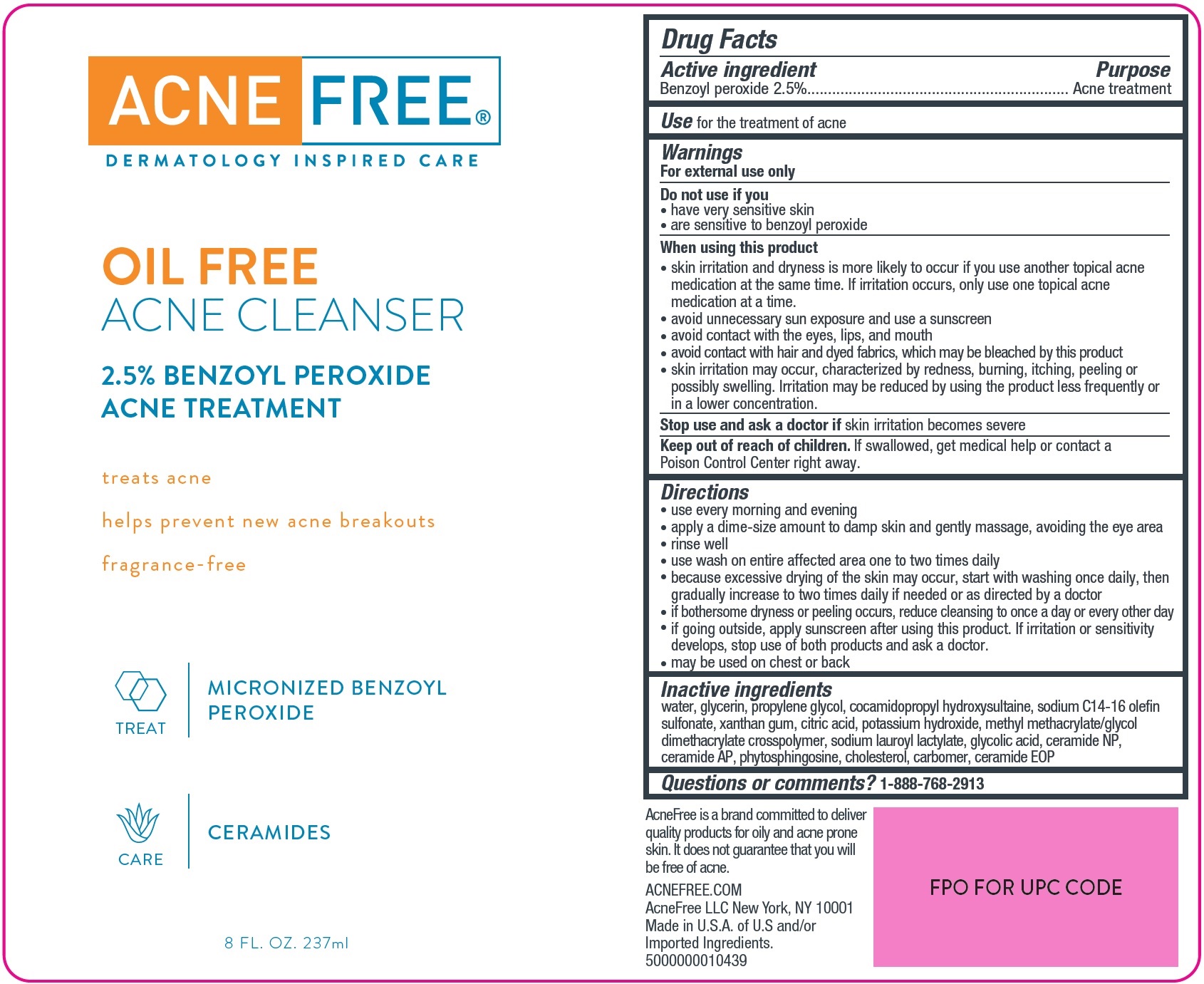
Acne Free Oil Free Acne Cleanser 2.5 Benzoyl Peroxide 25 mg/mL Liquid, 237 mL — NDC 80861-013-01 (Billing 80861-0013-01)
This is a package of 237 mL of Acne Free Oil Free Acne Cleanser 2.5 Benzoyl Peroxide 25 mg/mL Liquid from AcneFree LLC, marketed since Dec 2017 and currently FDA-listed. It is this product's only package size.
NDC database record
One package, one record: these facts belong to NDC 80861-013-01 alone.
- Record
- FDA NDC Directory package listing · Human OTC drug
- Code segments
- 80861 labeler · 013 product · 01 package
- Package marketed since
- Dec 1, 2017
- Sample package
- No — commercial package
- Listing certified through
- Dec 31, 2027
- Barcode (UPC-A, from the NDC)
- 3 8086101301 3
- FDA record last changed
- Aug 13, 2026
Other active recalls for Benzoyl Peroxide (different manufacturers) — 1 · tap to view
Identity & classification
Regulatory identifiers FDA, NLM and CMS codes for this package
- RxCUI (RxNorm): 845836
Where does this data come from?
- FDA openFDA NDC Directory · synced Oct 8, 2026
- FDA label on DailyMed · label index refreshed Oct 6, 2026
- RxNorm (NLM RxNav) · catalog refreshed Oct 1, 2026
- Medi-Span GPI (licensed)
- First Databank (licensed) · refreshed Oct 8, 2026
RxNorm drug class
This medicine belongs to the Peroxides class.
Where does this data come from?
- RxClass (NLM) · catalog refreshed Oct 1, 2026
Clinical
- Most products are for acne. They dry up pimples and help prevent new ones. Epsolay is a prescription cream for rosacea bumps in adults. The Folliculitis Treatment Cream products ar...
- For many acne products, start with once a day. You can move up to two or three times daily if your skin tolerates it. If you get dryness or peeling, cut back to once daily or every...
- Redness, dryness, peeling, itching, and stinging or burning are the usual ones. Using less often can help. Using another acne product at the same time makes irritation more likely.
- Stop if irritation gets severe. Stop right away and get help if you have hives, swelling or trouble breathing. Those can be signs of a serious allergic reaction.
Patient education
Supplement & herbal interactions
Some supplements/herbs that may interact with Benzoyl Peroxide — tap one for details:
Where does this data come from?
- MedlinePlus (NLM) · refreshed Oct 1, 2026
- FDA label on DailyMed · label index refreshed Oct 6, 2026
Ask a licensed pharmacist directly — free, answered by our team.
Pricing
A drug doesn't have one price. Each row is a different public payment system, and none is what you'd pay at the counter — that depends on your insurance. The ⓘ on each row explains what it measures.
| Price system | Per mL | Per package |
|---|---|---|
| Retail pharmacies payNADAC · weekly | Not in the retail survey — common for institutional, discontinued, or low-volume packs. | |
| Medicaid paysCMS SDUD · 12 mo | No recent Medicaid claims on file for this NDC — rare and low-volume NDCs are suppressed in the public data. | |
| Medicare drug plans payPart D · quarterly | No Part D plan price is available for this NDC in our data. | |
Where does this data come from?
- CMS NADAC weekly file
- CMS ASP pricing files · refreshed Sep 20, 2026
- CMS Medicaid State Drug Utilization Data · refreshed Oct 8, 2026
- CMS Part D plan pricing files · refreshed Sep 24, 2026
- VA National Acquisition Center price file
Packaging — all sizes for this product
| Package NDC | Description | Marketing start | Marketing end | Status |
|---|---|---|---|---|
| 80861-0013-01 You're viewing this Main listing | 237 mL in 1 BOTTLE, PLASTIC | 2017-12-01 | — | Active |
Therapeutic equivalents
| Product | Labeler | Pack | NADAC/unit | TE | Status | Price vs. this |
|---|---|---|---|---|---|---|
| Proactiv Renewing Cleanser 2.5 g/100mL 11410-0005-00 | Alchemee, | 1 bottle | — | — | FDA listed | — |
| BP Wash 25 mg/g 24470-0911-08 | CINTEX | 227 g | — | — | FDA listed | — |
| Acne Face and Body Wash 25 mg/mL 70707-0711-06 | Face | 180 ml | — | — | FDA listed | — |
| amazon basics step 1 cleanser Acne treatment 25 mg/mL 72288-0120-01 | AMAZON.COM | 120 ml | — | — | FDA listed | — |
| Oil Free Deep Cleansing Duo Cleansing Brush Oil Free Acne Cleanser 80861-0003-01 | AcneFree, | 1 kit | — | — | FDA listed | — |
| Acne Free Oil Free Acne Cleanser 2.5 Benzoyl Peroxide 25 mg/mLthis 80861-0013-01 | AcneFree | 237 ml | — | — | FDA listed | — |
| SkinPharmacy Advanced Acne Therapy Active Clearing 25 mg/mL 69842-0076-01 | CVS | 1 tube | — | — | FDA listed | — |
| Vie Naturelle Acne Body 25 mg/mL 73350-0105-08 | TNT | 237 ml | — | — | FDA listed | — |
Where does this data come from?
- FDA openFDA NDC Directory · synced Oct 8, 2026
- FDA Orange Book · refreshed Oct 3, 2026
- CMS NADAC weekly file
Availability & generic status
We did not find an FDA-approved generic match for this exact strength, form and route.
Where does this data come from?
- FDA Orange Book · refreshed Oct 3, 2026
Inactive Ingredients / Excipients
Inactive ingredients, also called excipients, are components of the drug product other than the active ingredient. They may include fillers, dyes, coatings, preservatives, flavors, or other formulation ingredients.
🧪 Avoiding an ingredient? See Benzoyl Peroxide inactive ingredients by manufacturer: every current product's list side by side, so you can ask your pharmacy for the version that does not list it.
💡 Tap an ingredient (hover on desktop) to see what it is and why it’s used.
-
UNII 0A5MM307FC
A synthetic polymer that absorbs water and forms a thick, gel-like substance. In medicines, it works as a thickener and stabilizer to improve texture and help ingredients stay mixed together in creams, gels, and lotions.
-
UNII 5THT33P7X7
A waxy, lipid-like substance derived from animal or plant sources. It helps soften and moisturize the skin by acting as an emollient and skin-conditioning agent in topical medicines and creams.
-
UNII F1X8L2B00J
A naturally derived fatty substance that helps bind and condition the product's texture. It works as an emollient and skin-conditioning agent in topical formulations, helping maintain moisture and smoothness.
-
UNII 4370DF050B
Ceramide NP is a waxy, lipid-based substance that mimics natural skin oils. It's used in topical formulations as an emollient and skin-conditioning agent to help soften, smooth, and protect the skin barrier.
-
UNII 97C5T2UQ7J
Cholesterol is a fatty substance found naturally in animal tissues. In medications, it's used as an ingredient in liposomal formulations and lipid-based drug delivery systems to help encapsulate and stabilize active drugs for better absorption.
-
UNII 2968PHW8QP
A weak organic acid derived from citrus fruits or made through fermentation. It works as a buffer to control pH, a preservative to extend shelf life, and a flavoring agent in medications.
-
UNII 62V75NI93W
A surfactant derived from coconut oil that helps cleanse and remove oils from skin or hair. In medicines and personal care products, it acts as a cleanser and foaming agent.
-
UNII PDC6A3C0OX
Glycerin is a clear, thick liquid derived from plant oils or fats. It acts as a humectant to retain moisture, a sweetener, and a solvent in medications.
-
UNII 0WT12SX38S
Glycolic acid is an alpha-hydroxy acid derived from sugar cane that helps dissolve and remove dead skin cells. In topical medicines, it works as an exfoliant and pH adjuster to improve skin penetration and product effectiveness.
-
UNII 196OC77688
A synthetic plastic polymer used as a film-coating material on tablets and capsules. It helps protect the medication, control how fast it dissolves, and improve appearance.
-
UNII GIN46U9Q2Q
Phytosphingosine is a naturally derived fatty compound that helps stabilize and thicken skincare and cosmetic formulations. It works as an emollient and conditioning agent to improve texture and skin feel in topical products.
-
UNII WZH3C48M4T
Potassium hydroxide is a strong alkaline chemical used in medicines to adjust and maintain the pH level of liquid formulations, helping keep the product stable and the active ingredients effective.
-
UNII 6DC9Q167V3
Propylene glycol is a clear liquid derived from petroleum or vegetable sources. It acts as a solvent, humectant, and preservative in medicines, helping dissolve active ingredients and maintain product stability.
-
UNII O9W3D3YF5U
A synthetic surfactant derived from petroleum-based olefins. It helps dissolve or suspend active ingredients and other substances in liquid formulations, improving how the medicine mixes and flows.
-
UNII 7243K85WFO
Sodium lauroyl lactylate is a mild surfactant derived from natural fats and lactic acid. It acts as an emulsifier and solubilizer to help blend oil and water-based ingredients and improve how the body absorbs the active drug.
-
UNII 059QF0KO0R
Water is a liquid solvent that dissolves and mixes ingredients together in liquid medicines, syrups, and injections. It helps distribute the active drug evenly throughout the product.
-
UNII TTV12P4NEE
Xanthan gum is a thickening and stabilizing ingredient made from fermented corn or other sugars. It's added to medicines to improve texture, prevent separation of liquids and solids, and help the product stay consistent.
17 inactive ingredients listed in the exact product block matched to this NDC.
Label-section wording can be broader than the structured product block and may mention additional formulation ingredients.
Where does this data come from?
ingredient classCode="IACT" elements from the exact product block matched by this NDC. Label-section narrative from DailyMed / the openFDA label index is shown separately when available.- FDA label on DailyMed · label index refreshed Oct 6, 2026
- FDA openFDA NDC Directory · synced Oct 8, 2026
Inactive ingredient FAQ
Are inactive ingredients the same for every manufacturer?
Why might an inactive ingredient be missing?
Can inactive ingredients matter?
Manufacturer & labeler
More NDCs from AcneFree LLC labeler code 80861
- Terminator 10 BENZOYL PEROXIDE 100 mg/mL Cream NDC 80861-002-01
- Oil Free Deep Cleansing Duo Cleansing Brush Oil Free Acne Cleanser BENZOYL PEROXIDE Kit NDC 80861-003-01
- Acne Free Free 24 HR Acne Clearing System BENZOYL PEROXIDE Kit NDC 80861-006-01
- Acne Free SENSITIVE SKIN 24 HR Acne Clearing System SALICYLIC ACID, BENZOYL PEROXIDE Kit NDC 80861-007-01
- Acne Free SEVERE ACNE 24 HR Acne Clearing System BENZOYL PEROXIDE Kit NDC 80861-010-01
- Acne Free BLACKHEAD REMOVING SCRUB 2 Salicylic Acid with Charcoal 20 mg/mL Gel NDC 80861-012-01
- Benzoyl Peroxide Deep Cleansing Foaming Wash .1 g/g Cream NDC 80861-112-01
- Sulfur Acne Foaming Cleanser .001 g/g Cream NDC 80861-113-01
- Adapalene Gel Adaplaene .00036 g/g Gel NDC 80861-114-01
- Adapalene Adaplane 0.1% .1 g/g Gel NDC 80861-115-01
- sulfur acne treatment .035 g/g Cream NDC 80861-116-01
- Salicylic Acid .02 g/g Cream NDC 80861-117-01
Where does this data come from?
- FDA openFDA NDC Directory · synced Oct 8, 2026
- Drugs@FDA
FDA label — Drug Facts FDA SPL
🎯 Indications and Usage ▾
Use for the treatment of acne
⏱️ Dosage and Administration ▾
Directions use every morning and evening apply a dime-size amount to damp skin and gently massage, avoiding the eye area rinse well use wash on entire affected area one to two times daily because excessive drying of the skin may occur, start with washing once daily, then gradually increase to two times daily if needed or as directed by a doctor if bothersome dryness or peeling occurs, reduce cleansing to once a day or every other day if going outside, apply sunscreen after using this product. If irritation or sensitivity develops, stop use of both products and ask a doctor. may be used on chest or back
⚠️ Warnings ▾
Warnings For external use only Do not use if you • have very sensitive skin • are sensitive to benzoyl peroxide When using this product skin irritation and dryness is more likely to occur if you use another topical acne medication at the same time. If irritation occurs, only use one topical acne medication at a time. avoid unnecessary sun exposure and use a sunscreen avoid contact with the eyes, lips, and mouth avoid contact with hair and dyed fabrics, which may be bleached by this product skin irritation may occur, characterized by redness, burning, itching, peeling or possibly swelling.
Irritation may be reduced by using the product less frequently or in a lower concentration. Stop use and ask a doctor if skin irritation becomes severe Keep out of reach of children. If swallowed, get medical help or contact a Poison Control Center right away.
🧪 Active Ingredient ▾
Active ingredient Benzoyl peroxide 2.5% Purpose Acne treatment
🧪 Inactive Ingredients ▾
Questions or comments? water, glycerin, propylene glycol, cocamidopropyl hydroxysultaine, sodium C14-16 olefin sulfonate, xanthan gum, citric acid, potassium hydroxide, methyl methacrylate/glycol dimethacrylate crosspolymer, sodium lauroyl lactylate, glycolic acid, ceramide NP, ceramide AP, phytosphingosine, cholesterol, carbomer, ceramide EOP
🎯 Purpose ▾
Purpose Acne treatment
📄 Do Not Use ▾
Do not use if you • have very sensitive skin • are sensitive to benzoyl peroxide
📄 When Using This Product ▾
When using this product skin irritation and dryness is more likely to occur if you use another topical acne medication at the same time. If irritation occurs, only use one topical acne medication at a time. avoid unnecessary sun exposure and use a sunscreen avoid contact with the eyes, lips, and mouth avoid contact with hair and dyed fabrics, which may be bleached by this product skin irritation may occur, characterized by redness, burning, itching, peeling or possibly swelling. Irritation may be reduced by using the product less frequently or in a lower concentration.
📄 Stop Use and Ask a Doctor If ▾
Stop use and ask a doctor if skin irritation becomes severe
📄 Keep Out of Reach of Children ▾
Keep out of reach of children. If swallowed, get medical help or contact a Poison Control Center right away.
📄 Questions or Comments ▾
Questions or comments? 1-888-768-2913
📄 Package Label / Principal Display Panel ▾
Pakage Labeling: Label2
Medicare Part D spend CMS · PART D · 2026 (Q1)
Reported adverse events (FAERS)
Top reported reactions
Age at onset
Reporter sex
Serious outcomes
Where does this data come from?
About this NDC listing & data coverage
What data is (and isn’t) available for this NDC — tap to expand
| NDC identity (package / product / labeler codes) | ✓ Available |
| Labeler | ✓ Available |
| Product & package description | ✓ Available |
| Marketing category & status | ✓ Available |
| Active ingredient / dosage form / route | ✓ Available |
| FDA label (SPL via DailyMed) | ✓ Available |
| Package photos | ✓ Available |
| Inactive ingredients (structured) | ✓ Available |
| NADAC pharmacy acquisition price (CMS) | — Not published for this NDC CMS publishes NADAC only for NDCs reported in its retail-pharmacy survey. |
| Orange Book / therapeutic-equivalence data | — Not published for this NDC Applies only to products approved under an NDA/ANDA; many listings are out of scope. |
| HCPCS J-code billing crosswalk | — Not published for this NDC Most self-administered / retail products have no J-code — that is normal. |
| Medicaid utilization (CMS SDUD) | — Not published for this NDC CMS reports utilization only for NDCs with Medicaid claims above its privacy threshold. |