
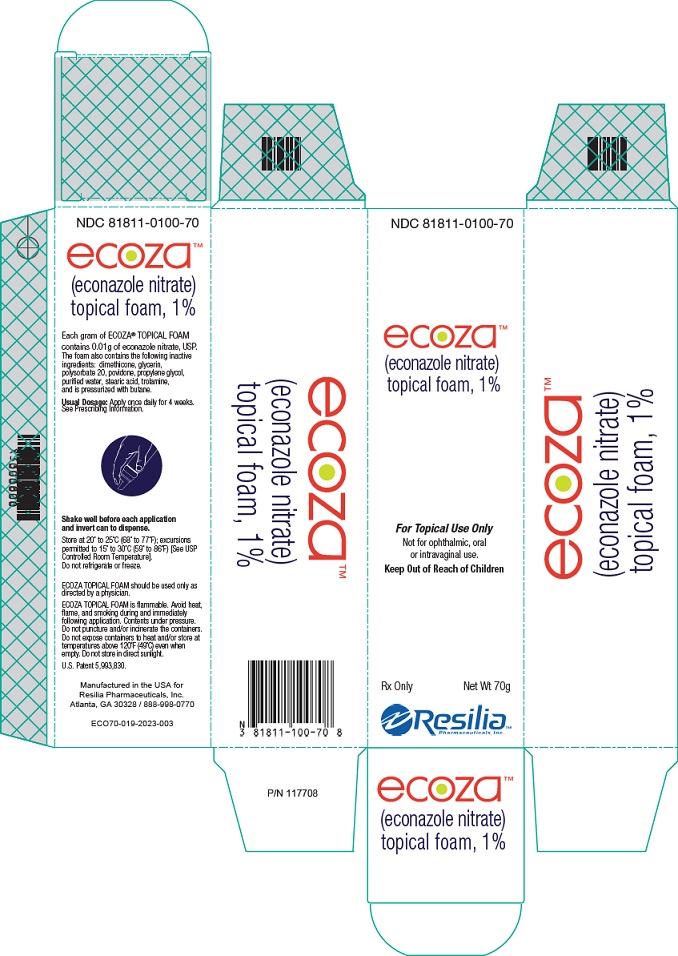
Ecoza econazole nitrate 10 mg/g Aerosol, Foam
🆔 Identity & classification
Where does this data come from?
🏷️ RxNorm drug class
This medicine belongs to the Azole Antifungal class.
Where does this data come from?
🏭 Manufacturer & labeler
Where does this data come from?
🩺 Clinical
Econazole is used to treat skin infections such as athlete's foot, jock itch, and ringworm. This medication is sometimes prescribed for other uses; ask your doctor or pharmacist for more information.
Read the full MedlinePlus article ↗- Econazole is an antifungal cream or foam that you apply to your skin to clear up fungal infections. Depending on which form you have, it can treat athlete's foot (the kind between...
- Many people notice some relief fairly soon after starting treatment. That said, it's really important to keep going for the full course your doctor recommends — even if your skin l...
- How long does it take to work, and how long do I need to use it?
- Econazole is generally very well tolerated. The most common side effects are mild — a little burning, itching, or redness right where you apply it. Those were reported in less than...
Patient education
Supplement & herbal interactions
Some supplements/herbs that may interact with Econazole Nitrate — tap one for details:
Where does this data come from?
Ask a licensed pharmacist directly — free, answered by our team.
💊 What it looks like
Where does this data come from?
🧪 Inactive Ingredients / Excipients
Inactive ingredients, also called excipients, are components of the drug product other than the active ingredient. They may include fillers, dyes, coatings, preservatives, flavors, or other formulation ingredients.
💡 Tap an ingredient (hover on desktop) to see what it is and why it’s used.
-
UNII 6LV4FOR43R
Butane is a colorless gas derived from petroleum. In medicines, it serves as a propellant in inhalers and aerosol sprays, helping deliver the active drug to the lungs or skin.
-
UNII 92RU3N3Y1O
Dimethicone is a silicone-based oil that acts as an anti-foaming agent and lubricant in medicines. It reduces gas bubbles in liquid formulations and helps coat and protect the stomach lining when ingested.
-
UNII PDC6A3C0OX
Glycerin is a clear, thick liquid derived from plant oils or fats. It acts as a humectant to retain moisture, a sweetener, and a solvent in medications.
-
UNII 7T1F30V5YH
A synthetic emulsifier derived from sorbitol and oleic acid. It helps mix oil and water-based ingredients together and keeps them from separating in liquid formulations.
-
UNII U725QWY32X
Povidone K30 is a synthetic polymer made from petroleum. It acts as a binder to hold tablet ingredients together and as a disintegrant to help the tablet break apart in the stomach so the medicine can be absorbed.
-
UNII 6DC9Q167V3
Propylene glycol is a clear liquid derived from petroleum or vegetable sources. It acts as a solvent, humectant, and preservative in medicines, helping dissolve active ingredients and maintain product stability.
-
UNII 4ELV7Z65AP
Stearic acid is a fatty acid derived from plant or animal sources. It acts as a binder and lubricant in tablets and capsules, helping them hold together and flow smoothly during manufacturing.
-
UNII 9O3K93S3TK
Trolamine is an alkaline compound used as a pH buffer and emulsifier in medicines. It helps neutralize acids, stabilize formulations, and enable mixing of oil and water-based ingredients.
-
UNII 059QF0KO0R
Water is a liquid solvent that dissolves and mixes ingredients together in liquid medicines, syrups, and injections. It helps distribute the active drug evenly throughout the product.
9 inactive ingredients listed in the exact product block matched to this NDC.
Where does this data come from?
ingredient classCode="IACT" elements from the exact product block matched by this NDC. Label-section narrative from DailyMed / the openFDA label index is shown separately when available.Inactive ingredient FAQ
Are inactive ingredients the same for every manufacturer?
Why might an inactive ingredient be missing?
Can inactive ingredients matter?
💲 Pricing
A drug doesn't have one price. Each row is a different public payment system, and none is what you'd pay at the counter — that depends on your insurance. The ⓘ on each row explains what it measures.
| Price system | Per g | Per package |
|---|---|---|
| Retail pharmacies payNADAC · weekly | Not in the retail survey — common for institutional, discontinued, or low-volume packs. | |
| Medicaid paysCMS SDUD · 12 mo | No recent Medicaid claims on file for this NDC — rare and low-volume NDCs are suppressed in the public data. | |
| Medicare drug plans payPart D · quarterly | No Part D plan price is available for this NDC in our data. | |
Where does this data come from?
🔁 Therapeutic equivalents
| Product | Labeler | Pack | NADAC/unit | TE | Status | Price vs. this |
|---|---|---|---|---|---|---|
| Econazole Nitrate 10 mg/g 73352-0100-70 | Trifluent | 1 canister | — | — | FDA listed | — |
| Ecoza 10 mg/gthis 81811-0100-70 | Resilia | 1 canister | — | — | FDA listed | — |
Where does this data come from?
⏳ Availability & generic status
We did not find an FDA-approved generic match for this exact strength, form and route. Patent/protection dates below may affect future generic timing.
Why the date isn’t exact: Generic timing can change because patents may be challenged, settled, licensed, added, removed, or worked around with a narrower label — and FDA approval does not always mean a pharmacy can get the generic today.
🛈 What do these terms mean?
- Patent
- Legal protection listed in the Orange Book that may delay generic approval or launch. Issued by the U.S. Patent & Trademark Office.
- Substance patent
- Covers the active drug molecule itself — the hardest to design around. A generic generally can’t launch until it expires.
- Formulation (product) patent
- Covers a specific formulation or dosage form. A generic can sometimes work around it with a different formulation.
- Method-of-use patent
- A patent covering one specific approved use of the drug — not necessarily the whole molecule. A generic can sometimes launch with a “skinny label” that carves out the protected use and keeps the others.
- Skinny label
- A generic label that omits a still-patented use when the FDA allows it — letting a generic reach the market for the unprotected uses.
- Exclusivity
- FDA-granted marketing protection, separate from patents — e.g. 5-yr new chemical entity, 7-yr orphan drug, or a +6-month pediatric extension.
- Paragraph IV
- A generic applicant’s formal challenge to a listed patent. It can potentially lead to earlier generic entry, but often involves litigation or a settlement.
- RLD / RS
- Reference Listed Drug — the brand product the FDA uses as the reference for generic applications. Reference Standard — the product the FDA expects generics to compare against in bioequivalence testing.
- TE / AB rating
- FDA therapeutic-equivalence rating. An AB rating generally means the FDA considers a generic therapeutically equivalent to — and substitutable for — the brand.
- LOE (loss of exclusivity)
- The latest patent or exclusivity currently listed — the loss-of-exclusivity / latest-listed-protection date shown on this page. Paragraph-IV challenges and settlements can move the real date earlier; FDA approval and a manufacturer’s decision to market can move it later.
Built from the FDA Orange Book. The bars above are scaled to each protection’s expiry; the red LOE marker is the last one to lapse.
| Patent | Type | Use code | Expires |
|---|---|---|---|
| US 10071054 ↗ | Drug product | — | Aug 8, 2031 |
Is there a generic version of ECOZA 1% FOAM?
The FDA approved a generic — why can’t I get it at my pharmacy yet?
Why do different websites show different generic release dates?
What does “FDA listed” mean?
What does a patent or protection date mean here?
What does “current Orange Book estimate” mean?
Can a generic come out before the last patent expires?
Can a generic come out after the listed dates?
What is the difference between patents and exclusivity?
Why are there multiple patent dates?
Where does this data come from?
📊 Medicare Part D spend CMS · PART D · 2026 (Q1)
🔬 Reported adverse events (FAERS)
Top reported reactions
Age at onset
Reporter sex
Serious outcomes
Where does this data come from?
📦 Packaging — all sizes for this product
| Package NDC | Description | Marketing start | Status |
|---|---|---|---|
| 81811-0100-70 You're viewing this | 1 CANISTER in 1 CARTON (81811-100-70) / 70 g in 1 CANISTER | 2023-12-04 | Active |
🧭 About this NDC listing & data coverage
What data is (and isn’t) available for this NDC — tap to expand
| NDC identity (package / product / labeler codes) | ✓ Available |
| Labeler | ✓ Available |
| Product & package description | ✓ Available |
| Marketing category & status | ✓ Available |
| Active ingredient / dosage form / route | ✓ Available |
| FDA label (SPL via DailyMed) | ✓ Available |
| Package photos | ✓ Available |
| Inactive ingredients (structured) | ✓ Available |
| NADAC pharmacy acquisition price (CMS) | — Not published for this NDC CMS publishes NADAC only for NDCs reported in its retail-pharmacy survey. |
| Orange Book / therapeutic-equivalence data | ✓ Available |
| HCPCS J-code billing crosswalk | — Not published for this NDC Most self-administered / retail products have no J-code — that is normal. |
| Medicaid utilization (CMS SDUD) | — Not published for this NDC CMS reports utilization only for NDCs with Medicaid claims above its privacy threshold. |
Questions about this listing
Why is there no price listed?
Is the NDC printed on the package the same as the 11-digit billing NDC?
What do the three segments of this NDC mean?
Is this package still being marketed?
Who lists this product with the FDA?
Do I need a prescription for this product?
Where does this data come from?
📄 Full prescribing information FDA SPL
🎯 Indications and Usage ▾
1 INDICATIONS AND USAGE Ecoza (econazole nitrate) topical foam, 1%, is indicated for the treatment of interdigital tinea pedis caused by Trichophyton rubrum, Trichophyton mentagrophytes, and Epidermophyton floccosum in patients 12 years of age and older. Ecoza is an azole antifungal indicated for the treatment of interdigital tinea pedis caused by Trichophyton rubrum, Trichophyton mentagrophytes , and Epidermophyton floccosum in patients 12 years of age and older. ( 1 )
⏱️ Dosage and Administration ▾
2 DOSAGE AND ADMINISTRATION Ecoza topical foam, 1% is for topical use only. Ecoza topical foam, 1% is not for oral, ophthalmic, or intravaginal use. Ecoza topical foam, 1% should be applied to cover affected areas once daily for 4 weeks. For topical use only; not for oral, ophthalmic, or intravaginal use. ( 2 ) Apply once daily for 4 weeks. ( 2 )
💊 Dosage Forms and Strengths ▾
3 DOSAGE FORMS AND STRENGTHS Foam, 1%. Each gram of Ecoza topical foam, 1%, contains 10 mg of econazole nitrate in a white to off-white foam. Foam, 1%. ( 3 )
⛔ Contraindications ▾
4 CONTRAINDICATIONS None. None. ( 4 )
⚠️ Warnings and Cautions ▾
5 WARNINGS AND PRECAUTIONS Contents are flammable. Instruct the patient to avoid heat, flame, and/or smoking during and immediately following application. ( 5.1 )
5.1Flammability Ecoza topical foam is flammable. Avoid heat, flame, and smoking during and immediately following application. Contents under pressure. Do not puncture and/or incinerate the containers. Do not expose containers to heat and/or store at temperatures above 120°F (49°C) even when empty. Do not store in direct sunlight.
🤒 Adverse Reactions ▾
6 ADVERSE REACTIONS During clinical trials with Ecoza topical foam, the most common adverse reactions were application site reactions which occurred in less than 1% of subjects in both the Ecoza and vehicle arms. ( 6.1 ) To report SUSPECTED ADVERSE REACTIONS, contact Resilia Pharmaceuticals at 1-888-998-0770 or FDA at 1-800-FDA-1088 or www.fda.gov/medwatch.
6.1Clinical Trials Experience Because clinical trials are conducted under widely varying conditions, adverse reaction rates observed in the clinical trials of a drug cannot be directly compared to rates in the clinical trials of another drug and may not reflect the rates observed in practice. In two double-blind, vehicle-controlled clinical trials, 495 subjects were exposed to Ecoza topical foam or vehicle (246 subjects were exposed to Ecoza topical foam, 1% and 249 were exposed to vehicle). Subjects with interdigital tinea pedis applied foam or vehicle once daily for approximately 28 days.
During clinical trials with Ecoza topical foam, the most common adverse reactions were application site reactions which occurred in less than 1% of subjects in both the Ecoza and vehicle arms.
🔄 Drug Interactions ▾
7 DRUG INTERACTIONS
7.1Warfarin Concomitant administration of econazole and warfarin has resulted in enhancement of anticoagulant effect. Most cases reported product application with use under occlusion, genital application, or application to a large body surface area which may increase the systemic absorption of econazole nitrate. Monitoring of International Normalized Ratio (INR) and/or prothrombin time may be indicated especially for patients who apply econazole to large body surface areas, in the genital area, or under occlusion.
👥 Use in Specific Populations ▾
8 USE IN SPECIFIC POPULATIONS
8.1Pregnancy Pregnancy Category C There are no adequate and well-controlled trials with Ecoza topical foam in pregnant women. Ecoza topical foam should be used during pregnancy only if the potential benefit justifies the potential risk to the fetus. Econazole nitrate has not been shown to be teratogenic when administered orally to mice, rabbits or rats.
Fetotoxic or embryotoxic effects were observed in Segment I oral studies with rats receiving 10 to 40 times the human dermal dose. Similar effects were observed in Segment II or Segment III studies with mice, rabbits and/or rats receiving oral doses 80 or 40 times the human dermal dose.
8.3Nursing Mothers It is not known whether econazole nitrate is excreted in human milk. Because many drugs are excreted in human milk, caution should be exercised when econazole nitrate is administered to a nursing woman. Following oral administration of econazole nitrate to lactating rats, econazole and/or metabolites were excreted in milk and were found in nursing pups.
8.4Pediatric Use Of the 173 subjects treated with Ecoza topical foam, 1% in the clinical trials, 2 subjects were 12 to 17 years old. In a pediatric maximal use trial, Ecoza topical foam, 1% was applied once daily to eighteen subjects aged 12 to 17 years with interdigital tinea pedis for 28 days [ see Clinical Pharmacology (12.3) ]. The safety findings for subjects 12 to 17 years were similar to those in adult population.
8.5Geriatric Use Of the 173 subjects treated with Ecoza topical foam, 1% in the adult clinical trials, 6 subjects were 65 years or older. No overall differences in safety or effectiveness were observed between these subjects and younger subjects.
🤰 Pregnancy ▾
8.1Pregnancy Pregnancy Category C There are no adequate and well-controlled trials with Ecoza topical foam in pregnant women. Ecoza topical foam should be used during pregnancy only if the potential benefit justifies the potential risk to the fetus. Econazole nitrate has not been shown to be teratogenic when administered orally to mice, rabbits or rats.
Fetotoxic or embryotoxic effects were observed in Segment I oral studies with rats receiving 10 to 40 times the human dermal dose. Similar effects were observed in Segment II or Segment III studies with mice, rabbits and/or rats receiving oral doses 80 or 40 times the human dermal dose.
🧒 Pediatric Use ▾
8.4Pediatric Use Of the 173 subjects treated with Ecoza topical foam, 1% in the clinical trials, 2 subjects were 12 to 17 years old. In a pediatric maximal use trial, Ecoza topical foam, 1% was applied once daily to eighteen subjects aged 12 to 17 years with interdigital tinea pedis for 28 days [ see Clinical Pharmacology (12.3) ]. The safety findings for subjects 12 to 17 years were similar to those in adult population.
🧓 Geriatric Use ▾
8.5Geriatric Use Of the 173 subjects treated with Ecoza topical foam, 1% in the adult clinical trials, 6 subjects were 65 years or older. No overall differences in safety or effectiveness were observed between these subjects and younger subjects.
🧬 Clinical Pharmacology ▾
12 CLINICAL PHARMACOLOGY
12.1Mechanism of Action Ecoza topical foam is an azole antifungal [ see Clinical Pharmacology (12.4) ] .
12.2Pharmacodynamics The pharmacodynamics of Ecoza topical foam, 1% have not been established .
12.3Pharmacokinetics The systemic absorption of Ecoza topical foam, 1% following topical application was studied in one clinical trial in adults and one clinical study in pediatric subjects. In the adult trial, 19 subjects (male and female) with tinea pedis applied Ecoza topical foam, 1% once daily for 29 days. Subjects applied a mean daily amount of 2.4 g of Ecoza topical foam, 1% to soles, toes, interdigital spaces and tops of both feet up to the ankles.
Blood samples were obtained on Day 29 at pre-dose and 1, 2, 4, 6, 8, and 12 hours after application. Results (mean ± SD) showed the time to reach peak plasma concentrations (T max ) was 6.8 ± 5.1 h with maximum concentration (C max ) of 417 ± 218 pg/ml. The area under the concentration time curve for the first 12 hours post application on Day 29 (AUC (0-12) ) was 3440 ± 1920 pg-h/ml.
In the pediatric trial, 18 subjects (male and female ages 12 - 17) with interdigital tinea pedis and positive fungal cultures were treated with Ecoza topical foam, 1% once daily for 4 weeks. Subjects applied a mean daily amount of 3.2 g of Ecoza topical foam, 1% to soles, toes, interdigital spaces and tops of both feet up to the ankles. Blood samples were obtained on Day 28 at pre-dose and 7 h and 11 h post-dose.
The mean ± SD econazole plasma concentration was 397 ± 289, 534 ± 745 and 575 ± 638 pg/mL at pre-dose and 7 h and 11 h post-dose, respectively.
12.4Microbiology Mechanism of Action Econazole nitrate, an azole antifungal agent, inhibits fungal cytochrome P-450-mediated 14 alpha-lanosterol demethylase enzyme. This enzyme functions to convert lanosterol to ergosterol. The accumulation of 14 alpha-methyl sterols correlates with the subsequent loss of ergosterol in the fungal cell wall and may be responsible for the fungistatic activity of econazole.
Mammalian cell demethylation is less sensitive to econazole inhibition. Activity in vitro and in clinical infections Econazole nitrate has been shown to be active against most strains of the following microorganisms, both in vitro and in clinical infections [ see Indications and Usage (1) ]. Trichophyton rubrum Epidermophyton floccosum Trichophyton mentagrophytes
🧬 Mechanism of Action ▾
12.1Mechanism of Action Ecoza topical foam is an azole antifungal [ see Clinical Pharmacology (12.4) ] .
📦 How Supplied / Storage and Handling ▾
16 HOW SUPPLIED/ STORAGE AND HANDLING Ecoza topical foam, 1% is white to off-white foam supplied in 10g (NDC 81811-100-10) and 70g (NDC 81811-100-70) aluminum pressurized canister. Store at controlled room temperature 20°C to 25°C (68°F to 77°F) with excursions permitted between 15°C and 30°C (59°F and 86°F). Do not refrigerate or freeze.
Ecoza topical foam is flammable. Avoid heat, flame, and smoking during and immediately following application. Contents under pressure.
Do not puncture and/or incinerate the containers. Do not expose containers to heat and/or store at temperatures above 120°F (49°C) even when empty. Do not store in direct sunlight.
📦 Storage and Handling ▾
Store at controlled room temperature 20°C to 25°C (68°F to 77°F) with excursions permitted between 15°C and 30°C (59°F and 86°F). Do not refrigerate or freeze. Ecoza topical foam is flammable.
Avoid heat, flame, and smoking during and immediately following application. Contents under pressure. Do not puncture and/or incinerate the containers.
Do not expose containers to heat and/or store at temperatures above 120°F (49°C) even when empty. Do not store in direct sunlight.
📋 Description ▾
11 DESCRIPTION Ecoza (econazole nitrate) topical foam, 1% contains the azole antifungal agent, econazole nitrate in an oil-in-water emulsion base consisting of the following inactive ingredients: dimethicone, glycerin, polysorbate 20, povidone, propylene glycol, stearic acid, trolamine, purified water and butane as a propellant. Each gram of Ecoza topical foam, 1% contains 10 mg of econazole nitrate, USP, in a white to off-white foam. Ecoza topical foam, 1% is alcohol (ethanol)-free and for topical use only.
Chemically, econazole nitrate is 1-[2-{(4-chloro-phenyl)methoxy}-2-(2,4-dichlorophenyl) ethyl]-1H-imidazole mononitrate. Econazole nitrate has the molecular formula C 18 H 15 Cl 3 N 2 O. HNO 3 and a molecular weight of 444.70.
Its molecular structure is as follows: Chemical Structure
💬 Information for Patients ▾
17 PATIENT COUNSELING INFORMATION See FDA-approved patient labeling (Patient Information) The patient should be instructed as follows: Inform patients that Ecoza (econazole nitrate) topical foam, 1% is for topical use only. Ecoza (econazole nitrate) topical foam, 1% is not intended for oral, intravaginal, or ophthalmic use. Ecoza topical foam, 1% is flammable; avoid heat, flame, and smoking during and immediately following application.
If a reaction suggesting sensitivity or chemical irritation develops with the use of Ecoza topical foam, 1%, use of the medication should be discontinued.