
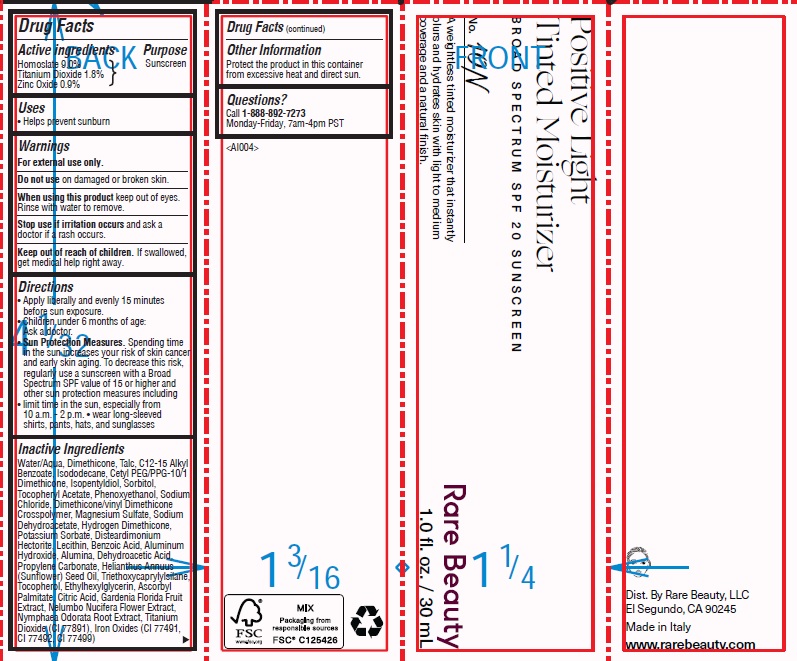
Positive Light Tinted Moisturizer Broad Spectrum SPF 20 Sunscreen 14W Homosalate, Titanium Dioxide, Zinc Oxide 18 mg/mL; 90 mg/mL; 9 mg/mL Lotion — NDC 82109-0102-01 package photo

Positive Light Tinted Moisturizer Broad Spectrum SPF 20 Sunscreen 14W Homosalate, Titanium Dioxide, Zinc Oxide 18 mg/mL; 90 mg/mL; 9 mg/mL Lotion

by Rare Beauty, LLC · 1 BOTTLE, PLASTIC in 1 CARTON (82109-102-01) / 30 mL in 1 BOTTLE, PLASTIC
NDC 82109-0102-01
🏷️ FDA NDC (as labeled) 82109-102-01 billing pads the product segment with a zero
OTC On market Non-controlled
🗂️ Data synced Sep 10, 2026 · sources: openFDA · FDA label (DailyMed) · FDA Orange & Purple Book · First Databank · CMS NADAC, ASP, Medicare & Medicaid · RxNorm
📋 All sources & update times →

🆔 Identity & classification

FDA NDC (as labeled) 82109-102-01
Product NDC 82109-102
11-digit billing NDC 82109010201
UNII 15FIX9V2JP, V06SV4M95S, SOI2LOH54Z
Application # M020
SPL Set ID cfee02eb-92f9-be12-e053-2a95a90a4337
DEA schedule Non-controlled
Marketing category OTC MONOGRAPH DRUG
Marketing status On market
FDA listing status Listed (active directory)
Marketing start 2022-03-30
Route TOPICAL
Dosage form LOTION
Substance TITANIUM DIOXIDE; HOMOSALATE; ZINC OXIDE
Why two NDCs? The FDA registers this code as 82109-102-01 — a 5-3-2 layout, and that's what's printed on the package and shown on DailyMed. For insurance claims, every NDC is standardized to a uniform 11-digit 5-4-2 format by adding a zero to the product segment → 82109-0102-01. Same drug, same package — only the format differs.
Where does this data come from?
Identifiers from the FDA openFDA NDC Directory and Structured Product Labeling; RxCUI from RxNorm (NLM); GPI from Medi-Span; GCN / HIC / AHFS / legend from First Databank.

🏭 Manufacturer & labeler

LabelerRare Beauty, LLC
FDA applicationM020 (OTC MONOGRAPH DRUG)
Labeler code82109
First marketedMar 2022
Product typeHuman Otc Drug
Portfolio48 products on file
The labeler markets the product; the application holder owns the FDA approval. They’re often the same company but can differ (e.g. a repackager or an authorized generic). A mailing address / phone appears here when the manufacturer includes it in the product’s FDA label (not all do).
Where does this data come from?
Labeler, application holder and registered establishment from the FDA openFDA NDC Directory and Drugs@FDA; address/contact from the product’s FDA label.

🩺 Clinical

🧪 What is this product?

Positive Light Tinted Moisturizer Broad Spectrum SPF 20 Sunscreen is a topical lotion marketed as an over-the-counter sunscreen product under FDA's monograph rules for sunscreen drugs. It contains three active ingredients that function as ultraviolet (UV) filters: homosalate, titanium dioxide, and zinc oxide. These mineral and chemical UV-blocking agents are typically used in sunscreen formulations to help protect skin from sun exposure. The product is formulated as a tinted moisturizer lotion applied to the skin.

Where does this data come from?
Plain-language summary from MedlinePlus (U.S. National Library of Medicine); supplement & herbal interactions and nutrient depletion data from the Natural Medicines database; our full guide is HelloPharmacist editorial content.

🧪 Inactive Ingredients / Excipients

Inactive ingredients, also called excipients, are components of the drug product other than the active ingredient. They may include fillers, dyes, coatings, preservatives, flavors, or other formulation ingredients.

💡 Tap an ingredient (hover on desktop) to see what it is and why it’s used.

  • UNII 9E8X80D2L0
    A synthetic form of vitamin E used as an antioxidant and preservative in medications. It helps prevent the active ingredients from degrading when exposed to oxygen or light.
  • UNII A9EJ3J61HQ
    A synthetic liquid derived from benzoic acid and long-chain alcohols. It functions as a solvent and penetration enhancer in topical formulations, helping active ingredients dissolve and absorb into the skin.
  • UNII 5QB0T2IUN0
    Aluminum hydroxide is a white powder mineral compound used as an antacid ingredient in some formulations. It works as a buffer and pH regulator to help neutralize stomach acid in the medicine.
  • UNII LMI26O6933
    Alumina is a white powder form of aluminum oxide. It's used as a filler to add bulk to tablets and capsules, and sometimes as a thickening or anti-caking agent in powdered formulations.
  • UNII QN83US2B0N
    Ascorbyl palmitate is a fat-soluble form of vitamin C used as an antioxidant in medicines. It prevents oils and fats in the product from breaking down and becoming less stable over time.
  • UNII 8SKN0B0MIM
    Benzoic acid is a naturally occurring organic acid used as a preservative in medicines and foods. It helps prevent bacterial and fungal growth to extend shelf life and maintain product stability.
  • UNII 035JKJ76MT
    A silicone-based ingredient that helps oil and water mix together in formulations. It works as an emulsifier to create smooth, stable textures in topical medicines and creams.
  • UNII 2968PHW8QP
    A weak organic acid derived from citrus fruits or made through fermentation. It works as a buffer to control pH, a preservative to extend shelf life, and a flavoring agent in medications.
  • UNII 2KAG279R6R
    Dehydroacetic acid is a synthetic preservative that prevents mold, yeast, and bacterial growth in medicines. It extends shelf life by protecting the product from spoilage during storage and use.
  • UNII 92RU3N3Y1O
    Dimethicone is a silicone-based oil that acts as an anti-foaming agent and lubricant in medicines. It reduces gas bubbles in liquid formulations and helps coat and protect the stomach lining when ingested.
  • UNII 9E4CO0W6C5
    A silicone-based polymer that forms soft, spongy particles. Used as a texture modifier and suspending agent to improve how the product feels and flows, and to help keep ingredients evenly distributed throughout the formulation.
  • UNII X687XDK09L
    A clay mineral processed to carry positive charges, used as a thickener and suspending agent in liquid medicines. It helps keep solid particles evenly distributed throughout the product.
  • UNII 147D247K3P
    Ethylhexylglycerin is a synthetic preservative used to prevent bacteria and mold from growing in medicines and personal care products. It helps keep the product safe and stable throughout its shelf life.
  • UNII 1K09F3G675
    Ferric oxide red is an inorganic iron compound used as a colorant in medicines. It gives tablets, capsules, or other dosage forms a red or reddish tint for identification and appearance.
  • UNII EX438O2MRT
    Ferric oxide yellow is a naturally occurring iron compound used as a colorant in medications. It gives tablets, capsules, and other forms a yellow or golden hue for identification and appearance.
  • UNII XM0M87F357
    A dark iron oxide compound that gives medicines their black or dark color. It's used as a colorant in tablets and capsules to help identify the product and make it visually distinctive.
  • UNII 7CTH8MD549
    A natural plant extract from gardenia fruit used as a colorant in medicines. It provides yellow to orange coloring and may help preserve product stability.
  • UNII 12Z59IF64N
    Hydrogen dimethicone is a silicone-based fluid that acts as a lubricant and anti-foaming agent in medicines. It helps the product flow smoothly during manufacturing and prevents excess air bubbles from forming.
  • UNII A8289P68Y2
    Isododecane is a lightweight liquid hydrocarbon used as a solvent and spreadability agent in topical formulations. It helps dissolve active ingredients and makes the product easier to apply and absorb into the skin.
  • UNII 19NOL5474Q
    Isopentyldiol is a synthetic alcohol derived from isoprene. It functions as a humectant and solvent in formulations, helping to retain moisture and dissolve or suspend active ingredients.
  • UNII 1DI56QDM62
    A natural fatty substance from soybeans that helps mix oil and water-based ingredients together. It acts as an emulsifier and lubricant in medicines to improve texture and help the product break down properly in your body.
  • UNII DE08037SAB
    Magnesium sulfate is a mineral salt that acts as an osmotic agent in medications. It draws water into the intestines to soften stool or is used as a filler and processing aid in some solid dosage forms.
  • UNII 61W322NLDV
    A plant extract from sacred lotus flowers. Used as a natural colorant, fragrance, or skin-conditioning agent in topical formulations.
  • UNII 69RAZ4C432
    A plant extract from fragrant water lily roots used as a natural ingredient in formulations. It may serve as a botanical additive for texture, consistency, or preservation properties in the medicine.
  • UNII HIE492ZZ3T
    Phenoxyethanol is a synthetic preservative and antimicrobial agent used to prevent bacterial and fungal growth in medicines and cosmetic products, extending shelf life and maintaining product safety.
  • UNII 1VPU26JZZ4
    Potassium sorbate is a salt derived from sorbic acid, a naturally occurring preservative. It prevents growth of mold, yeast, and some bacteria, extending the medicine's shelf life.
  • UNII 8D08K3S51E
    Propylene carbonate is a clear liquid solvent derived from propylene. It helps dissolve or suspend active ingredients in liquid medicines and can improve how well the product flows and mixes.
  • UNII 451W47IQ8X
    Sodium chloride is common table salt. It's used in medicines as a buffer to maintain proper pH, as a filler to add bulk, or to adjust the osmotic balance in liquid formulations.
  • UNII 8W46YN971G
    Sodium dehydroacetate is a salt derived from dehydroacetic acid, a compound used as a preservative. It helps prevent mold, bacteria, and yeast growth in medicines, extending shelf life and maintaining product safety.
  • UNII 506T60A25R
    Sorbitol is a natural sugar alcohol derived from glucose. It serves as a sweetener, humectant, and bulking agent in medications to improve taste and help maintain moisture in the product.
  • UNII 3W1JG795YI
    Sunflower oil is a natural vegetable oil derived from sunflower seeds. It serves as a solvent, lubricant, and carrier in medicines, helping dissolve active ingredients and improve how the medication flows and absorbs in the body.
  • UNII 7SEV7J4R1U
    A powder made from a naturally occurring mineral. In medicines, talc works as a glidant and anti-caking agent, helping tablets and capsules flow smoothly during manufacturing and preventing clumping.
  • UNII R0ZB2556P8
    Tocopherol is a form of vitamin E derived from plant oils. It acts as an antioxidant in medicines to prevent oils and fats from breaking down and spoiling during storage.
  • UNII LDC331P08E
    A silicone-based compound that acts as a glidant and flow agent in solid medications. It reduces friction between powder particles, helping the medicine flow smoothly during manufacturing and tablet compression.
  • UNII 059QF0KO0R
    Water is a liquid solvent that dissolves and mixes ingredients together in liquid medicines, syrups, and injections. It helps distribute the active drug evenly throughout the product.

35 inactive ingredients listed in the exact product block matched to this NDC.

The official label also statesWater/Aqua, Dimethicone, Talc, C12-15 Alkyl Benzoate, Isododecane, Cetyl PEG/PPG-10/1 Dimethicone, Isopentyldiol, Sorbitol, Tocopheryl Acetate, Phenoxyethanol, Sodium Chloride, Dimethicone/Vinyl Dimethicone Crosspolymer, Magnesium Sulfate, Sodium Dehydroacetate, Hydrogen Dimethicone, Potassium Sorbate, Disteardimonium Hectorite, Lecithin, Benzoic Acid, Aluminum Hydroxide, Alumina, Dehydroacetic Acid, Propylene Carbonate, Helianthus Annuus (Sunflower) Seed Oil, Triethoxycaprylylsilane, Tocopherol, Ethylhexylglycerin, Ascorbyl Palmitate, Citric Acid, Gardenia Florida Fruit Extract, Nelumbo Nucifera Flower Extract, Nymphaea Odorata Root Extract, Titanium Dioxide (CI 77891), Iron Oxides (CI 77491, CI 77492, CI 77499)

Label-section wording can be broader than the structured product block and may mention additional formulation ingredients.

Where does this data come from?
Data sourced from official FDA Structured Product Labeling (SPL) via DailyMedingredient classCode="IACT" elements from the exact product block matched by this NDC. Label-section narrative from DailyMed / the openFDA label index is shown separately when available.

Inactive ingredient FAQ

Are inactive ingredients the same for every manufacturer?
No. Inactive ingredients can differ by manufacturer, dosage form, strength, and package / product version.
Why might an inactive ingredient be missing?
Some SPLs do not provide a complete structured inactive-ingredient list, and older or unusual labels may only include the information in narrative text.
Can inactive ingredients matter?
Yes. They can matter for allergies, intolerances, dyes, gluten / lactose concerns, preservatives, and formulation differences — but confirm with a pharmacist or the manufacturer when it’s clinically important.

💲 Pricing

A drug doesn't have one price. Each row is a different public payment system, and none is what you'd pay at the counter — that depends on your insurance. The ⓘ on each row explains what it measures.

Price systemPer gPer package
Retail pharmacies payNADAC · weekly Not in the retail survey — common for institutional, discontinued, or low-volume packs.
Medicaid paysCMS SDUD · 12 mo No recent Medicaid claims on file for this NDC — rare and low-volume NDCs are suppressed in the public data.
Medicare drug plans payPart D · quarterly No Part D plan price is available for this NDC in our data.
ℹ️
No price is published for this exact package yet. CMS surveys NADAC per package size, so a different pack of the same drug often has one.
Where does this data come from?
NADAC (National Average Drug Acquisition Cost) is the CMS weekly pharmacy-acquisition-cost survey — what pharmacies pay. ASP (Average Sales Price) is the CMS Medicare Part B drug-payment file, published quarterly. Medicaid pays is computed by us from CMS State Drug Utilization Data (total reimbursed ÷ units, trailing 12 months) — gross of rebates and inclusive of dispensing fees, so it reflects what Medicaid paid, not an acquisition cost. Medicare drug plans pay is the median negotiated point-of-sale unit cost across plans listing this NDC in the CMS quarterly Prescription Drug Plan pricing files, before rebates. The VA pays is the federal contract price (FSS, and the statutory Big 4 ceiling where listed) from the VA National Acquisition Center pharmaceutical price file. All are free public government data; each measures a different payer, so the figures are not directly comparable.

🔁 Therapeutic equivalents

ProductLabelerPackNADAC/unitTEStatusPrice vs. this
Positive Light Tinted Moisturizer Broad Spectrum SPF 20 Sunscreen 12C 18 mg/mL; 90 mg/mL; 9 mg/mL 82109-0101-01 Rare 1 bottle FDA listed
Positive Light Tinted Moisturizer Broad Spectrum SPF 20 Sunscreen 24N 18 mg/mL; 90 mg/mL; 9 mg/mL 82109-0106-01 Rare 1 bottle FDA listed
Positive Light Tinted Moisturizer Broad Spectrum SPF 20 Sunscreen 50N 18 mg/mL; 90 mg/mL; 9 mg/mL 82109-0119-01 Rare 1 bottle FDA listed
Positive Light Tinted Moisturizer Broad Spectrum SPF 20 Sunscreen 26W 18 mg/mL; 90 mg/mL; 9 mg/mL 82109-0107-01 Rare 1 bottle FDA listed
Positive Light Tinted Moisturizer Broad Spectrum SPF 20 Sunscreen 38N 18 mg/mL; 90 mg/mL; 9 mg/mL 82109-0113-01 Rare 1 bottle FDA listed
Positive Light Tinted Moisturizer Broad Spectrum SPF 20 Sunscreen 42N 18 mg/mL; 90 mg/mL; 9 mg/mL 82109-0115-01 Rare 1 bottle FDA listed
Positive Light Tinted Moisturizer Broad Spectrum SPF 20 Sunscreen 44N 18 mg/mL; 90 mg/mL; 9 mg/mL 82109-0116-01 Rare 1 bottle FDA listed
Positive Light Tinted Moisturizer Broad Spectrum SPF 20 Sunscreen 40N 18 mg/mL; 90 mg/mL; 9 mg/mL 82109-0114-01 Rare 1 bottle FDA listed
Positive Light Tinted Moisturizer Broad Spectrum SPF 20 Sunscreen 52W 18 mg/mL; 90 mg/mL; 9 mg/mL 82109-0120-01 Rare 1 bottle FDA listed
Positive Light Tinted Moisturizer Broad Spectrum SPF 20 Sunscreen 16C 18 mg/mL; 90 mg/mL; 9 mg/mL 82109-0103-01 Rare 1 bottle FDA listed
Positive Light Tinted Moisturizer Broad Spectrum SPF 20 Sunscreen 58N 18 mg/mL; 90 mg/mL; 9 mg/mL 82109-0123-01 Rare 1 bottle FDA listed
Positive Light Tinted Moisturizer Broad Spectrum SPF 20 Sunscreen 34W 18 mg/mL; 90 mg/mL; 9 mg/mL 82109-0111-01 Rare 1 bottle FDA listed
Positive Light Tinted Moisturizer Broad Spectrum SPF 20 Sunscreen 32N 18 mg/mL; 90 mg/mL; 9 mg/mL 82109-0110-01 Rare 1 bottle FDA listed
Positive Light Tinted Moisturizer Broad Spectrum SPF 20 Sunscreen 10N 18 mg/mL; 90 mg/mL; 9 mg/mL 82109-0100-01 Rare 1 bottle FDA listed
Positive Light Tinted Moisturizer Broad Spectrum SPF 20 Sunscreen 20W 18 mg/mL; 90 mg/mL; 9 mg/mL 82109-0104-01 Rare 1 bottle FDA listed
Positive Light Tinted Moisturizer Broad Spectrum SPF 20 Sunscreen 22W 18 mg/mL; 90 mg/mL; 9 mg/mL 82109-0105-01 Rare 1 bottle FDA listed
Positive Light Tinted Moisturizer Broad Spectrum SPF 20 Sunscreen 28C 18 mg/mL; 90 mg/mL; 9 mg/mL 82109-0108-01 Rare 1 bottle FDA listed
Positive Light Tinted Moisturizer Broad Spectrum SPF 20 Sunscreen 36C 18 mg/mL; 90 mg/mL; 9 mg/mL 82109-0112-01 Rare 1 bottle FDA listed
Positive Light Tinted Moisturizer Broad Spectrum SPF 20 Sunscreen 48W 18 mg/mL; 90 mg/mL; 9 mg/mL 82109-0118-01 Rare 1 bottle FDA listed
Positive Light Tinted Moisturizer Broad Spectrum SPF 20 Sunscreen 30N 18 mg/mL; 90 mg/mL; 9 mg/mL 82109-0109-01 Rare 1 bottle FDA listed
Positive Light Tinted Moisturizer Broad Spectrum SPF 20 Sunscreen 54N 18 mg/mL; 90 mg/mL; 9 mg/mL 82109-0121-01 Rare 1 bottle FDA listed
Positive Light Tinted Moisturizer Broad Spectrum SPF 20 Sunscreen 14W 18 mg/mL; 90 mg/mL; 9 mg/mLthis 82109-0102-01 Rare 1 bottle FDA listed
Positive Light Tinted Moisturizer Broad Spectrum SPF 20 Sunscreen 46C 18 mg/mL; 90 mg/mL; 9 mg/mL 82109-0117-01 Rare 1 bottle FDA listed
Positive Light Tinted Moisturizer Broad Spectrum SPF 20 Sunscreen 56N 18 mg/mL; 90 mg/mL; 9 mg/mL 82109-0122-01 Rare 1 bottle FDA listed
About this product: other versions of the same ingredient, strength and form are listed above, least expensive first, with FDA equivalence ratings where available.
Where does this data come from?
Equivalents are other NDCs of the same ingredient, form and route from the openFDA NDC Directory, ranked least-expensive-first by NADAC. Therapeutic-equivalence (AB) ratings come from the FDA Orange Book; biologics use the FDA Purple Book for biosimilar & interchangeable status.

Availability & generic status

🏛️
2022
On the market since
Mar 2022
📍
2026
Currently FDA-listed
4 years listed
🔒
·
No generic listed yet
brand only
ℹ️No FDA-approved generic found

We did not find an FDA-approved generic match for this exact strength, form and route.

Where does this data come from?
Patents and exclusivity from the FDA Orange Book (small-molecule drugs), refreshed from public FDA data. Generic launch timing is an estimate, not a guarantee.

📦 Packaging — all sizes for this product

Package NDCDescription Marketing startStatus
82109-0102-01 You're viewing this 1 BOTTLE, PLASTIC in 1 CARTON (82109-102-01) / 30 mL in 1 BOTTLE, PLASTIC 2022-03-30 Active

🧭 About this NDC listing & data coverage

Over-the-counter (OTC) product
What data is (and isn’t) available for this NDC — tap to expand
NDC identity (package / product / labeler codes) ✓ Available
Labeler ✓ Available
Product & package description ✓ Available
Marketing category & status ✓ Available
Active ingredient / dosage form / route ✓ Available
FDA label (SPL via DailyMed) ✓ Available
Package photos ✓ Available
Inactive ingredients (structured) ✓ Available
NADAC pharmacy acquisition price (CMS) — Not published for this NDC CMS publishes NADAC only for NDCs reported in its retail-pharmacy survey.
Orange Book / therapeutic-equivalence data — Not published for this NDC Applies only to products approved under an NDA/ANDA; many listings are out of scope.
HCPCS J-code billing crosswalk — Not published for this NDC Most self-administered / retail products have no J-code — that is normal.
Medicaid utilization (CMS SDUD) — Not published for this NDC CMS reports utilization only for NDCs with Medicaid claims above its privacy threshold.
“Not published” reflects what the public FDA / CMS / NLM sources provide for this exact package code — it is a property of the data feeds, not a judgment about the product.

Questions about this listing

Is this NDC FDA-approved?
An NDC listing does not by itself establish FDA approval — the NDC Directory records that a product is listed with FDA, not that it was reviewed and approved. This listing's marketing category is "Otc Monograph Drug". Products approved under an application carry an NDA, ANDA, or BLA number.
Why is there no price listed?
The pricing shown on our NDC pages comes from CMS NADAC, a voluntary survey of retail community pharmacy invoices. CMS does not publish a NADAC for every NDC — packages outside the retail survey (institutional and hospital products, bulk packages, discontinued items, and many OTC items) may never receive one. A missing price reflects the survey's scope, not this product's actual cost, and does not mean the product is free or unavailable.
Is the NDC printed on the package the same as the 11-digit billing NDC?
Yes, they identify this exact package in different formats. The FDA registers it as 82109-102-01, which is what is printed on the packaging and shown on DailyMed. Insurance claims use a fixed 11-digit 5-4-2 format, so the short segment is padded with a leading zero: 82109-0102-01, written without dashes as 82109010201. The Identity section at the top of this page lists every form of this code.
What do the three segments of this NDC mean?
In 82109-0102-01, the first segment (82109) is the labeler code FDA assigned to Rare Beauty, LLC; the middle segment (0102) identifies this specific product — its ingredient, strength, and dosage form; and the last segment (01) identifies this exact package size and type. Together they name one specific package of one specific product.
Is this package still being marketed?
Yes, per the latest FDA NDC Directory data on this page: this package is listed as actively marketed, with no marketing end date reported by Rare Beauty, LLC. Listing status can change — the directory data on this page refreshes weekly.
Who lists this product with the FDA?
Rare Beauty, LLC is the labeler of record for this NDC — the company under whose FDA-assigned code the package is listed. The labeler may be the manufacturer itself or a distributor marketing the product under its own code.
Do I need a prescription for this product?
This NDC is listed with FDA as an over-the-counter product, so it does not require a prescription. Follow the package directions, and ask your pharmacist if you are unsure whether it is right for you.
This page identifies an FDA-listed package (the NDC) and reports public regulatory and pricing data about the listing. It is reference information, not a medical recommendation — talk to your pharmacist or prescriber about your own medication.
Where does this data come from?
Listing facts (marketing category, packager status, marketing dates) from the FDA openFDA NDC Directory; label availability from DailyMed; pricing coverage from CMS NADAC; equivalence scope from the FDA Orange Book.

📄 FDA label — Drug Facts FDA SPL

The complete FDA label for this product — the official Drug Facts labeling, verbatim, section by section. Jump with a chip, search within the label, or expand everything.
🎯 Indications and Usage 4 words

Uses Helps prevent sunburn

⏱️ Dosage and Administration 81 words

Directions Apply liberally and evenly 15 minutes before sun exposure. Children under 6 months of age: Ask a doctor. Sun Protection Measures .

Spending time in the sun increases your risk of skin cancer and early skin aging. To decrease this risk, regularly use a sunscreen with a Broad Spectrum SPF value of 15 or higher and other sun protection measures including limit time in the sun, especially from 10 a.m. - 2 p.m. wear long-sleeved shirts, pants, hats, and sunglasses

⚠️ Warnings 52 words

Warnings For external use only. Do not use on damaged or broken skin. When using this product keep out of eyes. Rinse with water to remove. Stop use if irritation occurs and ask a doctor if a rash occurs. Keep out of reach of children. If swallowed, get medical help right away.

🧪 Active Ingredient 10 words

Active ingredients Homosalate 9.0% Titanium Dioxide 1.8% Zinc Oxide 0.9%

🧪 Inactive Ingredients 78 words

Inactive Ingredients Water/Aqua, Dimethicone, Talc, C12-15 Alkyl Benzoate, Isododecane, Cetyl PEG/PPG-10/1 Dimethicone, Isopentyldiol, Sorbitol, Tocopheryl Acetate, Phenoxyethanol, Sodium Chloride, Dimethicone/Vinyl Dimethicone Crosspolymer, Magnesium Sulfate, Sodium Dehydroacetate, Hydrogen Dimethicone, Potassium Sorbate, Disteardimonium Hectorite, Lecithin, Benzoic Acid, Aluminum Hydroxide, Alumina, Dehydroacetic Acid, Propylene Carbonate, Helianthus Annuus (Sunflower) Seed Oil, Triethoxycaprylylsilane, Tocopherol, Ethylhexylglycerin, Ascorbyl Palmitate, Citric Acid, Gardenia Florida Fruit Extract, Nelumbo Nucifera Flower Extract, Nymphaea Odorata Root Extract, Titanium Dioxide (CI 77891), Iron Oxides (CI 77491, CI 77492, CI 77499)

🎯 Purpose 2 words

Purpose Sunscreen

Source: FDA Structured Product Labeling, mirrored from DailyMed / openFDA. Prefer the government’s original formatting? View this label on DailyMed ↗
For educational and professional reference only — not medical advice. Pricing reflects published NADAC and CMS ASP (free public data) and may differ from your acquisition cost; always verify before billing or dispensing.