
Nystatin 100000 U/g Cream, 30 g — NDC 82804-045-30 (Billing 82804-0045-30)
This is a package of 30 g of Nystatin 100000 U/g Cream from Proficient Rx LP, marketed since Jul 2019 and currently FDA-listed.
NDC database record
One package, one record: these facts belong to NDC 82804-045-30 alone.
- Record
- FDA NDC Directory package listing · Human prescription drug
- Code segments
- 82804 labeler · 045 product · 30 package
- Package marketed since
- Dec 8, 2023
- Sample package
- No — commercial package
- Listing certified through
- Dec 31, 2026
- Billing quantity
- 30 g per package
- Barcode (UPC)
- 0382804045150
- FDA record last changed
- Oct 8, 2026
Other active recalls for Nystatin (different manufacturers) — 2 · tap to view
Identity & classification
Regulatory identifiers FDA, NLM and CMS codes for this package
Drug-database identifiers Medi-Span GPI and First Databank GCN / HICL / AHFS classification
- GSN (GCN sequence number): 007282
- GCN: 30140
- HICL (First Databank): 004129
- AHFS class code: 08:14.28.00
- RxCUI (RxNorm): 543546
Where does this data come from?
- FDA openFDA NDC Directory · synced Oct 8, 2026
- FDA label on DailyMed · label index refreshed Oct 8, 2026
- RxNorm (NLM RxNav) · catalog refreshed Oct 1, 2026
- Medi-Span GPI (licensed)
- First Databank (licensed) · refreshed Oct 8, 2026
RxNorm drug class
This medicine belongs to the Polyene Antifungal class.
Where does this data come from?
- RxClass (NLM) · catalog refreshed Oct 1, 2026
Clinical
- It treats Candida yeast infections. Creams, ointment and powder are for the skin. The liquid is for the mouth. Tablets are for the digestive tract lining.
- Place half the dose in each side of your mouth and keep it there as long as you can before swallowing. For babies, use the dropper and avoid feeding for 5 to 10 minutes. Keep going...
- How do I use the liquid for a mouth infection?
- Cream and ointment are usually applied twice a day. Powders are used two or three times a day. Keep using it until the area has healed, and follow your prescriber’s directions.
Patient education
Supplement & herbal interactions
Some supplements/herbs that may interact with Nystatin — tap one for details:
Where does this data come from?
- MedlinePlus (NLM) · refreshed Oct 8, 2026
- FDA label on DailyMed · label index refreshed Oct 8, 2026
Ask a licensed pharmacist directly — free, answered by our team.
Pricing
A drug doesn't have one price. Each row is a different public payment system, and none is what you'd pay at the counter — that depends on your insurance. The ⓘ on each row explains what it measures.
| Price system | Per g | Per package |
|---|---|---|
| Retail pharmacies payNADAC · weekly | Not in the retail survey — common for institutional, discontinued, or low-volume packs. | |
| Medicaid paysCMS SDUD · 12 mo | No recent Medicaid claims on file for this NDC — rare and low-volume NDCs are suppressed in the public data. | |
| Medicare drug plans payPart D · Q2 2026 | $0.3523 | $10.57 / 30 g |
Where does this data come from?
- CMS NADAC weekly file
- CMS ASP pricing files · refreshed Sep 20, 2026
- CMS Medicaid State Drug Utilization Data · refreshed Oct 8, 2026
- CMS Part D plan pricing files · refreshed Sep 24, 2026
- VA National Acquisition Center price file
Packaging — all sizes for this product
| Package NDC | Description | Marketing start | Marketing end | Status |
|---|---|---|---|---|
| 82804-0045-15 82804-045-15 Main listing | 15 g in 1 TUBE | 2023-12-08 | — | Active |
| 82804-0045-30 You're viewing this | 30 g in 1 TUBE | 2023-12-08 | — | Active |
You're viewing the largest of 2 pack sizes for this product.
Pack size FAQ
What quantity is in this package?
How does this package differ from NDC 82804-0045-15?
What NDC number is used to bill for this package of Nystatin 100000 U/g Cream?
Therapeutic equivalents
| Product | Labeler | Pack | NADAC/unit | TE | Status | Price vs. this |
|---|---|---|---|---|---|---|
| Nystatin 100000 [USP'U]/g 45802-0059-11 | Padagis | 1 tube | $0.151 | AT | Availability likely | — |
| Nystatin 100000 [USP'U]/g 00713-0678-15 | Cosette | 1 tube | $0.198 | AT | Availability likely | — |
| Nystatin 100000 U/g 13668-0595-01 | Torrent | 15 g | $0.198 | AT | Availability likely | — |
| Nystatin 100000 1/g 33342-0469-15 | Macleods | 1 tube | $0.198 | AT | Availability likely | — |
| Nystatin 100000 [USP'U]/g 51672-1289-01 | Sun | 1 tube | $0.198 | AT | Availability likely | — |
| Nystatin 100000 [USP'U]/g 59651-0907-14 | Aurobindo | 1 tube | $0.198 | AT | Availability likely | — |
| Nystatin 100000 U/g 72578-0089-01 | Viona | 15 g | $0.233 | AT | Availability likely | — |
| Nystatin 100000 U/g 13668-0534-01 | Torrent | 15 g | $0.233 | AT | Availability likely | — |
| Nystatin Cream 100000 [USP'U]/g 00316-0221-15 | Crown | 1 tube | — | AT | FDA listed | — |
| Nystatin 100000 [USP'U]/g 50090-2763-00 | A-S | 1 tube | — | AT | FDA listed | — |
| Nystatin 100000 [USP'U]/g 50090-2854-00 | A-S | 1 tube | — | AT | FDA listed | — |
| Nystatin 100000 [USP'U]/g 50090-3772-00 | A-S | 1 tube | — | AT | FDA listed | — |
| Nystatin 100000 U/g 50090-7303-00 | A-S | 15 g | — | AT | FDA listed | — |
| Nystatin 100000 [USP'U]/g 63187-0703-15 | Proficient | 1 tube | — | AT | FDA listed | — |
| Nystatin 100000 [USP'U]/g 63187-0847-15 | Proficient | 1 tube | — | AT | FDA listed | — |
| Nystatin 100000 [USP'U]/g 63629-8694-01 | Bryant | 1 tube | — | AT | FDA listed | — |
| Nystatin 100000 [USP'U]/g 63629-8695-01 | Bryant | 1 tube | — | AT | FDA listed | — |
| Nystatin 100000 [USP'U]/g 66267-0952-30 | NuCare | 30 g | — | AT | FDA listed | — |
| Nystatin 100000 [USP'U]/g 66267-0953-15 | NuCare | 15 g | — | AT | FDA listed | — |
| Nystatin 100000 U/g 67296-1519-01 | RedPharm | 15 g | — | AT | FDA listed | — |
| Nystatin 100000 [USP'U]/g 68071-2556-05 | NuCare | 1 tube | — | AT | FDA listed | — |
| Nystatin 100000 [USP'U]/g 68071-3911-05 | NuCare | 1 tube | — | AT | FDA listed | — |
| Nystatin 100000 [USP'U]/g 68071-4293-03 | NuCare | 30 g | — | AT | FDA listed | — |
| Nystatin 100000 [USP'U]/g 68788-4099-01 | Preferred | 1 tube | — | AT | FDA listed | — |
| Nystatin 100000 U/g 68788-8631-01 | Preferred | 15 g | — | AT | FDA listed | — |
| Nystatin 100000 [USP'U]/g 71205-0723-30 | Proficient | 1 tube | — | AT | FDA listed | — |
| Nystatin 100000 [USP'U]/g 71335-2830-01 | Bryant | 1 tube | — | AT | FDA listed | — |
| Nystatin 100000 [USP'U]/g 72162-1385-02 | Bryant | 1 tube | — | AT | FDA listed | — |
| Nystatin 100000 [USP'U]/g 72162-2496-02 | Bryant | 1 tube | — | AT | FDA listed | — |
| Nystatin 100000 U/g 72162-2576-02 | Bryant | 15 g | — | AT | FDA listed | — |
| Nystatin 100000 [USP'U]/g 72189-0278-15 | DIRECT | 15 g | — | AT | FDA listed | — |
| Mycostatin 100000 [USP'U]/g 72189-0408-15 | Direct_Rx | 15 g | — | AT | FDA listed | — |
| Nystatin 100000 U/gthis 82804-0045-30 | Proficient | 30 g | — | AT | FDA listed | — |
| Nystatin 100000 U/g 50090-5845-00 | A-S | 15 g | — | AT | FDA listed | — |
| Nystatin 100000 U/g 63629-2515-01 | Bryant | 30 g | — | AT | FDA listed | — |
| Nystatin 100000 U/g 63629-2516-01 | Bryant | 15 g | — | AT | FDA listed | — |
| Nystatin 100000 U/g 72162-2007-02 | Bryant | 15 g | — | AT | FDA listed | — |
| Nystatin 100000 U/g 70771-1357-01 | Zydus | 15 g | — | AT | FDA listed | — |
Where does this data come from?
- FDA openFDA NDC Directory · synced Oct 8, 2026
- FDA Orange Book · refreshed Oct 3, 2026
- CMS NADAC weekly file
Availability & generic status
This product is an FDA-approved generic. Other versions of the same drug are listed under Therapeutic equivalents, least expensive first.
Where does this data come from?
- FDA Orange Book · refreshed Oct 3, 2026
Inactive Ingredients / Excipients
Inactive ingredients, also called excipients, are components of the drug product other than the active ingredient. They may include fillers, dyes, coatings, preservatives, flavors, or other formulation ingredients.
🧪 Avoiding an ingredient? See Nystatin inactive ingredients by manufacturer: every current product's list side by side, so you can ask your pharmacy for the version that does not list it.
💡 Tap an ingredient (hover on desktop) to see what it is and why it’s used.
-
UNII 5QB0T2IUN0
Aluminum hydroxide is a white powder mineral compound used as an antacid ingredient in some formulations. It works as a buffer and pH regulator to help neutralize stomach acid in the medicine.
-
UNII 867H4YOZ8Z
A waxy compound made from plant or animal oils mixed with ethylene oxide. It helps oils and water blend together in creams and lotions, and makes the product easier to spread and absorb.
-
UNII 92RU3N3Y1O
Dimethicone is a silicone-based oil that acts as an anti-foaming agent and lubricant in medicines. It reduces gas bubbles in liquid formulations and helps coat and protect the stomach lining when ingested.
-
UNII 230OU9XXE4
A waxy substance made from glycerin and stearic acid that acts as an emulsifier to blend oily and watery ingredients together. It also helps thicken and stabilize the medicine's texture.
-
UNII A2I8C7HI9T
Methylparaben is a preservative derived from benzoic acid that prevents growth of bacteria, fungi, and mold in medicines. It extends the product's shelf life and maintains safety during storage.
-
UNII 2P9L47VI5E
A waxy compound made by combining polyethylene glycol with stearic acid. It acts as an emulsifier and thickener, helping blend oil and water-based ingredients and giving the medicine a smooth, stable consistency.
-
UNII 4T6H12BN9U
Petrolatum is a purified mineral oil-based jelly derived from petroleum. In medicines, it acts as an emollient, lubricant, and moisture barrier to soften skin, reduce friction, and help prevent water loss from formulations.
-
UNII 6DC9Q167V3
Propylene glycol is a clear liquid derived from petroleum or vegetable sources. It acts as a solvent, humectant, and preservative in medicines, helping dissolve active ingredients and maintain product stability.
-
UNII Z8IX2SC1OH
Propylparaben is a chemical preservative used to prevent bacterial and fungal growth in medicines and personal care products. It helps extend shelf life and maintain product safety during storage.
-
UNII 506T60A25R
Sorbitol is a natural sugar alcohol derived from glucose. It serves as a sweetener, humectant, and bulking agent in medications to improve taste and help maintain moisture in the product.
-
UNII 15FIX9V2JP
Titanium dioxide is a bright white mineral powder commonly used as a colorant and opacifying agent. It makes pills and tablets white or lighter in color and helps make coatings non-transparent.
11 inactive ingredients listed in the exact product block matched to this NDC.
Where does this data come from?
ingredient classCode="IACT" elements from the exact product block matched by this NDC. Label-section narrative from DailyMed / the openFDA label index is shown separately when available.- FDA label on DailyMed · label index refreshed Oct 8, 2026
- FDA openFDA NDC Directory · synced Oct 8, 2026
Inactive ingredient FAQ
Are inactive ingredients the same for every manufacturer?
Why might an inactive ingredient be missing?
Can inactive ingredients matter?
Manufacturer & labeler
More NDCs from Proficient Rx LP labeler code 82804
- Buspirone Hydrochloride 7.5 mg Tablet NDC 82804-039-20
- Tadalafil 5 mg Tablet, Film Coated NDC 82804-040-30
- Tadalafil 10 mg Tablet, Film Coated NDC 82804-041-30
- Tadalafil 20 mg Tablet, Film Coated NDC 82804-042-10
- Simethicone 80 mg 80 mg Tablet, Chewable NDC 82804-043-30
- Solifenacin Succinate 5 mg Tablet, Film Coated NDC 82804-044-30
- doxycycline 100 mg Capsule NDC 82804-046-06
- Phenazopyridine Hydrochloride 100 mg Tablet NDC 82804-047-06
- Amitriptyline Hydrochloride 75 mg Tablet, Film Coated NDC 82804-048-30
- Pregabalin 25 mg Capsule NDC 82804-049-30
- Doxycycline 100 mg Capsule NDC 82804-050-02
- Loxapine 5 mg Capsule NDC 82804-051-30
Where does this data come from?
- FDA openFDA NDC Directory · synced Oct 8, 2026
- Drugs@FDA
Full prescribing information FDA SPL
🎯 Indications and Usage ▾
INDICATIONS AND USAGE Nystatin cream is indicated in the treatment of cutaneous or mucocutaneous mycotic infections caused by Candida albicans and other susceptible Candida species. This cream is not indicated for systemic, oral, intravaginal or ophthalmic use.
⏱️ Dosage and Administration ▾
DOSAGE AND ADMINISTRATION Adults and Pediatric Patients (Neonates and Older) Apply liberally to affected areas twice daily or as indicated until health is complete.
⛔ Contraindications ▾
CONTRAINDICATIONS Nystatin cream is contraindicated in patients with a history of hypersensitivity to any of their components.
🤒 Adverse Reactions ▾
ADVERSE REACTIONS The frequency of adverse events reported in patients using nystatin cream is less than 0.1%. The more common events that were reported include allergic reactions, burning, itching, rash, eczema, and pain on application. (See PRECAUTIONS: General. )
🧬 Clinical Pharmacology ▾
CLINICAL PHARMACOLOGY Pharmacokinetics Nystatin is not absorbed from intact skin or mucous membrane. Microbiology Nystatin is an antibiotic which is both fungistatic and fungicidal in vitro against a wide variety of yeasts and yeast-like fungi, including Candida albicans, C. parapsilosis, C. tropicalis, C. guilliermondi, C. pseudotropicalis, C. krusei, Torulopsis glabrata, Tricophyton rubrum, T. mentagrophytes. Nystatin acts by binding to sterols in the cell membrane of susceptible species resulting in a change in membrane permeability and the subsequent leakage of intracellular components.
On repeated subculturing with increasing levels of nystatin, Candida albicans does not develop resistance to nystatin. Generally, resistance to nystatin does not develop during therapy. However, other species of Candida ( C. tropicalis, C. guilliermondi, C. krusei, and C. stellatoides) become quite resistant on treatment with nystatin and simultaneously become cross resistant to amphotericin as well.
This resistance is lost when the antibiotic is removed. Nystatin exhibits no appreciable activity against bacteria, protozoa, or viruses.
📦 How Supplied / Storage and Handling ▾
HOW SUPPLIED Nystatin Cream, USP, 100,000 units per gram is a yellow to light green color cream available as follows: NDC 82804-045-15 15 g tube NDC 82804-045-30 30 g tube
📦 Storage and Handling ▾
STORAGE AND HANDLING Store at 20°C to 25°C (68°F to 77°F); excursions permitted between 15°C and 30°C (59°F and 86°F) [see USP Controlled Room Temperature]. Avoid freezing. Manufactured by: TORRENT PHARMACEUTICALS LTD., Pithampur-454775, INDIA . Manufactured for: TORRENT PHARMA INC., Basking Ridge, NJ 07920 Relabeled by: Proficient Rx LP Thousand Oaks, CA 91320 8088981 August 2022 Image
📋 Description ▾
DESCRIPTION Nystatin is a polyene antifungal antibiotic obtained from Streptomyces nursei. Structural formula: Molecular formula : C 47 H 75 NO 17 Molecular weight : 926.09 g/mol Nystatin cream is for dermatologic use. Nystatin cream, USP for topical use, contains 100,000 USP nystatin units per gram.
Inactive ingredients: aluminium hydroxide gel, ceteareth-15, mono- and di- glyceride, polyoxyl 8 stearate, propylene glycol, simethicone emulsion, sorbitol solution, titanium dioxide, white petrolatum, methylparaben and propylparaben. Image
💬 Information for Patients ▾
INFORMATION FOR PATIENTS Patients using these medications should receive the following information and instructions: 1. The patient should be instructed to use these medications as directed (including the replacement of missed doses). This medication is not for any disorder other than that for which it is prescribed.
2. Even if symptomatic relief occurs within the first few days of treatment, the patient should be advised not to interrupt or discontinue therapy until the prescribed course of treatment is completed. 3.
If symptoms of irritation develop, the patient should be advised to notify the physician promptly. Laboratory Tests If there is a lack of therapeutic response, KOH smears, cultures, or other diagnostic methods should be repeated. Carcinogenesis, Mutagenesis, Impairment of Fertility No long-term animal studies have been performed to evaluate the carcinogenic potential of nystatin.
No studies have been performed to determine the mutagenicity of nystatin or its effects on male or female fertility. Pregnancy Teratogenic Effects Category C. Animal reproduction studies have not been conducted with any nystatin cream.
It also is not known whether this cream can cause fetal harm when used by a pregnant woman or can affect reproductive capacity. Nystatin cream should be prescribed for a pregnant woman only if the potential benefit to the mother outweighs the potential risk to the fetus. Nursing Mothers It is not known whether nystatin is excreted in human milk.
Caution should be exercised when nystatin is prescribed for a nursing woman. Pediatric Use Safety and effectiveness have been established in the pediatric population from birth to 16 years. (See DOSAGE AND ADMINISTRATION) Geriatric Use Clinical studies with nystatin cream did not include sufficient numbers of subjects aged 65 years and older to determine whether they respond differently than younger subjects.
Other reported clinical experience has not identified differences in responses between elderly and younger patients, but greater sensitivity of some older individuals cannot be ruled out.
⚠️ Precautions ▾
PRECAUTIONS General Nystatin cream should not be used for the treatment of systemic, oral, intravaginal or ophthalmic infections. If irritation or sensitization develops, treatment should be discontinued and appropriate measures taken as indicated. It is recommended that KOH smears, cultures, or other diagnostic methods be used to confirm the diagnosis of cutaneous or mucocutaneous candidiasis and to rule out infection caused by other pathogens.
📄 Package Label / Principal Display Panel ▾
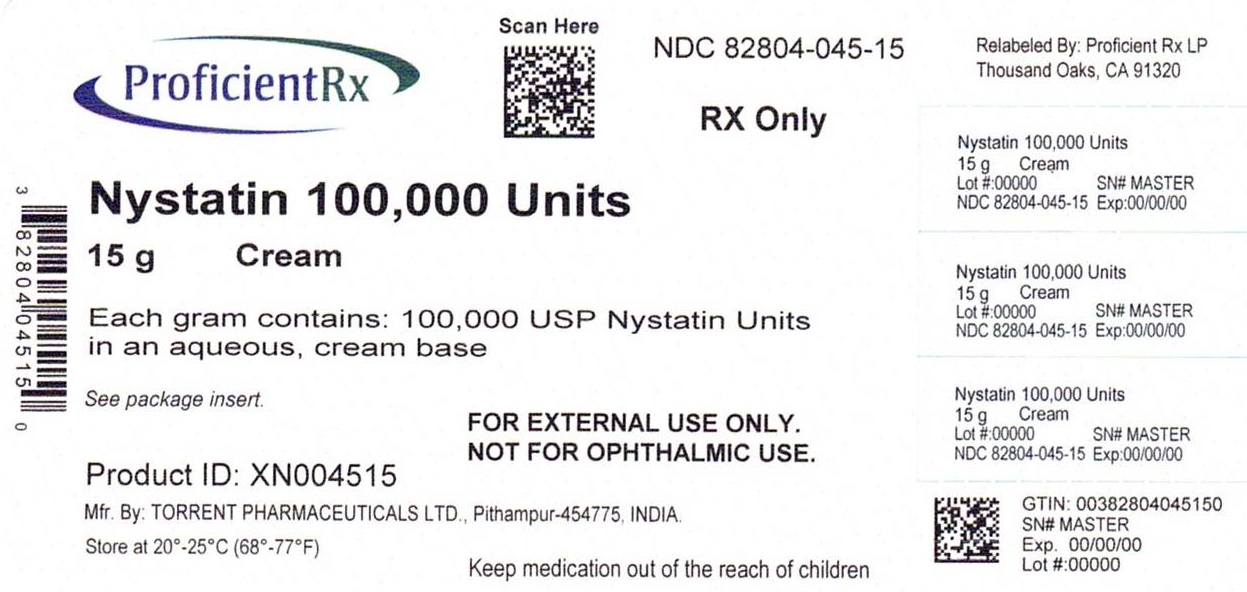
PACKAGE LABEL.PRINCIPAL DISPLAY PANEL 82804-045-15
Medicare Part D spend CMS · PART D · 2026 (Q1)
About this NDC listing & data coverage
What data is (and isn’t) available for this NDC — tap to expand
| NDC identity (package / product / labeler codes) | ✓ Available |
| Labeler | ✓ Available |
| Product & package description | ✓ Available |
| Marketing category & status | ✓ Available |
| Active ingredient / dosage form / route | ✓ Available |
| FDA label (SPL via DailyMed) | ✓ Available |
| Package photos | ✓ Available |
| Inactive ingredients (structured) | ✓ Available |
| NADAC pharmacy acquisition price (CMS) | — Not published for this NDC CMS publishes NADAC only for NDCs reported in its retail-pharmacy survey. |
| Orange Book / therapeutic-equivalence data | ✓ Available |
| HCPCS J-code billing crosswalk | — Not published for this NDC Most self-administered / retail products have no J-code — that is normal. |
| Medicaid utilization (CMS SDUD) | — Not published for this NDC CMS reports utilization only for NDCs with Medicaid claims above its privacy threshold. |