
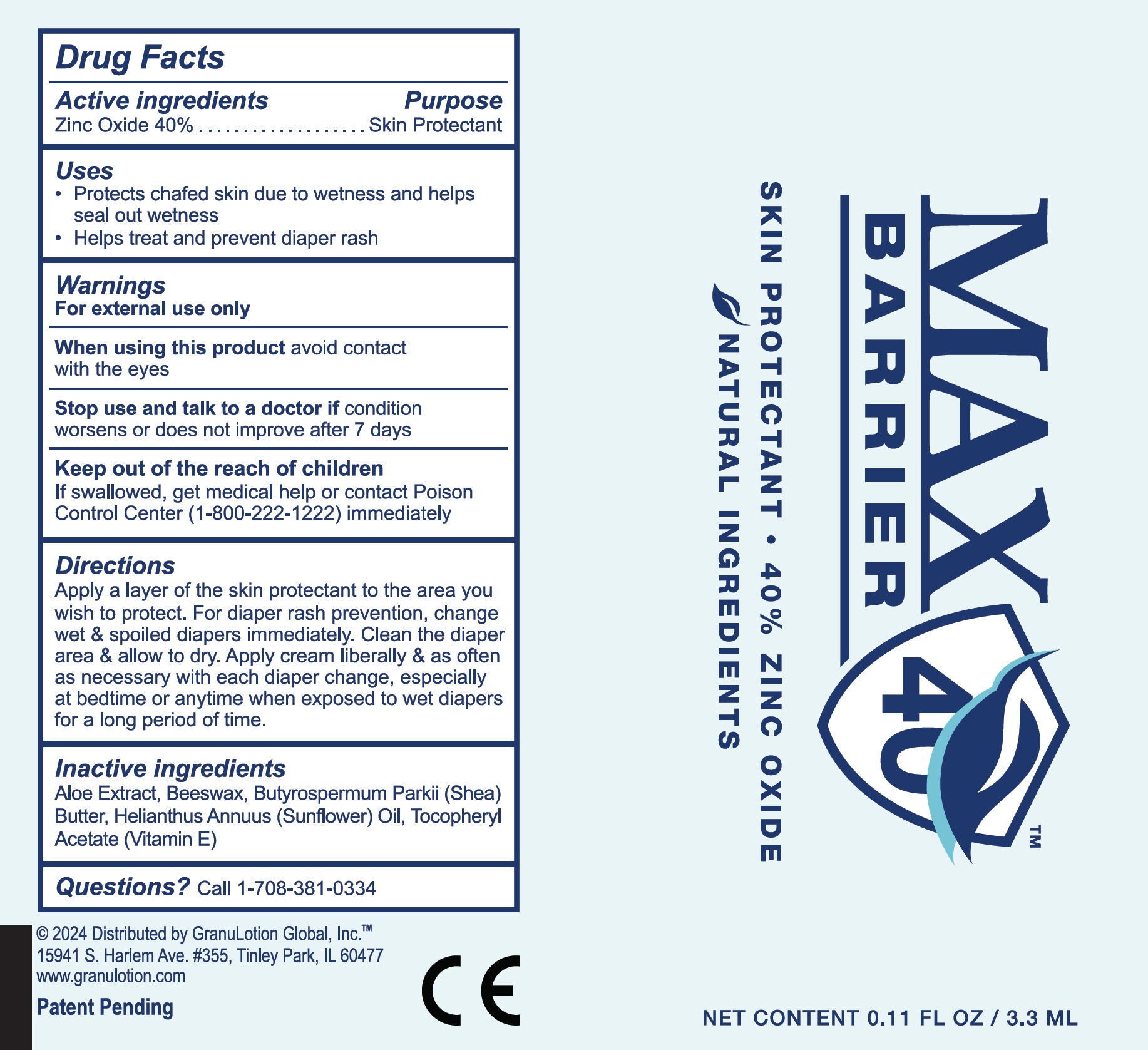
MAX BARRIER Skin Protectant ZINC OXIDE 400 mg/mL Cream, 3.3 mL — NDC 82897-468-00 (Billing 82897-0468-00)
This is a package of 3.3 mL of MAX BARRIER Skin Protectant ZINC OXIDE 400 mg/mL Cream from GL HEALTH, INC., marketed since Mar 2024 and currently FDA-listed. It is this product's only package size.
NDC database record
One package, one record: these facts belong to NDC 82897-468-00 alone.
- Record
- FDA NDC Directory package listing · Human OTC drug
- Code segments
- 82897 labeler · 468 product · 00 package
- Package marketed since
- Mar 8, 2024
- Sample package
- No — commercial package
- Listing certified through
- Dec 31, 2026
- Barcode (UPC-A, from the NDC)
- 3 8289746800 3
- FDA record last changed
- Jul 24, 2026
Other active recalls for Zinc Oxide (different manufacturers) — 6 · tap to view
Identity & classification
Regulatory identifiers FDA, NLM and CMS codes for this package
- RxCUI (RxNorm): 1305337
Where does this data come from?
- FDA openFDA NDC Directory · synced Oct 1, 2026
- FDA label on DailyMed · label index refreshed Oct 5, 2026
- RxNorm (NLM RxNav) · catalog refreshed Oct 1, 2026
- Medi-Span GPI (licensed)
- First Databank (licensed) · refreshed Oct 1, 2026
Clinical
Max Barrier Skin Protectant is an over-the-counter topical cream containing zinc oxide. This product is marketed under FDA's OTC monograph rules for skin protectants. Zinc oxide is commonly used in barrier creams to help protect and soothe skin, and may be applied to areas prone to irritation or moisture exposure. The cream formulation allows for easy application to affected skin areas.
Patient education
Supplement & herbal interactions
Some supplements/herbs that may interact with Zinc oxide (OTC drug) — tap one for details:
Where does this data come from?
- MedlinePlus (NLM) · refreshed Oct 1, 2026
- FDA label on DailyMed · label index refreshed Oct 5, 2026
Ask a licensed pharmacist directly — free, answered by our team.
Pricing
A drug doesn't have one price. Each row is a different public payment system, and none is what you'd pay at the counter — that depends on your insurance. The ⓘ on each row explains what it measures.
| Price system | Per g | Per package |
|---|---|---|
| Retail pharmacies payNADAC · weekly | Not in the retail survey — common for institutional, discontinued, or low-volume packs. | |
| Medicaid paysCMS SDUD · 12 mo | No recent Medicaid claims on file for this NDC — rare and low-volume NDCs are suppressed in the public data. | |
| Medicare drug plans payPart D · quarterly | No Part D plan price is available for this NDC in our data. | |
Where does this data come from?
- CMS NADAC weekly file
- CMS ASP pricing files · refreshed Sep 20, 2026
- CMS Medicaid State Drug Utilization Data · refreshed Oct 5, 2026
- CMS Part D plan pricing files · refreshed Sep 24, 2026
- VA National Acquisition Center price file
Packaging — all sizes for this product
| Package NDC | Description | Marketing start | Marketing end | Status |
|---|---|---|---|---|
| 82897-0468-00 You're viewing this Main listing | 3.3 mL in 1 PACKET | 2024-03-08 | — | Active |
Therapeutic equivalents
| Product | Labeler | Pack | NADAC/unit | TE | Status | Price vs. this |
|---|---|---|---|---|---|---|
| Diaper Rash Cream 2.5oz .4 g/g 57337-0151-01 | Rejoice | 1 tube | — | — | FDA listed | — |
| Diaper Rash Cream 2oz 40 g/100g 57337-0164-01 | Rejoice | 1 tube | — | — | FDA listed | — |
| Diaper Rash Cream 2.5oz 40 g/100g 57337-0165-01 | Rejoice | 1 tube | — | — | FDA listed | — |
| Diaper Rash Cream 15oz 40 g/100g 57337-0169-01 | Rejoice | 425 g | — | — | FDA listed | — |
| Diaper Rash Cream 5.6oz 40 g/100g 57337-0170-01 | Rejoice | 160 g | — | — | FDA listed | — |
| Diaper Rash Cream 2.5oz .4 g/g 58503-0170-01 | China | 1 tube | — | — | FDA listed | — |
| Diaper Rash Cream 5.6oz 40 g/100g 58503-0202-01 | China | 160 g | — | — | FDA listed | — |
| Diaper Rash Cream 15oz 40 g/100g 58503-0205-01 | China | 425 g | — | — | FDA listed | — |
| Earth Baby Diaper Rash Cream 40 g/100g 62588-0904-02 | Earth | 1 tube | — | — | FDA listed | — |
| Baby Diaper Rash Cream 400 mg/g 73418-0301-01 | Hello | 1 tube | — | — | FDA listed | — |
| Diaper Rash Cream 40% ZINC 40 g/100g 77338-0164-01 | ASTONEA | 1 tube | — | — | FDA listed | — |
| MAX BARRIER Skin Protectant 400 mg/mLthis 82897-0468-00 | GL | 3.3 ml | — | — | FDA listed | — |
Where does this data come from?
- FDA openFDA NDC Directory · synced Oct 1, 2026
- FDA Orange Book · refreshed Oct 3, 2026
- CMS NADAC weekly file
Availability & generic status
We did not find an FDA-approved generic match for this exact strength, form and route.
Where does this data come from?
- FDA Orange Book · refreshed Oct 3, 2026
Inactive Ingredients / Excipients
Inactive ingredients, also called excipients, are components of the drug product other than the active ingredient. They may include fillers, dyes, coatings, preservatives, flavors, or other formulation ingredients.
💡 Tap an ingredient (hover on desktop) to see what it is and why it’s used.
-
UNII H4N855PNZ1
Alpha-tocopherol is a form of vitamin E, a fat-soluble antioxidant derived from natural or synthetic sources. In medicines, it prevents oils and fats from breaking down and becoming rancid, protecting the product's stability and shelf life.
-
UNII V5VD430YW9
A plant-derived substance from the aloe vera leaf. Used in medicines as a natural flavor, skin-soothing agent in topical products, and sometimes as a mild laxative ingredient in oral formulations.
-
UNII BKJ0J3D1BP
A plant-derived ingredient from sunflower flowers, used as a natural colorant and flavoring agent in medicines. It may help provide color or mild taste to the product.
-
UNII K49155WL9Y
Shea butter is a fat extracted from shea tree nuts. It's used in medicines as an emollient and lubricant to soften the product, improve texture, and help ingredients blend smoothly together.
-
UNII 2ZA36H0S2V
Beeswax is a natural wax produced by honeybees. In medicines, it works as a coating agent and thickener to control how fast the drug dissolves and improve the product's texture and appearance.
5 inactive ingredients listed in the exact product block matched to this NDC.
Label-section wording can be broader than the structured product block and may mention additional formulation ingredients.
Where does this data come from?
ingredient classCode="IACT" elements from the exact product block matched by this NDC. Label-section narrative from DailyMed / the openFDA label index is shown separately when available.- FDA label on DailyMed · label index refreshed Oct 5, 2026
- FDA openFDA NDC Directory · synced Oct 1, 2026
Inactive ingredient FAQ
Are inactive ingredients the same for every manufacturer?
Why might an inactive ingredient be missing?
Can inactive ingredients matter?
Manufacturer & labeler
More NDCs from GL HEALTH, INC. labeler code 82897
Where does this data come from?
- FDA openFDA NDC Directory · synced Oct 1, 2026
- Drugs@FDA
FDA label — Drug Facts FDA SPL
🎯 Indications and Usage ▾
Uses Protects chafed skin due to wetness and helps seal out wetness Helps treat and prevent diaper rash
⏱️ Dosage and Administration ▾
Directions Apply a layer of the skin protectant to the area you wish to protect. For diaper rash prevention, change wet & spoiled diapers immediately. Clean the diaper area & allow to dry. Apply cream liberally & as often as necessary with each diaper change, especially at bedtime or anytime when exposed to wet diapers for a long period of time.
⚠️ Warnings ▾
Warnings For external use only When using this product avoid contact with the eyes Stop use and talk to a doctor if condition worsens or does not improve after 7 days Keep out of the reach of children If swallowed, get medical help or contact Poison Control Center (1-800-222-1222) immediately
🧪 Active Ingredient ▾
Active ingredients Zinc Oxide 40% Purpose Skin Protectant
🧪 Inactive Ingredients ▾
Inactive ingredients Aloe Extract, Beeswax, Butyrospermum Parkii (Shea) Butter, Helianthus Annuus (Sunflower) Oil, Tocopheryl Acetate (Vitamin E)
🎯 Purpose ▾
Purpose Skin Protectant
📄 When Using This Product ▾
When using this product avoid contact with the eyes
📄 Stop Use and Ask a Doctor If ▾
Stop use and talk to a doctor if condition worsens or does not improve after 7 days
📄 Keep Out of Reach of Children ▾
Keep out of the reach of children If swallowed, get medical help or contact Poison Control Center (1-800-222-1222) immediately
📄 Questions or Comments ▾
Questions? Call 1-708-381-0334
📄 Package Label / Principal Display Panel ▾
Package Labeling: Label
Reported adverse events (FAERS)
Top reported reactions
Age at onset
Reporter sex
Serious outcomes
Where does this data come from?
About this NDC listing & data coverage
What data is (and isn’t) available for this NDC — tap to expand
| NDC identity (package / product / labeler codes) | ✓ Available |
| Labeler | ✓ Available |
| Product & package description | ✓ Available |
| Marketing category & status | ✓ Available |
| Active ingredient / dosage form / route | ✓ Available |
| FDA label (SPL via DailyMed) | ✓ Available |
| Package photos | ✓ Available |
| Inactive ingredients (structured) | ✓ Available |
| NADAC pharmacy acquisition price (CMS) | — Not published for this NDC CMS publishes NADAC only for NDCs reported in its retail-pharmacy survey. |
| Orange Book / therapeutic-equivalence data | — Not published for this NDC Applies only to products approved under an NDA/ANDA; many listings are out of scope. |
| HCPCS J-code billing crosswalk | — Not published for this NDC Most self-administered / retail products have no J-code — that is normal. |
| Medicaid utilization (CMS SDUD) | — Not published for this NDC CMS reports utilization only for NDCs with Medicaid claims above its privacy threshold. |