
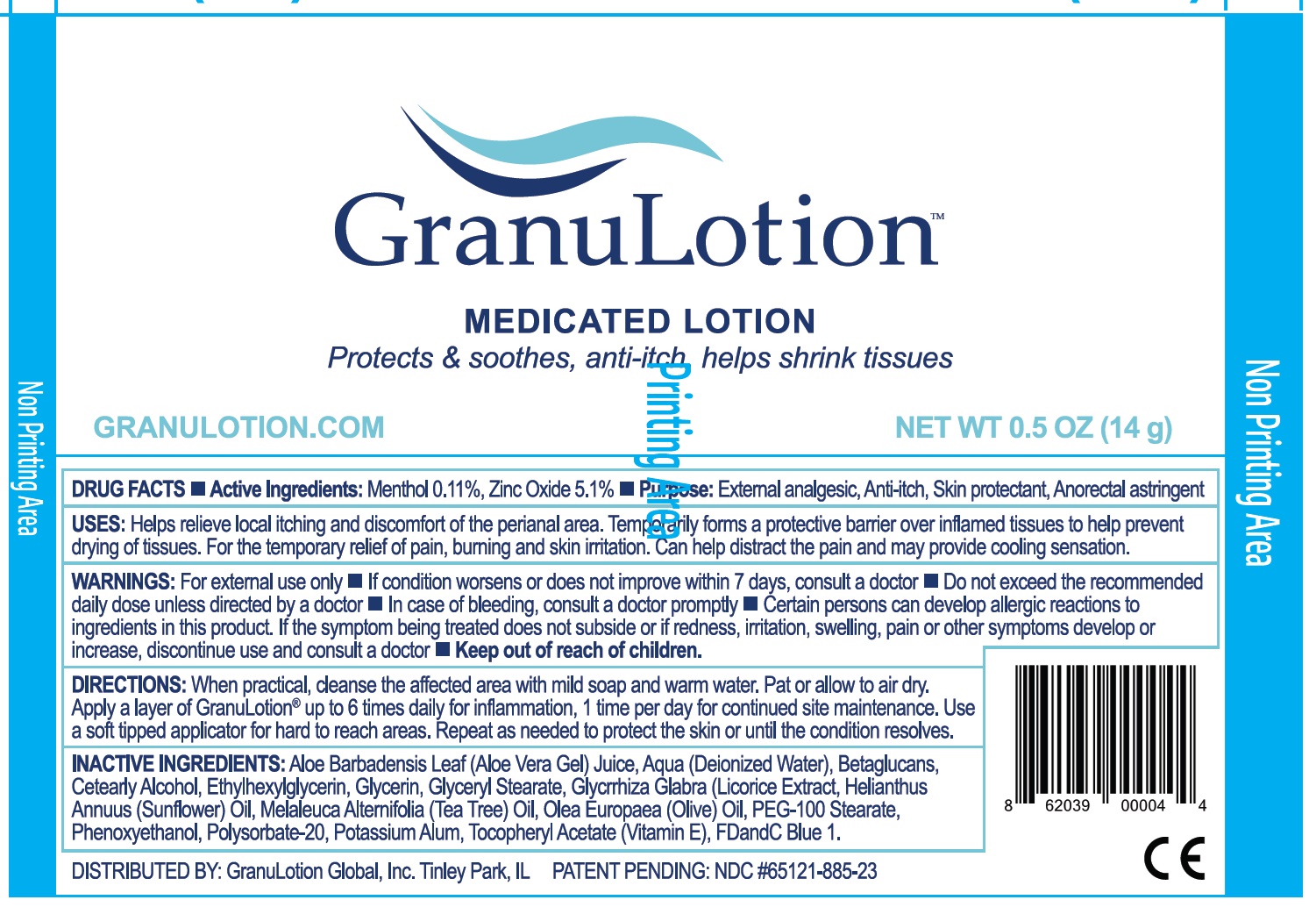
Granulotion Medicated MENTHOL, ZINC OXIDE 1.1 mg/g; 51 mg/g Lotion, 14 g — NDC 82897-544-00 (Billing 82897-0544-00)
This is a package of 14 g of Granulotion Medicated MENTHOL, ZINC OXIDE 1.1 mg/g; 51 mg/g Lotion from GL HEALTH, INC., marketed since Oct 2024 and currently FDA-listed. It is this product's only package size.
NDC database record
One package, one record: these facts belong to NDC 82897-544-00 alone.
- Record
- FDA NDC Directory package listing · Human OTC drug
- Code segments
- 82897 labeler · 544 product · 00 package
- Package marketed since
- Oct 14, 2024
- Sample package
- No — commercial package
- Listing certified through
- Dec 31, 2026
- Barcode (UPC)
- 0862039000044
- FDA record last changed
- Jul 24, 2026
Identity & classification
Regulatory identifiers FDA, NLM and CMS codes for this package
- RxCUI (RxNorm): 1492398
Where does this data come from?
- FDA openFDA NDC Directory · synced Oct 1, 2026
- FDA label on DailyMed · label index refreshed Oct 5, 2026
- RxNorm (NLM RxNav) · catalog refreshed Oct 1, 2026
- Medi-Span GPI (licensed)
- First Databank (licensed) · refreshed Oct 1, 2026
Clinical
Granulotion Medicated Menthol Zinc Oxide is a topical lotion marketed as an over-the-counter monograph product. It contains menthol, which is typically used to produce a cooling sensation on skin, and zinc oxide, which is commonly used as a skin protectant and mild astringent. This lotion is intended for application directly to the skin to help soothe and protect minor skin irritation.
Patient education
Supplement & herbal interactions
Where does this data come from?
- MedlinePlus (NLM) · refreshed Oct 1, 2026
- FDA label on DailyMed · label index refreshed Oct 5, 2026
Ask a licensed pharmacist directly — free, answered by our team.
Pricing
A drug doesn't have one price. Each row is a different public payment system, and none is what you'd pay at the counter — that depends on your insurance. The ⓘ on each row explains what it measures.
| Price system | Per g | Per package |
|---|---|---|
| Retail pharmacies payNADAC · weekly | Not in the retail survey — common for institutional, discontinued, or low-volume packs. | |
| Medicaid paysCMS SDUD · 12 mo | No recent Medicaid claims on file for this NDC — rare and low-volume NDCs are suppressed in the public data. | |
| Medicare drug plans payPart D · quarterly | No Part D plan price is available for this NDC in our data. | |
Where does this data come from?
- CMS NADAC weekly file
- CMS ASP pricing files · refreshed Sep 20, 2026
- CMS Medicaid State Drug Utilization Data · refreshed Oct 5, 2026
- CMS Part D plan pricing files · refreshed Sep 24, 2026
- VA National Acquisition Center price file
Packaging — all sizes for this product
| Package NDC | Description | Marketing start | Marketing end | Status |
|---|---|---|---|---|
| 82897-0544-00 You're viewing this Main listing | 14 g in 1 TUBE | 2024-10-14 | — | Active |
Therapeutic equivalents
| Product | Labeler | Pack | NADAC/unit | TE | Status | Price vs. this |
|---|---|---|---|---|---|---|
| GranuLotion .11 g/100g; 5.1 g/100g 65121-0885-23 | Pure | 1 bottle | — | — | Discontinued | — |
| GRANULOTION Hemorrhoidal 1.1 mg/mL; 51 mg/mL 82897-0293-00 | GL | 3.3 ml | — | — | FDA listed | — |
| Granulotion Medicated 1.1 mg/g; 51 mg/gthis 82897-0544-00 | GL | 14 g | — | — | FDA listed | — |
Where does this data come from?
- FDA openFDA NDC Directory · synced Oct 1, 2026
- FDA Orange Book · refreshed Oct 3, 2026
- CMS NADAC weekly file
Availability & generic status
We did not find an FDA-approved generic match for this exact strength, form and route.
Where does this data come from?
- FDA Orange Book · refreshed Oct 3, 2026
Inactive Ingredients / Excipients
Inactive ingredients, also called excipients, are components of the drug product other than the active ingredient. They may include fillers, dyes, coatings, preservatives, flavors, or other formulation ingredients.
💡 Tap an ingredient (hover on desktop) to see what it is and why it’s used.
-
UNII 9E8X80D2L0
A synthetic form of vitamin E used as an antioxidant and preservative in medications. It helps prevent the active ingredients from degrading when exposed to oxygen or light.
-
UNII ZY81Z83H0X
Aloe vera leaf is a plant extract derived from the aloe plant. It is used in medicines as a natural moisturizer and skin-soothing agent in topical formulations.
-
UNII 2DMT128M1S
A waxy solid derived from plant or animal sources. It acts as an emulsifier to blend oil and water components, and also thickens the medicine to give it the right texture and consistency.
-
UNII 147D247K3P
Ethylhexylglycerin is a synthetic preservative used to prevent bacteria and mold from growing in medicines and personal care products. It helps keep the product safe and stable throughout its shelf life.
-
UNII H3R47K3TBD
FD&C Blue No. 1 is a synthetic blue dye approved for use in foods and medicines. It serves as a colorant to give the medication its distinctive appearance and help with product identification.
-
UNII PDC6A3C0OX
Glycerin is a clear, thick liquid derived from plant oils or fats. It acts as a humectant to retain moisture, a sweetener, and a solvent in medications.
-
UNII 230OU9XXE4
A waxy substance made from glycerin and stearic acid that acts as an emulsifier to blend oily and watery ingredients together. It also helps thicken and stabilize the medicine's texture.
-
UNII BKJ0J3D1BP
A plant-derived ingredient from sunflower flowers, used as a natural colorant and flavoring agent in medicines. It may help provide color or mild taste to the product.
-
UNII 61ZBX54883
Licorice is a natural extract from the licorice plant root. It's used in medicines as a flavoring agent to mask bitter tastes and improve how the medicine tastes.
-
UNII 6UYK2W1W1E
A natural oil extracted from olives. It acts as an emollient and lubricant in formulations, helping to soften ingredients and improve how the medicine spreads or flows.
-
UNII YD01N1999R
A waxy substance made from polyethylene glycol and stearic acid. It helps mix oil and water-based ingredients together and serves as an emulsifier and solubilizer in liquid and semi-solid medicines.
-
UNII HIE492ZZ3T
Phenoxyethanol is a synthetic preservative and antimicrobial agent used to prevent bacterial and fungal growth in medicines and cosmetic products, extending shelf life and maintaining product safety.
-
UNII 7T1F30V5YH
A synthetic emulsifier derived from sorbitol and oleic acid. It helps mix oil and water-based ingredients together and keeps them from separating in liquid formulations.
-
UNII 1L24V9R23S
Potassium alum is a mineral salt used in medicines as an astringent agent and buffering ingredient. It helps control moisture, maintain pH balance, and can reduce irritation in topical or oral formulations.
-
UNII VIF565UC2G
Tea tree oil is an essential oil extracted from the leaves of the Australian tea tree plant. In medicines, it typically serves as a flavoring agent, fragrance, or antimicrobial component in topical formulations.
-
UNII 059QF0KO0R
Water is a liquid solvent that dissolves and mixes ingredients together in liquid medicines, syrups, and injections. It helps distribute the active drug evenly throughout the product.
16 inactive ingredients listed in the exact product block matched to this NDC.
Label-section wording can be broader than the structured product block and may mention additional formulation ingredients.
Where does this data come from?
ingredient classCode="IACT" elements from the exact product block matched by this NDC. Label-section narrative from DailyMed / the openFDA label index is shown separately when available.- FDA label on DailyMed · label index refreshed Oct 5, 2026
- FDA openFDA NDC Directory · synced Oct 1, 2026
Inactive ingredient FAQ
Are inactive ingredients the same for every manufacturer?
Why might an inactive ingredient be missing?
Can inactive ingredients matter?
Manufacturer & labeler
More NDCs from GL HEALTH, INC. labeler code 82897
Where does this data come from?
- FDA openFDA NDC Directory · synced Oct 1, 2026
- Drugs@FDA
FDA label — Drug Facts FDA SPL
🎯 Indications and Usage ▾
USES: Helps relieve local itching and discomfort of the perianal area. Temporarily forms a protective barrier over inflamed tissues to help prevent drying of tissues. For the temporary relief of pain, burning and skin irritation. Can help distract the pain and may provide cooling sensation.
⏱️ Dosage and Administration ▾
DIRECTIONS: When practical, cleanse the affected area with mild soap and warm water. Pat or allow to air dry. Apply a layer of GranuLotion® up to 6 times daily for inflammation, 1 time per day for continued site maintenance. Use a soft tipped applicator for hard to reach areas. Repeat as needed to protect the skin or until the condition resolves.
⚠️ Warnings ▾
WARNINGS: For external use only If condition worsens or does not improve within 7 days, consult a doctor Do not exceed the recommended daily dose unless directed by a doctor In case of bleeding, consult a doctor promptly Certain persons can develop allergic reactions to ingredients in this product. If the symptom being treated does not subside or if redness, irritation, swelling, pain or other symptoms develop or increase, discontinue use and consult a doctor • Keep out of reach of children.
🧪 Active Ingredient ▾
Active Ingredients: Menthol 0.11%, Zinc Oxide 5.1% Purpose: External analgesic, Anti-itch, Skin protectant, Anorectal astringent
🧪 Inactive Ingredients ▾
INACTIVE INGREDIENTS: Aloe Barbadensis Leaf (Aloe Vera Gel) Juice, Aqua (Deionized Water), Betaglucans, Cetearyl Alcohol, Ethylhexylglycerin, Glycerin, Glyceryl Stearate, Glycrrhiza Glabra (Licorice Extract, Helianthus Annuus (Sunflower) Oil, Melaleuca Alternifolia (Tea Tree) Oil, Olea Europaea (Olive) Oil, PEG-100 Stearate, Phenoxyethanol, Polysorbate-20, Potassium Alum, Tocopheryl Acetate (Vitamin E), FDandC Blue 1.
🎯 Purpose ▾
Purpose: External analgesic, Anti-itch, Skin protectant, Anorectal astringent
📄 Keep Out of Reach of Children ▾
• Keep out of reach of children.
📄 Package Label / Principal Display Panel ▾
Package Labeling: Label
Reported adverse events (FAERS)
Top reported reactions
Reporter sex
Serious outcomes
Where does this data come from?
About this NDC listing & data coverage
What data is (and isn’t) available for this NDC — tap to expand
| NDC identity (package / product / labeler codes) | ✓ Available |
| Labeler | ✓ Available |
| Product & package description | ✓ Available |
| Marketing category & status | ✓ Available |
| Active ingredient / dosage form / route | ✓ Available |
| FDA label (SPL via DailyMed) | ✓ Available |
| Package photos | ✓ Available |
| Inactive ingredients (structured) | ✓ Available |
| NADAC pharmacy acquisition price (CMS) | — Not published for this NDC CMS publishes NADAC only for NDCs reported in its retail-pharmacy survey. |
| Orange Book / therapeutic-equivalence data | — Not published for this NDC Applies only to products approved under an NDA/ANDA; many listings are out of scope. |
| HCPCS J-code billing crosswalk | — Not published for this NDC Most self-administered / retail products have no J-code — that is normal. |
| Medicaid utilization (CMS SDUD) | — Not published for this NDC CMS reports utilization only for NDCs with Medicaid claims above its privacy threshold. |