
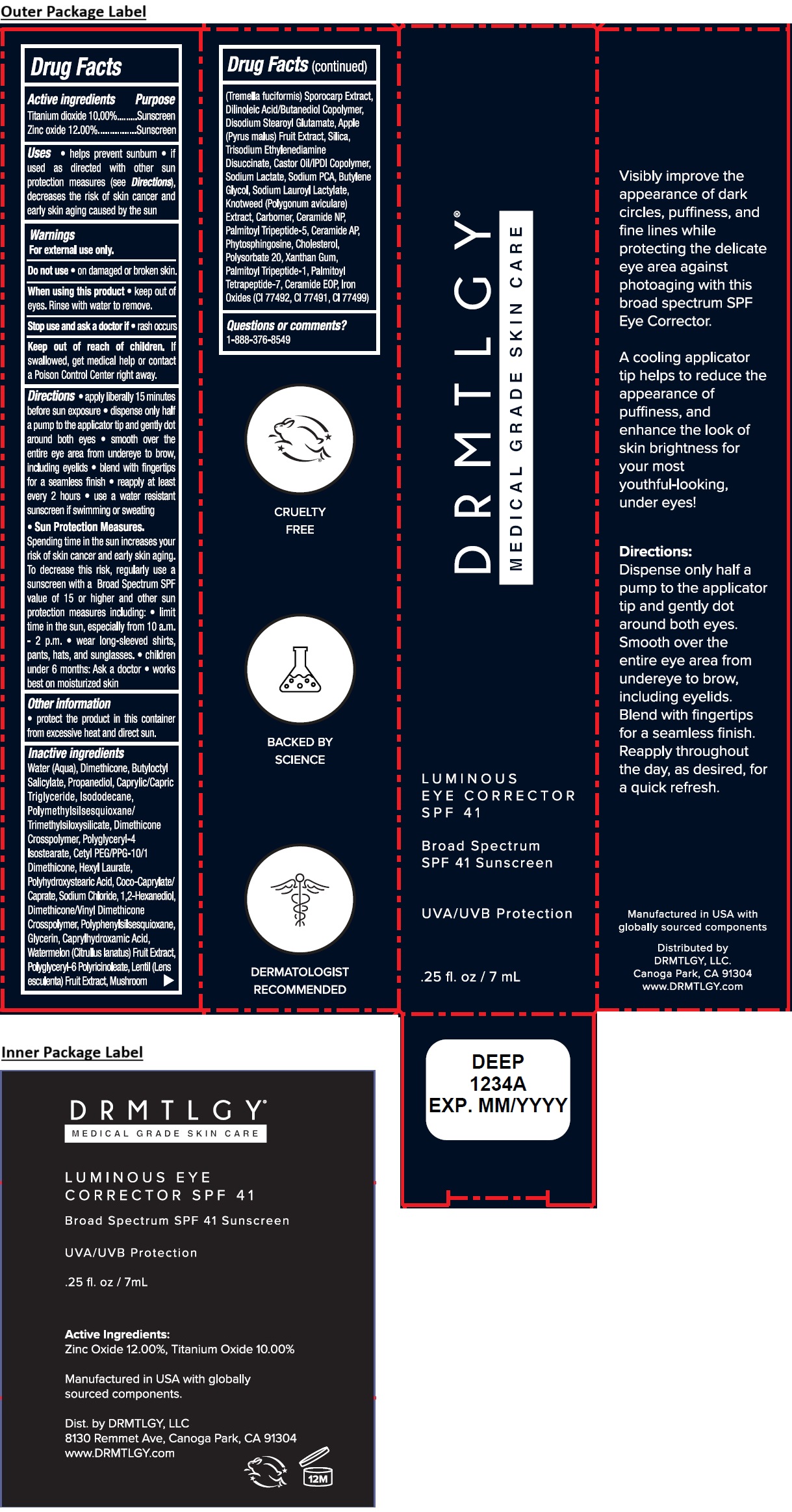
LUMINOUS EYE CORRECTOR SPF 41 - DEEP Titanium dioxide, Zinc oxide 12 g/100mL; 10 g/100mL Cream
Other active recalls for Titanium Dioxide, Zinc Oxide (different manufacturers) — 1 · tap to view
🆔 Identity & classification
Where does this data come from?
🏭 Manufacturer & labeler
Where does this data come from?
🩺 Clinical
Luminous Eye Corrector SPF 41 - Deep is a cream applied to the skin around the eyes. It contains titanium dioxide and zinc oxide, which are mineral ingredients commonly used in sunscreen products to reflect and scatter ultraviolet light. This product is marketed as an OTC monograph drug, meaning it follows FDA's established safety and effectiveness standards for over-the-counter sunscreen products rather than undergoing individual product review.
Patient education
Supplement & herbal interactions
Where does this data come from?
Ask a licensed pharmacist directly — free, answered by our team.
🧪 Inactive Ingredients / Excipients
Inactive ingredients, also called excipients, are components of the drug product other than the active ingredient. They may include fillers, dyes, coatings, preservatives, flavors, or other formulation ingredients.
💡 Tap an ingredient (hover on desktop) to see what it is and why it’s used.
-
UNII TR046Y3K1G
A liquid alcohol derived from petroleum or plant sources. It acts as a solvent and humectant in medicines, helping dissolve active ingredients and retain moisture in the formulation.
-
UNII B423VGH5S9
A natural fruit ingredient derived from apples, used as a flavoring agent and sweetener to improve taste and palatability of the medicine.
-
UNII 3XUS85K0RA
Butylene glycol is a clear liquid derived from petroleum or plants that acts as a humectant, solvent, and preservative booster in medicines. It helps keep formulations stable, dissolve active ingredients, and maintain moisture in topical products.
-
UNII 2EH13UN8D3
A synthetic compound used as a solvent and penetration enhancer in topical formulations. It helps dissolve active ingredients and allows them to penetrate the skin more effectively.
-
UNII UPY805K99W
A synthetic compound derived from caprylic acid that works as a preservative and antimicrobial agent to help prevent bacterial and fungal growth in the medicine.
-
UNII 0A5MM307FC
A synthetic polymer that absorbs water and forms a thick, gel-like substance. In medicines, it works as a thickener and stabilizer to improve texture and help ingredients stay mixed together in creams, gels, and lotions.
-
UNII GSA2TXZ34G
A synthetic polymer made from castor oil and a chemical linker, used as a coating or binder in medications to control how and when the active ingredient is released in the body.
-
UNII 5THT33P7X7
A waxy, lipid-like substance derived from animal or plant sources. It helps soften and moisturize the skin by acting as an emollient and skin-conditioning agent in topical medicines and creams.
-
UNII F1X8L2B00J
A naturally derived fatty substance that helps bind and condition the product's texture. It works as an emollient and skin-conditioning agent in topical formulations, helping maintain moisture and smoothness.
-
UNII 4370DF050B
Ceramide NP is a waxy, lipid-based substance that mimics natural skin oils. It's used in topical formulations as an emollient and skin-conditioning agent to help soften, smooth, and protect the skin barrier.
-
UNII 035JKJ76MT
A silicone-based ingredient that helps oil and water mix together in formulations. It works as an emulsifier to create smooth, stable textures in topical medicines and creams.
-
UNII 97C5T2UQ7J
Cholesterol is a fatty substance found naturally in animal tissues. In medications, it's used as an ingredient in liposomal formulations and lipid-based drug delivery systems to help encapsulate and stabilize active drugs for better absorption.
-
UNII 8D9H4QU99H
A synthetic fatty acid ester derived from coconut oil, used as an emulsifier and solubilizer to help mix oil and water-based ingredients and improve how the body absorbs certain drugs.
-
UNII 1F2S8T535O
A synthetic polymer made from fatty acids and a chemical compound that binds ingredients together. It works as a binder and film-former in solid dosage forms, helping hold tablets together and coat their surface.
-
UNII UF7620L1W6
A synthetic silicone polymer that acts as a thickener and absorbent in medicines. It helps create the right texture, improves how the product feels on skin or in the mouth, and can absorb excess moisture or oil in formulations.
-
UNII 92RU3N3Y1O
Dimethicone is a silicone-based oil that acts as an anti-foaming agent and lubricant in medicines. It reduces gas bubbles in liquid formulations and helps coat and protect the stomach lining when ingested.
-
UNII 9E4CO0W6C5
A silicone-based polymer that forms soft, spongy particles. Used as a texture modifier and suspending agent to improve how the product feels and flows, and to help keep ingredients evenly distributed throughout the formulation.
-
UNII 45ASM2L11M
A synthetic ingredient derived from glutamic acid and stearic acid. It acts as an emulsifier and surfactant, helping oils and water mix smoothly in the medication formulation.
-
UNII 1K09F3G675
Ferric oxide red is an inorganic iron compound used as a colorant in medicines. It gives tablets, capsules, or other dosage forms a red or reddish tint for identification and appearance.
-
UNII EX438O2MRT
Ferric oxide yellow is a naturally occurring iron compound used as a colorant in medications. It gives tablets, capsules, and other forms a yellow or golden hue for identification and appearance.
-
UNII XM0M87F357
A dark iron oxide compound that gives medicines their black or dark color. It's used as a colorant in tablets and capsules to help identify the product and make it visually distinctive.
-
UNII PDC6A3C0OX
Glycerin is a clear, thick liquid derived from plant oils or fats. It acts as a humectant to retain moisture, a sweetener, and a solvent in medications.
-
UNII 4CG9F9W01Q
A synthetic fatty acid ester used as an emollient and skin-conditioning agent in topical medicines. It helps soften the product texture and improves how it spreads and absorbs into the skin.
-
UNII A8289P68Y2
Isododecane is a lightweight liquid hydrocarbon used as a solvent and spreadability agent in topical formulations. It helps dissolve active ingredients and makes the product easier to apply and absorb into the skin.
-
UNII C9H2L21V7U
A fat derived from coconut or palm oil containing shorter fatty acid chains. It serves as a solvent and carrier to help dissolve or suspend active ingredients, improving absorption and stability in liquid formulations.
-
UNII Q41S464P1R
A synthetic peptide (short protein-like molecule) used in skincare and cosmetic formulations as an active conditioning ingredient to help improve skin texture and appearance. It may function as a humectant or skin-conditioning agent in topical products.
-
UNII RV743D216M
A synthetic peptide derived from fatty acids and amino acids. It functions as a skin-conditioning agent and emollient in topical formulations, helping soften and smooth the product texture while supporting skin hydration.
-
UNII 2A3916MQHO
A synthetic peptide derived from palm oil that functions as a skin-conditioning agent and emollient. In formulations, it helps soften and smooth the product texture while providing moisturizing properties to topical preparations.
-
UNII DNR46JQ8BT
Phenylsilanetriol is a silicon-based compound used in pharmaceutical formulations as a glidant and anti-caking agent. It helps powders flow smoothly and prevents clumping during manufacturing and storage.
-
UNII GIN46U9Q2Q
Phytosphingosine is a naturally derived fatty compound that helps stabilize and thicken skincare and cosmetic formulations. It works as an emollient and conditioning agent to improve texture and skin feel in topical products.
-
UNII 820DPX33S7
A synthetic emulsifier derived from glycerin and fatty acids. It helps mix oil and water-based ingredients together and keeps them evenly blended throughout the product.
-
UNII YPM0ZOC2HR
A synthetic emulsifier derived from glycerin and castor oil. It helps mix oil and water-based ingredients together in the formulation to create a uniform product and improve texture.
-
UNII ZCD6009IUF
A plant-derived ingredient from knotweed used as a natural filler and binding agent. It helps hold the medicine's ingredients together and add bulk to tablets or capsules.
-
UNII YXH47AOU0F
A synthetic fatty acid used as a thickener and stabilizer in medicines. It helps create the right texture and prevents separation of ingredients in liquid or semi-solid formulations.
-
UNII X2PZH4Y6HT
A silicone-based powder derived from silicon and oxygen compounds. It works as a glidant and anti-caking agent to improve how the tablet or capsule flows during manufacturing and prevent clumping in the finished product.
-
UNII 7T1F30V5YH
A synthetic emulsifier derived from sorbitol and oleic acid. It helps mix oil and water-based ingredients together and keeps them from separating in liquid formulations.
-
UNII 5965N8W85T
Propanediol is a clear liquid organic compound derived from vegetable sources or synthesized chemically. It acts as a humectant to retain moisture, a solvent to dissolve active ingredients, and a preservative booster in liquid medications and supplements.
-
UNII ETJ7Z6XBU4
Silicon dioxide is a naturally occurring mineral used as a glidant and anti-caking agent. It helps powder ingredients flow smoothly and prevents clumping during manufacturing and storage.
-
UNII 451W47IQ8X
Sodium chloride is common table salt. It's used in medicines as a buffer to maintain proper pH, as a filler to add bulk, or to adjust the osmotic balance in liquid formulations.
-
UNII TU7HW0W0QT
A salt derived from lactic acid, sodium lactate acts as a buffer and pH stabilizer in medicines. It helps maintain the product's acidity level and can also serve as a humectant to retain moisture.
-
UNII 7243K85WFO
Sodium lauroyl lactylate is a mild surfactant derived from natural fats and lactic acid. It acts as an emulsifier and solubilizer to help blend oil and water-based ingredients and improve how the body absorbs the active drug.
-
UNII 469OTG57A2
Sodium pyrrolidone carboxylate is a synthetic polymer derived from pyrrolidone chemistry. It functions as a solubilizer and binder in medications, helping dissolve poorly water-soluble drugs and hold tablet ingredients together.
-
UNII GG8N28393G
Tremella fuciformis, also called snow fungus, is a white jelly-like mushroom. In medications, it acts as a thickener and stabilizer to give the product a smooth texture and help keep ingredients evenly mixed.
-
UNII YA22H34H9Q
A chelating agent derived from sodium and organic compounds. It binds to metal ions in the formulation to improve stability and prevent unwanted chemical reactions that could degrade the medicine.
-
UNII ZYZ076G9JH
Lens culinaris fruit is a plant-derived ingredient from lentil plants. It serves as a filler and source of plant-based material in formulations.
-
UNII 059QF0KO0R
Water is a liquid solvent that dissolves and mixes ingredients together in liquid medicines, syrups, and injections. It helps distribute the active drug evenly throughout the product.
-
UNII 231473QB6R
Watermelon is a fruit extract or flavoring agent. It's added to medicines to improve taste, making the product more palatable, especially for children or medications with unpleasant flavors.
-
UNII TTV12P4NEE
Xanthan gum is a thickening and stabilizing ingredient made from fermented corn or other sugars. It's added to medicines to improve texture, prevent separation of liquids and solids, and help the product stay consistent.
48 inactive ingredients listed in the exact product block matched to this NDC.
Label-section wording can be broader than the structured product block and may mention additional formulation ingredients.
Where does this data come from?
ingredient classCode="IACT" elements from the exact product block matched by this NDC. Label-section narrative from DailyMed / the openFDA label index is shown separately when available.Inactive ingredient FAQ
Are inactive ingredients the same for every manufacturer?
Why might an inactive ingredient be missing?
Can inactive ingredients matter?
💲 Pricing
A drug doesn't have one price. Each row is a different public payment system, and none is what you'd pay at the counter — that depends on your insurance. The ⓘ on each row explains what it measures.
| Price system | Per g | Per package |
|---|---|---|
| Retail pharmacies payNADAC · weekly | Not in the retail survey — common for institutional, discontinued, or low-volume packs. | |
| Medicaid paysCMS SDUD · 12 mo | No recent Medicaid claims on file for this NDC — rare and low-volume NDCs are suppressed in the public data. | |
| Medicare drug plans payPart D · quarterly | No Part D plan price is available for this NDC in our data. | |
Where does this data come from?
🔁 Therapeutic equivalents
| Product | Labeler | Pack | NADAC/unit | TE | Status | Price vs. this |
|---|---|---|---|---|---|---|
| Luminous Eye Corrector Spf 41 - Medium 12 g/100mL; 10 g/100mL 83286-0004-01 | Drmtlgy, | 1 bottle | — | — | FDA listed | — |
| Luminous Eye Corrector Spf 41 - Fair 12 g/100mL; 10 g/100mL 83286-0003-01 | Drmtlgy, | 1 bottle | — | — | FDA listed | — |
| Luminous Eye Corrector Spf 41 - Deep 12 g/100mL; 10 g/100mLthis 83286-0006-01 | Drmtlgy, | 1 bottle | — | — | FDA listed | — |
| Luminous Eye Corrector Spf 41 - Tan 12 g/100mL; 10 g/100mL 83286-0005-01 | Drmtlgy, | 1 bottle | — | — | FDA listed | — |
Where does this data come from?
⏳ Availability & generic status
We did not find an FDA-approved generic match for this exact strength, form and route.
Where does this data come from?
📦 Packaging — all sizes for this product
| Package NDC | Description | Marketing start | Status |
|---|---|---|---|
| 83286-0006-01 You're viewing this | 1 BOTTLE in 1 CARTON (83286-006-01) / 7 mL in 1 BOTTLE | 2023-12-22 | Active |
🧭 About this NDC listing & data coverage
What data is (and isn’t) available for this NDC — tap to expand
| NDC identity (package / product / labeler codes) | ✓ Available |
| Labeler | ✓ Available |
| Product & package description | ✓ Available |
| Marketing category & status | ✓ Available |
| Active ingredient / dosage form / route | ✓ Available |
| FDA label (SPL via DailyMed) | ✓ Available |
| Package photos | ✓ Available |
| Inactive ingredients (structured) | ✓ Available |
| NADAC pharmacy acquisition price (CMS) | — Not published for this NDC CMS publishes NADAC only for NDCs reported in its retail-pharmacy survey. |
| Orange Book / therapeutic-equivalence data | — Not published for this NDC Applies only to products approved under an NDA/ANDA; many listings are out of scope. |
| HCPCS J-code billing crosswalk | — Not published for this NDC Most self-administered / retail products have no J-code — that is normal. |
| Medicaid utilization (CMS SDUD) | — Not published for this NDC CMS reports utilization only for NDCs with Medicaid claims above its privacy threshold. |
Questions about this listing
Is this NDC FDA-approved?
Why is there no price listed?
Is the NDC printed on the package the same as the 11-digit billing NDC?
What do the three segments of this NDC mean?
Is this package still being marketed?
Who lists this product with the FDA?
Do I need a prescription for this product?
Where does this data come from?
📄 FDA label — Drug Facts FDA SPL
🎯 Indications and Usage ▾
Uses • helps prevent sunburn • if used as directed with other sun protection measures (see Directions), decreases the risk of skin cancer and early skin aging caused by the sun
⏱️ Dosage and Administration ▾
Directions • apply liberally 15 minutes before sun exposure • dispense only half a pump to the applicator tip and gently dot around both eyes • smooth over the entire eye area from undereye to brow, including eyelids • blend with fingertips for a seamless finish • reapply at least every 2 hours • use a water resistant sunscreen if swimming or sweating Sun Protection Measures • spending time in the sun increases your risk of skin cancer and early skin aging. To decrease this risk, regularly use a sunscreen with a Broad Spectrum SPF value of 15 or higher and other sun protection measures including: • limit time in the sun, especially from 10 a.m. - 2 p.m. • wear long-sleeved shirts, pants, hats, and sunglasses. • children under 6 months: Ask a doctor • works best on moisturized skin
⚠️ Warnings ▾
Warnings For external use only. Do not use • on damaged or broken skin. When using this product • keep out of eyes. Rinse with water to remove. Stop use and ask a doctor if rash occurs Keep out of reach of children . If swallowed, get medical help or contact a Poison Control Center right away.
📦 Storage and Handling ▾
Other information • protect the product in this container from excessive heat and direct sun.
🧪 Active Ingredient ▾
Active ingredients Zinc oxide 12.00% Titanium dioxide 10.00%
🧪 Inactive Ingredients ▾
Inactive ingredients: Water/Aqua/Eau, Dimethicone, Butyloctyl Salicylate, Propanediol, Caprylic/Capric Triglyceride, Coco-Caprylate/Caprate, Isododecane, Polymethylsilsesquioxane/Trimethylsiloxysilicate, Dimethicone Crosspolymer, Polyhydroxystearic Acid, Polyglyceryl-4 Isostearate, Cetyl PEG/PPG-10/1 Dimethicone, Hexyl Laurate, Sodium Chloride, 1,2-Hexanediol, Dimethicone/Vinyl Dimethicone Crosspolymer, Polyphenylsilsesquioxane, Glycerin, Polyglyceryl-6 Polyricinoleate, Dilinoleic Acid/Butanediol Copolymer, Disodium Stearoyl Glutamate, Watermelon (Citrullus Lanatus) Fruit Extract, Caprylhydroxamic Acid, Lentil (Lens Esculenta) Fruit Extract, Mushroom (Tremella Fuciformis) Sporocarp Extract, Apple (Pyrus Malus) Fruit Extract, Silica, Castor Oil/IPDI Copolymer, Trisodium Ethylenediamine Disuccinate, Sodium Lactate, Sodium PCA, Butylene Glycol, Sodium Lauroyl Lactylate, Knotweed (Polygonum Aviculare) Extract, Carbomer, Ceramide NP, Palmitoyl Tripeptide-5, Ceramide AP, Phytosphingosine, Cholesterol, Polysorbate 20, Xanthan Gum, Palmitoyl Tripeptide-1, Palmitoyl Tetrapeptide-7, Ceramide EOP, Iron Oxides (CI 77492), Iron Oxides CI 77491), Iron Oxides CI 77499)
🎯 Purpose ▾
Purpose Sunscreen