
Ryzumvi phentolamine mesylate 10 mg/mL Solution/ Drops — NDC 83368-075-31 (Billing 83368-0075-31)
This is a package of Ryzumvi phentolamine mesylate 10 mg/mL Solution/ Drops from Oyster Point Pharma, Inc., marketed since Mar 2024 and currently FDA-listed.
NDC database record
One package, one record: these facts belong to NDC 83368-075-31 alone.
- Record
- FDA NDC Directory package listing · Human prescription drug
- Code segments
- 83368 labeler · 075 product · 31 package
- Package marketed since
- Sep 25, 2024
- Sample package
- Yes — professional sample, not for sale
- Listing certified through
- Dec 31, 2027
- Barcode (UPC-A, from the NDC)
- 3 8336807531 7
- FDA record last changed
- Jul 24, 2026
Other active recalls for Phentolamine Mesylate (different manufacturers) — 1 · tap to view
Identity & classification
Regulatory identifiers FDA, NLM and CMS codes for this package
Drug-database identifiers Medi-Span GPI and First Databank GCN / HICL / AHFS classification
- GSN (GCN sequence number): 086708
- GCN: 56455
- HICL (First Databank): 049978
- AHFS class code: 52:92.00.00
- RxCUI (RxNorm): 2677793
Where does this data come from?
- FDA openFDA NDC Directory · synced Oct 8, 2026
- FDA label on DailyMed · label index refreshed Oct 8, 2026
- RxNorm (NLM RxNav) · catalog refreshed Oct 1, 2026
- Medi-Span GPI (licensed)
- First Databank (licensed) · refreshed Oct 8, 2026
RxNorm drug class
This medicine belongs to the alpha-Adrenergic Blocker class.
Where does this data come from?
- RxClass (NLM) · catalog refreshed Oct 1, 2026
Clinical
Patient education
Supplement & herbal interactions
Where does this data come from?
- MedlinePlus (NLM) · refreshed Oct 8, 2026
- FDA label on DailyMed · label index refreshed Oct 8, 2026
Ask a licensed pharmacist directly — free, answered by our team.
Pricing
A drug doesn't have one price. Each row is a different public payment system, and none is what you'd pay at the counter — that depends on your insurance. The ⓘ on each row explains what it measures.
| Price system | Per mL | Per package |
|---|---|---|
| Retail pharmacies payNADAC · weekly | Not in the retail survey — common for institutional, discontinued, or low-volume packs. | |
| Medicaid paysCMS SDUD · 12 mo | No recent Medicaid claims on file for this NDC — rare and low-volume NDCs are suppressed in the public data. | |
| Medicare drug plans payPart D · quarterly | No Part D plan price is available for this NDC in our data. | |
Where does this data come from?
- CMS NADAC weekly file
- CMS ASP pricing files · refreshed Sep 20, 2026
- CMS Medicaid State Drug Utilization Data · refreshed Oct 8, 2026
- CMS Part D plan pricing files · refreshed Sep 24, 2026
- VA National Acquisition Center price file
Packaging — all sizes for this product
| Package NDC | Description | Marketing start | Marketing end | Status |
|---|---|---|---|---|
| 83368-0075-30 83368-075-30 Main listing | 6 POUCH in 1 CARTON / 5 VIAL, SINGLE-USE in 1 POUCH / .2 mL in 1 VIAL, SINGLE-USE | 2024-03-25 | — | Active |
| 83368-0075-31 You're viewing this | 1 POUCH in 1 CARTON / 5 VIAL, SINGLE-USE in 1 POUCH / .2 mL in 1 VIAL, SINGLE-USE Sample | 2024-09-25 | — | Active |
Pack size FAQ
What quantity is in this package?
What NDC number is used to bill for this package of Ryzumvi phentolamine mesylate 10 mg/mL Solution/ Drops?
Therapeutic equivalents
| Product | Labeler | Pack | NADAC/unit | TE | Status | Price vs. this |
|---|---|---|---|---|---|---|
| Ryzumvi 10 mg/mLthis 83368-0075-31 | Oyster | 1 pouch | — | — | FDA listed | — |
Where does this data come from?
- FDA openFDA NDC Directory · synced Oct 8, 2026
- FDA Orange Book · refreshed Oct 3, 2026
- CMS NADAC weekly file
Availability & generic status
We did not find an FDA-approved generic match for this exact strength, form and route. Patent/protection dates below may affect future generic timing.
Why the date isn’t exact: Generic timing can change because patents may be challenged, settled, licensed, added, removed, or worked around with a narrower label — and FDA approval does not always mean a pharmacy can get the generic today.
🛈 What do these terms mean?
- Patent
- Legal protection listed in the Orange Book that may delay generic approval or launch. Issued by the U.S. Patent & Trademark Office.
- Substance patent
- Covers the active drug molecule itself — the hardest to design around. A generic generally can’t launch until it expires.
- Formulation (product) patent
- Covers a specific formulation or dosage form. A generic can sometimes work around it with a different formulation.
- Method-of-use patent
- A patent covering one specific approved use of the drug — not necessarily the whole molecule. A generic can sometimes launch with a “skinny label” that carves out the protected use and keeps the others.
- Skinny label
- A generic label that omits a still-patented use when the FDA allows it — letting a generic reach the market for the unprotected uses.
- Exclusivity
- FDA-granted marketing protection, separate from patents — e.g. 5-yr new chemical entity, 7-yr orphan drug, or a +6-month pediatric extension.
- Paragraph IV
- A generic applicant’s formal challenge to a listed patent. It can potentially lead to earlier generic entry, but often involves litigation or a settlement.
- RLD / RS
- Reference Listed Drug — the brand product the FDA uses as the reference for generic applications. Reference Standard — the product the FDA expects generics to compare against in bioequivalence testing.
- TE / AB rating
- FDA therapeutic-equivalence rating. An AB rating generally means the FDA considers a generic therapeutically equivalent to — and substitutable for — the brand.
- LOE (loss of exclusivity)
- The latest patent or exclusivity currently listed — the loss-of-exclusivity / latest-listed-protection date shown on this page. Paragraph-IV challenges and settlements can move the real date earlier; FDA approval and a manufacturer’s decision to market can move it later.
Built from the FDA Orange Book. The bars above are scaled to each protection’s expiry; the red LOE marker is the last one to lapse.
| Patent | Type | Use code | Expires |
|---|---|---|---|
| US 12201616 ↗ | Method of use | U-3804 | Oct 25, 2039 |
| US 12201615 ↗ | Method of use | U-3804 | Oct 25, 2039 |
| US 11400077 ↗ | Method of use | U-3804 | Oct 25, 2039 |
| US 12576067 ↗ | Method of use | U-3804 | Oct 25, 2039 |
| US 12576066 ↗ | Method of use | U-3804 | Oct 25, 2039 |
| US 12350366 ↗ | Drug product | — | Jan 31, 2034 |
| US 11844858 ↗ | Drug product | — | Jan 31, 2034 |
| US 9795560 ↗ | Drug product | — | Jan 31, 2034 |
| US 11090261 ↗ | Drug product | — | Jan 31, 2034 |
| US 10278918 ↗ | Drug product | — | Jan 31, 2034 |
| US 10772829 ↗ | Drug product | — | Jan 31, 2034 |
| Code | What it grants | Expires |
|---|---|---|
| NP | New Product | Sep 25, 2026 |
Is there a generic version of RYZUMVI 0.75% EYE DROP?
The FDA approved a generic — why can’t I get it at my pharmacy yet?
Why do different websites show different generic release dates?
What does “FDA listed” mean?
What does a patent or protection date mean here?
What does “current Orange Book estimate” mean?
Can a generic come out before the last patent expires?
Can a generic come out after the listed dates?
What is the difference between patents and exclusivity?
Why are there multiple patent dates?
Where does this data come from?
- FDA Orange Book · refreshed Oct 3, 2026
Inactive Ingredients / Excipients
Inactive ingredients, also called excipients, are components of the drug product other than the active ingredient. They may include fillers, dyes, coatings, preservatives, flavors, or other formulation ingredients.
💡 Tap an ingredient (hover on desktop) to see what it is and why it’s used.
-
UNII 3OWL53L36A
A natural sugar alcohol derived from seaweed or synthesized in the lab. It's used as a filler to add bulk, a sweetener in sugar-free formulas, and a disintegrant to help tablets break apart in the stomach.
-
UNII 4550K0SC9B
Sodium acetate is a salt derived from acetic acid. It acts as a buffer to help maintain the medicine's pH stability and may serve as a preservative or solubilizer in liquid formulations.
-
UNII 059QF0KO0R
Water is a liquid solvent that dissolves and mixes ingredients together in liquid medicines, syrups, and injections. It helps distribute the active drug evenly throughout the product.
3 inactive ingredients listed in the exact product block matched to this NDC.
Where does this data come from?
ingredient classCode="IACT" elements from the exact product block matched by this NDC. Label-section narrative from DailyMed / the openFDA label index is shown separately when available.- FDA label on DailyMed · label index refreshed Oct 8, 2026
- FDA openFDA NDC Directory · synced Oct 8, 2026
Inactive ingredient FAQ
Are inactive ingredients the same for every manufacturer?
Why might an inactive ingredient be missing?
Can inactive ingredients matter?
Manufacturer & labeler
Where does this data come from?
- FDA openFDA NDC Directory · synced Oct 8, 2026
- Drugs@FDA
Full prescribing information FDA SPL
🎯 Indications and Usage ▾
1 INDICATIONS AND USAGE RYZUMVI is indicated for the treatment of pharmacologically-induced mydriasis produced by adrenergic agonists (e.g., phenylephrine) or parasympatholytic agents (e.g., tropicamide). RYZUMVI is an alpha-adrenergic blocker indicated for the treatment of pharmacologically-induced mydriasis produced by adrenergic agonists (e.g., phenylephrine) or parasympatholytic agents (e.g., tropicamide). ( 1 )
⏱️ Dosage and Administration ▾
2 DOSAGE AND ADMINISTRATION Adults and Pediatric Patients Aged 12 Years or Older: Instill 1 or 2 drops in each dilated eye following the completion of the ophthalmic examination or procedure. If 2 drops are instilled, the second drop should be administered 5 minutes after the first drop. Pediatric Patients Aged 3 to 11 Years: Instill 1 drop in each dilated eye following the completion of the ophthalmic examination or procedure.
One single-patient-use vial can be used to dose each dilated eye. Discard the single-patient-use vial immediately after use. • Adults and Pediatric Patients Aged 12 Years and Older: Instill 1 to 2 drops in each dilated eye following the completion of the ophthalmic examination or procedure to reverse mydriasis. ( 2 ) • Pediatric Patients Aged 3 to 11 Years: Instill 1 drop in each dilated eye following the completion of the ophthalmic examination or procedure to reverse mydriasis.
( 2 )
💊 Dosage Forms and Strengths ▾
3 DOSAGE FORMS AND STRENGTHS Ophthalmic solution: clear and colorless solution containing phentolamine 0.75% in a single-patient-use vial. Ophthalmic solution: phentolamine 0.75% in a single-patient-use vial. ( 3 )
⛔ Contraindications ▾
4 CONTRAINDICATIONS None. None. ( 4 )
⚠️ Warnings and Cautions ▾
5 WARNINGS AND PRECAUTIONS Uveitis : RYZUMVI is not recommended to be used in patients with active ocular inflammation. ( 5.1 )
5.1Uveitis RYZUMVI is not recommended when active ocular inflammation (e.g., iritis) is present because adhesions (synechiae) may form between the iris and the lens.
5.2Potential for Eye Injury or Contamination To avoid the potential for eye injury or contamination, care should be taken to avoid touching the vial tip to the eye or to any other surface.
5.3Use with Contact Lenses Contact lens wearers should be advised to remove their lenses prior to the instillation of RYZUMVI and wait 10 minutes after dosing before reinserting their contact lenses.
🤒 Adverse Reactions ▾
6 ADVERSE REACTIONS The most common adverse reactions that have been reported are instillation site discomfort (16%), conjunctival hyperemia (12%), and dysgeusia (6%). ( 6.1 ) To report SUSPECTED ADVERSE REACTIONS, contact Viatris at 1-877-446-3679 (1-877-4-INFO-RX) or FDA at 1-800-FDA-1088 or www.fda.gov/medwatch.
6.1Clinical Trials Experience Because clinical trials are conducted under widely varying conditions, adverse reaction rates observed in the clinical trials of a drug cannot be directly compared to rates in the clinical trials of another drug and may not reflect the rates observed in practice. RYZUMVI was evaluated in 642 subjects in clinical trials across various subject populations. The most common ocular adverse reactions reported in > 5% of subjects were instillation site discomfort including pain, stinging, and burning (16%) and conjunctival hyperemia (12%).
The only non-ocular adverse reaction reported in > 5% of subjects was dysgeusia (6%).
👥 Use in Specific Populations ▾
8 USE IN SPECIFIC POPULATIONS
8.1Pregnancy Risk Summary There are no available data with RYZUMVI administration in pregnant women to inform a drug-associated risk. In animal toxicology studies, when phentolamine was administered orally to pregnant mice and rats during the period of organogenesis, skeletal immaturity and decreased growth was observed in the offspring at doses at least 24-times the recommended clinical dose. Additionally, a lower rate of implantation was seen in pregnant rats treated with phentolamine administered at least 60-times the recommended clinical dose.
No malformations or embryofetal deaths were observed in the offspring of pregnant mice, rats, and rabbits administered phentolamine during the period of organogenesis at doses of at least 24-, 60-, and 20-times, respectively, the recommended clinical dose (see Data ) . RYZUMVI should only be used during pregnancy if the potential benefit justifies the potential risk to the fetus. Data Animal Data Oral administration of phentolamine to pregnant rats and mice at doses at least 24-times the recommended clinical dose (based on a body weight per surface area (mg/m 2 ) comparison with a 60-kg human) resulted in slightly decreased growth and slight skeletal immaturity of the fetuses.
Immaturity was manifested by increased incidence of incomplete or unossified calcanei and phalangeal nuclei of the hind limb and of incompletely ossified sternebrae. At oral phentolamine doses at least 60-times the recommended clinical dose (based on a mg/m 2 comparison with a 60-kg human), a slightly lower rate of implantation was found in rats. Phentolamine did not affect embryonic or fetal development in rabbits at oral doses at least 20-times the recommended dose (based on a mg/m 2 comparison with a 60-kg human).
No malformations or embryofetal deaths were observed in the rat, mouse or rabbit studies.
8.2Lactation Risk Summary There is no information regarding the presence of phentolamine in human milk, the effects on the breastfed infants, or the effects on milk production during lactation to inform risk of phentolamine ophthalmic solution 0.75% to an infant. The developmental and health benefits of breastfeeding should be considered along with the mother’s clinical need for RYZUMVI and any potential adverse effects on the breastfed child from RYZUMVI.
8.4Pediatric Use The safety and effectiveness of RYZUMVI have been established in pediatric patients aged 3 to 17 years. No overall differences have been observed between pediatric and adult subjects [see Clinical Studies (14) ] .
8.5Geriatric Use No overall differences in safety and effectiveness have been observed between elderly and younger adult subjects.
🤰 Pregnancy ▾
8.1Pregnancy Risk Summary There are no available data with RYZUMVI administration in pregnant women to inform a drug-associated risk. In animal toxicology studies, when phentolamine was administered orally to pregnant mice and rats during the period of organogenesis, skeletal immaturity and decreased growth was observed in the offspring at doses at least 24-times the recommended clinical dose. Additionally, a lower rate of implantation was seen in pregnant rats treated with phentolamine administered at least 60-times the recommended clinical dose.
No malformations or embryofetal deaths were observed in the offspring of pregnant mice, rats, and rabbits administered phentolamine during the period of organogenesis at doses of at least 24-, 60-, and 20-times, respectively, the recommended clinical dose (see Data ) . RYZUMVI should only be used during pregnancy if the potential benefit justifies the potential risk to the fetus. Data Animal Data Oral administration of phentolamine to pregnant rats and mice at doses at least 24-times the recommended clinical dose (based on a body weight per surface area (mg/m 2 ) comparison with a 60-kg human) resulted in slightly decreased growth and slight skeletal immaturity of the fetuses.
Immaturity was manifested by increased incidence of incomplete or unossified calcanei and phalangeal nuclei of the hind limb and of incompletely ossified sternebrae. At oral phentolamine doses at least 60-times the recommended clinical dose (based on a mg/m 2 comparison with a 60-kg human), a slightly lower rate of implantation was found in rats. Phentolamine did not affect embryonic or fetal development in rabbits at oral doses at least 20-times the recommended dose (based on a mg/m 2 comparison with a 60-kg human).
No malformations or embryofetal deaths were observed in the rat, mouse or rabbit studies.
🧒 Pediatric Use ▾
8.4Pediatric Use The safety and effectiveness of RYZUMVI have been established in pediatric patients aged 3 to 17 years. No overall differences have been observed between pediatric and adult subjects [see Clinical Studies (14) ] .
🧓 Geriatric Use ▾
8.5Geriatric Use No overall differences in safety and effectiveness have been observed between elderly and younger adult subjects.
🆘 Overdosage ▾
10 OVERDOSAGE No deaths due to acute poisoning with phentolamine have been reported. Overdosage with parenterally administered phentolamine is characterized chiefly by cardiovascular disturbances, such as arrhythmias, tachycardia, hypotension, and possibly shock. In addition, the following might occur: excitation, headache, sweating, visual disturbances, nausea, vomiting, diarrhea, or hypoglycemia.
There is no specific antidote; treatment consists of appropriate monitoring and supportive care. Substantial decreases in blood pressure or other evidence of shock-like conditions should be treated vigorously and promptly.
🧬 Clinical Pharmacology ▾
12 CLINICAL PHARMACOLOGY
12.1Mechanism of Action RYZUMVI is a relatively non-selective alpha-1 and alpha-2 adrenergic antagonist. Dilation of the pupil is primarily controlled by the radial iris dilator muscles surrounding the pupil; these muscles are activated by the alpha-1 adrenergic receptors. Phentolamine reversibly binds to these receptors on the iris dilator muscle, thereby reducing pupil diameter.
Phentolamine directly antagonizes the mydriatic effect of an α-1 adrenergic agonist, and indirectly reverses mydriasis induced by muscarinic antagonist effects on the iris sphincter muscle.
12.2Pharmacodynamics The onset of action after administration of RYZUMVI generally occurs in 30 minutes, with the maximal effect seen in 60 to 90 minutes, and the effect lasting at least 24 hours.
12.3Pharmacokinetics Phentolamine systemic exposure was evaluated in a Phase 3 trial (MIRA-3) following topical ocular administration of a total of 3 drops, each of 0.03 mL, of phentolamine ophthalmic solution 0.75%. The peak concentration levels are achieved between 15 minutes and 1 hour after dosing with the median value of 0.45 ng/mL.
🧬 Mechanism of Action ▾
12.1Mechanism of Action RYZUMVI is a relatively non-selective alpha-1 and alpha-2 adrenergic antagonist. Dilation of the pupil is primarily controlled by the radial iris dilator muscles surrounding the pupil; these muscles are activated by the alpha-1 adrenergic receptors. Phentolamine reversibly binds to these receptors on the iris dilator muscle, thereby reducing pupil diameter.
Phentolamine directly antagonizes the mydriatic effect of an α-1 adrenergic agonist, and indirectly reverses mydriasis induced by muscarinic antagonist effects on the iris sphincter muscle.
📦 How Supplied / Storage and Handling ▾
16 HOW SUPPLIED/STORAGE AND HANDLING RYZUMVI (phentolamine ophthalmic solution) 0.75% is supplied as a sterile, clear, and colorless solution for topical ophthalmic use contained in a translucent, low-density polyethylene, single-patient-use vial with a 0.2 mL fill. One strip of 5 single-patient-use vials is packaged into a foil pouch, with 5 or 6 foil pouches in a carton. One single-patient-use vial should be dispensed for each patient, and it can be used to dose both eyes.
Carton of 25 single-patient-use vials – NDC-83368-075-32 Carton of 30 single-patient-use vials – NDC-83368-075-30 Storage and Handling: Store refrigerated at 2°C to 8°C (36°F to 46°F) in original packaging, not to exceed the expiration date printed on the carton and pouch. Protect from freezing. If the carton or pouch is removed from refrigeration, RYZUMVI may be stored at room temperature [up to 25°C (77°F)] but must be used within 35 days, not to exceed the expiration date printed on the vial.
The vial once opened should be discarded immediately after use. Unused vials should remain in the opened foil pouch until ready for use. © 2025 Viatris Inc. RYZUMVI is a registered trademark of Opus Genetics, Inc., licensed to the Viatris Companies.
The brands listed are trademarks of their respective owners. Distributed by: Oyster Point Pharma, Inc., a Viatris Company Morgantown, WV 26505 U.S.A. OYP:RZMVI:RX
📋 Description ▾
11 DESCRIPTION RYZUMVI (phentolamine ophthalmic solution) 0.75% is a sterile, clear and colorless solution for topical ophthalmic use containing 1% phentolamine mesylate (equivalent to 0.75% phentolamine). The product does not contain an anti-microbial preservative. The chemical name of phentolamine mesylate is 3-[[(4,5-dihydro-1H-imidazol-2-yl)methyl](4-methylphenyl)amino]phenol; methanesulfonic acid (parent phentolamine: [3-[[(4,5-dihydro-1H-imidazol-2-yl)methyl](4-methylphenyl)amino]phenol]) and the molecular formula is C 18 H 23 N 3 O 4 S (parent C 17 H 19 N 3 O).
The molecular weight of phentolamine mesylate is 377.46 and the chemical structure is: Each mL of RYZUMVI contains phentolamine mesylate 10 mg as the active ingredient (equivalent to 7.5 mg phentolamine as the free base). Inactive ingredients are mannitol, sodium acetate trihydrate, and water for injection. Hydrochloric acid and/or sodium hydroxide are added to adjust pH (4.5 to 5.5), and the solution is overlaid with nitrogen. chemical structure
🧬 Pharmacokinetics ▾
12.3Pharmacokinetics Phentolamine systemic exposure was evaluated in a Phase 3 trial (MIRA-3) following topical ocular administration of a total of 3 drops, each of 0.03 mL, of phentolamine ophthalmic solution 0.75%. The peak concentration levels are achieved between 15 minutes and 1 hour after dosing with the median value of 0.45 ng/mL.
🧬 Pharmacodynamics ▾
12.2Pharmacodynamics The onset of action after administration of RYZUMVI generally occurs in 30 minutes, with the maximal effect seen in 60 to 90 minutes, and the effect lasting at least 24 hours.
🔬 Clinical Studies ▾
14 CLINICAL STUDIES The efficacy of RYZUMVI for the reversal of mydriasis was demonstrated in two, randomized, double-masked, vehicle-controlled trials; MIRA-2 (NCT#04620213) and MIRA-3 (NCT#05134974). A total of 553 subjects, aged 12 to 80 years, who had mydriasis induced by instillation of phenylephrine or tropicamide or a combination of hydroxyamphetamine hydrobromide and tropicamide (Paremyd ® ) were randomized. Subjects with light and dark irides were included in both trials.
Two drops (study eye) or one drop (fellow eye) of RYZUMVI or placebo (vehicle) were administered one hour after instillation of the mydriatic agent. The percentage of subjects with study eyes returning to ≤ 0.2 mm from baseline pupil diameter was statistically significantly greater (p < 0.01) at all time points measured from 60 minutes through 24 hours in the RYZUMVI group compared with the placebo (vehicle) group across both of the MIRA-2 and MIRA-3 trials (see Figure 1). Figure 1.
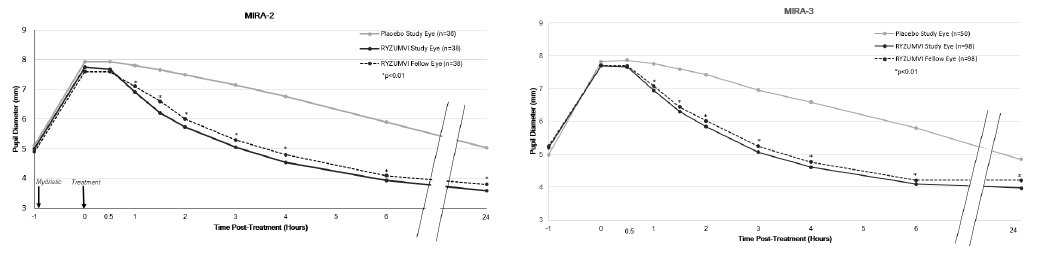
Percentage of Subjects with Study Eyes Returning to ≤ 0.2 mm from Baseline Pupil Diameter by Time Point in the MIRA-2 and MIRA-3 Trials The efficacy of MIRA-2 and MIRA-3 also showed that the change from maximum pupil dilation in study eyes and fellow eyes was statistically significantly different between the RYZUMVI-treated group and the placebo-treated group at all time points from 60 minutes through 24 hours post-treatment (p < 0.01). Pupil size at 24 hours was 1 mm smaller than baseline. These results were consistent regardless of whether phenylephrine or tropicamide/Paremyd were used as mydriatic agents (Figure 2, Figure 3; respectively).
Figure 2: Pupil Dilation by Time Point with Phenylephrine as Mydriatic Agent in MIRA-2 and MIRA-3 Trials (mITT Population) Figure 3: Pupil Dilation by Time Point with Tropicamide or Paremyd as Mydriatic Agent in MIRA-2 and MIRA-3 Trials (mITT Population) The efficacy of RYZUMVI was similar for all age ranges including pediatric subjects aged 3 to 17 years. Pediatric subjects aged 12 to 17 years (n = 27) were treated in MIRA-2 and MIRA-3 and pediatric subjects, aged 3 to 11 years (n = 11) were treated in MIRA-4, (NCT#05223478).
Figure 1 Figure 2 Figure 3
🧪 Nonclinical Toxicology ▾
13 NONCLINICAL TOXICOLOGY
13.1Carcinogenesis, Mutagenesis, Impairment of Fertility Carcinogenesis Carcinogenicity studies with RYZUMVI have not been conducted. Mutagenesis Phentolamine was not mutagenic in the in vitro bacterial reverse mutation (Ames) assay. In the in vitro chromosomal aberration study in Chinese hamster ovary cells, numerical aberrations were slightly increased after a 4-hour exposure to phentolamine without metabolic activation, and structural aberrations were slightly increased after a 4-hour exposure to phentolamine with metabolic activation only at the highest concentrations tested, but neither numerical nor structural aberrations were increased after a 20-hour exposure without metabolic activation.
Phentolamine was not clastogenic in two in vivo mouse micronucleus assays. Impairment of Fertility The effect of phentolamine on female fertility has not been studied. Male rats treated with oral phentolamine for 9 weeks (4 weeks prior to mating, 3 weeks during the mating period and 2 weeks after mating) were mated with untreated females.
At doses up to 648-times human therapeutic exposure levels at the Cmax, no adverse effects on male fertility parameters or on reproductive parameters in the untreated females mated with the treated males were observed.
📄 Carcinogenesis, Mutagenesis, Impairment of Fertility ▾
13.1Carcinogenesis, Mutagenesis, Impairment of Fertility Carcinogenesis Carcinogenicity studies with RYZUMVI have not been conducted. Mutagenesis Phentolamine was not mutagenic in the in vitro bacterial reverse mutation (Ames) assay. In the in vitro chromosomal aberration study in Chinese hamster ovary cells, numerical aberrations were slightly increased after a 4-hour exposure to phentolamine without metabolic activation, and structural aberrations were slightly increased after a 4-hour exposure to phentolamine with metabolic activation only at the highest concentrations tested, but neither numerical nor structural aberrations were increased after a 20-hour exposure without metabolic activation.
Phentolamine was not clastogenic in two in vivo mouse micronucleus assays. Impairment of Fertility The effect of phentolamine on female fertility has not been studied. Male rats treated with oral phentolamine for 9 weeks (4 weeks prior to mating, 3 weeks during the mating period and 2 weeks after mating) were mated with untreated females.
At doses up to 648-times human therapeutic exposure levels at the Cmax, no adverse effects on male fertility parameters or on reproductive parameters in the untreated females mated with the treated males were observed.
📄 Package Label / Principal Display Panel ▾
PRINCIPAL DISPLAY PANEL – 0.75% NDC: 83368-075-30 Rx Only Ryzumvi ® (phentolamine ophthalmic solution) 0.75% FOR TOPICAL USE IN THE EYES Sterile Contents: 30 single-patient-use vials (6 pouches containing 5 single-patient-use vials each) Dosage: See Prescribing Information. Active: Each mL contains phentolamine mesylate 10 mg (equivalent to 7.5 mg phentolamine as the free base); Inactives: mannitol, sodium acetate trihydrate, and water for injection. May contain either hydrochloric acid or sodium hydroxide to adjust pH.
Storage: Store refrigerated at 2°C to 8°C (36°F to 46°F) in original packaging, not to exceed the expiration date printed on the carton and pouch. Protect from freezing. If the carton or pouch is removed from refrigeration, RYZUMVI may be stored at room temperature [up to 25℃ (77°F)] but must be used within 35 days, not to exceed the expiration date printed on the vial.
The vial once opened should be discarded immediately after use. Unused vials should remain in the opened foil pouch until ready for use. Does not contain an anti-microbial preservative.
OYP:075:6C:R3 Distributed by: Oyster Point Pharma, Inc., a Viatris Company Morgantown, WV 26505 U.S.A. © 2025 Viatris Inc. RYZUMVI is a registered trademark and the Ryzumvi Logo is a trademark of Opus Genetics, Inc., licensed to the Viatris Companies. Ryzumvi 0.75% Container Label
About this NDC listing & data coverage
What data is (and isn’t) available for this NDC — tap to expand
| NDC identity (package / product / labeler codes) | ✓ Available |
| Labeler | ✓ Available |
| Product & package description | ✓ Available |
| Marketing category & status | ✓ Available |
| Active ingredient / dosage form / route | ✓ Available |
| FDA label (SPL via DailyMed) | ✓ Available |
| Package photos | ✓ Available |
| Inactive ingredients (structured) | ✓ Available |
| NADAC pharmacy acquisition price (CMS) | — Not published for this NDC CMS publishes NADAC only for NDCs reported in its retail-pharmacy survey. |
| Orange Book / therapeutic-equivalence data | ✓ Available |
| HCPCS J-code billing crosswalk | — Not published for this NDC Most self-administered / retail products have no J-code — that is normal. |
| Medicaid utilization (CMS SDUD) | — Not published for this NDC CMS reports utilization only for NDCs with Medicaid claims above its privacy threshold. |