
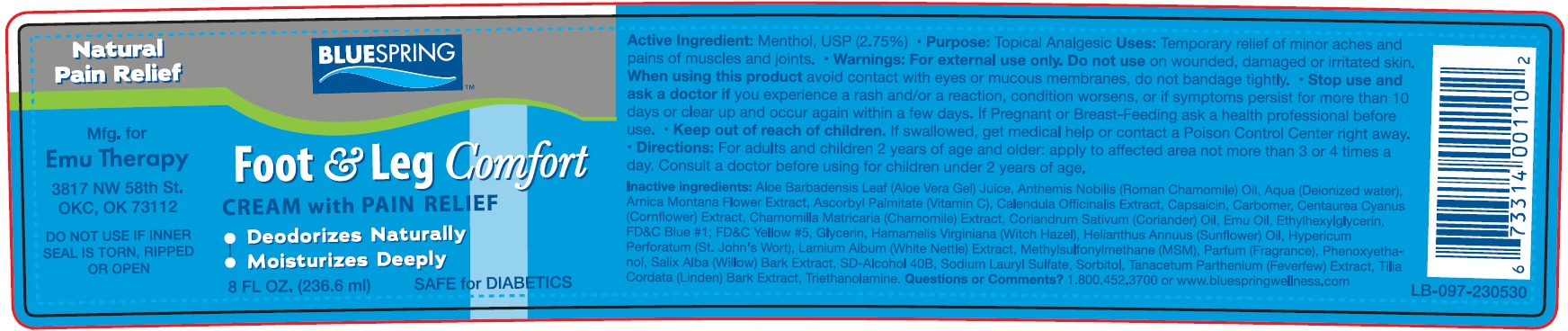
BLUE SPRING Foot and Leg Comfort MENTHOL 27.5 mg/mL Cream, 236.6 mL
Other active recalls for Menthol (different manufacturers) — 1 · tap to view
🆔 Identity & classification
Where does this data come from?
🏭 Manufacturer & labeler
Where does this data come from?
🩺 Clinical
- Menthol is found in a lot of over-the-counter topical products — creams, gels, patches, sprays, and powders. Depending on the product, it's used to temporarily ease minor muscle an...
- Start with clean, dry skin — free of lotions or creams — before applying the patch. Peel the backing off and press the sticky side firmly to the sore area. Most menthol patches sho...
- Yes, a mild burning or tingling feeling right after applying a menthol product is common and usually settles down within a few days of regular use. What's not normal is severe burn...
- Is that burning sensation after I apply it normal?
Patient education
Supplement & herbal interactions
Where does this data come from?
Ask a licensed pharmacist directly — free, answered by our team.
🧪 Inactive Ingredients / Excipients
Inactive ingredients, also called excipients, are components of the drug product other than the active ingredient. They may include fillers, dyes, coatings, preservatives, flavors, or other formulation ingredients.
💡 Tap an ingredient (hover on desktop) to see what it is and why it’s used.
-
UNII ZY81Z83H0X
Aloe vera leaf is a plant extract derived from the aloe plant. It is used in medicines as a natural moisturizer and skin-soothing agent in topical formulations.
-
UNII OZ0E5Y15PZ
A plant extract from arnica flowers, used as a flavoring agent or fragrance component in medicines. It may also provide mild soothing properties to certain topical formulations.
-
UNII QN83US2B0N
Ascorbyl palmitate is a fat-soluble form of vitamin C used as an antioxidant in medicines. It prevents oils and fats in the product from breaking down and becoming less stable over time.
-
UNII P0M7O4Y7YD
A plant extract from calendula flowers, traditionally used in formulations. It typically serves as a botanical ingredient that may provide color, fragrance, or skin-conditioning properties to topical products.
-
UNII S07O44R1ZM
Capsaicin is a pungent compound from chili peppers. In topical medicines, it acts as an active warming or heat-producing agent rather than a traditional inactive ingredient, creating localized skin sensation.
-
UNII 0A5MM307FC
A synthetic polymer that absorbs water and forms a thick, gel-like substance. In medicines, it works as a thickener and stabilizer to improve texture and help ingredients stay mixed together in creams, gels, and lotions.
-
UNII FGL3685T2X
Chamomile is a plant extract used in medications as a flavoring agent and for its mild soothing properties in formulations. It helps improve taste and aroma of the medicine.
-
UNII 1OV56052IK
Coriander is a plant-derived flavoring and aromatic agent used in medicines to improve taste and odor, making the product more pleasant to take.
-
UNII 9H4PO4Z4FT
A sulfur-containing organic compound used as a solvent and penetration enhancer in medicines. It helps dissolve active ingredients and improve their absorption through skin or mucous membranes.
-
UNII 344821WD61
Emu oil is a natural fat derived from emu birds, used in some medicines as an emollient and penetration enhancer to help active ingredients absorb through the skin and soften the formulation.
-
UNII 147D247K3P
Ethylhexylglycerin is a synthetic preservative used to prevent bacteria and mold from growing in medicines and personal care products. It helps keep the product safe and stable throughout its shelf life.
-
UNII H3R47K3TBD
FD&C Blue No. 1 is a synthetic blue dye approved for use in foods and medicines. It serves as a colorant to give the medication its distinctive appearance and help with product identification.
-
UNII I753WB2F1M
FD&C Yellow No. 5 is a synthetic yellow colorant approved by the FDA. It is added to medicines to make pills, tablets, or liquids visually distinct and easier to identify.
-
UNII Z64FK7P217
Feverfew is a plant extract used in some medicines. It may act as a natural flavoring agent or contribute mild therapeutic properties to herbal formulations.
-
UNII PDC6A3C0OX
Glycerin is a clear, thick liquid derived from plant oils or fats. It acts as a humectant to retain moisture, a sweetener, and a solvent in medications.
-
UNII T7S323PKJS
Hamamelis virginiana is an extract from the witch hazel plant. In medications, it's used as an astringent and skin-soothing agent to help reduce irritation and provide a mild drying effect in topical formulations.
-
UNII XK4IUX8MNB
Hypericum perforatum, also known as St. John's Wort, is a plant extract used in some medicines. It may serve as an active botanical ingredient or flavoring agent depending on the formulation.
-
UNII 046Y1357I6
Lamium album whole is a plant-derived ingredient used as a natural coloring, flavoring, or traditional botanical component in some formulations. It may help provide color, taste, or texture to the finished medicine.
-
UNII HIE492ZZ3T
Phenoxyethanol is a synthetic preservative and antimicrobial agent used to prevent bacterial and fungal growth in medicines and cosmetic products, extending shelf life and maintaining product safety.
-
UNII 205MXS71H7
A plant extract from white willow bark. It's used as a natural flavoring agent and may help preserve the medicine by providing mild antioxidant properties in the formulation.
-
UNII 368GB5141J
A detergent and foaming agent derived from coconut or palm oil. In medications, it helps break down and mix oil and water-based ingredients, aids in tablet disintegration, and improves how the drug dissolves and spreads in the mouth or digestive system.
-
UNII 506T60A25R
Sorbitol is a natural sugar alcohol derived from glucose. It serves as a sweetener, humectant, and bulking agent in medications to improve taste and help maintain moisture in the product.
-
UNII 9O3K93S3TK
Trolamine is an alkaline compound used as a pH buffer and emulsifier in medicines. It helps neutralize acids, stabilize formulations, and enable mixing of oil and water-based ingredients.
-
UNII 059QF0KO0R
Water is a liquid solvent that dissolves and mixes ingredients together in liquid medicines, syrups, and injections. It helps distribute the active drug evenly throughout the product.
24 inactive ingredients listed in the exact product block matched to this NDC.
Label-section wording can be broader than the structured product block and may mention additional formulation ingredients.
Where does this data come from?
ingredient classCode="IACT" elements from the exact product block matched by this NDC. Label-section narrative from DailyMed / the openFDA label index is shown separately when available.Inactive ingredient FAQ
Are inactive ingredients the same for every manufacturer?
Why might an inactive ingredient be missing?
Can inactive ingredients matter?
💲 Pricing
A drug doesn't have one price. Each row is a different public payment system, and none is what you'd pay at the counter — that depends on your insurance. The ⓘ on each row explains what it measures.
| Price system | Per g | Per package |
|---|---|---|
| Retail pharmacies payNADAC · weekly | Not in the retail survey — common for institutional, discontinued, or low-volume packs. | |
| Medicaid paysCMS SDUD · 12 mo | No recent Medicaid claims on file for this NDC — rare and low-volume NDCs are suppressed in the public data. | |
| Medicare drug plans payPart D · quarterly | No Part D plan price is available for this NDC in our data. | |
Where does this data come from?
🔁 Therapeutic equivalents
| Product | Labeler | Pack | NADAC/unit | TE | Status | Price vs. this |
|---|---|---|---|---|---|---|
| EMU THERAPY Cool Menthol Therapy Pain Relief Cream 27.5 mg/mL 83591-0416-00 | ACA | 237 ml | — | — | FDA listed | — |
| BLUE SPRING Foot and Leg Comfort 27.5 mg/mLthis 83591-0418-00 | ACA | 236.6 ml | — | — | FDA listed | — |
Where does this data come from?
⏳ Availability & generic status
We did not find an FDA-approved generic match for this exact strength, form and route.
Where does this data come from?
📦 Packaging — all sizes for this product
| Package NDC | Description | Marketing start | Status |
|---|---|---|---|
| 83591-0418-00 You're viewing this | 236.6 mL in 1 JAR (83591-418-00) | 2023-08-08 | Active |
🧭 About this NDC listing & data coverage
What data is (and isn’t) available for this NDC — tap to expand
| NDC identity (package / product / labeler codes) | ✓ Available |
| Labeler | ✓ Available |
| Product & package description | ✓ Available |
| Marketing category & status | ✓ Available |
| Active ingredient / dosage form / route | ✓ Available |
| FDA label (SPL via DailyMed) | ✓ Available |
| Package photos | ✓ Available |
| Inactive ingredients (structured) | ✓ Available |
| NADAC pharmacy acquisition price (CMS) | — Not published for this NDC CMS publishes NADAC only for NDCs reported in its retail-pharmacy survey. |
| Orange Book / therapeutic-equivalence data | — Not published for this NDC Applies only to products approved under an NDA/ANDA; many listings are out of scope. |
| HCPCS J-code billing crosswalk | — Not published for this NDC Most self-administered / retail products have no J-code — that is normal. |
| Medicaid utilization (CMS SDUD) | — Not published for this NDC CMS reports utilization only for NDCs with Medicaid claims above its privacy threshold. |
Questions about this listing
Is this NDC FDA-approved?
Why is there no price listed?
Is the NDC printed on the package the same as the 11-digit billing NDC?
What do the three segments of this NDC mean?
Is this package still being marketed?
Who lists this product with the FDA?
Do I need a prescription for this product?
Where does this data come from?
📄 FDA label — Drug Facts FDA SPL
🎯 Indications and Usage ▾
Uses: Temporary relief of minor aches and pains of muscles and joints.
⏱️ Dosage and Administration ▾
Directions: For adults and children 2 years of age and older: apply to affected area not more than 3 or 4 times a day. Consult a doctor before using for children under 2 years of age.
⚠️ Warnings ▾
Warnings: For external use only. Do not use on wounded, damaged or irritated skin. When using this product avoid contact with eyes or mucous membranes, do not bandage tightly.
Stop use and ask a doctor if you experience a rash and/or a reaction, condition worsens, or if symptoms persist for more than 10 days or clear up and occur again within a few days. If pregnant or Breast-Feeding ask a health professional before use. Keep out of reach of children.
If swallowed, get medical help or contact a Poison Control Center right away.
🧪 Active Ingredient ▾
Active Ingredient: Menthol, USP (2.75%) Purpose: Topical Analgesic
🧪 Inactive Ingredients ▾
Inactive Ingredients: Aloe Barbadensis leaf (Aloe Vera Gel) Juice, Anthemis Nobilis (Roman Chamomile) Oil, Aqua (Deionized water), Arnica Montana Flower Extract, Ascorbyl Palmitate (Vitamin C), Calendula Officinalis Extract, Capsaicin, Carbomer, Centaurea Cyanus (Cornflower) Extract, Chamomilla Matricaria (Chamomile) Extract, Coriandrum Sativum (Coriander) Oil, Emu Oil, Ethylhexylglycerin, FD&C Blue #1; FD&C Yellow #5, Glycerin, Hamamelis Virginiana (Witch Hazel), Helianthus Annuus (Sunflower) Oil, Hypericum Perforatum (St.
John's Wort), Lamium Album (White Nettle) Extract, Methylsulfonylmethane (MSM), Parfum (Fragrance), Phenoxyethanol, Salix Alba (Willow) Bark Extract, SD-Alohol 40B, Sodium Lauryl Sulfate, Sorbitol, Tanacetum Parthenium (Feverfew) Extract, Tilla Cordata (Linden) Bark Extract, Triethanolamine.
🎯 Purpose ▾
Purpose: Topical Analgesic