
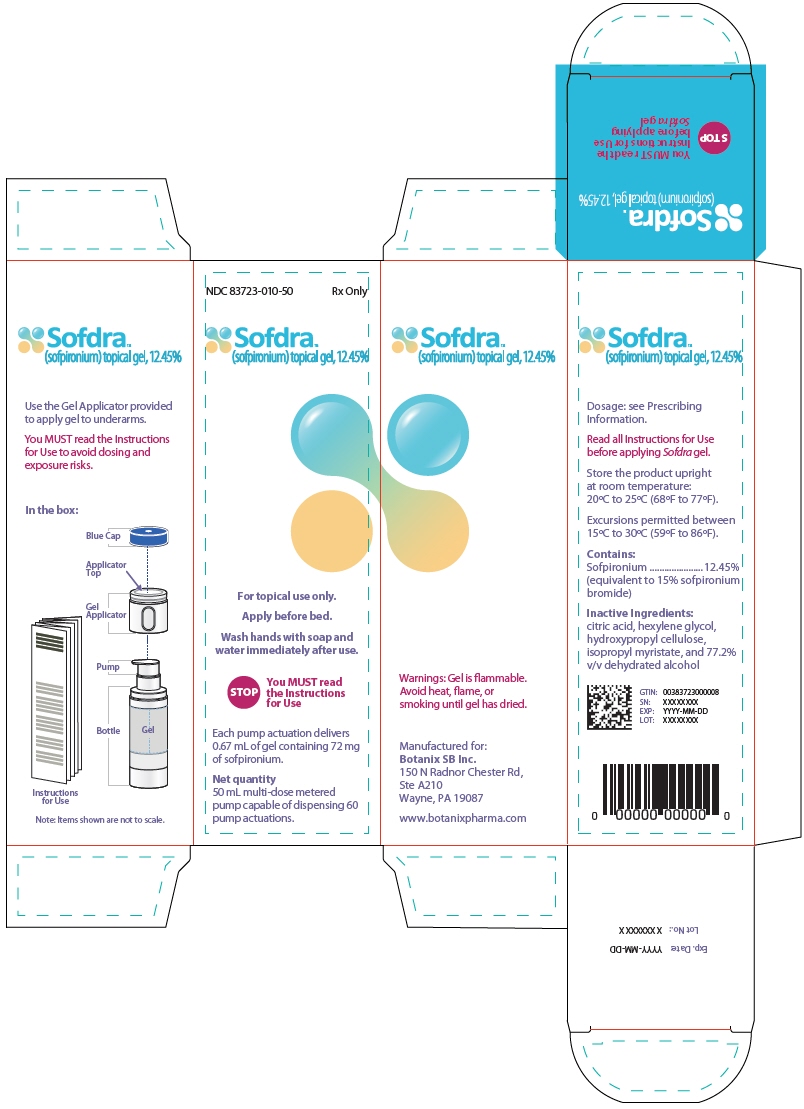
Sofdra sofpironium bromide 87 mg/.67mL Gel — NDC 83723-010-50 (Billing 83723-0010-50)
This is a package of Sofdra sofpironium bromide 87 mg/.67mL Gel from Botanix SB Inc., marketed since Aug 2024 and currently FDA-listed. It is this product's only package size.
Identity & classification
Regulatory identifiers FDA, NLM and CMS codes for this package
Drug-database identifiers Medi-Span GPI and First Databank GCN / HICL / AHFS classification
- GSN (GCN sequence number): 086231
- GCN: 55914
- GPI-14 (Medi-Span): 90970083204020
- HICL (First Databank): 049707
- AHFS class code: 84:12.00.00
- RxCUI (RxNorm): 2689326
Where does this data come from?
- FDA openFDA NDC Directory · synced Oct 1, 2026
- FDA label on DailyMed · label index refreshed Oct 1, 2026
- RxNorm (NLM RxNav) · catalog refreshed Oct 1, 2026
- Medi-Span GPI (licensed)
- First Databank (licensed) · refreshed Oct 1, 2026
RxNorm drug class
This medicine belongs to the Antihidrotics class.
Where does this data come from?
- RxClass (NLM) · catalog refreshed Oct 1, 2026
Clinical
Sofpironium is used to treat excessive underarm sweating in adults and children 9 years of age and older. Sofpironium is in a class of medications called anticholinergics. It works by blocking the activity of a certain natural substance that triggers the sweat glands to produce sweat.
Read the full MedlinePlus article ↗Patient education
Supplement & herbal interactions
Where does this data come from?
- MedlinePlus (NLM) · refreshed Oct 1, 2026
- FDA label on DailyMed · label index refreshed Oct 1, 2026
Ask a licensed pharmacist directly — free, answered by our team.
Pricing
A drug doesn't have one price. Each row is a different public payment system, and none is what you'd pay at the counter — that depends on your insurance. The ⓘ on each row explains what it measures.
| Price system | Per g | Per package |
|---|---|---|
| Retail pharmacies payNADAC · weekly | Not in the retail survey — common for institutional, discontinued, or low-volume packs. | |
| Medicaid paysCMS SDUD · 12 mo | $23.70 | — |
| Medicare drug plans payPart D · quarterly | No Part D plan price is available for this NDC in our data. | |
Where does this data come from?
- CMS NADAC weekly file
- CMS ASP pricing files · refreshed Sep 20, 2026
- CMS Medicaid State Drug Utilization Data · through Q1 2026
- CMS Part D plan pricing files · refreshed Sep 24, 2026
- VA National Acquisition Center price file
Packaging — all sizes for this product
| Package NDC | Description | Marketing start | Marketing end | Status |
|---|---|---|---|---|
| 83723-0010-50 You're viewing this Main listing | 1 BOTTLE in 1 CARTON / 50 mL in 1 BOTTLE | 2024-08-06 | — | Active |
Therapeutic equivalents
| Product | Labeler | Pack | NADAC/unit | TE | Status | Price vs. this |
|---|---|---|---|---|---|---|
| Sofdra 87 mg/.67mLthis 83723-0010-50 | Botanix | 1 bottle | — | — | FDA listed | — |
Where does this data come from?
- FDA openFDA NDC Directory · synced Oct 1, 2026
- FDA Orange Book · refreshed Oct 3, 2026
- CMS NADAC weekly file
Availability & generic status
We did not find an FDA-approved generic match for this exact strength, form and route. Patent/protection dates below may affect future generic timing.
Why the date isn’t exact: Generic timing can change because patents may be challenged, settled, licensed, added, removed, or worked around with a narrower label — and FDA approval does not always mean a pharmacy can get the generic today.
🛈 What do these terms mean?
- Patent
- Legal protection listed in the Orange Book that may delay generic approval or launch. Issued by the U.S. Patent & Trademark Office.
- Substance patent
- Covers the active drug molecule itself — the hardest to design around. A generic generally can’t launch until it expires.
- Formulation (product) patent
- Covers a specific formulation or dosage form. A generic can sometimes work around it with a different formulation.
- Method-of-use patent
- A patent covering one specific approved use of the drug — not necessarily the whole molecule. A generic can sometimes launch with a “skinny label” that carves out the protected use and keeps the others.
- Skinny label
- A generic label that omits a still-patented use when the FDA allows it — letting a generic reach the market for the unprotected uses.
- Exclusivity
- FDA-granted marketing protection, separate from patents — e.g. 5-yr new chemical entity, 7-yr orphan drug, or a +6-month pediatric extension.
- Paragraph IV
- A generic applicant’s formal challenge to a listed patent. It can potentially lead to earlier generic entry, but often involves litigation or a settlement.
- RLD / RS
- Reference Listed Drug — the brand product the FDA uses as the reference for generic applications. Reference Standard — the product the FDA expects generics to compare against in bioequivalence testing.
- TE / AB rating
- FDA therapeutic-equivalence rating. An AB rating generally means the FDA considers a generic therapeutically equivalent to — and substitutable for — the brand.
- LOE (loss of exclusivity)
- The latest patent or exclusivity currently listed — the loss-of-exclusivity / latest-listed-protection date shown on this page. Paragraph-IV challenges and settlements can move the real date earlier; FDA approval and a manufacturer’s decision to market can move it later.
Built from the FDA Orange Book. The bars above are scaled to each protection’s expiry; the red LOE marker is the last one to lapse.
| Patent | Type | Use code | Expires |
|---|---|---|---|
| US 12357609 ↗ | Method of use | U-2398 | May 22, 2034 |
| US 12156865 ↗ | Method of use | U-2398 | May 22, 2034 |
| US 12398102 ↗ | Method of use | U-2398 | May 22, 2034 |
| US 11123325 ↗ | Method of use | U-2398 | Jul 20, 2037 |
| US 11084788 ↗ | Method of use | U-2398 | May 22, 2034 |
| US 11052067 ↗ | Method of use | U-2398 | May 22, 2034 |
| US 11034652 ↗ | Method of use | U-2398 | May 22, 2034 |
| US 11026919 ↗ | Method of use | U-2398 | May 22, 2034 |
| US 10961191 ↗ | Method of use | U-2398 | May 22, 2034 |
| US 10959983 ↗ | Method of use | U-2398 | May 22, 2034 |
| US 8628759 ↗ | Method of use | U-2398 | Nov 13, 2026 |
| US 10952990 ↗ | Method of use | U-2398 | May 22, 2034 |
| US 10947192 ↗ | Method of use | U-2398 | May 22, 2034 |
| US 10383846 ↗ | Method of use | U-2398 | Mar 14, 2034 |
| US 9492429 ↗ | Method of use | U-2398 | Mar 14, 2034 |
| US 9895350 ↗ | Method of use | U-2398 | Mar 14, 2034 |
| US 9220707 ↗ | Method of use | U-2398 | Mar 14, 2034 |
| US 8147809 ↗ | Drug substance | — | Mar 26, 2027 |
| US 11584715 ↗ | Drug substance | — | May 22, 2040 |
| US 11566000 ↗ | Drug substance | — | May 22, 2040 |
| Code | What it grants | Expires |
|---|---|---|
| NCE | New Chemical Entity (5-year) | Jun 20, 2029 |
Is there a generic version of SOFDRA 12.45% GEL?
The FDA approved a generic — why can’t I get it at my pharmacy yet?
Why do different websites show different generic release dates?
What does “FDA listed” mean?
What does a patent or protection date mean here?
What does “current Orange Book estimate” mean?
Can a generic come out before the last patent expires?
Can a generic come out after the listed dates?
What is the difference between patents and exclusivity?
Why are there multiple patent dates?
Where does this data come from?
- FDA Orange Book · refreshed Oct 3, 2026
Inactive Ingredients / Excipients
Inactive ingredients, also called excipients, are components of the drug product other than the active ingredient. They may include fillers, dyes, coatings, preservatives, flavors, or other formulation ingredients.
💡 Tap an ingredient (hover on desktop) to see what it is and why it’s used.
-
UNII 3K9958V90M
A liquid solvent derived from fermentation or chemical synthesis. In medicines, alcohol dissolves active ingredients, helps preserve the product, and improves how the body absorbs certain drugs.
-
UNII 2968PHW8QP
A weak organic acid derived from citrus fruits or made through fermentation. It works as a buffer to control pH, a preservative to extend shelf life, and a flavoring agent in medications.
-
UNII KEH0A3F75J
Hexylene glycol is a clear liquid alcohol used as a solvent and preservative in medicines. It helps dissolve other ingredients and keeps the product stable during storage.
-
UNII 9XZ8H6N6OH
A plant-based cellulose derivative used as a binder to hold tablet ingredients together, a thickener in liquids, and a coating agent to control how fast the medicine dissolves.
-
UNII 0RE8K4LNJS
Isopropyl myristate is an oily liquid made from coconut or palm oil. It's used in medicines as an emollient and penetration enhancer to help the medicine absorb through skin or improve spreadability in topical products.
5 inactive ingredients listed in the exact product block matched to this NDC.
Where does this data come from?
ingredient classCode="IACT" elements from the exact product block matched by this NDC. Label-section narrative from DailyMed / the openFDA label index is shown separately when available.- FDA label on DailyMed · label index refreshed Oct 1, 2026
- FDA openFDA NDC Directory · synced Oct 1, 2026
Inactive ingredient FAQ
Are inactive ingredients the same for every manufacturer?
Why might an inactive ingredient be missing?
Can inactive ingredients matter?
Manufacturer & labeler
Where does this data come from?
- FDA openFDA NDC Directory · synced Oct 1, 2026
- Drugs@FDA
Full prescribing information FDA SPL
🎯 Indications and Usage ▾
1 INDICATIONS AND USAGE SOFDRA is indicated for the treatment of primary axillary hyperhidrosis in adults and pediatric patients 9 years of age and older. SOFDRA is an anticholinergic indicated for the treatment of primary axillary hyperhidrosis in adults and pediatric patients 9 years of age and older ( 1 ).
⏱️ Dosage and Administration ▾
2 DOSAGE AND ADMINISTRATION Do not shave armpits at least 8 hours before applying SOFDRA. Do not shower at least 30 minutes before applying SOFDRA. Apply SOFDRA to clean, dry skin once a day at bedtime.
Apply a single pump actuation to the top of the supplied applicator. Spread the entire amount to cover 1 underarm. Apply a separate, single pump actuation to the top of the supplied applicator.
Apply the entire amount to the second underarm. Allow to dry completely (5 minutes) before putting on clothing. Wash hands immediately with soap.
For topical use only. Avoid fire, flame, and smoking during and immediately following application. Do not shower or wash underarms for at least 8 hours after application.
Do not touch underarms after applying SOFDRA. Do not use more than once daily. Avoid transfer of SOFDRA to the periocular area [see Warnings and Precautions (5.3) ] .
Do not apply SOFDRA to broken skin. Avoid using SOFDRA with occlusive dressings. Apply 1 pump of SOFDRA per underarm once a day at bedtime.
For topical use only ( 2 ).
💊 Dosage Forms and Strengths ▾
3 DOSAGE FORMS AND STRENGTHS Topical gel: 12.45% (w/w) of sofpironium in a 50 mL bottle with a metered dose pump and applicator. One full pump delivers 72 mg sofpironium in 0.67 mL of gel. Topical gel: 12.45% of sofpironium ( 3 ).
⛔ Contraindications ▾
4 CONTRAINDICATIONS SOFDRA is contraindicated in patients with medical conditions that can be exacerbated by the anticholinergic effect of sofpironium bromide (e.g., glaucoma, paralytic ileus, unstable cardiovascular status in acute hemorrhage, severe ulcerative colitis, toxic megacolon complicating ulcerative colitis, myasthenia gravis, Sjögren's syndrome). Medical conditions that can be exacerbated by the anticholinergic effect of SOFDRA (e.g., glaucoma, paralytic ileus, unstable cardiovascular status in acute hemorrhage, severe ulcerative colitis, toxic megacolon complicating ulcerative colitis, myasthenia gravis, Sjögren's syndrome) ( 4 ).
⚠️ Warnings and Cautions ▾
5 WARNINGS AND PRECAUTIONS Urinary Retention: Use with caution in patients with a history or presence of documented urinary retention. Discontinue use immediately and consult a healthcare provider should any signs or symptoms of urinary retention develop ( 5.1 ). Control of Body Temperature: Watch for generalized lack of sweating when in hot or very warm environmental temperatures and avoid using SOFDRA if not sweating under these conditions ( 5.2 ).
Operating Machinery or an Automobile: Transient blurred vision may occur with use of SOFDRA. If blurred vision occurs, discontinue use and avoid operating a motor vehicle or other machinery until symptoms resolve ( 5.3 ).
5.1Urinary Retention Use SOFDRA with caution in patients with a history or presence of documented urinary retention. Prescribers and patients should be alert for signs and symptoms of urinary retention (e.g., difficulty passing urine, distended bladder), especially in patients with prostatic hypertrophy or bladder-neck obstruction. Discontinue use immediately and consult a healthcare provider should any of these signs or symptoms develop.
5.2Control of Body Temperature In the presence of high ambient temperature, heat illness (hyperpyrexia and heat stroke due to decreased sweating) can occur with the use of anticholinergic drugs, including SOFDRA. Watch for generalized lack of sweating when in hot or very warm environmental temperatures and avoid using SOFDRA if not sweating under these conditions.
5.3Operating Machinery or an Automobile Transient blurred vision may occur with use of SOFDRA. If blurred vision occurs, discontinue use and avoid engaging in activities that require clear vision, such as operating a motor vehicle or other machinery or performing hazardous work, until the symptoms have resolved.
🤒 Adverse Reactions ▾
6 ADVERSE REACTIONS The following clinically significant adverse reactions are described elsewhere in the labeling: Urinary Retention [See Warnings and Precautions (5.1) ]. Most common adverse reactions (incidence ≥2%) are dry mouth, vision blurred, application site pain, application site erythema, mydriasis, application site dermatitis, application site pruritus, urinary retention, and application site irritation ( 6.1 ). To report SUSPECTED ADVERSE REACTIONS, contact Botanix SB Inc. at 1-866-763-6337 or FDA at 1-800-FDA-1088 or www.fda.gov/medwatch .
6.1Clinical Trials Experience Because clinical trials are conducted under widely varying conditions, adverse reaction rates observed in the clinical trials of a drug cannot be directly compared to rates in the clinical trials of another drug and may not reflect the rates observed in practice. In two double-blind, vehicle controlled clinical trials (CARDIGAN 1 and CARDIGAN 2) of 700 subjects 10 to 76 years of age (353 subjects treated with SOFDRA and 347 subjects treated with vehicle), 44% of subjects were male, 79% were White, 21% were Black, and 1% were Asian.
A total of 618 subjects completed at least 6 weeks of treatment, including 307 subjects treated with SOFDRA and 311 subjects treated with vehicle. Table 1 summarizes the most frequent adverse reactions (≥2%) in subjects with primary axillary hyperhidrosis treated with SOFDRA. Table 1: Adverse Reactions Occurring in ≥2% of Subjects with Primary Axillary Hyperhidrosis Treated with SOFDRA in Trials CARDIGAN 1 and 2 Adverse Reactions SOFDRA (N = 353) n (%) Vehicle (N = 347) n (%) Note: COVID-19 was observed in 8 (2%) SOFDRA and 2 (0.6%) vehicle subjects.
Dry mouth 51 (14%) 2 (0.6%) Vision blurred 30 (9%) 1 (0.3%) Mydriasis 23 (7%) 0 Urinary retention 8 (2%) 0 Table 2 shows the local skin reactions reported ≥2%, which occurred more commonly in the SOFDRA group. Table 2: Local Skin Reactions Reported in ≥2% of Subjects with Primary Axillary Hyperhidrosis Treated with SOFDRA in Trials CARDIGAN 1 and 2 Local Skin Adverse Reactions SOFDRA (N = 353) n (%) Vehicle (N = 347) n (%) Pain 29 (8%) 6 (2%) Erythema 23 (7%) 1 (0.3%) Dermatitis 21 (6%) 1 (0.3%) Pruritus 16 (5%) 2 (0.6%) Irritation 8 (2%) 1 (0.3%) Exfoliation 7 (2%) 1 (0.3%) In an open-label, long-term safety trial (ARGYLE), 197 subjects were treated for 48 weeks with SOFDRA.
Adverse reactions occurring at a frequency ≥2% were vision blurred (19%), dry mouth (17%), application site pruritus (15%), application site pain (15%), application site dermatitis (11%), application site erythema (8%), application site irritation (6%), mydriasis (5%), application site rash (4%), upper respiratory tract infection (4%), dry eye (4%), urinary retention (4%), application site exfoliation (3%), application site folliculitis (3%), hypertension (3%), application site dryness (2%), viral upper respiratory tract infection (2%), influenza (2%), and headache (2%).
🔄 Drug Interactions ▾
7 DRUG INTERACTIONS Anticholinergics: Coadministration of SOFDRA with anticholinergic medications may result in additive interaction leading to an increase in anticholinergic adverse effects. Avoid coadministration of SOFDRA with other anticholinergic-containing drugs ( 7.1 ). Strong Inhibitors of CYP2D6: Avoid co-administration of SOFDRA with drugs that are strong inhibitors of CYP2D6 ( 7.2 ).
7.1Anticholinergics Coadministration of SOFDRA with anticholinergic medications may result in additive interaction leading to an increase in anticholinergic adverse effects [See Warnings and Precautions (5.2) and Adverse Reactions (6.1) ] . Avoid coadministration of SOFDRA with other anticholinergic-containing drugs.
7.2Strong Inhibitors of CYP2D6 Avoid co-administration of SOFDRA with drugs that are strong inhibitors of CYP2D6.
👥 Use in Specific Populations ▾
8 USE IN SPECIFIC POPULATIONS
8.1Pregnancy Risk Summary There are no available data with SOFDRA use in pregnant women to evaluate for drug-associated risks of major birth defects, miscarriage or adverse maternal or fetal outcomes. In animal reproduction studies, subcutaneous administration of sofpironium bromide to pregnant rats and rabbits during the period of organogenesis resulted in no significant adverse effects at doses 31 and 10 times, respectively, the maximum recommended human dose (MRHD) ( see Data ). The background risks of major birth defects and miscarriage for the indicated population are unknown.
All pregnancies have a background risk of birth defects, loss, and other adverse outcomes. In the U.S. general population, the estimated background risk of major birth defects and miscarriage in clinically recognized pregnancies is 2-4% and 15-20%, respectively. Data Animal Data In an embryofetal development study in rats, sofpironium bromide was not associated with embryofetal lethality or fetal malformations at subcutaneous dose levels of 1, 3, and 10 mg/kg/day administered during the period of organogenesis.
The maternal and fetal survival, growth and development no observed adverse effect level (NOAEL) was 10 mg/kg/day (31 times the MRHD based on AUC comparisons). In an embryofetal development study in rabbits, sofpironium bromide was administered by subcutaneous injection to pregnant rabbits at doses of 0.4, 2 and 10 mg/kg/day during the period of organogenesis. Maternal toxicity as evidenced by decreased maternal body weight gain and feed consumption was observed in all sofpironium bromide treated groups.
The decrease in maternal body weight was considered severe at 10 mg/kg/day and was associated with embryofetal lethality. The maternal toxicity NOAEL could not be established in the study. The NOAEL for embryo-fetal development toxicity was 2 mg/kg/day (10 times the MRHD based on AUC comparison).
Fetal malformation was not observed with sofpironium bromide treatment at doses up to 10 mg/kg/day (57 times the MRHD based on AUC comparison) in rabbits. In a pre- and postnatal development study, sofpironium bromide was administered by subcutaneous injection to pregnant rats at doses of 1, 3 and 6 mg/kg/day beginning on gestation day 6 through lactation day 20. Maternal toxicity associated with a 17% decrease in body weight gain noted at 6 mg/kg/day (approximately 19 times the MRHD based on AUC comparisons) when compared to the control group.
No sofpironium bromide-related effects on prenatal and postnatal development, neurobehavioral or reproductive performance of offspring were noted at doses up to 6 mg/kg/day (approximately 19 times the MRHD based on AUC comparison).
8.2Lactation Risk Summary There are no data on the presence of SOFDRA or its metabolites in human milk, the effects on the breastfed infant, or the effects on milk production. The developmental and health benefits of breastfeeding should be considered along with the mother's clinical need for SOFDRA and any potential adverse effects on the breastfed infant from sofpironium bromide or from the underlying maternal condition. Sofpironium bromide was detected in milk following single subcutaneous administration to lactating rats ( see Data ).
When a drug is present in animal milk, it is likely that the drug will be present in human milk. Data Animal Data Milk excretion studies in vivo showed sofpironium or its metabolites were transferred into the milk after a single subcutaneous administration of 0.5 mg/kg to lactating rats on postnatal day 10.
8.4Pediatric Use The safety, effectiveness, and pharmacokinetics of SOFDRA for the treatment of primary axillary hyperhidrosis have been established in pediatric patients 9 years of age and older [See Clinical Pharmacology (12.3) ] . Use of SOFDRA in this age group is supported by evidence from two multicenter, randomized, double-blind, parallel-group, vehicle-controlled 6-week trials and two multicenter, open-la… [Excerpted — this section continues on DailyMed.]
🤰 Pregnancy ▾
8.1Pregnancy Risk Summary There are no available data with SOFDRA use in pregnant women to evaluate for drug-associated risks of major birth defects, miscarriage or adverse maternal or fetal outcomes. In animal reproduction studies, subcutaneous administration of sofpironium bromide to pregnant rats and rabbits during the period of organogenesis resulted in no significant adverse effects at doses 31 and 10 times, respectively, the maximum recommended human dose (MRHD) ( see Data ). The background risks of major birth defects and miscarriage for the indicated population are unknown.
All pregnancies have a background risk of birth defects, loss, and other adverse outcomes. In the U.S. general population, the estimated background risk of major birth defects and miscarriage in clinically recognized pregnancies is 2-4% and 15-20%, respectively. Data Animal Data In an embryofetal development study in rats, sofpironium bromide was not associated with embryofetal lethality or fetal malformations at subcutaneous dose levels of 1, 3, and 10 mg/kg/day administered during the period of organogenesis.
The maternal and fetal survival, growth and development no observed adverse effect level (NOAEL) was 10 mg/kg/day (31 times the MRHD based on AUC comparisons). In an embryofetal development study in rabbits, sofpironium bromide was administered by subcutaneous injection to pregnant rabbits at doses of 0.4, 2 and 10 mg/kg/day during the period of organogenesis. Maternal toxicity as evidenced by decreased maternal body weight gain and feed consumption was observed in all sofpironium bromide treated groups.
The decrease in maternal body weight was considered severe at 10 mg/kg/day and was associated with embryofetal lethality. The maternal toxicity NOAEL could not be established in the study. The NOAEL for embryo-fetal development toxicity was 2 mg/kg/day (10 times the MRHD based on AUC comparison).
Fetal malformation was not observed with sofpironium bromide treatment at doses up to 10 mg/kg/day (57 times the MRHD based on AUC comparison) in rabbits. In a pre- and postnatal development study, sofpironium bromide was administered by subcutaneous injection to pregnant rats at doses of 1, 3 and 6 mg/kg/day beginning on gestation day 6 through lactation day 20. Maternal toxicity associated with a 17% decrease in body weight gain noted at 6 mg/kg/day (approximately 19 times the MRHD based on AUC comparisons) when compared to the control group.
No sofpironium bromide-related effects on prenatal and postnatal development, neurobehavioral or reproductive performance of offspring were noted at doses up to 6 mg/kg/day (approximately 19 times the MRHD based on AUC comparison).
🧒 Pediatric Use ▾
8.4Pediatric Use The safety, effectiveness, and pharmacokinetics of SOFDRA for the treatment of primary axillary hyperhidrosis have been established in pediatric patients 9 years of age and older [See Clinical Pharmacology (12.3) ] . Use of SOFDRA in this age group is supported by evidence from two multicenter, randomized, double-blind, parallel-group, vehicle-controlled 6-week trials and two multicenter, open-label, 24-week and 48-week trials, which included 72 pediatric subjects 9 years of age and older [See Adverse Reactions (6.1) and Clinical Studies (14) ] .
The safety and effectiveness of SOFDRA have not been established in pediatric patients younger than 9 years of age.
🧓 Geriatric Use ▾
8.5Geriatric Use Clinical trials of SOFDRA did not include sufficient numbers of subjects aged 65 years and older to determine whether they respond differently from younger subjects. Other reported clinical experience has not identified differences in responses between the elderly and younger patients. In general, dose selection for an elderly patient should be cautious, usually starting at the low end of the dosing range, reflecting the greater frequency of decreased hepatic, renal, or cardiac function and of concomitant disease or other drug therapy.
🆘 Overdosage ▾
10 OVERDOSAGE In case of an overdose, remove the topically applied product with soap and water, and treat the symptoms and signs attributed to the overdose symptomatically. Consider contacting the Poison Center at 1-800-222-1222 for the latest recommendations.
🧬 Clinical Pharmacology ▾
12 CLINICAL PHARMACOLOGY
12.1Mechanism of Action Sofpironium bromide is a competitive inhibitor of acetylcholine receptors that are located on certain peripheral tissues, including sweat glands. Sofpironium bromide indirectly reduces the rate of sweating by preventing the stimulation of these receptors.
12.2Pharmacodynamics Pharmacodynamics of SOFDRA are unknown. Cardiac Electrophysiology At an exposure 3 times the exposure associated with the maximum approved recommended dose, SOFDRA does not prolong the QTc interval to any clinically relevant extent.
12.3Pharmacokinetics Absorption The pharmacokinetics of sofpironium were evaluated in adult patients with primary axillary hyperhidrosis following SOFDRA applied once daily to the underarms for 21 days. The mean ± standard deviation (SD) exposures of sofpironium in adults are presented in Table 3. There was no evidence of accumulation.
Table 3: Mean (SD) Plasma Exposure of Sofpironium in Adults with Primary Axillary Hyperhidrosis Following SOFDRA Application on Day 1 PK Parameter Adult Patients C max (ng/mL) 2.71 (6.94) AUC 0-t (ng∙hr/mL) 45.1 (85.1) t max (hr) 5.34 (5.45) Distribution Plasma protein binding of sofpironium is around 34.8-37.8%. The major sofpironium metabolite (BBI-4010) had plasma protein binding around 2.3-3.7%. Elimination Metabolism Sofpironium is metabolized by nonenzymatic hydrolysis, CYP2D6 and CYP3A4 mediated-oxidative metabolism, and glycine conjugation.
In plasma, sofpironium was the major component (38%) followed by the BBI-4010 (20%) metabolite. Excretion Urinary excretion of sofpironium and BBI-4010 were less than 0.5% of the applied dose. Specific Populations The pharmacokinetics of sofpironium were not evaluated in pregnant patients or patients with hepatic or renal impairment.
Pediatric Subjects The mean ± SD exposures of sofpironium after a single dose in pediatric subjects 9 years to 16 years of age are presented in Table 4. After 24 weeks of dosing, trough concentrations of sofpironium were low and there was no evidence of accumulation. The exposure to major metabolite (BBI-4010) in pediatric subjects was similar to sofpironium exposure in adults.
Table 4: Mean (SD) Plasma Exposure of Sofpironium in Pediatric Subjects Following Single Dose Administration of SOFDRA on Day 1 PK Parameter Pediatric Patients t max reported as median and range. C max (ng/mL) 1.30 (3.16) AUC 0-t (ng∙hr/mL) 14.6 (35.0) t max (hr) 4.0 (0.9, 23.1) Drug Interaction Studies No clinically significant differences in sofpironium pharmacokinetics were observed when used concomitantly with inhibitors of CYP3A4, OCT2, MATE1, or MATE2-K. In vivo Study In presence of 20 mg oral dose of paroxetine HCl (strong CYP2D6 inhibitor) C max and AUC 0-t of sofpironium increased by approximately twofold compared to when SOFDRA was administered alone.
In vitro Studies Sofpironium is an inhibitor of CYP2D6, CYP3A4, OCT1, OCT2, and MATE1 in vitro. Sofpironium is not an inducer of CYP1A2, CYP2B6, or CYP3A4.
🧬 Mechanism of Action ▾
12.1Mechanism of Action Sofpironium bromide is a competitive inhibitor of acetylcholine receptors that are located on certain peripheral tissues, including sweat glands. Sofpironium bromide indirectly reduces the rate of sweating by preventing the stimulation of these receptors.
📦 How Supplied / Storage and Handling ▾
16 HOW SUPPLIED/STORAGE AND HANDLING How Supplied SOFDRA topical gel is supplied in a bottle with a multi-dose metered pump, applicator, and cap. Each bottle contains 50 mL of gel with a multi-dose pump capable of dispensing 60 pump actuations. Each pump actuation dispenses 0.67 mL of gel.
NDC 83723-010-50 Storage and Handling Store upright at 20°C to 25°C (68°F to 77°F); excursions permitted to 15°C to 30°C (59°F to 86°F) [See USP Controlled Room Temperature]. SOFDRA is flammable; keep away from heat or flame.
📦 Storage and Handling ▾
Storage and Handling Store upright at 20°C to 25°C (68°F to 77°F); excursions permitted to 15°C to 30°C (59°F to 86°F) [See USP Controlled Room Temperature]. SOFDRA is flammable; keep away from heat or flame.
📋 Description ▾
11 DESCRIPTION SOFDRA (sofpironium) topical gel is an anticholinergic drug. Sofpironium bromide drug substance is a white to off white powder with the chemical name 3'(R)-[2(R) cyclopentylphenylhydroxy-acetoxy]-1'-methyl-1'-ethoxycarbonylmethyl-pyrrolidinium bromide, very soluble in chloroform and freely soluble in water, ethanol, acetonitrile, and methanol, molecular formula of C 22 H 32 BrNO 5 , molecular weight of 470.4 g/mol, and the following structural formula: SOFDRA is a clear to translucent, colorless to pale yellow viscous gel containing 12.45% (w/w) sofpironium (equivalent to 15% sofpironium bromide) in an airless bottle sealed with a multi-dose metered pump.
Each pump delivers 72 mg of sofpironium (equivalent to 87 mg of sofpironium bromide) in 0.67 mL of gel. The inactive ingredients are citric acid, 77.2% v/v dehydrated alcohol, hexylene glycol, hydroxypropyl cellulose, and isopropyl myristate. Chemical Structure
💬 Information for Patients ▾
17 PATIENT COUNSELING INFORMATION Advise the patient to read the FDA-approved patient labeling (Patient Information and Instructions for Use). Urinary Retention Instruct patients to be alert for signs and symptoms of urinary retention (e.g., difficulty passing urine, distended bladder). Instruct patients to discontinue use and consult a healthcare provider immediately should any of these signs or symptoms develop [see Warnings and Precautions (5.1) ] .
Control of Body Temperature Advise patients that in the presence of high ambient temperature, heat illness due to decreased sweating can occur with the use of SOFDRA. Advise patients to watch for generalized lack of sweating when in hot or very warm environmental temperatures and to avoid using SOFDRA if not sweating under these conditions [see Warnings and Precautions (5.2) ] . Operating Machinery or an Automobile Advise patients that transient blurred vision may occur with SOFDRA.
If this occurs, instruct patients to contact their healthcare provider, discontinue use of SOFDRA, and avoid operating a motor vehicle or other machinery or performing hazardous work until symptoms resolve [see Warnings and Precautions (5.3) ] . Instructions for Administering SOFDRA Advise patients as follows [see Dosage and Administration (2) ] : Do not shave armpits at least 8 hours before applying SOFDRA. Do not shower at least 30 minutes before applying SOFDRA.
Apply 1 pump actuation per underarm to clean, dry skin once a day at bedtime (total 2 pumps). Allow to dry completely (5 minutes) before putting on clothing. Wait at least 8 hours after applying the gel to shower or wash underarms.
Do not use SOFDRA more frequently than once daily. Instruct patients to wash their hands with soap and water immediately after applying SOFDRA. Instruct patients not to apply SOFDRA to other body areas or to broken skin and to avoid using SOFDRA with occlusive dressings.
SOFDRA is flammable; avoid fire, flame, and smoking during and immediately following application.
🧬 Pharmacokinetics ▾
12.3Pharmacokinetics Absorption The pharmacokinetics of sofpironium were evaluated in adult patients with primary axillary hyperhidrosis following SOFDRA applied once daily to the underarms for 21 days. The mean ± standard deviation (SD) exposures of sofpironium in adults are presented in Table 3. There was no evidence of accumulation.
Table 3: Mean (SD) Plasma Exposure of Sofpironium in Adults with Primary Axillary Hyperhidrosis Following SOFDRA Application on Day 1 PK Parameter Adult Patients C max (ng/mL) 2.71 (6.94) AUC 0-t (ng∙hr/mL) 45.1 (85.1) t max (hr) 5.34 (5.45) Distribution Plasma protein binding of sofpironium is around 34.8-37.8%. The major sofpironium metabolite (BBI-4010) had plasma protein binding around 2.3-3.7%. Elimination Metabolism Sofpironium is metabolized by nonenzymatic hydrolysis, CYP2D6 and CYP3A4 mediated-oxidative metabolism, and glycine conjugation.
In plasma, sofpironium was the major component (38%) followed by the BBI-4010 (20%) metabolite. Excretion Urinary excretion of sofpironium and BBI-4010 were less than 0.5% of the applied dose. Specific Populations The pharmacokinetics of sofpironium were not evaluated in pregnant patients or patients with hepatic or renal impairment.
Pediatric Subjects The mean ± SD exposures of sofpironium after a single dose in pediatric subjects 9 years to 16 years of age are presented in Table 4. After 24 weeks of dosing, trough concentrations of sofpironium were low and there was no evidence of accumulation. The exposure to major metabolite (BBI-4010) in pediatric subjects was similar to sofpironium exposure in adults.
Table 4: Mean (SD) Plasma Exposure of Sofpironium in Pediatric Subjects Following Single Dose Administration of SOFDRA on Day 1 PK Parameter Pediatric Patients t max reported as median and range. C max (ng/mL) 1.30 (3.16) AUC 0-t (ng∙hr/mL) 14.6 (35.0) t max (hr) 4.0 (0.9, 23.1) Drug Interaction Studies No clinically significant differences in sofpironium pharmacokinetics were observed when used concomitantly with inhibitors of CYP3A4, OCT2, MATE1, or MATE2-K. In vivo Study In presence of 20 mg oral dose of paroxetine HCl (strong CYP2D6 inhibitor) C max and AUC 0-t of sofpironium increased by approximately twofold compared to when SOFDRA was administered alone.
In vitro Studies Sofpironium is an inhibitor of CYP2D6, CYP3A4, OCT1, OCT2, and MATE1 in vitro. Sofpironium is not an inducer of CYP1A2, CYP2B6, or CYP3A4.
🧬 Pharmacodynamics ▾
12.2Pharmacodynamics Pharmacodynamics of SOFDRA are unknown. Cardiac Electrophysiology At an exposure 3 times the exposure associated with the maximum approved recommended dose, SOFDRA does not prolong the QTc interval to any clinically relevant extent.
🔬 Clinical Studies ▾
14 CLINICAL STUDIES Two randomized, vehicle-controlled multicenter trials, CARDIGAN 1 (NCT03836287) and CARDIGAN 2 (NCT03948646), enrolled a total of 701 subjects 10 years of age or older with primary axillary hyperhidrosis. All subjects were to have symptoms of axillary hyperhidrosis for at least 6 months' duration, produce at least 50 mg of sweat in each axilla (underarm) with a combined total of at least 150 mg over a 5-minute period, and have a Hyperhidrosis Disease Severity Measure-Axillary, 7-item scale score (HDSM-Ax-7) ≥3.
In the trials, 56% of subjects were female, 78% were White, and 20% were Black or African American; for ethnicity, 31% identified as Hispanic or Latino. Fewer than 1% of subjects were less than 12 years of age, 7% were 12 to 17 years of age, 91% were 18 to 64 years of age, and 1% were 65 years of age or older. Subjects 12 years of age and older were asked to rate their underarm sweating severity and frequency since waking on the previous day ("since you woke up yesterday") on the 11-item HDSM-Ax Adult version instrument.
The HDSM-Ax-7 scale score was calculated by taking an average of 7 items, where the scale score ranges from 0 to 4 with a higher score representing greater underarm sweating severity. The mean HDSM-Ax-7 scale score at Baseline was 3.5 in CARDIGAN 1, and 3.6 in CARDIGAN 2. The median gravimetric sweat production (GSP) over 5 minutes at Baseline was 214.1 mg in the SOFDRA arm and 228.6 mg in the vehicle arm in CARDIGAN 1, and 207.7 mg in the SOFDRA arm and 231.1 mg in the vehicle arm in CARDIGAN 2.
Subjects were randomized to receive either SOFDRA or vehicle applied once daily at bedtime to each axilla. The co-primary endpoints were the proportion of subjects having at least a 2-point improvement in the HDSM-Ax-7 scale score from Baseline to Day 43, and the change in GSP from Baseline to Day 43. The results of CARDIGAN 1 and CARDIGAN 2 are presented in Table 5.
Table 5: Primary Efficacy Endpoints at Day 43 in Subjects with Primary Axillary Hyperhidrosis in Trials CARDIGAN 1 and 2 CARDIGAN 1 CARDIGAN 2 SOFDRA Vehicle SOFDRA Vehicle ≥2 point Improvement in HDSM-Ax-7 Hyperhidrosis Disease Severity Measure-Axillary, 7-item score scale score from Baseline to Day 43 in subjects 12 years of age and older N = 172 49% N= 177 29% N = 178 64% N = 169 48% Treatment Difference 95% Confidence Interval 18% (8%, 29%) 17% (6%, 27%) Baseline Median GSP Gravimetric Sweat Production in subjects 10 years of age and older (mg/5 minutes) N = 173 214 N = 177 229 N = 180 208 N = 171 231 Change from Baseline to Day 43 Median (mg/5 minutes) 25 th percentile, 75 th percentile -128 -201, -52 -100 -228, -29 -143 -260, -75 -134 -230, -60
🧪 Nonclinical Toxicology ▾
13 NONCLINICAL TOXICOLOGY
13.1Carcinogenesis, Mutagenesis, Impairment of Fertility The carcinogenic potential of sofpironium bromide was assessed in a 2-year dermal mouse carcinogenicity study and a 2-year subcutaneous rat carcinogenicity study. There were no drug-related neoplasms associated with daily topical administration of sofpironium bromide topical gel to mice at doses of up to 20% sofpironium bromide (2 times and 11 times the MRHD based on AUC comparisons for males and females, respectively). No drug-related neoplasms were identified in rats administered daily subcutaneous doses up to 1.5 mg/kg/day (males) and 5.0 mg/kg/day (females) (4 times and 12 times the MRHD based on AUC comparisons for males and females, respectively).
Sofpironium bromide was not mutagenic in a bacterial mutagenicity assay (Ames assay) or clastogenic in an in vitro mammalian chromosomal aberration assay (human peripheral blood lymphocytes) or in an in vivo micronucleus assay in rats. There were no sofpironium bromide-related effects on male or female fertility and early embryonic developmental endpoints in rats at subcutaneous doses up to 10 mg/kg/day (70 and 20 times the MRHD based on AUC comparisons for males and females, respectively).
📄 Carcinogenesis, Mutagenesis, Impairment of Fertility ▾
13.1Carcinogenesis, Mutagenesis, Impairment of Fertility The carcinogenic potential of sofpironium bromide was assessed in a 2-year dermal mouse carcinogenicity study and a 2-year subcutaneous rat carcinogenicity study. There were no drug-related neoplasms associated with daily topical administration of sofpironium bromide topical gel to mice at doses of up to 20% sofpironium bromide (2 times and 11 times the MRHD based on AUC comparisons for males and females, respectively). No drug-related neoplasms were identified in rats administered daily subcutaneous doses up to 1.5 mg/kg/day (males) and 5.0 mg/kg/day (females) (4 times and 12 times the MRHD based on AUC comparisons for males and females, respectively).
Sofpironium bromide was not mutagenic in a bacterial mutagenicity assay (Ames assay) or clastogenic in an in vitro mammalian chromosomal aberration assay (human peripheral blood lymphocytes) or in an in vivo micronucleus assay in rats. There were no sofpironium bromide-related effects on male or female fertility and early embryonic developmental endpoints in rats at subcutaneous doses up to 10 mg/kg/day (70 and 20 times the MRHD based on AUC comparisons for males and females, respectively).
📄 Patient Package Insert ▾
PATIENT INFORMATION SOFDRA™ (sof-drah) (sofpironium) topical gel, 12.45% This Patient Information has been approved by the U.S. Food and Drug Administration. Issued: 07/2025 Important information: SOFDRA is for use on the skin in the underarm area only.
Do not apply SOFDRA to other parts of your body. What is SOFDRA? SOFDRA is a prescription anticholinergic medicine used on the skin (topical) to treat excessive underarm sweating (primary axillary hyperhidrosis) in adults and children 9 years of age and older.
It is not known if SOFDRA is safe and effective in children under 9 years of age. Who should not use SOFDRA? Do not use SOFDRA if you have certain medical conditions that can be made worse by taking an anticholinergic medicine such as: glaucoma severe ulcerative colitis or certain other serious bowel problems myasthenia gravis Sjögren's syndrome Talk to your healthcare provider if you are not sure if you have a medical condition that can be made worse by taking an anticholinergic medicine.
Before using SOFDRA, tell your healthcare provider about all of your medical conditions, including if you: have prostate or bladder problems, or problems passing urine have kidney problems are pregnant or plan to become pregnant. It is not known if SOFDRA will harm your unborn baby. are breastfeeding or plan to breastfeed. It is not known if SOFDRA passes into your breast milk.
Talk to your healthcare provider about the best way to feed your baby during treatment with SOFDRA. Tell your healthcare provider about all the medicines you take, including prescription medicines, over-the-counter medicines, vitamins, and herbal supplements. SOFDRA may affect the way other medicines work causing side effects.
Especially tell your healthcare provider if you take anticholinergic medicines. Know the medicines you take. Keep a list of your medicines with you and show it to your healthcare provider and pharmacist when you get a new medicine.
How should I use SOFDRA? Use SOFDRA exactly as your healthcare provider tells you to use it. See the detailed " Instructions for Use " for directions about how to apply SOFDRA.
Apply SOFDRA 1 time a day at bedtime. Apply SOFDRA to clean, dry, intact skin of your underarm areas only. Apply SOFDRA to both underarm areas using 1 pump for each underarm.
Do not shower or wash underarms for at least 8 hours after applying SOFDRA. Do not use SOFDRA more than 1 time a day. Do not apply SOFDRA to broken skin.
Do not cover the treated area with a plastic (occlusive) dressing. Do not apply SOFDRA if you have shaved your underarms or applied deodorant within the last 8 hours. Do not apply SOFDRA if you have exercised or showered or washed your underarms within the last 30 minutes.
Wash your hands with soap and water right away after you apply SOFDRA. It is important that you wash your hands because the SOFDRA that is still on your hands can cause you to have blurred vision if you touch your eyes. Do not allow clothing to contact SOFDRA for 5 minutes after applying.
Do not touch your underarms after applying SOFDRA. If you use too much SOFDRA, remove SOFDRA with soap and water, and call your healthcare provider or Poison Help line at 1-800-222-1222. What should I avoid while using SOFDRA?
SOFDRA may cause you to have blurred vision that is temporary. If you develop blurred vision, call your healthcare provider, stop using SOFDRA and do not drive, operate machinery, or do hazardous work until your vision is clear. SOFDRA is flammable.
Avoid fire, flame, and smoking during and right after applying SOFDRA to your skin. What are possible side effects of SOFDRA? SOFDRA can cause serious side effects, including: Urinary retention.
People who use SOFDRA may develop urinary retention. Symptoms of urinary retention may include: difficulty urinating urinating frequently urination in a weak stream or drips full bladder or difficulty emptying your bladder (distended bladder) If you develop these symptoms, stop using SOFDRA and call your… [Excerpted — this section continues on DailyMed.]
📖 Instructions for Use ▾
INSTRUCTIONS FOR USE SOFDRA™ (sof-drah) (sofpironium) topical gel, 12.45% These Instructions for Use contain information on how to use SOFDRA. Read the Instructions for Use before you start using SOFDRA and each time you get a refill. This information does not take the place of talking to your healthcare provider about your medical condition or your treatment.
If you have questions, ask your pharmacist or healthcare provider. SOFDRA Parts Important Information You Need to Know Before Applying SOFDRA SOFDRA gel should be used before bedtime. SOFDRA gel is for the underarms only.
Do not apply SOFDRA to any other part of the body. Do not apply SOFDRA to broken skin. One complete dose of SOFDRA gel is 1 pump per underarm.
Do not use more than 1 pump per underarm, regardless of underarm size. Do not use SOFDRA if the expiration date has passed. Do not apply SOFDRA if you: Shaved your underarms or applied deodorant to your armpits within the last 8 hours .
Exercised, showered, or washed your underarms within the last 30 minutes . Avoid touching the gel with your hands or fingers. Do not get the gel on or near your eyes.
Always apply and spread SOFDRA gel using the provided Applicator. Do not spread gel with your hands or with a towel. Let SOFDRA gel dry for 5 minutes after it is applied.
Do not put on clothing until gel has dried completely. Do not smoke or go near an open flame until the gel is dry. SOFDRA gel is flammable.
Do not touch your underarms after applying the gel. Always wash your hands with soap and water right away after applying SOFDRA gel to avoid spreading any gel residue to any other parts of your body. Do not shower or wash your underarms for at least 8 hours after applying SOFDRA.
The Bottle contains 30 days of medicine. After applying 30 daily doses of SOFDRA gel, throw away the Blue Cap, Applicator, and Bottle into the household trash. Prepare to Apply SOFDRA 1 Check if you are ready to apply SOFDRA
1.1Apply SOFDRA before bedtime (Figure B).
1.2Before applying SOFDRA make sure that you: Do Not shave your underarms within the last 8 hours, Do Not apply deodorant to your underarms within the last 8 hours, Do Not exercise within the last 30 minutes, and Do Not shower or wash your underarms within the last 30 minutes. 2 Gather supplies
2.1Gather the following supplies. SOFDRA (Figure C) Clean towel (Figure D) 3 Check the expiration date
3.1Check the expiration date ("EXP") on the Bottle label to make sure it has not passed (Figure E). Do not use SOFDRA if the expiration date has passed. 4 Remove Blue Cap and Applicator from Bottle
4.1Pull the Blue Cap straight off the Bottle and set it aside (Figure F).
4.2Pull the gel Applicator straight off the Bottle and set it aside (Figure G). 5 Prime the pump (First time use only) Important: Priming the pump is required the first time you use a new Bottle. The purpose of priming is to make sure the pump works correctly and dispenses gel properly.
5.1Hold the Bottle over a sink. Press the pump all the way down 1 to 2 times, or until you see gel coming out (Figure H).
5.2Use water to wash down any gel in the sink (Figure I). Do not touch or use any of the gel residue from the sink. 6 Prepare underarms
6.1Remove all clothing around both underarms (Figure J). Note: It is okay to use SOFDRA on underarms with hair or new growth (stubble). Do not apply SOFDRA to any other part of the body Do not apply SOFDRA to broken skin.
6.2Dry both underarms with a clean towel before applying SOFDRA gel (Figure K). Apply 1 Pump of SOFDRA to Each Armpit 7 Apply 1 pump of SOFDRA gel to first underarm
7.1Hold the Applicator steady and level with the top (flat area) pointing up (Figure L). Put 1 full pump of gel onto the top of the Applicator (Figure L). Avoid touching the gel with your hands or fingers. Do not apply more than 1 pump per underarm, regardless of size. Do not tilt the Applicator until you apply it to your underarm to avoid spilling the gel. Do not put the gel inside of the… [Excerpted — this section continues on DailyMed.]
📄 Package Label / Principal Display Panel ▾
PRINCIPAL DISPLAY PANEL - 50 mL Bottle Carton NDC 83723-010-50 Rx Only Sofdra ™ (sofpironium) topical gel, 12.45% For topical use only. Apply before bed. Wash hands with soap and water immediately after use. STOP You MUST read the Instructions for Use Each pump actuation delivers 0.67 mL of gel containing 72 mg of sofpironium. Net quantity 50 mL multi-dose metered pump capable of dispensing 60 pump actuations. PRINCIPAL DISPLAY PANEL - 50 mL Bottle Carton
Medicaid utilization & spend
Medicare Part D spend CMS · PART D · 2026 (Q1)
About this NDC listing & data coverage
What data is (and isn’t) available for this NDC — tap to expand
| NDC identity (package / product / labeler codes) | ✓ Available |
| Labeler | ✓ Available |
| Product & package description | ✓ Available |
| Marketing category & status | ✓ Available |
| Active ingredient / dosage form / route | ✓ Available |
| FDA label (SPL via DailyMed) | ✓ Available |
| Package photos | ✓ Available |
| Inactive ingredients (structured) | ✓ Available |
| NADAC pharmacy acquisition price (CMS) | — Not published for this NDC CMS publishes NADAC only for NDCs reported in its retail-pharmacy survey. |
| Orange Book / therapeutic-equivalence data | ✓ Available |
| HCPCS J-code billing crosswalk | — Not published for this NDC Most self-administered / retail products have no J-code — that is normal. |
| Medicaid utilization (CMS SDUD) | ✓ Available |