
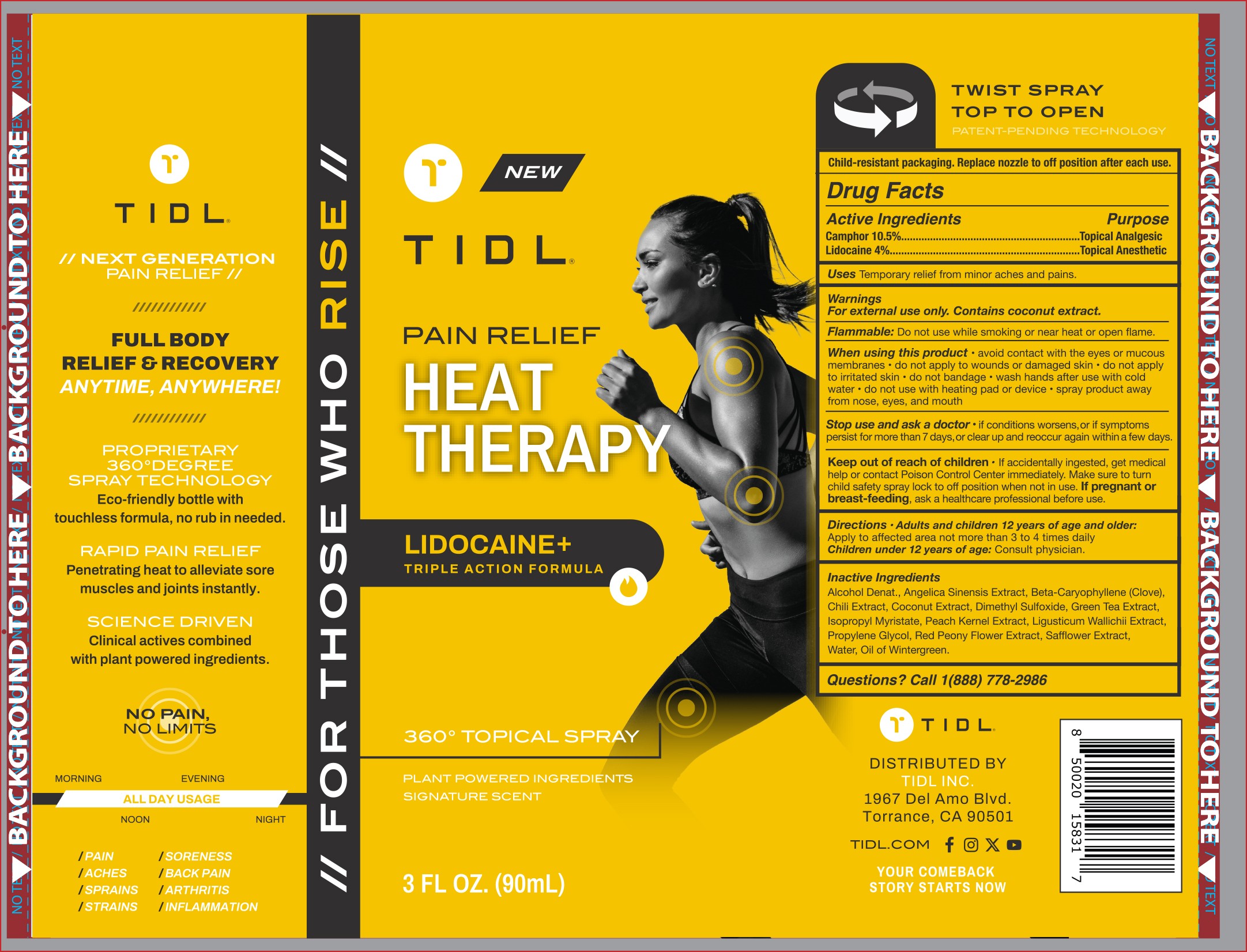
TIDL PAIN RELIEF HEAT THERAPY Spray. 4 g/100mL; 10.5 g/100mL Spray, 90 mL
🆔 Identity & classification
Where does this data come from?
🏭 Manufacturer & labeler
Where does this data come from?
🩺 Clinical
This is a topical spray product marketed as an over-the-counter monograph drug. It contains camphor and lidocaine, which are commonly combined in heat therapy and pain relief preparations. Camphor is often included to produce a warming sensation on the skin, while lidocaine is a local anesthetic typically used to numb minor pain in the area where it is applied. The spray form is intended for direct application to the skin.
Patient education
Supplement & herbal interactions
Where does this data come from?
Ask a licensed pharmacist directly — free, answered by our team.
🧪 Inactive Ingredients / Excipients
Inactive ingredients, also called excipients, are components of the drug product other than the active ingredient. They may include fillers, dyes, coatings, preservatives, flavors, or other formulation ingredients.
💡 Tap an ingredient (hover on desktop) to see what it is and why it’s used.
-
UNII 3K9958V90M
A liquid solvent derived from fermentation or chemical synthesis. In medicines, alcohol dissolves active ingredients, helps preserve the product, and improves how the body absorbs certain drugs.
-
UNII 697D19QDBN
A plant extract from Chinese angelica root used in traditional herbal formulations. It acts as an active botanical ingredient that may contribute flavor, color, or traditional therapeutic properties to the medicine.
-
UNII S07O44R1ZM
Capsaicin is a pungent compound from chili peppers. In topical medicines, it acts as an active warming or heat-producing agent rather than a traditional inactive ingredient, creating localized skin sensation.
-
UNII BHW853AU9H
A natural compound found in plants like cloves and hops, beta-caryophyllene is used in medicines as a flavoring agent and to add aroma to the product.
-
UNII 3RT3536DHY
A natural plant material derived from coconut that serves as a filler and texturizing agent in medicines. It helps give the product structure and consistency.
-
UNII YOW8V9698H
Dimethyl sulfoxide is a clear liquid solvent derived from wood pulp. In medicines, it helps dissolve or carry active ingredients and improve how the body absorbs the drug.
-
UNII W2ZU1RY8B0
A plant extract from green tea leaves. It's used as an antioxidant ingredient to help preserve the medicine and maintain its stability during storage.
-
UNII 0RE8K4LNJS
Isopropyl myristate is an oily liquid made from coconut or palm oil. It's used in medicines as an emollient and penetration enhancer to help the medicine absorb through skin or improve spreadability in topical products.
-
UNII 8Y1N3NX2DW
A plant extract derived from the Ligusticum wallichii herb. In medicines, it may serve as a natural flavoring agent, preservative, or active botanical ingredient depending on the formulation.
-
UNII LAV5U5022Y
Methyl salicylate is a naturally derived liquid compound commonly found in wintergreen plants. In medicines, it's used as a flavoring agent and penetrating solvent to help distribute active ingredients evenly throughout topical products.
-
UNII N44H57P7WG
A plant extract from peony flowers used in traditional herbal preparations. It may serve as a natural flavoring, coloring agent, or botanical ingredient in formulations designed to deliver plant-based compounds.
-
UNII 6DC9Q167V3
Propylene glycol is a clear liquid derived from petroleum or vegetable sources. It acts as a solvent, humectant, and preservative in medicines, helping dissolve active ingredients and maintain product stability.
-
UNII V9C81470RR
A plant-derived ingredient from peach seeds used as a natural emollient and skin-conditioning agent in topical formulations. It helps soften and smooth the product's texture.
-
UNII 4VBL71TY4Y
Safflower is a plant-derived ingredient used as a natural colorant and flavoring agent in medicines. It may also serve as a filler to add bulk to the formulation.
-
UNII 059QF0KO0R
Water is a liquid solvent that dissolves and mixes ingredients together in liquid medicines, syrups, and injections. It helps distribute the active drug evenly throughout the product.
15 inactive ingredients listed in the exact product block matched to this NDC.
Label-section wording can be broader than the structured product block and may mention additional formulation ingredients.
Where does this data come from?
ingredient classCode="IACT" elements from the exact product block matched by this NDC. Label-section narrative from DailyMed / the openFDA label index is shown separately when available.Inactive ingredient FAQ
Are inactive ingredients the same for every manufacturer?
Why might an inactive ingredient be missing?
Can inactive ingredients matter?
💲 Pricing
A drug doesn't have one price. Each row is a different public payment system, and none is what you'd pay at the counter — that depends on your insurance. The ⓘ on each row explains what it measures.
| Price system | Per mL | Per package |
|---|---|---|
| Retail pharmacies payNADAC · weekly | Not in the retail survey — common for institutional, discontinued, or low-volume packs. | |
| Medicaid paysCMS SDUD · 12 mo | No recent Medicaid claims on file for this NDC — rare and low-volume NDCs are suppressed in the public data. | |
| Medicare drug plans payPart D · quarterly | No Part D plan price is available for this NDC in our data. | |
Where does this data come from?
🔁 Therapeutic equivalents
| Product | Labeler | Pack | NADAC/unit | TE | Status | Price vs. this |
|---|---|---|---|---|---|---|
| Camphor plus Lidocaine Pain Relief 10.5 g/100mL; 4 g/100mL 71101-0984-01 | Veridian | 90 ml | — | — | FDA listed | — |
| TIDL PAIN RELIEF HEAT THERAPY Spray. 4 g/100mL; 10.5 g/100mLthis 84214-0004-01 | Shenzhen | 90 ml | — | — | FDA listed | — |
Where does this data come from?
⏳ Availability & generic status
We did not find an FDA-approved generic match for this exact strength, form and route.
Where does this data come from?
📦 Packaging — all sizes for this product
| Package NDC | Description | Marketing start | Status |
|---|---|---|---|
| 84214-0004-01 You're viewing this | 90 mL in 1 BOTTLE, SPRAY (84214-004-01) | 2024-07-13 | Active |
🧭 About this NDC listing & data coverage
What data is (and isn’t) available for this NDC — tap to expand
| NDC identity (package / product / labeler codes) | ✓ Available |
| Labeler | ✓ Available |
| Product & package description | ✓ Available |
| Marketing category & status | ✓ Available |
| Active ingredient / dosage form / route | ✓ Available |
| FDA label (SPL via DailyMed) | ✓ Available |
| Package photos | ✓ Available |
| Inactive ingredients (structured) | ✓ Available |
| NADAC pharmacy acquisition price (CMS) | — Not published for this NDC CMS publishes NADAC only for NDCs reported in its retail-pharmacy survey. |
| Orange Book / therapeutic-equivalence data | — Not published for this NDC Applies only to products approved under an NDA/ANDA; many listings are out of scope. |
| HCPCS J-code billing crosswalk | — Not published for this NDC Most self-administered / retail products have no J-code — that is normal. |
| Medicaid utilization (CMS SDUD) | — Not published for this NDC CMS reports utilization only for NDCs with Medicaid claims above its privacy threshold. |
Questions about this listing
Is this NDC FDA-approved?
Why is there no price listed?
Is the NDC printed on the package the same as the 11-digit billing NDC?
What do the three segments of this NDC mean?
Is this package still being marketed?
Who lists this product with the FDA?
Do I need a prescription for this product?
Where does this data come from?
📄 FDA label — Drug Facts FDA SPL
🎯 Indications and Usage ▾
Use Temporary relief from minor aches and pains.
⏱️ Dosage and Administration ▾
Directions ·Adults and children 12 years of age and older:Apply to affected area not more than 3 to 4 times daily ·Children under 12 years of age:Consult physician
⚠️ Warnings ▾
Warnings For external use only.Contains coconut extract.
🧪 Active Ingredient ▾
Active Ingredient Camphor 10.5% Lidocaine 4%
🧪 Inactive Ingredients ▾
Inactive ingredients Alcohol Denat, Angelica Sinensis Extract, Beta-Caryophyllene(Clove), Chili Extract, Coconut Extract, Dimethyl Sulfoxide, Green Tea Extract,Isopropyl Myristate, Peach Kernel Extract, Ligusticum Wallichii Extract, Propylene Glycol, Red Peony Flower Extract, Safflower Extract, Water, Oil of Wintergreen.
🎯 Purpose ▾
Purpose Topical Anesthetic