
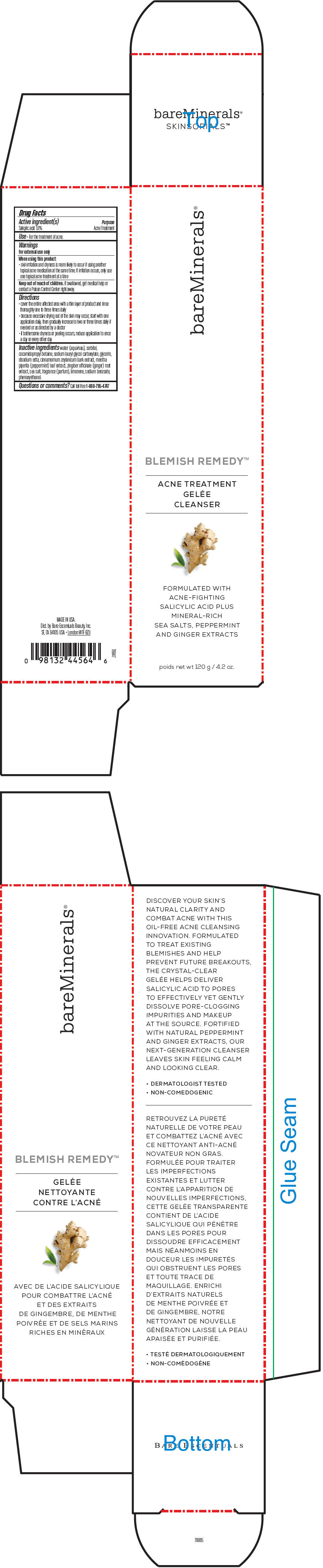
bareMinerals Blemish Remedy Acne Treatment Gelee Cleanser SALICYLIC ACID 10 mg/g Emulsion — NDC 98132-770-01 (Billing 98132-0770-01)
This is a package of bareMinerals Blemish Remedy Acne Treatment Gelee Cleanser SALICYLIC ACID 10 mg/g Emulsion from Orveon Global US LLC, marketed since Jan 2016 and currently FDA-listed. It is this product's only package size.
NDC database record
One package, one record: these facts belong to NDC 98132-770-01 alone.
- Record
- FDA NDC Directory package listing · Human OTC drug
- Code segments
- 98132 labeler · 770 product · 01 package
- Package marketed since
- Jan 30, 2016
- Sample package
- No — commercial package
- Listing certified through
- Dec 31, 2026
- Barcode (UPC)
- 0098132445646
- FDA record last changed
- Jul 24, 2026
Identity & classification
Regulatory identifiers FDA, NLM and CMS codes for this package
- RxCUI (RxNorm): 1038982
Where does this data come from?
- FDA openFDA NDC Directory · synced Oct 1, 2026
- FDA label on DailyMed · label index refreshed Oct 6, 2026
- RxNorm (NLM RxNav) · catalog refreshed Oct 1, 2026
- Medi-Span GPI (licensed)
- First Databank (licensed) · refreshed Oct 1, 2026
RxNorm drug class
This medicine belongs to the Salicylic acid and derivatives class.
Where does this data come from?
- RxClass (NLM) · catalog refreshed Oct 1, 2026
Clinical
- It is used in a facial routine for acne-prone and oil-prone skin. The routine includes a cleanser, serum, toner and emulsion. Salicylic acid helps loosen and shed dead skin cells.
- Use the cleanser morning and evening, and the serum in the morning after cleansing. Use the toner in the evening on dry skin, and the emulsion at night after cleansing. Avoid your...
- Mild stinging, burning, itching, dryness and extra peeling can happen. If dryness or peeling bothers you, try using the serum or toner every other day. If it gets excessive, stop a...
- It is best not to. Using another topical acne medication at the same time makes irritation and dryness more likely. If you get irritated, use only one at a time.
Patient education
Supplement & herbal interactions
Where does this data come from?
- MedlinePlus (NLM) · refreshed Oct 1, 2026
- FDA label on DailyMed · label index refreshed Oct 6, 2026
Ask a licensed pharmacist directly — free, answered by our team.
Pricing
A drug doesn't have one price. Each row is a different public payment system, and none is what you'd pay at the counter — that depends on your insurance. The ⓘ on each row explains what it measures.
| Price system | Per mL | Per package |
|---|---|---|
| Retail pharmacies payNADAC · weekly | Not in the retail survey — common for institutional, discontinued, or low-volume packs. | |
| Medicaid paysCMS SDUD · 12 mo | No recent Medicaid claims on file for this NDC — rare and low-volume NDCs are suppressed in the public data. | |
| Medicare drug plans payPart D · quarterly | No Part D plan price is available for this NDC in our data. | |
Where does this data come from?
- CMS NADAC weekly file
- CMS ASP pricing files · refreshed Sep 20, 2026
- CMS Medicaid State Drug Utilization Data · refreshed Oct 6, 2026
- CMS Part D plan pricing files · refreshed Sep 24, 2026
- VA National Acquisition Center price file
Packaging — all sizes for this product
| Package NDC | Description | Marketing start | Marketing end | Status |
|---|---|---|---|---|
| 98132-0770-01 You're viewing this Main listing | 1 TUBE in 1 CARTON / 120 g in 1 TUBE | 2016-01-30 | — | Active |
Therapeutic equivalents
| Product | Labeler | Pack | NADAC/unit | TE | Status | Price vs. this |
|---|---|---|---|---|---|---|
| Proactivplus Smoothing BHA Cleanser 10 mg/mL 11410-0216-01 | Alchemee, | 1 tube | — | — | FDA listed | — |
| Acne Advanced Cleansing 10 mg/mL 15751-3010-05 | Eminence | 1 bottle | — | — | FDA listed | — |
| Nas Pore Refining Scrub 1 g/100g 26052-0040-01 | BURT'S | 110 g | — | — | FDA listed | — |
| blackhead solutions 7 day deep pore cleanse and scrub acne medication 10 mg/mL 49527-0062-02 | CLINIQUE | 1 tube | — | — | Discontinued | — |
| clear days ahead oil-free salicylic acid acne treatment cleanser 2.4 g/240mL 50184-1005-01 | Philosophy | 240 ml | — | — | FDA listed | — |
| Sei Bella Clarity Clear Refining Foaming Cleanser Acne treatment 1.8 g/180mL 54473-0401-01 | Melaleuca, | 180 ml | — | — | FDA listed | — |
| Acne wash facial cleanser pink grapefruit 2 g/200mL 57337-0080-01 | Rejoice | 200 ml | — | — | FDA listed | — |
| Acne wash facial cleanser Tea tree oil 2 g/200mL 57337-0081-01 | Rejoice | 200 ml | — | — | FDA listed | — |
| Clear Improvement Blackhead Clearing Mask To Scrub 10 mg/mL 59427-0118-01 | ORIGINS | 75 ml | — | — | FDA listed | — |
| Dove 1 g/100mL 64942-2074-01 | CONOPCO | 512 ml | — | — | FDA listed | — |
| Dove 1 g/100mL 64942-2093-01 | CONOPCO | 500 ml | — | — | Discontinued | — |
| Neutrogena Stubborn Texture Daily Cleanser 10 mg/mL 69968-0704-06 | Kenvue | 186 ml | — | — | FDA listed | — |
| Neutrogena Stubborn Body Acne Cleanser and Exfoliator 10 mg/mL 69968-0759-08 | Kenvue | 250 ml | — | — | FDA listed | — |
| NAELI Exfoliator AHA-BHA Face Cleanser 10 mg/mL 73670-0606-00 | ALLI | 1 bottle | — | — | FDA listed | — |
| NAELI Exfoliator AHA BHA Face Cleanser 10 mg/mL 73670-0620-00 | ALLI | 1 bottle | — | — | FDA listed | — |
| Acne Clarifying Cleanser 10 mg/mL 76354-0415-01 | e.l.f. | 1 bottle | — | — | FDA listed | — |
| Acne Wash 1 mg/100mg 82442-0805-01 | Target | 650 mg | — | — | FDA listed | — |
| bareMinerals Blemish Remedy Acne Treatment Gelee Cleanser 10 mg/gthis 98132-0770-01 | Orveon | 1 tube | — | — | FDA listed | — |
Where does this data come from?
- FDA openFDA NDC Directory · synced Oct 1, 2026
- FDA Orange Book · refreshed Oct 3, 2026
- CMS NADAC weekly file
Availability & generic status
We did not find an FDA-approved generic match for this exact strength, form and route.
Where does this data come from?
- FDA Orange Book · refreshed Oct 3, 2026
Inactive Ingredients / Excipients
Inactive ingredients, also called excipients, are components of the drug product other than the active ingredient. They may include fillers, dyes, coatings, preservatives, flavors, or other formulation ingredients.
🧪 Avoiding an ingredient? See Salicylic Acid Topical inactive ingredients by manufacturer: every current product's list side by side, so you can ask your pharmacy for the version that does not list it.
💡 Tap an ingredient (hover on desktop) to see what it is and why it’s used.
-
UNII XE54U569EC
A natural essential oil extracted from cinnamon bark. It's used as a flavoring agent to mask bitter tastes and improve the flavor of medicines.
-
UNII 5OCF3O11KX
A plant-derived surfactant made from coconut oil. It helps mix oil and water ingredients together in the formulation and can improve how the medicine spreads or feels on the skin.
-
UNII 7FLD91C86K
Edetate disodium is a chemical compound that binds and removes certain metal ions. In medicines, it acts as a preservative and stabilizer by preventing metals like calcium from interfering with the product's shelf life and consistency.
-
UNII C5529G5JPQ
Ginger is a plant-derived ingredient used as a flavoring agent to add taste and aroma to medicines. It may also provide mild soothing properties to support product palatability.
-
UNII PDC6A3C0OX
Glycerin is a clear, thick liquid derived from plant oils or fats. It acts as a humectant to retain moisture, a sweetener, and a solvent in medications.
-
UNII 9MC3I34447
A natural oil extracted from citrus peel, used as a flavoring agent and solvent to improve taste and help dissolve or distribute other ingredients in the medicine.
-
UNII A389O33LX6
A plant extract from peppermint leaves used as a flavoring agent to improve taste. It may also provide a cooling or soothing sensory effect in the medicine.
-
UNII HIE492ZZ3T
Phenoxyethanol is a synthetic preservative and antimicrobial agent used to prevent bacterial and fungal growth in medicines and cosmetic products, extending shelf life and maintaining product safety.
-
UNII 87GE52P74G
Sea salt is sodium chloride harvested from seawater. It acts as a flavoring agent and preservative in medications, helping enhance taste and prevent microbial growth.
-
UNII OJ245FE5EU
Sodium benzoate is a salt derived from benzoic acid, a preservative. It's added to medicines to prevent growth of bacteria, fungi, and other microorganisms that could spoil the product.
-
UNII 8L0472VMYL
A synthetic cleanser derived from coconut or palm oil. It acts as a surfactant and emulsifier to help mix oil and water-based ingredients, and may aid in product texture or solubility.
-
UNII 506T60A25R
Sorbitol is a natural sugar alcohol derived from glucose. It serves as a sweetener, humectant, and bulking agent in medications to improve taste and help maintain moisture in the product.
-
UNII 059QF0KO0R
Water is a liquid solvent that dissolves and mixes ingredients together in liquid medicines, syrups, and injections. It helps distribute the active drug evenly throughout the product.
13 inactive ingredients listed in the exact product block matched to this NDC.
Label-section wording can be broader than the structured product block and may mention additional formulation ingredients.
Where does this data come from?
ingredient classCode="IACT" elements from the exact product block matched by this NDC. Label-section narrative from DailyMed / the openFDA label index is shown separately when available.- FDA label on DailyMed · label index refreshed Oct 6, 2026
- FDA openFDA NDC Directory · synced Oct 1, 2026
Inactive ingredient FAQ
Are inactive ingredients the same for every manufacturer?
Why might an inactive ingredient be missing?
Can inactive ingredients matter?
Manufacturer & labeler
More NDCs from Orveon Global US LLC labeler code 98132
- bareMinerals Complexion Rescue Broad Spectrum SPF 30 Natural 05 Titanium Dioxide 62 mg/mL Liquid NDC 98132-755-01
- bareMinerals Complexion Rescue Broad Spectrum SPF 30 Ginger 06 Titanium Dioxide 62 mg/mL Liquid NDC 98132-756-01
- bareMinerals Complexion Rescue Broad Spectrum SPF 30 Tan 07 Titanium Dioxide 62 mg/mL Liquid NDC 98132-757-01
- bareMinerals Complexion Rescue Broad Spectrum SPF 30 Spice 08 Titanium Dioxide 62 mg/mL Liquid NDC 98132-758-01
- bareMinerals Complexion Rescue Broad Spectrum SPF 30 Chestnut 09 Titanium Dioxide 62 mg/mL Liquid NDC 98132-759-01
- bareMinerals Complexion Rescue Broad Spectrum SPF 30 Sienna 10 Titanium Dioxide 62 mg/mL Liquid NDC 98132-760-01
- Fair Foundation SPF 15 Zinc Oxide, Titanium Dioxide 19 g/100g; 25 g/100g Powder NDC 98132-871-18
- bareMinerals Original Foundation Broad Spectrum SPF 15 Fair Ivory Titanium Dioxide 25 g/100g Powder NDC 98132-894-02
- bareMinerals Original Foundation Broad Spectrum SPF 15 Golden Beige Titanium Dioxide 25 g/100g Powder NDC 98132-895-02
- bareMinerals Original Foundation Broad Spectrum SPF 15 Golden Ivory Titanium Dioxide 25 g/100g Powder NDC 98132-896-02
- bareMinerals Original Foundation Broad Spectrum SPF 15 Golden Nude Titanium Dioxide 25 g/100g Powder NDC 98132-897-02
- bareMinerals Original Foundation Broad Spectrum SPF 15 Light Beige Titanium Dioxide 25 g/100g Powder NDC 98132-898-02
Where does this data come from?
- FDA openFDA NDC Directory · synced Oct 1, 2026
- Drugs@FDA
FDA label — Drug Facts FDA SPL
🎯 Indications and Usage ▾
Use For the treatment of acne.
⏱️ Dosage and Administration ▾
Directions cover the entire affected area with a thin layer of product and rinse thoroughly one to three times daily because excessive drying out of the skin may occur, start with one application daily, then gradually increase to two or three times daily if needed or as directed by a doctor if bothersome dryness or peeling occurs, reduce application to once a day or every other day
⚠️ Warnings ▾
Warnings For external use only When using this product skin irritation and dryness is more likely to occur if using another topical acne medication at the same time. If irritation occurs, only use one topical acne treatment at a time Keep out of reach of children. If swallowed, get medical help or contact a Poison Control Center right away.
🧪 Active Ingredient ▾
Active ingredient(s) Salicylic acid 1.0%
🧪 Inactive Ingredients ▾
Inactive ingredients water (aqua/eau), sorbitol, cocamidopropyl betaine, sodium lauryl glycol carboxylate, glycerin, disodium edta, cinnamomum zeylanicum bark extract, mentha piperita (peppermint) leaf extract, zingiber officinale (ginger) root extract, sea salt, fragrance (parfum), limonene, sodium benzoate, phenoxyethanol.
🎯 Purpose ▾
Purpose Acne Treatment
📄 When Using This Product ▾
When using this product skin irritation and dryness is more likely to occur if using another topical acne medication at the same time. If irritation occurs, only use one topical acne treatment at a time
📄 Keep Out of Reach of Children ▾
Keep out of reach of children. If swallowed, get medical help or contact a Poison Control Center right away.
📄 Questions or Comments ▾
Questions or comments? Call toll free 1-888-795-4747
📄 Package Label / Principal Display Panel ▾
PRINCIPAL DISPLAY PANEL - 120 g Tube Carton bareMinerals ® BLEMISH REMEDY™ ACNE TREATMENT GELÉE CLEANSER FORMULATED WITH ACNE-FIGHTING SALICYLIC ACID PLUS MINERAL-RICH SEA SALTS, PEPPERMINT AND GINGER EXTRACTS poids net wt 120 g / 4.2 oz. PRINCIPAL DISPLAY PANEL - 120 g Tube Carton
Medicare Part D spend CMS · PART D · 2026 (Q1)
Reported adverse events (FAERS)
Top reported reactions
Age at onset
Reporter sex
Serious outcomes
Where does this data come from?
About this NDC listing & data coverage
What data is (and isn’t) available for this NDC — tap to expand
| NDC identity (package / product / labeler codes) | ✓ Available |
| Labeler | ✓ Available |
| Product & package description | ✓ Available |
| Marketing category & status | ✓ Available |
| Active ingredient / dosage form / route | ✓ Available |
| FDA label (SPL via DailyMed) | ✓ Available |
| Package photos | ✓ Available |
| Inactive ingredients (structured) | ✓ Available |
| NADAC pharmacy acquisition price (CMS) | — Not published for this NDC CMS publishes NADAC only for NDCs reported in its retail-pharmacy survey. |
| Orange Book / therapeutic-equivalence data | — Not published for this NDC Applies only to products approved under an NDA/ANDA; many listings are out of scope. |
| HCPCS J-code billing crosswalk | — Not published for this NDC Most self-administered / retail products have no J-code — that is normal. |
| Medicaid utilization (CMS SDUD) | — Not published for this NDC CMS reports utilization only for NDCs with Medicaid claims above its privacy threshold. |