
Artemisinin 100 mg Ingredients & Drug Interactions
What is this page for?
First and foremost: checking Artemisinin 100 mg against your medications. The heart of this page is the interaction checker and the full interaction report — how this product’s ingredients may interact with prescription and over-the-counter medicines you may be taking.
Around that, we add a pharmacist’s high-level view of the product as a whole — what’s inside, the evidence for its stated use, how transparent the label is, and what safety data exists — so you can see the full picture in one place. It’s educational information from our licensed clinical databases and the clinical staff at HelloPharmacist — not medical advice — and we don’t sell or endorse products. Our editorial policy
Artemisinin 100 mg is a dietary supplement by Doctor's Best with 1 active ingredient. Its ingredients are commonly taken for malaria (traditional), fever, inflammation.Based on those ingredients, 892 medications have a known interaction with it, the most serious rated moderate. The ingredients most likely to interact are Artemisinin. Use the checker below to test your specific medication, or read the full HelloPharmacist Interaction Report.
Check Your Meds Against Artemisinin 100 mg by Doctor's Best
Ask about any prescription or over-the-counter medication and we check it for interactions with Artemisinin 100 mg by Doctor's Best — and tell you which ingredient is responsible.
AI summaries are generated from our interaction database for education only — always confirm with your pharmacist. How we use AI
Ask the Pharmacist
A licensed pharmacist will answer your question by email — free, usually within 24 hours.
Got it — thank you!
A licensed pharmacist will answer within 24 hours. Keep an eye on your email (worth checking spam, just in case).
HelloPharmacist Scorecard of Artemisinin 100 mg by Doctor's Best
Our pharmacy team’s full take, with four database checks built into the cards below — a summary of what is known, not a grade of the product itself.
What’s inside
Full disclosure
This product contains one active ingredient: artemisinin 100 mg per capsule. Artemisinin is a compound derived from Sweet Annie, a plant traditionally used in herbal medicine.
The capsule also holds inactive ingredients — microcrystalline cellulose, hypromellose, and magnesium stearate — which are common binders and fillers.
Does it work?
Moderate evidence
The evidence for artemisinin is mixed and incomplete in the data we hold. It's rated possibly effective for allergic rhinitis (hay fever), meaning there's some promise but the research isn't yet robust.
For nonalcoholic fatty liver disease, malaria, and osteoarthritis, we don't have enough reliable evidence to say whether it works or doesn't. If you're considering this product for any of those uses, talk with your doctor or pharmacist about what the current research suggests for your situation.
How safe is it?
Well-documented data
Artemisinin is generally well tolerated when taken by mouth. The most common side effects are nausea and vomiting.
Rarely, it can cause liver damage — one case report documented hepatitis in a patient taking a higher dose for 10 days, with symptoms that resolved after stopping. A mild allergic reaction (rash and cough) and tongue numbness have also been reported in rare cases.
Artemisinin is not safe to use during pregnancy because of the risk of harm to the developing baby. There isn't enough safety information to use it while breastfeeding, so avoid it unless your doctor tells you otherwise.
Because this product is generally used only short-term and quality varies widely, it shouldn't replace proven medical treatments.
Meds to double-check
Moderate interaction found
Before you take this, check your medications against these drug types: drugs that harm the liver (hepatotoxic drugs), and medications processed by the enzymes CYP3A4 and CYP2B6. Altogether, these interactions span 870 individual medications.
Use the search tool on this page to look up your exact prescriptions.
The bottom line
Scorecard at a glanceFully disclosed formula with some supporting evidence behind its ingredients' uses. Moderate medication interactions have been identified, and safety information is well characterized.
Artemisinin may be worth considering if you're exploring options for hay fever and your doctor agrees it's a fit for you. But because it interacts with many medications — particularly drugs processed by the liver or by common drug-metabolizing enzymes — you need to check your exact prescriptions before you start.
Don't use it in pregnancy or while breastfeeding. Talk with your pharmacist or doctor if you take anything regularly.
Educational only — not medical advice; always confirm with your pharmacist. Our editorial policy · How we use AI
Assessment coverage: 1 of 1 active ingredient matched to our full ingredient reviews (monographs). Based on the product label dated Jun 20, 2024.
This Scorecard evaluates available label information, ingredient evidence, and known medication-safety considerations. It does not independently verify product identity, purity, potency, contamination, or manufacturing quality. How these ratings are computed
General information
Key facts about Artemisinin 100 mg, straight from the product label.
| Brand | Doctor's Best |
|---|---|
| Barcode (UPC) | 753950001701 |
| Net contents | 90 Veggie Cap(s) |
| Market status | On market |
| Date entered into DSLD | Jun 20, 2024 |
| DSLD ID | 302638 |
| Product type | Non-nutrient/non-botanical |
| Supplement form | Capsule |
| Dietary claims / uses | All Other, Structure/Function |
| Intended target group(s) | Vegan, Vegetarian, Adult (18 - 50 Years), Gluten Free, Dairy Free |
Everything in this section is reproduced from the manufacturer’s own product label — it’s the label speaking, not HelloPharmacist. We show it so you can see exactly what the maker states; we don’t verify or endorse those statements.
Supplement Facts
The label details for Artemisinin 100 mg by Doctor's Best, sourced from the NIH Dietary Supplement Label Database.
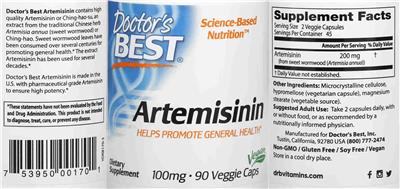
Supplement Facts
| Ingredient | Amount | % DV |
|---|---|---|
| Artemisinin | 200 mg | -- |
Other ingredients: Microcrystalline Cellulose, Hypromellose, Magnesium Stearate
Tap any ingredient to jump to its full detail below.
These statements are the manufacturer’s wording, reproduced from the product label — the label is saying it, not HelloPharmacist. We don’t verify or endorse them.
Formula
Doctor's Best Artemisinin contains high quality Artemisinin or Ching-hao-su, an extract from the traditional Chinese herb Artemisia annua (sweet wormwood) or Ching-hao. Sweet wormwood leaves have been consumed over several centuries for promoting general health. The extract Artemisinin has been used for several decades. Doctor's Best Artemisinin is made in the U.S. with pharmaceutical grade Artemisinin to ensure high potency.
FDA Disclaimer Statement
These statements have not been evaluated by the Food and Drug Administration. This product is not intended to diagnose, treat, cure, or prevent any disease.
Brand IP Statement(s)
Science-Based Nutrition
Formulation
Helps promote general health
Vegan
Non-GMO/Gluten free/Soy free/Vegan
Non-GMO/Gluten free/Soy free/Vegan
FDA Statement of Identity
Dietary Supplement
Suggested/Recommended/Usage/Directions
Suggested adult use: Take 2 capsules daily, with or without food, or as recommended by a nutritionally informed physician.
Storage
Store in a cool dry place.
Is this label outdated? Report a formula or label change and our pharmacy team will review it.
Artemisinin 100 mg by Doctor's Best label
The label scan from the NIH Dietary Supplement Label Database. Tap to enlarge.
Label images are published by the NIH Dietary Supplement Label Database for the version of this product on file. Always read your actual product label.
View the full label (PDF)The Ingredients in Artemisinin 100 mg by Doctor's Best
This is the 1 active ingredient this product is made of. Select it to open its full monograph.
Serving size2 Capsule(s) Dosage formCapsule Servings per container45 Amounts shown are per serving.
Artemisinin
Interacts with892 drugs
Sweet Annie (Artemisia annua) is the source of artemisinin, a compound used in prescription antimalarial drugs. While the purified drug is well studie...
Artemisinin monograph & interactionsOther (inactive) ingredients: Microcrystalline Cellulose, Hypromellose, Magnesium Stearate. These complete the product’s ingredient list but are not active constituents.
Artemisinin 100 mg by Doctor's Best Drug Interactions
HelloPharmacist Interaction Report
Artemisinin 100 mg by Doctor's Best contains a single active ingredient — artemisinin, derived from Sweet Annie — that interacts with a notable range of medications.
The most serious interaction involves drugs that stress the liver (hepatotoxic drugs). Because artemisinin itself may affect liver function, taking it alongside medications known to damage the liver could theoretically add to that risk and cause extra harm.
Read the full breakdown — every affected drug type, severity by severity
Artemisinin also affects how your body breaks down and clears two major groups of drugs: those processed by an enzyme called CYP3A4 and those processed by CYP2B6. In laboratory studies, artemisinin appears to rev up these enzymes, which could lower the blood levels of drugs that depend on them — making those medications less effective.
However, whole Sweet Annie extract seems to work the opposite way in some tests, so the real-world picture isn't fully clear.
Although we don't hold interaction data on the inactive ingredients in this product, you should still check your exact medications with the search tool on this page before you start, especially if you take anything for your liver, heart, blood pressure, or immune function.
Check your own medications below · Editorial policy · How we use AI
Want to check YOUR meds against Artemisinin 100 mg?
Ask about interactions with your drugs in plain English — “Can I take it with lisinopril?” — and we find you the answer in seconds, ingredient by ingredient.
Go to the checkerIngredients driving the most interactions
Individual Drug Interactions
The ingredients in Artemisinin 100 mg interact with 892 drugs. Click any drug to see the details.
1 of the 1 ingredient in Artemisinin 100 mg interact with drugs. Each result below shows which ingredient is responsible. Artemisinin
6-mercaptopurinePurinethol
How 6-mercaptopurine interacts with Artemisinin 100 mg — through 1 ingredient. Tap an ingredient for the detail:
ArtemisininHepatotoxic Drugs Moderate
Interaction Summary
Theoretically, concomitant use might have additive adverse hepatotoxic effects.
Read the full Artemisinin + 6-mercaptopurine interactionAdo-trastuzumab EmtansineKadcyla
How Ado-trastuzumab Emtansine interacts with Artemisinin 100 mg — through 1 ingredient. Tap an ingredient for the detail:
ArtemisininCytochrome P450 3a4 (cyp3a4) Substrates Moderate
Interaction Summary
Sweet Annie may alter plasma levels and clinical effects of drugs metabolized by CYP3A4.
Read the full Artemisinin + Ado-trastuzumab Emtansine interactionAbacavir Sulfate, Dolutegravir, LamivudineTriumeq
How Abacavir Sulfate, Dolutegravir, Lamivudine interacts with Artemisinin 100 mg — through 1 ingredient. Tap an ingredient for the detail:
ArtemisininHepatotoxic Drugs Moderate
Interaction Summary
Theoretically, concomitant use might have additive adverse hepatotoxic effects.
Read the full Artemisinin + Abacavir Sulfate, Dolutegravir, Lamivudine interactionAbacavir, LamivudineEpzicom
How Abacavir, Lamivudine interacts with Artemisinin 100 mg — through 1 ingredient. Tap an ingredient for the detail:
ArtemisininHepatotoxic Drugs Moderate
Interaction Summary
Theoretically, concomitant use might have additive adverse hepatotoxic effects.
Read the full Artemisinin + Abacavir, Lamivudine interactionAbemaciclibVerzenio
How Abemaciclib interacts with Artemisinin 100 mg — through 1 ingredient. Tap an ingredient for the detail:
ArtemisininCytochrome P450 3a4 (cyp3a4) Substrates Moderate
Interaction Summary
Sweet Annie may alter plasma levels and clinical effects of drugs metabolized by CYP3A4.
Read the full Artemisinin + Abemaciclib interactionAbiraterone
How Abiraterone interacts with Artemisinin 100 mg — through 1 ingredient. Tap an ingredient for the detail:
ArtemisininHepatotoxic Drugs, Cytochrome P450 3a4 (cyp3a4) Substrates Moderate
Interaction Summary
Theoretically, concomitant use might have additive adverse hepatotoxic effects.
Read the full Artemisinin + Abiraterone interactionAbiraterone AcetateYonsa, Zytiga
How Abiraterone Acetate interacts with Artemisinin 100 mg — through 1 ingredient. Tap an ingredient for the detail:
ArtemisininHepatotoxic Drugs, Cytochrome P450 3a4 (cyp3a4) Substrates Moderate
Interaction Summary
Theoretically, concomitant use might have additive adverse hepatotoxic effects.
Read the full Artemisinin + Abiraterone Acetate interactionAcalabrutinibCalquence
How Acalabrutinib interacts with Artemisinin 100 mg — through 1 ingredient. Tap an ingredient for the detail:
ArtemisininCytochrome P450 3a4 (cyp3a4) Substrates Moderate
Interaction Summary
Sweet Annie may alter plasma levels and clinical effects of drugs metabolized by CYP3A4.
Read the full Artemisinin + Acalabrutinib interactionAcarboseGlucobay, Prandase, Precose
How Acarbose interacts with Artemisinin 100 mg — through 1 ingredient. Tap an ingredient for the detail:
ArtemisininHepatotoxic Drugs Moderate
Interaction Summary
Theoretically, concomitant use might have additive adverse hepatotoxic effects.
Read the full Artemisinin + Acarbose interactionAcebutololRhotral, Sectral
How Acebutolol interacts with Artemisinin 100 mg — through 1 ingredient. Tap an ingredient for the detail:
ArtemisininHepatotoxic Drugs Moderate
Interaction Summary
Theoretically, concomitant use might have additive adverse hepatotoxic effects.
Read the full Artemisinin + Acebutolol interactionAcetaminophenChildren's Tylenol, Children's Tylenol Meltaways, Tylenol, Tylenol Ex Strength
How Acetaminophen interacts with Artemisinin 100 mg — through 1 ingredient. Tap an ingredient for the detail:
ArtemisininHepatotoxic Drugs Moderate
Interaction Summary
Theoretically, concomitant use might have additive adverse hepatotoxic effects.
Read the full Artemisinin + Acetaminophen interactionAcetaminophen, AspirinGemnisyn
How Acetaminophen, Aspirin interacts with Artemisinin 100 mg — through 1 ingredient. Tap an ingredient for the detail:
ArtemisininHepatotoxic Drugs Moderate
Interaction Summary
Theoretically, concomitant use might have additive adverse hepatotoxic effects.
Read the full Artemisinin + Acetaminophen, Aspirin interactionAcetaminophen, Aspirin, CaffeineExcedrin, Excedrin Extra Strength, Excedrin Migraine
How Acetaminophen, Aspirin, Caffeine interacts with Artemisinin 100 mg — through 1 ingredient. Tap an ingredient for the detail:
ArtemisininHepatotoxic Drugs, Cytochrome P450 3a4 (cyp3a4) Substrates Moderate
Interaction Summary
Theoretically, concomitant use might have additive adverse hepatotoxic effects.
Read the full Artemisinin + Acetaminophen, Aspirin, Caffeine interactionAcetaminophen, Brompheniramine, PhenylpropanolamineDimetapp Cold and Flu
How Acetaminophen, Brompheniramine, Phenylpropanolamine interacts with Artemisinin 100 mg — through 1 ingredient. Tap an ingredient for the detail:
ArtemisininHepatotoxic Drugs Moderate
Interaction Summary
Theoretically, concomitant use might have additive adverse hepatotoxic effects.
Read the full Artemisinin + Acetaminophen, Brompheniramine, Phenylpropanolamine interactionAcetaminophen, ButalbitalAxocet, Bancap, Bucet, Butex Forte, Esgic CF, Orbivan CF +5 more
How Acetaminophen, Butalbital interacts with Artemisinin 100 mg — through 1 ingredient. Tap an ingredient for the detail:
ArtemisininHepatotoxic Drugs Moderate
Interaction Summary
Theoretically, concomitant use might have additive adverse hepatotoxic effects.
Read the full Artemisinin + Acetaminophen, Butalbital interactionAcetaminophen, Butalbital, CaffeineEsgic, Esgic Plus, Fiogesic, Fioricet, Repan, Tecnal +1 more
How Acetaminophen, Butalbital, Caffeine interacts with Artemisinin 100 mg — through 1 ingredient. Tap an ingredient for the detail:
ArtemisininHepatotoxic Drugs, Cytochrome P450 3a4 (cyp3a4) Substrates Moderate
Interaction Summary
Theoretically, concomitant use might have additive adverse hepatotoxic effects.
Read the full Artemisinin + Acetaminophen, Butalbital, Caffeine interactionAcetaminophen, Butalbital, Caffeine, CodeineEsgic with Codeine, Fioricet w/ Codeine
How Acetaminophen, Butalbital, Caffeine, Codeine interacts with Artemisinin 100 mg — through 1 ingredient. Tap an ingredient for the detail:
ArtemisininCytochrome P450 3a4 (cyp3a4) Substrates, Hepatotoxic Drugs Moderate
Interaction Summary
Sweet Annie may alter plasma levels and clinical effects of drugs metabolized by CYP3A4.
Read the full Artemisinin + Acetaminophen, Butalbital, Caffeine, Codeine interactionAcetaminophen, Butalbital, CodeineBancap w/ Codeine
How Acetaminophen, Butalbital, Codeine interacts with Artemisinin 100 mg — through 1 ingredient. Tap an ingredient for the detail:
ArtemisininHepatotoxic Drugs Moderate
Interaction Summary
Theoretically, concomitant use might have additive adverse hepatotoxic effects.
Read the full Artemisinin + Acetaminophen, Butalbital, Codeine interactionAcetaminophen, Butalbital, Codeine PhosphatePhrenilin #3
How Acetaminophen, Butalbital, Codeine Phosphate interacts with Artemisinin 100 mg — through 1 ingredient. Tap an ingredient for the detail:
ArtemisininHepatotoxic Drugs Moderate
Interaction Summary
Theoretically, concomitant use might have additive adverse hepatotoxic effects.
Read the full Artemisinin + Acetaminophen, Butalbital, Codeine Phosphate interactionAcetaminophen, Caffeine, Chlorpheniramine, Hydrocodone, PhenylephrineHycomine Compound
How Acetaminophen, Caffeine, Chlorpheniramine, Hydrocodone, Phenylephrine interacts with Artemisinin 100 mg — through 1 ingredient. Tap an ingredient for the detail:
ArtemisininHepatotoxic Drugs, Cytochrome P450 3a4 (cyp3a4) Substrates Moderate
Interaction Summary
Theoretically, concomitant use might have additive adverse hepatotoxic effects.
Read the full Artemisinin + Acetaminophen, Caffeine, Chlorpheniramine, Hydrocodone, Phenylephrine interactionAcetaminophen, Caffeine, CodeineGesic C15, Gesic C30, Gesic C8, Lenoltec 1, Lenoltec 2, Lenoltec 3 +1 more
How Acetaminophen, Caffeine, Codeine interacts with Artemisinin 100 mg — through 1 ingredient. Tap an ingredient for the detail:
ArtemisininCytochrome P450 3a4 (cyp3a4) Substrates, Hepatotoxic Drugs Moderate
Interaction Summary
Sweet Annie may alter plasma levels and clinical effects of drugs metabolized by CYP3A4.
Read the full Artemisinin + Acetaminophen, Caffeine, Codeine interactionAcetaminophen, Caffeine, Codeine, SalicylamideCodalan No.1, Codalan No.2, Codalan No.3
How Acetaminophen, Caffeine, Codeine, Salicylamide interacts with Artemisinin 100 mg — through 1 ingredient. Tap an ingredient for the detail:
ArtemisininHepatotoxic Drugs, Cytochrome P450 3a4 (cyp3a4) Substrates Moderate
Interaction Summary
Theoretically, concomitant use might have additive adverse hepatotoxic effects.
Read the full Artemisinin + Acetaminophen, Caffeine, Codeine, Salicylamide interactionAcetaminophen, Caffeine, DihydrocodeineDHC Plus, Panlor DC, Panlor SS
How Acetaminophen, Caffeine, Dihydrocodeine interacts with Artemisinin 100 mg — through 1 ingredient. Tap an ingredient for the detail:
ArtemisininCytochrome P450 3a4 (cyp3a4) Substrates, Hepatotoxic Drugs Moderate
Interaction Summary
Sweet Annie may alter plasma levels and clinical effects of drugs metabolized by CYP3A4.
Read the full Artemisinin + Acetaminophen, Caffeine, Dihydrocodeine interactionAcetaminophen, Caffeine, IsomethepteneMigralam
How Acetaminophen, Caffeine, Isometheptene interacts with Artemisinin 100 mg — through 1 ingredient. Tap an ingredient for the detail:
ArtemisininHepatotoxic Drugs, Cytochrome P450 3a4 (cyp3a4) Substrates Moderate
Interaction Summary
Theoretically, concomitant use might have additive adverse hepatotoxic effects.
Read the full Artemisinin + Acetaminophen, Caffeine, Isometheptene interactionAcetaminophen, Caffeine, PyrilamineMidol Max Strength Menstrual
How Acetaminophen, Caffeine, Pyrilamine interacts with Artemisinin 100 mg — through 1 ingredient. Tap an ingredient for the detail:
ArtemisininCytochrome P450 3a4 (cyp3a4) Substrates, Hepatotoxic Drugs Moderate
Interaction Summary
Sweet Annie may alter plasma levels and clinical effects of drugs metabolized by CYP3A4.
Read the full Artemisinin + Acetaminophen, Caffeine, Pyrilamine interactionAcetaminophen, Chlorpheniramine Maleate, Dextromethorphan HbrVicks Formula 44M Cough, Cold & Flu Relief
How Acetaminophen, Chlorpheniramine Maleate, Dextromethorphan Hbr interacts with Artemisinin 100 mg — through 1 ingredient. Tap an ingredient for the detail:
ArtemisininHepatotoxic Drugs, Cytochrome P450 3a4 (cyp3a4) Substrates Moderate
Interaction Summary
Theoretically, concomitant use might have additive adverse hepatotoxic effects.
Read the full Artemisinin + Acetaminophen, Chlorpheniramine Maleate, Dextromethorphan Hbr interactionAcetaminophen, Chlorpheniramine, Codeine, PhenylephrineColrex
How Acetaminophen, Chlorpheniramine, Codeine, Phenylephrine interacts with Artemisinin 100 mg — through 1 ingredient. Tap an ingredient for the detail:
ArtemisininHepatotoxic Drugs, Cytochrome P450 3a4 (cyp3a4) Substrates Moderate
Interaction Summary
Theoretically, concomitant use might have additive adverse hepatotoxic effects.
Read the full Artemisinin + Acetaminophen, Chlorpheniramine, Codeine, Phenylephrine interactionAcetaminophen, Chlorpheniramine, DextromethorphanCoricidin II Extra Strength Cold and Flu
How Acetaminophen, Chlorpheniramine, Dextromethorphan interacts with Artemisinin 100 mg — through 1 ingredient. Tap an ingredient for the detail:
ArtemisininCytochrome P450 3a4 (cyp3a4) Substrates, Hepatotoxic Drugs Moderate
Interaction Summary
Sweet Annie may alter plasma levels and clinical effects of drugs metabolized by CYP3A4.
Read the full Artemisinin + Acetaminophen, Chlorpheniramine, Dextromethorphan interactionAcetaminophen, Chlorpheniramine, Dextromethorphan HydrobromideCoricidin HBP Maximum Strength Flu
How Acetaminophen, Chlorpheniramine, Dextromethorphan Hydrobromide interacts with Artemisinin 100 mg — through 1 ingredient. Tap an ingredient for the detail:
ArtemisininHepatotoxic Drugs, Cytochrome P450 3a4 (cyp3a4) Substrates Moderate
Interaction Summary
Theoretically, concomitant use might have additive adverse hepatotoxic effects.
Read the full Artemisinin + Acetaminophen, Chlorpheniramine, Dextromethorphan Hydrobromide interactionAcetaminophen, Chlorpheniramine, Dextromethorphan, PhenylpropanolamineMulti Symptom Cold Relief
How Acetaminophen, Chlorpheniramine, Dextromethorphan, Phenylpropanolamine interacts with Artemisinin 100 mg — through 1 ingredient. Tap an ingredient for the detail:
ArtemisininCytochrome P450 3a4 (cyp3a4) Substrates, Hepatotoxic Drugs Moderate
Interaction Summary
Sweet Annie may alter plasma levels and clinical effects of drugs metabolized by CYP3A4.
Read the full Artemisinin + Acetaminophen, Chlorpheniramine, Dextromethorphan, Phenylpropanolamine interactionEach ingredient & the kinds of drugs it affects
For each ingredient in Artemisinin 100 mg with known interactions, here are the types of medications it can affect. Open any type for the detail — or search your exact drug in the checker above.
Artemisinin
Cytochrome P450 2B6 (Cyp2B6) Substrates
Sweet Annie may alter plasma levels and clinical effects of drugs metabolized by CYP2B6.
In vitro research shows that the Sweet Annie constituent artemisinin induces CYP2B6, possibly increasing CYP2B6 activity by 1.6-fold. However, Sweet Annie extract seems to inhibit the activity of CYP2B6 in vitro, suggesting that other constituents of Sweet Annie play a role in its effects on the overall activity of this enzyme. More information is needed to determine whether taking Sweet Annie extract affects the metabolism of CYP2B6 substrates.
Cytochrome P450 3A4 (Cyp3A4) Substrates
Sweet Annie may alter plasma levels and clinical effects of drugs metabolized by CYP3A4.
In vitro research shows that the Sweet Annie constituent artemisinin induces CYP3A4, possibly increasing CYP3A4 activity by 1.9-fold. However, Sweet Annie extract seems to inhibit the activity of CYP3A4 in vitro, suggesting that other constituents of Sweet Annie play a role in its effects on the overall activity of this enzyme. More information is needed to determine whether taking Sweet Annie extract affects the metabolism of CYP3A4 substrates.
Hepatotoxic Drugs
Theoretically, concomitant use might have additive adverse hepatotoxic effects.
There is some concern that Sweet Annie can adversely affect the liver.
Brand information
Manufacturer and brand details for Artemisinin 100 mg, from the product label.
Doctor's Best
See all Doctor's Best products- Name
- Doctor's Best, Inc.
- City
- Tustin
- State
- California
- ZipCode
- 92780
- Phone Number
- (800) 777-2474
- Web Address
- www.drbvitamins.com
Artemisinin 100 mg by Doctor's Best: Common Questions
Does Artemisinin 100 mg by Doctor's Best interact with any medications?
How can one product interact with so many drugs?
Where does this information come from?
Can I take this if I'm pregnant or breastfeeding?
What's the most common side effect?
Does artemisinin actually work for hay fever?
Why does this product say it might harm the liver?
How long can I take this safely?
Written and reviewed by the HelloPharmacist editorial staff. Our editorial policy
Not sure if Artemisinin 100 mg is safe with your meds?
Our pharmacists answer your medication & supplement questions — free.
Label information is sourced from the NIH Dietary Supplement Label Database and reflects the product version on file; always read your actual product label. This page is for education only and is not a substitute for professional medical advice. Confirm with your pharmacist or doctor before combining supplements and medications.
The Full Monographs Behind Artemisinin 100 mg’s Ingredients
Every ingredient we hold a full HelloPharmacist monograph for — uses, evidence, safety, and the complete interaction list.
Sources & How We Checked
Artemisinin 100 mg's label data comes from the NIH Dietary Supplement Label Database; the ingredient interaction data is from the Natural Medicines database, reviewed by our pharmacists.
- NIH Dietary Supplement Label Database (DSLD) — The official product label on file for this supplement.
- Natural Medicines (Therapeutic Research Center) — Evidence-graded clinical reference behind the ingredient interaction data.
Content is written and reviewed by licensed HelloPharmacist pharmacists. See our data sources and editorial standards for how this information is built and checked.
The 11 references behind this product’s interaction data
Every citation that drives the interaction findings for this product’s ingredients, from the evidence-graded Natural Medicines (TRC Healthcare) database. Open an ingredient to browse its citations — links open the study on PubMed or the publisher’s site.
Sweet Annie 11 references
- Mueller MS, Karhagomba IB, Hirt HM, Wemakor E. The potential of Artemisia annua L. as a locally produced remedy for malaria in the tropics: agricultural, chemical and clinical aspects. J Ethnopharmacol 2000;73:487-93. PubMed
- Rath K, Taxis K, Walz G, et al. Pharmacokinetic study of artemisinin after oral intake of a traditional preparation of Artemisia annua L. (annual wormwood). Am J Trop Med Hyg 2004;70:128-32. DOI
- Centers for Disease Control and Prevention (CDC). Hepatitis temporally associated with an herbal supplement containing artemisinin-Washington, 2008. MMWR Morb Mortal Wkly Rep 2009;58:854-8.
- Xing J, Kirby BJ, Whittington D, et al. Evaluation of P450 inhibition and induction by artemisinin antimalarials in human liver microsomes and primary human hepatocytes. Drug Metabl Dispos 2012;40(9):1757-64. PubMed
- Savage RL, Hill GR, Barnes J, Kenyon SH, Tatley MV. Suspected hepatotoxicity with a supercritical carbon dioxide extract of Artemisia annua in grapeseed oil used in New Zealand. Front Pharmacol. 2019;10:1448. PubMed
- Ruperti-Repilado FJ, Haefliger S, Rehm S, et al. Danger of herbal tea: a case of acute cholestatic hepatitis due to Artemisia annua tea. Front Med (Lausanne). 2019;6:221. PubMed
- Yang J, Shen Z, Liu L, et al. Clinical efficacy and safety of Artesimia annua-Sublingual immunotherapy in seasonal allergic rhinitis patients based on different intervention time. Int Arch Allergy Immunol 2022;183(8):852-859.
- Kane NF, Kiani BH, Desrosiers MR, Towler MJ, Weathers PJ. Artemisia extracts differ from artemisinin effects on human hepatic CYP450s 2B6 and 3A4 in vitro. J Ethnopharmacol 2022. DOI
- Feng Y, Cao Y, Liu Y, et al. Clinical efficacy and safety of coseasonal initiation of Artemisia annua sublingual immunotherapy on patients with Artemisia-induced rhinoconjunctivitis. Am J Otolaryngol 2023;44(5):103942. PubMed
- Yang J, Wang W, Shen Z, et al. Efficacy and safety of Artemisia annua sublingual immunotherapy in patients with seasonal allergic rhinoconjunctivitis over two pollen seasons. Eur Arch Otorhinolaryngol. 2023;280(11):4939-4947. PubMed
- Shen Z, Zhang P, Kang W, et al. Clinical efficacy in one-year treatment with Artemisia annua-SLIT drops in monosensitized and polysensitized individuals. Am J Otolaryngol 2023;44(6):104002. PubMed
Parts of this content are provided by the Therapeutic Research Center, LLC.
DISCLAIMER: Currently this does not check for drug-drug interactions. This is not an all-inclusive comprehensive list of potential interactions and is for informational purposes only. Not all interactions are known or well-reported in the scientific literature, and new interactions are continually being reported. Input is needed from a qualified healthcare provider including a pharmacist before starting any therapy. Application of clinical judgment is necessary.
© 2021 Therapeutic Research Center, LLC