
Bee Pollen 500 mg Ingredients & Drug Interactions
by Solgar
What is this page for?
First and foremost: checking Bee Pollen 500 mg against your medications. The heart of this page is the interaction checker and the full interaction report — how this product’s ingredients may interact with prescription and over-the-counter medicines you may be taking.
Around that, we add a pharmacist’s high-level view of the product as a whole — what’s inside, the evidence for its stated use, how transparent the label is, and what safety data exists — so you can see the full picture in one place. It’s educational information from our licensed clinical databases and the clinical staff at HelloPharmacist — not medical advice — and we don’t sell or endorse products. Our editorial policy
Bee Pollen 500 mg is a dietary supplement by Solgar with 1 active ingredient. Its ingredients are commonly taken for general energy and vitality, immune support, nutritional supplement.Based on those ingredients, 2 medications have a known interaction with it, the most serious rated moderate. The ingredients most likely to interact are Bee Pollen. Use the checker below to test your specific medication, or read the full HelloPharmacist Interaction Report.
Check Your Meds Against Bee Pollen 500 mg by Solgar
Ask about any prescription or over-the-counter medication and we check it for interactions with Bee Pollen 500 mg by Solgar — and tell you which ingredient is responsible.
AI summaries are generated from our interaction database for education only — always confirm with your pharmacist. How we use AI
Ask the Pharmacist
A licensed pharmacist will answer your question by email — free, usually within 24 hours.
Got it — thank you!
A licensed pharmacist will answer within 24 hours. Keep an eye on your email (worth checking spam, just in case).
HelloPharmacist Scorecard of Bee Pollen 500 mg by Solgar
Our pharmacy team’s full take, with four database checks built into the cards below — a summary of what is known, not a grade of the product itself.
What’s inside
Full disclosure
This product contains one active ingredient: bee pollen at 500 mg per tablet. Bee pollen is a concentrated form of pollen and nectar collected by honeybees.
The tablet also contains silica, an inactive ingredient used as an excipient.
Does it work?
Couldn't assess
The evidence for bee pollen is mixed and incomplete in our data. It's rated possibly ineffective for athletic performance.
For hay fever, amenorrhea (missing periods), prostate enlargement, and breast cancer-related hot flashes, there isn't enough reliable evidence to know whether it works or doesn't. If you're considering it for any of these reasons, chat with us about what the research actually shows.
How safe is it?
Well-documented data
Bee pollen is generally well tolerated by many people, but it carries real risks you need to know about. The main concern is allergic reaction — sometimes severe.
If you have a history of seasonal pollen allergies, especially to ragweed, chrysanthemums, daisies, marigolds, or related plants, you're at higher risk for serious reactions including swelling, shortness of breath, lightheadedness, or anaphylaxis. Rare but serious side effects reported include hepatitis and kidney problems.
Bee pollen is rated possibly unsafe in pregnancy, so avoid it if you're pregnant. There isn't enough safety data while breastfeeding, so it's best to avoid it then as well.
Meds to double-check
Moderate interaction found
Check with us before taking this if you're on warfarin (Coumadin) or any other blood thinner. Bee pollen may increase bleeding risk by raising your blood-clotting levels unexpectedly.
The bottom line
Scorecard at a glanceFully disclosed formula with no assessable stated purpose. Moderate medication interactions have been identified, and safety information is well characterized.
If you take warfarin or any blood thinner, you'll want to talk with us before adding this — bee pollen can interfere with how your medication works. If you have pollen allergies, especially to ragweed or similar plants, steer clear.
For everyone else, it's generally tolerated, but the evidence for what it actually does is pretty thin.
Educational only — not medical advice; always confirm with your pharmacist. Our editorial policy · How we use AI
Assessment coverage: 1 of 1 active ingredient matched to our full ingredient reviews (monographs). Based on the product label dated Feb 26, 2020.
This Scorecard evaluates available label information, ingredient evidence, and known medication-safety considerations. It does not independently verify product identity, purity, potency, contamination, or manufacturing quality. How these ratings are computed
General information
Key facts about Bee Pollen 500 mg, straight from the product label.
| Brand | Solgar |
|---|---|
| Barcode (UPC) | 033984022416 |
| Net contents | 250 Tablet(s) |
| Market status | On market |
| Date entered into DSLD | Feb 26, 2020 |
| DSLD ID | 214787 |
| Product type | Non-nutrient/non-botanical |
| Supplement form | Tablet Or Pill |
| Dietary claims / uses | All Other |
| Intended target group(s) | Adult (18 - 50 Years), Kosher, Dairy Free |
Everything in this section is reproduced from the manufacturer’s own product label — it’s the label speaking, not HelloPharmacist. We show it so you can see exactly what the maker states; we don’t verify or endorse those statements.
Supplement Facts
The label details for Bee Pollen 500 mg by Solgar, sourced from the NIH Dietary Supplement Label Database.
Tap any ingredient to jump to its full detail below.
These statements are the manufacturer’s wording, reproduced from the product label — the label is saying it, not HelloPharmacist. We don’t verify or endorse them.
Formulation
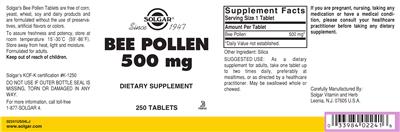
Solgar's Bee Pollen Tablets are free of corn, yeast, wheat, soy and dairy products and are formulated without the use of preservatives, artificial flavors or colors.
Storage
To assure freshness and potency, store at room temperature 15 degrees-30 degrees C (59 degrees-86 degrees F). Store away from heat, light and moisture.
Formula
Formulated for adults.
Solgar's KOF-K certification #K-1250
Precautions
Keep out of reach of children.
Do not use if outer bottle seal is missing, torn or damaged in any way.
If you are pregnant, nursing, taking any mediation or have a medical condition, please consult your healthcare practitioner before taking any dietary supplement.
General Statements
Solgar since 1947
FDA Statement of Identity
Dietary Supplement
Seals/Symbols
K Parve (Kosher)
Suggested/Recommended/Usage/Directions
Suggested Use: As a dietary supplement for adults, take one tablet up to two times daily, preferably at mealtimes, or as directed by a healthcare practitioner. May be swallowed whole or chewed.
Is this label outdated? Report a formula or label change and our pharmacy team will review it.
Bee Pollen 500 mg by Solgar label
The label scan from the NIH Dietary Supplement Label Database. Tap to enlarge.
Label images are published by the NIH Dietary Supplement Label Database for the version of this product on file. Always read your actual product label.
View the full label (PDF)The Ingredients in Bee Pollen 500 mg by Solgar
This is the 1 active ingredient this product is made of. Select it to open its full monograph.
Serving size1 Tablet(s) Dosage formTablet Or Pill Amounts shown are per serving.
Bee Pollen
Interacts with2 drugs
Bee pollen is a nutrient-rich product collected by bees and marketed as a 'superfood' for energy and immune support, but solid human evidence for most...
Bee Pollen monograph & interactionsOther (inactive) ingredients: Silica. These complete the product’s ingredient list but are not active constituents.
Bee Pollen 500 mg by Solgar Drug Interactions
HelloPharmacist Interaction Report
Bee Pollen by Solgar has a documented interaction with blood thinners.
The one active ingredient — bee pollen itself — can interact with warfarin (Coumadin), a common blood thinner used to prevent clots. In a case report, a patient whose blood-clotting level (INR) had been stable for 9 months at 1.9–3.3 saw it jump to 7.1 after taking bee pollen granules for about a month — a sign of increased bleeding risk.
Read the full breakdown — every affected drug type, severity by severity
Although we have interaction data only for warfarin in our monograph, bee pollen may affect other blood thinners similarly. Altogether, these interactions span 2 individual medications.
If you take warfarin or any other blood thinner, check your specific medications with the tool below before starting this supplement.
Check your own medications below · Editorial policy · How we use AI
Want to check YOUR meds against Bee Pollen 500 mg?
Ask about interactions with your drugs in plain English — “Can I take it with lisinopril?” — and we find you the answer in seconds, ingredient by ingredient.
Go to the checkerIngredients driving the most interactions
Individual Drug Interactions
The ingredients in Bee Pollen 500 mg interact with 2 drugs. Click any drug to see the details.
1 of the 1 ingredient in Bee Pollen 500 mg interact with drugs. Each result below shows which ingredient is responsible. Bee Pollen
WarfarinWarfarin
How Warfarin interacts with Bee Pollen 500 mg — through 1 ingredient. Tap an ingredient for the detail:
Bee PollenWarfarin (coumadin) Moderate
Interaction Summary
There is some concern that bee pollen might interact with warfarin and increase the risk of bleeding.
Read the full Bee Pollen + Warfarin interactionWarfarin SodiumCoumadin, Panwarfin, Sofarin
How Warfarin Sodium interacts with Bee Pollen 500 mg — through 1 ingredient. Tap an ingredient for the detail:
Bee PollenWarfarin (coumadin) Moderate
Interaction Summary
There is some concern that bee pollen might interact with warfarin and increase the risk of bleeding.
Read the full Bee Pollen + Warfarin Sodium interactionEach ingredient & the kinds of drugs it affects
For each ingredient in Bee Pollen 500 mg with known interactions, here are the types of medications it can affect. Open any type for the detail — or search your exact drug in the checker above.
Bee Pollen
Warfarin (Coumadin)
There is some concern that bee pollen might interact with warfarin and increase the risk of bleeding.
In one case report, a patient on warfarin had a stable international normalized ratio (INR) of 1.9-3.3 for 9 months. The patient's INR was found to be 7.1 after starting bee pollen granules one teaspoon twice daily for approximately one month. The patient's warfarin dose was decreased by approximately 11% in order to return the INR to the therapeutic range while continuing the bee pollen supplement.
Brand information
Manufacturer and brand details for Bee Pollen 500 mg, from the product label.
Solgar
See all Solgar products- Name
- Solgar Vitamin and Herb
- City
- Leonia
- State
- N.J.
- ZipCode
- 07605
- Phone Number
- 1-877-765-4274
- Web Address
- www.solgar.com
Bee Pollen 500 mg by Solgar: Common Questions
Does Bee Pollen 500 mg by Solgar interact with any medications?
How can one product interact with so many drugs?
Where does this information come from?
Can I take bee pollen if I have pollen allergies?
Is bee pollen safe during pregnancy?
Is bee pollen safe while breastfeeding?
Does bee pollen actually help with athletic performance?
What are the side effects?
What exactly is bee pollen?
Written and reviewed by the HelloPharmacist editorial staff. Our editorial policy
Not sure if Bee Pollen 500 mg is safe with your meds?
Our pharmacists answer your medication & supplement questions — free.
Label information is sourced from the NIH Dietary Supplement Label Database and reflects the product version on file; always read your actual product label. This page is for education only and is not a substitute for professional medical advice. Confirm with your pharmacist or doctor before combining supplements and medications.
The Full Monographs Behind Bee Pollen 500 mg’s Ingredients
Every ingredient we hold a full HelloPharmacist monograph for — uses, evidence, safety, and the complete interaction list.
Sources & How We Checked
Bee Pollen 500 mg's label data comes from the NIH Dietary Supplement Label Database; the ingredient interaction data is from the Natural Medicines database, reviewed by our pharmacists.
- NIH Dietary Supplement Label Database (DSLD) — The official product label on file for this supplement.
- Natural Medicines (Therapeutic Research Center) — Evidence-graded clinical reference behind the ingredient interaction data.
Content is written and reviewed by licensed HelloPharmacist pharmacists. See our data sources and editorial standards for how this information is built and checked.
The 15 references behind this product’s interaction data
Every citation that drives the interaction findings for this product’s ingredients, from the evidence-graded Natural Medicines (TRC Healthcare) database. Open an ingredient to browse its citations — links open the study on PubMed or the publisher’s site.
Bee Pollen 15 references
- Foster S, Tyler VE. Tyler's Honest Herbal: A Sensible Guide to the Use of Herbs and Related Remedies. 3rd ed., Binghamton, NY: Haworth Herbal Press, 1993.
- The Review of Natural Products by Facts and Comparisons. St. Louis, MO: Wolters Kluwer Co., 1999.
- Leung AY, Foster S. Encyclopedia of Common Natural Ingredients Used in Food, Drugs and Cosmetics. 2nd ed. New York, NY: John Wiley & Sons, 1996.
- Shad JA, Chinn CG, Brann OS. Acute hepatitis after ingestion of herbs. South Med J 1999;92:1095-7. PubMed
- Puente S, Iniguez A, Subirats M, et al. [Eosinophilic gastroenteritis caused by bee pollen sensitization]. Med Clin (Barc) 1997;108:698-700.
- Winther K, Hedman C. Assessment of the Effects of the Herbal Remedy Femal on the Symptoms of Premenstrual Syndrome: A Randomized, Double-Blind, Placebo-Controlled Study. Curr Ther Res Clin Exp 2002;63:344-53. DOI
- Cohen SH, Yunginger JW, Rosenberg N, Fink JN. Acute allergic reaction after composite pollen ingestion. J Allergy Clin Immunol 1979;64:270-4. PubMed
- Hurren KM, Lewis CL. Probable interaction between warfarin and bee pollen. Am J Health Syst Pharm 2010;67:2034-7. PubMed
- Akiyasu T, Paudyal B, Paudyal P, et al. A case report of acute renal failure associated with bee pollen contained in nutritional supplements. Ther Apher Dial 2010;14:93-7. PubMed
- Greenberger, P. A. and Flais, M. J. Bee pollen-induced anaphylactic reaction in an unknowingly sensitized subject. Ann.Allergy Asthma Immunol 2001;86(2):239-242. PubMed
- Lin FL, Vaughan TR, Vandewalker ML, et al. Hypereosinophilia, neurologic, and gastrointestinal symptoms after bee-pollen ingestion. J Allergy Clin Immunol 1989;83(4):793-796. PubMed
- Mansfield LE, Goldstein GB. Anaphylactic reaction after ingestion of local bee pollen. Ann Allergy 1981;47(3):154-156.
- Choi JH, Jang YS, Oh JW, Kim CH, Hyun IG. Bee pollen-induced anaphylaxis: a case report and literature review. Allergy Asthma Immunol Res 2015 Sep;7(5):513-7. PubMed
- Nonotte-Varly C. Allergenicity of Artemisia contained in bee pollen is proportional to its mass. Eur Ann Allergy Clin Immunol 2015;47(6):218-24.
- Leang ZX, Thalayasingam M, O'Sullivan M. A paediatric case of exercise-augmented anaphylaxis following bee pollen ingestion in Western Australia. Asia Pac Allergy. 2022 Jul 12;12(3):e23. PubMed
Parts of this content are provided by the Therapeutic Research Center, LLC.
DISCLAIMER: Currently this does not check for drug-drug interactions. This is not an all-inclusive comprehensive list of potential interactions and is for informational purposes only. Not all interactions are known or well-reported in the scientific literature, and new interactions are continually being reported. Input is needed from a qualified healthcare provider including a pharmacist before starting any therapy. Application of clinical judgment is necessary.
© 2021 Therapeutic Research Center, LLC