
Bee Pollen Complex 1000 mg Ingredients & Drug Interactions
What is this page for?
First and foremost: checking Bee Pollen Complex 1000 mg against your medications. The heart of this page is the interaction checker and the full interaction report — how this product’s ingredients may interact with prescription and over-the-counter medicines you may be taking.
Around that, we add a pharmacist’s high-level view of the product as a whole — what’s inside, the evidence for its stated use, how transparent the label is, and what safety data exists — so you can see the full picture in one place. It’s educational information from our licensed clinical databases and the clinical staff at HelloPharmacist — not medical advice — and we don’t sell or endorse products. Our editorial policy
Bee Pollen Complex 1000 mg is a dietary supplement by Best Naturals with 3 active ingredients. Its ingredients are commonly taken for general energy and vitality, immune support, nutritional supplement.Based on those ingredients, 1,038 medications have a known interaction with it, the most serious rated moderate. The ingredients most likely to interact are Bee Propolis, Royal Jelly powder, Bee Pollen. Use the checker below to test your specific medication, or read the full HelloPharmacist Interaction Report.
Check Your Meds Against Bee Pollen Complex 1000 mg by Best Naturals
Ask about any prescription or over-the-counter medication and we check it for interactions with Bee Pollen Complex 1000 mg by Best Naturals — and tell you which ingredient is responsible.
AI summaries are generated from our interaction database for education only — always confirm with your pharmacist. How we use AI
Ask the Pharmacist
A licensed pharmacist will answer your question by email — free, usually within 24 hours.
Got it — thank you!
A licensed pharmacist will answer within 24 hours. Keep an eye on your email (worth checking spam, just in case).
HelloPharmacist Scorecard of Bee Pollen Complex 1000 mg by Best Naturals
Our pharmacy team’s full take, with four database checks built into the cards below — a summary of what is known, not a grade of the product itself.
What’s inside
Full disclosure
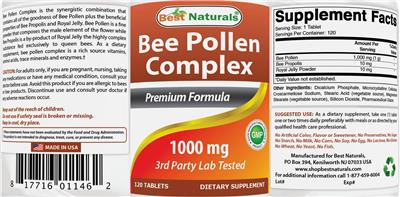
This product contains 3 active ingredients: bee pollen, royal jelly powder, and bee propolis. Bee pollen is a granular mix collected by honeybees; royal jelly is a secretion bees produce to nourish their young; and propolis is a resinous compound bees use to seal their hives.
The tablet also includes inactive ingredients such as dicalcium phosphate, microcrystalline cellulose, and magnesium stearate — these are standard binders and fillers that help hold the tablet together.
Does it work?
Moderate evidence
The evidence for bee pollen is sparse. It's rated possibly ineffective for athletic performance, and the data isn't established for hay fever, irregular periods, prostate enlargement, or hot flashes.
Royal jelly shows possibly effective for menopausal symptoms but is rated possibly ineffective for hay fever and athletic performance. Bee propolis has the strongest evidence: it's rated possibly effective for oral mouth sores (oral mucositis), cold sores, and diabetes, though the support for diabetes is limited.
For most other uses in this product, the evidence just isn't there yet.
How safe is it?
Well-documented data
All three ingredients are generally well tolerated by many people, but allergic reactions are the main worry — especially if you have seasonal pollen allergies (particularly to ragweed, daisies, or chrysanthemums), asthma, or a history of atopy (a tendency toward allergic conditions). Reactions can range from mild itching and swelling to severe ones like anaphylaxis and breathing trouble.
Rare cases of liver inflammation (hepatitis) and kidney problems have been reported with bee pollen. Royal jelly and propolis carry theoretical risks in pregnancy and lactation — there isn't enough safety data, so these are best avoided during pregnancy and while breastfeeding unless you've spoken with your doctor or pharmacist.
Meds to double-check
Moderate interaction found
Check warfarin (Coumadin) or any blood thinner with your pharmacist before starting — both bee pollen and royal jelly carry a moderate risk of increased bleeding. If you take blood pressure medication, discuss royal jelly with your pharmacist, as it may lower blood pressure further.
Propolis may slow how your liver clears certain medications; mention any prescription drugs you take — especially those processed by your liver — so your pharmacist can review the specific interaction risk.
The bottom line
Scorecard at a glanceFully disclosed formula with some supporting evidence behind its ingredients' uses. Moderate medication interactions have been identified, and safety information is well characterized.
This product may help with oral mouth sores, cold sores, or menopausal symptoms — though the evidence varies. If you take warfarin, blood pressure medication, or any drug processed through your liver, check with your pharmacist first.
Anyone with a history of pollen allergies, asthma, or bee product sensitivity should be especially careful and talk to their pharmacist before trying it.
Educational only — not medical advice; always confirm with your pharmacist. Our editorial policy · How we use AI
Assessment coverage: 3 of 3 active ingredients matched to our full ingredient reviews (monographs). Based on the product label dated Jun 16, 2022.
This Scorecard evaluates available label information, ingredient evidence, and known medication-safety considerations. It does not independently verify product identity, purity, potency, contamination, or manufacturing quality. How these ratings are computed
General information
Key facts about Bee Pollen Complex 1000 mg, straight from the product label.
| Brand | Best Naturals |
|---|---|
| Barcode (UPC) | 817716011462 |
| Net contents | 120 Tablet(s) |
| Market status | On market |
| Date entered into DSLD | Jun 16, 2022 |
| DSLD ID | 269290 |
| Product type | Other Combinations |
| Supplement form | Tablet Or Pill |
| Dietary claims / uses | All Other, Structure/Function |
| Intended target group(s) | Adult (18 - 50 Years), Gluten Free, Dairy Free, Sugar Free |
Everything in this section is reproduced from the manufacturer’s own product label — it’s the label speaking, not HelloPharmacist. We show it so you can see exactly what the maker states; we don’t verify or endorse those statements.
Supplement Facts
The label details for Bee Pollen Complex 1000 mg by Best Naturals, sourced from the NIH Dietary Supplement Label Database.
Supplement Facts
| Ingredient | Amount | % DV |
|---|---|---|
| Bee Pollen | 1000 mg | -- |
| Royal Jelly powder | 10 mg | -- |
| Bee Propolis | 10 mg | -- |
Other ingredients: Dicalcium Phosphate, Microcrystalline Cellulose, Croscarmellose Sodium, Stearic Acid, Magnesium Stearate, Silicon Dioxide, Pharmaceutical Glaze
Tap any ingredient to jump to its full detail below.
These statements are the manufacturer’s wording, reproduced from the product label — the label is saying it, not HelloPharmacist. We don’t verify or endorse them.
Formula
Bee Pollen Complex is the synergistic combination that contains all of the goodness of Bee Pollen plus the beneficial properties of Bee Propolis and Royal Jelly. Bee Pollen is a fine powder that composes the male element of the flower while Bee Propolis is a by-product of Royal Jelly the highly complex substance fed exclusively to queen bees. As a dietary supplement, bee pollen complex is a rich source vitamins, amino acids, trace minerals and enzymes.
Precautions
Caution: For adults only, if you are pregnant, nursing, taking any medications or have any medical condition, consult your doctor before use.
Avoid this product if you are allergic to bees or bee products.
Caution: For adults only, if you are pregnant, nursing, taking any medications or have any medical condition, consult your doctor before use. Discontinue use and consult our doctor if any adverse reactions occur.
Keep out of the reach of children.
Do not use if safety seal is broken or missing.
Storage
Keep in cool, dry place.
FDA Disclaimer Statement
These statements have not been evaluated by the Food and Drug Administration. This product is not intended to diagnose, treat, cure or prevent any disease.
Seals/Symbols
Made in USA
GMP Good Manufacturing Practice Product
Formulation
Premium formula
3rd party lab tested
No artificial color, flavor or sweetener, no preservatives, no sugar, no starch, no milk, no corn, no soy, no egg, no lactose, no gluten, no wheat, no yeast, no fish.
FDA Statement of Identity
Dietary Supplement
Suggested/Recommended/Usage/Directions
Suggested Use: As a dietary supplement, take one (1) tablet one or two times daily preferably with meals or as directed by your qualifies health care professional.
General Statements
For additional information call 1-877-659-6004
Is this label outdated? Report a formula or label change and our pharmacy team will review it.
Bee Pollen Complex 1000 mg by Best Naturals label
The label scan from the NIH Dietary Supplement Label Database. Tap to enlarge.
Label images are published by the NIH Dietary Supplement Label Database for the version of this product on file. Always read your actual product label.
View the full label (PDF)The Ingredients in Bee Pollen Complex 1000 mg by Best Naturals
These are the 3 active ingredients this product is made of. Select any to open its full monograph.
Serving size1 Tablet(s) Dosage formTablet Or Pill Servings per container120 Amounts shown are per serving.
Most supplement products combine several ingredients, and a medication can interact with the product through any one of them. Each ingredient below shows whether it has known drug interactions.
Bee Pollen
Interacts with2 drugs
Bee pollen is a nutrient-rich product collected by bees and marketed as a 'superfood' for energy and immune support, but solid human evidence for most...
Bee Pollen monograph & interactionsRoyal Jelly powder
Interacts with174 drugs
Royal jelly is a nutrient-rich substance made by worker bees to feed the queen bee. People take it for menopause symptoms, energy, skin, and immune su...
Royal Jelly powder monograph & interactionsBee Propolis
Interacts with923 drugs
Propolis is a natural, resin-like substance made by bees that has antimicrobial and anti-inflammatory properties in lab studies. Early research sugges...
Bee Propolis monograph & interactionsOther (inactive) ingredients: Dicalcium Phosphate, Microcrystalline Cellulose, Croscarmellose Sodium, Stearic Acid, Magnesium Stearate, Silicon Dioxide, Pharmaceutical Glaze. These complete the product’s ingredient list but are not active constituents.
Bee Pollen Complex 1000 mg by Best Naturals Drug Interactions
HelloPharmacist Interaction Report
Best Naturals Bee Pollen Complex does interact with medications.
The most serious concern is warfarin (Coumadin), a blood thinner. Both bee pollen and royal jelly carry a moderate risk of increasing bleeding when taken with warfarin — there are actual case reports of patients whose clotting times (INR) climbed dangerously high after starting bee pollen or royal jelly supplements while on stable warfarin doses.
Read the full breakdown — every affected drug type, severity by severity
Royal jelly may also lower blood pressure, so if you take blood pressure medication (antihypertensives), the combination could drop your pressure too far. Bee propolis introduces a broader concern: it can theoretically increase blood levels of drugs your liver processes through several pathways (CYP2C9, CYP2C19, CYP2D6, CYP1A2, CYP3A4, and CYP2E1).
In plain terms, propolis might slow how your body clears certain medications, potentially raising their levels to unsafe amounts. The list includes many common drugs, though animal studies suggest the effect may not be significant at typical doses.
Additionally, propolis carries a moderate interaction risk with antiplatelet and anticoagulant drugs (like aspirin and clopidogrel), similar to the warfarin concern.
Altogether, these interactions span 1,025 individual medications. Because of the enzyme inhibition risk with propolis alone, you should check your exact medications with the tool on this page before starting.
Check your own medications below · Editorial policy · How we use AI
Want to check YOUR meds against Bee Pollen Complex 1000 mg?
Ask about interactions with your drugs in plain English — “Can I take it with lisinopril?” — and we find you the answer in seconds, ingredient by ingredient.
Go to the checkerIngredients driving the most interactions
Individual Drug Interactions
The ingredients in Bee Pollen Complex 1000 mg interact with 1,038 drugs. Click any drug to see the details.
3 of the 3 ingredients in Bee Pollen Complex 1000 mg interact with drugs. Each result below shows which ingredient is responsible. Bee Propolis Royal Jelly powder Bee Pollen
Ado-trastuzumab EmtansineKadcyla
How Ado-trastuzumab Emtansine interacts with Bee Pollen Complex 1000 mg — through 1 ingredient. Tap an ingredient for the detail:
Bee PropolisCytochrome P450 3a4 (cyp3a4) Substrates Moderate
Interaction Summary
Theoretically, high doses of propolis might increase blood levels of drugs metabolized by CYP3A4.
Read the full Bee Propolis + Ado-trastuzumab Emtansine interactionAbciximabReoPro
How Abciximab interacts with Bee Pollen Complex 1000 mg — through 1 ingredient. Tap an ingredient for the detail:
Bee PropolisAnticoagulant/antiplatelet Drugs Moderate
Interaction Summary
Theoretically, propolis might increase the risk of bleeding when taken with antiplatelet or anticoagulant drugs.
Read the full Bee Propolis + Abciximab interactionAbemaciclibVerzenio
How Abemaciclib interacts with Bee Pollen Complex 1000 mg — through 1 ingredient. Tap an ingredient for the detail:
Bee PropolisCytochrome P450 3a4 (cyp3a4) Substrates Moderate
Interaction Summary
Theoretically, high doses of propolis might increase blood levels of drugs metabolized by CYP3A4.
Read the full Bee Propolis + Abemaciclib interactionAbiraterone
How Abiraterone interacts with Bee Pollen Complex 1000 mg — through 1 ingredient. Tap an ingredient for the detail:
Bee PropolisCytochrome P450 3a4 (cyp3a4) Substrates Moderate
Interaction Summary
Theoretically, high doses of propolis might increase blood levels of drugs metabolized by CYP3A4.
Read the full Bee Propolis + Abiraterone interactionAbiraterone AcetateYonsa, Zytiga
How Abiraterone Acetate interacts with Bee Pollen Complex 1000 mg — through 1 ingredient. Tap an ingredient for the detail:
Bee PropolisCytochrome P450 3a4 (cyp3a4) Substrates Moderate
Interaction Summary
Theoretically, high doses of propolis might increase blood levels of drugs metabolized by CYP3A4.
Read the full Bee Propolis + Abiraterone Acetate interactionAbrocitinibCibinqo
How Abrocitinib interacts with Bee Pollen Complex 1000 mg — through 1 ingredient. Tap an ingredient for the detail:
Bee PropolisCytochrome P450 2c9 (cyp2c9) Substrates, Anticoagulant/antiplatelet Drugs +1 Moderate
Interaction Summary
Theoretically, high doses of propolis might increase blood levels of drugs metabolized by CYP2C9.
Read the full Bee Propolis + Abrocitinib interactionAcalabrutinibCalquence
How Acalabrutinib interacts with Bee Pollen Complex 1000 mg — through 1 ingredient. Tap an ingredient for the detail:
Bee PropolisCytochrome P450 3a4 (cyp3a4) Substrates Moderate
Interaction Summary
Theoretically, high doses of propolis might increase blood levels of drugs metabolized by CYP3A4.
Read the full Bee Propolis + Acalabrutinib interactionAcebutololRhotral, Sectral
How Acebutolol interacts with Bee Pollen Complex 1000 mg — through 1 ingredient. Tap an ingredient for the detail:
Royal Jelly PowderAntihypertensive Drugs Moderate
Interaction Summary
Theoretically, royal jelly might increase the risk of hypotension when taken with antihypertensive drugs.
Read the full Royal Jelly Powder + Acebutolol interactionAcenocoumarolSintrom
How Acenocoumarol interacts with Bee Pollen Complex 1000 mg — through 1 ingredient. Tap an ingredient for the detail:
Bee PropolisAnticoagulant/antiplatelet Drugs Moderate
Interaction Summary
Theoretically, propolis might increase the risk of bleeding when taken with antiplatelet or anticoagulant drugs.
Read the full Bee Propolis + Acenocoumarol interactionAcetaminophenChildren's Tylenol, Children's Tylenol Meltaways, Tylenol, Tylenol Ex Strength
How Acetaminophen interacts with Bee Pollen Complex 1000 mg — through 1 ingredient. Tap an ingredient for the detail:
Bee PropolisCytochrome P450 2e1 (cyp2e1) Substrates, Cytochrome P450 1a2 (cyp1a2) Substrates Moderate
Interaction Summary
Theoretically, propolis might increase levels of drugs metabolized by CYP2E1.
Read the full Bee Propolis + Acetaminophen interactionAcetaminophen, AspirinGemnisyn
How Acetaminophen, Aspirin interacts with Bee Pollen Complex 1000 mg — through 1 ingredient. Tap an ingredient for the detail:
Bee PropolisCytochrome P450 1a2 (cyp1a2) Substrates, Anticoagulant/antiplatelet Drugs +1 Moderate
Interaction Summary
Theoretically, high doses of propolis might increase blood levels of drugs metabolized by CYP1A2.
Read the full Bee Propolis + Acetaminophen, Aspirin interactionAcetaminophen, Aspirin, CaffeineExcedrin, Excedrin Extra Strength, Excedrin Migraine
How Acetaminophen, Aspirin, Caffeine interacts with Bee Pollen Complex 1000 mg — through 1 ingredient. Tap an ingredient for the detail:
Bee PropolisCytochrome P450 1a2 (cyp1a2) Substrates, Anticoagulant/antiplatelet Drugs +2 Moderate
Interaction Summary
Theoretically, high doses of propolis might increase blood levels of drugs metabolized by CYP1A2.
Read the full Bee Propolis + Acetaminophen, Aspirin, Caffeine interactionAcetaminophen, Brompheniramine, PhenylpropanolamineDimetapp Cold and Flu
How Acetaminophen, Brompheniramine, Phenylpropanolamine interacts with Bee Pollen Complex 1000 mg — through 1 ingredient. Tap an ingredient for the detail:
Bee PropolisCytochrome P450 2e1 (cyp2e1) Substrates, Cytochrome P450 1a2 (cyp1a2) Substrates Moderate
Interaction Summary
Theoretically, propolis might increase levels of drugs metabolized by CYP2E1.
Read the full Bee Propolis + Acetaminophen, Brompheniramine, Phenylpropanolamine interactionAcetaminophen, ButalbitalAxocet, Bancap, Bucet, Butex Forte, Esgic CF, Orbivan CF +5 more
How Acetaminophen, Butalbital interacts with Bee Pollen Complex 1000 mg — through 1 ingredient. Tap an ingredient for the detail:
Bee PropolisCytochrome P450 1a2 (cyp1a2) Substrates, Cytochrome P450 2e1 (cyp2e1) Substrates Moderate
Interaction Summary
Theoretically, high doses of propolis might increase blood levels of drugs metabolized by CYP1A2.
Read the full Bee Propolis + Acetaminophen, Butalbital interactionAcetaminophen, Butalbital, CaffeineEsgic, Esgic Plus, Fiogesic, Fioricet, Repan, Tecnal +1 more
How Acetaminophen, Butalbital, Caffeine interacts with Bee Pollen Complex 1000 mg — through 1 ingredient. Tap an ingredient for the detail:
Bee PropolisCytochrome P450 3a4 (cyp3a4) Substrates, Cytochrome P450 1a2 (cyp1a2) Substrates +1 Moderate
Interaction Summary
Theoretically, high doses of propolis might increase blood levels of drugs metabolized by CYP3A4.
Read the full Bee Propolis + Acetaminophen, Butalbital, Caffeine interactionAcetaminophen, Butalbital, Caffeine, CodeineEsgic with Codeine, Fioricet w/ Codeine
How Acetaminophen, Butalbital, Caffeine, Codeine interacts with Bee Pollen Complex 1000 mg — through 1 ingredient. Tap an ingredient for the detail:
Bee PropolisCytochrome P450 2e1 (cyp2e1) Substrates, Cytochrome P450 2d6 (cyp2d6) Substrates +2 Moderate
Interaction Summary
Theoretically, propolis might increase levels of drugs metabolized by CYP2E1.
Read the full Bee Propolis + Acetaminophen, Butalbital, Caffeine, Codeine interactionAcetaminophen, Butalbital, CodeineBancap w/ Codeine
How Acetaminophen, Butalbital, Codeine interacts with Bee Pollen Complex 1000 mg — through 1 ingredient. Tap an ingredient for the detail:
Bee PropolisCytochrome P450 2e1 (cyp2e1) Substrates, Cytochrome P450 1a2 (cyp1a2) Substrates +1 Moderate
Interaction Summary
Theoretically, propolis might increase levels of drugs metabolized by CYP2E1.
Read the full Bee Propolis + Acetaminophen, Butalbital, Codeine interactionAcetaminophen, Butalbital, Codeine PhosphatePhrenilin #3
How Acetaminophen, Butalbital, Codeine Phosphate interacts with Bee Pollen Complex 1000 mg — through 1 ingredient. Tap an ingredient for the detail:
Bee PropolisCytochrome P450 2d6 (cyp2d6) Substrates, Cytochrome P450 1a2 (cyp1a2) Substrates +1 Moderate
Interaction Summary
Theoretically, high doses of propolis might increase blood levels of drugs metabolized by CYP2D6.
Read the full Bee Propolis + Acetaminophen, Butalbital, Codeine Phosphate interactionAcetaminophen, Caffeine, Chlorpheniramine, Hydrocodone, PhenylephrineHycomine Compound
How Acetaminophen, Caffeine, Chlorpheniramine, Hydrocodone, Phenylephrine interacts with Bee Pollen Complex 1000 mg — through 1 ingredient. Tap an ingredient for the detail:
Bee PropolisCytochrome P450 2e1 (cyp2e1) Substrates, Cytochrome P450 3a4 (cyp3a4) Substrates +2 Moderate
Interaction Summary
Theoretically, propolis might increase levels of drugs metabolized by CYP2E1.
Read the full Bee Propolis + Acetaminophen, Caffeine, Chlorpheniramine, Hydrocodone, Phenylephrine interactionAcetaminophen, Caffeine, CodeineGesic C15, Gesic C30, Gesic C8, Lenoltec 1, Lenoltec 2, Lenoltec 3 +1 more
How Acetaminophen, Caffeine, Codeine interacts with Bee Pollen Complex 1000 mg — through 1 ingredient. Tap an ingredient for the detail:
Bee PropolisCytochrome P450 2d6 (cyp2d6) Substrates, Cytochrome P450 2e1 (cyp2e1) Substrates +2 Moderate
Interaction Summary
Theoretically, high doses of propolis might increase blood levels of drugs metabolized by CYP2D6.
Read the full Bee Propolis + Acetaminophen, Caffeine, Codeine interactionAcetaminophen, Caffeine, Codeine, SalicylamideCodalan No.1, Codalan No.2, Codalan No.3
How Acetaminophen, Caffeine, Codeine, Salicylamide interacts with Bee Pollen Complex 1000 mg — through 1 ingredient. Tap an ingredient for the detail:
Bee PropolisCytochrome P450 2d6 (cyp2d6) Substrates, Cytochrome P450 3a4 (cyp3a4) Substrates +2 Moderate
Interaction Summary
Theoretically, high doses of propolis might increase blood levels of drugs metabolized by CYP2D6.
Read the full Bee Propolis + Acetaminophen, Caffeine, Codeine, Salicylamide interactionAcetaminophen, Caffeine, DihydrocodeineDHC Plus, Panlor DC, Panlor SS
How Acetaminophen, Caffeine, Dihydrocodeine interacts with Bee Pollen Complex 1000 mg — through 1 ingredient. Tap an ingredient for the detail:
Bee PropolisCytochrome P450 2e1 (cyp2e1) Substrates, Cytochrome P450 2d6 (cyp2d6) Substrates +2 Moderate
Interaction Summary
Theoretically, propolis might increase levels of drugs metabolized by CYP2E1.
Read the full Bee Propolis + Acetaminophen, Caffeine, Dihydrocodeine interactionAcetaminophen, Caffeine, IsomethepteneMigralam
How Acetaminophen, Caffeine, Isometheptene interacts with Bee Pollen Complex 1000 mg — through 1 ingredient. Tap an ingredient for the detail:
Bee PropolisCytochrome P450 1a2 (cyp1a2) Substrates, Cytochrome P450 2e1 (cyp2e1) Substrates +1 Moderate
Interaction Summary
Theoretically, high doses of propolis might increase blood levels of drugs metabolized by CYP1A2.
Read the full Bee Propolis + Acetaminophen, Caffeine, Isometheptene interactionAcetaminophen, Caffeine, PyrilamineMidol Max Strength Menstrual
How Acetaminophen, Caffeine, Pyrilamine interacts with Bee Pollen Complex 1000 mg — through 1 ingredient. Tap an ingredient for the detail:
Bee PropolisCytochrome P450 3a4 (cyp3a4) Substrates, Cytochrome P450 1a2 (cyp1a2) Substrates +1 Moderate
Interaction Summary
Theoretically, high doses of propolis might increase blood levels of drugs metabolized by CYP3A4.
Read the full Bee Propolis + Acetaminophen, Caffeine, Pyrilamine interactionAcetaminophen, Chlorpheniramine Maleate, Dextromethorphan HbrVicks Formula 44M Cough, Cold & Flu Relief
How Acetaminophen, Chlorpheniramine Maleate, Dextromethorphan Hbr interacts with Bee Pollen Complex 1000 mg — through 1 ingredient. Tap an ingredient for the detail:
Bee PropolisCytochrome P450 2e1 (cyp2e1) Substrates, Cytochrome P450 2d6 (cyp2d6) Substrates +2 Moderate
Interaction Summary
Theoretically, propolis might increase levels of drugs metabolized by CYP2E1.
Read the full Bee Propolis + Acetaminophen, Chlorpheniramine Maleate, Dextromethorphan Hbr interactionAcetaminophen, Chlorpheniramine, Codeine, PhenylephrineColrex
How Acetaminophen, Chlorpheniramine, Codeine, Phenylephrine interacts with Bee Pollen Complex 1000 mg — through 1 ingredient. Tap an ingredient for the detail:
Bee PropolisCytochrome P450 2e1 (cyp2e1) Substrates, Cytochrome P450 3a4 (cyp3a4) Substrates +2 Moderate
Interaction Summary
Theoretically, propolis might increase levels of drugs metabolized by CYP2E1.
Read the full Bee Propolis + Acetaminophen, Chlorpheniramine, Codeine, Phenylephrine interactionAcetaminophen, Chlorpheniramine, DextromethorphanCoricidin II Extra Strength Cold and Flu
How Acetaminophen, Chlorpheniramine, Dextromethorphan interacts with Bee Pollen Complex 1000 mg — through 1 ingredient. Tap an ingredient for the detail:
Bee PropolisCytochrome P450 2d6 (cyp2d6) Substrates, Cytochrome P450 2e1 (cyp2e1) Substrates +2 Moderate
Interaction Summary
Theoretically, high doses of propolis might increase blood levels of drugs metabolized by CYP2D6.
Read the full Bee Propolis + Acetaminophen, Chlorpheniramine, Dextromethorphan interactionAcetaminophen, Chlorpheniramine, Dextromethorphan HydrobromideCoricidin HBP Maximum Strength Flu
How Acetaminophen, Chlorpheniramine, Dextromethorphan Hydrobromide interacts with Bee Pollen Complex 1000 mg — through 1 ingredient. Tap an ingredient for the detail:
Bee PropolisCytochrome P450 1a2 (cyp1a2) Substrates, Cytochrome P450 2e1 (cyp2e1) Substrates +2 Moderate
Interaction Summary
Theoretically, high doses of propolis might increase blood levels of drugs metabolized by CYP1A2.
Read the full Bee Propolis + Acetaminophen, Chlorpheniramine, Dextromethorphan Hydrobromide interactionAcetaminophen, Chlorpheniramine, Dextromethorphan, PhenylpropanolamineMulti Symptom Cold Relief
How Acetaminophen, Chlorpheniramine, Dextromethorphan, Phenylpropanolamine interacts with Bee Pollen Complex 1000 mg — through 1 ingredient. Tap an ingredient for the detail:
Bee PropolisCytochrome P450 2e1 (cyp2e1) Substrates, Cytochrome P450 1a2 (cyp1a2) Substrates +2 Moderate
Interaction Summary
Theoretically, propolis might increase levels of drugs metabolized by CYP2E1.
Read the full Bee Propolis + Acetaminophen, Chlorpheniramine, Dextromethorphan, Phenylpropanolamine interactionAcetaminophen, Chlorpheniramine, Dextromethorphan, PseudoephedrineChildren's Tylenol Cold Plus Cough, Tylenol Cold Ex Strength
How Acetaminophen, Chlorpheniramine, Dextromethorphan, Pseudoephedrine interacts with Bee Pollen Complex 1000 mg — through 1 ingredient. Tap an ingredient for the detail:
Bee PropolisCytochrome P450 3a4 (cyp3a4) Substrates, Cytochrome P450 2e1 (cyp2e1) Substrates +2 Moderate
Interaction Summary
Theoretically, high doses of propolis might increase blood levels of drugs metabolized by CYP3A4.
Read the full Bee Propolis + Acetaminophen, Chlorpheniramine, Dextromethorphan, Pseudoephedrine interactionEach ingredient & the kinds of drugs it affects
For each ingredient in Bee Pollen Complex 1000 mg with known interactions, here are the types of medications they can affect. Open any type for the detail — or search your exact drug in the checker above.
Bee Propolis
Anticoagulant/Antiplatelet Drugs
Theoretically, propolis might increase the risk of bleeding when taken with antiplatelet or anticoagulant drugs.
In vitro research shows that propolis water extract and the propolis constituent, caffeic acid phenethyl ester, can inhibit platelet aggregation. Additionally, evidence from an animal model shows that taking propolis in addition to warfarin decreases INR, suggesting that propolis can decrease the effectiveness of warfarin.
Cytochrome P450 1A2 (Cyp1A2) Substrates
Theoretically, high doses of propolis might increase blood levels of drugs metabolized by CYP1A2.
In vitro research shows that propolis extract can inhibit CYP1A2. However, animal research shows that propolis extract does not significantly affect CYP1A2 activity when administered to rats at doses up to 250 mg/kg. It is postulated that the constituents of propolis that inhibit CYP1A2 in vitro do not have significant effects in vivo due to low bioavailability and hepatic first-pass effect. This effect has not been reported in humans.
Cytochrome P450 2C19 (Cyp2C19) Substrates
Theoretically, high doses of propolis might increase blood levels of drugs metabolized by CYP2C19.
In vitro research shows that propolis extract can inhibit CYP2C19. However, animal research shows that propolis extract does not significantly affect CYP2C19 activity when administered to rats at doses up to 250 mg/kg. It is postulated that the constituents of propolis that inhibit CYP2C19 in vitro do not have significant effects in vivo due to low bioavailability and hepatic first-pass effect. This effect has not been reported in humans.
Cytochrome P450 2C9 (Cyp2C9) Substrates
Theoretically, high doses of propolis might increase blood levels of drugs metabolized by CYP2C9.
In vitro research shows that propolis extract can inhibit CYP2C9. However, animal research shows that propolis extract does not significantly affect CYP2C9 activity when administered to rats at doses up to 250 mg/kg. It is postulated that the constituents of propolis that inhibit CYP2C9 in vitro do not have significant effects in vivo due to low bioavailability and hepatic first-pass effect. This effect has not been reported in humans.
Cytochrome P450 2D6 (Cyp2D6) Substrates
Theoretically, high doses of propolis might increase blood levels of drugs metabolized by CYP2D6.
In vitro research shows that propolis extract can inhibit CYP2D6. However, animal research shows that propolis extract does not significantly affect CYP2D6 activity when administered to rats at doses up to 250 mg/kg. It is postulated that the constituents of propolis that inhibit CYP2D6 in vitro do not have significant effects in vivo due to low bioavailability and hepatic first-pass effect. This effect has not been reported in humans.
Cytochrome P450 2E1 (Cyp2E1) Substrates
Theoretically, propolis might increase levels of drugs metabolized by CYP2E1.
In vitro research shows that propolis can inhibit CYP2E1. This effect has not been reported in humans.
Cytochrome P450 3A4 (Cyp3A4) Substrates
Theoretically, high doses of propolis might increase blood levels of drugs metabolized by CYP3A4.
Some in vitro research shows that propolis extract can inhibit CYP3A4; however, other in vitro research shows that propolis has no effect on CYP3A4 activity. Furthermore, animal research shows that propolis extract does not significantly affect CYP3A4 activity when administered to rats at doses up to 250 mg/kg. It is postulated that the constituents of propolis that might in inhibit CYP3A4 in vitro do not have significant effects in vivo due to low bioavailability and hepatic first-pass effect. This effect has not been reported in humans.
Warfarin (Coumadin)
Theoretically, propolis might decrease the effectiveness of warfarin.
Animal research shows that taking propolis in addition to warfarin decreases the international normalized ratio (INR). This effect has not been reported in humans.
Royal Jelly powder
Antihypertensive Drugs
Theoretically, royal jelly might increase the risk of hypotension when taken with antihypertensive drugs.
Animal research suggests that royal jelly might lower blood pressure.
Warfarin (Coumadin)
Royal jelly might increase the risk of bleeding when taken with warfarin.
In one case, an 87-year-old male who was previously stabilized on warfarin developed hematuria and was found to have an INR of 7.29 after taking a royal jelly supplement for one week.
Bee Pollen
Warfarin (Coumadin)
There is some concern that bee pollen might interact with warfarin and increase the risk of bleeding.
In one case report, a patient on warfarin had a stable international normalized ratio (INR) of 1.9-3.3 for 9 months. The patient's INR was found to be 7.1 after starting bee pollen granules one teaspoon twice daily for approximately one month. The patient's warfarin dose was decreased by approximately 11% in order to return the INR to the therapeutic range while continuing the bee pollen supplement.
Brand information
Manufacturer and brand details for Bee Pollen Complex 1000 mg, from the product label.
Best Naturals
See all Best Naturals products- Name
- Best Naturals
- Street Address
- PO Box 394
- City
- Kenilworth
- State
- NJ
- ZipCode
- 07033
- Phone Number
- 1-877-659-6004
- Web Address
- www.shopbestnaturals.com
Bee Pollen Complex 1000 mg by Best Naturals: Common Questions
Does Bee Pollen Complex 1000 mg by Best Naturals interact with any medications?
How can one product interact with so many drugs?
Where does this information come from?
Can I take this if I'm allergic to pollen or have hay fever?
Is it safe during pregnancy or breastfeeding?
What's bee propolis actually for?
I get headaches — could this cause them?
Does it actually improve athletic performance?
What are the inactive ingredients, and are there fillers?
Written and reviewed by the HelloPharmacist editorial staff. Our editorial policy
Not sure if Bee Pollen Complex 1000 mg is safe with your meds?
Our pharmacists answer your medication & supplement questions — free.
Label information is sourced from the NIH Dietary Supplement Label Database and reflects the product version on file; always read your actual product label. This page is for education only and is not a substitute for professional medical advice. Confirm with your pharmacist or doctor before combining supplements and medications.
The Full Monographs Behind Bee Pollen Complex 1000 mg’s Ingredients
Every ingredient we hold a full HelloPharmacist monograph for — uses, evidence, safety, and the complete interaction list.
Bee Pollen
Interacts with 2 drugsBee pollen is a nutrient-rich product collected by bees and marketed as a 'superfood' for energy and immune support, but solid human evidence for most of these claims is lacking. It can caus...
Read the full Bee Pollen monograph → Herb & supplement monographRoyal Jelly
Interacts with 174 drugsRoyal jelly is a nutrient-rich substance made by worker bees to feed the queen bee. People take it for menopause symptoms, energy, skin, and immune support, but solid human evidence is limit...
Read the full Royal Jelly monograph → Herb & supplement monographPropolis
Interacts with 923 drugsPropolis is a natural, resin-like substance made by bees that has antimicrobial and anti-inflammatory properties in lab studies. Early research suggests it may help with cold sores, mouth so...
Read the full Propolis monograph →Sources & How We Checked
Bee Pollen Complex 1000 mg's label data comes from the NIH Dietary Supplement Label Database; the ingredient interaction data is from the Natural Medicines database, reviewed by our pharmacists.
- NIH Dietary Supplement Label Database (DSLD) — The official product label on file for this supplement.
- Natural Medicines (Therapeutic Research Center) — Evidence-graded clinical reference behind the ingredient interaction data.
Content is written and reviewed by licensed HelloPharmacist pharmacists. See our data sources and editorial standards for how this information is built and checked.
The 50 references behind this product’s interaction data
Every citation that drives the interaction findings for this product’s ingredients, from the evidence-graded Natural Medicines (TRC Healthcare) database. Open an ingredient to browse its citations — links open the study on PubMed or the publisher’s site.
Bee Pollen 15 references
- Foster S, Tyler VE. Tyler's Honest Herbal: A Sensible Guide to the Use of Herbs and Related Remedies. 3rd ed., Binghamton, NY: Haworth Herbal Press, 1993.
- The Review of Natural Products by Facts and Comparisons. St. Louis, MO: Wolters Kluwer Co., 1999.
- Leung AY, Foster S. Encyclopedia of Common Natural Ingredients Used in Food, Drugs and Cosmetics. 2nd ed. New York, NY: John Wiley & Sons, 1996.
- Shad JA, Chinn CG, Brann OS. Acute hepatitis after ingestion of herbs. South Med J 1999;92:1095-7. PubMed
- Puente S, Iniguez A, Subirats M, et al. [Eosinophilic gastroenteritis caused by bee pollen sensitization]. Med Clin (Barc) 1997;108:698-700.
- Winther K, Hedman C. Assessment of the Effects of the Herbal Remedy Femal on the Symptoms of Premenstrual Syndrome: A Randomized, Double-Blind, Placebo-Controlled Study. Curr Ther Res Clin Exp 2002;63:344-53. DOI
- Cohen SH, Yunginger JW, Rosenberg N, Fink JN. Acute allergic reaction after composite pollen ingestion. J Allergy Clin Immunol 1979;64:270-4. PubMed
- Hurren KM, Lewis CL. Probable interaction between warfarin and bee pollen. Am J Health Syst Pharm 2010;67:2034-7. PubMed
- Akiyasu T, Paudyal B, Paudyal P, et al. A case report of acute renal failure associated with bee pollen contained in nutritional supplements. Ther Apher Dial 2010;14:93-7. PubMed
- Greenberger, P. A. and Flais, M. J. Bee pollen-induced anaphylactic reaction in an unknowingly sensitized subject. Ann.Allergy Asthma Immunol 2001;86(2):239-242. PubMed
- Lin FL, Vaughan TR, Vandewalker ML, et al. Hypereosinophilia, neurologic, and gastrointestinal symptoms after bee-pollen ingestion. J Allergy Clin Immunol 1989;83(4):793-796. PubMed
- Mansfield LE, Goldstein GB. Anaphylactic reaction after ingestion of local bee pollen. Ann Allergy 1981;47(3):154-156.
- Choi JH, Jang YS, Oh JW, Kim CH, Hyun IG. Bee pollen-induced anaphylaxis: a case report and literature review. Allergy Asthma Immunol Res 2015 Sep;7(5):513-7. PubMed
- Nonotte-Varly C. Allergenicity of Artemisia contained in bee pollen is proportional to its mass. Eur Ann Allergy Clin Immunol 2015;47(6):218-24.
- Leang ZX, Thalayasingam M, O'Sullivan M. A paediatric case of exercise-augmented anaphylaxis following bee pollen ingestion in Western Australia. Asia Pac Allergy. 2022 Jul 12;12(3):e23. PubMed
Royal Jelly 14 references
- Takahashi M, Matsuo I, Ohkido M. Contact dermatitis due to honeybee royal jelly. Contact Dermatitis 1983;9:452-5.
- Bullock RJ, et al. Fatal royal jelly-induced asthma. Med J Aust 1994;160:44. DOI
- Thien FC, Leung R, Baldo BA, et al. Asthma and anaphylaxis induced by royal jelly. Clin Exp Allergy 1996;26:216-22. PubMed
- Yonei Y, Shibagaki K, Tsukada N, et al. Case report: haemorrhagic colitis associated with royal jelly intake. J Gastroenterol Hepatol 1997;12:495-9.
- Harwood M, Harding S, Beasley R, Frankish PD. Asthma following royal jelly. N Z Med J 1996;109:325.
- Laporte JR, Ibaanez L, Vendrell L, Ballarin E. Bronchospasm induced by royal jelly. Allergy 1996;51:440. DOI
- Leung R, Thien FC, Baldo B, et al. Royal jelly-induced asthma and anaphylaxis: clinical characteristics and immunologic correlations. J Allergy Clin Immunol 1995;96:1004-7. PubMed
- Peacock S, Murray V, Turton C. Respiratory distress and royal jelly. BMJ 1995;311:1472. DOI
- Winther K, Hedman C. Assessment of the Effects of the Herbal Remedy Femal on the Symptoms of Premenstrual Syndrome: A Randomized, Double-Blind, Placebo-Controlled Study. Curr Ther Res Clin Exp 2002;63:344-53. DOI
- Lee NJ, Fermo JD. Warfarin and royal jelly interaction. Pharmacotherapy 2006;26:583-6. PubMed
- Tokunaga, K. H., Yoshida, C., Suzuki, K. M., Maruyama, H., Futamura, Y., Araki, Y., and Mishima, S. Antihypertensive effect of peptides from royal jelly in spontaneously hypertensive rats. Biol.Pharm.Bull. 2004;27(2):189-192. PubMed
- Sultana, A., Nabi, A. H., Nasir, U. M., Maruyama, H., Suzuki, K. M., Mishima, S., and Suzuki, F. A dipeptide YY derived from royal jelly proteins inhibits renin activity. Int.J.Mol.Med. 2008;21(6):677-681. DOI
- Gómez Torrijos E, Méndez Diaz Y, Borja Segade JM, et al. Occupational allergic respiratory disease due to royal jelly. Ann Allergy Asthma Immunol. 2016;117(1):102-3. PubMed
- Li JD, Cui L, Xu YY, Guan K. A case of anaphylaxis caused by major royal jelly protein 3 of royal jelly and its cross-reactivity with honeycomb. J Asthma Allergy 2021;14:1555-7. PubMed
Propolis 21 references
- Hay KD, Greig DE. Propolis allergy: a cause of oral mucositis with ulceration. Oral Surg Oral Med Oral Pathol 1990;70:584-6. PubMed
- Li YJ, Lin JL, Yang CW, Yu CC. Acute renal failure induced by a Brazilian variety of propolis. Am J Kidney Dis 2005;46:e125-9. PubMed
- Jensen CD, Andersen KE. Allergic contact dermatitis from cera alba (purified propolis) in a lip balm and candy. Contact Dermatitis 2006;55:312-3. PubMed
- Chen, T. G., Lee, J. J., Lin, K. H., Shen, C. H., Chou, D. S., and Sheu, J. R. Antiplatelet activity of caffeic acid phenethyl ester is mediated through a cyclic GMP-dependent pathway in human platelets. Chin J Physiol 6-30-2007;50(3):121-126.
- Hsu, C. Y., Chiang, W. C., Weng, T. I., Chen, W. J., and Yuan, A. Laryngeal edema and anaphalactic shock after topical propolis use for acute pharyngitis. Am J Emerg.Med 2004;22(5):432-433. PubMed
- Black, R. J. Vulval eczema associated with propolis sensitization from topical therapies treated successfully with pimecrolimus cream. Clin Exp.Dermatol. 2005;30(1):91-92. PubMed
- Matos D, Serrano P, Brandao FM. A case of allergic contact dermatitis caused by propolis-enriched honey. Contact Dermatitis 2015;72(1):59-60. PubMed
- Naramoto K, Kato M, Ichihara K. Effects of an ethanol extract of Brazilian green propolis on human cytochrome P450 enzyme activities in vitro. J Agric Food Chem 2014;62(46):11296-302. PubMed
- Nyman G, Hagvall L. A case of allergic contact cheilitis caused by propolis and honey. Contact Dermatitis 2016;74(3):186-7. PubMed
- Ryu CS, Oh SJ, Oh JM, et al. Inhibition of cytochrome P450 by propolis in human liver microsomes. Toxicol Res 2016;32(3):207-13. PubMed
- Akbay E, Özenirler Ç, Çelemli ÖG, Durukan AB, Onur MA, Sorkun K. Effects of propolis on warfarin efficacy. Kardiochir Torakochirurgia Pol. 2017;14(1):43-46. PubMed
- Lamoureux A, Meharon M, Durand AL, Darrigade AS, Doutre MS, Milpied B. A first case of erythema multiforme-like contact dermatitis caused by propolis. Contact Dermatitis. 2017;77(4):263-264. PubMed
- Piredda M, Facchinetti G, Biagioli V, et al. Propolis in the prevention of oral mucositis in breast cancer patients receiving adjuvant chemotherapy: A pilot randomised controlled trial. Eur J Cancer Care (Engl). 2017;26(6). PubMed
- Zhang YX, Yang TT, Xia L, Zhang WF, Wang JF, Wu YP. Inhibitory Effect of Propolis on Platelet Aggregation In Vitro. J Healthc Eng. 2017;2017:3050895. PubMed
- Nyman GSA, Tang M, Inerot A, Osmancevic A, Malmberg P, Hagvall L. Contact allergy to beeswax and propolis among patients with cheilitis or facial dermatitis. Contact Dermatitis 2019;81(2):110-6. PubMed
- Igarashi G, Segawa T, Akiyama N, et al. Efficacy of Brazilian propolis supplementation for japanese lactating women for atopic sensitization and nonspecific symptoms in their offspring: a randomized, double-blind, placebo-controlled trial. Evid Based Comp PubMed
- Soleimani D, Rezaie M, Rajabzadeh F, et al. Protective effects of propolis on hepatic steatosis and fibrosis among patients with nonalcoholic fatty liver disease (NAFLD) evaluated by real-time two-dimensional shear wave elastography: a randomized clinical
- D'Ercole MC. Prolonged use of propolis can increase liver enzymes. J Gastrointestin Liver Dis 2020;29(3):468-9. PubMed
- Cho E, Lee JD, Cho SH. Systemic contact dermatitis from propolis ingestion. Ann Dermatol. 2011;23(1):85-88. PubMed
- Hallajzadeh J, Milajerdi A, Amirani E, Attari VE, Maghsoudi H, Mirhashemi SM. Effects of propolis supplementation on glycemic status, lipid profiles, inflammation and oxidative stress, liver enzymes, and body weight: a systematic review and meta-analysis
- Gheflati A, Dehnavi Z, Ghannadzadeh Yazdi A, Khorasanchi Z, Raeisi-Dehkordi H, Ranjbar G. The effects of propolis supplementation on metabolic parameters: a systematic review and meta-analysis of randomized controlled clinical trials. Avicenna J Phytomed
Parts of this content are provided by the Therapeutic Research Center, LLC.
DISCLAIMER: Currently this does not check for drug-drug interactions. This is not an all-inclusive comprehensive list of potential interactions and is for informational purposes only. Not all interactions are known or well-reported in the scientific literature, and new interactions are continually being reported. Input is needed from a qualified healthcare provider including a pharmacist before starting any therapy. Application of clinical judgment is necessary.
© 2021 Therapeutic Research Center, LLC