
Boldo and Barberry Ingredients & Drug Interactions
by Herbal Terra
What is this page for?
First and foremost: checking Boldo and Barberry against your medications. The heart of this page is the interaction checker and the full interaction report — how this product’s ingredients may interact with prescription and over-the-counter medicines you may be taking.
Around that, we add a pharmacist’s high-level view of the product as a whole — what’s inside, the evidence for its stated use, how transparent the label is, and what safety data exists — so you can see the full picture in one place. It’s educational information from our licensed clinical databases and the clinical staff at HelloPharmacist — not medical advice — and we don’t sell or endorse products. Our editorial policy
Boldo and Barberry is a dietary supplement by Herbal Terra with 2 active ingredients. Its ingredients are commonly taken for digestive upset, antimicrobial support, blood sugar support.Based on those ingredients, 1,378 medications have a known interaction with it, the most serious rated moderate. The ingredients most likely to interact are certified organic Barberry (Berberis vulgaris) dried root extract, wild harvested Boldo (Peumus boldus) dried leaves extract. Use the checker below to test your specific medication, or read the full HelloPharmacist Interaction Report.
Check Your Meds Against Boldo and Barberry by Herbal Terra
Ask about any prescription or over-the-counter medication and we check it for interactions with Boldo and Barberry by Herbal Terra — and tell you which ingredient is responsible.
AI summaries are generated from our interaction database for education only — always confirm with your pharmacist. How we use AI
Ask the Pharmacist
A licensed pharmacist will answer your question by email — free, usually within 24 hours.
Got it — thank you!
A licensed pharmacist will answer within 24 hours. Keep an eye on your email (worth checking spam, just in case).
HelloPharmacist Scorecard of Boldo and Barberry by Herbal Terra
Our pharmacy team’s full take, with four database checks built into the cards below — a summary of what is known, not a grade of the product itself.
What’s inside
Low disclosure
This product contains 2 active ingredients: boldo leaf extract and barberry root extract. Boldo has traditionally been used for gallbladder and liver complaints, and barberry for digestive and kidney support — though the evidence for either is currently insufficient to rate.
The liquid form also contains menstruum, a solvent used to extract and preserve the herbs.
Does it work?
Couldn't assess
The evidence in our data for both boldo and barberry is insufficient to rate for any of their traditional uses, including benign prostate enlargement, gallbladder disease, kidney stones, and joint pain. That doesn't mean they don't work — it means the research we've reviewed doesn't yet establish how well they work for these purposes.
How safe is it?
Well-documented data
Boldo is generally well tolerated when used in food amounts, but at medicinal doses it can cause real harm. The most common side effects are abdominal pain, nausea, and vomiting.
The serious concern is liver damage — boldo leaf contains ascaridole, a liver toxin, and cases of elevated liver enzymes and jaundice have been reported. The safety data advises against boldo in pregnancy because it may stimulate the uterus.
There isn't enough safety data to recommend it while breastfeeding either — talk with your pharmacist or doctor for personalized advice.
Meds to double-check
Moderate interaction found
Before you start, double-check with your pharmacist if you take hepatotoxic drugs (drugs that stress the liver), blood thinners or antiplatelet drugs like warfarin, lithium, or tacrolimus. These carry Moderate-severity interactions with boldo.
The bottom line
Scorecard at a glanceFormula with limited ingredient disclosure with no assessable stated purpose. Moderate medication interactions have been identified, and safety information is well characterized.
This product is not for everyone. If you take any medication for your liver, blood clotting, mood (lithium), or immune function after transplant, you need to check with your pharmacist first.
Even without those drugs, short-term use in low doses is the way to go if you go forward — long-term or high-dose use raises the risk of liver damage.
Educational only — not medical advice; always confirm with your pharmacist. Our editorial policy · How we use AI
Assessment coverage: 2 of 2 active ingredients matched to our full ingredient reviews (monographs). Based on the product label dated Sep 25, 2020.
This Scorecard evaluates available label information, ingredient evidence, and known medication-safety considerations. It does not independently verify product identity, purity, potency, contamination, or manufacturing quality. How these ratings are computed
General information
Key facts about Boldo and Barberry, straight from the product label.
| Brand | Herbal Terra |
|---|---|
| Barcode (UPC) | 0606595868874 |
| Net contents | 4 Fluid Ounce(s); 120 mL |
| Market status | On market |
| Date entered into DSLD | Sep 25, 2020 |
| DSLD ID | 234051 |
| Product type | Botanical |
| Supplement form | Liquid |
| Dietary claims / uses | All Other, Structure/Function |
| Intended target group(s) | Adult (18 - 50 Years), Gluten Free, Sugar Free |
Everything in this section is reproduced from the manufacturer’s own product label — it’s the label speaking, not HelloPharmacist. We show it so you can see exactly what the maker states; we don’t verify or endorse those statements.
Supplement Facts
The label details for Boldo and Barberry by Herbal Terra, sourced from the NIH Dietary Supplement Label Database.
Supplement Facts
| Ingredient | Amount | % DV |
|---|---|---|
| Proprietary Herbal Extracts Blend | 970 mg | -- |
| certified organic Barberry (Berberis vulgaris) dried root extract | 0 NP | -- |
| wild harvested Boldo (Peumus boldus) dried leaves extract | 0 NP | -- |
Other ingredients: Menstruum
Tap any ingredient to jump to its full detail below.
These statements are the manufacturer’s wording, reproduced from the product label — the label is saying it, not HelloPharmacist. We don’t verify or endorse them.
Formula
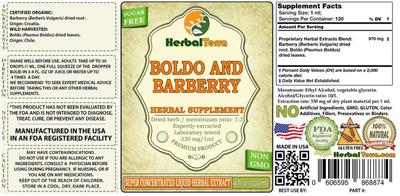
Certified organic: Barberry (Berberis vulgaris) dried root. Origin: Croatia. Wild harvested: Boldo (Peumus boldus) dried leaves. Origin: Chile.
Suggested/Recommended/Usage/Directions
Direction Shake well before use. Adults take up to 30 drops (1 mL, one full squeeze of the dropper bulb) in 3-4 fl. oz of juice or water up to 4 times a day. We recommend to seek expert medical advice before taking this or any other herbal supplements.
FDA Disclaimer Statement
Notice This product has not been evaluated by the FDA and is not intended to diagnose, treat, cure, or prevent any disease.
Formulation
Manufactured in the USA in an FDA registered facility
Sugar free
Dried herb/menstruum ratio: 1:3 Expertly extracted Laboratory tested 330 mg/1 mL Premium product Super concentrated liquid herbal extract
Non GMO
No artificial ingredients, GMO, gluten, color additives, fillers, preservatives or binders. Natural Gluten Free
Certified organic: Barberry (Berberis vulgaris) dried root. Origin: Croatia.
Precautions
Caution May have contraindications.
Do not use if you are allergic to any ingredients.
Consult a physician before using during pregnancy, if nursing, or if you are on any medications.
Keep out of the reach of children.
Storage
Store in a cool, dry, dark place.
FDA Statement of Identity
Herbal Supplement
Seals/Symbols
Made in USA FDA registered facility Natural Gluten Free 100% Natural guaranteed
Is this label outdated? Report a formula or label change and our pharmacy team will review it.
Boldo and Barberry by Herbal Terra label
The label scan from the NIH Dietary Supplement Label Database. Tap to enlarge.
Label images are published by the NIH Dietary Supplement Label Database for the version of this product on file. Always read your actual product label.
View the full label (PDF)The Ingredients in Boldo and Barberry by Herbal Terra
These are the 2 active ingredients this product is made of. Select any to open its full monograph.
Serving size1 mL Dosage formLiquid Servings per container120 Amounts shown are per serving.
Most supplement products combine several ingredients, and a medication can interact with the product through any one of them. Each ingredient below shows whether it has known drug interactions.
Proprietary Herbal Extracts Blend
Other (inactive) ingredients: Menstruum. These complete the product’s ingredient list but are not active constituents.
Boldo and Barberry by Herbal Terra Drug Interactions
HelloPharmacist Interaction Report
Boldo and Barberry by Herbal Terra contains boldo leaf extract, which interacts with a number of medications.
The biggest concern is hepatotoxic drugs — boldo leaf contains ascaridole, a known liver toxin, and taking it alongside drugs that can already stress your liver might increase the risk of liver injury. We've seen cases of elevated liver enzymes and jaundice in people using boldo on its own.
Read the full breakdown — every affected drug type, severity by severity
Boldo also carries Moderate-severity interactions with blood thinners (anticoagulants/antiplatelet drugs) like warfarin, increasing bleeding risk; lithium, where boldo's diuretic effect may raise lithium levels; and tacrolimus, an immunosuppressant used after transplant, where boldo may lower tacrolimus levels and raise the risk of rejection. One case report documented an increase in warfarin's effect when boldo was combined with another herb.
We couldn't check barberry — we hold no interaction data for it. Altogether, these interactions span 466 individual medications.
Use the medication checker on this page to run your exact prescriptions through before starting.
Check your own medications below · Editorial policy · How we use AI
Want to check YOUR meds against Boldo and Barberry?
Ask about interactions with your drugs in plain English — “Can I take it with lisinopril?” — and we find you the answer in seconds, ingredient by ingredient.
Go to the checkerIngredients driving the most interactions
Individual Drug Interactions
The ingredients in Boldo and Barberry interact with 1,378 drugs. Click any drug to see the details.
2 of the 2 ingredients in Boldo and Barberry interact with drugs. Each result below shows which ingredient is responsible. certified organic Barberry (Berberis vulgaris) dried root extract wild harvested Boldo (Peumus boldus) dried leaves extract
6-mercaptopurinePurinethol
How 6-mercaptopurine interacts with Boldo and Barberry — through 1 ingredient. Tap an ingredient for the detail:
Wild Harvested Boldo (peumus Boldus) Dried Leaves ExtractHepatotoxic Drugs Moderate
Interaction Summary
Theoretically, taking boldo with hepatotoxic drugs might increase the risk of hepatic injury and disease.
Read the full Wild Harvested Boldo (peumus Boldus) Dried Leaves Extract + 6-mercaptopurine interactionAdo-trastuzumab EmtansineKadcyla
How Ado-trastuzumab Emtansine interacts with Boldo and Barberry — through 1 ingredient. Tap an ingredient for the detail:
Certified Organic Barberry (berberis Vulgaris) Dried Root ExtractCytochrome P450 3a4 (cyp3a4) Substrates Moderate
Interaction Summary
Theoretically, European barberry might increase the levels and clinical effects of CYP3A4 substrates.
Read the full Certified Organic Barberry (berberis Vulgaris) Dried Root Extract + Ado-trastuzumab Emtansine interactionAbacavir Sulfate, Dolutegravir, LamivudineTriumeq
How Abacavir Sulfate, Dolutegravir, Lamivudine interacts with Boldo and Barberry — through 1 ingredient. Tap an ingredient for the detail:
Wild Harvested Boldo (peumus Boldus) Dried Leaves ExtractHepatotoxic Drugs Moderate
Interaction Summary
Theoretically, taking boldo with hepatotoxic drugs might increase the risk of hepatic injury and disease.
Read the full Wild Harvested Boldo (peumus Boldus) Dried Leaves Extract + Abacavir Sulfate, Dolutegravir, Lamivudine interactionAbacavir, LamivudineEpzicom
How Abacavir, Lamivudine interacts with Boldo and Barberry — through 1 ingredient. Tap an ingredient for the detail:
Wild Harvested Boldo (peumus Boldus) Dried Leaves ExtractHepatotoxic Drugs Moderate
Interaction Summary
Theoretically, taking boldo with hepatotoxic drugs might increase the risk of hepatic injury and disease.
Read the full Wild Harvested Boldo (peumus Boldus) Dried Leaves Extract + Abacavir, Lamivudine interactionAbciximabReoPro
How Abciximab interacts with Boldo and Barberry — through 2 ingredients. Tap an ingredient for the detail:
Wild Harvested Boldo (peumus Boldus) Dried Leaves ExtractAnticoagulant/antiplatelet Drugs Moderate
Interaction Summary
Theoretically, taking boldo with anticoagulant/antiplatelet drugs might increase the risk of bleeding.
Read the full Wild Harvested Boldo (peumus Boldus) Dried Leaves Extract + Abciximab interactionCertified Organic Barberry (berberis Vulgaris) Dried Root ExtractAnticoagulant/antiplatelet Drugs Moderate
Interaction Summary
Theoretically, European barberry may increase the risk of bleeding if used with anticoagulant or antiplatelet drugs.
Read the full Certified Organic Barberry (berberis Vulgaris) Dried Root Extract + Abciximab interactionAbemaciclibVerzenio
How Abemaciclib interacts with Boldo and Barberry — through 1 ingredient. Tap an ingredient for the detail:
Certified Organic Barberry (berberis Vulgaris) Dried Root ExtractCytochrome P450 3a4 (cyp3a4) Substrates Moderate
Interaction Summary
Theoretically, European barberry might increase the levels and clinical effects of CYP3A4 substrates.
Read the full Certified Organic Barberry (berberis Vulgaris) Dried Root Extract + Abemaciclib interactionAbiraterone
How Abiraterone interacts with Boldo and Barberry — through 2 ingredients. Tap an ingredient for the detail:
Certified Organic Barberry (berberis Vulgaris) Dried Root ExtractCytochrome P450 3a4 (cyp3a4) Substrates Moderate
Interaction Summary
Theoretically, European barberry might increase the levels and clinical effects of CYP3A4 substrates.
Read the full Certified Organic Barberry (berberis Vulgaris) Dried Root Extract + Abiraterone interactionWild Harvested Boldo (peumus Boldus) Dried Leaves ExtractHepatotoxic Drugs Moderate
Interaction Summary
Theoretically, taking boldo with hepatotoxic drugs might increase the risk of hepatic injury and disease.
Read the full Wild Harvested Boldo (peumus Boldus) Dried Leaves Extract + Abiraterone interactionAbiraterone AcetateYonsa, Zytiga
How Abiraterone Acetate interacts with Boldo and Barberry — through 2 ingredients. Tap an ingredient for the detail:
Wild Harvested Boldo (peumus Boldus) Dried Leaves ExtractHepatotoxic Drugs Moderate
Interaction Summary
Theoretically, taking boldo with hepatotoxic drugs might increase the risk of hepatic injury and disease.
Read the full Wild Harvested Boldo (peumus Boldus) Dried Leaves Extract + Abiraterone Acetate interactionCertified Organic Barberry (berberis Vulgaris) Dried Root ExtractCytochrome P450 3a4 (cyp3a4) Substrates Moderate
Interaction Summary
Theoretically, European barberry might increase the levels and clinical effects of CYP3A4 substrates.
Read the full Certified Organic Barberry (berberis Vulgaris) Dried Root Extract + Abiraterone Acetate interactionAbrocitinibCibinqo
How Abrocitinib interacts with Boldo and Barberry — through 2 ingredients. Tap an ingredient for the detail:
Wild Harvested Boldo (peumus Boldus) Dried Leaves ExtractAnticoagulant/antiplatelet Drugs Moderate
Interaction Summary
Theoretically, taking boldo with anticoagulant/antiplatelet drugs might increase the risk of bleeding.
Read the full Wild Harvested Boldo (peumus Boldus) Dried Leaves Extract + Abrocitinib interactionCertified Organic Barberry (berberis Vulgaris) Dried Root ExtractAnticoagulant/antiplatelet Drugs Moderate
Interaction Summary
Theoretically, European barberry may increase the risk of bleeding if used with anticoagulant or antiplatelet drugs.
Read the full Certified Organic Barberry (berberis Vulgaris) Dried Root Extract + Abrocitinib interactionAcalabrutinibCalquence
How Acalabrutinib interacts with Boldo and Barberry — through 1 ingredient. Tap an ingredient for the detail:
Certified Organic Barberry (berberis Vulgaris) Dried Root ExtractCytochrome P450 3a4 (cyp3a4) Substrates Moderate
Interaction Summary
Theoretically, European barberry might increase the levels and clinical effects of CYP3A4 substrates.
Read the full Certified Organic Barberry (berberis Vulgaris) Dried Root Extract + Acalabrutinib interactionAcarboseGlucobay, Prandase, Precose
How Acarbose interacts with Boldo and Barberry — through 2 ingredients. Tap an ingredient for the detail:
Certified Organic Barberry (berberis Vulgaris) Dried Root ExtractAntidiabetes Drugs Moderate
Interaction Summary
Theoretically, taking European barberry with antidiabetes drugs might increase the risk of hypoglycemia.
Read the full Certified Organic Barberry (berberis Vulgaris) Dried Root Extract + Acarbose interactionWild Harvested Boldo (peumus Boldus) Dried Leaves ExtractHepatotoxic Drugs Moderate
Interaction Summary
Theoretically, taking boldo with hepatotoxic drugs might increase the risk of hepatic injury and disease.
Read the full Wild Harvested Boldo (peumus Boldus) Dried Leaves Extract + Acarbose interactionAcebutololRhotral, Sectral
How Acebutolol interacts with Boldo and Barberry — through 2 ingredients. Tap an ingredient for the detail:
Wild Harvested Boldo (peumus Boldus) Dried Leaves ExtractHepatotoxic Drugs Moderate
Interaction Summary
Theoretically, taking boldo with hepatotoxic drugs might increase the risk of hepatic injury and disease.
Read the full Wild Harvested Boldo (peumus Boldus) Dried Leaves Extract + Acebutolol interactionCertified Organic Barberry (berberis Vulgaris) Dried Root ExtractAntihypertensive Drugs Moderate
Interaction Summary
Theoretically, taking European barberry with antihypertensive drugs might increase the risk of hypotension.
Read the full Certified Organic Barberry (berberis Vulgaris) Dried Root Extract + Acebutolol interactionAcenocoumarolSintrom
How Acenocoumarol interacts with Boldo and Barberry — through 2 ingredients. Tap an ingredient for the detail:
Certified Organic Barberry (berberis Vulgaris) Dried Root ExtractAnticoagulant/antiplatelet Drugs Moderate
Interaction Summary
Theoretically, European barberry may increase the risk of bleeding if used with anticoagulant or antiplatelet drugs.
Read the full Certified Organic Barberry (berberis Vulgaris) Dried Root Extract + Acenocoumarol interactionWild Harvested Boldo (peumus Boldus) Dried Leaves ExtractAnticoagulant/antiplatelet Drugs Moderate
Interaction Summary
Theoretically, taking boldo with anticoagulant/antiplatelet drugs might increase the risk of bleeding.
Read the full Wild Harvested Boldo (peumus Boldus) Dried Leaves Extract + Acenocoumarol interactionAcepromazineAtravet
How Acepromazine interacts with Boldo and Barberry — through 1 ingredient. Tap an ingredient for the detail:
Certified Organic Barberry (berberis Vulgaris) Dried Root ExtractCns Depressants, Anticholinergic Drugs Moderate
Interaction Summary
Theoretically, concomitant use with drugs that have sedative properties may cause additive effects.
Read the full Certified Organic Barberry (berberis Vulgaris) Dried Root Extract + Acepromazine interactionAcetaminophenChildren's Tylenol, Children's Tylenol Meltaways, Tylenol, Tylenol Ex Strength
How Acetaminophen interacts with Boldo and Barberry — through 1 ingredient. Tap an ingredient for the detail:
Wild Harvested Boldo (peumus Boldus) Dried Leaves ExtractHepatotoxic Drugs Moderate
Interaction Summary
Theoretically, taking boldo with hepatotoxic drugs might increase the risk of hepatic injury and disease.
Read the full Wild Harvested Boldo (peumus Boldus) Dried Leaves Extract + Acetaminophen interactionAcetaminophen, AspirinGemnisyn
How Acetaminophen, Aspirin interacts with Boldo and Barberry — through 2 ingredients. Tap an ingredient for the detail:
Certified Organic Barberry (berberis Vulgaris) Dried Root ExtractAnticoagulant/antiplatelet Drugs Moderate
Interaction Summary
Theoretically, European barberry may increase the risk of bleeding if used with anticoagulant or antiplatelet drugs.
Read the full Certified Organic Barberry (berberis Vulgaris) Dried Root Extract + Acetaminophen, Aspirin interactionWild Harvested Boldo (peumus Boldus) Dried Leaves ExtractHepatotoxic Drugs, Anticoagulant/antiplatelet Drugs Moderate
Interaction Summary
Theoretically, taking boldo with hepatotoxic drugs might increase the risk of hepatic injury and disease.
Read the full Wild Harvested Boldo (peumus Boldus) Dried Leaves Extract + Acetaminophen, Aspirin interactionAcetaminophen, Aspirin, CaffeineExcedrin, Excedrin Extra Strength, Excedrin Migraine
How Acetaminophen, Aspirin, Caffeine interacts with Boldo and Barberry — through 2 ingredients. Tap an ingredient for the detail:
Wild Harvested Boldo (peumus Boldus) Dried Leaves ExtractAnticoagulant/antiplatelet Drugs, Hepatotoxic Drugs Moderate
Interaction Summary
Theoretically, taking boldo with anticoagulant/antiplatelet drugs might increase the risk of bleeding.
Read the full Wild Harvested Boldo (peumus Boldus) Dried Leaves Extract + Acetaminophen, Aspirin, Caffeine interactionCertified Organic Barberry (berberis Vulgaris) Dried Root ExtractAnticoagulant/antiplatelet Drugs, Cytochrome P450 3a4 (cyp3a4) Substrates Moderate
Interaction Summary
Theoretically, European barberry may increase the risk of bleeding if used with anticoagulant or antiplatelet drugs.
Read the full Certified Organic Barberry (berberis Vulgaris) Dried Root Extract + Acetaminophen, Aspirin, Caffeine interactionAcetaminophen, Brompheniramine, PhenylpropanolamineDimetapp Cold and Flu
How Acetaminophen, Brompheniramine, Phenylpropanolamine interacts with Boldo and Barberry — through 1 ingredient. Tap an ingredient for the detail:
Wild Harvested Boldo (peumus Boldus) Dried Leaves ExtractHepatotoxic Drugs Moderate
Interaction Summary
Theoretically, taking boldo with hepatotoxic drugs might increase the risk of hepatic injury and disease.
Read the full Wild Harvested Boldo (peumus Boldus) Dried Leaves Extract + Acetaminophen, Brompheniramine, Phenylpropanolamine interactionAcetaminophen, ButalbitalAxocet, Bancap, Bucet, Butex Forte, Esgic CF, Orbivan CF +5 more
How Acetaminophen, Butalbital interacts with Boldo and Barberry — through 1 ingredient. Tap an ingredient for the detail:
Wild Harvested Boldo (peumus Boldus) Dried Leaves ExtractHepatotoxic Drugs Moderate
Interaction Summary
Theoretically, taking boldo with hepatotoxic drugs might increase the risk of hepatic injury and disease.
Read the full Wild Harvested Boldo (peumus Boldus) Dried Leaves Extract + Acetaminophen, Butalbital interactionAcetaminophen, Butalbital, CaffeineEsgic, Esgic Plus, Fiogesic, Fioricet, Repan, Tecnal +1 more
How Acetaminophen, Butalbital, Caffeine interacts with Boldo and Barberry — through 2 ingredients. Tap an ingredient for the detail:
Wild Harvested Boldo (peumus Boldus) Dried Leaves ExtractHepatotoxic Drugs Moderate
Interaction Summary
Theoretically, taking boldo with hepatotoxic drugs might increase the risk of hepatic injury and disease.
Read the full Wild Harvested Boldo (peumus Boldus) Dried Leaves Extract + Acetaminophen, Butalbital, Caffeine interactionCertified Organic Barberry (berberis Vulgaris) Dried Root ExtractCytochrome P450 3a4 (cyp3a4) Substrates Moderate
Interaction Summary
Theoretically, European barberry might increase the levels and clinical effects of CYP3A4 substrates.
Read the full Certified Organic Barberry (berberis Vulgaris) Dried Root Extract + Acetaminophen, Butalbital, Caffeine interactionAcetaminophen, Butalbital, Caffeine, CodeineEsgic with Codeine, Fioricet w/ Codeine
How Acetaminophen, Butalbital, Caffeine, Codeine interacts with Boldo and Barberry — through 2 ingredients. Tap an ingredient for the detail:
Certified Organic Barberry (berberis Vulgaris) Dried Root ExtractCytochrome P450 3a4 (cyp3a4) Substrates, Cns Depressants Moderate
Interaction Summary
Theoretically, European barberry might increase the levels and clinical effects of CYP3A4 substrates.
Read the full Certified Organic Barberry (berberis Vulgaris) Dried Root Extract + Acetaminophen, Butalbital, Caffeine, Codeine interactionWild Harvested Boldo (peumus Boldus) Dried Leaves ExtractHepatotoxic Drugs Moderate
Interaction Summary
Theoretically, taking boldo with hepatotoxic drugs might increase the risk of hepatic injury and disease.
Read the full Wild Harvested Boldo (peumus Boldus) Dried Leaves Extract + Acetaminophen, Butalbital, Caffeine, Codeine interactionAcetaminophen, Butalbital, CodeineBancap w/ Codeine
How Acetaminophen, Butalbital, Codeine interacts with Boldo and Barberry — through 2 ingredients. Tap an ingredient for the detail:
Certified Organic Barberry (berberis Vulgaris) Dried Root ExtractCns Depressants Moderate
Interaction Summary
Theoretically, concomitant use with drugs that have sedative properties may cause additive effects.
Read the full Certified Organic Barberry (berberis Vulgaris) Dried Root Extract + Acetaminophen, Butalbital, Codeine interactionWild Harvested Boldo (peumus Boldus) Dried Leaves ExtractHepatotoxic Drugs Moderate
Interaction Summary
Theoretically, taking boldo with hepatotoxic drugs might increase the risk of hepatic injury and disease.
Read the full Wild Harvested Boldo (peumus Boldus) Dried Leaves Extract + Acetaminophen, Butalbital, Codeine interactionAcetaminophen, Butalbital, Codeine PhosphatePhrenilin #3
How Acetaminophen, Butalbital, Codeine Phosphate interacts with Boldo and Barberry — through 2 ingredients. Tap an ingredient for the detail:
Certified Organic Barberry (berberis Vulgaris) Dried Root ExtractCns Depressants Moderate
Interaction Summary
Theoretically, concomitant use with drugs that have sedative properties may cause additive effects.
Read the full Certified Organic Barberry (berberis Vulgaris) Dried Root Extract + Acetaminophen, Butalbital, Codeine Phosphate interactionWild Harvested Boldo (peumus Boldus) Dried Leaves ExtractHepatotoxic Drugs Moderate
Interaction Summary
Theoretically, taking boldo with hepatotoxic drugs might increase the risk of hepatic injury and disease.
Read the full Wild Harvested Boldo (peumus Boldus) Dried Leaves Extract + Acetaminophen, Butalbital, Codeine Phosphate interactionAcetaminophen, Caffeine, Chlorpheniramine, Hydrocodone, PhenylephrineHycomine Compound
How Acetaminophen, Caffeine, Chlorpheniramine, Hydrocodone, Phenylephrine interacts with Boldo and Barberry — through 2 ingredients. Tap an ingredient for the detail:
Wild Harvested Boldo (peumus Boldus) Dried Leaves ExtractHepatotoxic Drugs Moderate
Interaction Summary
Theoretically, taking boldo with hepatotoxic drugs might increase the risk of hepatic injury and disease.
Read the full Wild Harvested Boldo (peumus Boldus) Dried Leaves Extract + Acetaminophen, Caffeine, Chlorpheniramine, Hydrocodone, Phenylephrine interactionCertified Organic Barberry (berberis Vulgaris) Dried Root ExtractCytochrome P450 3a4 (cyp3a4) Substrates, Anticholinergic Drugs +1 Moderate
Interaction Summary
Theoretically, European barberry might increase the levels and clinical effects of CYP3A4 substrates.
Read the full Certified Organic Barberry (berberis Vulgaris) Dried Root Extract + Acetaminophen, Caffeine, Chlorpheniramine, Hydrocodone, Phenylephrine interactionAcetaminophen, Caffeine, CodeineGesic C15, Gesic C30, Gesic C8, Lenoltec 1, Lenoltec 2, Lenoltec 3 +1 more
How Acetaminophen, Caffeine, Codeine interacts with Boldo and Barberry — through 2 ingredients. Tap an ingredient for the detail:
Certified Organic Barberry (berberis Vulgaris) Dried Root ExtractCns Depressants, Cytochrome P450 3a4 (cyp3a4) Substrates Moderate
Interaction Summary
Theoretically, concomitant use with drugs that have sedative properties may cause additive effects.
Read the full Certified Organic Barberry (berberis Vulgaris) Dried Root Extract + Acetaminophen, Caffeine, Codeine interactionWild Harvested Boldo (peumus Boldus) Dried Leaves ExtractHepatotoxic Drugs Moderate
Interaction Summary
Theoretically, taking boldo with hepatotoxic drugs might increase the risk of hepatic injury and disease.
Read the full Wild Harvested Boldo (peumus Boldus) Dried Leaves Extract + Acetaminophen, Caffeine, Codeine interactionAcetaminophen, Caffeine, Codeine, SalicylamideCodalan No.1, Codalan No.2, Codalan No.3
How Acetaminophen, Caffeine, Codeine, Salicylamide interacts with Boldo and Barberry — through 2 ingredients. Tap an ingredient for the detail:
Certified Organic Barberry (berberis Vulgaris) Dried Root ExtractCytochrome P450 3a4 (cyp3a4) Substrates, Cns Depressants Moderate
Interaction Summary
Theoretically, European barberry might increase the levels and clinical effects of CYP3A4 substrates.
Read the full Certified Organic Barberry (berberis Vulgaris) Dried Root Extract + Acetaminophen, Caffeine, Codeine, Salicylamide interactionWild Harvested Boldo (peumus Boldus) Dried Leaves ExtractHepatotoxic Drugs Moderate
Interaction Summary
Theoretically, taking boldo with hepatotoxic drugs might increase the risk of hepatic injury and disease.
Read the full Wild Harvested Boldo (peumus Boldus) Dried Leaves Extract + Acetaminophen, Caffeine, Codeine, Salicylamide interactionAcetaminophen, Caffeine, DihydrocodeineDHC Plus, Panlor DC, Panlor SS
How Acetaminophen, Caffeine, Dihydrocodeine interacts with Boldo and Barberry — through 2 ingredients. Tap an ingredient for the detail:
Certified Organic Barberry (berberis Vulgaris) Dried Root ExtractCns Depressants, Cytochrome P450 3a4 (cyp3a4) Substrates Moderate
Interaction Summary
Theoretically, concomitant use with drugs that have sedative properties may cause additive effects.
Read the full Certified Organic Barberry (berberis Vulgaris) Dried Root Extract + Acetaminophen, Caffeine, Dihydrocodeine interactionWild Harvested Boldo (peumus Boldus) Dried Leaves ExtractHepatotoxic Drugs Moderate
Interaction Summary
Theoretically, taking boldo with hepatotoxic drugs might increase the risk of hepatic injury and disease.
Read the full Wild Harvested Boldo (peumus Boldus) Dried Leaves Extract + Acetaminophen, Caffeine, Dihydrocodeine interactionAcetaminophen, Caffeine, IsomethepteneMigralam
How Acetaminophen, Caffeine, Isometheptene interacts with Boldo and Barberry — through 2 ingredients. Tap an ingredient for the detail:
Wild Harvested Boldo (peumus Boldus) Dried Leaves ExtractHepatotoxic Drugs Moderate
Interaction Summary
Theoretically, taking boldo with hepatotoxic drugs might increase the risk of hepatic injury and disease.
Read the full Wild Harvested Boldo (peumus Boldus) Dried Leaves Extract + Acetaminophen, Caffeine, Isometheptene interactionCertified Organic Barberry (berberis Vulgaris) Dried Root ExtractCytochrome P450 3a4 (cyp3a4) Substrates Moderate
Interaction Summary
Theoretically, European barberry might increase the levels and clinical effects of CYP3A4 substrates.
Read the full Certified Organic Barberry (berberis Vulgaris) Dried Root Extract + Acetaminophen, Caffeine, Isometheptene interactionAcetaminophen, Caffeine, PyrilamineMidol Max Strength Menstrual
How Acetaminophen, Caffeine, Pyrilamine interacts with Boldo and Barberry — through 2 ingredients. Tap an ingredient for the detail:
Certified Organic Barberry (berberis Vulgaris) Dried Root ExtractCytochrome P450 3a4 (cyp3a4) Substrates, Anticholinergic Drugs Moderate
Interaction Summary
Theoretically, European barberry might increase the levels and clinical effects of CYP3A4 substrates.
Read the full Certified Organic Barberry (berberis Vulgaris) Dried Root Extract + Acetaminophen, Caffeine, Pyrilamine interactionWild Harvested Boldo (peumus Boldus) Dried Leaves ExtractHepatotoxic Drugs Moderate
Interaction Summary
Theoretically, taking boldo with hepatotoxic drugs might increase the risk of hepatic injury and disease.
Read the full Wild Harvested Boldo (peumus Boldus) Dried Leaves Extract + Acetaminophen, Caffeine, Pyrilamine interactionAcetaminophen, Chlorpheniramine Maleate, Dextromethorphan HbrVicks Formula 44M Cough, Cold & Flu Relief
How Acetaminophen, Chlorpheniramine Maleate, Dextromethorphan Hbr interacts with Boldo and Barberry — through 2 ingredients. Tap an ingredient for the detail:
Certified Organic Barberry (berberis Vulgaris) Dried Root ExtractCytochrome P450 3a4 (cyp3a4) Substrates, Anticholinergic Drugs Moderate
Interaction Summary
Theoretically, European barberry might increase the levels and clinical effects of CYP3A4 substrates.
Read the full Certified Organic Barberry (berberis Vulgaris) Dried Root Extract + Acetaminophen, Chlorpheniramine Maleate, Dextromethorphan Hbr interactionWild Harvested Boldo (peumus Boldus) Dried Leaves ExtractHepatotoxic Drugs Moderate
Interaction Summary
Theoretically, taking boldo with hepatotoxic drugs might increase the risk of hepatic injury and disease.
Read the full Wild Harvested Boldo (peumus Boldus) Dried Leaves Extract + Acetaminophen, Chlorpheniramine Maleate, Dextromethorphan Hbr interactionEach ingredient & the kinds of drugs it affects
For each ingredient in Boldo and Barberry with known interactions, here are the types of medications they can affect. Open any type for the detail — or search your exact drug in the checker above.
certified organic Barberry (Berberis vulgaris) dried root extract
Anticholinergic Drugs
Theoretically, taking European barberry with anticholinergic drugs might cause additive effects.
In vitro evidence suggests that European barberry might have anticholinergic properties.
Anticoagulant/Antiplatelet Drugs
Theoretically, European barberry may increase the risk of bleeding if used with anticoagulant or antiplatelet drugs.
In vitro and animal evidence suggest that berberine, a constituent of European barberry, might inhibit platelet aggregation. Theoretically, European barberry might have a similar effect.
Antidiabetes Drugs
Theoretically, taking European barberry with antidiabetes drugs might increase the risk of hypoglycemia.
Preliminary clinical evidence suggests that European barberry juice reduces fasting glucose levels in patients with type 2 diabetes who are also taking antidiabetes drugs. Additionally, some animal studies show that berberine, a constituent of European barberry, has antiglycemic potential. Monitor blood glucose levels closely.
Antihypertensive Drugs
Theoretically, taking European barberry with antihypertensive drugs might increase the risk of hypotension.
Animal and human research suggests that European barberry extracts can have hypotensive effects.
Cholinergic Drugs
Theoretically, taking European barberry with cholinergic drugs might decrease the effects of cholinergic drugs.
In vitro evidence suggests that European barberry might have anticholinergic properties.
Cns Depressants
Theoretically, concomitant use with drugs that have sedative properties may cause additive effects.
Animal research suggests that berberine, a constituent of European barberry, might have sedative effects. Theoretically, European barberry might have a similar effect.
Cyclosporine (Neoral, Sandimmune)
Theoretically, concomitant use with cyclosporine may cause additive effects.
Berberine, a constituent of European barberry, can reduce the metabolism and increase serum levels of cyclosporine. This effect is attributed to the ability of berberine to inhibit cytochrome P450 3A4 (CYP3A4), which metabolizes cyclosporine. Theoretically, European barberry might have a similar effect.
Cytochrome P450 3A4 (Cyp3A4) Substrates
Theoretically, European barberry might increase the levels and clinical effects of CYP3A4 substrates.
There is very preliminary evidence suggesting that berberine, a constituent of European barberry, might inhibit the CYP3A4 enzyme. Theoretically, European barberry might have a similar effect.
wild harvested Boldo (Peumus boldus) dried leaves extract
Anticoagulant/Antiplatelet Drugs
Theoretically, taking boldo with anticoagulant/antiplatelet drugs might increase the risk of bleeding.
Animal and in vitro research shows that boldine, a constituent of boldo, has antiplatelet activity. In one case report, an adult taking a combination of boldo and fenugreek with warfarin experienced an increase in international normalized ratio (INR); however, it is unclear if this effect was due to boldo, fenugreek, the combination, or another factor.
Hepatotoxic Drugs
Theoretically, taking boldo with hepatotoxic drugs might increase the risk of hepatic injury and disease.
Boldo leaf contains ascaridole, a known liver toxin. Many cases of hepatotoxicity, including elevated liver transaminase levels and jaundice, have been reported in patients taking boldo.
Lithium
Theoretically, taking boldo with lithium might increase the levels and clinical effects of lithium.
Boldo is believed to have diuretic effects. Theoretically, these diuretic effects might reduce the excretion of lithium. The dose of lithium might need to be decreased.
Tacrolimus (Prograf)
Taking boldo with tacrolimus may decrease the levels and clinical effects of tacrolimus, potentially increasing the risk of transplant rejection.
In one case report, a patient with a long-term history of stable tacrolimus levels developed subtherapeutic levels after taking boldo 300 mg twice daily orally for several weeks. Tacrolimus levels returned to normal after discontinuing boldo. However, the mechanism of this interaction is unclear.
Warfarin (Coumadin)
A combination of boldo and fenugreek was thought to be associated with an increased international normalized ratio (INR) in a female on warfarin. It is not clear if boldo, fenugreek, or the combination played a role in this interaction. Therefore, boldo may have additive effects with warfarin.
Brand information
Manufacturer and brand details for Boldo and Barberry, from the product label.
Boldo and Barberry by Herbal Terra: Common Questions
Does Boldo and Barberry by Herbal Terra interact with any medications?
How can one product interact with so many drugs?
Where does this information come from?
Can I take this while pregnant or breastfeeding?
What are the side effects?
Does boldo actually work for gallbladder or liver problems?
Is this safe for long-term use?
What's barberry in this product for?
Written and reviewed by the HelloPharmacist editorial staff. Our editorial policy
Not sure if Boldo and Barberry is safe with your meds?
Our pharmacists answer your medication & supplement questions — free.
Label information is sourced from the NIH Dietary Supplement Label Database and reflects the product version on file; always read your actual product label. This page is for education only and is not a substitute for professional medical advice. Confirm with your pharmacist or doctor before combining supplements and medications.
The Full Monographs Behind Boldo and Barberry’s Ingredients
Every ingredient we hold a full HelloPharmacist monograph for — uses, evidence, safety, and the complete interaction list.
European Barberry
Interacts with 1,212 drugsEuropean barberry is a shrub whose root, bark, and berries contain berberine, a bitter plant alkaloid that has been studied mostly in isolated form. Some early research on berberine is promi...
Read the full European Barberry monograph → Herb & supplement monographBoldo
Interacts with 484 drugsBoldo is a South American shrub whose leaves are traditionally used for digestive and gallbladder complaints, but good human evidence is very limited. The leaves and oil contain ascaridole,...
Read the full Boldo monograph →Sources & How We Checked
Boldo and Barberry's label data comes from the NIH Dietary Supplement Label Database; the ingredient interaction data is from the Natural Medicines database, reviewed by our pharmacists.
- NIH Dietary Supplement Label Database (DSLD) — The official product label on file for this supplement.
- Natural Medicines (Therapeutic Research Center) — Evidence-graded clinical reference behind the ingredient interaction data.
Content is written and reviewed by licensed HelloPharmacist pharmacists. See our data sources and editorial standards for how this information is built and checked.
The 25 references behind this product’s interaction data
Every citation that drives the interaction findings for this product’s ingredients, from the evidence-graded Natural Medicines (TRC Healthcare) database. Open an ingredient to browse its citations — links open the study on PubMed or the publisher’s site.
European Barberry 15 references
- Chan E. Displacement of bilirubin from albumin by berberine. Biol Neonate 1993;63:201-8. PubMed
- Wu X, Li Q, Xin H, Yu A, Zhong M. Effects of berberine on the blood concentration of cyclosporin A in renal transplanted recipients: clinical and pharmacokinetic study. Eur J Clin Pharmacol 2005;61:567-72. PubMed
- Shamsa F, Ahmadiani A, Khosrokhavar R. Antihistaminic and anticholinergic activity of barberry fruit (Berberis vulgaris) in the guinea-pig ileum. J Ethnopharmacol 1999;64:161-6. PubMed
- Fatehi M, Saleh TM, Fatehi-Hassanabad Z, et al. A pharmacological study on Berberis vulgaris fruit extract. J Ethnopharmacol 2005;102:46-52. PubMed
- Kostalova, D., Bukovsky, M., Koscova, H., and Kardosova, A. [Anticomplement activity of Mahonia aquifolium bisbenzylisoquinoline alkaloids and berberine extract]. Ceska.Slov.Farm 2001;50(6):286-289.
- Fatehi-Hassanabad, Z., Jafarzadeh, M., Tarhini, A., and Fatehi, M. The antihypertensive and vasodilator effects of aqueous extract from Berberis vulgaris fruit on hypertensive rats. Phytother Res 2005;19(3):222-225.
- Singh, J. and Kakkar, P. Antihyperglycemic and antioxidant effect of Berberis aristata root extract and its role in regulating carbohydrate metabolism in diabetic rats. J Ethnopharmacol. 5-4-2009;123(1):22-26. PubMed
- Shanbhag, S. M., Kulkarni, H. J., and Gaitonde, B. B. Pharmacological actions of berberine on the central nervous system. Jpn.J Pharmacol 1970;20(4):482-487. PubMed
- Wu, J. F. and Liu, T. P. [Effects of berberine on platelet aggregation and plasma levels of TXB2 and 6-keto-PGF1 alpha in rats with reversible middle cerebral artery occlusion]. Yao Xue.Xue.Bao. 1995;30(2):98-102.
- Xuan, B., Wang, W., and Li, D. X. Inhibitory effect of tetrahydroberberine on platelet aggregation and thrombosis. Zhongguo Yao Li Xue.Bao. 1994;15(2):133-135.
- Gao, C. R., Zhang, J. Q., and Huang, Q. L. [Experimental study on berberin raised insulin sensitivity in insulin resistance rat models]. Zhongguo Zhong.Xi.Yi.Jie.He.Za Zhi. 1997;17(3):162-164. DOI
- Sabir M and Bhide NK. Study of some pharmacological actions of berberine. Ind J Physiol & Pharmac 1971;15(3):111-132.
- Tripathi YB and Shukla SD. Berberis artistata inhibits PAF induced aggregation of rabbit platelets. Phytotherapy Research 1996;10:628-630.
- Lazavi F, Mirmiran P, Sohrab G, Nikpayam O, Angoorani P, Hedayati M. The barberry juice effects on metabolic factors and oxidative stress in patients with type 2 diabetes: A randomized clinical trial. Complement Ther Clin Pract. 2018;31:170-174. PubMed
- Philips CA, Theruvath AH, Ravindran R. Toxic hepatitis-associated aplastic anaemia after dual homeopathic remedies and Gymnema sylvestre use. BMJ Case Rep 2022;15(3):e247867. PubMed
Boldo 10 references
- Newall CA, Anderson LA, Philpson JD. Herbal Medicine: A Guide for Healthcare Professionals. London, UK: The Pharmaceutical Press, 1996.
- Lambert J, Cormier J. Potential interaction between warfarin and boldo-fenugreek. Pharmacotherapy 2001;21:509-12. PubMed
- Piscaglia F, Leoni S, Venturi A, et al. Caution in the use of boldo in herbal laxatives: a case of hepatotoxicity. Scand J Gastroenterol 2005;40:236-9. PubMed
- Agarwal SC, Crook JR, Pepper CB. Herbal remedies -- how safe are they? A case report of polymorphic ventricular tachycardia/ventricular fibrillation induced by herbal medication used for obesity. Int J Cardiol 2006;106:260-1. PubMed
- Teng, C. M., Hsueh, C. M., Chang, Y. L., Ko, F. N., Lee, S. S., and Liu, K. C. Antiplatelet effects of some aporphine and phenanthrene alkaloids in rabbits and man. J Pharm Pharmacol 1997;49(7):706-711. PubMed
- Carbajal R, Yisfalem A, Pradhan N, et al. Case report: Boldo (Peumus boldus) and tacrolimus interaction in a renal transplant patient. Transplant Proc 2014;46(7):2400-2. PubMed
- Almeida ER, Melo AM, Xavier H. Toxicological evaluation of the hydro-alcohol extract of the dry leaves of Peumus boldus and boldine in rats. Phytother Res 2000;14(2):99-102. DOI
- Ribeiro RJ, Silvestre C, Duarte C. Hidden risks of alternative medicines: a case of boldo-induced hepatotoxicity. J Diet Suppl 2017;14(2):186-90. PubMed
- Oliveira Sá A, Pimentel T, Oliveira N. Boldo-Induced Hepatotoxicity: A Case of Unexplained Jaundice. Eur J Case Rep Intern Med 2020;7(12):002116. PubMed
- Valdes R, Feuereisen A, Bellinghausen M. Allergic Contact Dermatitis to Boldo. Dermatitis 2021;32(2):e31-e32. PubMed
Parts of this content are provided by the Therapeutic Research Center, LLC.
DISCLAIMER: Currently this does not check for drug-drug interactions. This is not an all-inclusive comprehensive list of potential interactions and is for informational purposes only. Not all interactions are known or well-reported in the scientific literature, and new interactions are continually being reported. Input is needed from a qualified healthcare provider including a pharmacist before starting any therapy. Application of clinical judgment is necessary.
© 2021 Therapeutic Research Center, LLC