
Chamomile 2,000 mg Ingredients & Drug Interactions
What is this page for?
First and foremost: checking Chamomile 2,000 mg against your medications. The heart of this page is the interaction checker and the full interaction report — how this product’s ingredients may interact with prescription and over-the-counter medicines you may be taking.
Around that, we add a pharmacist’s high-level view of the product as a whole — what’s inside, the evidence for its stated use, how transparent the label is, and what safety data exists — so you can see the full picture in one place. It’s educational information from our licensed clinical databases and the clinical staff at HelloPharmacist — not medical advice — and we don’t sell or endorse products. Our editorial policy
Chamomile 2,000 mg is a dietary supplement by Nature's Answer with 1 active ingredient. Its ingredients are commonly taken for anxiety and stress, sleep and relaxation, digestive upset.Based on those ingredients, 960 medications have a known interaction with it, the most serious rated moderate. The ingredients most likely to interact are Chamomile (Matricaria recutita) flower extract. Use the checker below to test your specific medication, or read the full HelloPharmacist Interaction Report.
Check Your Meds Against Chamomile 2,000 mg by Nature's Answer
Ask about any prescription or over-the-counter medication and we check it for interactions with Chamomile 2,000 mg by Nature's Answer — and tell you which ingredient is responsible.
AI summaries are generated from our interaction database for education only — always confirm with your pharmacist. How we use AI
Ask the Pharmacist
A licensed pharmacist will answer your question by email — free, usually within 24 hours.
Got it — thank you!
A licensed pharmacist will answer within 24 hours. Keep an eye on your email (worth checking spam, just in case).
HelloPharmacist Scorecard of Chamomile 2,000 mg by Nature's Answer
Our pharmacy team’s full take, with four database checks built into the cards below — a summary of what is known, not a grade of the product itself.
What’s inside
Full disclosure
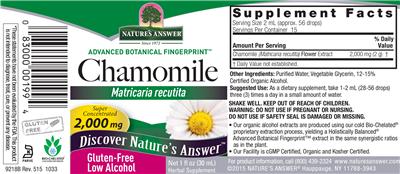
This product contains one active ingredient: German chamomile flower extract at 2,000 mg. The liquid also includes purified water, vegetable glycerin, and 12–15% certified organic alcohol as inactive ingredients to deliver and preserve the extract.
Does it work?
Couldn't assess
The evidence we hold doesn't establish how well chamomile works for the uses people commonly try it for—including anxiety, hay fever, ADHD, and poor appetite related to cancer. The data shows insufficient reliable evidence to rate its effectiveness for these conditions, so we can't tell you whether it's likely to help.
How safe is it?
Well-documented data
German chamomile is generally well tolerated by most adults. However, it can trigger allergic reactions—including severe reactions and anaphylaxis in some people—especially in those sensitive to ragweed and related plants.
When used topically, it may cause allergic skin reactions or eczema; as an oral rinse, it has caused nausea and mouth burning in some cases. The safety data during pregnancy is not strong enough to recommend it, so it's best avoided in pregnancy unless your doctor approves.
For breastfeeding, the data is limited; check with your doctor or pharmacist before using it if you're nursing.
Meds to double-check
Moderate interaction found
Check with your doctor or pharmacist before taking this product if you use warfarin or other blood thinners, CNS depressants like sedatives or sleep aids, oral contraceptives or hormone therapy, drugs processed through CYP2D6, CYP2C9, or CYP3A4 enzymes, or tamoxifen. Chamomile has documented or theoretical interactions with all of these.
The bottom line
Scorecard at a glanceFully disclosed formula with no assessable stated purpose. Moderate medication interactions have been identified, and safety information is well characterized.
This chamomile extract might appeal to you if you're interested in herbal relaxation support, but there's no proven effectiveness data for common uses in our database. The bigger issue is medication interactions—it can affect blood thinners, sedatives, birth control, and several other drug classes.
Talk it over with your own doctor or pharmacist before starting, especially if you take any prescription medications.
Educational only — not medical advice; always confirm with your pharmacist. Our editorial policy · How we use AI
Assessment coverage: 1 of 1 active ingredient matched to our full ingredient reviews (monographs). Based on the product label dated May 22, 2016.
This Scorecard evaluates available label information, ingredient evidence, and known medication-safety considerations. It does not independently verify product identity, purity, potency, contamination, or manufacturing quality. How these ratings are computed
General information
Key facts about Chamomile 2,000 mg, straight from the product label.
| Brand | Nature's Answer |
|---|---|
| Barcode (UPC) | 083000001994 |
| Net contents | 1 fl. Oz.; 30 mL |
| Market status | On market |
| Date entered into DSLD | May 22, 2016 |
| DSLD ID | 60061 |
| Product type | Botanical |
| Supplement form | Liquid |
| Dietary claims / uses | All Other, Structure/Function |
| Intended target group(s) | Adult (18 - 50 Years), Kosher, Gluten Free |
Everything in this section is reproduced from the manufacturer’s own product label — it’s the label speaking, not HelloPharmacist. We show it so you can see exactly what the maker states; we don’t verify or endorse those statements.
Supplement Facts
The label details for Chamomile 2,000 mg by Nature's Answer, sourced from the NIH Dietary Supplement Label Database.
Supplement Facts
| Ingredient | Amount | % DV |
|---|---|---|
| Chamomile (Matricaria recutita) flower extract | 2000 mg | -- |
Other ingredients: purified Water, Vegetable Glycerin, 12-15% certified organic Alcohol
Tap any ingredient to jump to its full detail below.
These statements are the manufacturer’s wording, reproduced from the product label — the label is saying it, not HelloPharmacist. We don’t verify or endorse them.
FDA Disclaimer Statement
These statements have not been evaluated by the FDA. This product is not intended to diagnose, treat, cure, or prevent any disease.
Seals/Symbols
Gluten Free
K Parve
Bio-Chelated Cold Extraction Process
Formula
K Parve
Matricaria recutita
Low Alcohol
General
9218B Rev. 515 1033
General Statements
Since 1972
Super Concentrated 2,000 mg
Our facility is cGMP certified, organic and kosher certified.
Brand IP Statement(s)
Advanced Botanical Fingerprint
Discover Nature's Answer
Our organic alcohol extracts are produced using our cold Bio-Chelated proprietary extraction process, yielding a Holistically Balanced Advanced Botanical Fingerprint extract in the same synergistic ratios as in the plant.
2015 Nature's Answer
Formulation
Gluten-Free
FDA Statement of Identity
Herbal Supplement
Suggested/Recommended/Usage/Directions
Suggested Use: As a dietary supplement, take 1-2 mL (28-56 drops) three (3) times a day in a small amount of water. Shake well.
Precautions
Keep out of reach of children.
Warning: Do not use if pregnant or nursing.
Do not use if safety seal is damaged or missing.
Is this label outdated? Report a formula or label change and our pharmacy team will review it.
Chamomile 2,000 mg by Nature's Answer label
The label scan from the NIH Dietary Supplement Label Database. Tap to enlarge.
Label images are published by the NIH Dietary Supplement Label Database for the version of this product on file. Always read your actual product label.
View the full label (PDF)The Ingredients in Chamomile 2,000 mg by Nature's Answer
This is the 1 active ingredient this product is made of. Select it to open its full monograph.
Serving size1 mL Dosage formLiquid Servings per container15 Amounts shown are per serving.
Chamomile (Matricaria recutita) flower extract
Interacts with960 drugs
German chamomile is a widely used herbal remedy taken mainly as a tea for calming, sleep, and digestive complaints. Early research suggests possible b...
Chamomile (Matricaria recutita) flower extract monograph & interactionsOther (inactive) ingredients: Purified Water, Vegetable Glycerin, 12-15% certified organic Alcohol. These complete the product’s ingredient list but are not active constituents.
Chamomile 2,000 mg by Nature's Answer Drug Interactions
HelloPharmacist Interaction Report
Chamomile 2,000 mg by Nature's Answer contains a single active ingredient—German chamomile flower extract—that does interact with medications.
The most serious concern is with warfarin (a blood thinner), where chamomile may increase its effects and raise your bleeding risk; one documented case involved significant bleeding when a patient took chamomile tea alongside warfarin.
Read the full breakdown — every affected drug type, severity by severity
Chamomile also interacts with CNS depressants (like sedatives and sleep aids), where it might add to their drowsy effects. It theoretically may slow how your body clears several classes of drugs—those processed through enzymes CYP2D6, CYP2C9, and CYP3A4—potentially raising their levels in your bloodstream.
In large amounts, chamomile may also reduce the effectiveness of oral contraceptives and estrogen-based hormone therapy, and it could interfere with tamoxifen (a breast cancer drug) through antiestrogenic activity.
Altogether, these interactions span 961 individual medications. Before starting this supplement, check your exact medications with the search tool on this page, and talk with your doctor or pharmacist if you take warfarin, any sedating drugs, birth control, hormone therapy, or tamoxifen.
Check your own medications below · Editorial policy · How we use AI
Want to check YOUR meds against Chamomile 2,000 mg?
Ask about interactions with your drugs in plain English — “Can I take it with lisinopril?” — and we find you the answer in seconds, ingredient by ingredient.
Go to the checkerIngredients driving the most interactions
Individual Drug Interactions
The ingredients in Chamomile 2,000 mg interact with 960 drugs. Click any drug to see the details.
1 of the 1 ingredient in Chamomile 2,000 mg interact with drugs. Each result below shows which ingredient is responsible. Chamomile (Matricaria recutita) flower extract
Acetaminophen, Chlorpheniramine, PseudoephedrineAlka-Seltzer PLUS Liquid Gels, Children's Tylenol Cold, Codimal, Comtrex, Extra Strength Tylenol Allergy Sinus, Lorsin +3 more
How Acetaminophen, Chlorpheniramine, Pseudoephedrine interacts with Chamomile 2,000 mg — through 1 ingredient. Tap an ingredient for the detail:
Chamomile (matricaria Recutita) Flower ExtractCytochrome P450 3a4 (cyp3a4) Substrates, Cytochrome P450 1a2 (cyp1a2) Substrates Moderate
Interaction Summary
Theoretically, German chamomile might inhibit CYP3A4 and increase levels of drugs metabolized by these enzymes.
Read the full Chamomile (matricaria Recutita) Flower Extract + Acetaminophen, Chlorpheniramine, Pseudoephedrine interactionAcetaminophen, Chlorzoxazone, CodeineAcetazone Forte C8, Parafon Forte C8
How Acetaminophen, Chlorzoxazone, Codeine interacts with Chamomile 2,000 mg — through 1 ingredient. Tap an ingredient for the detail:
Chamomile (matricaria Recutita) Flower ExtractCytochrome P450 2d6 (cyp2d6) Substrates, Cytochrome P450 1a2 (cyp1a2) Substrates +1 Moderate
Interaction Summary
Theoretically, German chamomile might inhibit CYP2D6 and increase levels of drugs metabolized by these enzymes.
Read the full Chamomile (matricaria Recutita) Flower Extract + Acetaminophen, Chlorzoxazone, Codeine interactionAcetaminophen, CodeineTylenol No.3, Tylenol w/ Codeine
How Acetaminophen, Codeine interacts with Chamomile 2,000 mg — through 1 ingredient. Tap an ingredient for the detail:
Chamomile (matricaria Recutita) Flower ExtractCns Depressants, Cytochrome P450 2d6 (cyp2d6) Substrates +1 Moderate
Interaction Summary
Theoretically, German chamomile might have additive effects when used with CNS depressants.
Read the full Chamomile (matricaria Recutita) Flower Extract + Acetaminophen, Codeine interactionAcetaminophen, Codeine, DoxylamineMersyndol
How Acetaminophen, Codeine, Doxylamine interacts with Chamomile 2,000 mg — through 1 ingredient. Tap an ingredient for the detail:
Chamomile (matricaria Recutita) Flower ExtractCytochrome P450 1a2 (cyp1a2) Substrates, Cns Depressants +1 Moderate
Interaction Summary
Theoretically, German chamomile might inhibit CYP1A2 and increase levels of drugs metabolized by these enzymes.
Read the full Chamomile (matricaria Recutita) Flower Extract + Acetaminophen, Codeine, Doxylamine interactionAcetaminophen, Codeine, MethocarbamolAcetaminophen, Codeine, Methocarbamol, Robaxacet 8
How Acetaminophen, Codeine, Methocarbamol interacts with Chamomile 2,000 mg — through 1 ingredient. Tap an ingredient for the detail:
Chamomile (matricaria Recutita) Flower ExtractCytochrome P450 2d6 (cyp2d6) Substrates, Cytochrome P450 1a2 (cyp1a2) Substrates +1 Moderate
Interaction Summary
Theoretically, German chamomile might inhibit CYP2D6 and increase levels of drugs metabolized by these enzymes.
Read the full Chamomile (matricaria Recutita) Flower Extract + Acetaminophen, Codeine, Methocarbamol interactionAcetaminophen, DextromethorphanTylenol Cough Ex Strength
How Acetaminophen, Dextromethorphan interacts with Chamomile 2,000 mg — through 1 ingredient. Tap an ingredient for the detail:
Chamomile (matricaria Recutita) Flower ExtractCytochrome P450 1a2 (cyp1a2) Substrates, Cytochrome P450 2d6 (cyp2d6) Substrates +1 Moderate
Interaction Summary
Theoretically, German chamomile might inhibit CYP1A2 and increase levels of drugs metabolized by these enzymes.
Read the full Chamomile (matricaria Recutita) Flower Extract + Acetaminophen, Dextromethorphan interactionAcetaminophen, Dextromethorphan, Doxylamine, PseudoephedrineVicks NyQuil
How Acetaminophen, Dextromethorphan, Doxylamine, Pseudoephedrine interacts with Chamomile 2,000 mg — through 1 ingredient. Tap an ingredient for the detail:
Chamomile (matricaria Recutita) Flower ExtractCytochrome P450 2d6 (cyp2d6) Substrates, Cytochrome P450 1a2 (cyp1a2) Substrates +1 Moderate
Interaction Summary
Theoretically, German chamomile might inhibit CYP2D6 and increase levels of drugs metabolized by these enzymes.
Read the full Chamomile (matricaria Recutita) Flower Extract + Acetaminophen, Dextromethorphan, Doxylamine, Pseudoephedrine interactionAcetaminophen, Dextromethorphan, Guaifenesin, PhenylephrineConar-A
How Acetaminophen, Dextromethorphan, Guaifenesin, Phenylephrine interacts with Chamomile 2,000 mg — through 1 ingredient. Tap an ingredient for the detail:
Chamomile (matricaria Recutita) Flower ExtractCytochrome P450 3a4 (cyp3a4) Substrates, Cytochrome P450 1a2 (cyp1a2) Substrates +1 Moderate
Interaction Summary
Theoretically, German chamomile might inhibit CYP3A4 and increase levels of drugs metabolized by these enzymes.
Read the full Chamomile (matricaria Recutita) Flower Extract + Acetaminophen, Dextromethorphan, Guaifenesin, Phenylephrine interactionAcetaminophen, Dextromethorphan, Guaifenesin, PhenylpropanolamineAnatuss
How Acetaminophen, Dextromethorphan, Guaifenesin, Phenylpropanolamine interacts with Chamomile 2,000 mg — through 1 ingredient. Tap an ingredient for the detail:
Chamomile (matricaria Recutita) Flower ExtractCytochrome P450 2d6 (cyp2d6) Substrates, Cytochrome P450 1a2 (cyp1a2) Substrates +1 Moderate
Interaction Summary
Theoretically, German chamomile might inhibit CYP2D6 and increase levels of drugs metabolized by these enzymes.
Read the full Chamomile (matricaria Recutita) Flower Extract + Acetaminophen, Dextromethorphan, Guaifenesin, Phenylpropanolamine interactionAcetaminophen, Dextromethorphan, Guaifenesin, PseudoephedrineRobitussin Cold, Severe Cold, Suphedrine Cold/Cough
How Acetaminophen, Dextromethorphan, Guaifenesin, Pseudoephedrine interacts with Chamomile 2,000 mg — through 1 ingredient. Tap an ingredient for the detail:
Chamomile (matricaria Recutita) Flower ExtractCytochrome P450 3a4 (cyp3a4) Substrates, Cytochrome P450 2d6 (cyp2d6) Substrates +1 Moderate
Interaction Summary
Theoretically, German chamomile might inhibit CYP3A4 and increase levels of drugs metabolized by these enzymes.
Read the full Chamomile (matricaria Recutita) Flower Extract + Acetaminophen, Dextromethorphan, Guaifenesin, Pseudoephedrine interactionAcetaminophen, Dextromethorphan, Phenylpropanolamine, PyrilamineTheracaps
How Acetaminophen, Dextromethorphan, Phenylpropanolamine, Pyrilamine interacts with Chamomile 2,000 mg — through 1 ingredient. Tap an ingredient for the detail:
Chamomile (matricaria Recutita) Flower ExtractCytochrome P450 3a4 (cyp3a4) Substrates, Cytochrome P450 2d6 (cyp2d6) Substrates +1 Moderate
Interaction Summary
Theoretically, German chamomile might inhibit CYP3A4 and increase levels of drugs metabolized by these enzymes.
Read the full Chamomile (matricaria Recutita) Flower Extract + Acetaminophen, Dextromethorphan, Phenylpropanolamine, Pyrilamine interactionAcetaminophen, Dextromethorphan, PseudoephedrineAlka-Seltzer PLUS Flu Liquid Gels, Non Aspirin Cold Caps, Tylenol Cold, Tylenol Flu Daytime Ex Strength, Tylenol Flu Ex Strength
How Acetaminophen, Dextromethorphan, Pseudoephedrine interacts with Chamomile 2,000 mg — through 1 ingredient. Tap an ingredient for the detail:
Chamomile (matricaria Recutita) Flower ExtractCytochrome P450 2d6 (cyp2d6) Substrates, Cytochrome P450 1a2 (cyp1a2) Substrates +1 Moderate
Interaction Summary
Theoretically, German chamomile might inhibit CYP2D6 and increase levels of drugs metabolized by these enzymes.
Read the full Chamomile (matricaria Recutita) Flower Extract + Acetaminophen, Dextromethorphan, Pseudoephedrine interactionAcetaminophen, Dichloralantipyrine, IsomethepteneAmidrine, Midchlor, Migquin, Migratine
How Acetaminophen, Dichloralantipyrine, Isometheptene interacts with Chamomile 2,000 mg — through 1 ingredient. Tap an ingredient for the detail:
Chamomile (matricaria Recutita) Flower ExtractCytochrome P450 1a2 (cyp1a2) Substrates, Cns Depressants Moderate
Interaction Summary
Theoretically, German chamomile might inhibit CYP1A2 and increase levels of drugs metabolized by these enzymes.
Read the full Chamomile (matricaria Recutita) Flower Extract + Acetaminophen, Dichloralantipyrine, Isometheptene interactionAcetaminophen, Dichloralphenazone, IsomethepteneMidrin
How Acetaminophen, Dichloralphenazone, Isometheptene interacts with Chamomile 2,000 mg — through 1 ingredient. Tap an ingredient for the detail:
Chamomile (matricaria Recutita) Flower ExtractCns Depressants, Cytochrome P450 1a2 (cyp1a2) Substrates Moderate
Interaction Summary
Theoretically, German chamomile might have additive effects when used with CNS depressants.
Read the full Chamomile (matricaria Recutita) Flower Extract + Acetaminophen, Dichloralphenazone, Isometheptene interactionAcetaminophen, Dichlorophenazone, IsometheptaneIsocom
How Acetaminophen, Dichlorophenazone, Isometheptane interacts with Chamomile 2,000 mg — through 1 ingredient. Tap an ingredient for the detail:
Chamomile (matricaria Recutita) Flower ExtractCytochrome P450 1a2 (cyp1a2) Substrates, Cns Depressants Moderate
Interaction Summary
Theoretically, German chamomile might inhibit CYP1A2 and increase levels of drugs metabolized by these enzymes.
Read the full Chamomile (matricaria Recutita) Flower Extract + Acetaminophen, Dichlorophenazone, Isometheptane interactionAcetaminophen, DiphenhydramineTylenol PM, Tylenol PM Ex Strength
How Acetaminophen, Diphenhydramine interacts with Chamomile 2,000 mg — through 1 ingredient. Tap an ingredient for the detail:
Chamomile (matricaria Recutita) Flower ExtractCns Depressants, Cytochrome P450 1a2 (cyp1a2) Substrates Moderate
Interaction Summary
Theoretically, German chamomile might have additive effects when used with CNS depressants.
Read the full Chamomile (matricaria Recutita) Flower Extract + Acetaminophen, Diphenhydramine interactionAcetaminophen, Diphenhydramine, PseudoephedrineChildren's Tylenol Allergy, Cold Control, Contac Night Allergy Relief
How Acetaminophen, Diphenhydramine, Pseudoephedrine interacts with Chamomile 2,000 mg — through 1 ingredient. Tap an ingredient for the detail:
Chamomile (matricaria Recutita) Flower ExtractCns Depressants, Cytochrome P450 1a2 (cyp1a2) Substrates Moderate
Interaction Summary
Theoretically, German chamomile might have additive effects when used with CNS depressants.
Read the full Chamomile (matricaria Recutita) Flower Extract + Acetaminophen, Diphenhydramine, Pseudoephedrine interactionAcetaminophen, HydrocodoneAnexsia, Anodynos DHC, Azdone, Co-Gesic, Doucet, Lorcet +9 more
How Acetaminophen, Hydrocodone interacts with Chamomile 2,000 mg — through 1 ingredient. Tap an ingredient for the detail:
Chamomile (matricaria Recutita) Flower ExtractCytochrome P450 2d6 (cyp2d6) Substrates, Cytochrome P450 1a2 (cyp1a2) Substrates +2 Moderate
Interaction Summary
Theoretically, German chamomile might inhibit CYP2D6 and increase levels of drugs metabolized by these enzymes.
Read the full Chamomile (matricaria Recutita) Flower Extract + Acetaminophen, Hydrocodone interactionAcetaminophen, IbuprofenCombogesic
How Acetaminophen, Ibuprofen interacts with Chamomile 2,000 mg — through 1 ingredient. Tap an ingredient for the detail:
Chamomile (matricaria Recutita) Flower ExtractCytochrome P450 2c9 (cyp2c9) Substrates, Cytochrome P450 1a2 (cyp1a2) Substrates Moderate
Interaction Summary
Theoretically, German chamomile might inhibit CYP2C9 and increase levels of drugs metabolized by these enzymes.
Read the full Chamomile (matricaria Recutita) Flower Extract + Acetaminophen, Ibuprofen interactionAcetaminophen, MeperidineDemerol APAP
How Acetaminophen, Meperidine interacts with Chamomile 2,000 mg — through 1 ingredient. Tap an ingredient for the detail:
Chamomile (matricaria Recutita) Flower ExtractCytochrome P450 1a2 (cyp1a2) Substrates, Cns Depressants +1 Moderate
Interaction Summary
Theoretically, German chamomile might inhibit CYP1A2 and increase levels of drugs metabolized by these enzymes.
Read the full Chamomile (matricaria Recutita) Flower Extract + Acetaminophen, Meperidine interactionAcetaminophen, OxycodonePercocet, Roxicet, Tylox, Xartemis XR
How Acetaminophen, Oxycodone interacts with Chamomile 2,000 mg — through 1 ingredient. Tap an ingredient for the detail:
Chamomile (matricaria Recutita) Flower ExtractCytochrome P450 1a2 (cyp1a2) Substrates, Cytochrome P450 2d6 (cyp2d6) Substrates +1 Moderate
Interaction Summary
Theoretically, German chamomile might inhibit CYP1A2 and increase levels of drugs metabolized by these enzymes.
Read the full Chamomile (matricaria Recutita) Flower Extract + Acetaminophen, Oxycodone interactionAcetaminophen, PentazocineTalacen
How Acetaminophen, Pentazocine interacts with Chamomile 2,000 mg — through 1 ingredient. Tap an ingredient for the detail:
Chamomile (matricaria Recutita) Flower ExtractCytochrome P450 1a2 (cyp1a2) Substrates, Cns Depressants Moderate
Interaction Summary
Theoretically, German chamomile might inhibit CYP1A2 and increase levels of drugs metabolized by these enzymes.
Read the full Chamomile (matricaria Recutita) Flower Extract + Acetaminophen, Pentazocine interactionAcetaminophen, Phenylephrine, ChlorpheniramineSuper Cold Tabs
How Acetaminophen, Phenylephrine, Chlorpheniramine interacts with Chamomile 2,000 mg — through 1 ingredient. Tap an ingredient for the detail:
Chamomile (matricaria Recutita) Flower ExtractCytochrome P450 3a4 (cyp3a4) Substrates, Cytochrome P450 1a2 (cyp1a2) Substrates Moderate
Interaction Summary
Theoretically, German chamomile might inhibit CYP3A4 and increase levels of drugs metabolized by these enzymes.
Read the full Chamomile (matricaria Recutita) Flower Extract + Acetaminophen, Phenylephrine, Chlorpheniramine interactionAcetaminophen, PropoxypheneDarvocet-N 100, Darvocet-N 50, E-Lor, Wygesic
How Acetaminophen, Propoxyphene interacts with Chamomile 2,000 mg — through 1 ingredient. Tap an ingredient for the detail:
Chamomile (matricaria Recutita) Flower ExtractCns Depressants, Cytochrome P450 2d6 (cyp2d6) Substrates +1 Moderate
Interaction Summary
Theoretically, German chamomile might have additive effects when used with CNS depressants.
Read the full Chamomile (matricaria Recutita) Flower Extract + Acetaminophen, Propoxyphene interactionAcetazolamideAk-Zol, Diamox
How Acetazolamide interacts with Chamomile 2,000 mg — through 1 ingredient. Tap an ingredient for the detail:
Chamomile (matricaria Recutita) Flower ExtractCns Depressants Moderate
Interaction Summary
Theoretically, German chamomile might have additive effects when used with CNS depressants.
Read the full Chamomile (matricaria Recutita) Flower Extract + Acetazolamide interactionAdagrasibKrazati
How Adagrasib interacts with Chamomile 2,000 mg — through 1 ingredient. Tap an ingredient for the detail:
Chamomile (matricaria Recutita) Flower ExtractCytochrome P450 3a4 (cyp3a4) Substrates Moderate
Interaction Summary
Theoretically, German chamomile might inhibit CYP3A4 and increase levels of drugs metabolized by these enzymes.
Read the full Chamomile (matricaria Recutita) Flower Extract + Adagrasib interactionAerosphere Budesonide, Formoterol Fumarate, GlycopyrrolateBreztri
How Aerosphere Budesonide, Formoterol Fumarate, Glycopyrrolate interacts with Chamomile 2,000 mg — through 1 ingredient. Tap an ingredient for the detail:
Chamomile (matricaria Recutita) Flower ExtractCytochrome P450 2d6 (cyp2d6) Substrates, Cytochrome P450 2c9 (cyp2c9) Substrates Moderate
Interaction Summary
Theoretically, German chamomile might inhibit CYP2D6 and increase levels of drugs metabolized by these enzymes.
Read the full Chamomile (matricaria Recutita) Flower Extract + Aerosphere Budesonide, Formoterol Fumarate, Glycopyrrolate interactionAgomelatineValdoxan
How Agomelatine interacts with Chamomile 2,000 mg — through 1 ingredient. Tap an ingredient for the detail:
Chamomile (matricaria Recutita) Flower ExtractCytochrome P450 2c9 (cyp2c9) Substrates, Cytochrome P450 1a2 (cyp1a2) Substrates Moderate
Interaction Summary
Theoretically, German chamomile might inhibit CYP2C9 and increase levels of drugs metabolized by these enzymes.
Read the full Chamomile (matricaria Recutita) Flower Extract + Agomelatine interactionAlfentanilAlfenta
How Alfentanil interacts with Chamomile 2,000 mg — through 1 ingredient. Tap an ingredient for the detail:
Chamomile (matricaria Recutita) Flower ExtractCns Depressants, Cytochrome P450 3a4 (cyp3a4) Substrates Moderate
Interaction Summary
Theoretically, German chamomile might have additive effects when used with CNS depressants.
Read the full Chamomile (matricaria Recutita) Flower Extract + Alfentanil interactionAlfuzosinUroxatral
How Alfuzosin interacts with Chamomile 2,000 mg — through 1 ingredient. Tap an ingredient for the detail:
Chamomile (matricaria Recutita) Flower ExtractCytochrome P450 3a4 (cyp3a4) Substrates Moderate
Interaction Summary
Theoretically, German chamomile might inhibit CYP3A4 and increase levels of drugs metabolized by these enzymes.
Read the full Chamomile (matricaria Recutita) Flower Extract + Alfuzosin interactionEach ingredient & the kinds of drugs it affects
For each ingredient in Chamomile 2,000 mg with known interactions, here are the types of medications it can affect. Open any type for the detail — or search your exact drug in the checker above.
Chamomile (Matricaria recutita) flower extract
Cns Depressants
Theoretically, German chamomile might have additive effects when used with CNS depressants.
German chamomile has mild sedative effects. Theoretically, concomitant use with drugs with sedative properties can cause additive effects and side effects.
Contraceptive Drugs
Theoretically, large amounts of German chamomile might reduce the effectiveness of oral contraceptives.
In vitro, German chamomile has demonstrated antiestrogenic activity. Theoretically, concomitant use of large amounts of German chamomile might interfere with contraceptive drugs through competition for estrogen receptors.
Cytochrome P450 2C9 (Cyp2C9) Substrates
Theoretically, German chamomile might inhibit CYP2C9 and increase levels of drugs metabolized by these enzymes.
In vitro evidence shows that German chamomile might inhibit CYP2C9. So far, this interaction has not been reported in humans. However, there might be an increase in the levels of drugs metabolized by CYP2C9 in patients taking German chamomile.
Cytochrome P450 2D6 (Cyp2D6) Substrates
Theoretically, German chamomile might inhibit CYP2D6 and increase levels of drugs metabolized by these enzymes.
In vitro evidence shows that German chamomile might inhibit CYP2D6. So far, this interaction has not been reported in humans. However, there might be an increase in the levels of drugs metabolized by CYP2D6 in patients taking German chamomile.
Cytochrome P450 3A4 (Cyp3A4) Substrates
Theoretically, German chamomile might inhibit CYP3A4 and increase levels of drugs metabolized by these enzymes.
In vitro evidence shows that German chamomile might inhibit CYP3A4. So far, this interaction has not been reported in humans. However, there might be an increase in the levels of drugs metabolized by CYP3A4 in patients taking German chamomile.
Estrogens
Theoretically, large amounts of German chamomile might reduce the effectiveness of estrogens.
In vitro, German chamomile has demonstrated antiestrogenic activity. Theoretically, large amounts of German chamomile might interfere with hormone replacement therapy through competition for estrogen receptors.
Tamoxifen (Nolvadex)
Theoretically, large amounts of German chamomile might interfere with the activity of tamoxifen.
In vitro, German chamomile has demonstrated antiestrogenic activity.
Warfarin (Coumadin)
German chamomile might increase the effects of warfarin and increase the risk of bleeding.
In one case, a 70-year-old female taking warfarin developed retroperitoneal hematoma and bilateral recti muscle bleeding along with an INR of 7.9 following ingestion of German chamomile tea 4-5 cups daily and use of a topical chamomile-based lotion applied 4-5 times daily.
Cytochrome P450 1A2 (Cyp1A2) Substrates
Theoretically, German chamomile might inhibit CYP1A2 and increase levels of drugs metabolized by these enzymes.
In vitro and animal research shows that German chamomile might inhibit CYP1A2. So far, this interaction has not been reported in humans. However, there might be an increase in the levels of drugs metabolized by CYP1A2 in patients taking German chamomile.
Brand information
Manufacturer and brand details for Chamomile 2,000 mg, from the product label.
Nature's Answer
See all Nature's Answer products- Name
- Nature's Answer
- City
- Hauppauge
- State
- NY
- ZipCode
- 11788-3943
- Phone Number
- (800) 439-2324
- Web Address
- www.naturesanswer.com
Chamomile 2,000 mg by Nature's Answer: Common Questions
Does Chamomile 2,000 mg by Nature's Answer interact with any medications?
How can one product interact with so many drugs?
Where does this information come from?
Can I take this if I'm allergic to ragweed?
Is it safe during pregnancy?
Can I use it while breastfeeding?
What's the alcohol content in this liquid?
Does this product actually work for anxiety?
What allergic reactions can chamomile cause?
Written and reviewed by the HelloPharmacist editorial staff. Our editorial policy
Not sure if Chamomile 2,000 mg is safe with your meds?
Our pharmacists answer your medication & supplement questions — free.
Label information is sourced from the NIH Dietary Supplement Label Database and reflects the product version on file; always read your actual product label. This page is for education only and is not a substitute for professional medical advice. Confirm with your pharmacist or doctor before combining supplements and medications.
The Full Monographs Behind Chamomile 2,000 mg’s Ingredients
Every ingredient we hold a full HelloPharmacist monograph for — uses, evidence, safety, and the complete interaction list.
Sources & How We Checked
Chamomile 2,000 mg's label data comes from the NIH Dietary Supplement Label Database; the ingredient interaction data is from the Natural Medicines database, reviewed by our pharmacists.
- NIH Dietary Supplement Label Database (DSLD) — The official product label on file for this supplement.
- Natural Medicines (Therapeutic Research Center) — Evidence-graded clinical reference behind the ingredient interaction data.
Content is written and reviewed by licensed HelloPharmacist pharmacists. See our data sources and editorial standards for how this information is built and checked.
The 15 references behind this product’s interaction data
Every citation that drives the interaction findings for this product’s ingredients, from the evidence-graded Natural Medicines (TRC Healthcare) database. Open an ingredient to browse its citations — links open the study on PubMed or the publisher’s site.
German Chamomile 15 references
- Subiza J, Subiza JL, Hinojosa M, et al. Anaphylactic reaction after the ingestion of chamomile tea; a study of cross-reactivity with other composite pollens. J Allergy Clin Immunol 1989;84:353-8. PubMed
- Budzinski JW, Foster BC, Vandenhoek S, Arnason JT. An in vitro evaluation of human cytochrome P450 3A4 inhibition by selected commercial herbal extracts and tinctures. Phytomedicine 2000;7:273-82. PubMed
- Viola H, Wasowski C, Levi de Stein M, et al. Apigenin, a component of Matricaria recutita flowers, is a central benzodiazepine receptors-ligand with anxiolytic effects. Planta Med 1995;61:213-6.
- van Ketel WG. Allergy to Matricaria chamomilla. Contact Dermatitis 1982;8:143. PubMed
- van Ketel WG. Allergy to Matricaria chamomilla. Contact Dermatitis 1987;16:50-1. PubMed
- Hormann HP, Korting HC. Evidence for the efficacy and safety of topical herbal drugs in dermatology: part I: anti-inflammatory agents. Phytomedicine 1994;1:161-71. PubMed
- Avallone R, Zanoli P, Puia G, et al. Pharmacological profile of apigenin, a flavonoid isolated from Matricaria chamomilla. Biochem Pharmacol 2000;59:1387-94. PubMed
- Kassi E, Papoutsi Z, Fokialakis N, et al. Greek plant extracts exhibit selective estrogen receptor modulator (SERM)-like properties. J Agric Food Chem 2004;52:6956-61. PubMed
- Maliakal PP, Wanwimolruk S. Effect of herbal teas on hepatic drug metabolizing enzymes in rats. J Pharm Pharmacol 2001;53:1323-9. PubMed
- Segal R, Pilote L. Warfarin interaction with Matricaria chamomilla. CMAJ 2006;174:1281-2. PubMed
- Loggia RD, Traversa U, Scarcia V, et al. Depressive effects of Chamomilla recutita (L.) Rausch, tubular flowers, on central nervous system in mice. Pharmacol Res Commun 1982;14(2):153-162. PubMed
- Ganzera M, Schneider P, Stuppner H. Inhibitory effects of the essential oil of chamomile (Matricaria recutita L.) and its major constituents on human cytochrome P450 enzymes. Life Sci 2006;78(8):856-861. PubMed
- Benito P, Rodríguez-Perez R, García F, Juste S, Moneo I, Caballero ML. Occupational allergic rhinoconjunctivitis induced by Matricaria chamomilla with tolerance of chamomile tea. J Investig Allergol Clin Immunol. 2014;24(5):369-70. No abstract available.
- Braga FT, Santos AC, Bueno PC, et al. Use of Chamomilla recutita in the prevention and treatment of oral mucositis in patients undergoing hematopoietic stem cell transplantation: a randomized, controlled, phase II clinical trial. Cancer Nurs 2015;38(4):32 PubMed
- Sarris J, Ravindran A, Yatham LN, et al. Clinician guidelines for the treatment of psychiatric disorders with nutraceuticals and phytoceuticals: The World Federation of Societies of Biological Psychiatry (WFSBP) and Canadian Network for Mood and Anxiety T
Parts of this content are provided by the Therapeutic Research Center, LLC.
DISCLAIMER: Currently this does not check for drug-drug interactions. This is not an all-inclusive comprehensive list of potential interactions and is for informational purposes only. Not all interactions are known or well-reported in the scientific literature, and new interactions are continually being reported. Input is needed from a qualified healthcare provider including a pharmacist before starting any therapy. Application of clinical judgment is necessary.
© 2021 Therapeutic Research Center, LLC