
Choline Ingredients & Drug Interactions
by UMZU
What is this page for?
First and foremost: checking Choline against your medications. The heart of this page is the interaction checker and the full interaction report — how this product’s ingredients may interact with prescription and over-the-counter medicines you may be taking.
Around that, we add a pharmacist’s high-level view of the product as a whole — what’s inside, the evidence for its stated use, how transparent the label is, and what safety data exists — so you can see the full picture in one place. It’s educational information from our licensed clinical databases and the clinical staff at HelloPharmacist — not medical advice — and we don’t sell or endorse products. Our editorial policy
Choline is a dietary supplement by UMZU with 1 active ingredient. Its ingredients are commonly taken for liver health and fatty liver, brain and memory support, prenatal nutrition and fetal development.Based on those ingredients, 16 medications have a known interaction with it, the most serious rated minor. The ingredients most likely to interact are Choline. Use the checker below to test your specific medication, or read the full HelloPharmacist Interaction Report.
Check Your Meds Against Choline by UMZU
Ask about any prescription or over-the-counter medication and we check it for interactions with Choline by UMZU — and tell you which ingredient is responsible.
AI summaries are generated from our interaction database for education only — always confirm with your pharmacist. How we use AI
Ask the Pharmacist
A licensed pharmacist will answer your question by email — free, usually within 24 hours.
Got it — thank you!
A licensed pharmacist will answer within 24 hours. Keep an eye on your email (worth checking spam, just in case).
HelloPharmacist Scorecard of Choline by UMZU
Our pharmacy team’s full take, with four database checks built into the cards below — a summary of what is known, not a grade of the product itself.
What’s inside
Full disclosure
UMZU Choline is a single-ingredient supplement: choline, an essential nutrient your body needs for brain function, cell structure, and other vital processes. It comes in a capsule with inactive ingredients (gelatin, microcrystalline cellulose, and magnesium stearate) that help hold the supplement together.
Does it work?
Not established
The evidence we hold on choline is mixed and incomplete. It's rated possibly ineffective for athletic performance.
For other uses—including age-related cognitive decline, Alzheimer disease, allergic rhinitis, bronchitis, and a liver condition called TPN-associated hepatic steatosis—we don't have enough reliable evidence to say whether it works or doesn't. Talk with your pharmacist about what you're hoping to address and what the science actually supports.
How safe is it?
Well-documented data
Choline is well tolerated when you take the right dose. The upper safe limit is 3.5 grams daily; doses above that can cause side effects.
At very high intakes (9 grams or more daily), you might experience diarrhea, nausea, sweating, vomiting, or salivation. A fishy body odor can occur because your gut breaks down choline into trimethylamine.
Choline is important during pregnancy and breastfeeding, but use it only at doses your doctor or pharmacist recommends—don't guess at supplements on your own during these times.
Meds to double-check
Minor interactions only
If you take atropine (used for eye conditions and other purposes), check with your pharmacist before starting—choline may reduce its effects in the brain. No other medication interactions are documented for the ingredients we could check.
The bottom line
Scorecard at a glanceFully disclosed formula with no established evidence rating for its marketed use. Only minor medication interactions are documented, and safety information is well characterized.
Choline is a single, simple supplement that's generally well tolerated at normal doses. It's particularly relevant if you're pregnant, breastfeeding, or your doctor has flagged a choline need.
If you take atropine or any other medications, check them against this product first. Your pharmacist can help you figure out whether this fits your situation.
Educational only — not medical advice; always confirm with your pharmacist. Our editorial policy · How we use AI
Assessment coverage: 1 of 1 active ingredient matched to our full ingredient reviews (monographs). Based on the product label dated Aug 22, 2024.
This Scorecard evaluates available label information, ingredient evidence, and known medication-safety considerations. It does not independently verify product identity, purity, potency, contamination, or manufacturing quality. How these ratings are computed
General information
Key facts about Choline, straight from the product label.
| Brand | UMZU |
|---|---|
| Barcode (UPC) | 850015514128 |
| Net contents | 90 Capsule(s) |
| Market status | On market |
| Date entered into DSLD | Aug 22, 2024 |
| DSLD ID | 309617 |
| Product type | Vitamin |
| Supplement form | Capsule |
| Dietary claims / uses | Nutrient, All Other, Structure/Function |
| Intended target group(s) | Adult (18 - 50 Years), Women (not pregnant or lactating) |
Everything in this section is reproduced from the manufacturer’s own product label — it’s the label speaking, not HelloPharmacist. We show it so you can see exactly what the maker states; we don’t verify or endorse those statements.
Supplement Facts
The label details for Choline by UMZU, sourced from the NIH Dietary Supplement Label Database.
Supplement Facts
| Ingredient | Amount | % DV |
|---|---|---|
| Choline | 750 mg | 136% |
Other ingredients: Gelatin, Microcrystalline Cellulose, Magnesium Stearate
Tap any ingredient to jump to its full detail below.
These statements are the manufacturer’s wording, reproduced from the product label — the label is saying it, not HelloPharmacist. We don’t verify or endorse them.
Formula
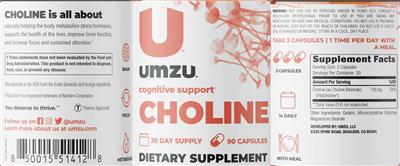
Choline is all about naturally helping the body metabolize stress hormones, supports the health of the liver, improve brain function, and increase focus and sustained attention.
FDA Disclaimer Statement
These statements have not been evaluated by the Food and Drug Administration. This product is not intended to diagnose, treat, cure, or prevent any disease.
Formulation
Manufactured in the USA from the finest domestic and foreign ingredients. Brain Focus Metabolism
Cognitive Support
Brand IP Statement(s)
UMZU You deserve to thrive.
VitaCholine is a registered trademark of Balchem Corporation.
FDA Statement of Identity
Dietary Supplement
Precautions
Warning: Not for use by persons under 18 years old.
Consult a healthcare professional prior to use if you are taking any medications or have any medical conditions. Do not use if pregnant or nursing.
Keep out of the reach of children.
Do not use if safety seal is damaged or missing.
Storage
Store in a cool, dry place.
Suggested/Recommended/Usage/Directions
Take 3 capsules 1 time per day with a meal. 3 Capsules 1x Daily with Meal
General Statements
Thermo Approved Follow us on Facebook, Instagram, Twitter @UMZU Learn more about us at UMZU.com
30 day supply
Is this label outdated? Report a formula or label change and our pharmacy team will review it.
Choline by UMZU label
The label scan from the NIH Dietary Supplement Label Database. Tap to enlarge.
Label images are published by the NIH Dietary Supplement Label Database for the version of this product on file. Always read your actual product label.
View the full label (PDF)The Ingredients in Choline by UMZU
This is the 1 active ingredient this product is made of. Select it to open its full monograph.
Serving size3 Capsule(s) Dosage formCapsule Servings per container30 Amounts shown are per serving.
Choline
Interacts with16 drugs
Choline is an essential nutrient your body needs for liver function, brain health, and nerve signaling, and many people get enough from foods like egg...
Choline monograph & interactionsOther (inactive) ingredients: Gelatin, Microcrystalline Cellulose, Magnesium Stearate. These complete the product’s ingredient list but are not active constituents.
Choline by UMZU Drug Interactions
HelloPharmacist Interaction Report
UMZU Choline has one documented interaction we're tracking: it may theoretically decrease how well atropine (a medication used for certain eye conditions and other purposes) works in the brain.
Animal research suggests that taking choline before atropine can reduce atropine's effects on brain acetylcholine levels. If you take atropine, run it through the checker below before starting this supplement.
Read the full breakdown — every affected drug type, severity by severity
Although we've identified this interaction category, the interaction itself is rated Minor in severity. We hold no other interaction data for choline beyond what's listed here.
Altogether, these interactions span 16 individual medications.
Since this product contains just one active ingredient, your main concern is atropine-type drugs. Check your exact medications with the search tool on this page.
Check your own medications below · Editorial policy · How we use AI
Want to check YOUR meds against Choline?
Ask about interactions with your drugs in plain English — “Can I take it with lisinopril?” — and we find you the answer in seconds, ingredient by ingredient.
Go to the checkerIngredients driving the most interactions
Individual Drug Interactions
The ingredients in Choline interact with 16 drugs. Click any drug to see the details.
1 of the 1 ingredient in Choline interact with drugs. Each result below shows which ingredient is responsible. Choline
AtropineSal-Tropine
How Atropine interacts with Choline — through 1 ingredient. Tap an ingredient for the detail:
CholineAtropine Minor
Interaction Summary
Theoretically, choline might decrease the effects of atropine in the brain.
Read the full Choline + Atropine interactionAtropine SulfateAtropine Sulfate, Isopto Atropine
How Atropine Sulfate interacts with Choline — through 1 ingredient. Tap an ingredient for the detail:
CholineAtropine Minor
Interaction Summary
Theoretically, choline might decrease the effects of atropine in the brain.
Read the full Choline + Atropine Sulfate interactionAtropine, Benzoic Acid, Hyoscyamine, Methenamine, Methylene Blue, PhenylAtrosept
How Atropine, Benzoic Acid, Hyoscyamine, Methenamine, Methylene Blue, Phenyl interacts with Choline — through 1 ingredient. Tap an ingredient for the detail:
CholineAtropine Minor
Interaction Summary
Theoretically, choline might decrease the effects of atropine in the brain.
Read the full Choline + Atropine, Benzoic Acid, Hyoscyamine, Methenamine, Methylene Blue, Phenyl interactionAtropine, Benzoic Acid, Hyoscyamine, Methenamine, Methylene Blue, Phenyl SalicylateUrinary Antiseptic 2, Urised
How Atropine, Benzoic Acid, Hyoscyamine, Methenamine, Methylene Blue, Phenyl Salicylate interacts with Choline — through 1 ingredient. Tap an ingredient for the detail:
CholineAtropine Minor
Interaction Summary
Theoretically, choline might decrease the effects of atropine in the brain.
Read the full Choline + Atropine, Benzoic Acid, Hyoscyamine, Methenamine, Methylene Blue, Phenyl Salicylate interactionAtropine, Chlorpheniramine, Hyoscyamine, Phenylephrine, Phenylpropanolamine, ScopolamineAtrohist Plus, Pro Tuss, Ru-tuss, Stahist
How Atropine, Chlorpheniramine, Hyoscyamine, Phenylephrine, Phenylpropanolamine, Scopolamine interacts with Choline — through 1 ingredient. Tap an ingredient for the detail:
CholineAtropine Minor
Interaction Summary
Theoretically, choline might decrease the effects of atropine in the brain.
Read the full Choline + Atropine, Chlorpheniramine, Hyoscyamine, Phenylephrine, Phenylpropanolamine, Scopolamine interactionAtropine, DifenoxinMotofen
How Atropine, Difenoxin interacts with Choline — through 1 ingredient. Tap an ingredient for the detail:
CholineAtropine Minor
Interaction Summary
Theoretically, choline might decrease the effects of atropine in the brain.
Read the full Choline + Atropine, Difenoxin interactionAtropine, DiphenoxylateLofene, Lomotil
How Atropine, Diphenoxylate interacts with Choline — through 1 ingredient. Tap an ingredient for the detail:
CholineAtropine Minor
Interaction Summary
Theoretically, choline might decrease the effects of atropine in the brain.
Read the full Choline + Atropine, Diphenoxylate interactionAtropine, Hyoscyamine, PhenobarbitalHypnaldyne
How Atropine, Hyoscyamine, Phenobarbital interacts with Choline — through 1 ingredient. Tap an ingredient for the detail:
CholineAtropine Minor
Interaction Summary
Theoretically, choline might decrease the effects of atropine in the brain.
Read the full Choline + Atropine, Hyoscyamine, Phenobarbital interactionAtropine, Hyoscyamine, Phenobarbital, ScopolamineBarbidonna No. 2, Belladonna Phenobarbital
How Atropine, Hyoscyamine, Phenobarbital, Scopolamine interacts with Choline — through 1 ingredient. Tap an ingredient for the detail:
CholineAtropine Minor
Interaction Summary
Theoretically, choline might decrease the effects of atropine in the brain.
Read the full Choline + Atropine, Hyoscyamine, Phenobarbital, Scopolamine interactionAtropine, Hyoscyamine, ScopolamineColytrol
How Atropine, Hyoscyamine, Scopolamine interacts with Choline — through 1 ingredient. Tap an ingredient for the detail:
CholineAtropine Minor
Interaction Summary
Theoretically, choline might decrease the effects of atropine in the brain.
Read the full Choline + Atropine, Hyoscyamine, Scopolamine interactionAtropine, Hyoscyamine, Scopolamine, PhenobarbitalBarbeloid, Donnatal #2, Donphen
How Atropine, Hyoscyamine, Scopolamine, Phenobarbital interacts with Choline — through 1 ingredient. Tap an ingredient for the detail:
CholineAtropine Minor
Interaction Summary
Theoretically, choline might decrease the effects of atropine in the brain.
Read the full Choline + Atropine, Hyoscyamine, Scopolamine, Phenobarbital interactionAtropine, PhenobarbitalAnthrocol
How Atropine, Phenobarbital interacts with Choline — through 1 ingredient. Tap an ingredient for the detail:
CholineAtropine Minor
Interaction Summary
Theoretically, choline might decrease the effects of atropine in the brain.
Read the full Choline + Atropine, Phenobarbital interactionAtropine, MeperidineAtropine, Meperidine
How Atropine, Meperidine interacts with Choline — through 1 ingredient. Tap an ingredient for the detail:
CholineAtropine Minor
Interaction Summary
Theoretically, choline might decrease the effects of atropine in the brain.
Read the full Choline + Atropine, Meperidine interactionAtropine, Morphine SulfateAtropine, Morphine Sulfate
How Atropine, Morphine Sulfate interacts with Choline — through 1 ingredient. Tap an ingredient for the detail:
CholineAtropine Minor
Interaction Summary
Theoretically, choline might decrease the effects of atropine in the brain.
Read the full Choline + Atropine, Morphine Sulfate interactionBelladonna Alkaloids, PhenobarbitalBarbidonna, Donnatal
How Belladonna Alkaloids, Phenobarbital interacts with Choline — through 1 ingredient. Tap an ingredient for the detail:
CholineAtropine Minor
Interaction Summary
Theoretically, choline might decrease the effects of atropine in the brain.
Read the full Choline + Belladonna Alkaloids, Phenobarbital interactionEdrophonium, AtropineEnlon-Plus
How Edrophonium, Atropine interacts with Choline — through 1 ingredient. Tap an ingredient for the detail:
CholineAtropine Minor
Interaction Summary
Theoretically, choline might decrease the effects of atropine in the brain.
Read the full Choline + Edrophonium, Atropine interactionEach ingredient & the kinds of drugs it affects
For each ingredient in Choline with known interactions, here are the types of medications it can affect. Open any type for the detail — or search your exact drug in the checker above.
Choline
Atropine
Theoretically, choline might decrease the effects of atropine in the brain.
Animal research shows that administering choline one hour before administering atropine can attenuate atropine-induced decreases in brain levels of acetylcholine. Theoretically, concomitant use of choline and atropine may decrease the effects of atropine.
Brand information
Manufacturer and brand details for Choline, from the product label.
UMZU
See all UMZU products- Name
- UMZU, LLC
- Street Address
- 6325 Spine Road
- City
- Boulder
- State
- CO
- ZipCode
- 80301
- Web Address
- umzu.com
Choline by UMZU: Common Questions
Does Choline by UMZU interact with any medications?
How can one product interact with so many drugs?
Where does this information come from?
Will choline help my memory or prevent Alzheimer disease?
Is choline safe during pregnancy?
Is choline safe while breastfeeding?
What side effects might I get from choline?
Can I use choline to boost my athletic performance?
Written and reviewed by the HelloPharmacist editorial staff. Our editorial policy
Not sure if Choline is safe with your meds?
Our pharmacists answer your medication & supplement questions — free.
Label information is sourced from the NIH Dietary Supplement Label Database and reflects the product version on file; always read your actual product label. This page is for education only and is not a substitute for professional medical advice. Confirm with your pharmacist or doctor before combining supplements and medications.
The Full Monographs Behind Choline’s Ingredients
Every ingredient we hold a full HelloPharmacist monograph for — uses, evidence, safety, and the complete interaction list.
Sources & How We Checked
Choline's label data comes from the NIH Dietary Supplement Label Database; the ingredient interaction data is from the Natural Medicines database, reviewed by our pharmacists.
- NIH Dietary Supplement Label Database (DSLD) — The official product label on file for this supplement.
- Natural Medicines (Therapeutic Research Center) — Evidence-graded clinical reference behind the ingredient interaction data.
Content is written and reviewed by licensed HelloPharmacist pharmacists. See our data sources and editorial standards for how this information is built and checked.
The 14 references behind this product’s interaction data
Every citation that drives the interaction findings for this product’s ingredients, from the evidence-graded Natural Medicines (TRC Healthcare) database. Open an ingredient to browse its citations — links open the study on PubMed or the publisher’s site.
Choline 14 references
- Yates AA, Schlicker SA, Suitor CW. Dietary reference intakes: The new basis for recommendations for calcium and related nutrients, B vitamins, and choline. J Am Diet Assoc 1998;98:699-706. PubMed
- Cho E, Willett WC, Colditz GA, et al. Dietary choline and betaine and the risk of distal colorectal adenoma in women. J Natl Cancer Inst 2007;99:1224-31. PubMed
- Schmidt, C., Abicht, A., Krampfl, K., Voss, W., Stucka, R., Mildner, G., Petrova, S., Schara, U., Mortier, W., Bufler, J., Huebner, A., and Lochmuller, H. Congenital myasthenic syndrome due to a novel missense mutation in the gene encoding choline acetyl
- Tamminga, C., Smith, R. C., Chang, S., Haraszti, J. S., and Davis, J. M. Depression associated with oral choline. Lancet 10-23-1976;2(7991):905. PubMed
- Wood, J. L. and Allison, R. G. Effects of consumption of choline and lecithin on neurological and cardiovascular systems. Fed.Proc. 1982;41(14):3015-3021.
- Growdon, J. H. and Gelenberg, A. J. Choline and lecithin administration to patients with tardive dyskinesia. Trans.Am.Neurol.Assoc. 1978;103:95-99.
- Smith, C. M., Swash, M., Exton-Smith, A. N., Phillips, M. J., Overstall, P. W., Piper, M. E., and Bailey, M. R. Choline therapy in Alzheimer's disease. Lancet 8-5-1978;2(8084):318. PubMed
- Morrison, L. M. and W. F. Gonzales. Choline in coronary atherosclerosis. Amer.Heart J. 1950;39:729.
- Christie, J. G. Blackburn 1. M. Glen A. I. M. Zeisel S. Shering A. & Yates C. M. Effects of choline and lecithin on CSF choline levels and on cognitive functioning in patients with presenile dementia of the Alzheimer type. Nutrition and the brain 1979;5
- Sidhu N, Davies S, Nadarajah A, et al. Oral choline supplementation for postoperative pain. Br J Anaesth 2013;111(2):249-55. PubMed
- Wozniak JR, Fuglestad AJ, Eckerle JK, et al. Choline supplementation in children with fetal alcohol spectrum disorders has high feasibility and tolerability. Nutr Res. 2013;33(11):897-904. PubMed
- Wozniak JR, Fuglestad AJ, Eckerle JK, et al. Choline supplementation in children with fetal alcohol disorders: a randomized, double-blind, placebo-controlled trial. Am J Clin Nutr. 2015;102(5): 1113-25.
- Ross RG, Hunter SK, McCarthy L, et al. Perinatal choline effects on neonatal pathophysiology related to later schizophrenia risk. Am J Psychiatry. 2013;170(3):290-8. PubMed
- Food and Nutrition Board, Institute of Medicine. Choline. Dietary Reference Intakes: Thiamin, Riboflavin, Niacin, Vitamin B-6, Vitamin B-12, Pantothenic Acid, Biotin, and Choline. Washington D.C.: National Academy Press; 1998:390-422.
Parts of this content are provided by the Therapeutic Research Center, LLC.
DISCLAIMER: Currently this does not check for drug-drug interactions. This is not an all-inclusive comprehensive list of potential interactions and is for informational purposes only. Not all interactions are known or well-reported in the scientific literature, and new interactions are continually being reported. Input is needed from a qualified healthcare provider including a pharmacist before starting any therapy. Application of clinical judgment is necessary.
© 2021 Therapeutic Research Center, LLC