
Cumin Ingredients & Drug Interactions
by Revive
What is this page for?
First and foremost: checking Cumin against your medications. The heart of this page is the interaction checker and the full interaction report — how this product’s ingredients may interact with prescription and over-the-counter medicines you may be taking.
Around that, we add a pharmacist’s high-level view of the product as a whole — what’s inside, the evidence for its stated use, how transparent the label is, and what safety data exists — so you can see the full picture in one place. It’s educational information from our licensed clinical databases and the clinical staff at HelloPharmacist — not medical advice — and we don’t sell or endorse products. Our editorial policy
Cumin is a dietary supplement by Revive with 1 active ingredient. Its ingredients are commonly taken for digestive upset, bloating and gas, appetite stimulation.Based on those ingredients, 211 medications have a known interaction with it, the most serious rated moderate. The ingredients most likely to interact are Cumin. Use the checker below to test your specific medication, or read the full HelloPharmacist Interaction Report.
Check Your Meds Against Cumin by Revive
Ask about any prescription or over-the-counter medication and we check it for interactions with Cumin by Revive — and tell you which ingredient is responsible.
AI summaries are generated from our interaction database for education only — always confirm with your pharmacist. How we use AI
Ask the Pharmacist
A licensed pharmacist will answer your question by email — free, usually within 24 hours.
Got it — thank you!
A licensed pharmacist will answer within 24 hours. Keep an eye on your email (worth checking spam, just in case).
HelloPharmacist Scorecard of Cumin by Revive
Our pharmacy team’s full take, with four database checks built into the cards below — a summary of what is known, not a grade of the product itself.
What’s inside
Full disclosure
This product contains one active ingredient: cumin, a spice commonly used in cooking and traditional medicine. The liquid form allows for flexible dosing, though cumin as a supplement is different from the small amounts you'd sprinkle in food.
Does it work?
Couldn't assess
The evidence for cumin's effectiveness is not established in the data we hold. Studies have looked at cumin for metabolic syndrome, prediabetes, fatty liver disease (NASH), obesity, and high cholesterol, but the results so far have been insufficient to give it a reliable rating for any of these uses.
How safe is it?
Well-documented data
Cumin as a spice in food is generally well tolerated. However, the safety data on supplement or medicinal doses is limited.
Short-term use of cumin powder and essential oil seems to be well tolerated, with the most common side effect being gastrointestinal upset. Rarely, people with sensitivities can have allergic reactions, including anaphylaxis, and topical application may cause contact dermatitis in sensitive individuals.
Because safety data at higher doses is incomplete, stick to food amounts unless you've talked with your doctor or pharmacist.
Meds to double-check
Moderate interaction found
Before taking this product, double-check with your pharmacist if you're on blood thinners or antiplatelet drugs (like aspirin or warfarin), diabetes medications, or rifampin. These are the medication types with documented Moderate interactions with cumin.
The bottom line
Scorecard at a glanceFully disclosed formula with no assessable stated purpose. Moderate medication interactions have been identified, and safety information is well characterized.
Cumin as a spice is safe for everyday use. If you're considering it as a supplement, especially for blood sugar or metabolic issues, check with your pharmacist first — particularly if you take blood thinners, diabetes drugs, or rifampin.
The evidence for its health benefits isn't strong enough yet to draw firm conclusions.
Educational only — not medical advice; always confirm with your pharmacist. Our editorial policy · How we use AI
Assessment coverage: 1 of 1 active ingredient matched to our full ingredient reviews (monographs). Based on the product label dated Jun 25, 2025.
This Scorecard evaluates available label information, ingredient evidence, and known medication-safety considerations. It does not independently verify product identity, purity, potency, contamination, or manufacturing quality. How these ratings are computed
General information
Key facts about Cumin, straight from the product label.
Everything in this section is reproduced from the manufacturer’s own product label — it’s the label speaking, not HelloPharmacist. We show it so you can see exactly what the maker states; we don’t verify or endorse those statements.
Supplement Facts
The label details for Cumin by Revive, sourced from the NIH Dietary Supplement Label Database.
Supplement Facts
| Ingredient | Amount | % DV |
|---|---|---|
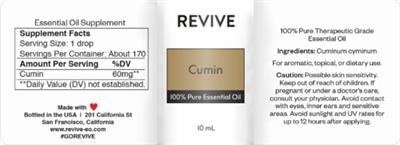
| Cumin | 60 mg | -- |
Tap any ingredient to jump to its full detail below.
These statements are the manufacturer’s wording, reproduced from the product label — the label is saying it, not HelloPharmacist. We don’t verify or endorse them.
FDA Statement of Identity
Essential Oil Supplement
General Statements
Made with love #Gorevive
Formulation
Bottled in the USA
For aromatic, topical, or dietary use.
Formula
100% Pure essential oil 100% pure therapeutic grade essential oil
Precautions
Caution: Possible skin sensitivity. Avoid contact with eyes, inner ears and sensitive areas. Avoid sunlight and UV rays for up to 12 hours after applying.
Keep out of reach of children.
If pregnant or under a doctor's care, consult your physician.
Is this label outdated? Report a formula or label change and our pharmacy team will review it.
Cumin by Revive label
The label scan from the NIH Dietary Supplement Label Database. Tap to enlarge.
Label images are published by the NIH Dietary Supplement Label Database for the version of this product on file. Always read your actual product label.
View the full label (PDF)The Ingredients in Cumin by Revive
This is the 1 active ingredient this product is made of. Select it to open its full monograph.
Serving size1 Drop(s) Dosage formLiquid Servings per container170 Amounts shown are per serving.
Cumin
Interacts with211 drugs
Cumin is a common cooking spice that has a long history in traditional medicine for digestion and other complaints. Food amounts are generally safe fo...
Cumin monograph & interactionsCumin by Revive Drug Interactions
HelloPharmacist Interaction Report
Cumin by Revive can interact with several medication types, and the interactions we know about are all Moderate in severity.
The biggest concern is with blood thinners (anticoagulant and antiplatelet drugs) — cumin may increase your bleeding risk if you're on aspirin, warfarin, or similar medications, because lab evidence suggests it can slow down platelet clumping.
Read the full breakdown — every affected drug type, severity by severity
Cumin may also raise your risk of low blood sugar (hypoglycemia) if you take diabetes medications. Animal research shows cumin can lower blood sugar, though studies in people have given mixed results.
Additionally, if you're on rifampin (an antibiotic used for tuberculosis and some infections), cumin might increase both the drug's effects and its side effects by raising how much of it your body absorbs.
We could not find interactions for any other medication types, but we checked only this one active ingredient. Altogether, these interactions span 210 individual medications.
Use the medication checker on this page to look up your exact drugs before you start.
Check your own medications below · Editorial policy · How we use AI
Want to check YOUR meds against Cumin?
Ask about interactions with your drugs in plain English — “Can I take it with lisinopril?” — and we find you the answer in seconds, ingredient by ingredient.
Go to the checkerIngredients driving the most interactions
Individual Drug Interactions
The ingredients in Cumin interact with 211 drugs. Click any drug to see the details.
1 of the 1 ingredient in Cumin interact with drugs. Each result below shows which ingredient is responsible. Cumin
ErtugliflozinSteglatro
How Ertugliflozin interacts with Cumin — through 1 ingredient. Tap an ingredient for the detail:
CuminAntidiabetes Drugs Moderate
Interaction Summary
Theoretically, cumin might increase the risk of hypoglycemia when taken with antidiabetes drugs.
Read the full Cumin + Ertugliflozin interactionErtugliflozin, Metformin HydrochlorideSegluromet
How Ertugliflozin, Metformin Hydrochloride interacts with Cumin — through 1 ingredient. Tap an ingredient for the detail:
CuminAntidiabetes Drugs Moderate
Interaction Summary
Theoretically, cumin might increase the risk of hypoglycemia when taken with antidiabetes drugs.
Read the full Cumin + Ertugliflozin, Metformin Hydrochloride interactionEsomeprazole, NaproxenVimovo
How Esomeprazole, Naproxen interacts with Cumin — through 1 ingredient. Tap an ingredient for the detail:
CuminAnticoagulant/antiplatelet Drugs Moderate
Interaction Summary
Theoretically, cumin might increase the risk of bleeding when used with antiplatelet or anticoagulant drugs.
Read the full Cumin + Esomeprazole, Naproxen interactionExenatideBydureon, Byetta
How Exenatide interacts with Cumin — through 1 ingredient. Tap an ingredient for the detail:
CuminAntidiabetes Drugs Moderate
Interaction Summary
Theoretically, cumin might increase the risk of hypoglycemia when taken with antidiabetes drugs.
Read the full Cumin + Exenatide interactionExenatide SyntheticBydureon BCISE
How Exenatide Synthetic interacts with Cumin — through 1 ingredient. Tap an ingredient for the detail:
CuminAntidiabetes Drugs Moderate
Interaction Summary
Theoretically, cumin might increase the risk of hypoglycemia when taken with antidiabetes drugs.
Read the full Cumin + Exenatide Synthetic interactionFamotidine, IbuprofenDuexis
How Famotidine, Ibuprofen interacts with Cumin — through 1 ingredient. Tap an ingredient for the detail:
CuminAnticoagulant/antiplatelet Drugs Moderate
Interaction Summary
Theoretically, cumin might increase the risk of bleeding when used with antiplatelet or anticoagulant drugs.
Read the full Cumin + Famotidine, Ibuprofen interactionFish Oil TriglyceridesOmegaven
How Fish Oil Triglycerides interacts with Cumin — through 1 ingredient. Tap an ingredient for the detail:
CuminAnticoagulant/antiplatelet Drugs Moderate
Interaction Summary
Theoretically, cumin might increase the risk of bleeding when used with antiplatelet or anticoagulant drugs.
Read the full Cumin + Fish Oil Triglycerides interactionFondaparinuxArixtra
How Fondaparinux interacts with Cumin — through 1 ingredient. Tap an ingredient for the detail:
CuminAnticoagulant/antiplatelet Drugs Moderate
Interaction Summary
Theoretically, cumin might increase the risk of bleeding when used with antiplatelet or anticoagulant drugs.
Read the full Cumin + Fondaparinux interactionGliclazideDiamicron
How Gliclazide interacts with Cumin — through 1 ingredient. Tap an ingredient for the detail:
CuminAntidiabetes Drugs Moderate
Interaction Summary
Theoretically, cumin might increase the risk of hypoglycemia when taken with antidiabetes drugs.
Read the full Cumin + Gliclazide interactionGlimepirideAmaryl
How Glimepiride interacts with Cumin — through 1 ingredient. Tap an ingredient for the detail:
CuminAntidiabetes Drugs Moderate
Interaction Summary
Theoretically, cumin might increase the risk of hypoglycemia when taken with antidiabetes drugs.
Read the full Cumin + Glimepiride interactionGlipizideGlucotrol, Glucotrol XL
How Glipizide interacts with Cumin — through 1 ingredient. Tap an ingredient for the detail:
CuminAntidiabetes Drugs Moderate
Interaction Summary
Theoretically, cumin might increase the risk of hypoglycemia when taken with antidiabetes drugs.
Read the full Cumin + Glipizide interactionGlipizide, MetforminMetaglip
How Glipizide, Metformin interacts with Cumin — through 1 ingredient. Tap an ingredient for the detail:
CuminAntidiabetes Drugs Moderate
Interaction Summary
Theoretically, cumin might increase the risk of hypoglycemia when taken with antidiabetes drugs.
Read the full Cumin + Glipizide, Metformin interactionGlucagonBaqsimi, Glucagon
How Glucagon interacts with Cumin — through 1 ingredient. Tap an ingredient for the detail:
CuminAntidiabetes Drugs Moderate
Interaction Summary
Theoretically, cumin might increase the risk of hypoglycemia when taken with antidiabetes drugs.
Read the full Cumin + Glucagon interactionGlucoseIV Glucose
How Glucose interacts with Cumin — through 1 ingredient. Tap an ingredient for the detail:
CuminAntidiabetes Drugs Moderate
Interaction Summary
Theoretically, cumin might increase the risk of hypoglycemia when taken with antidiabetes drugs.
Read the full Cumin + Glucose interactionGlyburideAlbert Glyburide, Diabeta, Glycron, Glynase, Glynase PresTab, Micronase +1 more
How Glyburide interacts with Cumin — through 1 ingredient. Tap an ingredient for the detail:
CuminAntidiabetes Drugs Moderate
Interaction Summary
Theoretically, cumin might increase the risk of hypoglycemia when taken with antidiabetes drugs.
Read the full Cumin + Glyburide interactionGlyburide, MetforminGlucovance
How Glyburide, Metformin interacts with Cumin — through 1 ingredient. Tap an ingredient for the detail:
CuminAntidiabetes Drugs Moderate
Interaction Summary
Theoretically, cumin might increase the risk of hypoglycemia when taken with antidiabetes drugs.
Read the full Cumin + Glyburide, Metformin interactionHeparinHeparin
How Heparin interacts with Cumin — through 1 ingredient. Tap an ingredient for the detail:
CuminAnticoagulant/antiplatelet Drugs Moderate
Interaction Summary
Theoretically, cumin might increase the risk of bleeding when used with antiplatelet or anticoagulant drugs.
Read the full Cumin + Heparin interactionHydrocodone, IbuprofenVicoprofen
How Hydrocodone, Ibuprofen interacts with Cumin — through 1 ingredient. Tap an ingredient for the detail:
CuminAnticoagulant/antiplatelet Drugs Moderate
Interaction Summary
Theoretically, cumin might increase the risk of bleeding when used with antiplatelet or anticoagulant drugs.
Read the full Cumin + Hydrocodone, Ibuprofen interactionIbrutinibImbruvica
How Ibrutinib interacts with Cumin — through 1 ingredient. Tap an ingredient for the detail:
CuminAnticoagulant/antiplatelet Drugs Moderate
Interaction Summary
Theoretically, cumin might increase the risk of bleeding when used with antiplatelet or anticoagulant drugs.
Read the full Cumin + Ibrutinib interactionIbuprofenAdvil, Arthrofen, Brufen, Brufen Retard, Calodor, Calprofen +14 more
How Ibuprofen interacts with Cumin — through 1 ingredient. Tap an ingredient for the detail:
CuminAnticoagulant/antiplatelet Drugs Moderate
Interaction Summary
Theoretically, cumin might increase the risk of bleeding when used with antiplatelet or anticoagulant drugs.
Read the full Cumin + Ibuprofen interactionIbuprofen LysineNeoProfen
How Ibuprofen Lysine interacts with Cumin — through 1 ingredient. Tap an ingredient for the detail:
CuminAnticoagulant/antiplatelet Drugs Moderate
Interaction Summary
Theoretically, cumin might increase the risk of bleeding when used with antiplatelet or anticoagulant drugs.
Read the full Cumin + Ibuprofen Lysine interactionIbuprofen, AcetaminophenAdvil Dual Action
How Ibuprofen, Acetaminophen interacts with Cumin — through 1 ingredient. Tap an ingredient for the detail:
CuminAnticoagulant/antiplatelet Drugs Moderate
Interaction Summary
Theoretically, cumin might increase the risk of bleeding when used with antiplatelet or anticoagulant drugs.
Read the full Cumin + Ibuprofen, Acetaminophen interactionIbuprofen, HydrocodoneIbucodone
How Ibuprofen, Hydrocodone interacts with Cumin — through 1 ingredient. Tap an ingredient for the detail:
CuminAnticoagulant/antiplatelet Drugs Moderate
Interaction Summary
Theoretically, cumin might increase the risk of bleeding when used with antiplatelet or anticoagulant drugs.
Read the full Cumin + Ibuprofen, Hydrocodone interactionIbuprofen, OxycodoneCombunox
How Ibuprofen, Oxycodone interacts with Cumin — through 1 ingredient. Tap an ingredient for the detail:
CuminAnticoagulant/antiplatelet Drugs Moderate
Interaction Summary
Theoretically, cumin might increase the risk of bleeding when used with antiplatelet or anticoagulant drugs.
Read the full Cumin + Ibuprofen, Oxycodone interactionIbuprofen, PseudoephedrineDristan
How Ibuprofen, Pseudoephedrine interacts with Cumin — through 1 ingredient. Tap an ingredient for the detail:
CuminAnticoagulant/antiplatelet Drugs Moderate
Interaction Summary
Theoretically, cumin might increase the risk of bleeding when used with antiplatelet or anticoagulant drugs.
Read the full Cumin + Ibuprofen, Pseudoephedrine interactionIcosapent Ethyl (prescription Drug)Vascepa
How Icosapent Ethyl (prescription Drug) interacts with Cumin — through 1 ingredient. Tap an ingredient for the detail:
CuminAnticoagulant/antiplatelet Drugs Moderate
Interaction Summary
Theoretically, cumin might increase the risk of bleeding when used with antiplatelet or anticoagulant drugs.
Read the full Cumin + Icosapent Ethyl (prescription Drug) interactionIloprostAurlumyn, Ventavis
How Iloprost interacts with Cumin — through 1 ingredient. Tap an ingredient for the detail:
CuminAnticoagulant/antiplatelet Drugs Moderate
Interaction Summary
Theoretically, cumin might increase the risk of bleeding when used with antiplatelet or anticoagulant drugs.
Read the full Cumin + Iloprost interactionInhaled InsulinExubera
How Inhaled Insulin interacts with Cumin — through 1 ingredient. Tap an ingredient for the detail:
CuminAntidiabetes Drugs Moderate
Interaction Summary
Theoretically, cumin might increase the risk of hypoglycemia when taken with antidiabetes drugs.
Read the full Cumin + Inhaled Insulin interactionInotersenTegsedi
How Inotersen interacts with Cumin — through 1 ingredient. Tap an ingredient for the detail:
CuminAnticoagulant/antiplatelet Drugs Moderate
Interaction Summary
Theoretically, cumin might increase the risk of bleeding when used with antiplatelet or anticoagulant drugs.
Read the full Cumin + Inotersen interactionInsulinNovoRapid Insulin
How Insulin interacts with Cumin — through 1 ingredient. Tap an ingredient for the detail:
CuminAntidiabetes Drugs Moderate
Interaction Summary
Theoretically, cumin might increase the risk of hypoglycemia when taken with antidiabetes drugs.
Read the full Cumin + Insulin interactionEach ingredient & the kinds of drugs it affects
For each ingredient in Cumin with known interactions, here are the types of medications it can affect. Open any type for the detail — or search your exact drug in the checker above.
Cumin
Anticoagulant/Antiplatelet Drugs
Theoretically, cumin might increase the risk of bleeding when used with antiplatelet or anticoagulant drugs.
In vitro evidence suggests that cumin can inhibit platelet aggregation. Theoretically, cumin might increase the risk of bleeding when used with antiplatelet or anticoagulant drugs.
Antidiabetes Drugs
Theoretically, cumin might increase the risk of hypoglycemia when taken with antidiabetes drugs.
Animal research suggests that cumin can lower blood sugar in diabetic animals. However, research in humans with and without diabetes has found conflicting results.
Rifampin (Rifadin)
Theoretically, cumin might increase the effects and adverse effects of rifampin.
Animal research suggests that an aqueous extract of cumin containing a specific flavonoid glycoside can increase the bioavailability and plasma levels of rifampin.
Brand information
Manufacturer and brand details for Cumin, from the product label.
Revive
See all Revive products- Name
- Revive
- Street Address
- 201 California St
- City
- San Francisco
- State
- California
- Web Address
- www.revive-eo.com
Cumin by Revive: Common Questions
Does Cumin by Revive interact with any medications?
How can one product interact with so many drugs?
Where does this information come from?
Can I take cumin as a supplement if I'm on warfarin or aspirin?
Will cumin help with my blood sugar or weight?
Is cumin safe to use every day?
What side effects might I get from cumin?
Can I take cumin if I'm taking diabetes medication?
Is there anything else in this product besides cumin?
Written and reviewed by the HelloPharmacist editorial staff. Our editorial policy
Not sure if Cumin is safe with your meds?
Our pharmacists answer your medication & supplement questions — free.
Label information is sourced from the NIH Dietary Supplement Label Database and reflects the product version on file; always read your actual product label. This page is for education only and is not a substitute for professional medical advice. Confirm with your pharmacist or doctor before combining supplements and medications.
The Full Monographs Behind Cumin’s Ingredients
Every ingredient we hold a full HelloPharmacist monograph for — uses, evidence, safety, and the complete interaction list.
Sources & How We Checked
Cumin's label data comes from the NIH Dietary Supplement Label Database; the ingredient interaction data is from the Natural Medicines database, reviewed by our pharmacists.
- NIH Dietary Supplement Label Database (DSLD) — The official product label on file for this supplement.
- Natural Medicines (Therapeutic Research Center) — Evidence-graded clinical reference behind the ingredient interaction data.
Content is written and reviewed by licensed HelloPharmacist pharmacists. See our data sources and editorial standards for how this information is built and checked.
The 10 references behind this product’s interaction data
Every citation that drives the interaction findings for this product’s ingredients, from the evidence-graded Natural Medicines (TRC Healthcare) database. Open an ingredient to browse its citations — links open the study on PubMed or the publisher’s site.
Cumin 10 references
- Brinker F. Herb Contraindications and Drug Interactions. 2nd ed. Sandy, OR: Eclectic Medical Publications, 1998.
- Anliker, M. D., Borelli, S., and Wuthrich, B. Occupational protein contact dermatitis from spices in a butcher: a new presentation of the mugwort-spice syndrome. Contact Dermatitis 2002;46(2):72-74. PubMed
- Dhandapani, S., Subramanian, V. R., Rajagopal, S., and Namasivayam, N. Hypolipidemic effect of Cuminum cyminum L. on alloxan-induced diabetic rats. Pharmacol.Res 2002;46(3):251-255. PubMed
- Sachin, B. S., Sharma, S. C., Sethi, S., Tasduq, S. A., Tikoo, M. K., Tikoo, A. K., Satti, N. K., Gupta, B. D., Suri, K. A., Johri, R. K., and Qazi, G. N. Herbal modulation of drug bioavailability: enhancement of rifampicin levels in plasma by herbal pro
- Jagtap, A. G. and Patil, P. B. Antihyperglycemic activity and inhibition of advanced glycation end product formation by Cuminum cyminum in streptozotocin induced diabetic rats. Food Chem.Toxicol. 5-6-2010; PubMed
- Srivastava, K. C. Extracts from two frequently consumed spices--cumin (Cuminum cyminum) and turmeric (Curcuma longa)--inhibit platelet aggregation and alter eicosanoid biosynthesis in human blood platelets. Prostaglandins Leukot.Essent.Fatty Acids 1989;3 PubMed
- Futrell, J. M. and Rietschel, R. L. Spice allergy evaluated by results of patch tests. Cutis 1993;52(5):288-290.
- Boxer, M., Roberts, M., and Grammer, L. Cumin anaphylaxis: a case report. J.Allergy Clin.Immunol. 1997;99(5):722-723. PubMed
- Karimian J, Farrokhzad A, Jalili C. The effect of cumin (Cuminum cyminum L.) supplementation on glycemic indices: A systematic review and meta-analysis of randomized controlled trials. Phytother Res 2021;35(8):4127-4135.
- Tavakoli-Rouzbehani OM, Faghfouri AH, Anbari M, et al. The effects of Cuminum cyminum on glycemic parameters: a systematic review and meta-analysis of controlled clinical trials. J Ethnopharmacol 2021;281:114510. PubMed
Parts of this content are provided by the Therapeutic Research Center, LLC.
DISCLAIMER: Currently this does not check for drug-drug interactions. This is not an all-inclusive comprehensive list of potential interactions and is for informational purposes only. Not all interactions are known or well-reported in the scientific literature, and new interactions are continually being reported. Input is needed from a qualified healthcare provider including a pharmacist before starting any therapy. Application of clinical judgment is necessary.
© 2021 Therapeutic Research Center, LLC