
David Winston's Kidney Relief Ingredients & Drug Interactions
What is this page for?
First and foremost: checking David Winston's Kidney Relief against your medications. The heart of this page is the interaction checker and the full interaction report — how this product’s ingredients may interact with prescription and over-the-counter medicines you may be taking.
Around that, we add a pharmacist’s high-level view of the product as a whole — what’s inside, the evidence for its stated use, how transparent the label is, and what safety data exists — so you can see the full picture in one place. It’s educational information from our licensed clinical databases and the clinical staff at HelloPharmacist — not medical advice — and we don’t sell or endorse products. Our editorial policy
David Winston's Kidney Relief is a dietary supplement by Herbalist & Alchemist with 5 active ingredients. Its ingredients are commonly taken for urinary tract complaints, diuretic (increasing urine flow), bloating and fluid retention.Based on those ingredients, 946 medications have a known interaction with it, the most serious rated moderate. The ingredients most likely to interact are Celery seed extract, Buchu leaf extract, Parsley whole plant extract. Use the checker below to test your specific medication, or read the full HelloPharmacist Interaction Report.
Check Your Meds Against David Winston's Kidney Relief by Herbalist & Alchemist
Ask about any prescription or over-the-counter medication and we check it for interactions with David Winston's Kidney Relief by Herbalist & Alchemist — and tell you which ingredient is responsible.
AI summaries are generated from our interaction database for education only — always confirm with your pharmacist. How we use AI
Ask the Pharmacist
A licensed pharmacist will answer your question by email — free, usually within 24 hours.
Got it — thank you!
A licensed pharmacist will answer within 24 hours. Keep an eye on your email (worth checking spam, just in case).
HelloPharmacist Scorecard of David Winston's Kidney Relief by Herbalist & Alchemist
Our pharmacy team’s full take, with four database checks built into the cards below — a summary of what is known, not a grade of the product itself.
What’s inside
Low disclosure
David Winston's Kidney Relief contains five active herbal ingredients. The product includes a proprietary blend—listed as one component—along with individual extracts of buchu leaf, corn silk, pipsissewa herb, parsley whole plant, and celery seed.
These are combined with ethyl alcohol, distilled water, and vegetable glycerin as inactive ingredients in this liquid formula.
Does it work?
Insufficient evidence
The evidence we hold does not establish that any of these ingredients work reliably for kidney support or the conditions they're traditionally used for. Corn silk is rated insufficient evidence for angina, heart disease, heart failure, depression, diabetes, and fatigue.
Parsley shows insufficient evidence for urinary tract infections, melasma, osteoarthritis, and skin cancer. Celery seed is insufficient evidence for sexual dysfunction, anxiety, headache, depression, diabetes, and indigestion.
Buchu and pipsissewa effectiveness ratings are not on file in our data.
How safe is it?
Well-documented data
Buchu leaf is traditionally thought to affect the uterus and should be avoided during pregnancy. It's not safe enough to use while breastfeeding.
Medicinal doses lack strong safety data, and the essential oil may irritate. Corn silk is generally well tolerated short-term, but human safety data are limited; it's best avoided during pregnancy, and safety while breastfeeding is unknown unless a clinician approves.
The most common side effects with prolonged use are low potassium and low sodium levels. Pipsissewa has limited modern safety data and should be avoided in pregnancy and while breastfeeding.
Chronic use may lead to hydroquinone toxicity with symptoms including ringing in the ears, vomiting, confusion, seizures, and collapse. Parsley is safe in food amounts but concentrated supplements, seeds, and essential oil may not be safe in large doses.
Medicinal amounts may stimulate the uterus, so stick to food amounts only during pregnancy; lactation data are not on file. Celery seed should be avoided in medicinal amounts during pregnancy—food amounts are likely fine—and is best avoided while breastfeeding due to lack of reliable safety data.
Rare serious side effects from very high parsley doses include anemia, low blood pressure, liver and kidney damage, and a blood disorder; anaphylaxis has been reported. Celery can cause photosensitivity reactions, allergic reactions ranging from oral itching to anaphylactic shock, and in one case, anaphylactic shock with severe swelling.
Meds to double-check
Moderate interaction found
Before taking David Winston's Kidney Relief, double-check these medication types with your doctor or pharmacist: blood thinners and antiplatelet drugs (aspirin, warfarin, clopidogrel, enoxaparin, and others), blood pressure drugs, diabetes medications, diuretics (water pills), corticosteroids, lithium, levothyroxine (thyroid hormone), venlafaxine (an antidepressant), pentobarbital (a sedative), sirolimus (an immunosuppressant), CYP1A2-metabolized drugs, photosensitizing medications, and acetaminophen. Several ingredients in this product can affect how these drugs work or raise your risk of side effects.
The bottom line
Scorecard at a glanceFormula with limited ingredient disclosure with insufficient evidence for its stated purpose. Moderate medication interactions have been identified, and safety information is well characterized.
This product is marketed for kidney support, but we don't have evidence that any of its ingredients reliably do that. More importantly, it contains multiple herbs that interact with common medications—blood thinners, diabetes drugs, blood pressure drugs, diuretics, and others.
If you take any prescription medication, check it against the interactions listed on this page or use the search tool below before starting this product. Talk with your own doctor or pharmacist about whether it's right for you.
Educational only — not medical advice; always confirm with your pharmacist. Our editorial policy · How we use AI
Assessment coverage: 5 of 5 active ingredients matched to our full ingredient reviews (monographs). Based on the product label dated Sep 21, 2018.
This Scorecard evaluates available label information, ingredient evidence, and known medication-safety considerations. It does not independently verify product identity, purity, potency, contamination, or manufacturing quality. How these ratings are computed
General information
Key facts about David Winston's Kidney Relief, straight from the product label.
| Brand | Herbalist & Alchemist |
|---|---|
| Barcode (UPC) | 667056137045 |
| Net contents | 2 fl. Oz.; 60 mL |
| Market status | On market |
| Date entered into DSLD | Sep 21, 2018 |
| DSLD ID | 179837 |
| Product type | Botanical |
| Supplement form | Liquid |
| Dietary claims / uses | All Other, Structure/Function |
| Intended target group(s) | Adult (18 - 50 Years), Kosher |
Everything in this section is reproduced from the manufacturer’s own product label — it’s the label speaking, not HelloPharmacist. We show it so you can see exactly what the maker states; we don’t verify or endorse those statements.
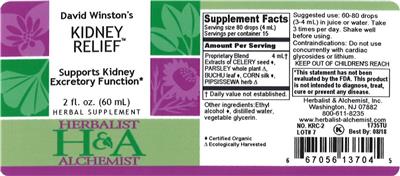
Supplement Facts
The label details for David Winston's Kidney Relief by Herbalist & Alchemist, sourced from the NIH Dietary Supplement Label Database.
Supplement Facts
| Ingredient | Amount | % DV |
|---|---|---|
| Proprietary Blend | 4 mL | -- |
| Buchu leaf extract | 0 NP | -- |
| Corn Silk extract | 0 NP | -- |
| Pipsissewa herb extract | 0 NP | -- |
| Parsley whole plant extract | 0 NP | -- |
| Celery seed extract | 0 NP | -- |
Other ingredients: Ethyl Alcohol, distilled Water, Vegetable Glycerin
Tap any ingredient to jump to its full detail below.
These statements are the manufacturer’s wording, reproduced from the product label — the label is saying it, not HelloPharmacist. We don’t verify or endorse them.
General Statements
Supports Kidney Excretory Function
FDA Statement of Identity
Herbal Supplement
Suggested/Recommended/Usage/Directions
Suggested use: 60-80 drops (3-4 mL) in juice or water. Take 3 times per day. Shake well before using.
Precautions
Contraindications: Do not use concurrently with cardiac glycosides of lithium.
Keep out of children's reach
FDA Disclaimer Statement
This statement has not been evaluated by the FDA. This product is not intended to diagnose, treat, cure or prevent any disease.
General
NO. KRC-2 1735TU
Seals/Symbols
OK
Formula
OK
Is this label outdated? Report a formula or label change and our pharmacy team will review it.
David Winston's Kidney Relief by Herbalist & Alchemist label
The label scan from the NIH Dietary Supplement Label Database. Tap to enlarge.
Label images are published by the NIH Dietary Supplement Label Database for the version of this product on file. Always read your actual product label.
View the full label (PDF)The Ingredients in David Winston's Kidney Relief by Herbalist & Alchemist
These are the 5 active ingredients this product is made of. Select any to open its full monograph.
Serving size3 mL Dosage formLiquid Servings per container15 Amounts shown are per serving.
Most supplement products combine several ingredients, and a medication can interact with the product through any one of them. Each ingredient below shows whether it has known drug interactions.
Proprietary Blend
Other (inactive) ingredients: Ethyl Alcohol, Distilled Water, Vegetable Glycerin. These complete the product’s ingredient list but are not active constituents.
David Winston's Kidney Relief by Herbalist & Alchemist Drug Interactions
HelloPharmacist Interaction Report
David Winston's Kidney Relief by Herbalist & Alchemist contains five herbal extracts, and through its buchu leaf, corn silk, parsley, and celery seed content, the product interacts with a range of medications.
The most serious interactions are Moderate in severity. Buchu may increase the risk of liver damage when used alongside hepatotoxic drugs, enhance bleeding risk with blood thinners (anticoagulants) and antiplatelet agents, and raise lithium levels.
Corn silk may lower blood pressure excessively with blood pressure drugs, increase potassium loss with corticosteroids and water pills (diuretics), raise low blood sugar (hypoglycemia) risk with diabetes drugs, cause electrolyte imbalances with diuretics, and interfere with warfarin's blood-thinning effect. Parsley similarly affects blood thinners and diabetes drugs, may interfere with diuretics, can lower warfarin's effectiveness, may prolong the effects of the sedative pentobarbital, and theoretically could raise levels of the immunosuppressant sirolimus; aspirin combined with parsley carries a minor risk of worsening allergic reactions.
Celery seed interacts with blood thinners, may reduce the effectiveness of the thyroid drug levothyroxine, can raise venlafaxine (an antidepressant) levels, may add to blood pressure lowering, and carries minor risks with photosensitizing drugs and acetaminophen. Altogether, these interactions span 947 individual medications.
Pipsissewa has no known interactions documented in our data, though long-term use carries theoretical concerns about a toxic compound. Check your exact medications with the search tool on this page before taking this product.
Check your own medications below · Editorial policy · How we use AI
Want to check YOUR meds against David Winston's Kidney Relief?
Ask about interactions with your drugs in plain English — “Can I take it with lisinopril?” — and we find you the answer in seconds, ingredient by ingredient.
Go to the checkerIngredients driving the most interactions
Individual Drug Interactions
The ingredients in David Winston's Kidney Relief interact with 946 drugs. Click any drug to see the details.
4 of the 5 ingredients in David Winston's Kidney Relief interact with drugs. Each result below shows which ingredient is responsible. Celery seed extract Buchu leaf extract Parsley whole plant extract Corn Silk extract
6-mercaptopurinePurinethol
How 6-mercaptopurine interacts with David Winston's Kidney Relief — through 1 ingredient. Tap an ingredient for the detail:
Buchu Leaf ExtractHepatotoxic Drugs Moderate
Interaction Summary
Buchu contains pulegone, a known hepatotoxin.
Read the full Buchu Leaf Extract + 6-mercaptopurine interactionAbacavir Sulfate, Dolutegravir, LamivudineTriumeq
How Abacavir Sulfate, Dolutegravir, Lamivudine interacts with David Winston's Kidney Relief — through 1 ingredient. Tap an ingredient for the detail:
Buchu Leaf ExtractHepatotoxic Drugs Moderate
Interaction Summary
Buchu contains pulegone, a known hepatotoxin.
Read the full Buchu Leaf Extract + Abacavir Sulfate, Dolutegravir, Lamivudine interactionAbacavir, LamivudineEpzicom
How Abacavir, Lamivudine interacts with David Winston's Kidney Relief — through 1 ingredient. Tap an ingredient for the detail:
Buchu Leaf ExtractHepatotoxic Drugs Moderate
Interaction Summary
Buchu contains pulegone, a known hepatotoxin.
Read the full Buchu Leaf Extract + Abacavir, Lamivudine interactionAbciximabReoPro
How Abciximab interacts with David Winston's Kidney Relief — through 3 ingredients. Tap an ingredient for the detail:
Celery Seed ExtractAnticoagulant/antiplatelet Drugs Moderate
Interaction Summary
Theoretically, celery root might increase the risk of bleeding when taken with anticoagulant/antiplatelet drugs.
Read the full Celery Seed Extract + Abciximab interactionParsley Whole Plant ExtractAnticoagulant/antiplatelet Drugs Moderate
Interaction Summary
Theoretically, parsley might increase the risk of bleeding when taken with anticoagulant or antiplatelet drugs.
Read the full Parsley Whole Plant Extract + Abciximab interactionBuchu Leaf ExtractAnticoagulant/antiplatelet Drugs Moderate
Interaction Summary
Buchu may have antiplatelet effects.
Read the full Buchu Leaf Extract + Abciximab interactionAbiraterone
How Abiraterone interacts with David Winston's Kidney Relief — through 1 ingredient. Tap an ingredient for the detail:
Buchu Leaf ExtractHepatotoxic Drugs Moderate
Interaction Summary
Buchu contains pulegone, a known hepatotoxin.
Read the full Buchu Leaf Extract + Abiraterone interactionAbiraterone AcetateYonsa, Zytiga
How Abiraterone Acetate interacts with David Winston's Kidney Relief — through 1 ingredient. Tap an ingredient for the detail:
Buchu Leaf ExtractHepatotoxic Drugs Moderate
Interaction Summary
Buchu contains pulegone, a known hepatotoxin.
Read the full Buchu Leaf Extract + Abiraterone Acetate interactionAbrocitinibCibinqo
How Abrocitinib interacts with David Winston's Kidney Relief — through 3 ingredients. Tap an ingredient for the detail:
Buchu Leaf ExtractAnticoagulant/antiplatelet Drugs Moderate
Interaction Summary
Buchu may have antiplatelet effects.
Read the full Buchu Leaf Extract + Abrocitinib interactionCelery Seed ExtractAnticoagulant/antiplatelet Drugs Moderate
Interaction Summary
Theoretically, celery root might increase the risk of bleeding when taken with anticoagulant/antiplatelet drugs.
Read the full Celery Seed Extract + Abrocitinib interactionParsley Whole Plant ExtractAnticoagulant/antiplatelet Drugs Moderate
Interaction Summary
Theoretically, parsley might increase the risk of bleeding when taken with anticoagulant or antiplatelet drugs.
Read the full Parsley Whole Plant Extract + Abrocitinib interactionAcarboseGlucobay, Prandase, Precose
How Acarbose interacts with David Winston's Kidney Relief — through 3 ingredients. Tap an ingredient for the detail:
Parsley Whole Plant ExtractAntidiabetes Drugs Moderate
Interaction Summary
Theoretically, parsley might increase the risk of hypoglycemia when taken with antidiabetes drugs.
Read the full Parsley Whole Plant Extract + Acarbose interactionCorn Silk ExtractAntidiabetes Drugs Moderate
Interaction Summary
Theoretically, taking corn silk with antidiabetes drugs might increase the risk of hypoglycemia.
Read the full Corn Silk Extract + Acarbose interactionBuchu Leaf ExtractHepatotoxic Drugs Moderate
Interaction Summary
Buchu contains pulegone, a known hepatotoxin.
Read the full Buchu Leaf Extract + Acarbose interactionAcebutololRhotral, Sectral
How Acebutolol interacts with David Winston's Kidney Relief — through 3 ingredients. Tap an ingredient for the detail:
Buchu Leaf ExtractHepatotoxic Drugs Moderate
Interaction Summary
Buchu contains pulegone, a known hepatotoxin.
Read the full Buchu Leaf Extract + Acebutolol interactionCelery Seed ExtractAntihypertensive Drugs Moderate
Interaction Summary
Theoretically, celery seed extract might have additive effects with antihypertensive drugs.
Read the full Celery Seed Extract + Acebutolol interactionCorn Silk ExtractAntihypertensive Drugs Moderate
Interaction Summary
Taking corn silk extract with antihypertensive drugs might increase the risk of hypotension.
Read the full Corn Silk Extract + Acebutolol interactionAcenocoumarolSintrom
How Acenocoumarol interacts with David Winston's Kidney Relief — through 3 ingredients. Tap an ingredient for the detail:
Buchu Leaf ExtractAnticoagulant/antiplatelet Drugs Moderate
Interaction Summary
Buchu may have antiplatelet effects.
Read the full Buchu Leaf Extract + Acenocoumarol interactionParsley Whole Plant ExtractAnticoagulant/antiplatelet Drugs Moderate
Interaction Summary
Theoretically, parsley might increase the risk of bleeding when taken with anticoagulant or antiplatelet drugs.
Read the full Parsley Whole Plant Extract + Acenocoumarol interactionCelery Seed ExtractAnticoagulant/antiplatelet Drugs Moderate
Interaction Summary
Theoretically, celery root might increase the risk of bleeding when taken with anticoagulant/antiplatelet drugs.
Read the full Celery Seed Extract + Acenocoumarol interactionAcetaminophenChildren's Tylenol, Children's Tylenol Meltaways, Tylenol, Tylenol Ex Strength
How Acetaminophen interacts with David Winston's Kidney Relief — through 3 ingredients. Tap an ingredient for the detail:
Parsley Whole Plant ExtractCytochrome P450 1a2 (cyp1a2) Substrates Moderate
Interaction Summary
Theoretically, parsley might increase serum levels of CYP1A2 substrates.
Read the full Parsley Whole Plant Extract + Acetaminophen interactionBuchu Leaf ExtractHepatotoxic Drugs Moderate
Interaction Summary
Buchu contains pulegone, a known hepatotoxin.
Read the full Buchu Leaf Extract + Acetaminophen interactionCelery Seed ExtractCytochrome P450 1a2 (cyp1a2) Substrates, Acetaminophen (tylenol, Others) Moderate
Interaction Summary
Theoretically, celery might increase levels of drugs metabolized by CYP1A2.
Read the full Celery Seed Extract + Acetaminophen interactionAcetaminophen, AspirinGemnisyn
How Acetaminophen, Aspirin interacts with David Winston's Kidney Relief — through 3 ingredients. Tap an ingredient for the detail:
Celery Seed ExtractAnticoagulant/antiplatelet Drugs, Cytochrome P450 1a2 (cyp1a2) Substrates +1 Moderate
Interaction Summary
Theoretically, celery root might increase the risk of bleeding when taken with anticoagulant/antiplatelet drugs.
Read the full Celery Seed Extract + Acetaminophen, Aspirin interactionBuchu Leaf ExtractHepatotoxic Drugs, Anticoagulant/antiplatelet Drugs Moderate
Interaction Summary
Buchu contains pulegone, a known hepatotoxin.
Read the full Buchu Leaf Extract + Acetaminophen, Aspirin interactionParsley Whole Plant ExtractCytochrome P450 1a2 (cyp1a2) Substrates, Aspirin +1 Moderate
Interaction Summary
Theoretically, parsley might increase serum levels of CYP1A2 substrates.
Read the full Parsley Whole Plant Extract + Acetaminophen, Aspirin interactionAcetaminophen, Aspirin, CaffeineExcedrin, Excedrin Extra Strength, Excedrin Migraine
How Acetaminophen, Aspirin, Caffeine interacts with David Winston's Kidney Relief — through 3 ingredients. Tap an ingredient for the detail:
Parsley Whole Plant ExtractAnticoagulant/antiplatelet Drugs, Cytochrome P450 1a2 (cyp1a2) Substrates +1 Moderate
Interaction Summary
Theoretically, parsley might increase the risk of bleeding when taken with anticoagulant or antiplatelet drugs.
Read the full Parsley Whole Plant Extract + Acetaminophen, Aspirin, Caffeine interactionBuchu Leaf ExtractAnticoagulant/antiplatelet Drugs, Hepatotoxic Drugs Moderate
Interaction Summary
Buchu may have antiplatelet effects.
Read the full Buchu Leaf Extract + Acetaminophen, Aspirin, Caffeine interactionCelery Seed ExtractAnticoagulant/antiplatelet Drugs, Acetaminophen (tylenol, Others) +1 Moderate
Interaction Summary
Theoretically, celery root might increase the risk of bleeding when taken with anticoagulant/antiplatelet drugs.
Read the full Celery Seed Extract + Acetaminophen, Aspirin, Caffeine interactionAcetaminophen, Brompheniramine, PhenylpropanolamineDimetapp Cold and Flu
How Acetaminophen, Brompheniramine, Phenylpropanolamine interacts with David Winston's Kidney Relief — through 3 ingredients. Tap an ingredient for the detail:
Celery Seed ExtractCytochrome P450 1a2 (cyp1a2) Substrates, Photosensitizing Drugs +1 Moderate
Interaction Summary
Theoretically, celery might increase levels of drugs metabolized by CYP1A2.
Read the full Celery Seed Extract + Acetaminophen, Brompheniramine, Phenylpropanolamine interactionParsley Whole Plant ExtractCytochrome P450 1a2 (cyp1a2) Substrates Moderate
Interaction Summary
Theoretically, parsley might increase serum levels of CYP1A2 substrates.
Read the full Parsley Whole Plant Extract + Acetaminophen, Brompheniramine, Phenylpropanolamine interactionBuchu Leaf ExtractHepatotoxic Drugs Moderate
Interaction Summary
Buchu contains pulegone, a known hepatotoxin.
Read the full Buchu Leaf Extract + Acetaminophen, Brompheniramine, Phenylpropanolamine interactionAcetaminophen, ButalbitalAxocet, Bancap, Bucet, Butex Forte, Esgic CF, Orbivan CF +5 more
How Acetaminophen, Butalbital interacts with David Winston's Kidney Relief — through 3 ingredients. Tap an ingredient for the detail:
Buchu Leaf ExtractHepatotoxic Drugs Moderate
Interaction Summary
Buchu contains pulegone, a known hepatotoxin.
Read the full Buchu Leaf Extract + Acetaminophen, Butalbital interactionCelery Seed ExtractAcetaminophen (tylenol, Others), Cytochrome P450 1a2 (cyp1a2) Substrates Moderate
Interaction Summary
Theoretically, celery juice might increase the effects and side effects of acetaminophen.
Read the full Celery Seed Extract + Acetaminophen, Butalbital interactionParsley Whole Plant ExtractCytochrome P450 1a2 (cyp1a2) Substrates Moderate
Interaction Summary
Theoretically, parsley might increase serum levels of CYP1A2 substrates.
Read the full Parsley Whole Plant Extract + Acetaminophen, Butalbital interactionAcetaminophen, Butalbital, CaffeineEsgic, Esgic Plus, Fiogesic, Fioricet, Repan, Tecnal +1 more
How Acetaminophen, Butalbital, Caffeine interacts with David Winston's Kidney Relief — through 3 ingredients. Tap an ingredient for the detail:
Parsley Whole Plant ExtractCytochrome P450 1a2 (cyp1a2) Substrates Moderate
Interaction Summary
Theoretically, parsley might increase serum levels of CYP1A2 substrates.
Read the full Parsley Whole Plant Extract + Acetaminophen, Butalbital, Caffeine interactionCelery Seed ExtractAcetaminophen (tylenol, Others), Cytochrome P450 1a2 (cyp1a2) Substrates Moderate
Interaction Summary
Theoretically, celery juice might increase the effects and side effects of acetaminophen.
Read the full Celery Seed Extract + Acetaminophen, Butalbital, Caffeine interactionBuchu Leaf ExtractHepatotoxic Drugs Moderate
Interaction Summary
Buchu contains pulegone, a known hepatotoxin.
Read the full Buchu Leaf Extract + Acetaminophen, Butalbital, Caffeine interactionAcetaminophen, Butalbital, Caffeine, CodeineEsgic with Codeine, Fioricet w/ Codeine
How Acetaminophen, Butalbital, Caffeine, Codeine interacts with David Winston's Kidney Relief — through 3 ingredients. Tap an ingredient for the detail:
Celery Seed ExtractCytochrome P450 1a2 (cyp1a2) Substrates, Acetaminophen (tylenol, Others) Moderate
Interaction Summary
Theoretically, celery might increase levels of drugs metabolized by CYP1A2.
Read the full Celery Seed Extract + Acetaminophen, Butalbital, Caffeine, Codeine interactionParsley Whole Plant ExtractCytochrome P450 1a2 (cyp1a2) Substrates Moderate
Interaction Summary
Theoretically, parsley might increase serum levels of CYP1A2 substrates.
Read the full Parsley Whole Plant Extract + Acetaminophen, Butalbital, Caffeine, Codeine interactionBuchu Leaf ExtractHepatotoxic Drugs Moderate
Interaction Summary
Buchu contains pulegone, a known hepatotoxin.
Read the full Buchu Leaf Extract + Acetaminophen, Butalbital, Caffeine, Codeine interactionAcetaminophen, Butalbital, CodeineBancap w/ Codeine
How Acetaminophen, Butalbital, Codeine interacts with David Winston's Kidney Relief — through 3 ingredients. Tap an ingredient for the detail:
Celery Seed ExtractCytochrome P450 1a2 (cyp1a2) Substrates, Acetaminophen (tylenol, Others) Moderate
Interaction Summary
Theoretically, celery might increase levels of drugs metabolized by CYP1A2.
Read the full Celery Seed Extract + Acetaminophen, Butalbital, Codeine interactionParsley Whole Plant ExtractCytochrome P450 1a2 (cyp1a2) Substrates Moderate
Interaction Summary
Theoretically, parsley might increase serum levels of CYP1A2 substrates.
Read the full Parsley Whole Plant Extract + Acetaminophen, Butalbital, Codeine interactionBuchu Leaf ExtractHepatotoxic Drugs Moderate
Interaction Summary
Buchu contains pulegone, a known hepatotoxin.
Read the full Buchu Leaf Extract + Acetaminophen, Butalbital, Codeine interactionAcetaminophen, Butalbital, Codeine PhosphatePhrenilin #3
How Acetaminophen, Butalbital, Codeine Phosphate interacts with David Winston's Kidney Relief — through 3 ingredients. Tap an ingredient for the detail:
Buchu Leaf ExtractHepatotoxic Drugs Moderate
Interaction Summary
Buchu contains pulegone, a known hepatotoxin.
Read the full Buchu Leaf Extract + Acetaminophen, Butalbital, Codeine Phosphate interactionCelery Seed ExtractAcetaminophen (tylenol, Others), Cytochrome P450 1a2 (cyp1a2) Substrates Moderate
Interaction Summary
Theoretically, celery juice might increase the effects and side effects of acetaminophen.
Read the full Celery Seed Extract + Acetaminophen, Butalbital, Codeine Phosphate interactionParsley Whole Plant ExtractCytochrome P450 1a2 (cyp1a2) Substrates Moderate
Interaction Summary
Theoretically, parsley might increase serum levels of CYP1A2 substrates.
Read the full Parsley Whole Plant Extract + Acetaminophen, Butalbital, Codeine Phosphate interactionAcetaminophen, Caffeine, Chlorpheniramine, Hydrocodone, PhenylephrineHycomine Compound
How Acetaminophen, Caffeine, Chlorpheniramine, Hydrocodone, Phenylephrine interacts with David Winston's Kidney Relief — through 3 ingredients. Tap an ingredient for the detail:
Celery Seed ExtractAcetaminophen (tylenol, Others), Photosensitizing Drugs +1 Moderate
Interaction Summary
Theoretically, celery juice might increase the effects and side effects of acetaminophen.
Read the full Celery Seed Extract + Acetaminophen, Caffeine, Chlorpheniramine, Hydrocodone, Phenylephrine interactionBuchu Leaf ExtractHepatotoxic Drugs Moderate
Interaction Summary
Buchu contains pulegone, a known hepatotoxin.
Read the full Buchu Leaf Extract + Acetaminophen, Caffeine, Chlorpheniramine, Hydrocodone, Phenylephrine interactionParsley Whole Plant ExtractCytochrome P450 1a2 (cyp1a2) Substrates Moderate
Interaction Summary
Theoretically, parsley might increase serum levels of CYP1A2 substrates.
Read the full Parsley Whole Plant Extract + Acetaminophen, Caffeine, Chlorpheniramine, Hydrocodone, Phenylephrine interactionAcetaminophen, Caffeine, CodeineGesic C15, Gesic C30, Gesic C8, Lenoltec 1, Lenoltec 2, Lenoltec 3 +1 more
How Acetaminophen, Caffeine, Codeine interacts with David Winston's Kidney Relief — through 3 ingredients. Tap an ingredient for the detail:
Parsley Whole Plant ExtractCytochrome P450 1a2 (cyp1a2) Substrates Moderate
Interaction Summary
Theoretically, parsley might increase serum levels of CYP1A2 substrates.
Read the full Parsley Whole Plant Extract + Acetaminophen, Caffeine, Codeine interactionCelery Seed ExtractAcetaminophen (tylenol, Others), Cytochrome P450 1a2 (cyp1a2) Substrates Moderate
Interaction Summary
Theoretically, celery juice might increase the effects and side effects of acetaminophen.
Read the full Celery Seed Extract + Acetaminophen, Caffeine, Codeine interactionBuchu Leaf ExtractHepatotoxic Drugs Moderate
Interaction Summary
Buchu contains pulegone, a known hepatotoxin.
Read the full Buchu Leaf Extract + Acetaminophen, Caffeine, Codeine interactionAcetaminophen, Caffeine, Codeine, SalicylamideCodalan No.1, Codalan No.2, Codalan No.3
How Acetaminophen, Caffeine, Codeine, Salicylamide interacts with David Winston's Kidney Relief — through 3 ingredients. Tap an ingredient for the detail:
Buchu Leaf ExtractHepatotoxic Drugs Moderate
Interaction Summary
Buchu contains pulegone, a known hepatotoxin.
Read the full Buchu Leaf Extract + Acetaminophen, Caffeine, Codeine, Salicylamide interactionParsley Whole Plant ExtractCytochrome P450 1a2 (cyp1a2) Substrates Moderate
Interaction Summary
Theoretically, parsley might increase serum levels of CYP1A2 substrates.
Read the full Parsley Whole Plant Extract + Acetaminophen, Caffeine, Codeine, Salicylamide interactionCelery Seed ExtractAcetaminophen (tylenol, Others), Cytochrome P450 1a2 (cyp1a2) Substrates Moderate
Interaction Summary
Theoretically, celery juice might increase the effects and side effects of acetaminophen.
Read the full Celery Seed Extract + Acetaminophen, Caffeine, Codeine, Salicylamide interactionAcetaminophen, Caffeine, DihydrocodeineDHC Plus, Panlor DC, Panlor SS
How Acetaminophen, Caffeine, Dihydrocodeine interacts with David Winston's Kidney Relief — through 3 ingredients. Tap an ingredient for the detail:
Celery Seed ExtractCytochrome P450 1a2 (cyp1a2) Substrates, Acetaminophen (tylenol, Others) Moderate
Interaction Summary
Theoretically, celery might increase levels of drugs metabolized by CYP1A2.
Read the full Celery Seed Extract + Acetaminophen, Caffeine, Dihydrocodeine interactionBuchu Leaf ExtractHepatotoxic Drugs Moderate
Interaction Summary
Buchu contains pulegone, a known hepatotoxin.
Read the full Buchu Leaf Extract + Acetaminophen, Caffeine, Dihydrocodeine interactionParsley Whole Plant ExtractCytochrome P450 1a2 (cyp1a2) Substrates Moderate
Interaction Summary
Theoretically, parsley might increase serum levels of CYP1A2 substrates.
Read the full Parsley Whole Plant Extract + Acetaminophen, Caffeine, Dihydrocodeine interactionAcetaminophen, Caffeine, IsomethepteneMigralam
How Acetaminophen, Caffeine, Isometheptene interacts with David Winston's Kidney Relief — through 3 ingredients. Tap an ingredient for the detail:
Celery Seed ExtractAcetaminophen (tylenol, Others), Cytochrome P450 1a2 (cyp1a2) Substrates Moderate
Interaction Summary
Theoretically, celery juice might increase the effects and side effects of acetaminophen.
Read the full Celery Seed Extract + Acetaminophen, Caffeine, Isometheptene interactionBuchu Leaf ExtractHepatotoxic Drugs Moderate
Interaction Summary
Buchu contains pulegone, a known hepatotoxin.
Read the full Buchu Leaf Extract + Acetaminophen, Caffeine, Isometheptene interactionParsley Whole Plant ExtractCytochrome P450 1a2 (cyp1a2) Substrates Moderate
Interaction Summary
Theoretically, parsley might increase serum levels of CYP1A2 substrates.
Read the full Parsley Whole Plant Extract + Acetaminophen, Caffeine, Isometheptene interactionAcetaminophen, Caffeine, PyrilamineMidol Max Strength Menstrual
How Acetaminophen, Caffeine, Pyrilamine interacts with David Winston's Kidney Relief — through 4 ingredients. Tap an ingredient for the detail:
Parsley Whole Plant ExtractCytochrome P450 1a2 (cyp1a2) Substrates, Diuretic Drugs Moderate
Interaction Summary
Theoretically, parsley might increase serum levels of CYP1A2 substrates.
Read the full Parsley Whole Plant Extract + Acetaminophen, Caffeine, Pyrilamine interactionCorn Silk ExtractDiuretic Drugs Moderate
Interaction Summary
Taking corn silk with diuretic drugs might increase the risk of adverse effects such as hyponatremia and hypokalemia.
Read the full Corn Silk Extract + Acetaminophen, Caffeine, Pyrilamine interactionBuchu Leaf ExtractHepatotoxic Drugs Moderate
Interaction Summary
Buchu contains pulegone, a known hepatotoxin.
Read the full Buchu Leaf Extract + Acetaminophen, Caffeine, Pyrilamine interactionCelery Seed ExtractAcetaminophen (tylenol, Others), Cytochrome P450 1a2 (cyp1a2) Substrates Moderate
Interaction Summary
Theoretically, celery juice might increase the effects and side effects of acetaminophen.
Read the full Celery Seed Extract + Acetaminophen, Caffeine, Pyrilamine interactionAcetaminophen, Chlorpheniramine Maleate, Dextromethorphan HbrVicks Formula 44M Cough, Cold & Flu Relief
How Acetaminophen, Chlorpheniramine Maleate, Dextromethorphan Hbr interacts with David Winston's Kidney Relief — through 3 ingredients. Tap an ingredient for the detail:
Parsley Whole Plant ExtractCytochrome P450 1a2 (cyp1a2) Substrates Moderate
Interaction Summary
Theoretically, parsley might increase serum levels of CYP1A2 substrates.
Read the full Parsley Whole Plant Extract + Acetaminophen, Chlorpheniramine Maleate, Dextromethorphan Hbr interactionBuchu Leaf ExtractHepatotoxic Drugs Moderate
Interaction Summary
Buchu contains pulegone, a known hepatotoxin.
Read the full Buchu Leaf Extract + Acetaminophen, Chlorpheniramine Maleate, Dextromethorphan Hbr interactionCelery Seed ExtractPhotosensitizing Drugs, Cytochrome P450 1a2 (cyp1a2) Substrates +1 Moderate
Interaction Summary
Theoretically, celery might increase the risk of photosensitivity reactions when taken with photosensitizing drugs.
Read the full Celery Seed Extract + Acetaminophen, Chlorpheniramine Maleate, Dextromethorphan Hbr interactionAcetaminophen, Chlorpheniramine, Codeine, PhenylephrineColrex
How Acetaminophen, Chlorpheniramine, Codeine, Phenylephrine interacts with David Winston's Kidney Relief — through 3 ingredients. Tap an ingredient for the detail:
Parsley Whole Plant ExtractCytochrome P450 1a2 (cyp1a2) Substrates Moderate
Interaction Summary
Theoretically, parsley might increase serum levels of CYP1A2 substrates.
Read the full Parsley Whole Plant Extract + Acetaminophen, Chlorpheniramine, Codeine, Phenylephrine interactionBuchu Leaf ExtractHepatotoxic Drugs Moderate
Interaction Summary
Buchu contains pulegone, a known hepatotoxin.
Read the full Buchu Leaf Extract + Acetaminophen, Chlorpheniramine, Codeine, Phenylephrine interactionCelery Seed ExtractPhotosensitizing Drugs, Acetaminophen (tylenol, Others) +1 Moderate
Interaction Summary
Theoretically, celery might increase the risk of photosensitivity reactions when taken with photosensitizing drugs.
Read the full Celery Seed Extract + Acetaminophen, Chlorpheniramine, Codeine, Phenylephrine interactionAcetaminophen, Chlorpheniramine, DextromethorphanCoricidin II Extra Strength Cold and Flu
How Acetaminophen, Chlorpheniramine, Dextromethorphan interacts with David Winston's Kidney Relief — through 3 ingredients. Tap an ingredient for the detail:
Celery Seed ExtractPhotosensitizing Drugs, Acetaminophen (tylenol, Others) +1 Moderate
Interaction Summary
Theoretically, celery might increase the risk of photosensitivity reactions when taken with photosensitizing drugs.
Read the full Celery Seed Extract + Acetaminophen, Chlorpheniramine, Dextromethorphan interactionParsley Whole Plant ExtractCytochrome P450 1a2 (cyp1a2) Substrates Moderate
Interaction Summary
Theoretically, parsley might increase serum levels of CYP1A2 substrates.
Read the full Parsley Whole Plant Extract + Acetaminophen, Chlorpheniramine, Dextromethorphan interactionBuchu Leaf ExtractHepatotoxic Drugs Moderate
Interaction Summary
Buchu contains pulegone, a known hepatotoxin.
Read the full Buchu Leaf Extract + Acetaminophen, Chlorpheniramine, Dextromethorphan interactionAcetaminophen, Chlorpheniramine, Dextromethorphan HydrobromideCoricidin HBP Maximum Strength Flu
How Acetaminophen, Chlorpheniramine, Dextromethorphan Hydrobromide interacts with David Winston's Kidney Relief — through 3 ingredients. Tap an ingredient for the detail:
Buchu Leaf ExtractHepatotoxic Drugs Moderate
Interaction Summary
Buchu contains pulegone, a known hepatotoxin.
Read the full Buchu Leaf Extract + Acetaminophen, Chlorpheniramine, Dextromethorphan Hydrobromide interactionCelery Seed ExtractAcetaminophen (tylenol, Others), Photosensitizing Drugs +1 Moderate
Interaction Summary
Theoretically, celery juice might increase the effects and side effects of acetaminophen.
Read the full Celery Seed Extract + Acetaminophen, Chlorpheniramine, Dextromethorphan Hydrobromide interactionParsley Whole Plant ExtractCytochrome P450 1a2 (cyp1a2) Substrates Moderate
Interaction Summary
Theoretically, parsley might increase serum levels of CYP1A2 substrates.
Read the full Parsley Whole Plant Extract + Acetaminophen, Chlorpheniramine, Dextromethorphan Hydrobromide interactionAcetaminophen, Chlorpheniramine, Dextromethorphan, PhenylpropanolamineMulti Symptom Cold Relief
How Acetaminophen, Chlorpheniramine, Dextromethorphan, Phenylpropanolamine interacts with David Winston's Kidney Relief — through 3 ingredients. Tap an ingredient for the detail:
Buchu Leaf ExtractHepatotoxic Drugs Moderate
Interaction Summary
Buchu contains pulegone, a known hepatotoxin.
Read the full Buchu Leaf Extract + Acetaminophen, Chlorpheniramine, Dextromethorphan, Phenylpropanolamine interactionParsley Whole Plant ExtractCytochrome P450 1a2 (cyp1a2) Substrates Moderate
Interaction Summary
Theoretically, parsley might increase serum levels of CYP1A2 substrates.
Read the full Parsley Whole Plant Extract + Acetaminophen, Chlorpheniramine, Dextromethorphan, Phenylpropanolamine interactionCelery Seed ExtractAcetaminophen (tylenol, Others), Cytochrome P450 1a2 (cyp1a2) Substrates +1 Moderate
Interaction Summary
Theoretically, celery juice might increase the effects and side effects of acetaminophen.
Read the full Celery Seed Extract + Acetaminophen, Chlorpheniramine, Dextromethorphan, Phenylpropanolamine interactionEach ingredient & the kinds of drugs it affects
For each ingredient in David Winston's Kidney Relief with known interactions, here are the types of medications they can affect. Open any type for the detail — or search your exact drug in the checker above.
Celery seed extract
Anticoagulant/Antiplatelet Drugs
Theoretically, celery root might increase the risk of bleeding when taken with anticoagulant/antiplatelet drugs.
Celery root contains the constituents falcarinol and falcarindiol. Laboratory research suggests that these constituents can inhibit platelet aggregation. This effect has not been reported in humans.
Antihypertensive Drugs
Theoretically, celery seed extract might have additive effects with antihypertensive drugs.
Clinical research suggests that taking celery seed extract may reduce daytime systolic blood pressure by about 12 mmHg compared to less than 1 mmHg with placebo.
Cytochrome P450 1A2 (Cyp1A2) Substrates
Theoretically, celery might increase levels of drugs metabolized by CYP1A2.
In vitro and animal research suggests that constituents of celery can inhibit CYP1A2. This effect has not been reported in humans.
Levothyroxine (Synthroid, Others)
Theoretically, celery seed might decrease the effects of levothyroxine.
Several cases of hypothyroidism with low T4 levels have been reported in people who were previously stabilized on levothyroxine and then started taking celery seed tablets. They presented with symptoms such as lethargy, bloating, and dry skin, and recovered when celery seed was stopped. However, celery stem and leaf has been associated with case reports of hyperthyroidism in patients with no pre-existing thyroid disorders.
Lithium
Theoretically, celery might reduce excretion and increase levels of lithium due to potential diuretic effects.
Celery is thought to have diuretic properties. However, this effect has not been confirmed in humans.
Venlafaxine (Effexor)
Theoretically, celery root extract might increase blood levels of venlafaxine.
There is one case report of a patient who experienced medication-induced bipolar disorder after beginning to take celery root extract 1000 mg daily along with venlafaxine 75 mg and St. John's wort 600 mg daily. Symptoms included confusion, speech abnormalities, manic affect, and visual hallucinations. The plasma level of venlafaxine was 476.8 ng/mL (normal range 195-400 ng/mL). It is theorized that celery root increased venlafaxine levels by inhibiting cytochrome P450 2D6.
Acetaminophen (Tylenol, Others)
Theoretically, celery juice might increase the effects and side effects of acetaminophen.
Animal research suggests that concomitant use of celery juice plus acetaminophen prolongs the effects of acetaminophen. This effect has been attributed to a decrease in hepatic cytochrome P450 activity. However, other animal research shows that pretreatment with celery root extract protects against acetaminophen-induced acute liver failure. These effects have not been reported in humans.
Photosensitizing Drugs
Theoretically, celery might increase the risk of photosensitivity reactions when taken with photosensitizing drugs.
Laboratory research shows that celery contains photosensitizing agents such as phenols and psoralens.
Buchu leaf extract
Anticoagulant/Antiplatelet Drugs
Buchu may have antiplatelet effects. Theoretically, buchu may enhance the effects of anticoagulant or antiplatelet drugs and increase the risk of bleeding in some patients. Some anticoagulant or antiplatelet drugs include aspirin, clopidogrel (Plavix), dalteparin (Fragmin), enoxaparin (Lovenox), heparin, ticlopidine (Ticlid), warfarin (Coumadin), and others.
Hepatotoxic Drugs
Buchu contains pulegone, a known hepatotoxin. There is some concern that buchu may adversely affect the liver, especially when the leaf is used in large doses or the oil is ingested. Theoretically, concomitant use with hepatotoxic drugs might increase the risk of liver damage. Some of these drugs include acarbose (Precose, Prandase), amiodarone (Cordarone), atorvastatin (Lipitor), azathioprine (Imuran), carbamazepine (Tegretol), cerivastatin (Baycol), diclofenac (Voltaren), felbamate (Felbatol), fenofibrate (Tricor), fluvastatin (Lescol), gemfibrozil (Lopid), isoniazid, itraconazole, (Sporanox), ketoconazole (Nizoral), leflunomide (Arava), lovastatin (Mevacor), methotrexate (Rheumatrex), nevirapine (Viramune), niacin, nitrofurantoin (Macrodantin), pioglitazone (Actos), pravastatin (Pravachol), pyrazinamide, rifampin (Rifadin), ritonavir (Norvir), rosiglitazone (Avandia), simvastatin (Zocor), tacrine (Cognex), tamoxifen, terbinafine (Lamisil), valproic acid, and zileuton (Zyflo)
Lithium
Buchu is thought to have diuretic properties. Theoretically, buchu might reduce excretion and increase levels of lithium. The dose of lithium might need to be decreased.
Parsley whole plant extract
Anticoagulant/Antiplatelet Drugs
Theoretically, parsley might increase the risk of bleeding when taken with anticoagulant or antiplatelet drugs.
Animal research suggests that parsley has antiplatelet effects.
Antidiabetes Drugs
Theoretically, parsley might increase the risk of hypoglycemia when taken with antidiabetes drugs.
Animal research suggests that parsley might decrease blood glucose. Monitor blood glucose levels closely. Dose adjustments might be necessary.
Cytochrome P450 1A2 (Cyp1A2) Substrates
Theoretically, parsley might increase serum levels of CYP1A2 substrates.
Laboratory research suggests that parsley can inhibit CYP1A2.
Diuretic Drugs
Theoretically, parsley might enhance or interfere with the effects of diuretic drugs.
Animal research suggests that parsley seed extract increases urine elimination. Parsley leaf and root might also interfere with diuretic therapy due their purported aquaretic effects.
Pentobarbital (Nembutal)
Theoretically, parsley might increase the duration of pentobarbital effects.
Animal research suggests that parsley juice prolongs the action of pentobarbital, perhaps by decreasing cytochrome P450 levels. It is not known if this occurs in humans or if this applies to other barbiturates or sedatives.
Sirolimus (Rapamune)
Theoretically, large quantities of parsley might increase sirolimus levels.
In one case report, an adult female with a history of kidney transplant presented with elevated blood sirolimus levels, approximately 4-7 times greater than previous measures, after daily consumption of a juice containing approximately 30 grams of parsley for 7 days. Sirolimus levels returned to normal a week after the parsley juice was discontinued.
Warfarin (Coumadin)
Theoretically, large amounts of parsley leaf and root might decrease the effects of warfarin.
Parlsey contains vitamin K.
Aspirin
Theoretically, aspirin might increase the severity of allergic reactions to parsley.
In one case, severe urticaria and swelling were reported after taking aspirin with parsley in an individual with a known mild parsley allergy.
Corn Silk extract
Antidiabetes Drugs
Theoretically, taking corn silk with antidiabetes drugs might increase the risk of hypoglycemia.
Animal research in diabetic mice shows that taking corn silk extract lowers fasting blood glucose levels.
Antihypertensive Drugs
Taking corn silk extract with antihypertensive drugs might increase the risk of hypotension.
Clinical research in both hypertensive and normotensive adults shows that taking corn silk extract lowers systolic and diastolic blood pressure.
Corticosteroids
Taking corn silk with corticosteroids might increase the risk of hypokalemia.
Clinical research shows that taking corn silk extract increases the urinary excretion of potassium.
Diuretic Drugs
Taking corn silk with diuretic drugs might increase the risk of adverse effects such as hyponatremia and hypokalemia.
Clinical research shows that taking corn silk extract increases urine volume and promotes the urinary excretion of sodium and potassium. Some patients may require electrolyte supplementation.
Warfarin (Coumadin)
Theoretically, suddenly stopping, starting, or changing corn silk treatment may alter the effects of warfarin.
Corn silk contains vitamin K. Individuals taking warfarin should consume a consistent daily amount of corn silk to maintain consistent anticoagulation.
Brand information
Manufacturer and brand details for David Winston's Kidney Relief, from the product label.
Herbalist & Alchemist
See all Herbalist & Alchemist products- Name
- Herbalist & Alchemist, Inc.
- City
- Washington
- State
- NJ
- ZipCode
- 07882
- Phone Number
- 800-611-8235
- Web Address
- www.herbalist-alchemist.com
David Winston's Kidney Relief by Herbalist & Alchemist: Common Questions
Does David Winston's Kidney Relief by Herbalist & Alchemist interact with any medications?
How can one product interact with so many drugs?
Where does this information come from?
Is it safe to take this while I'm pregnant or breastfeeding?
Can this herb cause side effects?
Does this actually work for kidney problems?
What is buchu leaf used for?
Why is there so much alcohol in this product?
What does corn silk do in this formula?
Written and reviewed by the HelloPharmacist editorial staff. Our editorial policy
Not sure if David Winston's Kidney Relief is safe with your meds?
Our pharmacists answer your medication & supplement questions — free.
Label information is sourced from the NIH Dietary Supplement Label Database and reflects the product version on file; always read your actual product label. This page is for education only and is not a substitute for professional medical advice. Confirm with your pharmacist or doctor before combining supplements and medications.
The Full Monographs Behind David Winston's Kidney Relief’s Ingredients
Every ingredient we hold a full HelloPharmacist monograph for — uses, evidence, safety, and the complete interaction list.
Buchu
Interacts with 481 drugsBuchu is a fragrant South African shrub whose leaves are traditionally used for urinary and bladder complaints and as a diuretic. Solid human studies are lacking, so its benefits are largely...
Read the full Buchu monograph → Herb & supplement monographCorn Silk
Interacts with 290 drugsCorn silk is a traditional herbal remedy taken as a tea or extract, mostly for urinary and mild fluid-related complaints. High-quality human evidence for these uses is limited, so it should...
Read the full Corn Silk monograph → Herb & supplement monographPipsissewa
Pipsissewa is a North American forest herb with a long history of traditional use as a diuretic and urinary remedy, but modern human research is very limited. There is not enough good eviden...
Read the full Pipsissewa monograph → Herb & supplement monographParsley
Interacts with 443 drugsParsley is a popular culinary herb that is safe to eat in normal food amounts and is a good source of vitamins K and C. It is traditionally used as a diuretic and for digestion, but solid hu...
Read the full Parsley monograph → Herb & supplement monographCelery
Interacts with 651 drugsCelery is a common vegetable that is also taken as a seed extract or oil supplement, mainly for blood pressure, fluid retention, and joint discomfort. Human evidence for these supplement use...
Read the full Celery monograph →Sources & How We Checked
David Winston's Kidney Relief's label data comes from the NIH Dietary Supplement Label Database; the ingredient interaction data is from the Natural Medicines database, reviewed by our pharmacists.
- NIH Dietary Supplement Label Database (DSLD) — The official product label on file for this supplement.
- Natural Medicines (Therapeutic Research Center) — Evidence-graded clinical reference behind the ingredient interaction data.
Content is written and reviewed by licensed HelloPharmacist pharmacists. See our data sources and editorial standards for how this information is built and checked.
The 77 references behind this product’s interaction data
Every citation that drives the interaction findings for this product’s ingredients, from the evidence-graded Natural Medicines (TRC Healthcare) database. Open an ingredient to browse its citations — links open the study on PubMed or the publisher’s site.
Buchu 3 references
- Newall CA, Anderson LA, Philpson JD. Herbal Medicine: A Guide for Healthcare Professionals. London, UK: The Pharmaceutical Press, 1996.
- Fetrow CW, Avila JR. Professional's Handbook of Complementary & Alternative Medicines. 1st ed. Springhouse, PA: Springhouse Corp., 1999.
- Moolla A, Viljoen AM. 'Buchu' - Agathosma betulina and Agathosma crenulata (Retaceae): a review. J Ethnopharmacol 2008;119(3):413-9.
Corn Silk 4 references
- Newall CA, Anderson LA, Philpson JD. Herbal Medicine: A Guide for Healthcare Professionals. London, UK: The Pharmaceutical Press, 1996.
- Brinker F. Herb Contraindications and Drug Interactions. 2nd ed. Sandy, OR: Eclectic Medical Publications, 1998.
- George GO, Idu FK. Corn silk aqueous extracts and intraocular pressure of systemic and non-systemic hypertensive subjects. Clin Exp Optom. 2015 Mar;98(2):138-49. PubMed
- Sheng L, Chen Q, Di L, Li N. Evaluation of anti-diabetic potential of corn silk in high-fat diet/streptozotocin- induced type 2 diabetes mice model. Endocr Metab Immune Disord Drug Targets. 2020. PubMed
Pipsissewa 1 reference
- Leung AY, Foster S. Encyclopedia of Common Natural Ingredients Used in Food, Drugs and Cosmetics. 2nd ed. New York, NY: John Wiley & Sons, 1996.
Parsley 21 references
- Newall CA, Anderson LA, Philpson JD. Herbal Medicine: A Guide for Healthcare Professionals. London, UK: The Pharmaceutical Press, 1996.
- Leung AY, Foster S. Encyclopedia of Common Natural Ingredients Used in Food, Drugs and Cosmetics. 2nd ed. New York, NY: John Wiley & Sons, 1996.
- McGuffin M, Hobbs C, Upton R, Goldberg A, eds. American Herbal Products Association's Botanical Safety Handbook. Boca Raton, FL: CRC Press, LLC 1997.
- Brinker F. Herb Contraindications and Drug Interactions. 2nd ed. Sandy, OR: Eclectic Medical Publications, 1998.
- Robbers JE, Tyler VE. Tyler's Herbs of Choice: The Therapeutic Use of Phytomedicinals. New York, NY: The Haworth Herbal Press, 1999.
- Foster S, Tyler VE. Tyler's Honest Herbal, 4th ed., Binghamton, NY: Haworth Herbal Press, 1999. DOI
- Eberhard P, Gall HM, Muller I, Moller R. Dramatic augmentation of a food allergy by acetylsalicylic acid. J Allergy Clin Immunol 2000;105:844 PubMed
- Tunali T, Yarat A, Yanardag R, et al. Effect of parsley (Petroselinum crispum) on the skin of STZ induced diabetic rats. Phytother Res 1999;13:138-41.. DOI
- Chuang CH, Doyle P, Wang JD, et al. Herbal medicines used during the first trimester and major congenital malformations: an analysis of data from a pregnancy cohort study. Drug Saf 2006;29:537-48. PubMed
- Ciganda C, and Laborde A. Herbal infusions used for induced abortion. J Toxicol.Clin Toxicol. 2003;41:235-239. PubMed
- Jakovljevic, V., Raskovic, A., Popovic, M., and Sabo, J. The effect of celery and parsley juices on pharmacodynamic activity of drugs involving cytochrome P450 in their metabolism. Eur.J Drug Metab Pharmacokinet. 2002;27(3):153-156. PubMed
- Kreydiyyeh, S. I. and Usta, J. Diuretic effect and mechanism of action of parsley. J Ethnopharmacol 2002;79(3):353-357. PubMed
- Yanardag, R., Bolkent, S., Tabakoglu-Oguz, A., and Ozsoy-Sacan, O. Effects of Petroselinum crispum extract on pancreatic B cells and blood glucose of streptozotocin-induced diabetic rats. Biol Pharm Bull. 2003;26(8):1206-1210. PubMed
- Bolkent, S., Yanardag, R., Ozsoy-Sacan, O., and Karabulut-Bulan, O. Effects of parsley (Petroselinum crispum) on the liver of diabetic rats: a morphological and biochemical study. Phytother.Res 2004;18(12):996-999.
- Ozsoy-Sacan, O., Yanardag, R., Orak, H., Ozgey, Y., Yarat, A., and Tunali, T. Effects of parsley (Petroselinum crispum) extract versus glibornuride on the liver of streptozotocin-induced diabetic rats. J Ethnopharmacol 3-8-2006;104(1-2):175-181. PubMed
- Peterson, S., Lampe, J. W., Bammler, T. K., Gross-Steinmeyer, K., and Eaton, D. L. Apiaceous vegetable constituents inhibit human cytochrome P-450 1A2 (hCYP1A2) activity and hCYP1A2-mediated mutagenicity of aflatoxin B1. Food Chem.Toxicol. 2006;44(9):147 PubMed
- Gadi, D., Bnouham, M., Aziz, M., Ziyyat, A., Legssyer, A., Legrand, C., Lafeve, F. F., and Mekhfi, H. Parsley extract inhibits in vitro and ex vivo platelet aggregation and prolongs bleeding time in rats. J Ethnopharmacol 8-17-2009;125(1):170-174. PubMed
- Arslan S, Ucar R, Caliskaner AZ. A Cases of Near-fatal Anaphylaxis: Parsley "Over-use" as an Herbal Remedy. Med Arch. 2014;68(6):426-7.
- Foti C, Cassano N, Mistrello G, Amato S, Romita P, Vena GA. Contact urticaria to raw arugula and parsley. Ann Allergy Asthma Immunol. 2011 May;106(5):447-8. PubMed
- Farzaei MH, Abbasabadi Z, Ardekani MR, Rahimi R, Farzaei F. Parsley: a review of ethnopharmacology, phytochemistry and biological activities. J Tradit Chin Med. 2013;33(6):815-26. PubMed
- Kurtaran M, Koc NS, Aksun MS, Yildirim T, Yilmaz SR, Erdem Y. Petroselinum crispum, a commonly consumed food, affects sirolimus level in a renal transplant recipient: a case report. Ther Adv Drug Saf 2021;12:20420986211009358.
Celery 48 references
- Newall CA, Anderson LA, Philpson JD. Herbal Medicine: A Guide for Healthcare Professionals. London, UK: The Pharmaceutical Press, 1996.
- The Review of Natural Products by Facts and Comparisons. St. Louis, MO: Wolters Kluwer Co., 1999.
- Brinker F. Herb Contraindications and Drug Interactions. 2nd ed. Sandy, OR: Eclectic Medical Publications, 1998.
- Heck AM, DeWitt BA, Lukes AL. Potential interactions between alternative therapies and warfarin. Am J Health Syst Pharm 2000;57:1221-7. DOI
- Gral N, Beani JC, Bonnot D, et al. [Plasma levels of psoralens after celery ingestion]. Ann Dermatol Venereol 1993;120:599-603.
- Moses, G. Thyroxine interacts with celery seed tablets? Australian Prescriber 2001;24:6-7. DOI
- Ciganda C, and Laborde A. Herbal infusions used for induced abortion. J Toxicol.Clin Toxicol. 2003;41:235-239. PubMed
- Jakovljevic, V., Raskovic, A., Popovic, M., and Sabo, J. The effect of celery and parsley juices on pharmacodynamic activity of drugs involving cytochrome P450 in their metabolism. Eur.J Drug Metab Pharmacokinet. 2002;27(3):153-156. PubMed
- Wang, L., Sterling, B., and Don, P. Berloque dermatitis induced by "Florida water". Cutis 2002;70(1):29-30.
- Weber, I. C., Davis, C. P., and Greeson, D. M. Phytophotodermatitis: the other "lime" disease. J Emerg.Med 1999;17(2):235-237. PubMed
- Rueff, F., Eberlein-Konig, B., and Przybilla, B. Oral hyposensitization with celery juice. Allergy 2001;56(1):82-83. PubMed
- Lombaert, G. A., Siemens, K. H., Pellaers, P., Mankotia, M., and Ng, W. Furanocoumarins in celery and parsnips: method and multiyear Canadian survey. J AOAC Int 2001;84(4):1135-1143. DOI
- Ballmer-Weber, B. K., Hoffmann, A., Wuthrich, B., Luttkopf, D., Pompei, C., Wangorsch, A., Kastner, M., and Vieths, S. Influence of food processing on the allergenicity of celery: DBPCFC with celery spice and cooked celery in patients with celery allergy PubMed
- Hoerler, S. and Ukiwe, J. Laryngeal edema from celery allergic reaction. Am.J.Emerg.Med. 1992;10(6):613. PubMed
- DeLeo, V. A. Photocontact dermatitis. Dermatol Ther 2004;17(4):279-288. PubMed
- Groot, B. J., Belinfante-van Gelder, M. E., and Jans, H. W. [An epidemic of dermatitis caused by blanched celery]. Ned.Tijdschr.Geneeskd. 6-20-1992;136(25):1210-1213.
- Erdmann, S. M., Sachs, B., Schmidt, A., Merk, H. F., Scheiner, O., Moll-Slodowy, S., Sauer, I., Kwiecien, R., Maderegger, B., and Hoffmann-Sommergruber, K. In vitro analysis of birch-pollen-associated food allergy by use of recombinant allergens in the b
- Jeanmougin, M., Varroud-Vial, C., and Dubertret, L. [Phototoxic side-effect following celery ingestion during puvatherapy]. Ann.Dermatol Venereol 2005;132(6-7 Pt 1):566-567.
- Christensen, L. P. and Brandt, K. Bioactive polyacetylenes in food plants of the Apiaceae family: occurrence, bioactivity and analysis. J Pharm.Biomed.Anal. 6-7-2006;41(3):683-693. PubMed
- Gorgus, E., Lohr, C., Raquet, N., Guth, S., and Schrenk, D. Limettin and furocoumarins in beverages containing citrus juices or extracts. Food Chem.Toxicol. 2010;48(1):93-98. PubMed
- Maso, M. J., Ruszkowski, A. M., Bauerle, J., DeLeo, V. A., and Gasparro, F. P. Celery phytophotodermatitis in a chef. Arch.Dermatol. 1991;127(6):912-913. DOI
- Ljunggren, B. Severe phototoxic burn following celery ingestion. Arch.Dermatol. 1990;126(10):1334-1336. DOI
- Held, J. L. Phytophotodermatitis. Am Fam.Physician 1989;39(4):143-146.
- Silverstein, S. R., Frommer, D. A., Dobozin, B., and Rosen, P. Celery-dependent exercise-induced anaphylaxis. J.Emerg.Med. 1986;4(3):195-199. PubMed
- Rose, M. H. and Altman, L. C. Anaphylaxis after ingestion of raw celery. Ann.Allergy 1985;54(2):166.
- Forsbeck, M. and Ros, A. M. Anaphylactoid reaction to celery. Contact Dermatitis 1979;5(3):191. PubMed
- DeChamp, C., Michel, J., Deviller, P., and Perrin, L. F. [Anaphylactic shock to celery and sensitization to ragweed and mugwort. Crossed or concomitant allergy?]. Presse Med. 3-31-1984;13(14):871-874.
- Johansson, S. G., Dannaeus, A., and Lilja, G. The relevance of anti-food antibodies for the diagnosis of food allergy. Ann.Allergy 1984;53(6 Pt 2):665-672.
- Beier, R. C., Ivie, G. W., Oertli, E. H., and Holt, D. L. HPLC analysis of linear furocoumarins (psoralens) in healthy celery (Apium graveolens). Food Chem.Toxicol. 1983;21(2):163-165. PubMed
- Kidd, J. M., III, Cohen, S. H., Sosman, A. J., and Fink, J. N. Food-dependent exercise-induced anaphylaxis. J Allergy Clin Immunol 1983;71(4):407-411. PubMed
- Moneret-Vautrin, D. A. and Kanny, G. [Food-induced anaphylaxis. A new French multicenter survey]. Ann.Gastroenterol Hepatol (Paris) 1995;31(4):256-263.
- Bonnin, J. P., Grezard, P., Colin, L., and Perrot, H. [A very significant case of allergy to celery]. Allerg.Immunol.(Paris) 1995;27(6):209.
- Bonnin, J. P., Grezard, P., Colin, L., and Perrot, H. [A very significant case of allergy to celery cross-reacting with ragweed]. Allerg.Immunol.(Paris) 1995;27(3):91-93.
- Moneret-Vautrin, D. A. and Kanny, G. [Food-induced anaphylaxis. A new French multicenter study]. Bull.Acad.Natl.Med 1995;179(1):161-184.
- Puig, L. and de Moragas, J. M. Enhancement of PUVA phototoxic effects following celery ingestion: cool broth also can burn. Arch.Dermatol. 1994;130(6):809-810. DOI
- Egan, C. L. and Sterling, G. Phytophotodermatitis: a visit to Margaritaville. Cutis 1993;51(1):41-42.
- Boffa, M. J., Gilmour, E., and Ead, R. D. Celery soup causing severe phototoxicity during PUVA therapy. Br.J.Dermatol. 1996;135(2):334.
- Wuthrich, B., Borga, A., and Yman, L. Oral allergy syndrome to a jackfruit (Artocarpus integrifolia). Allergy 1997;52(4):428-431.
- Peterson, S., Lampe, J. W., Bammler, T. K., Gross-Steinmeyer, K., and Eaton, D. L. Apiaceous vegetable constituents inhibit human cytochrome P-450 1A2 (hCYP1A2) activity and hCYP1A2-mediated mutagenicity of aflatoxin B1. Food Chem.Toxicol. 2006;44(9):147 PubMed
- Baek CH, Bae YJ, Cho YS, Moon HB, Kim TB. Food-dependent exercise-induced anaphylaxis in the celery-mugwort-birch-spice syndrome. Allergy. 2010;65(6):792-3. PubMed
- Khalid Z, Osuagwu FC, Shah B, Roy N, Dillon JE, Bradley R. Celery root extract as an inducer of mania induction in a patient on venlafaxine and St John's Wort. Postgrad Med. 2016;128(7):682-3. PubMed
- Palgan K, Götz-Zbikowska M, Tykwinska M, Napiórkowska K, Bartuzi Z. Celery-cause of severe anaphylactic shock. Postepy Hig Med Dosw (Online). 2012;66:132-4.
- Maljaei MB, Moosavian SP, Mirmosayyeb O, Rouhani MH, Namjoo I, Bahreini A. Effect of celery extract on thyroid function; is herbal therapy safe in obesity? Int J Prev Med 2019;10:55. doi: 10.4103/ijpvm.IJPVM_209_17. PubMed
- Rouhi-Boroujeni H, Hosseini M, Gharipour M, Rouhi-Boroujeni H. Is herbal therapy safe in obesity? A case of Apium graveolens (Celery) induced hyperthyroidism. ARYA Atheroscler 2016;12(5):248-9.
- Emad AM, Ali SF, Abdel-Rahman EA, et al. Anti-inflammatory and antioxidant effects of Apium graveolens L. extracts mitigate against fatal acetaminophen-induced acute liver toxicity. J Food Biochem 2020:e13399. Online ahead of print.
- Shayani Rad M, Moohebati M, Mohajeri SA. Effect of celery (Apium graveolens) seed extract on hypertension: A randomized, triple-blind, placebo-controlled, cross-over, clinical trial. Phytother Res 2022.
- Azimi M, Zahedi MJ, Raeiszadeh M, Iraji A, Cramer H, Pasalar M. Efficacy and Safety of a Persian Medicine Formula on Functional Dyspepsia Symptoms: A Randomized Double-Blind Active-Control Clinical Trial. Complement Med Res 2023;30(3):238-247. PubMed
- Ukleja-Sokolowska N, Lis K, Graczyk M, Bartuzi M, Bartuzi Z. The use of inhibition assay in Api g 7 suspected allergy in a female patient with anaphylaxis: A case report. Int J Immunopathol Pharmacol 2024;38:3946320231223004. PubMed
Parts of this content are provided by the Therapeutic Research Center, LLC.
DISCLAIMER: Currently this does not check for drug-drug interactions. This is not an all-inclusive comprehensive list of potential interactions and is for informational purposes only. Not all interactions are known or well-reported in the scientific literature, and new interactions are continually being reported. Input is needed from a qualified healthcare provider including a pharmacist before starting any therapy. Application of clinical judgment is necessary.
© 2021 Therapeutic Research Center, LLC