
DIM-plus Ingredients & Drug Interactions
by Nature's Way
What is this page for?
First and foremost: checking DIM-plus against your medications. The heart of this page is the interaction checker and the full interaction report — how this product’s ingredients may interact with prescription and over-the-counter medicines you may be taking.
Around that, we add a pharmacist’s high-level view of the product as a whole — what’s inside, the evidence for its stated use, how transparent the label is, and what safety data exists — so you can see the full picture in one place. It’s educational information from our licensed clinical databases and the clinical staff at HelloPharmacist — not medical advice — and we don’t sell or endorse products. Our editorial policy
DIM-plus is a dietary supplement by Nature's Way with 4 active ingredients. Its ingredients are commonly taken for general nutrition and antioxidant support, heart and digestive health, detoxification support.Based on those ingredients, 401 medications have a known interaction with it, the most serious rated moderate. The ingredients most likely to interact are Cabbage, Indolplex Diindolylmethane (BR-DIM) Complex, Broccoli. Use the checker below to test your specific medication, or read the full HelloPharmacist Interaction Report.
Check Your Meds Against DIM-plus by Nature's Way
Ask about any prescription or over-the-counter medication and we check it for interactions with DIM-plus by Nature's Way — and tell you which ingredient is responsible.
AI summaries are generated from our interaction database for education only — always confirm with your pharmacist. How we use AI
Ask the Pharmacist
A licensed pharmacist will answer your question by email — free, usually within 24 hours.
Got it — thank you!
A licensed pharmacist will answer within 24 hours. Keep an eye on your email (worth checking spam, just in case).
HelloPharmacist Scorecard of DIM-plus by Nature's Way
Our pharmacy team’s full take, with four database checks built into the cards below — a summary of what is known, not a grade of the product itself.
What’s inside
Low disclosure
DIM-plus contains four active ingredients. Broccoli, Spinach, and Cabbage are cruciferous vegetables that contribute glucosinolates and other plant compounds.
The fourth active is Indolplex Diindolylmethane (BR-DIM) Complex, which is diindolylmethane, a compound derived from cruciferous vegetables like broccoli. The product also contains inactive ingredients—cellulose, hypromellose, modified food starch, tocophersolan, phosphatidylcholine, and silica—which serve as capsule material, binders, and flow agents.
Does it work?
Insufficient evidence
The evidence for DIM-plus is mixed and incomplete. Broccoli is rated possibly effective for colorectal cancer, but evidence is insufficient to rate it for bladder cancer, breast cancer, fibromyalgia, and gastric cancer.
Spinach has insufficient evidence for nonalcoholic fatty liver disease, cognitive function, muscle strength, obesity, and polycystic ovary syndrome. Cabbage is rated possibly effective for breast engorgement but has insufficient evidence for bladder cancer, colorectal cancer, gastric cancer, and high cholesterol.
Diindolylmethane (the DIM ingredient) has insufficient evidence for benign prostate enlargement, breast cancer, colorectal cancer, cervical dysplasia, and breast pain. In short, the evidence we hold doesn't support most of the conditions these ingredients are claimed to address.
How safe is it?
Well-documented data
Broccoli as a food is generally well tolerated, but concentrated supplements are less studied—use only if your doctor approves. Some people taking broccoli extracts, especially at high doses, have reported loose stools, diarrhea, abdominal pain, and cramping.
Spinach is likely safe in pregnancy and lactation, and safe as a food for most people; allergic reactions are rare. Diindolylmethane is likely safe in pregnancy but should be avoided in lactation due to insufficient safety data.
The safety data for diindolylmethane also advises against its use because of possible effects on hormones and insufficient long-term safety information. Cabbage is safe as a food; concentrated or large medicinal amounts are not well studied.
The most common side effects reported with diindolylmethane are diarrhea, gas, headache, nausea, rash, and vomiting. A serious but rare condition called DRESS (drug rash with eosinophilia and systemic symptoms) has been reported.
Meds to double-check
Moderate interaction found
Before you start DIM-plus, double-check with your pharmacist if you take: warfarin or other blood thinners (Moderate risk); diabetes medications; drugs metabolized by CYP1A2 or CYP2A6 enzyme pathways; estrogen-based medications or hormone replacement therapy; sodium-depleting diuretics (water pills); acetaminophen regularly; oxazepam or other glucuronidated drugs; or any drug metabolized through glucuronide conjugation. These are Moderate-severity interactions except the CYP1A2 interaction with diindolylmethane alone, which is Minor.
The bottom line
Scorecard at a glanceFormula with limited ingredient disclosure with insufficient evidence for its stated purpose. Moderate medication interactions have been identified, and safety information is well characterized.
This product combines vegetables with a long food history (broccoli, spinach, cabbage) with diindolylmethane, which has limited evidence for its intended uses. If you take blood thinners, diabetes medications, hormone replacement therapy, or certain diuretics, you'll want to run this past your pharmacist or doctor first—the interactions are real and may require dose adjustments.
The safety data on diindolylmethane suggests caution even without other medications.
Educational only — not medical advice; always confirm with your pharmacist. Our editorial policy · How we use AI
Assessment coverage: 4 of 4 active ingredients matched to our full ingredient reviews (monographs). Based on the product label dated Sep 25, 2025.
This Scorecard evaluates available label information, ingredient evidence, and known medication-safety considerations. It does not independently verify product identity, purity, potency, contamination, or manufacturing quality. How these ratings are computed
General information
Key facts about DIM-plus, straight from the product label.
| Brand | Nature's Way |
|---|---|
| Barcode (UPC) | 033674148105 |
| Net contents | 60 Vegan Capsule(s) |
| Market status | On market |
| Date entered into DSLD | Sep 25, 2025 |
| DSLD ID | 333910 |
| Product type | Other Combinations |
| Supplement form | Capsule |
| Dietary claims / uses | All Other, Structure/Function |
| Intended target group(s) | Vegan, Vegetarian, Adult (18 - 50 Years), Women (not pregnant or lactating), Gluten Free, Dairy Free |
Everything in this section is reproduced from the manufacturer’s own product label — it’s the label speaking, not HelloPharmacist. We show it so you can see exactly what the maker states; we don’t verify or endorse those statements.
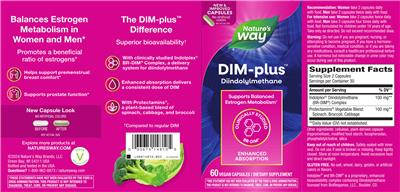
Supplement Facts
The label details for DIM-plus by Nature's Way, sourced from the NIH Dietary Supplement Label Database.
Supplement Facts
| Ingredient | Amount | % DV |
|---|---|---|
| Broccoli | 0 NP | -- |
| Spinach | 0 NP | -- |
| Protectamins Vegetable Blend | 100 mg | -- |
| Indolplex Diindolylmethane (BR-DIM) Complex | 100 mg | -- |
| Cabbage | 0 NP | -- |
Other ingredients: Cellulose, Hypromellose, Food Starch, Modified, Tocophersolan, Phosphatidylcholine, Silica
Tap any ingredient to jump to its full detail below.
These statements are the manufacturer’s wording, reproduced from the product label — the label is saying it, not HelloPharmacist. We don’t verify or endorse them.
Formulation
Balances Estrogen Metabolism in Women and Men Promotes a beneficial ratio of estrogens Helps support premenstrual breast comfort Supports prostate function
No artificial colors
Bottled and tested in the USA
Vegan Gelatin Free
Vegan Gelatin Free
The DIM-plus Difference Superior bioavailability Compared to regular DIM With clinically studied Indolplex BR-DIM Complex, a delivery system for diindolylmethane Enhanced absorption delivers a consistent dose of DIM With Protectamins, a plant-based blend of spinach, cabbage, and broccoli
Supports Balanced Estrogen Metabolism Enhanced absorption
Gluten free. No salt, wheat, dairy, gelatin, or artificial colors or flavors.
General Statements
New Capsule Look Explore more products at Naturesway.com Questions? 1-800-962-8873 / naturesway.com
New & improved capsules
Brand IP Statement(s)
Copyright 2024 Nature's Way Brands, LLC
Indolplex and BR-DIM is a proprietary, enhanced bioavailability complex containing Diindolymethane licensed from BioResponse, LLC., Boulder, CO.
Seals/Symbols
Vegan Gelatin Free
FDA Disclaimer Statement
These statements have not been evaluated by the Food & Drug Administration. This product is not intended to diagnose, treat, cure or prevent any disease.
Formula
Diindolylmethane Clinically Studied BR-DIM
FDA Statement of Identity
Dietary Supplement
Suggested/Recommended/Usage/Directions
Recommendation: Women take 2 capsules daily with food. Men take 2 capsules twice daily with food. For intensive use: Women take 2 capsules twice daily with food. Men take 2 capsules four times daily with food. Take only as directed. Do not exceed recommended dose.
Precautions
Not formulated for children under 18 years of age. Keep out of reach of children.
Take only as directed. Do not exceed recommended dose.
Warning: Do not use if you are pregnant, nursing, or attempting to become pregnant. If you have a hormone sensitive condition, medical condition, or if you are taking any medications, consult a healthcare professional before use.
A harmless but noticeable change in urine color may occur during use of this product. Safety sealed with inner seal. Do not use if seal is broken or missing.
Storage
Keep tightly closed. Store at room temperature. Avoid excessive heat and direct sunlight.
Is this label outdated? Report a formula or label change and our pharmacy team will review it.
DIM-plus by Nature's Way label
The label scan from the NIH Dietary Supplement Label Database. Tap to enlarge.
Label images are published by the NIH Dietary Supplement Label Database for the version of this product on file. Always read your actual product label.
View the full label (PDF)The Ingredients in DIM-plus by Nature's Way
These are the 4 active ingredients this product is made of. Select any to open its full monograph.
Serving size2 Capsule(s) Dosage formCapsule Servings per container30 Amounts shown are per serving.
Most supplement products combine several ingredients, and a medication can interact with the product through any one of them. Each ingredient below shows whether it has known drug interactions.
Indolplex Diindolylmethane (BR-DIM) Complex
Interacts with269 drugs
Diindolylmethane (DIM) is a compound made when your body digests cruciferous vegetables, and it is sold as a supplement mainly for hormone balance and...
Indolplex Diindolylmethane (BR-DIM) Complex monograph & interactionsOther (inactive) ingredients: Cellulose, Hypromellose, Food Starch, Modified, Tocophersolan, Phosphatidylcholine, Silica. These complete the product’s ingredient list but are not active constituents.
DIM-plus by Nature's Way Drug Interactions
HelloPharmacist Interaction Report
DIM-plus by Nature's Way contains four active ingredients, and together they interact with a substantial number of medications.
The most serious interaction we've documented is Moderate in severity: Spinach in this product contains vitamin K, which can interfere with warfarin (Coumadin), a blood thinner. Daily spinach consumption for a week can require your doctor to adjust your warfarin dose to maintain its effectiveness.
Read the full breakdown — every affected drug type, severity by severity
Broccoli and Cabbage in this formula may reduce how your body processes certain medications through liver pathways called CYP1A2 and CYP2A6. This could lower blood levels and effects of drugs metabolized by these pathways.
Cabbage also contains vitamin K and theoretically might decrease warfarin's anticoagulant effects if consumed in large amounts.
Additionally, Cabbage may increase the clearance of several other drug types: glucuronidated drugs (metabolized through a different liver pathway), acetaminophen, and oxazepam. Spinach theoretically might add to the blood-sugar-lowering effects of diabetes medications.
Diindolylmethane (the DIM ingredient) may interfere with estrogens, including hormone replacement therapy, and theoretically could increase the risk of low sodium levels if you're on certain diuretics. We could not check the Protectamins Vegetable Blend because its individual component ingredients are listed separately.
Altogether, these interactions span 399 individual medications. Use the medication checker on this page to verify your exact prescriptions before starting.
Check your own medications below · Editorial policy · How we use AI
Want to check YOUR meds against DIM-plus?
Ask about interactions with your drugs in plain English — “Can I take it with lisinopril?” — and we find you the answer in seconds, ingredient by ingredient.
Go to the checkerIngredients driving the most interactions
Individual Drug Interactions
The ingredients in DIM-plus interact with 401 drugs. Click any drug to see the details.
4 of the 4 ingredients in DIM-plus interact with drugs. Each result below shows which ingredient is responsible. Cabbage Indolplex Diindolylmethane (BR-DIM) Complex Broccoli Spinach
AcarboseGlucobay, Prandase, Precose
How Acarbose interacts with DIM-plus — through 2 ingredients. Tap an ingredient for the detail:
SpinachAntidiabetes Drugs Moderate
Interaction Summary
There are claims that spinach leaves have hypoglycemic effects.
Read the full Spinach + Acarbose interactionCabbageAntidiabetes Drugs Moderate
Interaction Summary
Theoretically, cabbage might increase the risk of hypoglycemia when taken with antidiabetes drugs.
Read the full Cabbage + Acarbose interactionAcetaminophenChildren's Tylenol, Children's Tylenol Meltaways, Tylenol, Tylenol Ex Strength
How Acetaminophen interacts with DIM-plus — through 3 ingredients. Tap an ingredient for the detail:
CabbageCytochrome P450 1a2 (cyp1a2) Substrates, Glucuronidated Drugs +1 Moderate
Interaction Summary
Theoretically, cabbage might decrease levels of drugs metabolized by CYP1A2.
Read the full Cabbage + Acetaminophen interactionBroccoliCytochrome P450 1a2 (cyp1a2) Substrates Moderate
Interaction Summary
Theoretically, broccoli might reduce the levels and effects of drugs metabolized by CYP1A2.
Read the full Broccoli + Acetaminophen interactionIndolplex Diindolylmethane (br-dim) ComplexCytochrome P450 1a2 (cyp1a2) Substrates Minor
Interaction Summary
Theoretically, diindolylmethane might lower serum levels of CYP1A2 substrates.
Read the full Indolplex Diindolylmethane (br-dim) Complex + Acetaminophen interactionAcetaminophen, AspirinGemnisyn
How Acetaminophen, Aspirin interacts with DIM-plus — through 3 ingredients. Tap an ingredient for the detail:
CabbageCytochrome P450 1a2 (cyp1a2) Substrates, Glucuronidated Drugs +1 Moderate
Interaction Summary
Theoretically, cabbage might decrease levels of drugs metabolized by CYP1A2.
Read the full Cabbage + Acetaminophen, Aspirin interactionBroccoliCytochrome P450 1a2 (cyp1a2) Substrates Moderate
Interaction Summary
Theoretically, broccoli might reduce the levels and effects of drugs metabolized by CYP1A2.
Read the full Broccoli + Acetaminophen, Aspirin interactionIndolplex Diindolylmethane (br-dim) ComplexCytochrome P450 1a2 (cyp1a2) Substrates Minor
Interaction Summary
Theoretically, diindolylmethane might lower serum levels of CYP1A2 substrates.
Read the full Indolplex Diindolylmethane (br-dim) Complex + Acetaminophen, Aspirin interactionAcetaminophen, Aspirin, CaffeineExcedrin, Excedrin Extra Strength, Excedrin Migraine
How Acetaminophen, Aspirin, Caffeine interacts with DIM-plus — through 3 ingredients. Tap an ingredient for the detail:
CabbageGlucuronidated Drugs, Acetaminophen (tylenol, Others) +1 Moderate
Interaction Summary
Theoretically, cabbage might increase clearance and decrease the effects of drugs metabolized through glucuronide conjugation.
Read the full Cabbage + Acetaminophen, Aspirin, Caffeine interactionBroccoliCytochrome P450 1a2 (cyp1a2) Substrates Moderate
Interaction Summary
Theoretically, broccoli might reduce the levels and effects of drugs metabolized by CYP1A2.
Read the full Broccoli + Acetaminophen, Aspirin, Caffeine interactionIndolplex Diindolylmethane (br-dim) ComplexCytochrome P450 1a2 (cyp1a2) Substrates Minor
Interaction Summary
Theoretically, diindolylmethane might lower serum levels of CYP1A2 substrates.
Read the full Indolplex Diindolylmethane (br-dim) Complex + Acetaminophen, Aspirin, Caffeine interactionAcetaminophen, Brompheniramine, PhenylpropanolamineDimetapp Cold and Flu
How Acetaminophen, Brompheniramine, Phenylpropanolamine interacts with DIM-plus — through 3 ingredients. Tap an ingredient for the detail:
CabbageGlucuronidated Drugs, Acetaminophen (tylenol, Others) +1 Moderate
Interaction Summary
Theoretically, cabbage might increase clearance and decrease the effects of drugs metabolized through glucuronide conjugation.
Read the full Cabbage + Acetaminophen, Brompheniramine, Phenylpropanolamine interactionBroccoliCytochrome P450 1a2 (cyp1a2) Substrates Moderate
Interaction Summary
Theoretically, broccoli might reduce the levels and effects of drugs metabolized by CYP1A2.
Read the full Broccoli + Acetaminophen, Brompheniramine, Phenylpropanolamine interactionIndolplex Diindolylmethane (br-dim) ComplexCytochrome P450 1a2 (cyp1a2) Substrates Minor
Interaction Summary
Theoretically, diindolylmethane might lower serum levels of CYP1A2 substrates.
Read the full Indolplex Diindolylmethane (br-dim) Complex + Acetaminophen, Brompheniramine, Phenylpropanolamine interactionAcetaminophen, ButalbitalAxocet, Bancap, Bucet, Butex Forte, Esgic CF, Orbivan CF +5 more
How Acetaminophen, Butalbital interacts with DIM-plus — through 3 ingredients. Tap an ingredient for the detail:
CabbageGlucuronidated Drugs, Acetaminophen (tylenol, Others) +1 Moderate
Interaction Summary
Theoretically, cabbage might increase clearance and decrease the effects of drugs metabolized through glucuronide conjugation.
Read the full Cabbage + Acetaminophen, Butalbital interactionBroccoliCytochrome P450 1a2 (cyp1a2) Substrates Moderate
Interaction Summary
Theoretically, broccoli might reduce the levels and effects of drugs metabolized by CYP1A2.
Read the full Broccoli + Acetaminophen, Butalbital interactionIndolplex Diindolylmethane (br-dim) ComplexCytochrome P450 1a2 (cyp1a2) Substrates Minor
Interaction Summary
Theoretically, diindolylmethane might lower serum levels of CYP1A2 substrates.
Read the full Indolplex Diindolylmethane (br-dim) Complex + Acetaminophen, Butalbital interactionAcetaminophen, Butalbital, CaffeineEsgic, Esgic Plus, Fiogesic, Fioricet, Repan, Tecnal +1 more
How Acetaminophen, Butalbital, Caffeine interacts with DIM-plus — through 3 ingredients. Tap an ingredient for the detail:
CabbageCytochrome P450 1a2 (cyp1a2) Substrates, Glucuronidated Drugs +1 Moderate
Interaction Summary
Theoretically, cabbage might decrease levels of drugs metabolized by CYP1A2.
Read the full Cabbage + Acetaminophen, Butalbital, Caffeine interactionBroccoliCytochrome P450 1a2 (cyp1a2) Substrates Moderate
Interaction Summary
Theoretically, broccoli might reduce the levels and effects of drugs metabolized by CYP1A2.
Read the full Broccoli + Acetaminophen, Butalbital, Caffeine interactionIndolplex Diindolylmethane (br-dim) ComplexCytochrome P450 1a2 (cyp1a2) Substrates Minor
Interaction Summary
Theoretically, diindolylmethane might lower serum levels of CYP1A2 substrates.
Read the full Indolplex Diindolylmethane (br-dim) Complex + Acetaminophen, Butalbital, Caffeine interactionAcetaminophen, Butalbital, Caffeine, CodeineEsgic with Codeine, Fioricet w/ Codeine
How Acetaminophen, Butalbital, Caffeine, Codeine interacts with DIM-plus — through 3 ingredients. Tap an ingredient for the detail:
BroccoliCytochrome P450 1a2 (cyp1a2) Substrates Moderate
Interaction Summary
Theoretically, broccoli might reduce the levels and effects of drugs metabolized by CYP1A2.
Read the full Broccoli + Acetaminophen, Butalbital, Caffeine, Codeine interactionCabbageCytochrome P450 1a2 (cyp1a2) Substrates, Glucuronidated Drugs +1 Moderate
Interaction Summary
Theoretically, cabbage might decrease levels of drugs metabolized by CYP1A2.
Read the full Cabbage + Acetaminophen, Butalbital, Caffeine, Codeine interactionIndolplex Diindolylmethane (br-dim) ComplexCytochrome P450 1a2 (cyp1a2) Substrates Minor
Interaction Summary
Theoretically, diindolylmethane might lower serum levels of CYP1A2 substrates.
Read the full Indolplex Diindolylmethane (br-dim) Complex + Acetaminophen, Butalbital, Caffeine, Codeine interactionAcetaminophen, Butalbital, CodeineBancap w/ Codeine
How Acetaminophen, Butalbital, Codeine interacts with DIM-plus — through 3 ingredients. Tap an ingredient for the detail:
CabbageGlucuronidated Drugs, Acetaminophen (tylenol, Others) +1 Moderate
Interaction Summary
Theoretically, cabbage might increase clearance and decrease the effects of drugs metabolized through glucuronide conjugation.
Read the full Cabbage + Acetaminophen, Butalbital, Codeine interactionBroccoliCytochrome P450 1a2 (cyp1a2) Substrates Moderate
Interaction Summary
Theoretically, broccoli might reduce the levels and effects of drugs metabolized by CYP1A2.
Read the full Broccoli + Acetaminophen, Butalbital, Codeine interactionIndolplex Diindolylmethane (br-dim) ComplexCytochrome P450 1a2 (cyp1a2) Substrates Minor
Interaction Summary
Theoretically, diindolylmethane might lower serum levels of CYP1A2 substrates.
Read the full Indolplex Diindolylmethane (br-dim) Complex + Acetaminophen, Butalbital, Codeine interactionAcetaminophen, Butalbital, Codeine PhosphatePhrenilin #3
How Acetaminophen, Butalbital, Codeine Phosphate interacts with DIM-plus — through 3 ingredients. Tap an ingredient for the detail:
CabbageCytochrome P450 1a2 (cyp1a2) Substrates, Glucuronidated Drugs +1 Moderate
Interaction Summary
Theoretically, cabbage might decrease levels of drugs metabolized by CYP1A2.
Read the full Cabbage + Acetaminophen, Butalbital, Codeine Phosphate interactionBroccoliCytochrome P450 1a2 (cyp1a2) Substrates Moderate
Interaction Summary
Theoretically, broccoli might reduce the levels and effects of drugs metabolized by CYP1A2.
Read the full Broccoli + Acetaminophen, Butalbital, Codeine Phosphate interactionIndolplex Diindolylmethane (br-dim) ComplexCytochrome P450 1a2 (cyp1a2) Substrates Minor
Interaction Summary
Theoretically, diindolylmethane might lower serum levels of CYP1A2 substrates.
Read the full Indolplex Diindolylmethane (br-dim) Complex + Acetaminophen, Butalbital, Codeine Phosphate interactionAcetaminophen, Caffeine, Chlorpheniramine, Hydrocodone, PhenylephrineHycomine Compound
How Acetaminophen, Caffeine, Chlorpheniramine, Hydrocodone, Phenylephrine interacts with DIM-plus — through 3 ingredients. Tap an ingredient for the detail:
BroccoliCytochrome P450 1a2 (cyp1a2) Substrates Moderate
Interaction Summary
Theoretically, broccoli might reduce the levels and effects of drugs metabolized by CYP1A2.
Read the full Broccoli + Acetaminophen, Caffeine, Chlorpheniramine, Hydrocodone, Phenylephrine interactionCabbageCytochrome P450 1a2 (cyp1a2) Substrates, Glucuronidated Drugs +1 Moderate
Interaction Summary
Theoretically, cabbage might decrease levels of drugs metabolized by CYP1A2.
Read the full Cabbage + Acetaminophen, Caffeine, Chlorpheniramine, Hydrocodone, Phenylephrine interactionIndolplex Diindolylmethane (br-dim) ComplexCytochrome P450 1a2 (cyp1a2) Substrates Minor
Interaction Summary
Theoretically, diindolylmethane might lower serum levels of CYP1A2 substrates.
Read the full Indolplex Diindolylmethane (br-dim) Complex + Acetaminophen, Caffeine, Chlorpheniramine, Hydrocodone, Phenylephrine interactionAcetaminophen, Caffeine, CodeineGesic C15, Gesic C30, Gesic C8, Lenoltec 1, Lenoltec 2, Lenoltec 3 +1 more
How Acetaminophen, Caffeine, Codeine interacts with DIM-plus — through 3 ingredients. Tap an ingredient for the detail:
CabbageGlucuronidated Drugs, Acetaminophen (tylenol, Others) +1 Moderate
Interaction Summary
Theoretically, cabbage might increase clearance and decrease the effects of drugs metabolized through glucuronide conjugation.
Read the full Cabbage + Acetaminophen, Caffeine, Codeine interactionBroccoliCytochrome P450 1a2 (cyp1a2) Substrates Moderate
Interaction Summary
Theoretically, broccoli might reduce the levels and effects of drugs metabolized by CYP1A2.
Read the full Broccoli + Acetaminophen, Caffeine, Codeine interactionIndolplex Diindolylmethane (br-dim) ComplexCytochrome P450 1a2 (cyp1a2) Substrates Minor
Interaction Summary
Theoretically, diindolylmethane might lower serum levels of CYP1A2 substrates.
Read the full Indolplex Diindolylmethane (br-dim) Complex + Acetaminophen, Caffeine, Codeine interactionAcetaminophen, Caffeine, Codeine, SalicylamideCodalan No.1, Codalan No.2, Codalan No.3
How Acetaminophen, Caffeine, Codeine, Salicylamide interacts with DIM-plus — through 3 ingredients. Tap an ingredient for the detail:
CabbageCytochrome P450 1a2 (cyp1a2) Substrates, Glucuronidated Drugs +1 Moderate
Interaction Summary
Theoretically, cabbage might decrease levels of drugs metabolized by CYP1A2.
Read the full Cabbage + Acetaminophen, Caffeine, Codeine, Salicylamide interactionBroccoliCytochrome P450 1a2 (cyp1a2) Substrates Moderate
Interaction Summary
Theoretically, broccoli might reduce the levels and effects of drugs metabolized by CYP1A2.
Read the full Broccoli + Acetaminophen, Caffeine, Codeine, Salicylamide interactionIndolplex Diindolylmethane (br-dim) ComplexCytochrome P450 1a2 (cyp1a2) Substrates Minor
Interaction Summary
Theoretically, diindolylmethane might lower serum levels of CYP1A2 substrates.
Read the full Indolplex Diindolylmethane (br-dim) Complex + Acetaminophen, Caffeine, Codeine, Salicylamide interactionAcetaminophen, Caffeine, DihydrocodeineDHC Plus, Panlor DC, Panlor SS
How Acetaminophen, Caffeine, Dihydrocodeine interacts with DIM-plus — through 3 ingredients. Tap an ingredient for the detail:
BroccoliCytochrome P450 1a2 (cyp1a2) Substrates Moderate
Interaction Summary
Theoretically, broccoli might reduce the levels and effects of drugs metabolized by CYP1A2.
Read the full Broccoli + Acetaminophen, Caffeine, Dihydrocodeine interactionCabbageCytochrome P450 1a2 (cyp1a2) Substrates, Glucuronidated Drugs +1 Moderate
Interaction Summary
Theoretically, cabbage might decrease levels of drugs metabolized by CYP1A2.
Read the full Cabbage + Acetaminophen, Caffeine, Dihydrocodeine interactionIndolplex Diindolylmethane (br-dim) ComplexCytochrome P450 1a2 (cyp1a2) Substrates Minor
Interaction Summary
Theoretically, diindolylmethane might lower serum levels of CYP1A2 substrates.
Read the full Indolplex Diindolylmethane (br-dim) Complex + Acetaminophen, Caffeine, Dihydrocodeine interactionAcetaminophen, Caffeine, IsomethepteneMigralam
How Acetaminophen, Caffeine, Isometheptene interacts with DIM-plus — through 3 ingredients. Tap an ingredient for the detail:
CabbageGlucuronidated Drugs, Acetaminophen (tylenol, Others) +1 Moderate
Interaction Summary
Theoretically, cabbage might increase clearance and decrease the effects of drugs metabolized through glucuronide conjugation.
Read the full Cabbage + Acetaminophen, Caffeine, Isometheptene interactionBroccoliCytochrome P450 1a2 (cyp1a2) Substrates Moderate
Interaction Summary
Theoretically, broccoli might reduce the levels and effects of drugs metabolized by CYP1A2.
Read the full Broccoli + Acetaminophen, Caffeine, Isometheptene interactionIndolplex Diindolylmethane (br-dim) ComplexCytochrome P450 1a2 (cyp1a2) Substrates Minor
Interaction Summary
Theoretically, diindolylmethane might lower serum levels of CYP1A2 substrates.
Read the full Indolplex Diindolylmethane (br-dim) Complex + Acetaminophen, Caffeine, Isometheptene interactionAcetaminophen, Caffeine, PyrilamineMidol Max Strength Menstrual
How Acetaminophen, Caffeine, Pyrilamine interacts with DIM-plus — through 3 ingredients. Tap an ingredient for the detail:
CabbageCytochrome P450 1a2 (cyp1a2) Substrates, Glucuronidated Drugs +1 Moderate
Interaction Summary
Theoretically, cabbage might decrease levels of drugs metabolized by CYP1A2.
Read the full Cabbage + Acetaminophen, Caffeine, Pyrilamine interactionBroccoliCytochrome P450 1a2 (cyp1a2) Substrates Moderate
Interaction Summary
Theoretically, broccoli might reduce the levels and effects of drugs metabolized by CYP1A2.
Read the full Broccoli + Acetaminophen, Caffeine, Pyrilamine interactionIndolplex Diindolylmethane (br-dim) ComplexDiuretic Drugs, Cytochrome P450 1a2 (cyp1a2) Substrates Moderate
Interaction Summary
Theoretically, diindolylmethane might increase the risk of hyponatremia if used with sodium-depleting diuretics.
Read the full Indolplex Diindolylmethane (br-dim) Complex + Acetaminophen, Caffeine, Pyrilamine interactionAcetaminophen, Chlorpheniramine Maleate, Dextromethorphan HbrVicks Formula 44M Cough, Cold & Flu Relief
How Acetaminophen, Chlorpheniramine Maleate, Dextromethorphan Hbr interacts with DIM-plus — through 3 ingredients. Tap an ingredient for the detail:
CabbageAcetaminophen (tylenol, Others), Cytochrome P450 1a2 (cyp1a2) Substrates +1 Moderate
Interaction Summary
Cabbage might increase clearance and reduce the effects of acetaminophen.
Read the full Cabbage + Acetaminophen, Chlorpheniramine Maleate, Dextromethorphan Hbr interactionBroccoliCytochrome P450 1a2 (cyp1a2) Substrates Moderate
Interaction Summary
Theoretically, broccoli might reduce the levels and effects of drugs metabolized by CYP1A2.
Read the full Broccoli + Acetaminophen, Chlorpheniramine Maleate, Dextromethorphan Hbr interactionIndolplex Diindolylmethane (br-dim) ComplexCytochrome P450 1a2 (cyp1a2) Substrates Minor
Interaction Summary
Theoretically, diindolylmethane might lower serum levels of CYP1A2 substrates.
Read the full Indolplex Diindolylmethane (br-dim) Complex + Acetaminophen, Chlorpheniramine Maleate, Dextromethorphan Hbr interactionAcetaminophen, Chlorpheniramine, Codeine, PhenylephrineColrex
How Acetaminophen, Chlorpheniramine, Codeine, Phenylephrine interacts with DIM-plus — through 3 ingredients. Tap an ingredient for the detail:
CabbageGlucuronidated Drugs, Acetaminophen (tylenol, Others) +1 Moderate
Interaction Summary
Theoretically, cabbage might increase clearance and decrease the effects of drugs metabolized through glucuronide conjugation.
Read the full Cabbage + Acetaminophen, Chlorpheniramine, Codeine, Phenylephrine interactionBroccoliCytochrome P450 1a2 (cyp1a2) Substrates Moderate
Interaction Summary
Theoretically, broccoli might reduce the levels and effects of drugs metabolized by CYP1A2.
Read the full Broccoli + Acetaminophen, Chlorpheniramine, Codeine, Phenylephrine interactionIndolplex Diindolylmethane (br-dim) ComplexCytochrome P450 1a2 (cyp1a2) Substrates Minor
Interaction Summary
Theoretically, diindolylmethane might lower serum levels of CYP1A2 substrates.
Read the full Indolplex Diindolylmethane (br-dim) Complex + Acetaminophen, Chlorpheniramine, Codeine, Phenylephrine interactionAcetaminophen, Chlorpheniramine, DextromethorphanCoricidin II Extra Strength Cold and Flu
How Acetaminophen, Chlorpheniramine, Dextromethorphan interacts with DIM-plus — through 3 ingredients. Tap an ingredient for the detail:
CabbageAcetaminophen (tylenol, Others), Glucuronidated Drugs +1 Moderate
Interaction Summary
Cabbage might increase clearance and reduce the effects of acetaminophen.
Read the full Cabbage + Acetaminophen, Chlorpheniramine, Dextromethorphan interactionBroccoliCytochrome P450 1a2 (cyp1a2) Substrates Moderate
Interaction Summary
Theoretically, broccoli might reduce the levels and effects of drugs metabolized by CYP1A2.
Read the full Broccoli + Acetaminophen, Chlorpheniramine, Dextromethorphan interactionIndolplex Diindolylmethane (br-dim) ComplexCytochrome P450 1a2 (cyp1a2) Substrates Minor
Interaction Summary
Theoretically, diindolylmethane might lower serum levels of CYP1A2 substrates.
Read the full Indolplex Diindolylmethane (br-dim) Complex + Acetaminophen, Chlorpheniramine, Dextromethorphan interactionAcetaminophen, Chlorpheniramine, Dextromethorphan HydrobromideCoricidin HBP Maximum Strength Flu
How Acetaminophen, Chlorpheniramine, Dextromethorphan Hydrobromide interacts with DIM-plus — through 3 ingredients. Tap an ingredient for the detail:
BroccoliCytochrome P450 1a2 (cyp1a2) Substrates Moderate
Interaction Summary
Theoretically, broccoli might reduce the levels and effects of drugs metabolized by CYP1A2.
Read the full Broccoli + Acetaminophen, Chlorpheniramine, Dextromethorphan Hydrobromide interactionCabbageGlucuronidated Drugs, Acetaminophen (tylenol, Others) +1 Moderate
Interaction Summary
Theoretically, cabbage might increase clearance and decrease the effects of drugs metabolized through glucuronide conjugation.
Read the full Cabbage + Acetaminophen, Chlorpheniramine, Dextromethorphan Hydrobromide interactionIndolplex Diindolylmethane (br-dim) ComplexCytochrome P450 1a2 (cyp1a2) Substrates Minor
Interaction Summary
Theoretically, diindolylmethane might lower serum levels of CYP1A2 substrates.
Read the full Indolplex Diindolylmethane (br-dim) Complex + Acetaminophen, Chlorpheniramine, Dextromethorphan Hydrobromide interactionAcetaminophen, Chlorpheniramine, Dextromethorphan, PhenylpropanolamineMulti Symptom Cold Relief
How Acetaminophen, Chlorpheniramine, Dextromethorphan, Phenylpropanolamine interacts with DIM-plus — through 3 ingredients. Tap an ingredient for the detail:
CabbageCytochrome P450 1a2 (cyp1a2) Substrates, Glucuronidated Drugs +1 Moderate
Interaction Summary
Theoretically, cabbage might decrease levels of drugs metabolized by CYP1A2.
Read the full Cabbage + Acetaminophen, Chlorpheniramine, Dextromethorphan, Phenylpropanolamine interactionBroccoliCytochrome P450 1a2 (cyp1a2) Substrates Moderate
Interaction Summary
Theoretically, broccoli might reduce the levels and effects of drugs metabolized by CYP1A2.
Read the full Broccoli + Acetaminophen, Chlorpheniramine, Dextromethorphan, Phenylpropanolamine interactionIndolplex Diindolylmethane (br-dim) ComplexCytochrome P450 1a2 (cyp1a2) Substrates Minor
Interaction Summary
Theoretically, diindolylmethane might lower serum levels of CYP1A2 substrates.
Read the full Indolplex Diindolylmethane (br-dim) Complex + Acetaminophen, Chlorpheniramine, Dextromethorphan, Phenylpropanolamine interactionAcetaminophen, Chlorpheniramine, Dextromethorphan, PseudoephedrineChildren's Tylenol Cold Plus Cough, Tylenol Cold Ex Strength
How Acetaminophen, Chlorpheniramine, Dextromethorphan, Pseudoephedrine interacts with DIM-plus — through 3 ingredients. Tap an ingredient for the detail:
BroccoliCytochrome P450 1a2 (cyp1a2) Substrates Moderate
Interaction Summary
Theoretically, broccoli might reduce the levels and effects of drugs metabolized by CYP1A2.
Read the full Broccoli + Acetaminophen, Chlorpheniramine, Dextromethorphan, Pseudoephedrine interactionCabbageCytochrome P450 1a2 (cyp1a2) Substrates, Glucuronidated Drugs +1 Moderate
Interaction Summary
Theoretically, cabbage might decrease levels of drugs metabolized by CYP1A2.
Read the full Cabbage + Acetaminophen, Chlorpheniramine, Dextromethorphan, Pseudoephedrine interactionIndolplex Diindolylmethane (br-dim) ComplexCytochrome P450 1a2 (cyp1a2) Substrates Minor
Interaction Summary
Theoretically, diindolylmethane might lower serum levels of CYP1A2 substrates.
Read the full Indolplex Diindolylmethane (br-dim) Complex + Acetaminophen, Chlorpheniramine, Dextromethorphan, Pseudoephedrine interactionAcetaminophen, Chlorpheniramine, Guaifenesin, Phenylephrine, SalicylamideRhinogesic GG
How Acetaminophen, Chlorpheniramine, Guaifenesin, Phenylephrine, Salicylamide interacts with DIM-plus — through 3 ingredients. Tap an ingredient for the detail:
CabbageGlucuronidated Drugs, Acetaminophen (tylenol, Others) +1 Moderate
Interaction Summary
Theoretically, cabbage might increase clearance and decrease the effects of drugs metabolized through glucuronide conjugation.
Read the full Cabbage + Acetaminophen, Chlorpheniramine, Guaifenesin, Phenylephrine, Salicylamide interactionBroccoliCytochrome P450 1a2 (cyp1a2) Substrates Moderate
Interaction Summary
Theoretically, broccoli might reduce the levels and effects of drugs metabolized by CYP1A2.
Read the full Broccoli + Acetaminophen, Chlorpheniramine, Guaifenesin, Phenylephrine, Salicylamide interactionIndolplex Diindolylmethane (br-dim) ComplexCytochrome P450 1a2 (cyp1a2) Substrates Minor
Interaction Summary
Theoretically, diindolylmethane might lower serum levels of CYP1A2 substrates.
Read the full Indolplex Diindolylmethane (br-dim) Complex + Acetaminophen, Chlorpheniramine, Guaifenesin, Phenylephrine, Salicylamide interactionAcetaminophen, Chlorpheniramine, PhenylephrineAlka-Seltzer PLUS, Histex SR, Protid
How Acetaminophen, Chlorpheniramine, Phenylephrine interacts with DIM-plus — through 3 ingredients. Tap an ingredient for the detail:
CabbageCytochrome P450 1a2 (cyp1a2) Substrates, Glucuronidated Drugs +1 Moderate
Interaction Summary
Theoretically, cabbage might decrease levels of drugs metabolized by CYP1A2.
Read the full Cabbage + Acetaminophen, Chlorpheniramine, Phenylephrine interactionBroccoliCytochrome P450 1a2 (cyp1a2) Substrates Moderate
Interaction Summary
Theoretically, broccoli might reduce the levels and effects of drugs metabolized by CYP1A2.
Read the full Broccoli + Acetaminophen, Chlorpheniramine, Phenylephrine interactionIndolplex Diindolylmethane (br-dim) ComplexCytochrome P450 1a2 (cyp1a2) Substrates Minor
Interaction Summary
Theoretically, diindolylmethane might lower serum levels of CYP1A2 substrates.
Read the full Indolplex Diindolylmethane (br-dim) Complex + Acetaminophen, Chlorpheniramine, Phenylephrine interactionAcetaminophen, Chlorpheniramine, Phenylephrine, SalicylamideRhinogesic, Rhinogesic JR
How Acetaminophen, Chlorpheniramine, Phenylephrine, Salicylamide interacts with DIM-plus — through 3 ingredients. Tap an ingredient for the detail:
CabbageAcetaminophen (tylenol, Others), Glucuronidated Drugs +1 Moderate
Interaction Summary
Cabbage might increase clearance and reduce the effects of acetaminophen.
Read the full Cabbage + Acetaminophen, Chlorpheniramine, Phenylephrine, Salicylamide interactionBroccoliCytochrome P450 1a2 (cyp1a2) Substrates Moderate
Interaction Summary
Theoretically, broccoli might reduce the levels and effects of drugs metabolized by CYP1A2.
Read the full Broccoli + Acetaminophen, Chlorpheniramine, Phenylephrine, Salicylamide interactionIndolplex Diindolylmethane (br-dim) ComplexCytochrome P450 1a2 (cyp1a2) Substrates Minor
Interaction Summary
Theoretically, diindolylmethane might lower serum levels of CYP1A2 substrates.
Read the full Indolplex Diindolylmethane (br-dim) Complex + Acetaminophen, Chlorpheniramine, Phenylephrine, Salicylamide interactionAcetaminophen, Chlorpheniramine, PhenylpropanolamineAlumadrine, Conex, Sinadrin Max Strength, Sinulin
How Acetaminophen, Chlorpheniramine, Phenylpropanolamine interacts with DIM-plus — through 3 ingredients. Tap an ingredient for the detail:
BroccoliCytochrome P450 1a2 (cyp1a2) Substrates Moderate
Interaction Summary
Theoretically, broccoli might reduce the levels and effects of drugs metabolized by CYP1A2.
Read the full Broccoli + Acetaminophen, Chlorpheniramine, Phenylpropanolamine interactionCabbageGlucuronidated Drugs, Acetaminophen (tylenol, Others) +1 Moderate
Interaction Summary
Theoretically, cabbage might increase clearance and decrease the effects of drugs metabolized through glucuronide conjugation.
Read the full Cabbage + Acetaminophen, Chlorpheniramine, Phenylpropanolamine interactionIndolplex Diindolylmethane (br-dim) ComplexCytochrome P450 1a2 (cyp1a2) Substrates Minor
Interaction Summary
Theoretically, diindolylmethane might lower serum levels of CYP1A2 substrates.
Read the full Indolplex Diindolylmethane (br-dim) Complex + Acetaminophen, Chlorpheniramine, Phenylpropanolamine interactionAcetaminophen, Chlorpheniramine, Phenylpropanolamine, OpiumHista-Derfule
How Acetaminophen, Chlorpheniramine, Phenylpropanolamine, Opium interacts with DIM-plus — through 3 ingredients. Tap an ingredient for the detail:
CabbageCytochrome P450 1a2 (cyp1a2) Substrates, Glucuronidated Drugs +1 Moderate
Interaction Summary
Theoretically, cabbage might decrease levels of drugs metabolized by CYP1A2.
Read the full Cabbage + Acetaminophen, Chlorpheniramine, Phenylpropanolamine, Opium interactionBroccoliCytochrome P450 1a2 (cyp1a2) Substrates Moderate
Interaction Summary
Theoretically, broccoli might reduce the levels and effects of drugs metabolized by CYP1A2.
Read the full Broccoli + Acetaminophen, Chlorpheniramine, Phenylpropanolamine, Opium interactionIndolplex Diindolylmethane (br-dim) ComplexCytochrome P450 1a2 (cyp1a2) Substrates Minor
Interaction Summary
Theoretically, diindolylmethane might lower serum levels of CYP1A2 substrates.
Read the full Indolplex Diindolylmethane (br-dim) Complex + Acetaminophen, Chlorpheniramine, Phenylpropanolamine, Opium interactionAcetaminophen, Chlorpheniramine, Phenylpropanolamine, PhenyltoloxamineNorel Plus
How Acetaminophen, Chlorpheniramine, Phenylpropanolamine, Phenyltoloxamine interacts with DIM-plus — through 3 ingredients. Tap an ingredient for the detail:
CabbageGlucuronidated Drugs, Acetaminophen (tylenol, Others) +1 Moderate
Interaction Summary
Theoretically, cabbage might increase clearance and decrease the effects of drugs metabolized through glucuronide conjugation.
Read the full Cabbage + Acetaminophen, Chlorpheniramine, Phenylpropanolamine, Phenyltoloxamine interactionBroccoliCytochrome P450 1a2 (cyp1a2) Substrates Moderate
Interaction Summary
Theoretically, broccoli might reduce the levels and effects of drugs metabolized by CYP1A2.
Read the full Broccoli + Acetaminophen, Chlorpheniramine, Phenylpropanolamine, Phenyltoloxamine interactionIndolplex Diindolylmethane (br-dim) ComplexCytochrome P450 1a2 (cyp1a2) Substrates Minor
Interaction Summary
Theoretically, diindolylmethane might lower serum levels of CYP1A2 substrates.
Read the full Indolplex Diindolylmethane (br-dim) Complex + Acetaminophen, Chlorpheniramine, Phenylpropanolamine, Phenyltoloxamine interactionAcetaminophen, Chlorpheniramine, PseudoephedrineAlka-Seltzer PLUS Liquid Gels, Children's Tylenol Cold, Codimal, Comtrex, Extra Strength Tylenol Allergy Sinus, Lorsin +3 more
How Acetaminophen, Chlorpheniramine, Pseudoephedrine interacts with DIM-plus — through 3 ingredients. Tap an ingredient for the detail:
CabbageCytochrome P450 1a2 (cyp1a2) Substrates, Glucuronidated Drugs +1 Moderate
Interaction Summary
Theoretically, cabbage might decrease levels of drugs metabolized by CYP1A2.
Read the full Cabbage + Acetaminophen, Chlorpheniramine, Pseudoephedrine interactionBroccoliCytochrome P450 1a2 (cyp1a2) Substrates Moderate
Interaction Summary
Theoretically, broccoli might reduce the levels and effects of drugs metabolized by CYP1A2.
Read the full Broccoli + Acetaminophen, Chlorpheniramine, Pseudoephedrine interactionIndolplex Diindolylmethane (br-dim) ComplexCytochrome P450 1a2 (cyp1a2) Substrates Minor
Interaction Summary
Theoretically, diindolylmethane might lower serum levels of CYP1A2 substrates.
Read the full Indolplex Diindolylmethane (br-dim) Complex + Acetaminophen, Chlorpheniramine, Pseudoephedrine interactionAcetaminophen, ChlorzoxazoneAcetazone Forte, Extra Strength Tylenol Aches & Strains, Parafon Forte
How Acetaminophen, Chlorzoxazone interacts with DIM-plus — through 3 ingredients. Tap an ingredient for the detail:
CabbageGlucuronidated Drugs, Acetaminophen (tylenol, Others) +1 Moderate
Interaction Summary
Theoretically, cabbage might increase clearance and decrease the effects of drugs metabolized through glucuronide conjugation.
Read the full Cabbage + Acetaminophen, Chlorzoxazone interactionBroccoliCytochrome P450 1a2 (cyp1a2) Substrates Moderate
Interaction Summary
Theoretically, broccoli might reduce the levels and effects of drugs metabolized by CYP1A2.
Read the full Broccoli + Acetaminophen, Chlorzoxazone interactionIndolplex Diindolylmethane (br-dim) ComplexCytochrome P450 1a2 (cyp1a2) Substrates Minor
Interaction Summary
Theoretically, diindolylmethane might lower serum levels of CYP1A2 substrates.
Read the full Indolplex Diindolylmethane (br-dim) Complex + Acetaminophen, Chlorzoxazone interactionEach ingredient & the kinds of drugs it affects
For each ingredient in DIM-plus with known interactions, here are the types of medications they can affect. Open any type for the detail — or search your exact drug in the checker above.
Cabbage
Acetaminophen (Tylenol, Others)
Cabbage might increase clearance and reduce the effects of acetaminophen.
A small clinical study shows that daily consumption of cabbage and Brussels sprout decreases acetaminophen levels by as much as 16%, with some evidence suggesting that this effect is due to increased elimination through glucuronide conjugation.
Antidiabetes Drugs
Theoretically, cabbage might increase the risk of hypoglycemia when taken with antidiabetes drugs.
Animal and in vivo research suggests that cabbage might have hypoglycemic effects.
Cytochrome P450 1A2 (Cyp1A2) Substrates
Theoretically, cabbage might decrease levels of drugs metabolized by CYP1A2.
Some animal research suggests that cabbage or its constituent indole-3-carbinol might increase drug metabolism and elimination by stimulating CYP1A2 activity.
Glucuronidated Drugs
Theoretically, cabbage might increase clearance and decrease the effects of drugs metabolized through glucuronide conjugation.
A small clinical study shows that daily consumption of cabbage and Brussels sprout decreases levels of some drugs metabolized through glucuronide conjugation.
Oxazepam (Serax)
Cabbage might increase clearance and reduce the effects of oxazepam.
A small clinical study shows that daily consumption of cabbage and brussels sprout decreases oxazepam levels by as much as 17%, with some evidence suggesting that this effect is due to increased elimination through glucuronide conjugation.
Warfarin (Coumadin)
Theoretically, cabbage might decrease the anticoagulant effects of warfarin.
Cabbage contains vitamin K. If consumed in large quantities, cabbage might decrease the anticoagulant effects of warfarin.
Indolplex Diindolylmethane (BR-DIM) Complex
Diuretic Drugs
Theoretically, diindolylmethane might increase the risk of hyponatremia if used with sodium-depleting diuretics.
Large doses of diindolylmethane (600 mg daily) have been associated with two cases of asymptomatic hyponatremia in clinical research.
Estrogens
Theoretically, diindolylmethane might increase or decrease the effects of estrogens.
Diindolylmethane might have mild estrogenic or antiestrogenic effects. Theoretically, large amounts of diindolylmethane might interfere with hormone replacement therapy.
Cytochrome P450 1A2 (Cyp1A2) Substrates
Theoretically, diindolylmethane might lower serum levels of CYP1A2 substrates.
In vitro evidence suggests that diindolylmethane can induce CYP1A2. Theoretically, it might increase metabolism of CYP1A2 substrates and lower serum concentrations. This interaction has not been reported in humans.
Broccoli
Cytochrome P450 1A2 (Cyp1A2) Substrates
Theoretically, broccoli might reduce the levels and effects of drugs metabolized by CYP1A2.
Pharmacokinetic research in humans shows that eating 500 grams of fresh broccoli daily for 6-12 days can increase CYP1A2 activity by 10% to 200%. Induction of CYP1A2 activity by broccoli is attributed to its glucosinolate constituents.
Cytochrome P450 2A6 (Cyp2A6) Substrates
Theoretically, broccoli might reduce the levels and effects of drugs metabolized by CYP2A6.
Pharmacokinetic research in humans shows that eating 500 grams of broccoli daily for 6 days increases CYP2A6 activity by 135% to 550%. Induction of CYP2A6 activity is attributed to its glucosinolate constituents.
Spinach
Antidiabetes Drugs
There are claims that spinach leaves have hypoglycemic effects. Evidence from clinical research suggests that consumption of a spinach-rich meal reduces post-meal blood glucose levels. Theoretically, spinach might have additive effects with antidiabetes drugs and increase the risk of hypoglycemia. Monitor blood glucose levels closely. Dose adjustments might be necessary. Some antidiabetes drugs include glimepiride (Amaryl), glyburide (DiaBeta, Glynase PresTab, Micronase), insulin, pioglitazone (Actos), rosiglitazone (Avandia), and others.
Warfarin (Coumadin)
Spinach contains vitamin K, which can interfere with the activity of warfarin.
In human research, although eating spinach with one meal does not result in coagulation test results outside the therapeutic range, daily consumption for one week necessitates dose adjustment of warfarin. Individuals using anticoagulants should consume a consistent daily amount of spinach to maintain the effect of anticoagulant therapy.
Brand information
Manufacturer and brand details for DIM-plus, from the product label.
Nature's Way
See all Nature's Way products- Name
- Nature's Way Brands, LLC
- City
- Green Bay
- State
- WI
- ZipCode
- 54311
- Phone Number
- 1-800-962-8873
- Web Address
- naturesway.com
DIM-plus by Nature's Way: Common Questions
Does DIM-plus by Nature's Way interact with any medications?
How can one product interact with so many drugs?
Where does this information come from?
Is DIM-plus safe to take if I'm pregnant or breastfeeding?
What are the most common side effects I might experience?
Will this product actually help with cancer prevention or other health conditions?
Why does this product interact with so many medications?
Can I take DIM-plus with my blood thinner?
What is diindolylmethane (DIM), and what is it supposed to do?
Written and reviewed by the HelloPharmacist editorial staff. Our editorial policy
Not sure if DIM-plus is safe with your meds?
Our pharmacists answer your medication & supplement questions — free.
Label information is sourced from the NIH Dietary Supplement Label Database and reflects the product version on file; always read your actual product label. This page is for education only and is not a substitute for professional medical advice. Confirm with your pharmacist or doctor before combining supplements and medications.
The Full Monographs Behind DIM-plus’s Ingredients
Every ingredient we hold a full HelloPharmacist monograph for — uses, evidence, safety, and the complete interaction list.
Broccoli
Interacts with 187 drugsBroccoli is a nutritious cruciferous vegetable rich in fiber, vitamins, and plant compounds like sulforaphane that have drawn scientific interest for health benefits. Eating broccoli as food...
Read the full Broccoli monograph → Herb & supplement monographSpinach
Interacts with 88 drugsSpinach is a nutrient-dense leafy green that is a healthy part of a balanced diet, providing vitamins, minerals, fiber, and antioxidants. While it is very safe as a food, concentrated supple...
Read the full Spinach monograph → Herb & supplement monographCabbage
Interacts with 325 drugsCabbage is a nutritious, low-calorie vegetable that is safe to eat as food and is sometimes applied to the skin as a leaf wrap for breast engorgement or sore joints. Most medicinal claims ar...
Read the full Cabbage monograph → Herb & supplement monographDiindolylmethane
Interacts with 269 drugsDiindolylmethane (DIM) is a compound made when your body digests cruciferous vegetables, and it is sold as a supplement mainly for hormone balance and cancer prevention. Although early lab s...
Read the full Diindolylmethane monograph →Sources & How We Checked
DIM-plus's label data comes from the NIH Dietary Supplement Label Database; the ingredient interaction data is from the Natural Medicines database, reviewed by our pharmacists.
- NIH Dietary Supplement Label Database (DSLD) — The official product label on file for this supplement.
- Natural Medicines (Therapeutic Research Center) — Evidence-graded clinical reference behind the ingredient interaction data.
Content is written and reviewed by licensed HelloPharmacist pharmacists. See our data sources and editorial standards for how this information is built and checked.
The 40 references behind this product’s interaction data
Every citation that drives the interaction findings for this product’s ingredients, from the evidence-graded Natural Medicines (TRC Healthcare) database. Open an ingredient to browse its citations — links open the study on PubMed or the publisher’s site.
Broccoli 5 references
- Kristal AR, Lampe JW. Brassica vegetables and prostate cancer risk: a review of the epidemiological evidence. Nutr Cancer 2002;42:1-9. PubMed
- Chakrabarti A, Prais L, Foulds IS. Allergic contact dermatitis to broccoli. Br J Dermatol 2003;148:172-3. PubMed
- Hakooz, N. and Hamdan, I. Effects of dietary broccoli on human in vivo caffeine metabolism: a pilot study on a group of Jordanian volunteers. Curr Drug Metab 2007;8(1):9-15. PubMed
- Kall MA, Vang O, Clausen J. Effects of dietary broccoli on human drug metabolising activity. Cancer Lett. 1997;114(1-2):169-70. PubMed
- Bauman JE, Hsu CH, Centuori S, et al. Randomized Crossover Trial Evaluating Detoxification of Tobacco Carcinogens by Broccoli Seed and Sprout Extract in Current Smokers. Cancers (Basel). 2022;14(9):2129. Published 2022 Apr 24. PubMed
Spinach 6 references
- Brinker F. Herb Contraindications and Drug Interactions. 2nd ed. Sandy, OR: Eclectic Medical Publications, 1998.
- Karlson, B., Leijd, B., and Hellstrom, K. On the influence of vitamin K-rich vegetables and wine on the effectiveness of warfarin treatment. Acta Med Scand. 1986;220(4):347-350. PubMed
- Roller, E., Meller, S., Homey, B., Ruzicka, T., and Neumann, N. J. [Contact dermatitis caused by spinach, hedge mustard and chives]. Hautarzt 2003;54(4):374-375.
- Schuller, A., Morisset, M., Maadi, F., Kolopp Sarda, M. N., Fremont, S., Parisot, L., Kanny, G., and Moneret-Vautrin, D. A. Occupational asthma due to allergy to spinach powder in a pasta factory. Allergy 2005;60(3):408-409. PubMed
- Gustafsson, K., Asp, N. G., Hagander, B., and Nyman, M. Satiety effects of spinach in mixed meals: comparison with other vegetables. Int.J.Food Sci.Nutr. 1995;46(4):327-334. PubMed
- Schreiber, J., Muller, E., Becker, W. M., Zabel, P., Schlaak, M., and Amthor, M. [Spinach powder-induced exogenous allergic alveolitis]. Pneumologie 1998;52(1):61-65.
Diindolylmethane 14 references
- Natl Inst Health, Natl Inst Environmental Health Sci. Indole-3-carbinol. Available at: http://ntp-server.niehs.nih.gov.
- Balk JL. Indole-3-carbinol for cancer prevention. Altern Med Alert 2000; 3:105-7.
- Riby JE, Chang GHF, Firestone GL, Bjeldanes LF. Ligand-independent activation of estrogen receptor function by 3,3'-diindolylmethane in human breast cancer cells. Biochem Pharmacol 2000;60:167-77. PubMed
- Lake BG, Tredger JM, Renwick AB, et al. 3'3-diindolylmethane induces CYP1A2 in cultured precision-cut human liver slices. Xenobiotica 1998;28:803-11. PubMed
- Dalessandri, K. M., Firestone, G. L., Fitch, M. D., Bradlow, H. L., and Bjeldanes, L. F. Pilot study: effect of 3,3'-diindolylmethane supplements on urinary hormone metabolites in postmenopausal women with a history of early-stage breast cancer. Nutr Canc PubMed
- Reed, G. A., Arneson, D. W., Putnam, W. C., Smith, H. J., Gray, J. C., Sullivan, D. K., Mayo, M. S., Crowell, J. A., and Hurwitz, A. Single-dose and multiple-dose administration of indole-3-carbinol to women: pharmacokinetics based on 3,3'-diindolylmetha
- Reed, G. A., Sunega, J. M., Sullivan, D. K., Gray, J. C., Mayo, M. S., Crowell, J. A., and Hurwitz, A. Single-dose pharmacokinetics and tolerability of absorption-enhanced 3,3'-diindolylmethane in healthy subjects. Cancer Epidemiol.Biomarkers Prev. 2008; PubMed
- Del Priore G., Gudipudi, D. K., Montemarano, N., Restivo, A. M., Malanowska-Stega, J., and Arslan, A. A. Oral diindolylmethane (DIM): pilot evaluation of a nonsurgical treatment for cervical dysplasia. Gynecol.Oncol. 2010;116(3):464-467. PubMed
- Heath, E. I., Heilbrun, L. K., Li, J., Vaishampayan, U., Harper, F., Pemberton, P., and Sarkar, F. H. A phase I dose-escalation study of oral BR-DIM (BioResponse 3,3'- Diindolylmethane) in castrate-resistant, non-metastatic prostate cancer. Am.J.Transl.R
- Jellinck, P. H., Forkert, P. G., Riddick, D. S., Okey, A. B., Michnovicz, J. J., and Bradlow, H. L. Ah receptor binding properties of indole carbinols and induction of hepatic estradiol hydroxylation. Biochem.Pharmacol. 3-9-1993;45(5):1129-1136. PubMed
- Bui PV, Moualla M, Upson DJ. A Possible Association of Diindolylmethane with Pulmonary Embolism and Deep Venous Thrombosis. Case Rep Med. 2016;2016:7527098. PubMed
- Castañon A, Tristram A, Mesher D, Powell N, Beer H, Ashman S, Rieck G, Fielder H, Fiander A, Sasieni P. Effect of diindolylmethane supplementation on low-grade cervical cytological abnormalities: double-blind, randomised, controlled trial. Br J Cancer. 20 PubMed
- Le TM, Sanders CJ, van de Corput L, van Erpecum KJ, Röckmann H. Drug rash with eosinophilia and systemic symptoms caused by the dietary supplement diindolylmethane. J Allergy Clin Immunol Pract. 2016 Jan-Feb;4(1):175-6. PubMed
- Pence ST, Mehta K, Crum-Bailey J. The Serious Side of Supplements: An Ischemic Stroke in a Healthy 38-year-old Female. Mil Med 2022. PubMed
Cabbage 15 references
- Brinker F. Herb Contraindications and Drug Interactions. 2nd ed. Sandy, OR: Eclectic Medical Publications, 1998.
- Pantuck EJ, Pantuck CB, Anderson KE, et al. Effect of brussels sprouts and cabbage on drug conjugation. Clin Pharmacol Ther 1984;35:161-9. PubMed
- Roberts KL. A comparison of chilled cabbage leaves and chilled gelpaks in reducing breast engorgement. J Hum Lact 1995;11:17-20. PubMed
- Roberts KL, Reiter M, Schuster D. A comparison of chilled and room temperature cabbage leaves in treating breast engorgement. J Hum Lact 1995;11:191-4. PubMed
- Roberts KL, Reiter M, Schuster D. Effects of cabbage leaf extract on breast engorgement. J Hum Lact 1998;14:231-6. PubMed
- Nikodem VC, Danziger D, Gebka N, et al. Do cabbage leaves prevent breast engorgement? A randomized, controlled study. Birth 1993;20:61-4. PubMed
- Balk JL. Indole-3-carbinol for cancer prevention. Altern Med Alert 2000; 3:105-7.
- He YH, Friesen MD, Ruch RJ, Schut HA. Indole-3-carbinol as a chemopreventive agent in 2-amino-1-methyl-6-phenylimidazo[4,5-b]pyridine (PhIP) carcinogenesis: inhibition of PhIP-DNA adduct formation, acceleration of PhIP metabolism, and induction of cytoch
- Platel, K. and Srinivasan, K. Plant foods in the management of diabetes mellitus: vegetables as potential hypoglycaemic agents. Nahrung 1997;41(2):68-74. PubMed
- Steinkellner, H., Rabot, S., Freywald, C., Nobis, E., Scharf, G., Chabicovsky, M., Knasmuller, S., and Kassie, F. Effects of cruciferous vegetables and their constituents on drug metabolizing enzymes involved in the bioactivation of DNA-reactive dietary c
- Dolle S, Hompes S, Lange L, Worm M. Cabbage allergy: a rare cause of food-induced anaphylaxis. Acta Derm Venereol 2013;93(4):485-6. PubMed
- Lauche R, Graf N, Cramer H, Al-Abtah J, Dobos G, Saha FJ. Efficacy of cabbage leaf wraps in the treatment of symptomatic osteoarthritis of the knee: a randomized controlled trial. Clin J Pain 2016;32(11):961-71. PubMed
- Lim AR, Song JA, Hur MH, Lee MK, Lee MS. Cabbage compression early breast care on breast engorgement in primiparous women after cesarean birth: a controlled trial. Int J Clin Exp Med 2015;8(11):21335-42.
- Milanesi N, Gola M. Irritant contact dermatitis caused by Savoy cabbage. Contact Dermatitis 2016;74(1):60-1. PubMed
- Saini P, Saini R. Cabbage leaves and breast engorgement. Indian J Public Health 2014;58(4):291-2. PubMed
Parts of this content are provided by the Therapeutic Research Center, LLC.
DISCLAIMER: Currently this does not check for drug-drug interactions. This is not an all-inclusive comprehensive list of potential interactions and is for informational purposes only. Not all interactions are known or well-reported in the scientific literature, and new interactions are continually being reported. Input is needed from a qualified healthcare provider including a pharmacist before starting any therapy. Application of clinical judgment is necessary.
© 2021 Therapeutic Research Center, LLC