
Fiber Force Ingredients & Drug Interactions
What is this page for?
First and foremost: checking Fiber Force against your medications. The heart of this page is the interaction checker and the full interaction report — how this product’s ingredients may interact with prescription and over-the-counter medicines you may be taking.
Around that, we add a pharmacist’s high-level view of the product as a whole — what’s inside, the evidence for its stated use, how transparent the label is, and what safety data exists — so you can see the full picture in one place. It’s educational information from our licensed clinical databases and the clinical staff at HelloPharmacist — not medical advice — and we don’t sell or endorse products. Our editorial policy
Fiber Force is a dietary supplement by Puritan's Pride with 12 active ingredients. Its ingredients are commonly taken for constipation, diarrhea, high cholesterol.Based on those ingredients, 2,089 medications have a known interaction with it, the most serious rated moderate. The ingredients most likely to interact are Dietary Fiber, Broccoli, Cauliflower. Use the checker below to test your specific medication, or read the full HelloPharmacist Interaction Report.
Check Your Meds Against Fiber Force by Puritan's Pride
Ask about any prescription or over-the-counter medication and we check it for interactions with Fiber Force by Puritan's Pride — and tell you which ingredient is responsible.
AI summaries are generated from our interaction database for education only — always confirm with your pharmacist. How we use AI
Ask the Pharmacist
A licensed pharmacist will answer your question by email — free, usually within 24 hours.
Got it — thank you!
A licensed pharmacist will answer within 24 hours. Keep an eye on your email (worth checking spam, just in case).
HelloPharmacist Scorecard of Fiber Force by Puritan's Pride
Our pharmacy team’s full take, with four database checks built into the cards below — a summary of what is known, not a grade of the product itself.
What’s inside
Low disclosure
Fiber Force contains 11 active ingredients designed to support digestive health. The main components are soluble fibers — including soluble fiber itself, apple pectin, oat bran, and psyllium husk — plus whole-food sources like carrot, peach, kidney bean, broccoli, and cauliflower.
It also includes Lactobacillus acidophilus, a probiotic strain meant to support beneficial gut bacteria. The capsules contain inactive ingredients: gelatin, silica, magnesium stearate, and stearic acid.
Does it work?
Strong evidence
According to the data we hold, Apple Pectin is possibly effective for high cholesterol. Broccoli is possibly effective for colorectal cancer prevention.
The probiotic Lactobacillus acidophilus is possibly effective for irritable bowel syndrome, antibiotic-associated diarrhea, Helicobacter pylori infection, and bacterial vaginosis. For most of the other ingredients and conditions — carrot for cancer prevention, cauliflower for various cancers and diabetes, pectin for blood sugar control — the evidence isn't established or is rated insufficient.
How safe is it?
Well-documented data
Apple Pectin and Carrot are likely safe during pregnancy and lactation when consumed in normal food amounts, though concentrated carrot supplements should be avoided during those periods. Broccoli is likely safe in pregnancy; as a food it's fine while breastfeeding.
Pectin is generally well tolerated; the most common side effects are mild and include gas, diarrhea, and loose stools. Carrot is well tolerated as a food; some people are allergic and may experience hives, swelling, asthma, or digestive symptoms.
The Lactobacillus probiotic is generally well tolerated in healthy adults and children, though uncommon gastrointestinal side effects like bloating, gas, and abdominal discomfort have been reported. No pregnancy or lactation data are on file for this probiotic ingredient.
Meds to double-check
Moderate interaction found
Before starting Fiber Force, double-check with your pharmacist if you take digoxin (Lanoxin) or tetracycline antibiotics — Apple Pectin may reduce how well your body absorbs them. If you're on lovastatin, a CYP1A2 or CYP2A6 substrate drug, or any antibiotic, also check first, as this product may interfere with their effectiveness.
No interactions are documented for the other ingredients we could check.
The bottom line
Scorecard at a glanceFormula with limited ingredient disclosure with clinical evidence supporting its stated purpose. Moderate medication interactions have been identified, and safety information is well characterized.
Fiber Force is a multi-ingredient fiber and probiotic supplement that may help with digestive health, cholesterol, or IBS — but it does interact with important medications, especially heart drugs, antibiotics, and cholesterol drugs, and it can affect how your liver processes certain prescriptions. If you take digoxin, tetracycline antibiotics, lovastatin, antibiotic drugs, or any medication metabolized by your liver, check with your pharmacist before starting this product.
Otherwise, it's generally well tolerated in the doses used.
Educational only — not medical advice; always confirm with your pharmacist. Our editorial policy · How we use AI
Assessment coverage: 6 of 11 active ingredients matched to our full ingredient reviews (monographs). Based on the product label dated Dec 21, 2024.
This Scorecard evaluates available label information, ingredient evidence, and known medication-safety considerations. It does not independently verify product identity, purity, potency, contamination, or manufacturing quality. How these ratings are computed
General information
Key facts about Fiber Force, straight from the product label.
| Brand | Puritan's Pride |
|---|---|
| Barcode (UPC) | 025077139866 |
| Net contents | 100 Rapid Release Capsule(s) |
| Market status | On market |
| Date entered into DSLD | Dec 21, 2024 |
| DSLD ID | 318140 |
| Product type | Other Combinations |
| Supplement form | Capsule |
| Dietary claims / uses | Nutrient, All Other, Structure/Function |
| Intended target group(s) | Adult (18 - 50 Years) |
Everything in this section is reproduced from the manufacturer’s own product label — it’s the label speaking, not HelloPharmacist. We show it so you can see exactly what the maker states; we don’t verify or endorse those statements.
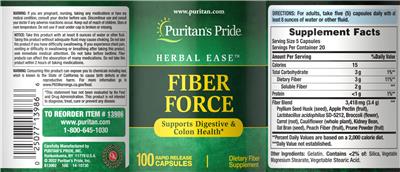
Supplement Facts
The label details for Fiber Force by Puritan's Pride, sourced from the NIH Dietary Supplement Label Database.
Supplement Facts
| Ingredient | Amount | % DV |
|---|---|---|
| Calories | 15 Calories | -- |
| Total Carbohydrates | 3 Gram(s) | 1% |
| Dietary Fiber | 3 Gram(s) | 11% |
| Protein | 1 Gram(s) | 1% |
| Fiber, Soluble | 2 Gram(s) | -- |
| Carrot | 0 NP | -- |
| Peach Fiber | 0 NP | -- |
| Apple Pectin | 0 NP | -- |
| Fiber Blend | 3418 mg | -- |
| Kidney Bean | 0 NP | -- |
| Psyllium Husk | 0 NP | -- |
| Lactobacillus acidophilus SD-5212 | 0 NP | -- |
| Cauliflower | 0 NP | -- |
| Broccoli | 0 NP | -- |
| Oat Bran | 0 NP | -- |
| Prune, Powder | 0 NP | -- |
Other ingredients: Gelatin, Silica, Magnesium Stearate, Stearic Acid
Tap any ingredient to jump to its full detail below.
These statements are the manufacturer’s wording, reproduced from the product label — the label is saying it, not HelloPharmacist. We don’t verify or endorse them.
Precautions
Warning: If you are pregnant, nursing, taking any medications or have any medical condition, consult your doctor before use.
Discontinue use and consult your doctor if any adverse reactions occur.
Keep out of reach of children.
Do not use if seal under cap is broken or missing. Notice: Take this product with at least 8 ounces of water or other fluid. Taking this product without adequate fluid may cause choking. Do not take this product if you have difficulty swallowing. If you experience chest pain, vomiting or difficulty in swallowing or breathing after taking this product, seek immediate medical attention. Do not take before bedtime.
Fiber products can affect the absorption of many medications. Do not take this product within 2 hours of taking medications.
Warning: Consuming this product can expose you to chemicals including lead, which is known to the State of California to cause birth defects or other reproductive harm. For more information go to www.P65Warnings.ca.gov/food.
Storage
Store at room temperature.
FDA Disclaimer Statement
These statements have not been evaluated by the Food and Drug Administration. This product is not intended to diagnose, treat, cure or prevent any disease.
General Statements
To reorder Item # 13986 www.puritan.com 1-800-645-1030
Brand IP Statement(s)
Copyright 2022 Puritan's Pride, Inc.
Puritan's Pride Herbal Ease
Seals/Symbols
QA Quality Assured
Formulation
Supports digestive & colon health
FDA Statement of Identity
Dietary Fiber Supplement
Suggested/Recommended/Usage/Directions
Directions: For adults, take five (5) capsules daily with at least 8 ounces of water or other fluid.
Formula
Dietary Fiber Supplement
Is this label outdated? Report a formula or label change and our pharmacy team will review it.
Fiber Force by Puritan's Pride label
The label scan from the NIH Dietary Supplement Label Database. Tap to enlarge.
Label images are published by the NIH Dietary Supplement Label Database for the version of this product on file. Always read your actual product label.
View the full label (PDF)The Ingredients in Fiber Force by Puritan's Pride
These are the 12 active ingredients this product is made of. Select any to open its full monograph.
Serving size5 Capsule(s) Dosage formCapsule Servings per container20 Amounts shown are per serving.
Most supplement products combine several ingredients, and a medication can interact with the product through any one of them. Each ingredient below shows whether it has known drug interactions.
Dietary Fiber
Interacts with2,025 drugs
Black psyllium is a soluble-fiber supplement made from the seeds of a Plantago plant, used mostly to ease constipation and support digestive health. I...
Dietary Fiber monograph & interactions- › Fiber, Soluble
Protein
Fiber Blend
- › Carrot
- › Peach Fiber
- › Apple Pectin
- › Kidney Bean
- › Psyllium Husk
- › Lactobacillus acidophilus SD-5212
- › Cauliflower
- › Broccoli
- › Oat Bran
- › Prune, Powder
Other (inactive) ingredients: Gelatin, Silica, Magnesium Stearate, Stearic Acid. These complete the product’s ingredient list but are not active constituents.
Fiber Force by Puritan's Pride Drug Interactions
HelloPharmacist Interaction Report
Fiber Force by Puritan's Pride does interact with medications.
The most serious documented interactions involve Apple Pectin, which can reduce how well your body absorbs three important drugs. Pectin may lower digoxin (Lanoxin) — a heart medication — by blocking its absorption in the gut, potentially weakening its effect on your heart rhythm.
It can also interfere with tetracycline antibiotics and lovastatin (a cholesterol drug) in the same way.
Read the full breakdown — every affected drug type, severity by severity
Broccoli and cauliflower in this product contain compounds that speed up how your liver processes certain medications. Broccoli is the bigger concern: eating the amount in a typical supplement can increase liver enzyme activity by 10% to 200%, which may reduce the effectiveness of drugs metabolized by CYP1A2 and CYP2A6.
Cauliflower has a similar but milder effect on CYP1A2 substrates.
The Lactobacillus acidophilus probiotic in Fiber Force has a documented Moderate interaction with antibiotic drugs — antibiotics can kill the live bacteria in the supplement, making it less effective. You'll want to space them apart.
We couldn't check several other ingredients in this product: Fiber (Soluble), Peach Fiber, Kidney Bean, Psyllium Husk, Oat Bran, and Prune Powder. Altogether, these interactions span 374 individual medications.
Use the medication checker on this page to verify your exact prescriptions before you start.
Check your own medications below · Editorial policy · How we use AI
Want to check YOUR meds against Fiber Force?
Ask about interactions with your drugs in plain English — “Can I take it with lisinopril?” — and we find you the answer in seconds, ingredient by ingredient.
Go to the checkerIngredients driving the most interactions
Individual Drug Interactions
The ingredients in Fiber Force interact with 2,089 drugs. Click any drug to see the details.
5 of the 12 ingredients in Fiber Force interact with drugs. Each result below shows which ingredient is responsible. Dietary Fiber Broccoli Cauliflower Lactobacillus acidophilus SD-5212 Apple Pectin
Acetaminophen, CodeineTylenol No.3, Tylenol w/ Codeine
How Acetaminophen, Codeine interacts with Fiber Force — through 3 ingredients. Tap an ingredient for the detail:
BroccoliCytochrome P450 1a2 (cyp1a2) Substrates Moderate
Interaction Summary
Theoretically, broccoli might reduce the levels and effects of drugs metabolized by CYP1A2.
Read the full Broccoli + Acetaminophen, Codeine interactionCauliflowerCytochrome P450 1a2 (cyp1a2) Substrates Moderate
Interaction Summary
Preliminary clinical evidence suggests that eating cruciferous vegetables, including broccoli, cauliflower, daikon radish sprouts, and cabbage, can increase cytochrome P450 1A2 (CYP1A2) activity by 14% to 27%.
Read the full Cauliflower + Acetaminophen, Codeine interactionDietary FiberOral Drugs Minor
Interaction Summary
Theoretically, psyllium might increase, decrease, or have no effect on the absorption of oral drugs.
Read the full Dietary Fiber + Acetaminophen, Codeine interactionAcetaminophen, Codeine, DoxylamineMersyndol
How Acetaminophen, Codeine, Doxylamine interacts with Fiber Force — through 3 ingredients. Tap an ingredient for the detail:
BroccoliCytochrome P450 1a2 (cyp1a2) Substrates Moderate
Interaction Summary
Theoretically, broccoli might reduce the levels and effects of drugs metabolized by CYP1A2.
Read the full Broccoli + Acetaminophen, Codeine, Doxylamine interactionCauliflowerCytochrome P450 1a2 (cyp1a2) Substrates Moderate
Interaction Summary
Preliminary clinical evidence suggests that eating cruciferous vegetables, including broccoli, cauliflower, daikon radish sprouts, and cabbage, can increase cytochrome P450 1A2 (CYP1A2) activity by 14% to 27%.
Read the full Cauliflower + Acetaminophen, Codeine, Doxylamine interactionDietary FiberOral Drugs Minor
Interaction Summary
Theoretically, psyllium might increase, decrease, or have no effect on the absorption of oral drugs.
Read the full Dietary Fiber + Acetaminophen, Codeine, Doxylamine interactionAcetaminophen, Codeine, MethocarbamolAcetaminophen, Codeine, Methocarbamol, Robaxacet 8
How Acetaminophen, Codeine, Methocarbamol interacts with Fiber Force — through 3 ingredients. Tap an ingredient for the detail:
BroccoliCytochrome P450 1a2 (cyp1a2) Substrates Moderate
Interaction Summary
Theoretically, broccoli might reduce the levels and effects of drugs metabolized by CYP1A2.
Read the full Broccoli + Acetaminophen, Codeine, Methocarbamol interactionCauliflowerCytochrome P450 1a2 (cyp1a2) Substrates Moderate
Interaction Summary
Preliminary clinical evidence suggests that eating cruciferous vegetables, including broccoli, cauliflower, daikon radish sprouts, and cabbage, can increase cytochrome P450 1A2 (CYP1A2) activity by 14% to 27%.
Read the full Cauliflower + Acetaminophen, Codeine, Methocarbamol interactionDietary FiberOral Drugs Minor
Interaction Summary
Theoretically, psyllium might increase, decrease, or have no effect on the absorption of oral drugs.
Read the full Dietary Fiber + Acetaminophen, Codeine, Methocarbamol interactionAcetaminophen, Dexbrompheniramine, PseudoephedrineSinadrin Plus
How Acetaminophen, Dexbrompheniramine, Pseudoephedrine interacts with Fiber Force — through 3 ingredients. Tap an ingredient for the detail:
CauliflowerCytochrome P450 1a2 (cyp1a2) Substrates Moderate
Interaction Summary
Preliminary clinical evidence suggests that eating cruciferous vegetables, including broccoli, cauliflower, daikon radish sprouts, and cabbage, can increase cytochrome P450 1A2 (CYP1A2) activity by 14% to 27%.
Read the full Cauliflower + Acetaminophen, Dexbrompheniramine, Pseudoephedrine interactionBroccoliCytochrome P450 1a2 (cyp1a2) Substrates Moderate
Interaction Summary
Theoretically, broccoli might reduce the levels and effects of drugs metabolized by CYP1A2.
Read the full Broccoli + Acetaminophen, Dexbrompheniramine, Pseudoephedrine interactionDietary FiberOral Drugs Minor
Interaction Summary
Theoretically, psyllium might increase, decrease, or have no effect on the absorption of oral drugs.
Read the full Dietary Fiber + Acetaminophen, Dexbrompheniramine, Pseudoephedrine interactionAcetaminophen, DextromethorphanTylenol Cough Ex Strength
How Acetaminophen, Dextromethorphan interacts with Fiber Force — through 3 ingredients. Tap an ingredient for the detail:
BroccoliCytochrome P450 1a2 (cyp1a2) Substrates Moderate
Interaction Summary
Theoretically, broccoli might reduce the levels and effects of drugs metabolized by CYP1A2.
Read the full Broccoli + Acetaminophen, Dextromethorphan interactionCauliflowerCytochrome P450 1a2 (cyp1a2) Substrates Moderate
Interaction Summary
Preliminary clinical evidence suggests that eating cruciferous vegetables, including broccoli, cauliflower, daikon radish sprouts, and cabbage, can increase cytochrome P450 1A2 (CYP1A2) activity by 14% to 27%.
Read the full Cauliflower + Acetaminophen, Dextromethorphan interactionDietary FiberOral Drugs Minor
Interaction Summary
Theoretically, psyllium might increase, decrease, or have no effect on the absorption of oral drugs.
Read the full Dietary Fiber + Acetaminophen, Dextromethorphan interactionAcetaminophen, Dextromethorphan, Doxylamine, PseudoephedrineVicks NyQuil
How Acetaminophen, Dextromethorphan, Doxylamine, Pseudoephedrine interacts with Fiber Force — through 3 ingredients. Tap an ingredient for the detail:
CauliflowerCytochrome P450 1a2 (cyp1a2) Substrates Moderate
Interaction Summary
Preliminary clinical evidence suggests that eating cruciferous vegetables, including broccoli, cauliflower, daikon radish sprouts, and cabbage, can increase cytochrome P450 1A2 (CYP1A2) activity by 14% to 27%.
Read the full Cauliflower + Acetaminophen, Dextromethorphan, Doxylamine, Pseudoephedrine interactionBroccoliCytochrome P450 1a2 (cyp1a2) Substrates Moderate
Interaction Summary
Theoretically, broccoli might reduce the levels and effects of drugs metabolized by CYP1A2.
Read the full Broccoli + Acetaminophen, Dextromethorphan, Doxylamine, Pseudoephedrine interactionDietary FiberOral Drugs Minor
Interaction Summary
Theoretically, psyllium might increase, decrease, or have no effect on the absorption of oral drugs.
Read the full Dietary Fiber + Acetaminophen, Dextromethorphan, Doxylamine, Pseudoephedrine interactionAcetaminophen, Dextromethorphan, Guaifenesin, PhenylephrineConar-A
How Acetaminophen, Dextromethorphan, Guaifenesin, Phenylephrine interacts with Fiber Force — through 3 ingredients. Tap an ingredient for the detail:
BroccoliCytochrome P450 1a2 (cyp1a2) Substrates Moderate
Interaction Summary
Theoretically, broccoli might reduce the levels and effects of drugs metabolized by CYP1A2.
Read the full Broccoli + Acetaminophen, Dextromethorphan, Guaifenesin, Phenylephrine interactionCauliflowerCytochrome P450 1a2 (cyp1a2) Substrates Moderate
Interaction Summary
Preliminary clinical evidence suggests that eating cruciferous vegetables, including broccoli, cauliflower, daikon radish sprouts, and cabbage, can increase cytochrome P450 1A2 (CYP1A2) activity by 14% to 27%.
Read the full Cauliflower + Acetaminophen, Dextromethorphan, Guaifenesin, Phenylephrine interactionDietary FiberOral Drugs Minor
Interaction Summary
Theoretically, psyllium might increase, decrease, or have no effect on the absorption of oral drugs.
Read the full Dietary Fiber + Acetaminophen, Dextromethorphan, Guaifenesin, Phenylephrine interactionAcetaminophen, Dextromethorphan, Guaifenesin, PhenylpropanolamineAnatuss
How Acetaminophen, Dextromethorphan, Guaifenesin, Phenylpropanolamine interacts with Fiber Force — through 3 ingredients. Tap an ingredient for the detail:
CauliflowerCytochrome P450 1a2 (cyp1a2) Substrates Moderate
Interaction Summary
Preliminary clinical evidence suggests that eating cruciferous vegetables, including broccoli, cauliflower, daikon radish sprouts, and cabbage, can increase cytochrome P450 1A2 (CYP1A2) activity by 14% to 27%.
Read the full Cauliflower + Acetaminophen, Dextromethorphan, Guaifenesin, Phenylpropanolamine interactionBroccoliCytochrome P450 1a2 (cyp1a2) Substrates Moderate
Interaction Summary
Theoretically, broccoli might reduce the levels and effects of drugs metabolized by CYP1A2.
Read the full Broccoli + Acetaminophen, Dextromethorphan, Guaifenesin, Phenylpropanolamine interactionDietary FiberOral Drugs Minor
Interaction Summary
Theoretically, psyllium might increase, decrease, or have no effect on the absorption of oral drugs.
Read the full Dietary Fiber + Acetaminophen, Dextromethorphan, Guaifenesin, Phenylpropanolamine interactionAcetaminophen, Dextromethorphan, Guaifenesin, PseudoephedrineRobitussin Cold, Severe Cold, Suphedrine Cold/Cough
How Acetaminophen, Dextromethorphan, Guaifenesin, Pseudoephedrine interacts with Fiber Force — through 3 ingredients. Tap an ingredient for the detail:
CauliflowerCytochrome P450 1a2 (cyp1a2) Substrates Moderate
Interaction Summary
Preliminary clinical evidence suggests that eating cruciferous vegetables, including broccoli, cauliflower, daikon radish sprouts, and cabbage, can increase cytochrome P450 1A2 (CYP1A2) activity by 14% to 27%.
Read the full Cauliflower + Acetaminophen, Dextromethorphan, Guaifenesin, Pseudoephedrine interactionBroccoliCytochrome P450 1a2 (cyp1a2) Substrates Moderate
Interaction Summary
Theoretically, broccoli might reduce the levels and effects of drugs metabolized by CYP1A2.
Read the full Broccoli + Acetaminophen, Dextromethorphan, Guaifenesin, Pseudoephedrine interactionDietary FiberOral Drugs Minor
Interaction Summary
Theoretically, psyllium might increase, decrease, or have no effect on the absorption of oral drugs.
Read the full Dietary Fiber + Acetaminophen, Dextromethorphan, Guaifenesin, Pseudoephedrine interactionAcetaminophen, Dextromethorphan, Phenylpropanolamine, PyrilamineTheracaps
How Acetaminophen, Dextromethorphan, Phenylpropanolamine, Pyrilamine interacts with Fiber Force — through 3 ingredients. Tap an ingredient for the detail:
BroccoliCytochrome P450 1a2 (cyp1a2) Substrates Moderate
Interaction Summary
Theoretically, broccoli might reduce the levels and effects of drugs metabolized by CYP1A2.
Read the full Broccoli + Acetaminophen, Dextromethorphan, Phenylpropanolamine, Pyrilamine interactionCauliflowerCytochrome P450 1a2 (cyp1a2) Substrates Moderate
Interaction Summary
Preliminary clinical evidence suggests that eating cruciferous vegetables, including broccoli, cauliflower, daikon radish sprouts, and cabbage, can increase cytochrome P450 1A2 (CYP1A2) activity by 14% to 27%.
Read the full Cauliflower + Acetaminophen, Dextromethorphan, Phenylpropanolamine, Pyrilamine interactionDietary FiberOral Drugs Minor
Interaction Summary
Theoretically, psyllium might increase, decrease, or have no effect on the absorption of oral drugs.
Read the full Dietary Fiber + Acetaminophen, Dextromethorphan, Phenylpropanolamine, Pyrilamine interactionAcetaminophen, Dextromethorphan, PseudoephedrineAlka-Seltzer PLUS Flu Liquid Gels, Non Aspirin Cold Caps, Tylenol Cold, Tylenol Flu Daytime Ex Strength, Tylenol Flu Ex Strength
How Acetaminophen, Dextromethorphan, Pseudoephedrine interacts with Fiber Force — through 3 ingredients. Tap an ingredient for the detail:
BroccoliCytochrome P450 1a2 (cyp1a2) Substrates Moderate
Interaction Summary
Theoretically, broccoli might reduce the levels and effects of drugs metabolized by CYP1A2.
Read the full Broccoli + Acetaminophen, Dextromethorphan, Pseudoephedrine interactionCauliflowerCytochrome P450 1a2 (cyp1a2) Substrates Moderate
Interaction Summary
Preliminary clinical evidence suggests that eating cruciferous vegetables, including broccoli, cauliflower, daikon radish sprouts, and cabbage, can increase cytochrome P450 1A2 (CYP1A2) activity by 14% to 27%.
Read the full Cauliflower + Acetaminophen, Dextromethorphan, Pseudoephedrine interactionDietary FiberOral Drugs Minor
Interaction Summary
Theoretically, psyllium might increase, decrease, or have no effect on the absorption of oral drugs.
Read the full Dietary Fiber + Acetaminophen, Dextromethorphan, Pseudoephedrine interactionAcetaminophen, Dichloralantipyrine, IsomethepteneAmidrine, Midchlor, Migquin, Migratine
How Acetaminophen, Dichloralantipyrine, Isometheptene interacts with Fiber Force — through 3 ingredients. Tap an ingredient for the detail:
BroccoliCytochrome P450 1a2 (cyp1a2) Substrates Moderate
Interaction Summary
Theoretically, broccoli might reduce the levels and effects of drugs metabolized by CYP1A2.
Read the full Broccoli + Acetaminophen, Dichloralantipyrine, Isometheptene interactionCauliflowerCytochrome P450 1a2 (cyp1a2) Substrates Moderate
Interaction Summary
Preliminary clinical evidence suggests that eating cruciferous vegetables, including broccoli, cauliflower, daikon radish sprouts, and cabbage, can increase cytochrome P450 1A2 (CYP1A2) activity by 14% to 27%.
Read the full Cauliflower + Acetaminophen, Dichloralantipyrine, Isometheptene interactionDietary FiberOral Drugs Minor
Interaction Summary
Theoretically, psyllium might increase, decrease, or have no effect on the absorption of oral drugs.
Read the full Dietary Fiber + Acetaminophen, Dichloralantipyrine, Isometheptene interactionAcetaminophen, Dichloralphenazone, IsomethepteneMidrin
How Acetaminophen, Dichloralphenazone, Isometheptene interacts with Fiber Force — through 3 ingredients. Tap an ingredient for the detail:
CauliflowerCytochrome P450 1a2 (cyp1a2) Substrates Moderate
Interaction Summary
Preliminary clinical evidence suggests that eating cruciferous vegetables, including broccoli, cauliflower, daikon radish sprouts, and cabbage, can increase cytochrome P450 1A2 (CYP1A2) activity by 14% to 27%.
Read the full Cauliflower + Acetaminophen, Dichloralphenazone, Isometheptene interactionBroccoliCytochrome P450 1a2 (cyp1a2) Substrates Moderate
Interaction Summary
Theoretically, broccoli might reduce the levels and effects of drugs metabolized by CYP1A2.
Read the full Broccoli + Acetaminophen, Dichloralphenazone, Isometheptene interactionDietary FiberOral Drugs Minor
Interaction Summary
Theoretically, psyllium might increase, decrease, or have no effect on the absorption of oral drugs.
Read the full Dietary Fiber + Acetaminophen, Dichloralphenazone, Isometheptene interactionAcetaminophen, Dichlorophenazone, IsometheptaneIsocom
How Acetaminophen, Dichlorophenazone, Isometheptane interacts with Fiber Force — through 3 ingredients. Tap an ingredient for the detail:
BroccoliCytochrome P450 1a2 (cyp1a2) Substrates Moderate
Interaction Summary
Theoretically, broccoli might reduce the levels and effects of drugs metabolized by CYP1A2.
Read the full Broccoli + Acetaminophen, Dichlorophenazone, Isometheptane interactionCauliflowerCytochrome P450 1a2 (cyp1a2) Substrates Moderate
Interaction Summary
Preliminary clinical evidence suggests that eating cruciferous vegetables, including broccoli, cauliflower, daikon radish sprouts, and cabbage, can increase cytochrome P450 1A2 (CYP1A2) activity by 14% to 27%.
Read the full Cauliflower + Acetaminophen, Dichlorophenazone, Isometheptane interactionDietary FiberOral Drugs Minor
Interaction Summary
Theoretically, psyllium might increase, decrease, or have no effect on the absorption of oral drugs.
Read the full Dietary Fiber + Acetaminophen, Dichlorophenazone, Isometheptane interactionAcetaminophen, DiphenhydramineTylenol PM, Tylenol PM Ex Strength
How Acetaminophen, Diphenhydramine interacts with Fiber Force — through 3 ingredients. Tap an ingredient for the detail:
BroccoliCytochrome P450 1a2 (cyp1a2) Substrates Moderate
Interaction Summary
Theoretically, broccoli might reduce the levels and effects of drugs metabolized by CYP1A2.
Read the full Broccoli + Acetaminophen, Diphenhydramine interactionCauliflowerCytochrome P450 1a2 (cyp1a2) Substrates Moderate
Interaction Summary
Preliminary clinical evidence suggests that eating cruciferous vegetables, including broccoli, cauliflower, daikon radish sprouts, and cabbage, can increase cytochrome P450 1A2 (CYP1A2) activity by 14% to 27%.
Read the full Cauliflower + Acetaminophen, Diphenhydramine interactionDietary FiberOral Drugs Minor
Interaction Summary
Theoretically, psyllium might increase, decrease, or have no effect on the absorption of oral drugs.
Read the full Dietary Fiber + Acetaminophen, Diphenhydramine interactionAcetaminophen, Diphenhydramine, PseudoephedrineChildren's Tylenol Allergy, Cold Control, Contac Night Allergy Relief
How Acetaminophen, Diphenhydramine, Pseudoephedrine interacts with Fiber Force — through 3 ingredients. Tap an ingredient for the detail:
BroccoliCytochrome P450 1a2 (cyp1a2) Substrates Moderate
Interaction Summary
Theoretically, broccoli might reduce the levels and effects of drugs metabolized by CYP1A2.
Read the full Broccoli + Acetaminophen, Diphenhydramine, Pseudoephedrine interactionCauliflowerCytochrome P450 1a2 (cyp1a2) Substrates Moderate
Interaction Summary
Preliminary clinical evidence suggests that eating cruciferous vegetables, including broccoli, cauliflower, daikon radish sprouts, and cabbage, can increase cytochrome P450 1A2 (CYP1A2) activity by 14% to 27%.
Read the full Cauliflower + Acetaminophen, Diphenhydramine, Pseudoephedrine interactionDietary FiberOral Drugs Minor
Interaction Summary
Theoretically, psyllium might increase, decrease, or have no effect on the absorption of oral drugs.
Read the full Dietary Fiber + Acetaminophen, Diphenhydramine, Pseudoephedrine interactionAcetaminophen, Doxylamine, PseudoephedrineEx Strength Tylenol Sinus Nighttime
How Acetaminophen, Doxylamine, Pseudoephedrine interacts with Fiber Force — through 3 ingredients. Tap an ingredient for the detail:
CauliflowerCytochrome P450 1a2 (cyp1a2) Substrates Moderate
Interaction Summary
Preliminary clinical evidence suggests that eating cruciferous vegetables, including broccoli, cauliflower, daikon radish sprouts, and cabbage, can increase cytochrome P450 1A2 (CYP1A2) activity by 14% to 27%.
Read the full Cauliflower + Acetaminophen, Doxylamine, Pseudoephedrine interactionBroccoliCytochrome P450 1a2 (cyp1a2) Substrates Moderate
Interaction Summary
Theoretically, broccoli might reduce the levels and effects of drugs metabolized by CYP1A2.
Read the full Broccoli + Acetaminophen, Doxylamine, Pseudoephedrine interactionDietary FiberOral Drugs Minor
Interaction Summary
Theoretically, psyllium might increase, decrease, or have no effect on the absorption of oral drugs.
Read the full Dietary Fiber + Acetaminophen, Doxylamine, Pseudoephedrine interactionAcetaminophen, HydrocodoneAnexsia, Anodynos DHC, Azdone, Co-Gesic, Doucet, Lorcet +9 more
How Acetaminophen, Hydrocodone interacts with Fiber Force — through 3 ingredients. Tap an ingredient for the detail:
BroccoliCytochrome P450 1a2 (cyp1a2) Substrates Moderate
Interaction Summary
Theoretically, broccoli might reduce the levels and effects of drugs metabolized by CYP1A2.
Read the full Broccoli + Acetaminophen, Hydrocodone interactionCauliflowerCytochrome P450 1a2 (cyp1a2) Substrates Moderate
Interaction Summary
Preliminary clinical evidence suggests that eating cruciferous vegetables, including broccoli, cauliflower, daikon radish sprouts, and cabbage, can increase cytochrome P450 1A2 (CYP1A2) activity by 14% to 27%.
Read the full Cauliflower + Acetaminophen, Hydrocodone interactionDietary FiberOral Drugs Minor
Interaction Summary
Theoretically, psyllium might increase, decrease, or have no effect on the absorption of oral drugs.
Read the full Dietary Fiber + Acetaminophen, Hydrocodone interactionAcetaminophen, IbuprofenCombogesic
How Acetaminophen, Ibuprofen interacts with Fiber Force — through 3 ingredients. Tap an ingredient for the detail:
BroccoliCytochrome P450 1a2 (cyp1a2) Substrates Moderate
Interaction Summary
Theoretically, broccoli might reduce the levels and effects of drugs metabolized by CYP1A2.
Read the full Broccoli + Acetaminophen, Ibuprofen interactionCauliflowerCytochrome P450 1a2 (cyp1a2) Substrates Moderate
Interaction Summary
Preliminary clinical evidence suggests that eating cruciferous vegetables, including broccoli, cauliflower, daikon radish sprouts, and cabbage, can increase cytochrome P450 1A2 (CYP1A2) activity by 14% to 27%.
Read the full Cauliflower + Acetaminophen, Ibuprofen interactionDietary FiberOral Drugs Minor
Interaction Summary
Theoretically, psyllium might increase, decrease, or have no effect on the absorption of oral drugs.
Read the full Dietary Fiber + Acetaminophen, Ibuprofen interactionAcetaminophen, MeperidineDemerol APAP
How Acetaminophen, Meperidine interacts with Fiber Force — through 3 ingredients. Tap an ingredient for the detail:
CauliflowerCytochrome P450 1a2 (cyp1a2) Substrates Moderate
Interaction Summary
Preliminary clinical evidence suggests that eating cruciferous vegetables, including broccoli, cauliflower, daikon radish sprouts, and cabbage, can increase cytochrome P450 1A2 (CYP1A2) activity by 14% to 27%.
Read the full Cauliflower + Acetaminophen, Meperidine interactionBroccoliCytochrome P450 1a2 (cyp1a2) Substrates Moderate
Interaction Summary
Theoretically, broccoli might reduce the levels and effects of drugs metabolized by CYP1A2.
Read the full Broccoli + Acetaminophen, Meperidine interactionDietary FiberOral Drugs Minor
Interaction Summary
Theoretically, psyllium might increase, decrease, or have no effect on the absorption of oral drugs.
Read the full Dietary Fiber + Acetaminophen, Meperidine interactionAcetaminophen, MethocarbamolRobaxacet
How Acetaminophen, Methocarbamol interacts with Fiber Force — through 3 ingredients. Tap an ingredient for the detail:
BroccoliCytochrome P450 1a2 (cyp1a2) Substrates Moderate
Interaction Summary
Theoretically, broccoli might reduce the levels and effects of drugs metabolized by CYP1A2.
Read the full Broccoli + Acetaminophen, Methocarbamol interactionCauliflowerCytochrome P450 1a2 (cyp1a2) Substrates Moderate
Interaction Summary
Preliminary clinical evidence suggests that eating cruciferous vegetables, including broccoli, cauliflower, daikon radish sprouts, and cabbage, can increase cytochrome P450 1A2 (CYP1A2) activity by 14% to 27%.
Read the full Cauliflower + Acetaminophen, Methocarbamol interactionDietary FiberOral Drugs Minor
Interaction Summary
Theoretically, psyllium might increase, decrease, or have no effect on the absorption of oral drugs.
Read the full Dietary Fiber + Acetaminophen, Methocarbamol interactionAcetaminophen, OrphenadrineOrfenagesic
How Acetaminophen, Orphenadrine interacts with Fiber Force — through 3 ingredients. Tap an ingredient for the detail:
BroccoliCytochrome P450 1a2 (cyp1a2) Substrates Moderate
Interaction Summary
Theoretically, broccoli might reduce the levels and effects of drugs metabolized by CYP1A2.
Read the full Broccoli + Acetaminophen, Orphenadrine interactionCauliflowerCytochrome P450 1a2 (cyp1a2) Substrates Moderate
Interaction Summary
Preliminary clinical evidence suggests that eating cruciferous vegetables, including broccoli, cauliflower, daikon radish sprouts, and cabbage, can increase cytochrome P450 1A2 (CYP1A2) activity by 14% to 27%.
Read the full Cauliflower + Acetaminophen, Orphenadrine interactionDietary FiberOral Drugs Minor
Interaction Summary
Theoretically, psyllium might increase, decrease, or have no effect on the absorption of oral drugs.
Read the full Dietary Fiber + Acetaminophen, Orphenadrine interactionAcetaminophen, OxycodonePercocet, Roxicet, Tylox, Xartemis XR
How Acetaminophen, Oxycodone interacts with Fiber Force — through 3 ingredients. Tap an ingredient for the detail:
CauliflowerCytochrome P450 1a2 (cyp1a2) Substrates Moderate
Interaction Summary
Preliminary clinical evidence suggests that eating cruciferous vegetables, including broccoli, cauliflower, daikon radish sprouts, and cabbage, can increase cytochrome P450 1A2 (CYP1A2) activity by 14% to 27%.
Read the full Cauliflower + Acetaminophen, Oxycodone interactionBroccoliCytochrome P450 1a2 (cyp1a2) Substrates Moderate
Interaction Summary
Theoretically, broccoli might reduce the levels and effects of drugs metabolized by CYP1A2.
Read the full Broccoli + Acetaminophen, Oxycodone interactionDietary FiberOral Drugs Minor
Interaction Summary
Theoretically, psyllium might increase, decrease, or have no effect on the absorption of oral drugs.
Read the full Dietary Fiber + Acetaminophen, Oxycodone interactionAcetaminophen, Pamabrom, PyrilamineMidol Max Strength PMS, Pamprin, Pamprin ES
How Acetaminophen, Pamabrom, Pyrilamine interacts with Fiber Force — through 3 ingredients. Tap an ingredient for the detail:
BroccoliCytochrome P450 1a2 (cyp1a2) Substrates Moderate
Interaction Summary
Theoretically, broccoli might reduce the levels and effects of drugs metabolized by CYP1A2.
Read the full Broccoli + Acetaminophen, Pamabrom, Pyrilamine interactionCauliflowerCytochrome P450 1a2 (cyp1a2) Substrates Moderate
Interaction Summary
Preliminary clinical evidence suggests that eating cruciferous vegetables, including broccoli, cauliflower, daikon radish sprouts, and cabbage, can increase cytochrome P450 1A2 (CYP1A2) activity by 14% to 27%.
Read the full Cauliflower + Acetaminophen, Pamabrom, Pyrilamine interactionDietary FiberOral Drugs Minor
Interaction Summary
Theoretically, psyllium might increase, decrease, or have no effect on the absorption of oral drugs.
Read the full Dietary Fiber + Acetaminophen, Pamabrom, Pyrilamine interactionAcetaminophen, PentazocineTalacen
How Acetaminophen, Pentazocine interacts with Fiber Force — through 3 ingredients. Tap an ingredient for the detail:
CauliflowerCytochrome P450 1a2 (cyp1a2) Substrates Moderate
Interaction Summary
Preliminary clinical evidence suggests that eating cruciferous vegetables, including broccoli, cauliflower, daikon radish sprouts, and cabbage, can increase cytochrome P450 1A2 (CYP1A2) activity by 14% to 27%.
Read the full Cauliflower + Acetaminophen, Pentazocine interactionBroccoliCytochrome P450 1a2 (cyp1a2) Substrates Moderate
Interaction Summary
Theoretically, broccoli might reduce the levels and effects of drugs metabolized by CYP1A2.
Read the full Broccoli + Acetaminophen, Pentazocine interactionDietary FiberOral Drugs Minor
Interaction Summary
Theoretically, psyllium might increase, decrease, or have no effect on the absorption of oral drugs.
Read the full Dietary Fiber + Acetaminophen, Pentazocine interactionAcetaminophen, Phenylephrine, ChlorpheniramineSuper Cold Tabs
How Acetaminophen, Phenylephrine, Chlorpheniramine interacts with Fiber Force — through 3 ingredients. Tap an ingredient for the detail:
BroccoliCytochrome P450 1a2 (cyp1a2) Substrates Moderate
Interaction Summary
Theoretically, broccoli might reduce the levels and effects of drugs metabolized by CYP1A2.
Read the full Broccoli + Acetaminophen, Phenylephrine, Chlorpheniramine interactionCauliflowerCytochrome P450 1a2 (cyp1a2) Substrates Moderate
Interaction Summary
Preliminary clinical evidence suggests that eating cruciferous vegetables, including broccoli, cauliflower, daikon radish sprouts, and cabbage, can increase cytochrome P450 1A2 (CYP1A2) activity by 14% to 27%.
Read the full Cauliflower + Acetaminophen, Phenylephrine, Chlorpheniramine interactionDietary FiberOral Drugs Minor
Interaction Summary
Theoretically, psyllium might increase, decrease, or have no effect on the absorption of oral drugs.
Read the full Dietary Fiber + Acetaminophen, Phenylephrine, Chlorpheniramine interactionAcetaminophen, PhenylpropanolamineTetra Caps
How Acetaminophen, Phenylpropanolamine interacts with Fiber Force — through 3 ingredients. Tap an ingredient for the detail:
CauliflowerCytochrome P450 1a2 (cyp1a2) Substrates Moderate
Interaction Summary
Preliminary clinical evidence suggests that eating cruciferous vegetables, including broccoli, cauliflower, daikon radish sprouts, and cabbage, can increase cytochrome P450 1A2 (CYP1A2) activity by 14% to 27%.
Read the full Cauliflower + Acetaminophen, Phenylpropanolamine interactionBroccoliCytochrome P450 1a2 (cyp1a2) Substrates Moderate
Interaction Summary
Theoretically, broccoli might reduce the levels and effects of drugs metabolized by CYP1A2.
Read the full Broccoli + Acetaminophen, Phenylpropanolamine interactionDietary FiberOral Drugs Minor
Interaction Summary
Theoretically, psyllium might increase, decrease, or have no effect on the absorption of oral drugs.
Read the full Dietary Fiber + Acetaminophen, Phenylpropanolamine interactionAcetaminophen, Phenylpropanolamine, PhenyltoloxamineSinubid
How Acetaminophen, Phenylpropanolamine, Phenyltoloxamine interacts with Fiber Force — through 3 ingredients. Tap an ingredient for the detail:
BroccoliCytochrome P450 1a2 (cyp1a2) Substrates Moderate
Interaction Summary
Theoretically, broccoli might reduce the levels and effects of drugs metabolized by CYP1A2.
Read the full Broccoli + Acetaminophen, Phenylpropanolamine, Phenyltoloxamine interactionCauliflowerCytochrome P450 1a2 (cyp1a2) Substrates Moderate
Interaction Summary
Preliminary clinical evidence suggests that eating cruciferous vegetables, including broccoli, cauliflower, daikon radish sprouts, and cabbage, can increase cytochrome P450 1A2 (CYP1A2) activity by 14% to 27%.
Read the full Cauliflower + Acetaminophen, Phenylpropanolamine, Phenyltoloxamine interactionDietary FiberOral Drugs Minor
Interaction Summary
Theoretically, psyllium might increase, decrease, or have no effect on the absorption of oral drugs.
Read the full Dietary Fiber + Acetaminophen, Phenylpropanolamine, Phenyltoloxamine interactionAcetaminophen, PhenyltoloxaminePercogesic, Relagesic
How Acetaminophen, Phenyltoloxamine interacts with Fiber Force — through 3 ingredients. Tap an ingredient for the detail:
CauliflowerCytochrome P450 1a2 (cyp1a2) Substrates Moderate
Interaction Summary
Preliminary clinical evidence suggests that eating cruciferous vegetables, including broccoli, cauliflower, daikon radish sprouts, and cabbage, can increase cytochrome P450 1A2 (CYP1A2) activity by 14% to 27%.
Read the full Cauliflower + Acetaminophen, Phenyltoloxamine interactionBroccoliCytochrome P450 1a2 (cyp1a2) Substrates Moderate
Interaction Summary
Theoretically, broccoli might reduce the levels and effects of drugs metabolized by CYP1A2.
Read the full Broccoli + Acetaminophen, Phenyltoloxamine interactionDietary FiberOral Drugs Minor
Interaction Summary
Theoretically, psyllium might increase, decrease, or have no effect on the absorption of oral drugs.
Read the full Dietary Fiber + Acetaminophen, Phenyltoloxamine interactionAcetaminophen, Phenyltoloxamine, SalicylamideLobac
How Acetaminophen, Phenyltoloxamine, Salicylamide interacts with Fiber Force — through 3 ingredients. Tap an ingredient for the detail:
CauliflowerCytochrome P450 1a2 (cyp1a2) Substrates Moderate
Interaction Summary
Preliminary clinical evidence suggests that eating cruciferous vegetables, including broccoli, cauliflower, daikon radish sprouts, and cabbage, can increase cytochrome P450 1A2 (CYP1A2) activity by 14% to 27%.
Read the full Cauliflower + Acetaminophen, Phenyltoloxamine, Salicylamide interactionBroccoliCytochrome P450 1a2 (cyp1a2) Substrates Moderate
Interaction Summary
Theoretically, broccoli might reduce the levels and effects of drugs metabolized by CYP1A2.
Read the full Broccoli + Acetaminophen, Phenyltoloxamine, Salicylamide interactionDietary FiberOral Drugs Minor
Interaction Summary
Theoretically, psyllium might increase, decrease, or have no effect on the absorption of oral drugs.
Read the full Dietary Fiber + Acetaminophen, Phenyltoloxamine, Salicylamide interactionEach ingredient & the kinds of drugs it affects
For each ingredient in Fiber Force with known interactions, here are the types of medications they can affect. Open any type for the detail — or search your exact drug in the checker above.
Dietary Fiber
Carbamazepine (Tegretol)
Theoretically, black psyllium might reduce the effects of carbamazepine and increase the risk for convulsions.
Theoretically, black psyllium might reduce carbamazepine absorption. A preliminary study using blond psyllium reported decreased carbamazepine bioavailability due to binding of the drug to psyllium, as well as reduction of available fluid in the gut for dissolution of the drug. This interaction may also occur with black psyllium.
Lithium
Theoretically, taking black psyllium at the same time as lithium might reduce lithium absorption.
The fiber in black psyllium might reduce lithium absorption and plasma levels. Some case reports describe a reduction in plasma lithium levels with concomitant administration of blond psyllium. This was reversed when psyllium was stopped. This interaction may also occur with black psyllium.
Metformin (Glucophage)
Theoretically, black psyllium might increase the therapeutic and adverse effects of metformin.
Animal research shows that concurrent consumption of blond psyllium with metformin slows and increases the absorption of metformin. This interaction may also occur with black psyllium. To avoid changes in absorption, take psyllium 30-60 minutes after metformin.
Olanzapine (Zyprexa)
Theoretically, taking black psyllium at the same time as olanzapine might reduce olanzapine absorption.
The fiber in black psyllium might decrease the absorption of olanzapine. A single case report describes a reduction in the effectiveness of olanzapine when it was concomitantly administered with an unspecified type of psyllium 3 grams orally twice daily. This effect was reversed when psyllium was stopped.
Digoxin (Lanoxin)
Theoretically, taking black psyllium at the same time as digoxin might reduce digoxin absorption and decrease digoxin levels.
Psyllium might bind digoxin in the gut. However, some clinical evidence suggests that psyllium does not impact digoxin absorption.
Ethinyl Estradiol
Theoretically, taking black psyllium at the same time as ethinyl estradiol might alter levels of estradiol.
Concurrent use of blond psyllium with ethinyl estradiol results in a slight increase in the extent of ethinyl estradiol absorption and a slower rate of absorption. This is unlikely to be clinically significant.
Oral Drugs
Theoretically, psyllium might increase, decrease, or have no effect on the absorption of oral drugs.
Psyllium seems to have variable effects on drug absorption. To avoid changes in absorption, take psyllium 30-60 minutes after oral medications. Animal research shows that blond psyllium delays and increases the absorption of metformin and ethinyl estradiol. Case reports and animal research suggest that blond psyllium might reduce absorption of lithium, digoxin, olanzapine, and carbamazepine. Finally, some pharmacokinetic studies show that psyllium does not affect the absorption of levothyroxine or warfarin. Although many of these studies evaluated blond psyllium, the fiber content in black psyllium may have similar effects.
Broccoli
Cytochrome P450 1A2 (Cyp1A2) Substrates
Theoretically, broccoli might reduce the levels and effects of drugs metabolized by CYP1A2.
Pharmacokinetic research in humans shows that eating 500 grams of fresh broccoli daily for 6-12 days can increase CYP1A2 activity by 10% to 200%. Induction of CYP1A2 activity by broccoli is attributed to its glucosinolate constituents.
Cytochrome P450 2A6 (Cyp2A6) Substrates
Theoretically, broccoli might reduce the levels and effects of drugs metabolized by CYP2A6.
Pharmacokinetic research in humans shows that eating 500 grams of broccoli daily for 6 days increases CYP2A6 activity by 135% to 550%. Induction of CYP2A6 activity is attributed to its glucosinolate constituents.
Cauliflower
Cytochrome P450 1A2 (Cyp1A2) Substrates
Preliminary clinical evidence suggests that eating cruciferous vegetables, including broccoli, cauliflower, daikon radish sprouts, and cabbage, can increase cytochrome P450 1A2 (CYP1A2) activity by 14% to 27%. Theoretically, cauliflower might increase the clearance and decrease the effects of drugs metabolized by CYP1A2. Some drugs metabolized by CYP1A2 include clozapine (Clozaril), cyclobenzaprine (Flexeril), fluvoxamine (Luvox), haloperidol (Haldol), imipramine (Tofranil), mexiletine (Mexitil), olanzapine (Zyprexa), pentazocine (Talwin), propranolol (Inderal), tacrine (Cognex), theophylline, zileuton (Zyflo), zolmitriptan (Zomig), and others.
Lactobacillus acidophilus SD-5212
Antibiotic Drugs
Theoretically, taking Lactobacillus acidophilus with antibiotic drugs might decrease the effectiveness of L. acidophilus.
L. acidophilus preparations usually contain live and active organisms. Therefore, simultaneously taking antibiotics might kill a significant number of the organisms. Tell patients to separate administration of antibiotics and L. acidophilus preparations by at least two hours.
Apple Pectin
Digoxin (Lanoxin)
Theoretically, pectin might reduce the absorption of digoxin, potentially decreasing its effectiveness.
A small clinical study shows that taking digoxin with a kaolin-pectin suspension reduces the absorption of digoxin by about 62%. It is unclear if these effects are due to pectin, kaolin, or the combination.
Lovastatin (Mevacor)
Theoretically, pectin might reduce the absorption of lovastatin, potentially decreasing its effectiveness.
Case reports suggest that concomitant use of pectin and lovastatin might reduce the cholesterol-lowering effect of lovastatin, possibly due to reduced intestinal absorption of lovastatin.
Tetracycline Antibiotics
Theoretically, pectin might reduce the absorption of tetracycline antibiotics, potentially decreasing their effectiveness.
A small clinical study shows that taking tetracycline with bismuth subsalicylate in a kaolin-pectin suspension reduces the absorption of tetracycline by about 34%. It is unclear if these effects are due to pectin, kaolin, bismuth subsalicylate, or the combination.
Brand information
Manufacturer and brand details for Fiber Force, from the product label.
Puritan's Pride
See all Puritan's Pride products- Name
- Puritan's Pride, Inc.
- City
- Ronkonkoma
- State
- NY
- ZipCode
- 11779
- Phone Number
- 1-800-645-1030
- Web Address
- www.puritan.com
Fiber Force by Puritan's Pride: Common Questions
Does Fiber Force by Puritan's Pride interact with any medications?
How can one product interact with so many drugs?
Where does this information come from?
Will this help my high cholesterol?
Can I take this while I'm pregnant or breastfeeding?
What are the most common side effects?
Can I take this with my antibiotics?
Is this good for IBS?
Does this have any fillers?
Written and reviewed by the HelloPharmacist editorial staff. Our editorial policy
Not sure if Fiber Force is safe with your meds?
Our pharmacists answer your medication & supplement questions — free.
Label information is sourced from the NIH Dietary Supplement Label Database and reflects the product version on file; always read your actual product label. This page is for education only and is not a substitute for professional medical advice. Confirm with your pharmacist or doctor before combining supplements and medications.
The Full Monographs Behind Fiber Force’s Ingredients
Every ingredient we hold a full HelloPharmacist monograph for — uses, evidence, safety, and the complete interaction list.
Black Psyllium
Interacts with 2,025 drugsBlack psyllium is a soluble-fiber supplement made from the seeds of a Plantago plant, used mostly to ease constipation and support digestive health. It is best known and most studied for rel...
Read the full Black Psyllium monograph → Herb & supplement monographCarrot
Carrot is a common food vegetable that is a rich source of beta-carotene (which the body turns into vitamin A) and other nutrients. Eating carrots is safe and nutritious for most people, but...
Read the full Carrot monograph → Herb & supplement monographPectin
Interacts with 23 drugsPectin is a natural soluble fiber found in fruits like apples and citrus, and it is widely used in foods and as a fiber supplement. It may modestly help with cholesterol, blood sugar, and di...
Read the full Pectin monograph → Herb & supplement monographLactobacillus Acidophilus
Interacts with 182 drugsLactobacillus acidophilus is a 'friendly' bacterium used as a probiotic to support gut and vaginal health. It is generally well tolerated in healthy people, and there is reasonable evidence...
Read the full Lactobacillus Acidophilus monograph → Herb & supplement monographCauliflower
Interacts with 186 drugsCauliflower is a nutritious cruciferous vegetable that provides vitamin C, fiber, and plant compounds called glucosinolates. As a food it is healthy and safe for most people, but there is no...
Read the full Cauliflower monograph → Herb & supplement monographBroccoli
Interacts with 187 drugsBroccoli is a nutritious cruciferous vegetable rich in fiber, vitamins, and plant compounds like sulforaphane that have drawn scientific interest for health benefits. Eating broccoli as food...
Read the full Broccoli monograph →Sources & How We Checked
Fiber Force's label data comes from the NIH Dietary Supplement Label Database; the ingredient interaction data is from the Natural Medicines database, reviewed by our pharmacists.
- NIH Dietary Supplement Label Database (DSLD) — The official product label on file for this supplement.
- Natural Medicines (Therapeutic Research Center) — Evidence-graded clinical reference behind the ingredient interaction data.
Content is written and reviewed by licensed HelloPharmacist pharmacists. See our data sources and editorial standards for how this information is built and checked.
The 72 references behind this product’s interaction data
Every citation that drives the interaction findings for this product’s ingredients, from the evidence-graded Natural Medicines (TRC Healthcare) database. Open an ingredient to browse its citations — links open the study on PubMed or the publisher’s site.
Black Psyllium 18 references
- McGuffin M, Hobbs C, Upton R, Goldberg A, eds. American Herbal Products Association's Botanical Safety Handbook. Boca Raton, FL: CRC Press, LLC 1997.
- Gruenwald J, Brendler T, Jaenicke C. PDR for Herbal Medicines. 1st ed. Montvale, NJ: Medical Economics Company, Inc., 1998.
- Covington TR, et al. Handbook of Nonprescription Drugs. 11th ed. Washington, DC: American Pharmaceutical Association, 1996.
- Etman M. Effect of a bulk forming laxative on the bioavailablility of carbamazepine in man. Drug Dev Ind Pharm 1995;21:1901-6.
- Perlman BB. Interaction between lithium salts and ispaghula husk. Lancet 1990;335:416.
- Vaswani SK, Hamilton RG, Valentine MD, Adkinson NF. Psyllium laxative-induced anaphylaxis, asthma, and rhinitis. Allergy 1996;51:266-8. PubMed
- Lantner RR, Espiritu BR, Zumerchik P, Tobin MC. Anaphylaxis following ingestion of a psyllium-containing cereal. JAMA 1990;264:2534-6. DOI
- Kaplan MJ. Anaphylactic reaction to "Heartwise." N Engl J Med 1990;323:1072-3. DOI
- Nordstrom M, Melander A, Robertsson E, Steen B. Influence of wheat bran and of a bulk-forming ispaghula cathartic on the bioavailability of digoxin in geriatric in-patients. Drug Nutr Interact 1987;5:67-9..
- Robinson DS, Benjamin DM, McCormack JJ. Interaction of warfarin and nonsystemic gastrointestinal drugs. Clin Pharmacol Ther 1971;12:491-5. PubMed
- Garcia JJ, Fernandez N, Diez MJ, et al. Influence of two dietary fibers in the oral bioavailability and other pharmacokinetic parameters of ethinyloestradiol. Contraception 2000;62:253-7. PubMed
- Fernandez N, Lopez C, Díez R, et al. Drug interactions with the dietary fiber Plantago ovata husk. Expert Opin Drug Metab Toxicol 2012;8(11):1377-86.
- Semen plantaginis in: WHO Monographs on Selected Medicinal Plants, volume 1. World Health Organization, Geneva, 1999. Available at http://apps.who.int/medicinedocs/en/d/Js2200e/. Accessed November 26, 1026.
- Code of Federal Regulations, Title 21 (21CFR 101.17). Food labeling warning, notice, and safe handling statements. Available at www.ecfr.gov/cgi-bin/text-idx?SID=20f647d3b74161501f46564b915b4048&mc=true&node=se21.2.101_117&rgn=div8. Accessed December 3, 2
- Code of Federal Regulations, Title 21 (21CFR 201.319). Specific labeling requirements - water-soluble gums, hydrophilic gums, and hydrophilic mucilloids. Available at www.accessdata.fda.gov/scripts/cdrh/cfdocs/cfcfr/CFRSearch.cfm?fr=201.319. Accessed Dece
- Diez R, Garcia JJ, Diez MJ, Sierra M, Sahagun AM, Fernandez N. Influence of Plantago ovata husk (dietary fiber) on the bioavailability and other pharmacokinetic parameters of metformin in diabetic rabbits. BMC Complement Altern Med. 2017 Jun 7;17(1):298. PubMed
- Chiu AC, Sherman SI. Effects of pharmacological fiber supplements on levothyroxine absorption. Thyroid. 1998;8(8):667-71. PubMed
- Merrick C, Madden CA, Capurso NA. A Case of Blunted Orally Disintegrating Olanzapine Effect Due to Coadministered Psyllium. J Clin Psychiatry 2021;82(2):20cr13633. PubMed
Carrot 14 references
- Electronic Code of Federal Regulations. Title 21. Part 182 -- Substances Generally Recognized As Safe. Available at: https://www.accessdata.fda.gov/scripts/cdrh/cfdocs/cfcfr/CFRSearch.cfm?CFRPart=182
- Wetzel WE, Lehn W, Grieb A. [Carotene jaundice in infants with "sugar nursing bottle syndrome"]. Monatsschr Kinderheilkd 1989;137(10):659-61.
- el-Arab AE, Khalil F, Hussein L. Vitamin A deficiency among preschool children in a rural area of Egypt: the results of dietary assessment and biochemical assay. Int J Food Sci Nutr 2002;53(6):465-74. PubMed
- Helbling A. [Food allergy]. Ther Umsch 1994;51(1):31-7.
- Kaplan R. Carrot addiction. Aust N Z J Psychiatry 1996;30(5):698-700.
- Ncube, T. N., Greiner, T., Malaba, L. C., and Gebre-Medhin, M. Supplementing lactating women with puréed papaya and grated carrots improved vitamin A status in a placebo-controlled trial. J Nutr 2001;131(5):1497-1502. PubMed
- Mullins M, Froelke BR, Rivera MR. Effect of delayed activated charcoal on acetaminophen concentration after simulated overdose of oxycodone and acetaminophen. Clin Toxicol (Phila) 2009;47(2):112-5. PubMed
- Kawai M, Tamagawa-Mineoka R, Hagura A, Masuda K, Katoh N. Allergic contact dermatitis due to carrots. J Dermatol 2014;41(8):753-4. PubMed
- Xu X, Cheng Y, Li S, et al. Dietary carrot consumption and the risk of prostate cancer. Eur J Nutr 2014;53(8):1615-23. PubMed
- Donaldson MS, Speight N, Loomis S. Fibromyalgia syndrome improved using a mostly raw vegetarian diet: an observational study. BMC Complement Altern Med. 2001;1:7. PubMed
- Chen H, Shao F, Zhang F, Miao Q. Association between dietary carrot intake and breast cancer: A meta-analysis. Medicine (Baltimore). 2018;97(37):e12164. PubMed
- Bosanac SS, Clark AK, Sivamani RK. Phytophotodermatitis related to carrot extract-containing sunscreen. Dermatol Online J. 2018;24(1). pii: 13030/qt2nv2d1n0. DOI
- Deding U, Baatrup G, Christensen LP, Kobaek-Larsen M. Carrot Intake and Risk of Colorectal Cancer: A Prospective Cohort Study of 57,053 Danes. Nutrients 2020;12(2):332. PubMed
- Sánchez-Guerrero IM, Nieto A, Meseguer J, et al. Occupational Rhinoconjunctivitis Induced by Unusual Allergens of Carrot. J Investig Allergol Clin Immunol 2020;30(3):204-206. PubMed
Pectin 11 references
- Jaakkola MS, et al. Asthma caused by occupational exposure to pectin. J Allergy Clin Immunol 1997;100:575-6. PubMed
- Westphal W, et al. [Exogenous allergic asthma following pectin exposure-a new occupational allergen]. Pneumologie 1990;44(Suppl 1):337-8.
- Baldwin JL, et al. Pectin-induced occupational asthma. Chest 1993;104:1936-7. PubMed
- Cohen AJ, Forse MS, Tarlo SM. Occupational asthma caused by pectin inhalation during the manufacture of jam. Chest 1993;103:309-11.
- Kraut A, et al. Christmas candy maker's asthma. IgG4-mediated pectin allergy. Chest 1992;102:1605-7. PubMed
- Richter WO, Jacob BG, Schwandt P. Interaction between fibre and lovastatin. Lancet 1991;338:706.
- Albert KS, Ayres JW, DiSanto AR, et al. Influence of kaolin-pectin suspension on digoxin bioavailability. J Pharm Sci 1978;67:1582-6. PubMed
- Albert KS, Welch RD, DeSante KA, et al. Decreased tetracycline bioavailability caused by a bismuth subsalicylate antidiarrheal mixture. J Pharm Sci 1979;68:586-8. PubMed
- Electronic Code of Federal Regulations. Title 21. Part 182 -- Substances Generally Recognized As Safe. Available at: https://www.accessdata.fda.gov/scripts/cdrh/cfdocs/cfcfr/CFRSearch.cfm?CFRPart=182
- Federal Register April 17,2003. Anti-Diarrheal Products for over-the-counter human use; final monograph. Available at: http://www.fda.gov/OHRMS/DOCKETS/98fr/03-9380.pdf (Accessed 27 December 2004).
- Washio K, Nakamura M, Sato N, et al. Anaphylaxis in a pectin- and cashew nut-allergic child caused by a citrus bath. Allergol Int 2022;71(1):155-157. PubMed
Lactobacillus Acidophilus 15 references
- Pierce A. The American Pharmaceutical Association Practical Guide to Natural Medicines. New York: The Stonesong Press, 1999:19.
- Begtrup LM, de Muckadell OB, Kjeldsen J, Christensen RD, Jarbøl DE. Long-term treatment with probiotics in primary care patients with irritable bowel syndrome--a randomised, double-blind, placebo controlled trial. Scand J Gastroenterol 2013;48(10):1127-35 PubMed
- Chatterjee S, Kar P, Das T, Ray S, Gangulyt S, Rajendiran C, Mitra M. Randomised placebo-controlled double blind multicentric trial on efficacy and safety of Lactobacillus acidophilus LA-5 and Bifidobacterium BB-12 for prevention of antibiotic-associated
- Shavakhi A, Tabesh E, Yaghoutkar A, Hashemi H, Tabesh F, Khodadoostan M,Minakari M, Shavakhi S, Gholamrezaei A. The effects of multistrain probiotic compound on bismuth-containing quadruple therapy for Helicobacter pylori infection: a randomized placebo-c
- Karamali M, Dadkhah F, Sadrkhanlou M, et al. Effects of probiotic supplementation on glycaemic control and lipid profiles in gestational diabetes: a randomized, double-blind, placebo-controlled trial. Diabetes Metab 2016;42(4):234-41. PubMed
- Badehnoosh B, Karamali M, Zarrati M, et al. The effects of probiotic supplementation on biomarkers of inflammation, oxidative stress and pregnancy outcomes in gestational diabetes. J Matern Fetal Neonatal Med. 2018 May;31(9):1128-1136.
- Kumar S, Kumar R, Rohilla L, Jacob N, Yadav J, Sachdeva N. A high potency multi-strain probiotic improves glycemic control in children with new-onset type 1 diabetes mellitus: A randomized, double-blind, and placebo-controlled pilot study. Pediatr Diabete
- Shahriari A, Karimi E, Shahriari M, Aslani N, Khooshideh M, Arab A. The effect of probiotic supplementation on the risk of gestational diabetes mellitus among high-risk pregnant women: A parallel double-blind, randomized, placebo-controlled clinical trial PubMed
- Xiao SD, Zhang DZ, Lu H, et al. Multicenter, randomized, controlled trial of heat-killed Lactobacillus acidophilus LB in patients with chronic diarrhea. Adv Ther. 2003;20(5):253-60.
- Rossi F, Amadoro C, Gasperi M, Colavita G. Lactobacilli infection case reports in the last three years and safety implications. Nutrients. 2022;14(6):1178. PubMed
- Ozer M, Goksu SY, Shahverdiani A, Mustafa M. Lactobacillus acidophilus-induced endocarditis and associated splenic abscess. Case Rep Infect Dis 2020;2020:1382709.
- Sadrin S, Sennoune S, Gout B, et al. A 2-strain mixture of Lactobacillus acidophilus in the treatment of irritable bowel syndrome: A placebo-controlled randomized clinical trial. Dig Liver Dis 2020;52(5):534-540. PubMed
- Stoffer JN, Slingsby TJ, Giuliari GP. Lactobacillus acidophilus endophthalmitis after intravitreal bevacizumab injection requiring intraocular lens explantation. Can J Ophthalmol 2022;57(1):e21-e22. PubMed
- Cukovic-Cavka S, Likic R, Francetic I, Rustemovic N, Opacic M, Vucelic B. Lactobacillus acidophilus as a cause of liver abscess in a NOD2/CARD15-positive patient with Crohn's disease. Digestion 2006;73(2-3):107-10.
- Hui J, Ren Y, Wang Y, Han Q. Lactobacillus acidophilus endophthalmitis postcataract operation: A case report with a literature review. Ocul Immunol Inflamm 2023.
See these in context on the Lactobacillus Acidophilus monograph →
Cauliflower 9 references
- Joshipura KJ, Ascherio A, Manson JE, et al. Fruit and vegetable intake in relation to risk of ischemic stroke. JAMA 1999;282:1233-39. PubMed
- Zhao H, Lin J, Grossman HB, et al. Dietary isothiocyanates, GSTM1, GSTT1, NAT2 polymorphisms and bladder cancer risk. Int J Cancer 2007;120:2208-13.
- Cohen, J. H., Kristal, A. R., and Stanford, J. L. Fruit and vegetable intakes and prostate cancer risk. J Natl.Cancer Inst. 1-5-2000;92(1):61-68. PubMed
- Michaud DS, Spiegelman D, Clinton SK, et al. Fruit and vegetable intake and incidence of bladder cancer in a male prospective cohort. J Natl Cancer Inst 1999;91(7):605-13. PubMed
- Feskanich D, Ziegler RG, Michaud DS, et al. Prospective study of fruit and vegetable consumption and risk of lung cancer among men and women. J Natl Cancer Inst 2000;92(22):1812-23. PubMed
- Chang ET, Smedby KE, Zhang SM, et al. Dietary factors and risk of non-Hodgkin lymphoma in men and women. Cancer Epidemiol Biomarkers Prev 2005;14(2):512-20. PubMed
- Liu S, Serdula M, Janket SJ, et al. A prospective study of fruit and vegetable intake and the risk of type 2 diabetes in women. Diabetes Care 2004;27(12):2993-6. PubMed
- Gaudet MM, Britton JA, Kabat GC, et al. Fruits, vegetables, and micronutrients in relation to breast cancer modified by menopause and hormone receptor status. Cancer Epidemiol Biomarkers Prev 2004;13(9):1485-94. DOI
- Peterson S, Schwarz Y, Li SS, et al. CYP1A2, GSTM1, and GSTT1 polymorphisms and diet effects on CYP1A2 activity in a crossover feeding trial. Cancer Epidemiol Biomarkers Prev 2009;18(11):3118-25.
Broccoli 5 references
- Kristal AR, Lampe JW. Brassica vegetables and prostate cancer risk: a review of the epidemiological evidence. Nutr Cancer 2002;42:1-9. PubMed
- Chakrabarti A, Prais L, Foulds IS. Allergic contact dermatitis to broccoli. Br J Dermatol 2003;148:172-3. PubMed
- Hakooz, N. and Hamdan, I. Effects of dietary broccoli on human in vivo caffeine metabolism: a pilot study on a group of Jordanian volunteers. Curr Drug Metab 2007;8(1):9-15. PubMed
- Kall MA, Vang O, Clausen J. Effects of dietary broccoli on human drug metabolising activity. Cancer Lett. 1997;114(1-2):169-70. PubMed
- Bauman JE, Hsu CH, Centuori S, et al. Randomized Crossover Trial Evaluating Detoxification of Tobacco Carcinogens by Broccoli Seed and Sprout Extract in Current Smokers. Cancers (Basel). 2022;14(9):2129. Published 2022 Apr 24. PubMed
Parts of this content are provided by the Therapeutic Research Center, LLC.
DISCLAIMER: Currently this does not check for drug-drug interactions. This is not an all-inclusive comprehensive list of potential interactions and is for informational purposes only. Not all interactions are known or well-reported in the scientific literature, and new interactions are continually being reported. Input is needed from a qualified healthcare provider including a pharmacist before starting any therapy. Application of clinical judgment is necessary.
© 2021 Therapeutic Research Center, LLC