
Full Spectrum Optimum Enzymes Ingredients & Drug Interactions
by Bluebonnet
What is this page for?
First and foremost: checking Full Spectrum Optimum Enzymes against your medications. The heart of this page is the interaction checker and the full interaction report — how this product’s ingredients may interact with prescription and over-the-counter medicines you may be taking.
Around that, we add a pharmacist’s high-level view of the product as a whole — what’s inside, the evidence for its stated use, how transparent the label is, and what safety data exists — so you can see the full picture in one place. It’s educational information from our licensed clinical databases and the clinical staff at HelloPharmacist — not medical advice — and we don’t sell or endorse products. Our editorial policy
Full Spectrum Optimum Enzymes is a dietary supplement by Bluebonnet with 9 active ingredients. Its ingredients are commonly taken for digestive support for protein digestion, wound cleaning (debridement of dead tissue), sore throat and inflammation.Based on those ingredients, 365 medications have a known interaction with it, the most serious rated moderate. The ingredients most likely to interact are Anise, Powder, Bromelain, Papain. Use the checker below to test your specific medication, or read the full HelloPharmacist Interaction Report.
Check Your Meds Against Full Spectrum Optimum Enzymes by Bluebonnet
Ask about any prescription or over-the-counter medication and we check it for interactions with Full Spectrum Optimum Enzymes by Bluebonnet — and tell you which ingredient is responsible.
AI summaries are generated from our interaction database for education only — always confirm with your pharmacist. How we use AI
Ask the Pharmacist
A licensed pharmacist will answer your question by email — free, usually within 24 hours.
Got it — thank you!
A licensed pharmacist will answer within 24 hours. Keep an eye on your email (worth checking spam, just in case).
HelloPharmacist Scorecard of Full Spectrum Optimum Enzymes by Bluebonnet
Our pharmacy team’s full take, with four database checks built into the cards below — a summary of what is known, not a grade of the product itself.
What’s inside
Full disclosure
This product contains 9 ingredients, 6 of which are active enzymes and one herbal component. Papain and bromelain are proteases — enzymes that break down proteins.
Lipase breaks down fats, while amylase, glucoamylase, cellulase, and Protease 4.5 break down carbohydrates or other food components. Anise powder is included for its traditional use.
The remaining ingredients are inactive — hypromellose, purified water, beet root fiber, and magnesium stearate are fillers and capsule materials.
Does it work?
Not established
The evidence supporting these enzymes is limited. For papain, bromelain, and anise, the data we hold shows insufficient reliable evidence to rate their use for the conditions they're traditionally used for — papain for cancer, dental health, and muscle soreness; bromelain for allergies, burns, and diabetes; anise for migraines, menopause symptoms, and period pain.
Lipase and the other enzymes also lack established evidence in our data. Before relying on this product for any specific health goal, talk with your pharmacist or doctor about what the research actually shows.
How safe is it?
Well-documented data
Papain is generally tolerated as a food but may irritate the digestive tract or trigger allergic reactions in sensitive people. High doses can rarely cause severe stomach damage or esophageal perforation.
Avoid concentrated papain and unripe papaya products in pregnancy; safety data for breastfeeding is too limited. Bromelain is generally well tolerated short-term; long-term safety data is limited.
Common side effects include diarrhea, gas, and stomach upset. It's best avoided in pregnancy and while breastfeeding.
Anise is generally safe as a food or tea but should not be used in medicinal amounts during pregnancy. Lipase and Protease 4.5 are generally well tolerated, though little pregnancy and breastfeeding data exists — check with your doctor if you're pregnant or nursing.
Meds to double-check
Moderate interaction found
Check with your pharmacist if you take warfarin or other blood thinners — papain and bromelain both carry Moderate risks. Also flag any use of birth control pills, estrogen replacement therapy, diabetes medications, fluoxetine (Prozac), imipramine (Tofranil), codeine, diazepam (Valium), caffeine, or tetracycline antibiotics — anise has Moderate interactions with most of these.
Blood thinner (anticoagulant or antiplatelet) and tetracycline users are the top priority.
The bottom line
Scorecard at a glanceFully disclosed formula with no established evidence rating for its marketed use. Moderate medication interactions have been identified, and safety information is well characterized.
This enzyme product is not suitable if you take warfarin or other blood thinners without checking with your pharmacist first. If you take diabetes medications, birth control, antidepressants, or sedatives, review your medications before starting — anise in particular has multiple theoretical interactions.
Women who are pregnant or breastfeeding should talk with their doctor or pharmacist before use.
Educational only — not medical advice; always confirm with your pharmacist. Our editorial policy · How we use AI
Assessment coverage: 5 of 9 active ingredients matched to our full ingredient reviews (monographs). Based on the product label dated Sep 25, 2024.
This Scorecard evaluates available label information, ingredient evidence, and known medication-safety considerations. It does not independently verify product identity, purity, potency, contamination, or manufacturing quality. How these ratings are computed
General information
Key facts about Full Spectrum Optimum Enzymes, straight from the product label.
| Brand | Bluebonnet |
|---|---|
| Barcode (UPC) | 743715009042 |
| Net contents | 90 Vegetable Capsule(s) |
| Market status | On market |
| Date entered into DSLD | Sep 25, 2024 |
| DSLD ID | 317133 |
| Product type | Other Combinations |
| Supplement form | Capsule |
| Dietary claims / uses | All Other, Structure/Function |
| Intended target group(s) | Vegan, Vegetarian, Adult (18 - 50 Years), Kosher, No Allergies, Gluten Free |
Everything in this section is reproduced from the manufacturer’s own product label — it’s the label speaking, not HelloPharmacist. We show it so you can see exactly what the maker states; we don’t verify or endorse those statements.
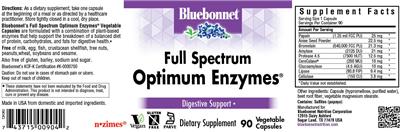
Supplement Facts
The label details for Full Spectrum Optimum Enzymes by Bluebonnet, sourced from the NIH Dietary Supplement Label Database.
Supplement Facts
| Ingredient | Amount | % DV |
|---|---|---|
| Papain | 25 mg | -- |
| Bromelain | 21.3 mg | -- |
| Lipase | 9.4 mg | -- |
| Cellulase | 3.8 mg | -- |
| Amylase | 21 mg | -- |
| Glucoamylase | 10 mg | -- |
| CereCalase | 10 mg | -- |
| Anise, Powder | 22.5 mg | -- |
| Protease 4.5 | 12.5 mg | -- |
Other ingredients: Hypromellose, Water, Purified, Beet root Fiber, Magnesium Stearate
Tap any ingredient to jump to its full detail below.
These statements are the manufacturer’s wording, reproduced from the product label — the label is saying it, not HelloPharmacist. We don’t verify or endorse them.
Suggested/Recommended/Usage/Directions
Directions: As a dietary supplement, take one capsule at the beginning of a meal or as directed by a healthcare practitioner.
Storage
Store tightly closed in a cool, dry place.
Formula
Bluebonnet's Full Spectrum Optimum Enzymes Vegetable Capsules are formulated with a combination of plant-based enzymes that help support the breakdown of a balanced diet of protein, carbohydrates, and fats for digestive health.
Bluebonnet's KOF-K Certification #K-0000700
K Parve (Kosher)
Formulation
Free of milk, egg, fish, crustacean shellfish, tree nuts, peanuts, wheat, soybeans and sesame. Also free of gluten, barley, sodium and sugar.
Made in USA from domestic and imported ingredients.
Digestive support
V Vegan
Gluten free
Precautions
Caution: Do not use in cases of stomach pain or ulcers.
Keep out of reach of children.
Contains: sulfites (papaya)
FDA Disclaimer Statement
These statements have not been evaluated by the Food and Drug Administration. This product is not intended to diagnose, treat, cure or prevent any disease.
Brand IP Statement(s)
N-Zimes
Seals/Symbols
V Vegan K Parve (Kosher)
FDA Statement of Identity
Dietary Supplement
Is this label outdated? Report a formula or label change and our pharmacy team will review it.
Full Spectrum Optimum Enzymes by Bluebonnet label
The label scan from the NIH Dietary Supplement Label Database. Tap to enlarge.
Label images are published by the NIH Dietary Supplement Label Database for the version of this product on file. Always read your actual product label.
View the full label (PDF)The Ingredients in Full Spectrum Optimum Enzymes by Bluebonnet
These are the 9 active ingredients this product is made of. Select any to open its full monograph.
Serving size1 Capsule(s) Dosage formCapsule Servings per container90 Amounts shown are per serving.
Most supplement products combine several ingredients, and a medication can interact with the product through any one of them. Each ingredient below shows whether it has known drug interactions.
Papain
Interacts with2 drugs
Papain is a protein-digesting enzyme from the papaya plant that is used in digestive supplements and some topical products. While it has clear food an...
Papain monograph & interactionsBromelain
Interacts with141 drugs
Bromelain is a group of protein-digesting enzymes from pineapple that people take mainly for inflammation, swelling, and sinus problems. Some early st...
Bromelain monograph & interactionsLipase
No knowninteractions
Lipase is a digestive enzyme that helps your body break down dietary fats. It is well established as part of prescription pancreatic enzyme therapy fo...
Lipase monograph & interactionsCellulase
Amylase
Glucoamylase
CereCalase
Anise, Powder
Interacts with245 drugs
Anise is a fragrant, licorice-flavored seed used for centuries to ease digestion and soothe coughs. Most of its health claims are based on tradition a...
Anise, Powder monograph & interactionsProtease 4.5
No knowninteractions
Proteolytic enzymes are proteins that help break down other proteins, and common examples include bromelain (from pineapple), papain (from papaya), tr...
Protease 4.5 monograph & interactionsOther (inactive) ingredients: Hypromellose, Water, Purified, Beet root Fiber, Magnesium Stearate. These complete the product’s ingredient list but are not active constituents.
Full Spectrum Optimum Enzymes by Bluebonnet Drug Interactions
HelloPharmacist Interaction Report
Bluebonnet's Full Spectrum Optimum Enzymes contains several active ingredients with documented interactions.
The most serious concern is papain with warfarin (Coumadin), a blood thinner — papain may increase warfarin's effects and side effects, raising bleeding risk. One patient previously stable on warfarin developed dangerously high levels after taking a papain-containing supplement.
Read the full breakdown — every affected drug type, severity by severity
Bromelain, another enzyme in this product, may increase bleeding risk if you're taking anticoagulants or antiplatelet drugs (blood thinners or aspirin-like medications). It's rated Moderate for this interaction.
Bromelain also has a Minor interaction with tetracycline antibiotics, though human studies show conflicting results on whether the effect is real.
Anise powder carries the most interactions overall. It may theoretically interfere with estrogen-based hormone replacement therapy and birth control pills, increase low blood sugar (hypoglycemia) risk with diabetes medications, reduce how well fluoxetine (Prozac), caffeine, and imipramine (Tofranil) work, and increase the effects of codeine and diazepam (Valium).
All are rated Moderate. Altogether, these interactions span 364 individual medications.
We could not check cellulase, amylase, glucoamylase, and CereCalase — no interaction data is on file for them. Lipase and Protease 4.5 show no known interactions in our data.
Run your exact medications through the checker on this page before starting.
Check your own medications below · Editorial policy · How we use AI
Want to check YOUR meds against Full Spectrum Optimum Enzymes?
Ask about interactions with your drugs in plain English — “Can I take it with lisinopril?” — and we find you the answer in seconds, ingredient by ingredient.
Go to the checkerIngredients driving the most interactions
Individual Drug Interactions
The ingredients in Full Spectrum Optimum Enzymes interact with 365 drugs. Click any drug to see the details.
3 of the 9 ingredients in Full Spectrum Optimum Enzymes interact with drugs. Each result below shows which ingredient is responsible. Anise, Powder Bromelain Papain
AbciximabReoPro
How Abciximab interacts with Full Spectrum Optimum Enzymes — through 1 ingredient. Tap an ingredient for the detail:
BromelainAnticoagulant/antiplatelet Drugs Moderate
Interaction Summary
Bromelain may have antiplatelet effects and may increase the risk of bleeding if used with anticoagulant or antiplatelet drugs.
Read the full Bromelain + Abciximab interactionAbrocitinibCibinqo
How Abrocitinib interacts with Full Spectrum Optimum Enzymes — through 1 ingredient. Tap an ingredient for the detail:
BromelainAnticoagulant/antiplatelet Drugs Moderate
Interaction Summary
Bromelain may have antiplatelet effects and may increase the risk of bleeding if used with anticoagulant or antiplatelet drugs.
Read the full Bromelain + Abrocitinib interactionAcarboseGlucobay, Prandase, Precose
How Acarbose interacts with Full Spectrum Optimum Enzymes — through 1 ingredient. Tap an ingredient for the detail:
Anise, PowderAntidiabetes Drugs Moderate
Interaction Summary
Theoretically, anise seed might increase the risk of hypoglycemia when taken with antidiabetes drugs.
Read the full Anise, Powder + Acarbose interactionAcenocoumarolSintrom
How Acenocoumarol interacts with Full Spectrum Optimum Enzymes — through 1 ingredient. Tap an ingredient for the detail:
BromelainAnticoagulant/antiplatelet Drugs Moderate
Interaction Summary
Bromelain may have antiplatelet effects and may increase the risk of bleeding if used with anticoagulant or antiplatelet drugs.
Read the full Bromelain + Acenocoumarol interactionAcetaminophen, AspirinGemnisyn
How Acetaminophen, Aspirin interacts with Full Spectrum Optimum Enzymes — through 2 ingredients. Tap an ingredient for the detail:
BromelainAnticoagulant/antiplatelet Drugs Moderate
Interaction Summary
Bromelain may have antiplatelet effects and may increase the risk of bleeding if used with anticoagulant or antiplatelet drugs.
Read the full Bromelain + Acetaminophen, Aspirin interactionAnise, PowderAcetaminophen (tylenol, Others) Minor
Interaction Summary
Theoretically, anise oil might decrease the levels and clinical effects of acetaminophen.
Read the full Anise, Powder + Acetaminophen, Aspirin interactionAcetaminophen, Aspirin, CaffeineExcedrin, Excedrin Extra Strength, Excedrin Migraine
How Acetaminophen, Aspirin, Caffeine interacts with Full Spectrum Optimum Enzymes — through 2 ingredients. Tap an ingredient for the detail:
Anise, PowderCaffeine, Acetaminophen (tylenol, Others) Moderate
Interaction Summary
Theoretically, anise oil might decrease the efficacy of caffeine.
Read the full Anise, Powder + Acetaminophen, Aspirin, Caffeine interactionBromelainAnticoagulant/antiplatelet Drugs Moderate
Interaction Summary
Bromelain may have antiplatelet effects and may increase the risk of bleeding if used with anticoagulant or antiplatelet drugs.
Read the full Bromelain + Acetaminophen, Aspirin, Caffeine interactionAcetaminophen, Butalbital, CaffeineEsgic, Esgic Plus, Fiogesic, Fioricet, Repan, Tecnal +1 more
How Acetaminophen, Butalbital, Caffeine interacts with Full Spectrum Optimum Enzymes — through 1 ingredient. Tap an ingredient for the detail:
Anise, PowderAcetaminophen (tylenol, Others), Caffeine Moderate
Interaction Summary
Theoretically, anise oil might decrease the levels and clinical effects of acetaminophen.
Read the full Anise, Powder + Acetaminophen, Butalbital, Caffeine interactionAcetaminophen, Butalbital, Caffeine, CodeineEsgic with Codeine, Fioricet w/ Codeine
How Acetaminophen, Butalbital, Caffeine, Codeine interacts with Full Spectrum Optimum Enzymes — through 1 ingredient. Tap an ingredient for the detail:
Anise, PowderCaffeine, Codeine +1 Moderate
Interaction Summary
Theoretically, anise oil might decrease the efficacy of caffeine.
Read the full Anise, Powder + Acetaminophen, Butalbital, Caffeine, Codeine interactionAcetaminophen, Butalbital, CodeineBancap w/ Codeine
How Acetaminophen, Butalbital, Codeine interacts with Full Spectrum Optimum Enzymes — through 1 ingredient. Tap an ingredient for the detail:
Anise, PowderAcetaminophen (tylenol, Others), Codeine Moderate
Interaction Summary
Theoretically, anise oil might decrease the levels and clinical effects of acetaminophen.
Read the full Anise, Powder + Acetaminophen, Butalbital, Codeine interactionAcetaminophen, Butalbital, Codeine PhosphatePhrenilin #3
How Acetaminophen, Butalbital, Codeine Phosphate interacts with Full Spectrum Optimum Enzymes — through 1 ingredient. Tap an ingredient for the detail:
Anise, PowderCodeine, Acetaminophen (tylenol, Others) Moderate
Interaction Summary
Theoretically, anise oil might increase the effects and adverse effects of codeine.
Read the full Anise, Powder + Acetaminophen, Butalbital, Codeine Phosphate interactionAcetaminophen, Caffeine, Chlorpheniramine, Hydrocodone, PhenylephrineHycomine Compound
How Acetaminophen, Caffeine, Chlorpheniramine, Hydrocodone, Phenylephrine interacts with Full Spectrum Optimum Enzymes — through 1 ingredient. Tap an ingredient for the detail:
Anise, PowderAcetaminophen (tylenol, Others), Caffeine Moderate
Interaction Summary
Theoretically, anise oil might decrease the levels and clinical effects of acetaminophen.
Read the full Anise, Powder + Acetaminophen, Caffeine, Chlorpheniramine, Hydrocodone, Phenylephrine interactionAcetaminophen, Caffeine, CodeineGesic C15, Gesic C30, Gesic C8, Lenoltec 1, Lenoltec 2, Lenoltec 3 +1 more
How Acetaminophen, Caffeine, Codeine interacts with Full Spectrum Optimum Enzymes — through 1 ingredient. Tap an ingredient for the detail:
Anise, PowderCaffeine, Codeine +1 Moderate
Interaction Summary
Theoretically, anise oil might decrease the efficacy of caffeine.
Read the full Anise, Powder + Acetaminophen, Caffeine, Codeine interactionAcetaminophen, Caffeine, Codeine, SalicylamideCodalan No.1, Codalan No.2, Codalan No.3
How Acetaminophen, Caffeine, Codeine, Salicylamide interacts with Full Spectrum Optimum Enzymes — through 1 ingredient. Tap an ingredient for the detail:
Anise, PowderAcetaminophen (tylenol, Others), Caffeine +1 Moderate
Interaction Summary
Theoretically, anise oil might decrease the levels and clinical effects of acetaminophen.
Read the full Anise, Powder + Acetaminophen, Caffeine, Codeine, Salicylamide interactionAcetaminophen, Caffeine, DihydrocodeineDHC Plus, Panlor DC, Panlor SS
How Acetaminophen, Caffeine, Dihydrocodeine interacts with Full Spectrum Optimum Enzymes — through 1 ingredient. Tap an ingredient for the detail:
Anise, PowderCaffeine, Acetaminophen (tylenol, Others) Moderate
Interaction Summary
Theoretically, anise oil might decrease the efficacy of caffeine.
Read the full Anise, Powder + Acetaminophen, Caffeine, Dihydrocodeine interactionAcetaminophen, Caffeine, IsomethepteneMigralam
How Acetaminophen, Caffeine, Isometheptene interacts with Full Spectrum Optimum Enzymes — through 1 ingredient. Tap an ingredient for the detail:
Anise, PowderAcetaminophen (tylenol, Others), Caffeine Moderate
Interaction Summary
Theoretically, anise oil might decrease the levels and clinical effects of acetaminophen.
Read the full Anise, Powder + Acetaminophen, Caffeine, Isometheptene interactionAcetaminophen, Caffeine, PyrilamineMidol Max Strength Menstrual
How Acetaminophen, Caffeine, Pyrilamine interacts with Full Spectrum Optimum Enzymes — through 1 ingredient. Tap an ingredient for the detail:
Anise, PowderCaffeine, Acetaminophen (tylenol, Others) Moderate
Interaction Summary
Theoretically, anise oil might decrease the efficacy of caffeine.
Read the full Anise, Powder + Acetaminophen, Caffeine, Pyrilamine interactionAcetaminophen, Chlorpheniramine, Codeine, PhenylephrineColrex
How Acetaminophen, Chlorpheniramine, Codeine, Phenylephrine interacts with Full Spectrum Optimum Enzymes — through 1 ingredient. Tap an ingredient for the detail:
Anise, PowderAcetaminophen (tylenol, Others), Codeine Moderate
Interaction Summary
Theoretically, anise oil might decrease the levels and clinical effects of acetaminophen.
Read the full Anise, Powder + Acetaminophen, Chlorpheniramine, Codeine, Phenylephrine interactionAcetaminophen, Chlorzoxazone, CodeineAcetazone Forte C8, Parafon Forte C8
How Acetaminophen, Chlorzoxazone, Codeine interacts with Full Spectrum Optimum Enzymes — through 1 ingredient. Tap an ingredient for the detail:
Anise, PowderAcetaminophen (tylenol, Others), Codeine Moderate
Interaction Summary
Theoretically, anise oil might decrease the levels and clinical effects of acetaminophen.
Read the full Anise, Powder + Acetaminophen, Chlorzoxazone, Codeine interactionAcetaminophen, CodeineTylenol No.3, Tylenol w/ Codeine
How Acetaminophen, Codeine interacts with Full Spectrum Optimum Enzymes — through 1 ingredient. Tap an ingredient for the detail:
Anise, PowderCodeine, Acetaminophen (tylenol, Others) Moderate
Interaction Summary
Theoretically, anise oil might increase the effects and adverse effects of codeine.
Read the full Anise, Powder + Acetaminophen, Codeine interactionAcetaminophen, Codeine, DoxylamineMersyndol
How Acetaminophen, Codeine, Doxylamine interacts with Full Spectrum Optimum Enzymes — through 1 ingredient. Tap an ingredient for the detail:
Anise, PowderAcetaminophen (tylenol, Others), Codeine Moderate
Interaction Summary
Theoretically, anise oil might decrease the levels and clinical effects of acetaminophen.
Read the full Anise, Powder + Acetaminophen, Codeine, Doxylamine interactionAcetaminophen, Codeine, MethocarbamolAcetaminophen, Codeine, Methocarbamol, Robaxacet 8
How Acetaminophen, Codeine, Methocarbamol interacts with Full Spectrum Optimum Enzymes — through 1 ingredient. Tap an ingredient for the detail:
Anise, PowderCodeine, Acetaminophen (tylenol, Others) Moderate
Interaction Summary
Theoretically, anise oil might increase the effects and adverse effects of codeine.
Read the full Anise, Powder + Acetaminophen, Codeine, Methocarbamol interactionAcetaminophen, IbuprofenCombogesic
How Acetaminophen, Ibuprofen interacts with Full Spectrum Optimum Enzymes — through 2 ingredients. Tap an ingredient for the detail:
BromelainAnticoagulant/antiplatelet Drugs Moderate
Interaction Summary
Bromelain may have antiplatelet effects and may increase the risk of bleeding if used with anticoagulant or antiplatelet drugs.
Read the full Bromelain + Acetaminophen, Ibuprofen interactionAnise, PowderAcetaminophen (tylenol, Others) Minor
Interaction Summary
Theoretically, anise oil might decrease the levels and clinical effects of acetaminophen.
Read the full Anise, Powder + Acetaminophen, Ibuprofen interactionAcetohexamideDymelor
How Acetohexamide interacts with Full Spectrum Optimum Enzymes — through 1 ingredient. Tap an ingredient for the detail:
Anise, PowderAntidiabetes Drugs Moderate
Interaction Summary
Theoretically, anise seed might increase the risk of hypoglycemia when taken with antidiabetes drugs.
Read the full Anise, Powder + Acetohexamide interactionAcetylsalicylic AcidEntrophen
How Acetylsalicylic Acid interacts with Full Spectrum Optimum Enzymes — through 1 ingredient. Tap an ingredient for the detail:
BromelainAnticoagulant/antiplatelet Drugs Moderate
Interaction Summary
Bromelain may have antiplatelet effects and may increase the risk of bleeding if used with anticoagulant or antiplatelet drugs.
Read the full Bromelain + Acetylsalicylic Acid interactionAlbiglutideTanzeum
How Albiglutide interacts with Full Spectrum Optimum Enzymes — through 1 ingredient. Tap an ingredient for the detail:
Anise, PowderAntidiabetes Drugs Moderate
Interaction Summary
Theoretically, anise seed might increase the risk of hypoglycemia when taken with antidiabetes drugs.
Read the full Anise, Powder + Albiglutide interactionAlogliptinNesina
How Alogliptin interacts with Full Spectrum Optimum Enzymes — through 1 ingredient. Tap an ingredient for the detail:
Anise, PowderAntidiabetes Drugs Moderate
Interaction Summary
Theoretically, anise seed might increase the risk of hypoglycemia when taken with antidiabetes drugs.
Read the full Anise, Powder + Alogliptin interactionAlogliptin, MetforminKazano
How Alogliptin, Metformin interacts with Full Spectrum Optimum Enzymes — through 1 ingredient. Tap an ingredient for the detail:
Anise, PowderAntidiabetes Drugs Moderate
Interaction Summary
Theoretically, anise seed might increase the risk of hypoglycemia when taken with antidiabetes drugs.
Read the full Anise, Powder + Alogliptin, Metformin interactionAlogliptin, PioglitazoneOseni
How Alogliptin, Pioglitazone interacts with Full Spectrum Optimum Enzymes — through 1 ingredient. Tap an ingredient for the detail:
Anise, PowderAntidiabetes Drugs Moderate
Interaction Summary
Theoretically, anise seed might increase the risk of hypoglycemia when taken with antidiabetes drugs.
Read the full Anise, Powder + Alogliptin, Pioglitazone interactionAlteplase, TpaActilyse, Activase
How Alteplase, Tpa interacts with Full Spectrum Optimum Enzymes — through 1 ingredient. Tap an ingredient for the detail:
BromelainAnticoagulant/antiplatelet Drugs Moderate
Interaction Summary
Bromelain may have antiplatelet effects and may increase the risk of bleeding if used with anticoagulant or antiplatelet drugs.
Read the full Bromelain + Alteplase, Tpa interactionAluminum Hydroxide, Aspirin, Codeine Phosphate, Magnesium HydroxideAscriptin Codeine #2
How Aluminum Hydroxide, Aspirin, Codeine Phosphate, Magnesium Hydroxide interacts with Full Spectrum Optimum Enzymes — through 2 ingredients. Tap an ingredient for the detail:
Anise, PowderCodeine Moderate
Interaction Summary
Theoretically, anise oil might increase the effects and adverse effects of codeine.
Read the full Anise, Powder + Aluminum Hydroxide, Aspirin, Codeine Phosphate, Magnesium Hydroxide interactionBromelainAnticoagulant/antiplatelet Drugs Moderate
Interaction Summary
Bromelain may have antiplatelet effects and may increase the risk of bleeding if used with anticoagulant or antiplatelet drugs.
Read the full Bromelain + Aluminum Hydroxide, Aspirin, Codeine Phosphate, Magnesium Hydroxide interactionEach ingredient & the kinds of drugs it affects
For each ingredient in Full Spectrum Optimum Enzymes with known interactions, here are the types of medications they can affect. Open any type for the detail — or search your exact drug in the checker above.
Anise, Powder
Antidiabetes Drugs
Theoretically, anise seed might increase the risk of hypoglycemia when taken with antidiabetes drugs.
A small clinical study shows that anise seed powder decreases fasting blood glucose levels by 36% when compared to baseline.
Caffeine
Theoretically, anise oil might decrease the efficacy of caffeine.
Animal research shows that taking anise oil with caffeine decreases the bioavailability of caffeine. Whether this interaction will occur in humans is unclear.
Codeine
Theoretically, anise oil might increase the effects and adverse effects of codeine.
Animal research shows that anise oil increases the analgesic effects of codeine, possibly by inducing its phase I metabolism and increasing conversion to morphine. Whether this interaction occurs in humans is unclear.
Contraceptive Drugs
Theoretically, anise might interfere with contraceptive drug therapy.
Some in vitro research suggests that anise has estrogenic effects, while other in vitro research suggests that anise has antiestrogenic effects.
Diazepam (Valium)
Theoretically, anise oil might increase the effects and adverse effects of diazepam.
Animal research shows that taking anise oil with diazepam increases the motor impairment associated with diazepam, possibly by inhibiting its breakdown by cytochrome P450 3A4. Whether this interaction occurs in humans is unclear.
Estrogens
Theoretically, anise might interfere with estrogen-based hormone replacement therapy.
Some in vitro research suggests that anise has estrogenic effects, while other in vitro research suggests that anise has antiestrogenic effects.
Fluoxetine (Prozac)
Theoretically, anise oil might decrease the efficacy of fluoxetine.
Animal research shows that taking anise oil with fluoxetine reduces the antidepressant effects of fluoxetine, possibly by promoting its breakdown by cytochrome P450 2D6. Whether this interaction occurs in humans is unclear.
Imipramine (Tofranil)
Theoretically, anise oil might decrease the efficacy of imipramine.
Animal research shows that taking anise oil with imipramine reduces the antidepressant effects of imipramine, possibly by promoting its breakdown by cytochrome P450 2D6. Whether this interaction occurs in humans is unclear.
Midazolam (Versed)
Theoretically, anise oil might increase the effects and adverse effects of midazolam.
Animal research shows that taking anise oil with midazolam increases the motor impairment associated with midazolam, possibly by inhibiting its breakdown by cytochrome P450 3A4. Whether this interaction occurs in humans is unclear.
Tamoxifen (Nolvadex)
Theoretically, anise might interfere with tamoxifen therapy.
Some in vitro research suggests that anise has estrogenic effects, while other in vitro research suggests that anise has antiestrogenic effects.
Acetaminophen (Tylenol, Others)
Theoretically, anise oil might decrease the levels and clinical effects of acetaminophen.
Animal research shows that taking anise oil with acetaminophen decreases peak plasma levels of acetaminophen but does not reduce overall bioavailability. Whether this interaction will occur in humans is unclear.
Bromelain
Anticoagulant/Antiplatelet Drugs
Bromelain may have antiplatelet effects and may increase the risk of bleeding if used with anticoagulant or antiplatelet drugs.
There is one case report of a patient experiencing minor bruising while taking bromelain with naproxen. Bromelain is thought to have antiplatelet activity. Whether this interaction is of concern with topical bromelain is unclear. Interference with coagulation of burn wounds has been reported in a patient receiving bromelain-based enzymatic debridement. However, observational research has found that topical bromelain debridement is not associated with increases or decreases in laboratory markers of coagulation when compared with surgical debridement.
Tetracycline Antibiotics
Theoretically, bromelain might increase levels of tetracycline antibiotics.
Laboratory research suggests that bromelain might increase the absorption of tetracycline antibiotics. However, a study in healthy adults reported no difference in tetracycline plasma levels when a 500 mg dose was taken with or without bromelain 80 mg.
Papain
Warfarin (Coumadin)
Theoretically, papain might increase the effects and side effects of warfarin.
In one case report, a patient previously stable on warfarin was found to have an international normalization ratio (INR) of 7.4, which was attributed to ingestion of a supplement containing papain from papaya extract.
Brand information
Manufacturer and brand details for Full Spectrum Optimum Enzymes, from the product label.
Bluebonnet
- Name
- Bluebonnet Nutrition Corporation
- Street Address
- 12915 Dairy Ashford
- City
- Sugar Land
- State
- Texas
- ZipCode
- 77478
- Web Address
- www.bluebonnetnutrition.com
Full Spectrum Optimum Enzymes by Bluebonnet: Common Questions
Does Full Spectrum Optimum Enzymes by Bluebonnet interact with any medications?
How can one product interact with so many drugs?
Where does this information come from?
Is this safe to take if I'm pregnant or breastfeeding?
What are the most common side effects?
Does this product actually help with digestion?
Can I take this with my tetracycline antibiotic?
Why does anise have so many interactions?
Are there any fillers or extra ingredients I should know about?
Written and reviewed by the HelloPharmacist editorial staff. Our editorial policy
Not sure if Full Spectrum Optimum Enzymes is safe with your meds?
Our pharmacists answer your medication & supplement questions — free.
Label information is sourced from the NIH Dietary Supplement Label Database and reflects the product version on file; always read your actual product label. This page is for education only and is not a substitute for professional medical advice. Confirm with your pharmacist or doctor before combining supplements and medications.
The Full Monographs Behind Full Spectrum Optimum Enzymes’s Ingredients
Every ingredient we hold a full HelloPharmacist monograph for — uses, evidence, safety, and the complete interaction list.
Papain
Interacts with 2 drugsPapain is a protein-digesting enzyme from the papaya plant that is used in digestive supplements and some topical products. While it has clear food and laboratory uses, strong human evidence...
Read the full Papain monograph → Herb & supplement monographBromelain
Interacts with 141 drugsBromelain is a group of protein-digesting enzymes from pineapple that people take mainly for inflammation, swelling, and sinus problems. Some early studies are promising, but the overall evi...
Read the full Bromelain monograph → Herb & supplement monographLipase
Lipase is a digestive enzyme that helps your body break down dietary fats. It is well established as part of prescription pancreatic enzyme therapy for people who cannot make enough of their...
Read the full Lipase monograph → Herb & supplement monographAnise
Interacts with 245 drugsAnise is a fragrant, licorice-flavored seed used for centuries to ease digestion and soothe coughs. Most of its health claims are based on tradition and small or laboratory studies rather th...
Read the full Anise monograph → Herb & supplement monographProteolytic Enzymes (proteases)
Proteolytic enzymes are proteins that help break down other proteins, and common examples include bromelain (from pineapple), papain (from papaya), trypsin, chymotrypsin, and pancreatin. Peo...
Read the full Proteolytic Enzymes (proteases) monograph →Sources & How We Checked
Full Spectrum Optimum Enzymes's label data comes from the NIH Dietary Supplement Label Database; the ingredient interaction data is from the Natural Medicines database, reviewed by our pharmacists.
- NIH Dietary Supplement Label Database (DSLD) — The official product label on file for this supplement.
- Natural Medicines (Therapeutic Research Center) — Evidence-graded clinical reference behind the ingredient interaction data.
Content is written and reviewed by licensed HelloPharmacist pharmacists. See our data sources and editorial standards for how this information is built and checked.
The 46 references behind this product’s interaction data
Every citation that drives the interaction findings for this product’s ingredients, from the evidence-graded Natural Medicines (TRC Healthcare) database. Open an ingredient to browse its citations — links open the study on PubMed or the publisher’s site.
Papain 11 references
- The Review of Natural Products by Facts and Comparisons. St. Louis, MO: Wolters Kluwer Co., 1999.
- Shaw D, Leon C, Kolev S, Murray V. Traditional remedies and food supplements: a 5-year toxicological study (1991-1995). Drug Saf 1997;17:342-56.
- Shuttleworth D, Hill S, Marks R, Connelly DM. Relief of experimentally induced pruritus with a novel eutectic mixture of local anaesthetic agents. Br J Dermatol 1988;119:535-40.
- Mansfield LE, Ting S, Haverly RW, Yoo TJ. The incidence and clinical implications of hypersensitivity to papain in an allergic population, confirmed by blinded oral challenge. Ann Allergy 1985;55:541-3.
- Martin, T., Uhder, K., Kurek, R., Roeddiger, S., Schneider, L., Vogt, H. G., Heyd, R., and Zamboglou, N. Does prophylactic treatment with proteolytic enzymes reduce acute toxicity of adjuvant pelvic irradiation? Results of a double-blind randomized trial PubMed
- Walker-Renard, P. Update on the medicinal management of phytobezoars. Am J Gastroenterol. 1993;88(10):1663-1666.
- Tymoszuk D, Wiszniewska M, Walusiak-Skorupa J. Papain-induced occupational rhinoconjunctivitis and asthma - A case report. Med Pr 2016;67(1):109-12. PubMed
- Soto-Mera MT, López-Rico MR, Filgueira JF, et al. Occupational allergy to papain. Allergy 2000;55(10):983-4. PubMed
- Tarlo SM, Shaikh W, Bell B, et al. Papain-induced allergic reactions. Clin Allergy 1978;8(3):207-15. PubMed
- Baur X, König G, Bencze K, Fruhmann G. Clinical symptoms and results of skin test, RAST and bronchial provocation test in thirty-three papain workers: Evidence for strong immunogenic potency and clinically relevant proteolytic e?ects of airborne papain. C
- Novey HS, Keenan WJ, Fairshter RD, Wells ID, Wilson AF, Culver BD. Pulmonary disease in workers exposed to papain: clinico-physiological and immunological studies. Clin Allergy 1980;10(6):721-31. PubMed
Bromelain 19 references
- Nettis E, Napoli G, Ferrannini A, Tursi A. IgE-mediated allergy to bromelain. Allergy 2001;56:257-8. PubMed
- Taussig SJ, Batkin S. Bromelain, the enzyme complex of pineapple (Ananas comosus) and its clinical application. An update. J Ethnopharmacol 1988;22:191-203.. PubMed
- Bradbrook ID, Morrison PJ, Rogers HJ. The effect of bromelain on the absorption of orally administered tetracycline. Br J Clin Pharmacol 1978;6:552-4. PubMed
- Bush TM, Rayburn KS, Holloway SW, et al. Adverse interactions between herbal and dietary substances and prescription medications: a clinical survey. Altern Ther Health Med 2007;13:30-5.
- Brien S, Lewith G, Walker AF, et al. Bromelain as an adjunctive treatment for moderate-to-severe osteoarthritis of the knee: a randomized placebo-controlled pilot study. QJM 2006;99:841-50. PubMed
- Mori S, Ojima Y, Hirose T, et al. The clinical effect of proteolytic enzyme containing bromelain and trypsin on urinary tract infection evaluated by double blind method. Acta Obstet Gynaecol Jpn 1972;19:147-53.
- Glaser D, Hilberg T. The influence of bromelain on platelet count and platelet activity in vitro. Platelets 2006;17:37-41. PubMed
- Heinicke R M, van der Wal L, Yokoyama M. Effect of bromelain (Ananase) on human platelet aggregation. Experientia 1972;28:844-5. PubMed
- Gailhofer, G., Wilders-Truschnig, M., Smolle, J., and Ludvan, M. Asthma caused by bromelain: an occupational allergy. Clin Allergy 1988;18(5):445-450. PubMed
- Mattei, O., Fabri, G., and Farina, G. [Occupational health experience regarding four cases of asthma due to bromelain (author's transl)]. Medicina del Lavoro 1979;70(5):404-409.
- Galleguillos, F. and Rodriguez, J. C. Asthma caused by bromelin inhalation. Clin Allergy 1978;8(1):21-24. PubMed
- Perez-Camo I, Quirce S, Duran MA, and et al. Latex allergy: evidence of cross-reactivity with papain and bromelain [abstract]. Allergy 1996;51(suppl 31):48.
- Martin GJ, Ehrenreich J, and Asbell N. Bromelain: pineapple proteases with anti-edema activity. Exp Med Surg 1962;20:227-247.
- Kasemsuk T, Saengpetch N, Sibmooh N, Unchern S. Improved WOMAC score following 16-week treatment with bromelain for knee osteoarthritis. Clin Rheumatol. 2016 Oct;35(10):2531-40. PubMed
- Kutlu Ö, DemirbaS A, Elmas ÖF, Güvenç U, Metin A. Fixed drug eruption: a new side effect of bromelain. Contact Dermatitis 2020. Online ahead of print. PubMed
- Shoham Y, Shapira E, Haik J, et al. Bromelain-based enzymatic debridement of chronic wounds: Results of a multicentre randomized controlled trial. Wound Repair Regen 2021;29(6):899-907. PubMed
- Pfister P, Garcia Wendel PD, Kim BS, et al. Coagulation side effects of enzymatic debridement in burned patients. Burns 2022. PubMed
- Hasham S, Riyat H, Fletcher A, O'Boyle CP, Alexander S. To bleed or not to bleed? Case series and discussion of haemorrhage risk with enzymatic debridement in burn injuries. Scars Burn Heal 2023;9:20595131231168333. PubMed
- Leelakanok N, Petchsomrit A, Janurai T, Saechan C, Sunsandee N. Efficacy and safety of bromelain: A systematic review and meta-analysis. Nutr Health 2023. PubMed
Lipase 1 reference
- Casper C, Hascoet JM, Ertl T, et al. Recombinant bile salt-stimulated lipase in preterm infant feeding: A randomized phase 3 study. PLoS One. 2016;11(5):e0156071. PubMed
Anise 12 references
- Electronic Code of Federal Regulations. Title 21. Part 182 -- Substances Generally Recognized As Safe. Available at: https://www.accessdata.fda.gov/scripts/cdrh/cfdocs/cfcfr/CFRSearch.cfm?CFRPart=182
- Kassi E, Papoutsi Z, Fokialakis N, et al. Greek plant extracts exhibit selective estrogen receptor modulator (SERM)-like properties. J Agric Food Chem 2004;52:6956-61. PubMed
- Mumcuoglu KY, Miller J, Zamir C, et al. The in vivo pediculicidal efficacy of a natural remedy. Isr Med Assoc J 2002;4:790-3.
- Garcia-Gonzalez JJ, Bartolome-Zavala B, Fernandez-Melendez S, et al. Occupational rhinoconjunctivitis and food allergy because of aniseed sensitization. Ann Allergy Asthma Immunol 2002;88:518-22. . PubMed
- Tabanca N, Khan SI, Bedir E, et al. Estrogenic activity of isolated compounds and essential oils of Pimpinella species from Turkey, evaluated using a recombinant yeast screen. Planta Med 2004;70:728-35.
- Gonzalez-Gutierrez, M. L., Sanchez-Fernandez, C., Esteban-Lopez, M. I., Sempere-Ortells, J. M., and Diaz-Alperi, P. Allergy to anis. Allergy 2000;55(2):195-196.
- Anliker, M. D., Borelli, S., and Wuthrich, B. Occupational protein contact dermatitis from spices in a butcher: a new presentation of the mugwort-spice syndrome. Contact Dermatitis 2002;46(2):72-74. PubMed
- Poon, T. S. and Freeman, S. Cheilitis caused by contact allergy to anethole in spearmint flavoured toothpaste. Australas.J Dermatol. 2006;47(4):300-301. PubMed
- Andersen, K. E. Contact allergy to toothpaste flavors. Contact Dermatitis 1978;4(4):195-198. PubMed
- Samojlik I, Mijatovic V, Petkovic S, et al. The influence of essential oil of aniseed (Pimpinella anisum, L.) on drug effects on the central nervous system. Fitoterapia 2012;83:1466-73. PubMed
- Samojlik I, Petkovic S, Stilinovic N, et al. Pharmacokinetic herb-drug interaction between essential oil of aniseed (Pimpinella anisum L., Apiaceae) and acetaminophen and caffeine: A potential risk for clinical practice. Phytother Res 2016;30:253-9.
- Rajeshwari U, Shobha I, Andallu B. Comparison of aniseeds and coriander seeds for antidiabetic, hypolipidemic and antioxidant activities. Spatula DD-Peer Reviewed Journal on Complementary Medicine and Drug Discovery 2011;1:9-16. DOI
Proteolytic Enzymes (proteases) 3 references
- Weeks JA, Harper RA, Simon RA, Burdick JD. Assessment of sensitization risk of a laundry pre-spotter containing protease. Cutan Ocul Toxicol. 2011;30(4):272-9. PubMed
- Marquès LI, Lara S, Abós T, Bartolomé B. Occupational rhinitis due to pepsin. J Investig Allergol Clin Immunol. 2006;16(2):136-7. DOI
- Cartier A, Malo JL, Pineau L, Dolovich J. Occupational asthma due to pepsin. J Allergy Clin Immunol. 1984;73(5 Pt 1):574-7. PubMed
See these in context on the Proteolytic Enzymes (proteases) monograph →
Parts of this content are provided by the Therapeutic Research Center, LLC.
DISCLAIMER: Currently this does not check for drug-drug interactions. This is not an all-inclusive comprehensive list of potential interactions and is for informational purposes only. Not all interactions are known or well-reported in the scientific literature, and new interactions are continually being reported. Input is needed from a qualified healthcare provider including a pharmacist before starting any therapy. Application of clinical judgment is necessary.
© 2021 Therapeutic Research Center, LLC