
G.I. Detox INT Ingredients & Drug Interactions
What is this page for?
First and foremost: checking G.I. Detox INT against your medications. The heart of this page is the interaction checker and the full interaction report — how this product’s ingredients may interact with prescription and over-the-counter medicines you may be taking.
Around that, we add a pharmacist’s high-level view of the product as a whole — what’s inside, the evidence for its stated use, how transparent the label is, and what safety data exists — so you can see the full picture in one place. It’s educational information from our licensed clinical databases and the clinical staff at HelloPharmacist — not medical advice — and we don’t sell or endorse products. Our editorial policy
G.I. Detox INT is a dietary supplement by Biocidin Botanicals with 6 active ingredients. Its ingredients are commonly taken for hair, skin, and nail health, bone health and osteoporosis, joint and connective tissue support.Based on those ingredients, 2,082 medications have a known interaction with it, the most serious rated major. The ingredients most likely to interact are Charcoal, Activated, Aloe Vera Gel, Apple Pectin. Use the checker below to test your specific medication, or read the full HelloPharmacist Interaction Report.
Check Your Meds Against G.I. Detox INT by Biocidin Botanicals
Ask about any prescription or over-the-counter medication and we check it for interactions with G.I. Detox INT by Biocidin Botanicals — and tell you which ingredient is responsible.
AI summaries are generated from our interaction database for education only — always confirm with your pharmacist. How we use AI
Ask the Pharmacist
A licensed pharmacist will answer your question by email — free, usually within 24 hours.
Got it — thank you!
A licensed pharmacist will answer within 24 hours. Keep an eye on your email (worth checking spam, just in case).
HelloPharmacist Scorecard of G.I. Detox INT by Biocidin Botanicals
Our pharmacy team’s full take, with four database checks built into the cards below — a summary of what is known, not a grade of the product itself.
What’s inside
Full disclosure
G.I. Detox INT contains 6 active ingredients.
The main ones are activated charcoal, a highly absorbent compound used to trap substances in your digestive tract; aloe vera gel, a plant extract with laxative and anti-inflammatory properties; apple pectin, a soluble fiber from fruit; silica, a mineral form of silicon; velay green clay, a mineral-based absorbent; and humic powder, a compound derived from organic matter. There are also inactive ingredients — hydroxypropyl methylcellulose, water, and rice extract — that act as fillers and binders to hold the capsule together.
Does it work?
Moderate evidence
The evidence for this product's ingredients is mixed. Activated charcoal is possibly effective for poisoning; aloe vera gel is possibly effective for acne, weight loss, diabetes, psoriasis, burns, and constipation; apple pectin is possibly effective for high cholesterol; silica is possibly effective for osteoporosis; and velay green clay is possibly effective for rotaviral diarrhea.
For most other claimed uses — like prediabetes, wound healing, IBS, and chemotherapy-related diarrhea — the evidence we hold is insufficient to rate. Humic powder has no effectiveness data on file.
How safe is it?
Well-documented data
Activated charcoal is generally low-risk for short-term use but can cause constipation, black stools, bloating, and gas. Rarely, it may cause gastrointestinal obstruction.
Apple pectin from food and typical supplement amounts is generally well tolerated, though some people experience diarrhea, gas, loose stools, or mild cramps. Aloe vera gel applied topically is generally well tolerated, but oral aloe latex can cause abdominal pain, cramps, and diarrhea; long-term use may cause more serious effects including muscle weakness and irregular heartbeat from potassium loss.
Silica from food and most supplements is generally well tolerated, though high-dose or long-term safety hasn't been well studied. Velay green clay is generally low-risk topically but can be contaminated with heavy metals when taken orally; constipation, vomiting, and diarrhea are common, and habitual use has been linked to heart problems and severe iron deficiency anemia.
Humic powder has limited safety data.
Meds to double-check
Major interaction found
Before taking G.I. Detox INT, double-check any oral medications you take — activated charcoal can reduce their absorption.
If you take digoxin or other heart medications, blood thinners (including warfarin), diabetes drugs, water pills/diuretics, strong laxatives, tetracycline antibiotics, lovastatin, cimetidine, or quinine, talk to your pharmacist first. No interactions are documented for silica or humic powder, which we hold data for.
The bottom line
Scorecard at a glanceFully disclosed formula with some supporting evidence for its stated purpose. Major medication interactions have been identified, and safety information is well characterized.
G.I. Detox INT isn't a product you can take casually with other medications — its main ingredients (especially activated charcoal) bind to many drugs and reduce how well they work.
If you take any prescription medication, blood thinner, heart drug, diabetes medication, or acid reflux medication, check with your pharmacist before you start. This product is best used under professional guidance.
Educational only — not medical advice; always confirm with your pharmacist. Our editorial policy · How we use AI
Assessment coverage: 6 of 6 active ingredients matched to our full ingredient reviews (monographs). Based on the product label dated Jun 20, 2024.
This Scorecard evaluates available label information, ingredient evidence, and known medication-safety considerations. It does not independently verify product identity, purity, potency, contamination, or manufacturing quality. How these ratings are computed
General information
Key facts about G.I. Detox INT, straight from the product label.
| Brand | Biocidin Botanicals |
|---|---|
| Barcode (UPC) | 899870002258 |
| Net contents | 60 Capsule(s) |
| Market status | On market |
| Date entered into DSLD | Jun 20, 2024 |
| DSLD ID | 314058 |
| Product type | Other Combinations |
| Supplement form | Capsule |
| Dietary claims / uses | All Other, Structure/Function |
| Intended target group(s) | Vegan, Vegetarian, Adult (18 - 50 Years), Women (not pregnant or lactating), Gluten Free, Dairy Free |
Everything in this section is reproduced from the manufacturer’s own product label — it’s the label speaking, not HelloPharmacist. We show it so you can see exactly what the maker states; we don’t verify or endorse those statements.
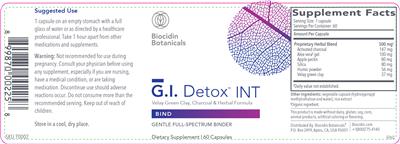
Supplement Facts
The label details for G.I. Detox INT by Biocidin Botanicals, sourced from the NIH Dietary Supplement Label Database.
Supplement Facts
| Ingredient | Amount | % DV |
|---|---|---|
| Silica | 80 mg | -- |
| Apple Pectin | 80 mg | -- |
| Charcoal, Activated | 147 mg | -- |
| Proprietary Herbal Blend | 500 mg | -- |
| Aloe Vera Gel | 100 mg | -- |
| Humic, Powder | 56 mg | -- |
| Velay Green Clay | 37 mg | -- |
Other ingredients: Hydroxypropyl Methylcellulose, Water, Rice extract
Tap any ingredient to jump to its full detail below.
These statements are the manufacturer’s wording, reproduced from the product label — the label is saying it, not HelloPharmacist. We don’t verify or endorse them.
Suggested/Recommended/Usage/Directions
Suggested use 1 capsule on an empty stomach with a full glass of water or as directed by a healthcare professional. Take 1 hour apart from the other medications and supplements.
Precautions
Warning: Not recommended for use during pregnancy. Consult your physician before using any supplement, especially if you are nursing, have a medical condition, or are taking medication.
Discontinue use should adverse reactions occur. Do not consume more than the recommended serving.
Keep out of reach of children.
Storage
Store in a cool, dry place.
Formula
Velay green clay, charcoal & herbal formula
General Statements
Bind
Formulation
Gentle full-spectrum binder
This product is made without dairy, gluten, soy, corn, animal products, artificial coloring or flavoring.
FDA Statement of Identity
Dietary Supplement
Is this label outdated? Report a formula or label change and our pharmacy team will review it.
G.I. Detox INT by Biocidin Botanicals label
The label scan from the NIH Dietary Supplement Label Database. Tap to enlarge.
Label images are published by the NIH Dietary Supplement Label Database for the version of this product on file. Always read your actual product label.
View the full label (PDF)The Ingredients in G.I. Detox INT by Biocidin Botanicals
These are the 6 active ingredients this product is made of. Select any to open its full monograph.
Serving size1 Capsule(s) Dosage formCapsule Servings per container60 Amounts shown are per serving.
Most supplement products combine several ingredients, and a medication can interact with the product through any one of them. Each ingredient below shows whether it has known drug interactions.
Proprietary Herbal Blend
Other (inactive) ingredients: Hydroxypropyl Methylcellulose, Water, Rice extract. These complete the product’s ingredient list but are not active constituents.
G.I. Detox INT by Biocidin Botanicals Drug Interactions
HelloPharmacist Interaction Report
G.I.
Detox INT by Biocidin Botanicals contains several ingredients with documented interactions with medications. The most serious concern is activated charcoal, which has a Major interaction with oral drugs in general — it binds to many medications and can reduce their absorption and effectiveness, regardless of how you take the drug.
This is a broad category that includes dozens of common medications.
Read the full breakdown — every affected drug type, severity by severity
Aloe vera gel carries a Major interaction with digoxin (a heart medication), where overuse of the aloe can increase toxicity risk by depleting potassium. Aloe also has Moderate interactions with blood thinners and antiplatelet drugs (increasing bleeding risk), diabetes medications (increasing low blood sugar risk), water pills/diuretics (worsening potassium loss), strong laxatives (compounding fluid loss), and warfarin specifically.
Additionally, apple pectin has Moderate interactions with lovastatin (a cholesterol drug), tetracycline antibiotics, and digoxin — all three may have reduced effectiveness because pectin can bind them in your stomach. Velay green clay may reduce absorption of cimetidine (an acid reflux medication) and quinine.
Aloe also has a Minor interaction with certain drugs metabolized by the CYP1A2 enzyme pathway.
Silica and humic powder have no known interactions documented in our data. Altogether, these interactions span 2,063 individual medications.
Because this product's binding ingredients can affect so many drugs, it's important to check your exact medications with the search tool on this page before you start.
Check your own medications below · Editorial policy · How we use AI
Want to check YOUR meds against G.I. Detox INT?
Ask about interactions with your drugs in plain English — “Can I take it with lisinopril?” — and we find you the answer in seconds, ingredient by ingredient.
Go to the checkerIngredients driving the most interactions
Individual Drug Interactions
The ingredients in G.I. Detox INT interact with 2,082 drugs. Click any drug to see the details.
4 of the 6 ingredients in G.I. Detox INT interact with drugs. Each result below shows which ingredient is responsible. Charcoal, Activated Aloe Vera Gel Apple Pectin Velay Green Clay
"phentolamineOraVerse, Rogitine, Ryzumvi
How "phentolamine interacts with G.I. Detox INT — through 1 ingredient. Tap an ingredient for the detail:
Charcoal, ActivatedOral Drugs Major
Interaction Summary
Activated charcoal reduces systemic exposure to many drugs, including those that undergo enterohepatic recirculation, regardless of the route of administration.
Read the full Charcoal, Activated + "phentolamine interaction6-mercaptopurinePurinethol
How 6-mercaptopurine interacts with G.I. Detox INT — through 1 ingredient. Tap an ingredient for the detail:
Charcoal, ActivatedOral Drugs Major
Interaction Summary
Activated charcoal reduces systemic exposure to many drugs, including those that undergo enterohepatic recirculation, regardless of the route of administration.
Read the full Charcoal, Activated + 6-mercaptopurine interactionAbacavirZiagen
How Abacavir interacts with G.I. Detox INT — through 1 ingredient. Tap an ingredient for the detail:
Charcoal, ActivatedOral Drugs Major
Interaction Summary
Activated charcoal reduces systemic exposure to many drugs, including those that undergo enterohepatic recirculation, regardless of the route of administration.
Read the full Charcoal, Activated + Abacavir interactionAbacavir Sulfate, Dolutegravir, LamivudineTriumeq
How Abacavir Sulfate, Dolutegravir, Lamivudine interacts with G.I. Detox INT — through 1 ingredient. Tap an ingredient for the detail:
Charcoal, ActivatedOral Drugs Major
Interaction Summary
Activated charcoal reduces systemic exposure to many drugs, including those that undergo enterohepatic recirculation, regardless of the route of administration.
Read the full Charcoal, Activated + Abacavir Sulfate, Dolutegravir, Lamivudine interactionAbacavir, LamivudineEpzicom
How Abacavir, Lamivudine interacts with G.I. Detox INT — through 1 ingredient. Tap an ingredient for the detail:
Charcoal, ActivatedOral Drugs Major
Interaction Summary
Activated charcoal reduces systemic exposure to many drugs, including those that undergo enterohepatic recirculation, regardless of the route of administration.
Read the full Charcoal, Activated + Abacavir, Lamivudine interactionAbciximabReoPro
How Abciximab interacts with G.I. Detox INT — through 2 ingredients. Tap an ingredient for the detail:
Charcoal, ActivatedOral Drugs Major
Interaction Summary
Activated charcoal reduces systemic exposure to many drugs, including those that undergo enterohepatic recirculation, regardless of the route of administration.
Read the full Charcoal, Activated + Abciximab interactionAloe Vera GelAnticoagulant/antiplatelet Drugs Moderate
Interaction Summary
Theoretically, aloe gel might increase the risk of bleeding when taken with anticoagulant or antiplatelet drugs.
Read the full Aloe Vera Gel + Abciximab interactionAbemaciclibVerzenio
How Abemaciclib interacts with G.I. Detox INT — through 1 ingredient. Tap an ingredient for the detail:
Charcoal, ActivatedOral Drugs Major
Interaction Summary
Activated charcoal reduces systemic exposure to many drugs, including those that undergo enterohepatic recirculation, regardless of the route of administration.
Read the full Charcoal, Activated + Abemaciclib interactionAbiraterone
How Abiraterone interacts with G.I. Detox INT — through 1 ingredient. Tap an ingredient for the detail:
Charcoal, ActivatedOral Drugs Major
Interaction Summary
Activated charcoal reduces systemic exposure to many drugs, including those that undergo enterohepatic recirculation, regardless of the route of administration.
Read the full Charcoal, Activated + Abiraterone interactionAbiraterone AcetateYonsa, Zytiga
How Abiraterone Acetate interacts with G.I. Detox INT — through 1 ingredient. Tap an ingredient for the detail:
Charcoal, ActivatedOral Drugs Major
Interaction Summary
Activated charcoal reduces systemic exposure to many drugs, including those that undergo enterohepatic recirculation, regardless of the route of administration.
Read the full Charcoal, Activated + Abiraterone Acetate interactionAbrocitinibCibinqo
How Abrocitinib interacts with G.I. Detox INT — through 2 ingredients. Tap an ingredient for the detail:
Charcoal, ActivatedOral Drugs Major
Interaction Summary
Activated charcoal reduces systemic exposure to many drugs, including those that undergo enterohepatic recirculation, regardless of the route of administration.
Read the full Charcoal, Activated + Abrocitinib interactionAloe Vera GelAnticoagulant/antiplatelet Drugs Moderate
Interaction Summary
Theoretically, aloe gel might increase the risk of bleeding when taken with anticoagulant or antiplatelet drugs.
Read the full Aloe Vera Gel + Abrocitinib interactionAcalabrutinibCalquence
How Acalabrutinib interacts with G.I. Detox INT — through 1 ingredient. Tap an ingredient for the detail:
Charcoal, ActivatedOral Drugs Major
Interaction Summary
Activated charcoal reduces systemic exposure to many drugs, including those that undergo enterohepatic recirculation, regardless of the route of administration.
Read the full Charcoal, Activated + Acalabrutinib interactionAcamprosateCampral
How Acamprosate interacts with G.I. Detox INT — through 1 ingredient. Tap an ingredient for the detail:
Charcoal, ActivatedOral Drugs Major
Interaction Summary
Activated charcoal reduces systemic exposure to many drugs, including those that undergo enterohepatic recirculation, regardless of the route of administration.
Read the full Charcoal, Activated + Acamprosate interactionAcarboseGlucobay, Prandase, Precose
How Acarbose interacts with G.I. Detox INT — through 2 ingredients. Tap an ingredient for the detail:
Charcoal, ActivatedOral Drugs Major
Interaction Summary
Activated charcoal reduces systemic exposure to many drugs, including those that undergo enterohepatic recirculation, regardless of the route of administration.
Read the full Charcoal, Activated + Acarbose interactionAloe Vera GelAntidiabetes Drugs Moderate
Interaction Summary
Aloe might increase the risk of hypoglycemia when taken with antidiabetes drugs.
Read the full Aloe Vera Gel + Acarbose interactionAcebutololRhotral, Sectral
How Acebutolol interacts with G.I. Detox INT — through 1 ingredient. Tap an ingredient for the detail:
Charcoal, ActivatedOral Drugs Major
Interaction Summary
Activated charcoal reduces systemic exposure to many drugs, including those that undergo enterohepatic recirculation, regardless of the route of administration.
Read the full Charcoal, Activated + Acebutolol interactionAcenocoumarolSintrom
How Acenocoumarol interacts with G.I. Detox INT — through 2 ingredients. Tap an ingredient for the detail:
Charcoal, ActivatedOral Drugs Major
Interaction Summary
Activated charcoal reduces systemic exposure to many drugs, including those that undergo enterohepatic recirculation, regardless of the route of administration.
Read the full Charcoal, Activated + Acenocoumarol interactionAloe Vera GelAnticoagulant/antiplatelet Drugs Moderate
Interaction Summary
Theoretically, aloe gel might increase the risk of bleeding when taken with anticoagulant or antiplatelet drugs.
Read the full Aloe Vera Gel + Acenocoumarol interactionAcepromazineAtravet
How Acepromazine interacts with G.I. Detox INT — through 1 ingredient. Tap an ingredient for the detail:
Charcoal, ActivatedOral Drugs Major
Interaction Summary
Activated charcoal reduces systemic exposure to many drugs, including those that undergo enterohepatic recirculation, regardless of the route of administration.
Read the full Charcoal, Activated + Acepromazine interactionAcetaminophenChildren's Tylenol, Children's Tylenol Meltaways, Tylenol, Tylenol Ex Strength
How Acetaminophen interacts with G.I. Detox INT — through 2 ingredients. Tap an ingredient for the detail:
Charcoal, ActivatedOral Drugs Major
Interaction Summary
Activated charcoal reduces systemic exposure to many drugs, including those that undergo enterohepatic recirculation, regardless of the route of administration.
Read the full Charcoal, Activated + Acetaminophen interactionAloe Vera GelCytochrome P450 1a2 (cyp1a2) Substrates Minor
Interaction Summary
Theoretically, aloe might decrease the levels and clinical effects of CYP1A2 substrates.
Read the full Aloe Vera Gel + Acetaminophen interactionAcetaminophen, AspirinGemnisyn
How Acetaminophen, Aspirin interacts with G.I. Detox INT — through 2 ingredients. Tap an ingredient for the detail:
Charcoal, ActivatedOral Drugs Major
Interaction Summary
Activated charcoal reduces systemic exposure to many drugs, including those that undergo enterohepatic recirculation, regardless of the route of administration.
Read the full Charcoal, Activated + Acetaminophen, Aspirin interactionAloe Vera GelCytochrome P450 1a2 (cyp1a2) Substrates, Anticoagulant/antiplatelet Drugs Moderate
Interaction Summary
Theoretically, aloe might decrease the levels and clinical effects of CYP1A2 substrates.
Read the full Aloe Vera Gel + Acetaminophen, Aspirin interactionAcetaminophen, Aspirin, CaffeineExcedrin, Excedrin Extra Strength, Excedrin Migraine
How Acetaminophen, Aspirin, Caffeine interacts with G.I. Detox INT — through 2 ingredients. Tap an ingredient for the detail:
Charcoal, ActivatedOral Drugs Major
Interaction Summary
Activated charcoal reduces systemic exposure to many drugs, including those that undergo enterohepatic recirculation, regardless of the route of administration.
Read the full Charcoal, Activated + Acetaminophen, Aspirin, Caffeine interactionAloe Vera GelAnticoagulant/antiplatelet Drugs, Cytochrome P450 1a2 (cyp1a2) Substrates Moderate
Interaction Summary
Theoretically, aloe gel might increase the risk of bleeding when taken with anticoagulant or antiplatelet drugs.
Read the full Aloe Vera Gel + Acetaminophen, Aspirin, Caffeine interactionAcetaminophen, Brompheniramine, PhenylpropanolamineDimetapp Cold and Flu
How Acetaminophen, Brompheniramine, Phenylpropanolamine interacts with G.I. Detox INT — through 2 ingredients. Tap an ingredient for the detail:
Charcoal, ActivatedOral Drugs Major
Interaction Summary
Activated charcoal reduces systemic exposure to many drugs, including those that undergo enterohepatic recirculation, regardless of the route of administration.
Read the full Charcoal, Activated + Acetaminophen, Brompheniramine, Phenylpropanolamine interactionAloe Vera GelCytochrome P450 1a2 (cyp1a2) Substrates Minor
Interaction Summary
Theoretically, aloe might decrease the levels and clinical effects of CYP1A2 substrates.
Read the full Aloe Vera Gel + Acetaminophen, Brompheniramine, Phenylpropanolamine interactionAcetaminophen, ButalbitalAxocet, Bancap, Bucet, Butex Forte, Esgic CF, Orbivan CF +5 more
How Acetaminophen, Butalbital interacts with G.I. Detox INT — through 2 ingredients. Tap an ingredient for the detail:
Charcoal, ActivatedOral Drugs Major
Interaction Summary
Activated charcoal reduces systemic exposure to many drugs, including those that undergo enterohepatic recirculation, regardless of the route of administration.
Read the full Charcoal, Activated + Acetaminophen, Butalbital interactionAloe Vera GelCytochrome P450 1a2 (cyp1a2) Substrates Minor
Interaction Summary
Theoretically, aloe might decrease the levels and clinical effects of CYP1A2 substrates.
Read the full Aloe Vera Gel + Acetaminophen, Butalbital interactionAcetaminophen, Butalbital, CaffeineEsgic, Esgic Plus, Fiogesic, Fioricet, Repan, Tecnal +1 more
How Acetaminophen, Butalbital, Caffeine interacts with G.I. Detox INT — through 2 ingredients. Tap an ingredient for the detail:
Charcoal, ActivatedOral Drugs Major
Interaction Summary
Activated charcoal reduces systemic exposure to many drugs, including those that undergo enterohepatic recirculation, regardless of the route of administration.
Read the full Charcoal, Activated + Acetaminophen, Butalbital, Caffeine interactionAloe Vera GelCytochrome P450 1a2 (cyp1a2) Substrates Minor
Interaction Summary
Theoretically, aloe might decrease the levels and clinical effects of CYP1A2 substrates.
Read the full Aloe Vera Gel + Acetaminophen, Butalbital, Caffeine interactionAcetaminophen, Butalbital, Caffeine, CodeineEsgic with Codeine, Fioricet w/ Codeine
How Acetaminophen, Butalbital, Caffeine, Codeine interacts with G.I. Detox INT — through 2 ingredients. Tap an ingredient for the detail:
Charcoal, ActivatedOral Drugs Major
Interaction Summary
Activated charcoal reduces systemic exposure to many drugs, including those that undergo enterohepatic recirculation, regardless of the route of administration.
Read the full Charcoal, Activated + Acetaminophen, Butalbital, Caffeine, Codeine interactionAloe Vera GelCytochrome P450 1a2 (cyp1a2) Substrates Minor
Interaction Summary
Theoretically, aloe might decrease the levels and clinical effects of CYP1A2 substrates.
Read the full Aloe Vera Gel + Acetaminophen, Butalbital, Caffeine, Codeine interactionAcetaminophen, Butalbital, CodeineBancap w/ Codeine
How Acetaminophen, Butalbital, Codeine interacts with G.I. Detox INT — through 2 ingredients. Tap an ingredient for the detail:
Charcoal, ActivatedOral Drugs Major
Interaction Summary
Activated charcoal reduces systemic exposure to many drugs, including those that undergo enterohepatic recirculation, regardless of the route of administration.
Read the full Charcoal, Activated + Acetaminophen, Butalbital, Codeine interactionAloe Vera GelCytochrome P450 1a2 (cyp1a2) Substrates Minor
Interaction Summary
Theoretically, aloe might decrease the levels and clinical effects of CYP1A2 substrates.
Read the full Aloe Vera Gel + Acetaminophen, Butalbital, Codeine interactionAcetaminophen, Butalbital, Codeine PhosphatePhrenilin #3
How Acetaminophen, Butalbital, Codeine Phosphate interacts with G.I. Detox INT — through 2 ingredients. Tap an ingredient for the detail:
Charcoal, ActivatedOral Drugs Major
Interaction Summary
Activated charcoal reduces systemic exposure to many drugs, including those that undergo enterohepatic recirculation, regardless of the route of administration.
Read the full Charcoal, Activated + Acetaminophen, Butalbital, Codeine Phosphate interactionAloe Vera GelCytochrome P450 1a2 (cyp1a2) Substrates Minor
Interaction Summary
Theoretically, aloe might decrease the levels and clinical effects of CYP1A2 substrates.
Read the full Aloe Vera Gel + Acetaminophen, Butalbital, Codeine Phosphate interactionAcetaminophen, Caffeine, Chlorpheniramine, Hydrocodone, PhenylephrineHycomine Compound
How Acetaminophen, Caffeine, Chlorpheniramine, Hydrocodone, Phenylephrine interacts with G.I. Detox INT — through 2 ingredients. Tap an ingredient for the detail:
Charcoal, ActivatedOral Drugs Major
Interaction Summary
Activated charcoal reduces systemic exposure to many drugs, including those that undergo enterohepatic recirculation, regardless of the route of administration.
Read the full Charcoal, Activated + Acetaminophen, Caffeine, Chlorpheniramine, Hydrocodone, Phenylephrine interactionAloe Vera GelCytochrome P450 1a2 (cyp1a2) Substrates Minor
Interaction Summary
Theoretically, aloe might decrease the levels and clinical effects of CYP1A2 substrates.
Read the full Aloe Vera Gel + Acetaminophen, Caffeine, Chlorpheniramine, Hydrocodone, Phenylephrine interactionAcetaminophen, Caffeine, CodeineGesic C15, Gesic C30, Gesic C8, Lenoltec 1, Lenoltec 2, Lenoltec 3 +1 more
How Acetaminophen, Caffeine, Codeine interacts with G.I. Detox INT — through 2 ingredients. Tap an ingredient for the detail:
Charcoal, ActivatedOral Drugs Major
Interaction Summary
Activated charcoal reduces systemic exposure to many drugs, including those that undergo enterohepatic recirculation, regardless of the route of administration.
Read the full Charcoal, Activated + Acetaminophen, Caffeine, Codeine interactionAloe Vera GelCytochrome P450 1a2 (cyp1a2) Substrates Minor
Interaction Summary
Theoretically, aloe might decrease the levels and clinical effects of CYP1A2 substrates.
Read the full Aloe Vera Gel + Acetaminophen, Caffeine, Codeine interactionAcetaminophen, Caffeine, Codeine, SalicylamideCodalan No.1, Codalan No.2, Codalan No.3
How Acetaminophen, Caffeine, Codeine, Salicylamide interacts with G.I. Detox INT — through 2 ingredients. Tap an ingredient for the detail:
Charcoal, ActivatedOral Drugs Major
Interaction Summary
Activated charcoal reduces systemic exposure to many drugs, including those that undergo enterohepatic recirculation, regardless of the route of administration.
Read the full Charcoal, Activated + Acetaminophen, Caffeine, Codeine, Salicylamide interactionAloe Vera GelCytochrome P450 1a2 (cyp1a2) Substrates Minor
Interaction Summary
Theoretically, aloe might decrease the levels and clinical effects of CYP1A2 substrates.
Read the full Aloe Vera Gel + Acetaminophen, Caffeine, Codeine, Salicylamide interactionAcetaminophen, Caffeine, DihydrocodeineDHC Plus, Panlor DC, Panlor SS
How Acetaminophen, Caffeine, Dihydrocodeine interacts with G.I. Detox INT — through 2 ingredients. Tap an ingredient for the detail:
Charcoal, ActivatedOral Drugs Major
Interaction Summary
Activated charcoal reduces systemic exposure to many drugs, including those that undergo enterohepatic recirculation, regardless of the route of administration.
Read the full Charcoal, Activated + Acetaminophen, Caffeine, Dihydrocodeine interactionAloe Vera GelCytochrome P450 1a2 (cyp1a2) Substrates Minor
Interaction Summary
Theoretically, aloe might decrease the levels and clinical effects of CYP1A2 substrates.
Read the full Aloe Vera Gel + Acetaminophen, Caffeine, Dihydrocodeine interactionAcetaminophen, Caffeine, IsomethepteneMigralam
How Acetaminophen, Caffeine, Isometheptene interacts with G.I. Detox INT — through 2 ingredients. Tap an ingredient for the detail:
Charcoal, ActivatedOral Drugs Major
Interaction Summary
Activated charcoal reduces systemic exposure to many drugs, including those that undergo enterohepatic recirculation, regardless of the route of administration.
Read the full Charcoal, Activated + Acetaminophen, Caffeine, Isometheptene interactionAloe Vera GelCytochrome P450 1a2 (cyp1a2) Substrates Minor
Interaction Summary
Theoretically, aloe might decrease the levels and clinical effects of CYP1A2 substrates.
Read the full Aloe Vera Gel + Acetaminophen, Caffeine, Isometheptene interactionEach ingredient & the kinds of drugs it affects
For each ingredient in G.I. Detox INT with known interactions, here are the types of medications they can affect. Open any type for the detail — or search your exact drug in the checker above.
Charcoal, Activated
Oral Drugs
Activated charcoal reduces systemic exposure to many drugs, including those that undergo enterohepatic recirculation, regardless of the route of administration.
Activated charcoal adsorbs various drugs and may reduce their absorption and/or half-life. Examples of affected drugs include acetaminophen, aminophylline, amiodarone, atenolol, carbamazepine, dapsone, digoxin, disopyramide, fluoxetine, indomethacin, moxifloxacin, nadolol, phenytoin, phenobarbital, piroxicam, quinine, sotalol, theophylline, tricyclic antidepressants, valproate, and verapamil. Avoid co-administration, except after drug overdose.
Alcohol (Ethanol)
The binding action of activated charcoal may be reduced by alcohol.
Alcohol may lower the adsorptive capacity of activated charcoal.
Contraceptive Drugs
Activated charcoal may reduce the clinical effects of oral contraceptives.
Activated charcoal, taken in a dose of 5 grams four times daily for 3 days, may bind to, and reduce the absorption of, oral contraceptives, thereby limiting their effectiveness and increasing the risk of contraceptive failure. However, some clinical research shows that the risk for this interaction is minimal when activated charcoal is taken either 3 hours after or at least 12 hours before oral contraceptives.
Aloe Vera Gel
Digoxin (Lanoxin)
Theoretically, aloe latex might increase the risk of adverse effects when taken with cardiac glycosides.
Overuse of aloe latex can increase the risk of adverse effects from cardiac glycoside drugs, such as digoxin, due to potassium depletion. Overuse of aloe, along with cardiac glycoside drugs, can increase the risk of toxicity.
Anticoagulant/Antiplatelet Drugs
Theoretically, aloe gel might increase the risk of bleeding when taken with anticoagulant or antiplatelet drugs.
In vitro research shows that aloe gel can inhibit platelet aggregation. This inhibition was greater than that seen with celecoxib, but less than that seen with aspirin.
Antidiabetes Drugs
Aloe might increase the risk of hypoglycemia when taken with antidiabetes drugs.
Preliminary clinical research suggests aloe gel might lower blood glucose levels and have additive effects when used with antidiabetes drugs. Monitor blood glucose levels closely.
Diuretic Drugs
Theoretically, aloe latex might increase the risk of hypokalemia when taken with diuretic drugs.
Overuse of aloe latex might compound diuretic-induced potassium loss, increasing the risk of hypokalemia.
Stimulant Laxatives
Theoretically, aloe latex might increase the risk for fluid and electrolyte loss when taken with stimulant laxatives.
Due to cathartic laxative effects of aloe latex, concomitant use with other stimulant laxatives might compound fluid and electrolyte loss.
Warfarin (Coumadin)
Theoretically, aloe latex might increase the risk of bleeding when taken with warfarin.
Aloe latex has stimulant laxative effects. In some people aloe latex can cause diarrhea. Diarrhea can increase the effects of warfarin, increase international normalized ratio (INR), and increase the risk of bleeding. Advise patients who take warfarin not to take excessive amounts of aloe vera.
Cytochrome P450 1A2 (Cyp1A2) Substrates
Theoretically, aloe might decrease the levels and clinical effects of CYP1A2 substrates.
In vitro research shows that aloe extract induces CYP1A2 enzymes.
Apple Pectin
Digoxin (Lanoxin)
Theoretically, pectin might reduce the absorption of digoxin, potentially decreasing its effectiveness.
A small clinical study shows that taking digoxin with a kaolin-pectin suspension reduces the absorption of digoxin by about 62%. It is unclear if these effects are due to pectin, kaolin, or the combination.
Lovastatin (Mevacor)
Theoretically, pectin might reduce the absorption of lovastatin, potentially decreasing its effectiveness.
Case reports suggest that concomitant use of pectin and lovastatin might reduce the cholesterol-lowering effect of lovastatin, possibly due to reduced intestinal absorption of lovastatin.
Tetracycline Antibiotics
Theoretically, pectin might reduce the absorption of tetracycline antibiotics, potentially decreasing their effectiveness.
A small clinical study shows that taking tetracycline with bismuth subsalicylate in a kaolin-pectin suspension reduces the absorption of tetracycline by about 34%. It is unclear if these effects are due to pectin, kaolin, bismuth subsalicylate, or the combination.
Velay Green Clay
Cimetidine (Tagamet)
Preliminary clinical research suggests that clay might inhibit the absorption of cimetidine when taken simultaneously. Consumption of clay along with cimetidine might reduce the effectiveness of cimetidine therapy.
Quinine
In vitro evidence suggests that consuming clay reduces the bioavailability of quinine by about 30%. Theoretically, consumption of clay along with quinine might reduce the effectiveness of quinine therapy.
Brand information
Manufacturer and brand details for G.I. Detox INT, from the product label.
Biocidin Botanicals
See all Biocidin Botanicals products- Name
- Biocidin Botanicals
- Street Address
- P.O. Box 2499
- City
- Aptos
- State
- CA
- ZipCode
- 95001
- Phone Number
- 1(800)775-4140
- Web Address
- Biocidin.com
G.I. Detox INT by Biocidin Botanicals: Common Questions
Does G.I. Detox INT by Biocidin Botanicals interact with any medications?
How can one product interact with so many drugs?
Where does this information come from?
Can I take this while I'm pregnant?
Is this safe to use while breastfeeding?
What does activated charcoal actually do in this product?
Will this cause constipation?
What's the difference between aloe vera gel and aloe latex?
Why should I be worried about heavy metals in the clay?
Written and reviewed by the HelloPharmacist editorial staff. Our editorial policy
Not sure if G.I. Detox INT is safe with your meds?
Our pharmacists answer your medication & supplement questions — free.
Label information is sourced from the NIH Dietary Supplement Label Database and reflects the product version on file; always read your actual product label. This page is for education only and is not a substitute for professional medical advice. Confirm with your pharmacist or doctor before combining supplements and medications.
The Full Monographs Behind G.I. Detox INT’s Ingredients
Every ingredient we hold a full HelloPharmacist monograph for — uses, evidence, safety, and the complete interaction list.
Silicon
Silicon is a trace mineral found in the body and in foods like oats, barley, and certain fruits and vegetables, and it is popular in supplements for hair, skin, nail, and bone health. Some s...
Read the full Silicon monograph → Herb & supplement monographPectin
Interacts with 23 drugsPectin is a natural soluble fiber found in fruits like apples and citrus, and it is widely used in foods and as a fiber supplement. It may modestly help with cholesterol, blood sugar, and di...
Read the full Pectin monograph → Herb & supplement monographActivated Charcoal
Interacts with 2,027 drugsActivated charcoal is a highly porous form of carbon that can bind certain substances in the gut, and it is used in hospitals to treat some poisonings and overdoses. For everyday uses like g...
Read the full Activated Charcoal monograph → Herb & supplement monographAloe
Interacts with 461 drugsAloe vera gel is widely used on the skin for minor burns and irritation, and some research suggests it may help. Aloe latex (the yellow part) is a strong laxative that can cause cramping and...
Read the full Aloe monograph → Herb & supplement monographHumic Acid
Humic acid is a natural substance formed when plant and animal matter break down in soil, peat, and coal-like deposits, and it is sold as a supplement marketed for immune, gut, and 'detox' s...
Read the full Humic Acid monograph → Herb & supplement monographClay
Interacts with 3 drugsClay is a fine, mineral-rich earth (such as bentonite or kaolin) used on the skin and sometimes taken by mouth for digestive and 'detox' purposes. Topical use for masks and minor skin issues...
Read the full Clay monograph →Sources & How We Checked
G.I. Detox INT's label data comes from the NIH Dietary Supplement Label Database; the ingredient interaction data is from the Natural Medicines database, reviewed by our pharmacists.
- NIH Dietary Supplement Label Database (DSLD) — The official product label on file for this supplement.
- Natural Medicines (Therapeutic Research Center) — Evidence-graded clinical reference behind the ingredient interaction data.
Content is written and reviewed by licensed HelloPharmacist pharmacists. See our data sources and editorial standards for how this information is built and checked.
The 119 references behind this product’s interaction data
Every citation that drives the interaction findings for this product’s ingredients, from the evidence-graded Natural Medicines (TRC Healthcare) database. Open an ingredient to browse its citations — links open the study on PubMed or the publisher’s site.
Silicon 19 references
- Food and Nutrition Board, Institute of Medicine. Dietary Reference Intakes for Vitamin A, Vitamin K, Arsenic, Boron, Chromium, Copper, Iodine, Iron, Manganese, Molybdenum, Nickel, Silicon, Vanadium, and Zinc. Washington, DC: National Academy Press, 2002.
- Jugdaohsingh R, Anderson SH, Tucker KL, et al. Dietary silicon intake and absorption. Am J Clin Nutr 2002;75:887-93. PubMed
- Ichiyanagi O, Sasagawa I, Adachi Y, et al. Silica urolithiasis without magnesium trisilicate intake. Urol Int 1998;61:39-42. PubMed
- Levison DA, Crocker PR, Banim S, Wallace DM. Silica stones in the urinary bladder. Lancet 1982;1:704-5. PubMed
- Lee MH, Lee YH, Hsu TH, et al. Silica stone--development due to long time oral trisilicate intake. Scand J Urol Nephrol 1993;27:267-9. PubMed
- Cruz Guerra, N. A., Gomez Garcia, M. A., Lovaco, Castellano F., Saez Garrido, J. C., Garcia, Cuerpo E., and Escudero, Barrilero A. [Silica urolithiasis: report of a new case]. Actas Urol.Esp 2000;24(2):202-204.
- Merget, R., Bauer, T., Kupper, H. U., Philippou, S., Bauer, H. D., Breitstadt, R., and Bruening, T. Health hazards due to the inhalation of amorphous silica. Arch Toxicol. 2002;75(11-12):625-634. PubMed
- Khuder, S. A., Peshimam, A. Z., and Agraharam, S. Environmental risk factors for rheumatoid arthritis. Rev Environ Health 2002;17(4):307-315. PubMed
- McLaughlin, J. K., Chow, W. H., and Levy, L. S. Amorphous silica: a review of health effects from inhalation exposure with particular reference to cancer. J Toxicol.Environ Health 4-25-1997;50(6):553-566. DOI
- Pelucchi, C., Pira, E., Piolatto, G., Coggiola, M., Carta, P., and La, Vecchia C. Occupational silica exposure and lung cancer risk: a review of epidemiological studies 1996-2005. Ann.Oncol. 2006;17(7):1039-1050. PubMed
- Gillissen, A., Gessner, C., Hammerschmidt, S., Hoheisel, G., and Wirtz, H. [Health significance of inhaled particles]. Dtsch.Med Wochenschr. 3-24-2006;131(12):639-644.
- Hu, J. F., Qu, H., and Wang, J. Z. [Meta analysis for relationship between exposure of free silicon dioxide and lung tumor]. Zhonghua Lao.Dong.Wei Sheng Zhi.Ye.Bing.Za Zhi. 2006;24(7):415-417.
- Jugdaohsingh, R. Silicon and bone health. J Nutr Health Aging 2007;11(2):99-110.
- Lacasse, Y., Martin, S., Gagne, D., and Lakhal, L. Dose-response meta-analysis of silica and lung cancer. Cancer Causes Control 2009;20(6):925-933. PubMed
- McCormic, Z. D., Khuder, S. S., Aryal, B. K., Ames, A. L., and Khuder, S. A. Occupational silica exposure as a risk factor for scleroderma: a meta-analysis. Int Arch Occup.Environ Health 2010;83(7):763-769. PubMed
- Haddad, F. S. and Kouyoumdjian, A. Silica stones in humans. Urol.Int 1986;41(1):70-76. PubMed
- Tervaert, J. W., Stegeman, C. A., and Kallenberg, C. G. Silicon exposure and vasculitis. Curr Opin.Rheumatol 1998;10(1):12-17. PubMed
- Steenland, K. and Stayner, L. Silica, asbestos, man-made mineral fibers, and cancer. Cancer Causes Control 1997;8(3):491-503. PubMed
- Boqué N, Valls RM, Pedret A, Puiggrós F, Arola L, Solà R. Relative absorption of silicon from different formulations of dietary supplements: a pilot randomized, double-blind, crossover post-prandial study. Sci Rep 2021;11(1):16479. PubMed
Pectin 11 references
- Jaakkola MS, et al. Asthma caused by occupational exposure to pectin. J Allergy Clin Immunol 1997;100:575-6. PubMed
- Westphal W, et al. [Exogenous allergic asthma following pectin exposure-a new occupational allergen]. Pneumologie 1990;44(Suppl 1):337-8.
- Baldwin JL, et al. Pectin-induced occupational asthma. Chest 1993;104:1936-7. PubMed
- Cohen AJ, Forse MS, Tarlo SM. Occupational asthma caused by pectin inhalation during the manufacture of jam. Chest 1993;103:309-11.
- Kraut A, et al. Christmas candy maker's asthma. IgG4-mediated pectin allergy. Chest 1992;102:1605-7. PubMed
- Richter WO, Jacob BG, Schwandt P. Interaction between fibre and lovastatin. Lancet 1991;338:706.
- Albert KS, Ayres JW, DiSanto AR, et al. Influence of kaolin-pectin suspension on digoxin bioavailability. J Pharm Sci 1978;67:1582-6. PubMed
- Albert KS, Welch RD, DeSante KA, et al. Decreased tetracycline bioavailability caused by a bismuth subsalicylate antidiarrheal mixture. J Pharm Sci 1979;68:586-8. PubMed
- Electronic Code of Federal Regulations. Title 21. Part 182 -- Substances Generally Recognized As Safe. Available at: https://www.accessdata.fda.gov/scripts/cdrh/cfdocs/cfcfr/CFRSearch.cfm?CFRPart=182
- Federal Register April 17,2003. Anti-Diarrheal Products for over-the-counter human use; final monograph. Available at: http://www.fda.gov/OHRMS/DOCKETS/98fr/03-9380.pdf (Accessed 27 December 2004).
- Washio K, Nakamura M, Sato N, et al. Anaphylaxis in a pectin- and cashew nut-allergic child caused by a citrus bath. Allergol Int 2022;71(1):155-157. PubMed
Activated Charcoal 14 references
- Kaaja RJ, Kontula KK, Raiha A, Laatikainen T. Treatment of cholestasis of pregnancy with peroral activated charcoal. A preliminary study. Scand J Gastroenterol 1994;29:178-81.
- Anon. Position statement and practice guidelines on the use of multi-dose activated charcoal in the treatment of acute poisoning. American Academy of Clinical Toxicology; European Association of Poisons Centres and Clinical Toxicologists. J Toxicol Clin T
- Park GD, Spector R, Kitt TM. Superactivated charcoal versus cholestyramine for cholesterol lowering: a randomized cross-over trial. J Clin Pharmacol 1988;28:416-9. PubMed
- Hoegberg LC, Angelo HR, Christophersen AB, Christensen HR. Effect of ethanol and pH on the adsorption of acetaminophen (paracetamol) to high surface activated charcoal, in vitro studies. J Toxicol Clin Toxicol 2002;40:59-67. PubMed
- Brahmi N, Kouraichi N, Thabet H, Amamou M. Influence of activated charcoal on the pharmacokinetics and the clinical features of carbamazepine poisoning. Am J Emerg Med 2006;24(4):440-3. PubMed
- Gude AB, Hoegberg LC, Angelo HR, Christensen HR. Dose-dependent adsorptive capacity of activated charcoal for gastrointestinal decontamination of a simulated paracetamol overdose in human volunteers. Basic Clin Pharmacol Toxicol 2010;106(5)406-10. PubMed
- Wananukul W, Klaikleun S, Sriapha C, Tongpoo A. Effect of activated charcoal in reducing paracetamol absorption at supra-therapeutic dose. J Med Assoc Thai 2010;93(10):1145-9.
- Wang Z, Cui M, Tang L, et al. Oral activated charcoal suppresses hyperphosphataemia in haemodialysis patients. Nephrology (Carlton) 2012;17(7):616-20. PubMed
- Wang X, Mondal S, Wang J, et al. Effect of activated charcoal on apixaban pharmacokinetics in healthy subjects. Am J Cardiovasc Drugs 2014;14(2):147-54. PubMed
- Chyka PA, Seger D, Krenzelok EP, et al. Position paper: single-dose activated charcoal. Clin Toxicol (Phila) 2005;43(2):61-87. PubMed
- Chiew AL, Gluud C, Brok J, Buckley NA. Interventions for paracetamol (acetaminophen) overdose. Cochrane Database Syst Rev 2018;2:CD003328. PubMed
- Elomaa K, Ranta S, Tuominen J, Lähteenmäki P. Charcoal treatment and risk of escape ovulation in oral contraceptive users. Hum Reprod. 2001;16(1):76-81. PubMed
- Gao Y, Wang G, Li Y, Lv C, Wang Z. Effects of oral activated charcoal on hyperphosphatemia and vascular calcification in Chinese patients with stage 3-4 chronic kidney disease. J Nephrol. 2019;32(2):265-72. PubMed
- Skov K, Graudal NA, Jürgens G. The effect of activated charcoal on drug exposure following intravenous administration: A meta-analysis. Basic Clin Pharmacol Toxicol 2021;128(4):568-578. PubMed
Aloe 41 references
- Newall CA, Anderson LA, Philpson JD. Herbal Medicine: A Guide for Healthcare Professionals. London, UK: The Pharmaceutical Press, 1996.
- Wichtl MW. Herbal Drugs and Phytopharmaceuticals. Ed. N.M. Bisset. Stuttgart: Medpharm GmbH Scientific Publishers, 1994.
- Brinker F. Herb Contraindications and Drug Interactions. 2nd ed. Sandy, OR: Eclectic Medical Publications, 1998.
- Nusko G, Schneider B, Schneider I, et al. Anthranoid laxative use is not a risk factor for colorectal neoplasia: results of a prospective case control study. Gut 2000;46:651-5. PubMed
- Luyckx VA, Ballantine R, Claeys M, et al. Herbal remedy-associated acute renal failure secondary to Cape aloes. Am J Kidney Dis 2002;39:E13. PubMed
- Rajasekaran S, Sivagnanam K, Ravi K, Subramanian S. Hypoglycemic effect of Aloe vera gel on streptozotocin-induced diabetes in experimental rats. J Med Food 2004;7:61-6.
- Williams MS, Burk M, Loprinzi CL, et al. Phase III double-blind evaluation of an aloe vera gel as a prophylactic agent for radiation-induced skin toxicity. Int J Radiat Oncol Biol Phys 1996;36:345-9. PubMed
- Vogler BK, Ernst E. Aloe vera: a systematic review of its clinical effectiveness. Br J Gen Pract 1999;49:823-8.
- Bottenberg MM, Wall GC, Harvey RL, Habib S. Oral aloe vera-induced hepatitis. Ann Pharmacother 2007;41:1740-3. PubMed
- Rabe C, Musch A, Schirmacher P, et al. Acute hepatitis induced by an Aloe vera preparation: a case report. World J Gastroenterol 2005;11:303-4. PubMed
- Kanat O, Ozet A, Ataergin S. Aloe vera-induced acute toxic hepatitis in a healthy young man. Eur J Int Med 2006;17:589. PubMed
- Mueller SO, Stopper H. Characterization of the genotoxicity of anthraquinones in mammalian cells. Biochim Biophys Acta 1999;1428:406-14. PubMed
- Schorkhuber M, Richter M, Dutter A, et al. Effect of anthraquinone laxatives on the proliferation and urokinase secretion of normal, premalignant and malignant colonic epithelial cells. Eur J Cancer 1998;34:1091-8. PubMed
- Yang HN, Kim DJ, Kim YM, et al. Aloe-induced toxic hepatitis. J Korean Med Sci 2010;25:492-5. PubMed
- Choonhakarn C, Busaracome P, Sripanidkulchai B, et al. A prospective, randomized clinical trial comparing topical aloe vera with 0.1% triamcinolone acetonide in mild to moderate plaque psoriasis. J.Eur.Acad.Dermatol.Venereol. 2010;24:168-72. PubMed
- Ishii Y, Tanizawa H, Takino Y. Studies of aloe. IV. Mechanism of cathartic effect. (3). Biol Pharm Bull. 1994;17:495-7. PubMed
- Ishii Y, Tanizawa H, Takino Y. Studies of aloe. V. Mechanism of cathartic effect. (4). Biol Pharm Bull. 1994;17:651-3. PubMed
- Nelemans FA. Clinical and toxicological aspects of anthraquinone laxatives. Pharmacology. 1976;14 Suppl 1:73-7. PubMed
- Paulsen E, Korsholm L, Brandrup F. A double-blind, placebo-controlled study of a commercial Aloe vera gel in the treatment of slight to moderate psoriasis vulgaris. J Eur Acad Dermatol Venereol. 2005;19:326-31.
- Huseini HF, Kianbakht S, Hajiaghaee R, et al. Anti-hyperglycemic and anti-hypercholesterolemic effects of Aloe vera leaf gel in hyperlipidemic type 2 diabetic patients: a randomized double-blind placebo-controlled clinical trial. Planta Med. 2012;78:311-6
- Ferreira, M., Teixeira, M., Silva, E., and Selores, M. Allergic contact dermatitis to Aloe vera. Contact Dermatitis 2007;57(4):278-279.
- Choonhakarn, C., Busaracome, P., Sripanidkulchai, B., and Sarakarn, P. The efficacy of aloe vera gel in the treatment of oral lichen planus: a randomized controlled trial. Br J Dermatol 2008;158(3):573-577. PubMed
- Baretta, Z., Ghiotto, C., Marino, D., and Jirillo, A. Aloe-induced hypokalemia in a patient with breast cancer during chemotherapy. Ann.Oncol. 2009;20(8):1445-1446. PubMed
- Hunter, D. and Frumkin, A. Adverse reactions to vitamin E and aloe vera preparations after dermabrasion and chemical peel. Cutis 1991;47(3):193-196.
- Alvarez-Perea, A., Garcia, A. P., Hernandez, A. L., de, Barrio M., and Baeza, M. L. Urticaria due to aloe vera: a new sensitizer? Ann.Allergy Asthma Immunol. 2010;105(5):404-405. PubMed
- Hogan, D. J. Widespread dermatitis after topical treatment of chronic leg ulcers and stasis dermatitis. CMAJ. 2-15-1988;138(4):336-338.
- Savchak VI. Acute bullous allergic dermatitis due to local application of aloe leaves. Vestnik Dermatologii i Venerologii 1977;12:44-45.
- Nakamura, T. and Kotajima, S. Contact dermatitis from aloe arborescens. Contact Dermatitis 1984;11(1):51. PubMed
- Shoji, A. Contact dermatitis to Aloe arborescens. Contact Dermatitis 1982;8(3):164-167. PubMed
- Morrow, D. M., Rapaport, M. J., and Strick, R. A. Hypersensitivity to aloe. Arch Dermatol. 1980;116(9):1064-1065. DOI
- Cosmetic Ingredient Review Expert Panel. Final report on the safety assessment of AloeAndongensis Extract, Aloe Andongensis Leaf Juice,aloe Arborescens Leaf Extract, Aloe Arborescens Leaf Juice, Aloe Arborescens Leaf Protoplasts, Aloe Barbadensis Flower E
- Bhalang K, Thunyakitpisal P, Rungsirisatean N. Acemannan, a polysaccharide extracted from Aloe vera, is effective in the treatment of oral aphthous ulceration. J Altern Complement Med 2013;19(5):429-34.
- Hajheydari Z, Saeedi M, Morteza-Semnani K, Soltani A. Effect of Aloe vera topical gel combined with tretinoin in treatment of mild and moderate acne vulgaris: a randomized, double-blind, prospective trial. J Dermatolog Treat 2014;25(2):123-9.
- Jiménez-Encarnación E, Ríos G, Muñoz-Mirabal A, Vilá LM. Euforia-induced acute hepatitis in a patient with scleroderma. BMJ Case Rep 2012;2012. PubMed
- Lee J, Lee MS, Nam KW. Acute toxic hepatitis caused by an aloe vera preparation in a young patient: a case report with a literature review. Korean J Gastroenterol 2014;64(1):54-8. PubMed
- Guo X, Mei N. Aloe Vera - A Review of Toxicity and Adverse Clinical Effects. J Environ Sci Health C Environ Carcinog Ecotoxicol Rev 2016;34(2):77-96.
- Hoogenboom TCH, Patel N, Cook NA, Williams R, Taylor-Robinson SD, Lim AKP. The effect of Aloe vera juice on liver enzymes and hepatic structure in a healthy population. Integr Med (Encinitas) 2020;19(3):30-4.
- Mushtaq S, Mushtaq Z, Sarfraz J, et al. Comparison of effect of aloe vera gel with aspirin and celecoxib on platelet aggregation. Professional Med J. 2020; 27(5):973-978. DOI
- Haron MH, Dale O, Martin K, et al. Evaluation of the Herb-Drug Interaction Potential of Commonly Used Botanicals on the US Market with Regard to PXR- and AhR-Mediated Influences on CYP3A4 and CYP1A2. J Diet Suppl 2022. PubMed
- Sabbaghzadegan S, Soltani MH, Kamalinejad M, Bahrami M, Kabir A, Dadmehr M. The effect of a standardized capsule of Aloe vera gel on the quality of life in patients with systolic heart failure: A randomized double-blind placebo-controlled clinical trial.
- Lewis ED, Crowley DC, Guthrie N, Evans M. Healthy adults supplemented with a nutraceutical formulation containing Aloe vera gel, rosemary and Poria cocos enhances the effect of influenza vaccination in a randomized, triple-blind, placebo-controlled trial. PubMed
Humic Acid 3 references
Clay 31 references
- Gonzalez JJ, Owens W, Ungaro PC, et al. Clay ingestion: a rare cause of hypokalemia. Ann Intern Med 1982;97(1):65-6. PubMed
- Mengel CE, Carter WA, Horton ES. Geophagia with iron deficiency and hypokalemia. Cachexia Africana. Arch Intern Med 1964;114:470-4. PubMed
- Severance HW Jr, Holt T, Patrone NA, Chapman L. Profound muscle weakness and hypokalemia due to clay ingestion. South Med J 1988;81(2):272-4. PubMed
- Minnich V, Okcuoglu A, Tarcon Y, et al. Pica in Turkey. II. Effect of clay upon iron absorption. Am J Clin Nutr 1968;21(1):78-86.
- O'Rourke DE, Quinn JG, Nicholson JO, Gibson HH. Geophagia during pregnancy. Obstet Gynecol 1967;29(4):581-4.
- Edwards CE, McDonald S, Mitchell JK, et al. Effect of clay and cornstarch intake on women and their infants. J Amer Diet Assoc 1964;44:109-15. DOI
- Carpenter WM. Observations on Cachexia Africana, on habits and effects of dirt eating in negro race. New Orleans Med Surg J 1844;1:146-68.
- Ducrotte P, Dapoigny M, Bonaz B, Siproudhis L. Symptomatic efficacy of beidellitic montmorillonite in irritable bowel syndrome: a randomized, controlled trial. Aliment Pharmacol Ther 2005;21(4):435-44. PubMed
- Chang FY, Lu CL, Chen CY, Luo JC. Efficacy of dioctahedral smectite in treating patients of diarrhea-predominant irritable bowel syndrome. J Gastroenterol Hepatol 2007;22(12):2266-72. PubMed
- Blum M, Orton C, Rose L. The effect of starch ingestion on excessive iron association, abstracted. Ann Intern Med 1968;68:1165.
- Ukaonu C, Hill DA, Christensen F. Hypokalemic myopathy in pregnancy caused by clay ingestion. Obstet Gynecol 2003;102(5 Pt 2):1169-71. DOI
- Andrews PL, Horn CC. Signals for nausea and emesis: Implications for models of upper gastrointestinal diseases. Auton Neurosci 2006;125(1-2):100-15. PubMed
- Wang JS, Luo H, Billam M, et al. Short-term safety evaluation of processed calcium montmorillonite clay (NovaSil) in humans. Food Addit Contam 2005;22(3):270-9. PubMed
- Bateson EM, Lebroy T. Clay eating by Aboriginals of the Northern Territory. Med J Aust 1978;1 Suppl 1:1-3. PubMed
- Delaitre B, Lemaigre G, Acar JF, et al. [Necrotizing enteritis and geophagia]. Nouv Presse Med 1976;5(28):1743-6.
- Sanchez A JE. Perforation of the colon due to clay ball. Arch Surg 1978;113(7):906. PubMed
- Prasad AS, Halsted JA, Nadimi M. Syndrome of iron deficiency anemia, hepatospelenomegaly, hypogonadism, dwarfism and geophagia. Am J Med 1961;31:532-46.
- Bennett A, Stryjewski G. Severe hypokalemia caused by oral and rectal administration of bentonite in a pediatric patient. Pediatr Emerg Care 2006;22(7):500-2. PubMed
- Guinee VF. Pica and lead poisoning. Nutr Rev 1971;29(12):267-9. PubMed
- Getahun H, Lambein F, Vanhoorne M, Van der Stuyft P. Neurolathyrism risk depends on type of grass pea preparation and on mixing with cereals and antioxidants. Trop Med Int Health 2005;10(2):169-78. PubMed
- Trivedi TH, Daga GL, Yeolekar ME. Geophagia leading to hypokalemic quadriparesis in a postpartum patient. J Assoc Physicians India 2005;53:205-7.
- Fredj G, Farinotti R, Salvadori C, et al. [Topical digestive drugs with a clay base. Influence on the absorption of cimetidine]. Therapie 1986;41(1):23-5.
- Dominy NJ, Davoust E, Minekus M. Adaptive function of soil consumption: an in vitro study modeling the human stomach and small intestine. J Exp Biol 2004;207(Pt 2):319-24.
- Pariente EA, De La Garoullaye G. A multicenter comparative study of a mucilage (Karaya gum + PVPP) versus clay in functional intestinal disorders. Med Chir Dig 1994;23(3):193-9.
- Pérez-Gaxiola G, Cuello-García CA, Florez ID, Pérez-Pico VM. Smectite for acute infectious diarrhoea in children. Cochrane Database Syst Rev. 2018;4:CD011526. PubMed
- Kee BK, Morris JS, Slack RS, et al. A phase II, randomized, double blind trial of calcium aluminosilicate clay versus placebo for the prevention of diarrhea in patients with metastatic colorectal cancer treated with irinotecan. Support Care Cancer. 2015;2 PubMed
- Mitchell NJ, Kumi J, Aleser M, et al. Short-term safety and efficacy of calcium montmorillonite clay (UPSN) in children. Am J Trop Med Hyg. 2014;91(4):777-85. PubMed
- Gupta M, Sachdev A, Lehl SS, Singh K. Clay impaction causing acute dysphagia. BMJ Case Rep. 2013;2013. pii: bcr2013008929. PubMed
- Lin JX, Fan ZY, Lin Q, et al. A comparison of dioctahedral smectite and iodine glycerin cream with topical mouth rinse in treatment of chemotherapy induced oral mucositis: a pilot study. Eur J Oncol Nurs. 2015;19(2):136-41. PubMed
- Lai BY, Liang N, Cao HJ, et al. Pediatric Tui Na for acute diarrhea in children under 5 years old: A systematic review and meta-analysis of randomized clinical trials. Complement Ther Med. 2018;41:10-22. PubMed
- Schmidt C, Oxley Oxland J, Freercks R. A rare case of hypokalaemia and hypophosphataemia secondary to geophagia. BMJ Case Rep. 2021 May 12;14(5):e239322. PubMed
Parts of this content are provided by the Therapeutic Research Center, LLC.
DISCLAIMER: Currently this does not check for drug-drug interactions. This is not an all-inclusive comprehensive list of potential interactions and is for informational purposes only. Not all interactions are known or well-reported in the scientific literature, and new interactions are continually being reported. Input is needed from a qualified healthcare provider including a pharmacist before starting any therapy. Application of clinical judgment is necessary.
© 2021 Therapeutic Research Center, LLC