
GPC GlyceroPhosphoCholine Ingredients & Drug Interactions
What is this page for?
First and foremost: checking GPC GlyceroPhosphoCholine against your medications. The heart of this page is the interaction checker and the full interaction report — how this product’s ingredients may interact with prescription and over-the-counter medicines you may be taking.
Around that, we add a pharmacist’s high-level view of the product as a whole — what’s inside, the evidence for its stated use, how transparent the label is, and what safety data exists — so you can see the full picture in one place. It’s educational information from our licensed clinical databases and the clinical staff at HelloPharmacist — not medical advice — and we don’t sell or endorse products. Our editorial policy
GPC GlyceroPhosphoCholine is a dietary supplement by Designs for Health with 1 active ingredient. Its ingredients are commonly taken for memory and learning support, age-related cognitive decline, alzheimer's disease and dementia (under study).Based on those ingredients, 16 medications have a known interaction with it, the most serious rated minor. The ingredients most likely to interact are Glycerophosphocholine. Use the checker below to test your specific medication, or read the full HelloPharmacist Interaction Report.
Check Your Meds Against GPC GlyceroPhosphoCholine by Designs for Health
Ask about any prescription or over-the-counter medication and we check it for interactions with GPC GlyceroPhosphoCholine by Designs for Health — and tell you which ingredient is responsible.
AI summaries are generated from our interaction database for education only — always confirm with your pharmacist. How we use AI
Ask the Pharmacist
A licensed pharmacist will answer your question by email — free, usually within 24 hours.
Got it — thank you!
A licensed pharmacist will answer within 24 hours. Keep an eye on your email (worth checking spam, just in case).
HelloPharmacist Scorecard of GPC GlyceroPhosphoCholine by Designs for Health
Our pharmacy team’s full take, with four database checks built into the cards below — a summary of what is known, not a grade of the product itself.
What’s inside
Full disclosure
This product contains one active ingredient: glycerophosphocholine (also called alpha-GPC). The capsule also contains microcrystalline cellulose, dicalcium phosphate, silicon dioxide, and magnesium stearate as inactive ingredients.
Does it work?
Moderate evidence
The evidence for alpha-GPC is mixed and depends on the condition. It's rated possibly effective for Alzheimer disease.
For brain tumor, cognitive function, vascular dementia, and stroke, there isn't enough reliable evidence in our data to rate how well it works.
How safe is it?
Well-documented data
Alpha-GPC is generally well tolerated in studies, though long-term safety hasn't been fully established. Rarely, it's been associated with dizziness, headache, insomnia, excitation, nausea, heartburn, diarrhea, and vomiting.
There's a rare but important concern: oral use for at least 2 months has been associated with an elevated stroke risk compared with non-users or those who used it for less than 2 months. Very rarely, stroke itself has been reported.
There isn't enough safety information to use this supplement in pregnancy or while breastfeeding unless your doctor directs it.
Meds to double-check
Minor interactions only
If you use a scopolamine patch (Transderm Scop) for motion sickness, check with your pharmacist or doctor before starting—alpha-GPC may reduce its effectiveness. No other medication interactions are documented in our data for the ingredients we hold.
The bottom line
Scorecard at a glanceFully disclosed formula with some supporting evidence for its stated purpose. Only minor medication interactions are documented, and safety information is well characterized.
Alpha-GPC may help with Alzheimer disease, but the evidence for other uses is unclear. If you use a scopolamine patch, check with your doctor or pharmacist before taking this.
The long-term safety profile isn't fully known, and there's a rare stroke signal with extended use—discuss this product with your healthcare provider to see if it's right for you.
Educational only — not medical advice; always confirm with your pharmacist. Our editorial policy · How we use AI
Assessment coverage: 1 of 1 active ingredient matched to our full ingredient reviews (monographs). Based on the product label dated Jul 25, 2013.
This Scorecard evaluates available label information, ingredient evidence, and known medication-safety considerations. It does not independently verify product identity, purity, potency, contamination, or manufacturing quality. How these ratings are computed
General information
Key facts about GPC GlyceroPhosphoCholine, straight from the product label.
| Brand | Designs for Health |
|---|---|
| Barcode (UPC) | 879452000797 |
| Net contents | 60 Vegetarian Capsule(s) |
| Market status | On market |
| Date entered into DSLD | Jul 25, 2013 |
| DSLD ID | 23518 |
| Product type | Non-nutrient/non-botanical |
| Supplement form | Capsule |
| Dietary claims / uses | All Other, Structure/Function |
| Intended target group(s) | Vegetarian, Adult (18 - 50 Years), Dairy Free |
Everything in this section is reproduced from the manufacturer’s own product label — it’s the label speaking, not HelloPharmacist. We show it so you can see exactly what the maker states; we don’t verify or endorse those statements.
Supplement Facts
The label details for GPC GlyceroPhosphoCholine by Designs for Health, sourced from the NIH Dietary Supplement Label Database.
Supplement Facts
| Ingredient | Amount | % DV |
|---|---|---|
| Glycerophosphocholine | 300 mg | -- |
Other ingredients: Microcrystalline Cellulose, Dicalcium Phosphate, Silicon Dioxide, Magnesium Stearate
Tap any ingredient to jump to its full detail below.
These statements are the manufacturer’s wording, reproduced from the product label — the label is saying it, not HelloPharmacist. We don’t verify or endorse them.
FDA Disclaimer Statement
*These statements have not been evaluated by the Food and Drug Administration. This product is not intended to diagnose, treat, cure, or prevent any disease.
Storage
STORE IN A COOL, DRY PLACE.
Precautions
KEEP OUT OF REACH OF CHILDREN.
General Statements
NOTICE: Color, size or shape may appear different between lots.
This product is manufactured in a NSF GMP registered facility
SUPPORTS BRAIN FUNCTION
Seals/Symbols
GMP 800.847.8302 For details on DFH GMPs
GPC(TM) Mental Performance
General
GPC060
FDA Statement of Identity
Dietary Supplement
Suggested/Recommended/Usage/Directions
Recommended Use: As a dietary supplement, take one or more capsules daily or as directed by your health care practitioner.
Formulation
This product does not contain wheat, yeast, eggs, dairy products, corn, or animal products, and is suitable for vegetarians. It is free of artificial colors, flavors and preservatives.
This product does not contain wheat, yeast, eggs, dairy products, corn, or animal products, and is suitable for vegetarians.
Is this label outdated? Report a formula or label change and our pharmacy team will review it.
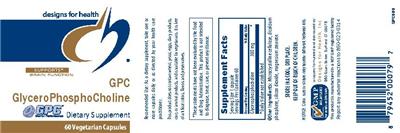
GPC GlyceroPhosphoCholine by Designs for Health label
The label scan from the NIH Dietary Supplement Label Database. Tap to enlarge.
Label images are published by the NIH Dietary Supplement Label Database for the version of this product on file. Always read your actual product label.
View the full label (PDF)The Ingredients in GPC GlyceroPhosphoCholine by Designs for Health
This is the 1 active ingredient this product is made of. Select it to open its full monograph.
Serving size1 Capsule(s) Dosage formCapsule Servings per container60 Amounts shown are per serving.
Glycerophosphocholine
Interacts with16 drugs
Alpha-GPC is a choline-containing compound used mainly for memory, brain health, and as a choline source. There is some evidence it may help cognition...
Glycerophosphocholine monograph & interactionsOther (inactive) ingredients: Microcrystalline Cellulose, Dicalcium Phosphate, Silicon Dioxide, Magnesium Stearate. These complete the product’s ingredient list but are not active constituents.
GPC GlyceroPhosphoCholine by Designs for Health Drug Interactions
HelloPharmacist Interaction Report
GPC GlyceroPhosphoCholine by Designs for Health contains glycerophosphocholine (alpha-GPC), which has one documented interaction.
It may theoretically decrease the effects of scopolamine (Transderm Scop), the motion-sickness patch. A small clinical study found that alpha-GPC can partially counteract the attention and memory impairment caused by scopolamine, but it's unclear whether it would reduce the patch's anti-motion sickness benefits.
Read the full breakdown — every affected drug type, severity by severity
Altogether, these interactions span 16 individual medications.
Before you start this supplement, run your exact medications—especially if you use a scopolamine patch—through the interaction checker on this page.
Check your own medications below · Editorial policy · How we use AI
Want to check YOUR meds against GPC GlyceroPhosphoCholine?
Ask about interactions with your drugs in plain English — “Can I take it with lisinopril?” — and we find you the answer in seconds, ingredient by ingredient.
Go to the checkerIngredients driving the most interactions
Individual Drug Interactions
The ingredients in GPC GlyceroPhosphoCholine interact with 16 drugs. Click any drug to see the details.
1 of the 1 ingredient in GPC GlyceroPhosphoCholine interact with drugs. Each result below shows which ingredient is responsible. Glycerophosphocholine
Atropine, Chlorpheniramine, Hyoscyamine, Phenylephrine, Phenylpropanolamine, ScopolamineAtrohist Plus, Pro Tuss, Ru-tuss, Stahist
How Atropine, Chlorpheniramine, Hyoscyamine, Phenylephrine, Phenylpropanolamine, Scopolamine interacts with GPC GlyceroPhosphoCholine — through 1 ingredient. Tap an ingredient for the detail:
GlycerophosphocholineScopolamine (transderm Scop) Minor
Interaction Summary
Theoretically, alpha-GPC might decrease the effects of scopolamine.
Read the full Glycerophosphocholine + Atropine, Chlorpheniramine, Hyoscyamine, Phenylephrine, Phenylpropanolamine, Scopolamine interactionAtropine, Hyoscyamine, Phenobarbital, ScopolamineBarbidonna No. 2, Belladonna Phenobarbital
How Atropine, Hyoscyamine, Phenobarbital, Scopolamine interacts with GPC GlyceroPhosphoCholine — through 1 ingredient. Tap an ingredient for the detail:
GlycerophosphocholineScopolamine (transderm Scop) Minor
Interaction Summary
Theoretically, alpha-GPC might decrease the effects of scopolamine.
Read the full Glycerophosphocholine + Atropine, Hyoscyamine, Phenobarbital, Scopolamine interactionAtropine, Hyoscyamine, ScopolamineColytrol
How Atropine, Hyoscyamine, Scopolamine interacts with GPC GlyceroPhosphoCholine — through 1 ingredient. Tap an ingredient for the detail:
GlycerophosphocholineScopolamine (transderm Scop) Minor
Interaction Summary
Theoretically, alpha-GPC might decrease the effects of scopolamine.
Read the full Glycerophosphocholine + Atropine, Hyoscyamine, Scopolamine interactionAtropine, Hyoscyamine, Scopolamine, PhenobarbitalBarbeloid, Donnatal #2, Donphen
How Atropine, Hyoscyamine, Scopolamine, Phenobarbital interacts with GPC GlyceroPhosphoCholine — through 1 ingredient. Tap an ingredient for the detail:
GlycerophosphocholineScopolamine (transderm Scop) Minor
Interaction Summary
Theoretically, alpha-GPC might decrease the effects of scopolamine.
Read the full Glycerophosphocholine + Atropine, Hyoscyamine, Scopolamine, Phenobarbital interactionBarbital, Hyoscyamine, Scopolamine, Passiflora, ValeriBarbatose #2
How Barbital, Hyoscyamine, Scopolamine, Passiflora, Valeri interacts with GPC GlyceroPhosphoCholine — through 1 ingredient. Tap an ingredient for the detail:
GlycerophosphocholineScopolamine (transderm Scop) Minor
Interaction Summary
Theoretically, alpha-GPC might decrease the effects of scopolamine.
Read the full Glycerophosphocholine + Barbital, Hyoscyamine, Scopolamine, Passiflora, Valeri interactionBelladonna Alkaloids, PhenobarbitalBarbidonna, Donnatal
How Belladonna Alkaloids, Phenobarbital interacts with GPC GlyceroPhosphoCholine — through 1 ingredient. Tap an ingredient for the detail:
GlycerophosphocholineScopolamine (transderm Scop) Minor
Interaction Summary
Theoretically, alpha-GPC might decrease the effects of scopolamine.
Read the full Glycerophosphocholine + Belladonna Alkaloids, Phenobarbital interactionCamphor, Hyoscyamine, Passif, Phenobarbital, Scopolamine, ValerianNevrotose #3
How Camphor, Hyoscyamine, Passif, Phenobarbital, Scopolamine, Valerian interacts with GPC GlyceroPhosphoCholine — through 1 ingredient. Tap an ingredient for the detail:
GlycerophosphocholineScopolamine (transderm Scop) Minor
Interaction Summary
Theoretically, alpha-GPC might decrease the effects of scopolamine.
Read the full Glycerophosphocholine + Camphor, Hyoscyamine, Passif, Phenobarbital, Scopolamine, Valerian interactionChlorpheniramine, MethscopolamineAllerx
How Chlorpheniramine, Methscopolamine interacts with GPC GlyceroPhosphoCholine — through 1 ingredient. Tap an ingredient for the detail:
GlycerophosphocholineScopolamine (transderm Scop) Minor
Interaction Summary
Theoretically, alpha-GPC might decrease the effects of scopolamine.
Read the full Glycerophosphocholine + Chlorpheniramine, Methscopolamine interactionChlorpheniramine, Methscopolamine, PhenylephrineAH Chew, DA, DA II, Dallergy, Dallergy ER, Dura Vent DA +9 more
How Chlorpheniramine, Methscopolamine, Phenylephrine interacts with GPC GlyceroPhosphoCholine — through 1 ingredient. Tap an ingredient for the detail:
GlycerophosphocholineScopolamine (transderm Scop) Minor
Interaction Summary
Theoretically, alpha-GPC might decrease the effects of scopolamine.
Read the full Glycerophosphocholine + Chlorpheniramine, Methscopolamine, Phenylephrine interactionChlorpheniramine, Methscopolamine, PhenylpropanolaminePannaz
How Chlorpheniramine, Methscopolamine, Phenylpropanolamine interacts with GPC GlyceroPhosphoCholine — through 1 ingredient. Tap an ingredient for the detail:
GlycerophosphocholineScopolamine (transderm Scop) Minor
Interaction Summary
Theoretically, alpha-GPC might decrease the effects of scopolamine.
Read the full Glycerophosphocholine + Chlorpheniramine, Methscopolamine, Phenylpropanolamine interactionChlorpheniramine, Methscopolamine, PseudoephedrineMescolor, Rescon-Mx, Xiral
How Chlorpheniramine, Methscopolamine, Pseudoephedrine interacts with GPC GlyceroPhosphoCholine — through 1 ingredient. Tap an ingredient for the detail:
GlycerophosphocholineScopolamine (transderm Scop) Minor
Interaction Summary
Theoretically, alpha-GPC might decrease the effects of scopolamine.
Read the full Glycerophosphocholine + Chlorpheniramine, Methscopolamine, Pseudoephedrine interactionDextromethorphan, Methscopolamine, PhenylephrineDA Chewable
How Dextromethorphan, Methscopolamine, Phenylephrine interacts with GPC GlyceroPhosphoCholine — through 1 ingredient. Tap an ingredient for the detail:
GlycerophosphocholineScopolamine (transderm Scop) Minor
Interaction Summary
Theoretically, alpha-GPC might decrease the effects of scopolamine.
Read the full Glycerophosphocholine + Dextromethorphan, Methscopolamine, Phenylephrine interactionMethscopolamine BromidePamine
How Methscopolamine Bromide interacts with GPC GlyceroPhosphoCholine — through 1 ingredient. Tap an ingredient for the detail:
GlycerophosphocholineScopolamine (transderm Scop) Minor
Interaction Summary
Theoretically, alpha-GPC might decrease the effects of scopolamine.
Read the full Glycerophosphocholine + Methscopolamine Bromide interactionMethscopolamine, Mivacurium, PhenylephrineDallergy IR
How Methscopolamine, Mivacurium, Phenylephrine interacts with GPC GlyceroPhosphoCholine — through 1 ingredient. Tap an ingredient for the detail:
GlycerophosphocholineScopolamine (transderm Scop) Minor
Interaction Summary
Theoretically, alpha-GPC might decrease the effects of scopolamine.
Read the full Glycerophosphocholine + Methscopolamine, Mivacurium, Phenylephrine interactionMethscopolamine, PseudoephedrineAllerx D
How Methscopolamine, Pseudoephedrine interacts with GPC GlyceroPhosphoCholine — through 1 ingredient. Tap an ingredient for the detail:
GlycerophosphocholineScopolamine (transderm Scop) Minor
Interaction Summary
Theoretically, alpha-GPC might decrease the effects of scopolamine.
Read the full Glycerophosphocholine + Methscopolamine, Pseudoephedrine interactionScopolamineScopace, Scopolamine Injection, Transderm Scop
How Scopolamine interacts with GPC GlyceroPhosphoCholine — through 1 ingredient. Tap an ingredient for the detail:
GlycerophosphocholineScopolamine (transderm Scop) Minor
Interaction Summary
Theoretically, alpha-GPC might decrease the effects of scopolamine.
Read the full Glycerophosphocholine + Scopolamine interactionEach ingredient & the kinds of drugs it affects
For each ingredient in GPC GlyceroPhosphoCholine with known interactions, here are the types of medications it can affect. Open any type for the detail — or search your exact drug in the checker above.
Glycerophosphocholine
Scopolamine (Transderm Scop)
Theoretically, alpha-GPC might decrease the effects of scopolamine.
A small clinical study shows that alpha-GPC can partially counteract the attention and memory impairment effects caused by scopolamine given intramuscularly. Whether alpha-GPC can decrease the beneficial anti-motion sickness effects of the scopolamine patch (Transderm Scop) is unclear.
Brand information
Manufacturer and brand details for GPC GlyceroPhosphoCholine, from the product label.
GPC GlyceroPhosphoCholine by Designs for Health: Common Questions
Does GPC GlyceroPhosphoCholine by Designs for Health interact with any medications?
How can one product interact with so many drugs?
Where does this information come from?
Can I take this if I'm pregnant or breastfeeding?
What are the most common side effects?
Does it actually work for memory and cognitive function?
Is there a long-term safety concern I should know about?
How many active ingredients are in this product?
Written and reviewed by the HelloPharmacist editorial staff. Our editorial policy
Not sure if GPC GlyceroPhosphoCholine is safe with your meds?
Our pharmacists answer your medication & supplement questions — free.
Label information is sourced from the NIH Dietary Supplement Label Database and reflects the product version on file; always read your actual product label. This page is for education only and is not a substitute for professional medical advice. Confirm with your pharmacist or doctor before combining supplements and medications.
The Full Monographs Behind GPC GlyceroPhosphoCholine’s Ingredients
Every ingredient we hold a full HelloPharmacist monograph for — uses, evidence, safety, and the complete interaction list.
Sources & How We Checked
GPC GlyceroPhosphoCholine's label data comes from the NIH Dietary Supplement Label Database; the ingredient interaction data is from the Natural Medicines database, reviewed by our pharmacists.
- NIH Dietary Supplement Label Database (DSLD) — The official product label on file for this supplement.
- Natural Medicines (Therapeutic Research Center) — Evidence-graded clinical reference behind the ingredient interaction data.
Content is written and reviewed by licensed HelloPharmacist pharmacists. See our data sources and editorial standards for how this information is built and checked.
The 4 references behind this product’s interaction data
Every citation that drives the interaction findings for this product’s ingredients, from the evidence-graded Natural Medicines (TRC Healthcare) database. Open an ingredient to browse its citations — links open the study on PubMed or the publisher’s site.
Alpha-gpc 4 references
- Di Perri R, Coppola G, Ambrosio LA, et al. A multicentre trial to the evaluate the efficacy and tolerability of alpha-glycerylphosphorylcholine versus cytosine diphosphocholine in patients with vascular dementia. J Int Med Res 1991;19:330-41.
- Barbagallo Sangiorgi G, Barbagallo M, Giordano M, et al. Alpha-glycerophosphocholine in the mental recovery of cerebral ischemic attacks: An Italian multicenter clinical trial. Ann N Y Acad Sci 1994;717:253-69. PubMed
- Canal N, Franceschi M, Alberoni M, et al. Effect of L-alpha-glyceryl-phosphorylcholine on amnesia caused by scopolamine. Int J Clin Pharmacol Ther Toxicol 1991;29:103-7.
- Lee G, Choi S, Chang J, et al. Association of L-a glycerylphosphorylcholine with subsequent stroke risk after 10 Years. JAMA Netw Open 2021;4(11):e2136008.
Parts of this content are provided by the Therapeutic Research Center, LLC.
DISCLAIMER: Currently this does not check for drug-drug interactions. This is not an all-inclusive comprehensive list of potential interactions and is for informational purposes only. Not all interactions are known or well-reported in the scientific literature, and new interactions are continually being reported. Input is needed from a qualified healthcare provider including a pharmacist before starting any therapy. Application of clinical judgment is necessary.
© 2021 Therapeutic Research Center, LLC