
Horsechestnut Extract 300 mg Ingredients & Drug Interactions
by Ron Teeguarden Nutraceuticals
What is this page for?
First and foremost: checking Horsechestnut Extract 300 mg against your medications. The heart of this page is the interaction checker and the full interaction report — how this product’s ingredients may interact with prescription and over-the-counter medicines you may be taking.
Around that, we add a pharmacist’s high-level view of the product as a whole — what’s inside, the evidence for its stated use, how transparent the label is, and what safety data exists — so you can see the full picture in one place. It’s educational information from our licensed clinical databases and the clinical staff at HelloPharmacist — not medical advice — and we don’t sell or endorse products. Our editorial policy
Horsechestnut Extract 300 mg is a dietary supplement by Ron Teeguarden Nutraceuticals with 1 active ingredient. Its ingredients are commonly taken for chronic venous insufficiency, leg swelling and heaviness, varicose veins.Based on those ingredients, 122 medications have a known interaction with it, the most serious rated moderate. The ingredients most likely to interact are Horse Chestnut Seed Extract. Use the checker below to test your specific medication, or read the full HelloPharmacist Interaction Report.
Check Your Meds Against Horsechestnut Extract 300 mg by Ron Teeguarden Nutraceuticals
Ask about any prescription or over-the-counter medication and we check it for interactions with Horsechestnut Extract 300 mg by Ron Teeguarden Nutraceuticals — and tell you which ingredient is responsible.
AI summaries are generated from our interaction database for education only — always confirm with your pharmacist. How we use AI
Ask the Pharmacist
A licensed pharmacist will answer your question by email — free, usually within 24 hours.
Got it — thank you!
A licensed pharmacist will answer within 24 hours. Keep an eye on your email (worth checking spam, just in case).
HelloPharmacist Scorecard of Horsechestnut Extract 300 mg by Ron Teeguarden Nutraceuticals
Four independent checks of what is known — a summary of the available information, not a grade of the product itself.
By FDA rules, dietary supplements can’t claim to treat, cure, or prevent disease — so labels speak in careful marketing language. We discern each product’s intended use from its name, label claims, and label statements, then grade the clinical evidence for that use. How these ratings are computed
None of the active ingredients could be matched to our evidence database, so intended use can't be graded.
Why this rating?
- None of the active ingredients could be matched to a HelloPharmacist monograph, so intended use can't be graded against our evidence data.
Every active ingredient lists its own amount on the label.
Why this rating?
- The label discloses an exact amount for 1 of its 1 active ingredient.
- “Horse Chestnut Seed Extract” is listed as a grouped ingredient — the label gives one combined amount (300 mg) without saying how much of each component you get.
None of the active ingredients could be matched to our interaction database.
Why this rating?
- We couldn't match any ingredient to a HelloPharmacist monograph, so there was nothing to check interactions against.
None of the active ingredients could be matched to our safety data.
Why this rating?
- We couldn't match any ingredient to a HelloPharmacist monograph, so there was no safety data to measure.
HelloPharmacist summaryFully disclosed formula with no assessable stated purpose. Medication interactions could not be assessed, and safety information could not be assessed.
Assessment coverage: 0 of 1 active ingredient matched to our full ingredient reviews (monographs). Based on the product label dated Jul 25, 2024.
This Scorecard evaluates available label information, ingredient evidence, and known medication-safety considerations. It does not independently verify product identity, purity, potency, contamination, or manufacturing quality. How these ratings are computed
General information
Key facts about Horsechestnut Extract 300 mg, straight from the product label.
| Brand | Ron Teeguarden Nutraceuticals |
|---|---|
| Net contents | 90 Capsule(s) |
| Market status | On market |
| Date entered into DSLD | Jul 25, 2024 |
| DSLD ID | 316697 |
| Product type | Botanical |
| Supplement form | Capsule |
| Dietary claims / uses | All Other |
| Intended target group(s) | Adult (18 - 50 Years), Gluten Free, Dairy Free, Sugar Free |
Everything in this section is reproduced from the manufacturer’s own product label — it’s the label speaking, not HelloPharmacist. We show it so you can see exactly what the maker states; we don’t verify or endorse those statements.
Supplement Facts
The label details for Horsechestnut Extract 300 mg by Ron Teeguarden Nutraceuticals, sourced from the NIH Dietary Supplement Label Database.
Supplement Facts
| Ingredient | Amount | % DV |
|---|---|---|
| Aescin | 60 mg | -- |
| Horse Chestnut Seed Extract | 300 mg | -- |
Other ingredients: Gelatin, Water, Rice, Powder, Cellulose, Magnesium Stearate, Silica
Tap any ingredient to jump to its full detail below.
These statements are the manufacturer’s wording, reproduced from the product label — the label is saying it, not HelloPharmacist. We don’t verify or endorse them.
Formulation
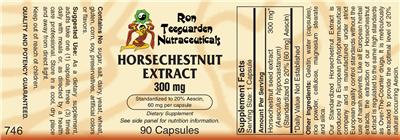
Contains no sugar, salt, dairy, yeast, wheat, gluten, corn, soy, preservatives, artificial colors or flavors.
Quality and potency guaranteed
Suggested/Recommended/Usage/Directions
Suggested Use: As a dietary supplement, adults take one (1) capsule, three (3) times daily with meals or, as directed by a health care professional.
Storage
Store in a cool, dry place and away from direct light.
Precautions
Keep out of reach of children.
Formula
Horsechestnut Extract 300 mg Standardized to 20% Aescin, 60mg per capsule
Our Standardized Horsechestnut Extract is produced by a European phytopharmaceutical company and is manufactured under strict European quality control standards without the use of harsh solvents. Like all European herbal extracts, the extraction of our Horsechestnut Extract is regulated to the same high standards as Over-The-Counter drugs. It is meticulously extracted to provide the optimal level of 20% natural occurring Aescin.
FDA Statement of Identity
Dietary Supplement
General Statements
See side panel for nutrition information.
Is this label outdated? Report a formula or label change and our pharmacy team will review it.
Horsechestnut Extract 300 mg by Ron Teeguarden Nutraceuticals label
The label scan from the NIH Dietary Supplement Label Database. Tap to enlarge.
Label images are published by the NIH Dietary Supplement Label Database for the version of this product on file. Always read your actual product label.
View the full label (PDF)The Ingredients in Horsechestnut Extract 300 mg by Ron Teeguarden Nutraceuticals
This is the 1 active ingredient this product is made of. Select it to open its full monograph.
Serving size1 Capsule(s) Dosage formCapsule Servings per container90 Amounts shown are per serving.
Horse Chestnut Seed Extract
Interacts with122 drugs
Horse chestnut seed extract is most often used for chronic venous insufficiency, where standardized products may help reduce leg swelling, pain, and h...
Horse Chestnut Seed Extract monograph & interactions- › Aescin
Other (inactive) ingredients: Gelatin, Water, Rice, Powder, Cellulose, Magnesium Stearate, Silica. These complete the product’s ingredient list but are not active constituents.
Horsechestnut Extract 300 mg by Ron Teeguarden Nutraceuticals Drug Interactions
Horsechestnut Extract 300 mg contains a single active ingredient, and it has known interactions with 122 medications. Here’s the picture, then you can look up your own drug.
Want to check YOUR meds against Horsechestnut Extract 300 mg?
Ask about interactions with your drugs in plain English — “Can I take it with lisinopril?” — and we find you the answer in seconds, ingredient by ingredient.
Go to the checkerIngredients driving the most interactions
Individual Drug Interactions
The ingredients in Horsechestnut Extract 300 mg interact with 122 drugs. Click any drug to see the details.
1 of the 1 ingredient in Horsechestnut Extract 300 mg interact with drugs. Each result below shows which ingredient is responsible. Horse Chestnut Seed Extract
AbciximabReoPro
How Abciximab interacts with Horsechestnut Extract 300 mg — through 1 ingredient. Tap an ingredient for the detail:
Horse Chestnut Seed ExtractAnticoagulant/antiplatelet Drugs Moderate
Interaction Summary
Horse chestnut may have antiplatelet effects and may increase the risk of bleeding if used with anticoagulant or antiplatelet drugs.
Read the full Horse Chestnut Seed Extract + Abciximab interactionAbrocitinibCibinqo
How Abrocitinib interacts with Horsechestnut Extract 300 mg — through 1 ingredient. Tap an ingredient for the detail:
Horse Chestnut Seed ExtractAnticoagulant/antiplatelet Drugs Moderate
Interaction Summary
Horse chestnut may have antiplatelet effects and may increase the risk of bleeding if used with anticoagulant or antiplatelet drugs.
Read the full Horse Chestnut Seed Extract + Abrocitinib interactionAcenocoumarolSintrom
How Acenocoumarol interacts with Horsechestnut Extract 300 mg — through 1 ingredient. Tap an ingredient for the detail:
Horse Chestnut Seed ExtractAnticoagulant/antiplatelet Drugs Moderate
Interaction Summary
Horse chestnut may have antiplatelet effects and may increase the risk of bleeding if used with anticoagulant or antiplatelet drugs.
Read the full Horse Chestnut Seed Extract + Acenocoumarol interactionAcetaminophen, AspirinGemnisyn
How Acetaminophen, Aspirin interacts with Horsechestnut Extract 300 mg — through 1 ingredient. Tap an ingredient for the detail:
Horse Chestnut Seed ExtractAnticoagulant/antiplatelet Drugs Moderate
Interaction Summary
Horse chestnut may have antiplatelet effects and may increase the risk of bleeding if used with anticoagulant or antiplatelet drugs.
Read the full Horse Chestnut Seed Extract + Acetaminophen, Aspirin interactionAcetaminophen, Aspirin, CaffeineExcedrin, Excedrin Extra Strength, Excedrin Migraine
How Acetaminophen, Aspirin, Caffeine interacts with Horsechestnut Extract 300 mg — through 1 ingredient. Tap an ingredient for the detail:
Horse Chestnut Seed ExtractAnticoagulant/antiplatelet Drugs Moderate
Interaction Summary
Horse chestnut may have antiplatelet effects and may increase the risk of bleeding if used with anticoagulant or antiplatelet drugs.
Read the full Horse Chestnut Seed Extract + Acetaminophen, Aspirin, Caffeine interactionAcetaminophen, IbuprofenCombogesic
How Acetaminophen, Ibuprofen interacts with Horsechestnut Extract 300 mg — through 1 ingredient. Tap an ingredient for the detail:
Horse Chestnut Seed ExtractAnticoagulant/antiplatelet Drugs Moderate
Interaction Summary
Horse chestnut may have antiplatelet effects and may increase the risk of bleeding if used with anticoagulant or antiplatelet drugs.
Read the full Horse Chestnut Seed Extract + Acetaminophen, Ibuprofen interactionAcetylsalicylic AcidEntrophen
How Acetylsalicylic Acid interacts with Horsechestnut Extract 300 mg — through 1 ingredient. Tap an ingredient for the detail:
Horse Chestnut Seed ExtractAnticoagulant/antiplatelet Drugs Moderate
Interaction Summary
Horse chestnut may have antiplatelet effects and may increase the risk of bleeding if used with anticoagulant or antiplatelet drugs.
Read the full Horse Chestnut Seed Extract + Acetylsalicylic Acid interactionAlteplase, TpaActilyse, Activase
How Alteplase, Tpa interacts with Horsechestnut Extract 300 mg — through 1 ingredient. Tap an ingredient for the detail:
Horse Chestnut Seed ExtractAnticoagulant/antiplatelet Drugs Moderate
Interaction Summary
Horse chestnut may have antiplatelet effects and may increase the risk of bleeding if used with anticoagulant or antiplatelet drugs.
Read the full Horse Chestnut Seed Extract + Alteplase, Tpa interactionAluminum Hydroxide, Aspirin, Codeine Phosphate, Magnesium HydroxideAscriptin Codeine #2
How Aluminum Hydroxide, Aspirin, Codeine Phosphate, Magnesium Hydroxide interacts with Horsechestnut Extract 300 mg — through 1 ingredient. Tap an ingredient for the detail:
Horse Chestnut Seed ExtractAnticoagulant/antiplatelet Drugs Moderate
Interaction Summary
Horse chestnut may have antiplatelet effects and may increase the risk of bleeding if used with anticoagulant or antiplatelet drugs.
Read the full Horse Chestnut Seed Extract + Aluminum Hydroxide, Aspirin, Codeine Phosphate, Magnesium Hydroxide interactionAluminum Hydroxide, Aspirin, Magnesium HydroxideAscriptin
How Aluminum Hydroxide, Aspirin, Magnesium Hydroxide interacts with Horsechestnut Extract 300 mg — through 1 ingredient. Tap an ingredient for the detail:
Horse Chestnut Seed ExtractAnticoagulant/antiplatelet Drugs Moderate
Interaction Summary
Horse chestnut may have antiplatelet effects and may increase the risk of bleeding if used with anticoagulant or antiplatelet drugs.
Read the full Horse Chestnut Seed Extract + Aluminum Hydroxide, Aspirin, Magnesium Hydroxide interactionAnacaulase-bcdbNexoBrid
How Anacaulase-bcdb interacts with Horsechestnut Extract 300 mg — through 1 ingredient. Tap an ingredient for the detail:
Horse Chestnut Seed ExtractAnticoagulant/antiplatelet Drugs Moderate
Interaction Summary
Horse chestnut may have antiplatelet effects and may increase the risk of bleeding if used with anticoagulant or antiplatelet drugs.
Read the full Horse Chestnut Seed Extract + Anacaulase-bcdb interactionAnagrelideAgrylin
How Anagrelide interacts with Horsechestnut Extract 300 mg — through 1 ingredient. Tap an ingredient for the detail:
Horse Chestnut Seed ExtractAnticoagulant/antiplatelet Drugs Moderate
Interaction Summary
Horse chestnut may have antiplatelet effects and may increase the risk of bleeding if used with anticoagulant or antiplatelet drugs.
Read the full Horse Chestnut Seed Extract + Anagrelide interactionAnisindioneMiradon
How Anisindione interacts with Horsechestnut Extract 300 mg — through 1 ingredient. Tap an ingredient for the detail:
Horse Chestnut Seed ExtractAnticoagulant/antiplatelet Drugs Moderate
Interaction Summary
Horse chestnut may have antiplatelet effects and may increase the risk of bleeding if used with anticoagulant or antiplatelet drugs.
Read the full Horse Chestnut Seed Extract + Anisindione interactionAntithrombin IiiThrombate III
How Antithrombin Iii interacts with Horsechestnut Extract 300 mg — through 1 ingredient. Tap an ingredient for the detail:
Horse Chestnut Seed ExtractAnticoagulant/antiplatelet Drugs Moderate
Interaction Summary
Horse chestnut may have antiplatelet effects and may increase the risk of bleeding if used with anticoagulant or antiplatelet drugs.
Read the full Horse Chestnut Seed Extract + Antithrombin Iii interactionApixabanEliquis
How Apixaban interacts with Horsechestnut Extract 300 mg — through 1 ingredient. Tap an ingredient for the detail:
Horse Chestnut Seed ExtractAnticoagulant/antiplatelet Drugs Moderate
Interaction Summary
Horse chestnut may have antiplatelet effects and may increase the risk of bleeding if used with anticoagulant or antiplatelet drugs.
Read the full Horse Chestnut Seed Extract + Apixaban interactionArgatrobanArgatroban
How Argatroban interacts with Horsechestnut Extract 300 mg — through 1 ingredient. Tap an ingredient for the detail:
Horse Chestnut Seed ExtractAnticoagulant/antiplatelet Drugs Moderate
Interaction Summary
Horse chestnut may have antiplatelet effects and may increase the risk of bleeding if used with anticoagulant or antiplatelet drugs.
Read the full Horse Chestnut Seed Extract + Argatroban interactionAspirinAngettes 75, ASA, Asaphen, Aspirin, Caprin, Cartia +8 more
How Aspirin interacts with Horsechestnut Extract 300 mg — through 1 ingredient. Tap an ingredient for the detail:
Horse Chestnut Seed ExtractAnticoagulant/antiplatelet Drugs Moderate
Interaction Summary
Horse chestnut may have antiplatelet effects and may increase the risk of bleeding if used with anticoagulant or antiplatelet drugs.
Read the full Horse Chestnut Seed Extract + Aspirin interactionAspirin, Aluminum Hydroxide, Codeine Phosphate, Magnesium HydroxideAscriptin Codeine #3
How Aspirin, Aluminum Hydroxide, Codeine Phosphate, Magnesium Hydroxide interacts with Horsechestnut Extract 300 mg — through 1 ingredient. Tap an ingredient for the detail:
Horse Chestnut Seed ExtractAnticoagulant/antiplatelet Drugs Moderate
Interaction Summary
Horse chestnut may have antiplatelet effects and may increase the risk of bleeding if used with anticoagulant or antiplatelet drugs.
Read the full Horse Chestnut Seed Extract + Aspirin, Aluminum Hydroxide, Codeine Phosphate, Magnesium Hydroxide interactionAspirin, ButalbitalAxotal
How Aspirin, Butalbital interacts with Horsechestnut Extract 300 mg — through 1 ingredient. Tap an ingredient for the detail:
Horse Chestnut Seed ExtractAnticoagulant/antiplatelet Drugs Moderate
Interaction Summary
Horse chestnut may have antiplatelet effects and may increase the risk of bleeding if used with anticoagulant or antiplatelet drugs.
Read the full Horse Chestnut Seed Extract + Aspirin, Butalbital interactionAspirin, Butalbital, CaffeineFiorinal
How Aspirin, Butalbital, Caffeine interacts with Horsechestnut Extract 300 mg — through 1 ingredient. Tap an ingredient for the detail:
Horse Chestnut Seed ExtractAnticoagulant/antiplatelet Drugs Moderate
Interaction Summary
Horse chestnut may have antiplatelet effects and may increase the risk of bleeding if used with anticoagulant or antiplatelet drugs.
Read the full Horse Chestnut Seed Extract + Aspirin, Butalbital, Caffeine interactionAspirin, Butalbital, Caffeine, Codeine PhosphateFiorinal w/ Codeine
How Aspirin, Butalbital, Caffeine, Codeine Phosphate interacts with Horsechestnut Extract 300 mg — through 1 ingredient. Tap an ingredient for the detail:
Horse Chestnut Seed ExtractAnticoagulant/antiplatelet Drugs Moderate
Interaction Summary
Horse chestnut may have antiplatelet effects and may increase the risk of bleeding if used with anticoagulant or antiplatelet drugs.
Read the full Horse Chestnut Seed Extract + Aspirin, Butalbital, Caffeine, Codeine Phosphate interactionAspirin, Butalbital, Caffeine, PhenacetinMarnal
How Aspirin, Butalbital, Caffeine, Phenacetin interacts with Horsechestnut Extract 300 mg — through 1 ingredient. Tap an ingredient for the detail:
Horse Chestnut Seed ExtractAnticoagulant/antiplatelet Drugs Moderate
Interaction Summary
Horse chestnut may have antiplatelet effects and may increase the risk of bleeding if used with anticoagulant or antiplatelet drugs.
Read the full Horse Chestnut Seed Extract + Aspirin, Butalbital, Caffeine, Phenacetin interactionAspirin, CaffeineAnacin
How Aspirin, Caffeine interacts with Horsechestnut Extract 300 mg — through 1 ingredient. Tap an ingredient for the detail:
Horse Chestnut Seed ExtractAnticoagulant/antiplatelet Drugs Moderate
Interaction Summary
Horse chestnut may have antiplatelet effects and may increase the risk of bleeding if used with anticoagulant or antiplatelet drugs.
Read the full Horse Chestnut Seed Extract + Aspirin, Caffeine interactionAspirin, Caffeine, Codeine PhosphateAnacin w/ Codeine
How Aspirin, Caffeine, Codeine Phosphate interacts with Horsechestnut Extract 300 mg — through 1 ingredient. Tap an ingredient for the detail:
Horse Chestnut Seed ExtractAnticoagulant/antiplatelet Drugs Moderate
Interaction Summary
Horse chestnut may have antiplatelet effects and may increase the risk of bleeding if used with anticoagulant or antiplatelet drugs.
Read the full Horse Chestnut Seed Extract + Aspirin, Caffeine, Codeine Phosphate interactionAspirin, Caffeine, Dihydrocodeine BitartrateSynalgos DC
How Aspirin, Caffeine, Dihydrocodeine Bitartrate interacts with Horsechestnut Extract 300 mg — through 1 ingredient. Tap an ingredient for the detail:
Horse Chestnut Seed ExtractAnticoagulant/antiplatelet Drugs Moderate
Interaction Summary
Horse chestnut may have antiplatelet effects and may increase the risk of bleeding if used with anticoagulant or antiplatelet drugs.
Read the full Horse Chestnut Seed Extract + Aspirin, Caffeine, Dihydrocodeine Bitartrate interactionAspirin, Caffeine, Dover's PwdAcedoval, Dovacet
How Aspirin, Caffeine, Dover's Pwd interacts with Horsechestnut Extract 300 mg — through 1 ingredient. Tap an ingredient for the detail:
Horse Chestnut Seed ExtractAnticoagulant/antiplatelet Drugs Moderate
Interaction Summary
Horse chestnut may have antiplatelet effects and may increase the risk of bleeding if used with anticoagulant or antiplatelet drugs.
Read the full Horse Chestnut Seed Extract + Aspirin, Caffeine, Dover's Pwd interactionAspirin, Caffeine, HydrocodoneDamason-P
How Aspirin, Caffeine, Hydrocodone interacts with Horsechestnut Extract 300 mg — through 1 ingredient. Tap an ingredient for the detail:
Horse Chestnut Seed ExtractAnticoagulant/antiplatelet Drugs Moderate
Interaction Summary
Horse chestnut may have antiplatelet effects and may increase the risk of bleeding if used with anticoagulant or antiplatelet drugs.
Read the full Horse Chestnut Seed Extract + Aspirin, Caffeine, Hydrocodone interactionAspirin, Caffeine, Isobutylallylbarbituric Acid, PhenacetinLanorinal
How Aspirin, Caffeine, Isobutylallylbarbituric Acid, Phenacetin interacts with Horsechestnut Extract 300 mg — through 1 ingredient. Tap an ingredient for the detail:
Horse Chestnut Seed ExtractAnticoagulant/antiplatelet Drugs Moderate
Interaction Summary
Horse chestnut may have antiplatelet effects and may increase the risk of bleeding if used with anticoagulant or antiplatelet drugs.
Read the full Horse Chestnut Seed Extract + Aspirin, Caffeine, Isobutylallylbarbituric Acid, Phenacetin interactionAspirin, Caffeine, OrphenadrineInvagesic, Invagesic Forte, Norgesic, Norgesic Forte, Orphengesic, Orphengesic Forte
How Aspirin, Caffeine, Orphenadrine interacts with Horsechestnut Extract 300 mg — through 1 ingredient. Tap an ingredient for the detail:
Horse Chestnut Seed ExtractAnticoagulant/antiplatelet Drugs Moderate
Interaction Summary
Horse chestnut may have antiplatelet effects and may increase the risk of bleeding if used with anticoagulant or antiplatelet drugs.
Read the full Horse Chestnut Seed Extract + Aspirin, Caffeine, Orphenadrine interactionAspirin, Caffeine, Phenacetin, PropoxypheneMargesic Comp. 65
How Aspirin, Caffeine, Phenacetin, Propoxyphene interacts with Horsechestnut Extract 300 mg — through 1 ingredient. Tap an ingredient for the detail:
Horse Chestnut Seed ExtractAnticoagulant/antiplatelet Drugs Moderate
Interaction Summary
Horse chestnut may have antiplatelet effects and may increase the risk of bleeding if used with anticoagulant or antiplatelet drugs.
Read the full Horse Chestnut Seed Extract + Aspirin, Caffeine, Phenacetin, Propoxyphene interactionEach ingredient & the kinds of drugs it affects
For each ingredient in Horsechestnut Extract 300 mg with known interactions, here are the types of medications it can affect. Open any type for the detail — or search your exact drug in the checker above.
Horse Chestnut Seed Extract
Anticoagulant/Antiplatelet Drugs
Horse chestnut may have antiplatelet effects and may increase the risk of bleeding if used with anticoagulant or antiplatelet drugs.
Horse chestnut contains the constituent esculin which has been shown to have antithrombotic effects. Therefore, horse chestnut might have antiplatelet effects. This has not been shown in humans.
Brand information
Manufacturer and brand details for Horsechestnut Extract 300 mg, from the product label.
Ron Teeguarden Nutraceuticals
See all Ron Teeguarden Nutraceuticals products- Name
- Ron Teeguarden's Nutraceuticals
Horsechestnut Extract 300 mg by Ron Teeguarden Nutraceuticals: Common Questions
Does Horsechestnut Extract 300 mg by Ron Teeguarden Nutraceuticals interact with any medications?
How can one product interact with so many drugs?
Where does this information come from?
Written and reviewed by the HelloPharmacist editorial staff. Our editorial policy
Not sure if Horsechestnut Extract 300 mg is safe with your meds?
Our pharmacists answer your medication & supplement questions — free.
Label information is sourced from the NIH Dietary Supplement Label Database and reflects the product version on file; always read your actual product label. This page is for education only and is not a substitute for professional medical advice. Confirm with your pharmacist or doctor before combining supplements and medications.
The Full Monographs Behind Horsechestnut Extract 300 mg’s Ingredients
Every ingredient we hold a full HelloPharmacist monograph for — uses, evidence, safety, and the complete interaction list.
Sources & How We Checked
Horsechestnut Extract 300 mg's label data comes from the NIH Dietary Supplement Label Database; the ingredient interaction data is from the Natural Medicines database, reviewed by our pharmacists.
- NIH Dietary Supplement Label Database (DSLD) — The official product label on file for this supplement.
- Natural Medicines (Therapeutic Research Center) — Evidence-graded clinical reference behind the ingredient interaction data.
Content is written and reviewed by licensed HelloPharmacist pharmacists. See our data sources and editorial standards for how this information is built and checked.
The 21 references behind this product’s interaction data
Every citation that drives the interaction findings for this product’s ingredients, from the evidence-graded Natural Medicines (TRC Healthcare) database. Open an ingredient to browse its citations — links open the study on PubMed or the publisher’s site.
Horse Chestnut 21 references
- Blumenthal M, ed. The Complete German Commission E Monographs: Therapeutic Guide to Herbal Medicines. Trans. S. Klein. Boston, MA: American Botanical Council, 1998.
- Ellenhorn MJ, et al. Ellenhorn's Medical Toxicology: Diagnoses and Treatment of Human Poisoning. 2nd ed. Baltimore, MD: Williams & Wilkins, 1997.
- Gruenwald J, Brendler T, Jaenicke C. PDR for Herbal Medicines. 1st ed. Montvale, NJ: Medical Economics Company, Inc., 1998.
- Brinker F. Herb Contraindications and Drug Interactions. 2nd ed. Sandy, OR: Eclectic Medical Publications, 1998.
- Greeske K, Pohlmann BK. Horse chestnut seed extract-an effective therapy principle in general practice. Drug therapy of chronic venous insufficiency. Fortschr Med 1996;114:196-200.
- Robbers JE, Tyler VE. Tyler's Herbs of Choice: The Therapeutic Use of Phytomedicinals. New York, NY: The Haworth Herbal Press, 1999.
- Takegoshi K, Tohyama T, Okuda K, et al. A case of Venoplant-induced hepatic injury. Gastroenterol Jpn 1986;21:62-5.
- Jaspersen-Schib R, Theus L, Guirguis-Oeschger M, et al. [Serious plant poisonings in Switzerland 1966-1994. Case analysis from the Swiss Toxicology Information Center]. Schweiz Med Wochenschr 1996;126:1085-98.
- Popp W, Horak F, Jager S, et al. Horse chestnut (Aesculus hippocastanum) pollen: a frequent cause of allergic sensitization in urban children. Allergy 1992;47:380-3.
- Diaz-Perales A, Collada C, Blanco C, et al. Cross-reactions in the latex-fruit syndrome: A relevant role of chitinases but not of complex asparagine-linked glycans. J Allergy Clin Immunol 1999;104:681-7. PubMed
- Blanco C, Diaz-Perales A, Collada C, et al. Class I chitinases as potential panallergens involved in the latex-fruit syndrome. J Allergy Clin Immunol 1999;103:507-13. PubMed
- Comaish JS, Kersey PJ. Contact dermatitis to extract of horse chestnut (esculin). Contact Dermatitis 1980;6:150-1. PubMed
- Pittler MH, Ernst E. Horse chestnut seed extract for chronic venous insufficiency (Cochrane Review). In: The Cochrane Library, Issue 3, 2004. Chichester, UK: John Wiley & Sons, Ltd. PubMed
- Ottillinger, B. and Greeske, K. Rational therapy of chronic venous insufficiency--chances and limits of the therapeutic use of horse-chestnut seeds extract. BMC.Cardiovasc.Disord. 2001;1(1):5. PubMed
- Pittler, M. H. and Ernst, E. Horse chestnut seed extract for chronic venous insufficiency. Cochrane.Database.Syst.Rev. 2004;(2):CD003230. PubMed
- Fang, Y., Zhao, L., Yan, F., Xia, X., Xu, D., and Cui, X. Escin improves sperm quality in male patients with varicocele-associated infertility. Phytomedicine. 2010;17(3-4):192-196. PubMed
- De Smet, P. A., Van den Eertwegh, A. J., Lesterhuis, W., and Stricker, B. H. Hepatotoxicity associated with herbal tablets. BMJ 7-13-1996;313(7049):92.
- Rehn, D., Unkauf, M., Klein, P., Jost, V., and Lucker, P. W. Comparative clinical efficacy and tolerability of oxerutins and horse chestnut extract in patients with chronic venous insufficiency. Arzneimittelforschung 1996;46(5):483-487.
- Edem E, Kahyaoglu B, Çakar MA. Acute Effusive Pericarditis due to Horse Chestnut Consumption. Am J Case Rep. 2016;17:305-8. PubMed
- Costa Santos D, Lérias G, Madruga I. Drug-induced Liver Injury Due to a Horse Chestnut Dietary Supplement. Eur J Case Rep Intern Med 2021;8(3):002389. PubMed
- Yi HY, Lee JY. Poisoning due to consumption of horse chestnut seed. Clin Exp Emerg Med 2021;8(4):333-335. PubMed
Parts of this content are provided by the Therapeutic Research Center, LLC.
DISCLAIMER: Currently this does not check for drug-drug interactions. This is not an all-inclusive comprehensive list of potential interactions and is for informational purposes only. Not all interactions are known or well-reported in the scientific literature, and new interactions are continually being reported. Input is needed from a qualified healthcare provider including a pharmacist before starting any therapy. Application of clinical judgment is necessary.
© 2021 Therapeutic Research Center, LLC