
Kelp 550 mg Ingredients & Drug Interactions
by Solaray
What is this page for?
First and foremost: checking Kelp 550 mg against your medications. The heart of this page is the interaction checker and the full interaction report — how this product’s ingredients may interact with prescription and over-the-counter medicines you may be taking.
Around that, we add a pharmacist’s high-level view of the product as a whole — what’s inside, the evidence for its stated use, how transparent the label is, and what safety data exists — so you can see the full picture in one place. It’s educational information from our licensed clinical databases and the clinical staff at HelloPharmacist — not medical advice — and we don’t sell or endorse products. Our editorial policy
Kelp 550 mg is a dietary supplement by Solaray with 2 active ingredients. Its ingredients are commonly taken for preventing neural tube birth defects, treating or preventing folate deficiency, supporting pregnancy health.Based on those ingredients, 923 medications have a known interaction with it, the most serious rated moderate. The ingredients most likely to interact are Kelp, Folic Acid. Use the checker below to test your specific medication, or read the full HelloPharmacist Interaction Report.
Check Your Meds Against Kelp 550 mg by Solaray
Ask about any prescription or over-the-counter medication and we check it for interactions with Kelp 550 mg by Solaray — and tell you which ingredient is responsible.
AI summaries are generated from our interaction database for education only — always confirm with your pharmacist. How we use AI
Ask the Pharmacist
A licensed pharmacist will answer your question by email — free, usually within 24 hours.
Got it — thank you!
A licensed pharmacist will answer within 24 hours. Keep an eye on your email (worth checking spam, just in case).
HelloPharmacist Scorecard of Kelp 550 mg by Solaray
Our pharmacy team’s full take, with four database checks built into the cards below — a summary of what is known, not a grade of the product itself.
What’s inside
Full disclosure
Solaray Kelp 550 mg contains 2 active ingredients: folic acid and folate (a blend of related forms of the B vitamin). Folate and folic acid are different names for the same nutrient — your body converts folic acid into active folate forms that support cell division, DNA synthesis, and blood formation.
The product also contains inactive ingredients: cellulose and rice bran extract.
Does it work?
Not established
Folic acid is effective for folate deficiency and likely effective at preventing neural tube birth defects and reducing methotrexate toxicity. It may help with depression, gingival overgrowth from phenytoin use, and cognitive impairment, though the evidence for these uses is not as strong.
We have no effectiveness data on file for kelp.
How safe is it?
Well-documented data
Folic acid is generally well tolerated at recommended doses — most people have no side effects. At doses of 5 mg daily or higher, some experience abdominal cramps, diarrhea, or rash; at 15 mg daily, confusion, irritability, nausea, sleep problems, and altered taste are possible.
Rare serious effects include seizures and liver injury with long-term use. Folic acid is considered safe during pregnancy at standard prenatal doses to help prevent birth defects, and safe while breastfeeding at normal recommended doses.
One caution: if you're deficient in vitamin B12, large doses of folic acid can worsen nerve damage (neuropathy), and folic acid can mask pernicious anemia — don't self-treat suspected anemia without a diagnosis from your doctor.
Meds to double-check
Moderate interaction found
If you take phenytoin (Dilantin), phenobarbital (Luminal), or primidone (Mysoline) for epilepsy; capecitabine (Xeloda), 5-fluorouracil, or methotrexate for cancer; or pyrimethamine (Daraprim) for infection, double-check with your pharmacist before starting this product. Folic acid can reduce the effectiveness of these drugs or increase their side effects.
The bottom line
Scorecard at a glanceFully disclosed formula with no established evidence rating for its marketed use. Moderate medication interactions have been identified, and safety information is well characterized.
This product is an option if you need to correct a folate deficiency or are looking for prenatal support. If you take seizure medications, cancer drugs, or antimicrobials like pyrimethamine, talk to your pharmacist before adding it — folic acid can interfere with how these work.
Check your exact medications using the tool on this page.
Educational only — not medical advice; always confirm with your pharmacist. Our editorial policy · How we use AI
Assessment coverage: 2 of 2 active ingredients matched to our full ingredient reviews (monographs). Based on the product label dated Sep 25, 2025.
This Scorecard evaluates available label information, ingredient evidence, and known medication-safety considerations. It does not independently verify product identity, purity, potency, contamination, or manufacturing quality. How these ratings are computed
General information
Key facts about Kelp 550 mg, straight from the product label.
| Brand | Solaray |
|---|---|
| Barcode (UPC) | 076280013658 |
| Net contents | 100 VegCap(s) |
| Market status | On market |
| Date entered into DSLD | Sep 25, 2025 |
| DSLD ID | 339013 |
| Product type | Botanical With Nutrients |
| Supplement form | Capsule |
| Dietary claims / uses | All Other, Structure/Function |
| Intended target group(s) | Vegan, Vegetarian, Adult (18 - 50 Years), Dairy Free |
Everything in this section is reproduced from the manufacturer’s own product label — it’s the label speaking, not HelloPharmacist. We show it so you can see exactly what the maker states; we don’t verify or endorse those statements.
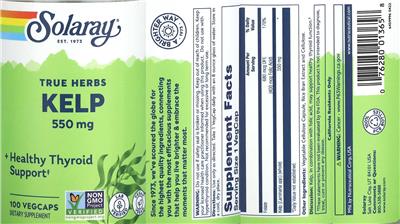
Supplement Facts
The label details for Kelp 550 mg by Solaray, sourced from the NIH Dietary Supplement Label Database.
Supplement Facts
| Ingredient | Amount | % DV |
|---|---|---|
| Folic Acid | 400 mcg | -- |
| Folate | 680 mcg DFE | 170% |
| Kelp | 550 mg | -- |
Other ingredients: Cellulose, Rice Bran Extract
Tap any ingredient to jump to its full detail below.
These statements are the manufacturer’s wording, reproduced from the product label — the label is saying it, not HelloPharmacist. We don’t verify or endorse them.
Brand IP Statement(s)
Solaray Est. 1973 A brighter way 1973
Formulation
Healthy Thyroid Support
Non GMO Project Verified Nongmoproject.org
Vegan
FDA Statement of Identity
Dietary Supplement
Seals/Symbols
Non GMO Project Verified Nongmoproject.org
Lab verified Vegan
General Statements
Since 1973, we've scoured the globe for the highest quality ingredients, connecting you with the most efficacious supplements that help you live brighter & embrace the moments that matter most.
100% PCR bottles
True Herbs
Precautions
Warning: Do not use if safety seal is broken or missing. Keep your licensed health care practitioner informed when using this product. Do not use with hyperthyroid condition. Not recommended for excessive or long term use.
Keep out of reach of children.
Directions: Use only as directed.
California residents only Warning: Cancer - www.P65Warnings.ca.gov
Suggested/Recommended/Usage/Directions
Directions: Use only as directed. Take 1 vegcap daily with an 8 ounce glass of water.
Storage
Store in a cool, dry place.
Formula
Discussion: Kelp, in combination with folic acid, may support healthy thyroid function.
FDA Disclaimer Statement
These statements have not been evaluated by the FDA. This product is not intended to diagnose, treat, cure or prevent any disease.
Is this label outdated? Report a formula or label change and our pharmacy team will review it.
Kelp 550 mg by Solaray label
The label scan from the NIH Dietary Supplement Label Database. Tap to enlarge.
Label images are published by the NIH Dietary Supplement Label Database for the version of this product on file. Always read your actual product label.
View the full label (PDF)The Ingredients in Kelp 550 mg by Solaray
These are the 2 active ingredients this product is made of. Select any to open its full monograph.
Serving size1 VegCap(s) Dosage formCapsule Servings per container100 Amounts shown are per serving.
Most supplement products combine several ingredients, and a medication can interact with the product through any one of them. Each ingredient below shows whether it has known drug interactions.
Folate
Kelp
Interacts with893 drugs
Fucus vesiculosus (bladderwrack) is a brown seaweed rich in iodine that has been used traditionally for thyroid concerns, weight, and skin. There is l...
Kelp monograph & interactionsOther (inactive) ingredients: Cellulose, Rice Bran Extract. These complete the product’s ingredient list but are not active constituents.
Kelp 550 mg by Solaray Drug Interactions
HelloPharmacist Interaction Report
Solaray Kelp 550 mg contains folic acid, which interacts with a number of medications.
The most serious interactions are Moderate in severity. Folic acid can interfere with seizure control — it may reduce levels of the epilepsy drug phenytoin (Dilantin) and directly reverse the effects of phenobarbital (Luminal) and primidone (Mysoline), increasing seizure risk.
If you take any of these, your dose may need adjustment and seizure activity should be monitored closely.
Read the full breakdown — every affected drug type, severity by severity
Folic acid also reduces how cancer drugs work. It can lower the effectiveness of methotrexate when treating blood cancers, interfere with pyrimethamine (Daraprim) when used against certain infections, and increase the toxicity of capecitabine (Xeloda) and 5-fluorouracil during colorectal cancer treatment.
These are serious concerns if you're undergoing cancer therapy or taking antimicrobial medications for parasitic or opportunistic infections.
We could not check kelp — we hold no interaction data for it. Altogether, these interactions span 40 individual medications.
Use the medication checker on this page to look up your exact prescriptions before starting this supplement.
Check your own medications below · Editorial policy · How we use AI
Want to check YOUR meds against Kelp 550 mg?
Ask about interactions with your drugs in plain English — “Can I take it with lisinopril?” — and we find you the answer in seconds, ingredient by ingredient.
Go to the checkerIngredients driving the most interactions
Individual Drug Interactions
The ingredients in Kelp 550 mg interact with 923 drugs. Click any drug to see the details.
2 of the 2 ingredients in Kelp 550 mg interact with drugs. Each result below shows which ingredient is responsible. Kelp Folic Acid
AmiodaroneCordarone, Pacerone
How Amiodarone interacts with Kelp 550 mg — through 1 ingredient. Tap an ingredient for the detail:
KelpCytochrome P450 2c8 (cyp2c8) Substrates, Cytochrome P450 3a4 (cyp3a4) Substrates +1 Moderate
Interaction Summary
Theoretically, concomitant use of Fucus vesiculosus with CYP2C8 substrates might increase the risk for adverse effects.
Read the full Kelp + Amiodarone interactionAprobarbital, Butabarbital, PhenobarbitalTriple Barbital
How Aprobarbital, Butabarbital, Phenobarbital interacts with Kelp 550 mg — through 1 ingredient. Tap an ingredient for the detail:
Folic AcidPhenobarbital (luminal) Moderate
Interaction Summary
Folic acid might have antagonistic effects on phenobarbital and increase the risk for seizures.
Read the full Folic Acid + Aprobarbital, Butabarbital, Phenobarbital interactionAspirin, Codeine Phosphate, PhenobarbitalPhenaphen
How Aspirin, Codeine Phosphate, Phenobarbital interacts with Kelp 550 mg — through 2 ingredients. Tap an ingredient for the detail:
Folic AcidPhenobarbital (luminal) Moderate
Interaction Summary
Folic acid might have antagonistic effects on phenobarbital and increase the risk for seizures.
Read the full Folic Acid + Aspirin, Codeine Phosphate, Phenobarbital interactionKelpAnticoagulant/antiplatelet Drugs, Cytochrome P450 2d6 (cyp2d6) Substrates Minor
Interaction Summary
Theoretically, taking Fucus vesiculosus with antiplatelet or anticoagulant drugs might increase the risk of bruising and bleeding.
Read the full Kelp + Aspirin, Codeine Phosphate, Phenobarbital interactionAtropine, Hyoscyamine, PhenobarbitalHypnaldyne
How Atropine, Hyoscyamine, Phenobarbital interacts with Kelp 550 mg — through 1 ingredient. Tap an ingredient for the detail:
Folic AcidPhenobarbital (luminal) Moderate
Interaction Summary
Folic acid might have antagonistic effects on phenobarbital and increase the risk for seizures.
Read the full Folic Acid + Atropine, Hyoscyamine, Phenobarbital interactionAtropine, Hyoscyamine, Phenobarbital, ScopolamineBarbidonna No. 2, Belladonna Phenobarbital
How Atropine, Hyoscyamine, Phenobarbital, Scopolamine interacts with Kelp 550 mg — through 1 ingredient. Tap an ingredient for the detail:
Folic AcidPhenobarbital (luminal) Moderate
Interaction Summary
Folic acid might have antagonistic effects on phenobarbital and increase the risk for seizures.
Read the full Folic Acid + Atropine, Hyoscyamine, Phenobarbital, Scopolamine interactionAtropine, Hyoscyamine, Scopolamine, PhenobarbitalBarbeloid, Donnatal #2, Donphen
How Atropine, Hyoscyamine, Scopolamine, Phenobarbital interacts with Kelp 550 mg — through 1 ingredient. Tap an ingredient for the detail:
Folic AcidPhenobarbital (luminal) Moderate
Interaction Summary
Folic acid might have antagonistic effects on phenobarbital and increase the risk for seizures.
Read the full Folic Acid + Atropine, Hyoscyamine, Scopolamine, Phenobarbital interactionAtropine, PhenobarbitalAnthrocol
How Atropine, Phenobarbital interacts with Kelp 550 mg — through 1 ingredient. Tap an ingredient for the detail:
Folic AcidPhenobarbital (luminal) Moderate
Interaction Summary
Folic acid might have antagonistic effects on phenobarbital and increase the risk for seizures.
Read the full Folic Acid + Atropine, Phenobarbital interactionBelladona Extract, PhenobarbitalChardonna-2
How Belladona Extract, Phenobarbital interacts with Kelp 550 mg — through 1 ingredient. Tap an ingredient for the detail:
Folic AcidPhenobarbital (luminal) Moderate
Interaction Summary
Folic acid might have antagonistic effects on phenobarbital and increase the risk for seizures.
Read the full Folic Acid + Belladona Extract, Phenobarbital interactionBelladonna Alkaloids, Ergotamine Tartrate, PhenobarbitalBel Tabs, Bellamine-S, Bellaphen-S, Duragal S, Phenarbal S, Spastrin
How Belladonna Alkaloids, Ergotamine Tartrate, Phenobarbital interacts with Kelp 550 mg — through 2 ingredients. Tap an ingredient for the detail:
Folic AcidPhenobarbital (luminal) Moderate
Interaction Summary
Folic acid might have antagonistic effects on phenobarbital and increase the risk for seizures.
Read the full Folic Acid + Belladonna Alkaloids, Ergotamine Tartrate, Phenobarbital interactionKelpCytochrome P450 3a4 (cyp3a4) Substrates Minor
Interaction Summary
Theoretically, concomitant use of Fucus vesiculosus with CYP3A4 substrates might increase the risk for adverse effects.
Read the full Kelp + Belladonna Alkaloids, Ergotamine Tartrate, Phenobarbital interactionBelladonna Alkaloids, PhenobarbitalBarbidonna, Donnatal
How Belladonna Alkaloids, Phenobarbital interacts with Kelp 550 mg — through 1 ingredient. Tap an ingredient for the detail:
Folic AcidPhenobarbital (luminal) Moderate
Interaction Summary
Folic acid might have antagonistic effects on phenobarbital and increase the risk for seizures.
Read the full Folic Acid + Belladonna Alkaloids, Phenobarbital interactionBelladonna Extract, PhenobarbitalBelap
How Belladonna Extract, Phenobarbital interacts with Kelp 550 mg — through 1 ingredient. Tap an ingredient for the detail:
Folic AcidPhenobarbital (luminal) Moderate
Interaction Summary
Folic acid might have antagonistic effects on phenobarbital and increase the risk for seizures.
Read the full Folic Acid + Belladonna Extract, Phenobarbital interactionBelladonna, Ergotamine Tartrate, Phenobarbital
How Belladonna, Ergotamine Tartrate, Phenobarbital interacts with Kelp 550 mg — through 2 ingredients. Tap an ingredient for the detail:
Folic AcidPhenobarbital (luminal) Moderate
Interaction Summary
Folic acid might have antagonistic effects on phenobarbital and increase the risk for seizures.
Read the full Folic Acid + Belladonna, Ergotamine Tartrate, Phenobarbital interactionKelpCytochrome P450 3a4 (cyp3a4) Substrates Minor
Interaction Summary
Theoretically, concomitant use of Fucus vesiculosus with CYP3A4 substrates might increase the risk for adverse effects.
Read the full Kelp + Belladonna, Ergotamine Tartrate, Phenobarbital interactionBelladonna, Ergotamine, PhenobarbitalBellergal-S
How Belladonna, Ergotamine, Phenobarbital interacts with Kelp 550 mg — through 2 ingredients. Tap an ingredient for the detail:
Folic AcidPhenobarbital (luminal) Moderate
Interaction Summary
Folic acid might have antagonistic effects on phenobarbital and increase the risk for seizures.
Read the full Folic Acid + Belladonna, Ergotamine, Phenobarbital interactionKelpCytochrome P450 3a4 (cyp3a4) Substrates Minor
Interaction Summary
Theoretically, concomitant use of Fucus vesiculosus with CYP3A4 substrates might increase the risk for adverse effects.
Read the full Kelp + Belladonna, Ergotamine, Phenobarbital interactionBelladonna, PhenobarbitalBellophen, Susano
How Belladonna, Phenobarbital interacts with Kelp 550 mg — through 1 ingredient. Tap an ingredient for the detail:
Folic AcidPhenobarbital (luminal) Moderate
Interaction Summary
Folic acid might have antagonistic effects on phenobarbital and increase the risk for seizures.
Read the full Folic Acid + Belladonna, Phenobarbital interactionBellafoline, PhenobarbitalBelladenal, Belladenal-S
How Bellafoline, Phenobarbital interacts with Kelp 550 mg — through 1 ingredient. Tap an ingredient for the detail:
Folic AcidPhenobarbital (luminal) Moderate
Interaction Summary
Folic acid might have antagonistic effects on phenobarbital and increase the risk for seizures.
Read the full Folic Acid + Bellafoline, Phenobarbital interactionButabarbital, Phenobarbital, SecobarbitalS.B.P.
How Butabarbital, Phenobarbital, Secobarbital interacts with Kelp 550 mg — through 1 ingredient. Tap an ingredient for the detail:
Folic AcidPhenobarbital (luminal) Moderate
Interaction Summary
Folic acid might have antagonistic effects on phenobarbital and increase the risk for seizures.
Read the full Folic Acid + Butabarbital, Phenobarbital, Secobarbital interactionButalbital, Phenobarbital, SecobarbitalTribarb
How Butalbital, Phenobarbital, Secobarbital interacts with Kelp 550 mg — through 1 ingredient. Tap an ingredient for the detail:
Folic AcidPhenobarbital (luminal) Moderate
Interaction Summary
Folic acid might have antagonistic effects on phenobarbital and increase the risk for seizures.
Read the full Folic Acid + Butalbital, Phenobarbital, Secobarbital interactionCamphor, Hyoscyamine, Passif, Phenobarbital, Scopolamine, ValerianNevrotose #3
How Camphor, Hyoscyamine, Passif, Phenobarbital, Scopolamine, Valerian interacts with Kelp 550 mg — through 1 ingredient. Tap an ingredient for the detail:
Folic AcidPhenobarbital (luminal) Moderate
Interaction Summary
Folic acid might have antagonistic effects on phenobarbital and increase the risk for seizures.
Read the full Folic Acid + Camphor, Hyoscyamine, Passif, Phenobarbital, Scopolamine, Valerian interactionCapecitabineXeloda
How Capecitabine interacts with Kelp 550 mg — through 1 ingredient. Tap an ingredient for the detail:
Folic AcidCapecitabine (xeloda) Moderate
Interaction Summary
Use of high-dose folic acid might contribute to capecitabine toxicity.
Read the full Folic Acid + Capecitabine interactionCarbimazoleNeo-Mercazole
How Carbimazole interacts with Kelp 550 mg — through 1 ingredient. Tap an ingredient for the detail:
KelpAntithyroid Drugs Moderate
Interaction Summary
Due to its iodine content, Fucus vesiculosus might alter the effects of antithyroid drugs.
Read the full Kelp + Carbimazole interactionConjugated EstrogensCenestin, Enjuvia, Premarin, Premarin Vaginal Cream
How Conjugated Estrogens interacts with Kelp 550 mg — through 1 ingredient. Tap an ingredient for the detail:
KelpCytochrome P450 3a4 (cyp3a4) Substrates, Thyroid Hormone Moderate
Interaction Summary
Theoretically, concomitant use of Fucus vesiculosus with CYP3A4 substrates might increase the risk for adverse effects.
Read the full Kelp + Conjugated Estrogens interactionDehydrocholic Acid, Homatropine Methylbromide, PhenobarbitalG.B.S.
How Dehydrocholic Acid, Homatropine Methylbromide, Phenobarbital interacts with Kelp 550 mg — through 1 ingredient. Tap an ingredient for the detail:
Folic AcidPhenobarbital (luminal) Moderate
Interaction Summary
Folic acid might have antagonistic effects on phenobarbital and increase the risk for seizures.
Read the full Folic Acid + Dehydrocholic Acid, Homatropine Methylbromide, Phenobarbital interactionDesiccated Thyroid ExtractWesthroid, WP Thyroid
How Desiccated Thyroid Extract interacts with Kelp 550 mg — through 1 ingredient. Tap an ingredient for the detail:
KelpThyroid Hormone Moderate
Interaction Summary
Due to its iodine content, Fucus vesiculosus might alter the effects of thyroid hormone.
Read the full Kelp + Desiccated Thyroid Extract interactionDesiccated Thyroid Extract (prescription Drug)Nature-Throid, Thyrar
How Desiccated Thyroid Extract (prescription Drug) interacts with Kelp 550 mg — through 1 ingredient. Tap an ingredient for the detail:
KelpThyroid Hormone Moderate
Interaction Summary
Due to its iodine content, Fucus vesiculosus might alter the effects of thyroid hormone.
Read the full Kelp + Desiccated Thyroid Extract (prescription Drug) interactionDextrothyroxineCholoxin
How Dextrothyroxine interacts with Kelp 550 mg — through 1 ingredient. Tap an ingredient for the detail:
KelpThyroid Hormone Moderate
Interaction Summary
Due to its iodine content, Fucus vesiculosus might alter the effects of thyroid hormone.
Read the full Kelp + Dextrothyroxine interactionDicyclomine, PhenobarbitalBentyl w/ Pb
How Dicyclomine, Phenobarbital interacts with Kelp 550 mg — through 1 ingredient. Tap an ingredient for the detail:
Folic AcidPhenobarbital (luminal) Moderate
Interaction Summary
Folic acid might have antagonistic effects on phenobarbital and increase the risk for seizures.
Read the full Folic Acid + Dicyclomine, Phenobarbital interactionDyphylline, Ephedrine, Guaifenesin, PhenobarbitalLufyllin-EPG
How Dyphylline, Ephedrine, Guaifenesin, Phenobarbital interacts with Kelp 550 mg — through 1 ingredient. Tap an ingredient for the detail:
Folic AcidPhenobarbital (luminal) Moderate
Interaction Summary
Folic acid might have antagonistic effects on phenobarbital and increase the risk for seizures.
Read the full Folic Acid + Dyphylline, Ephedrine, Guaifenesin, Phenobarbital interactionEphedrine, Guaifenesin, Phenobarbital, TheophyllineMudrane GG
How Ephedrine, Guaifenesin, Phenobarbital, Theophylline interacts with Kelp 550 mg — through 1 ingredient. Tap an ingredient for the detail:
Folic AcidPhenobarbital (luminal) Moderate
Interaction Summary
Folic acid might have antagonistic effects on phenobarbital and increase the risk for seizures.
Read the full Folic Acid + Ephedrine, Guaifenesin, Phenobarbital, Theophylline interactionEphedrine, Phenobarbital, Potassium Iodide, TheophyllineMudrane, Quadrinal
How Ephedrine, Phenobarbital, Potassium Iodide, Theophylline interacts with Kelp 550 mg — through 1 ingredient. Tap an ingredient for the detail:
Folic AcidPhenobarbital (luminal) Moderate
Interaction Summary
Folic acid might have antagonistic effects on phenobarbital and increase the risk for seizures.
Read the full Folic Acid + Ephedrine, Phenobarbital, Potassium Iodide, Theophylline interactionEphedrine, Phenobarbital, TheophyllineTedral
How Ephedrine, Phenobarbital, Theophylline interacts with Kelp 550 mg — through 1 ingredient. Tap an ingredient for the detail:
Folic AcidPhenobarbital (luminal) Moderate
Interaction Summary
Folic acid might have antagonistic effects on phenobarbital and increase the risk for seizures.
Read the full Folic Acid + Ephedrine, Phenobarbital, Theophylline interactionEach ingredient & the kinds of drugs it affects
For each ingredient in Kelp 550 mg with known interactions, here are the types of medications they can affect. Open any type for the detail — or search your exact drug in the checker above.
Kelp
Amiodarone (Cordarone)
Theoretically, combining Fucus vesiculosus with amiodarone might cause excessively high iodine levels.
Fucus vesiculosus contains high concentrations of iodine. Amiodarone contains 37.3% iodine and can increase iodine levels. Concomitant use might increase the risk of having excessive iodine levels and adversely affecting thyroid function. Monitor thyroid function.
Antithyroid Drugs
Due to its iodine content, Fucus vesiculosus might alter the effects of antithyroid drugs.
Fucus vesiculosus contains high concentrations of iodine. Iodine in high doses has been reported to cause both hyperthyroidism and hypothyroidism, depending on the individual's past medical history. Taking Fucus vesiculosus while using antithyroid drugs could alter the effects of the antithyroid drugs.
Lithium
Concomitant use of Fucus vesiculosus and lithium has resulted in hyperthyroidism.
There is a case of hyperthyroidism occurring in a patient taking Fucus vesiculosus and lithium. Monitor thyroid hormones closely in patients taking lithium and Fucus vesiculosus concomitantly.
Thyroid Hormone
Due to its iodine content, Fucus vesiculosus might alter the effects of thyroid hormone.
Fucus vesiculosus contains high concentrations of iodine. Iodine in high doses has been reported to cause both hyperthyroidism and hypothyroidism, depending on the individual's past medical history. Taking Fucus vesiculosus while using thyroid hormone could alter the effects of thyroid hormone.
Anticoagulant/Antiplatelet Drugs
Theoretically, taking Fucus vesiculosus with antiplatelet or anticoagulant drugs might increase the risk of bruising and bleeding.
In vitro evidence suggests that a constituent of Fucus vesiculosus, known as fucoidan, has anticoagulant effects. However, in clinical research, fucoidan does not seem to have significant anticoagulant activity when taken orally, possibly due to poor absorption.
Cytochrome P450 2C8 (Cyp2C8) Substrates
Theoretically, concomitant use of Fucus vesiculosus with CYP2C8 substrates might increase the risk for adverse effects.
In vitro research shows that fucoidan, a constituent of Fucus vesiculosus, inhibits CYP2C8. This interaction has not been reported in humans.
Cytochrome P450 2C9 (Cyp2C9) Substrates
Theoretically, concomitant use of Fucus vesiculosus with CYP2C9 substrates might increase the risk for adverse effects.
In vitro research shows that fucoidan, a constituent of Fucus vesiculosus, inhibits CYP2C9. This interaction has not been reported in humans.
Cytochrome P450 2D6 (Cyp2D6) Substrates
Theoretically, concomitant use of Fucus vesiculosus with CYP2D6 substrates might alter the effects of these substrates.
In vitro research shows that fucoidan, a constituent of Fucus vesiculosus, both inhibits and induces CYP2D6. This interaction has not been reported in humans.
Cytochrome P450 3A4 (Cyp3A4) Substrates
Theoretically, concomitant use of Fucus vesiculosus with CYP3A4 substrates might increase the risk for adverse effects.
In vitro research shows that fucoidan, a constituent of Fucus vesiculosus, inhibits CYP3A4. This interaction has not been reported in humans.
Folic Acid
5-Fluorouracil
Theoretically, high doses of folic acid might increase the toxicity of 5-fluorouracil.
Increases in gastrointestinal side effects of 5-fluorouracil, such as stomatitis and diarrhea, have been described in two clinical studies when leucovorin, a form of folic acid, was administered with 5-fluorouracil.
Capecitabine (Xeloda)
Use of high-dose folic acid might contribute to capecitabine toxicity.
Clinical research suggests that higher serum folate levels are associated with an increased risk for moderate or severe toxicity during capecitabine-based treatment for colorectal cancer. Additionally, in one case report, taking folic acid 15 mg daily might have contributed to increased toxicity, including severe diarrhea, vomiting, edema, hand-foot syndrome, and eventually death, in a patient prescribed capecitabine.
Methotrexate (Trexall, Others)
Folic acid might reduce the efficacy of methotrexate as a cancer treatment when given concurrently.
Methotrexate exerts its cytotoxic effects by preventing conversion of folic acid to the active form needed by cells. There is some evidence that folic acid supplements reduce the efficacy of methotrexate in the treatment of acute lymphoblastic leukemia, and theoretically they could reduce its efficacy in the treatment of other cancers. Advise cancer patients to consult their oncologist before using folic acid supplements. In patients treated with long-term, low-dose methotrexate for rheumatoid arthritis (RA) or psoriasis, folic acid supplements can reduce the incidence of side effects, without reducing efficacy.
Phenobarbital (Luminal)
Folic acid might have antagonistic effects on phenobarbital and increase the risk for seizures.
Folic acid can have direct convulsant activity in some people, reversing the effects of phenobarbital and worsening seizure control. Monitor closely for increased seizure activity.
Phenytoin (Dilantin)
Folic acid might reduce serum levels of phenytoin in some patients.
Folic acid may be a cofactor in phenytoin metabolism. Folic acid, in doses of 1 mg daily or more, can reduce serum levels of phenytoin in some patients. Increases in seizure frequency have been reported. If folic acid supplements are added to established phenytoin therapy, monitor serum phenytoin levels closely. If phenytoin and folic acid are started at the same time and continued together, adverse changes in phenytoin pharmacokinetics are avoided. Note that phenytoin also reduces serum folate levels.
Primidone (Mysoline)
Folic acid might have antagonistic effects on primidone and increase the risk for seizures.
Folic acid can have direct convulsant activity in some people, reversing the effects of primidone and worsening seizure control. Monitor closely for increased seizure activity. Note that primidone also reduces serum folate levels.
Pyrimethamine (Daraprim)
Folic acid might antagonize the effects of pyrimethamine.
Folic acid can antagonize the antiparasitic effects of pyrimethamine against toxoplasmosis and Pneumocystis carinii pneumonia. Folic acid doesn't antagonize the effects of pyrimethamine in the treatment of malaria, because malarial parasites cannot use exogenous folic acid. Use folinic acid as an alternative to folic acid when indicated.
Brand information
Manufacturer and brand details for Kelp 550 mg, from the product label.
Solaray
See all Solaray products- Name
- Solaray
- City
- Salt Lake City
- State
- UT
- ZipCode
- 84101
- Phone Number
- 800-538-5888
- Web Address
- www.solaray.com
Kelp 550 mg by Solaray: Common Questions
Does Kelp 550 mg by Solaray interact with any medications?
How can one product interact with so many drugs?
Where does this information come from?
Is this safe to take during pregnancy?
Can I take this if I'm breastfeeding?
What side effects might I notice?
Does this actually work for folate deficiency?
What's the difference between the folic acid and folate in this product?
Can I use this if I suspect I have anemia?
Written and reviewed by the HelloPharmacist editorial staff. Our editorial policy
Not sure if Kelp 550 mg is safe with your meds?
Our pharmacists answer your medication & supplement questions — free.
Label information is sourced from the NIH Dietary Supplement Label Database and reflects the product version on file; always read your actual product label. This page is for education only and is not a substitute for professional medical advice. Confirm with your pharmacist or doctor before combining supplements and medications.
The Full Monographs Behind Kelp 550 mg’s Ingredients
Every ingredient we hold a full HelloPharmacist monograph for — uses, evidence, safety, and the complete interaction list.
Folic Acid
Interacts with 40 drugsFolic acid is the man-made form of vitamin B9 and is one of the most well-studied supplements, especially for preventing serious birth defects when taken before and during early pregnancy. I...
Read the full Folic Acid monograph → Herb & supplement monographFucus Vesiculosus
Interacts with 893 drugsFucus vesiculosus (bladderwrack) is a brown seaweed rich in iodine that has been used traditionally for thyroid concerns, weight, and skin. There is little solid human evidence to support mo...
Read the full Fucus Vesiculosus monograph →Sources & How We Checked
Kelp 550 mg's label data comes from the NIH Dietary Supplement Label Database; the ingredient interaction data is from the Natural Medicines database, reviewed by our pharmacists.
- NIH Dietary Supplement Label Database (DSLD) — The official product label on file for this supplement.
- Natural Medicines (Therapeutic Research Center) — Evidence-graded clinical reference behind the ingredient interaction data.
Content is written and reviewed by licensed HelloPharmacist pharmacists. See our data sources and editorial standards for how this information is built and checked.
The 71 references behind this product’s interaction data
Every citation that drives the interaction findings for this product’s ingredients, from the evidence-graded Natural Medicines (TRC Healthcare) database. Open an ingredient to browse its citations — links open the study on PubMed or the publisher’s site.
Folic Acid 56 references
- McEvoy GK, ed. AHFS Drug Information. Bethesda, MD: American Society of Health-System Pharmacists, 1998.
- Duhra P. Treatment of gastrointestinal symptoms associated with methotrexate therapy for psoriasis. J Am Acad Dermatol 1993;28:466-9. PubMed
- Morgan SL, Baggott JE, Vaughn WH, et al. Supplementation with folic acid during methotrexate therapy for rheumatoid arthritis. A double-blind, placebo-controlled trial. Ann Intern Med 1994;121:833-41. PubMed
- Froscher W, Maier V, Laage M, et al. Folate deficiency, anticonvulsant drugs, and psychiatric morbidity. Clin Neuropharmacol 1995;18:165-82. PubMed
- Lewis DP, Van Dyke DC, Willhite LA, et al. Phenytoin-folic acid interaction. Ann Pharmacother 1995;29:726-35. PubMed
- Berg MJ, Stumbo PJ, Chenard CA, et al. Folic acid improves phenytoin pharmacokinetics. J Am Diet Assoc 1995;95:352-6. PubMed
- Berg MJ, Fincham RW, Ebert BE, et al. Phenytoin pharmacokinetics: Before and after folic acid administration. Epilepsia 1992;33:712-20. PubMed
- Shafer RB, Nuttall FQ. Calcium and folic acid absorption in patients taking anticonvulsant drugs. J Clin Endocrinol Metab 1975;41:1125-9. PubMed
- Leeb BF, Witzmann G, Ogris E, et al. Folic acid and cyanocobalamin levels in serum and erythrocytes during low-dose methotrexate therapy of rheumatoid arthritis and psoriatic arthritis patients. Clin Exp Rheumatol 1995;13:459-63.
- Morgan SL, Baggott JE, Lee JY, Alarcón GS. Folic acid supplementation prevents deficient blood folate levels and hyperhomocysteinemia during longterm, low dose methotrexate therapy for rheumatoid arthritis: implications for cardiovascular disease preventi
- Dijkmans BA. Folate supplementation and methotrexate. Br J Rheumatol 1995;34:1172-4. PubMed
- Segal S, Kaminski S. Drug-nutrient interactions. American Druggist 1996 Jul;42-8.
- Lambie DG, Johnson RH. Drugs and folate metabolism. Drugs 1985;30:145-55. PubMed
- Amer College of Rheumatology ad hoc committee on clinical guidelines. Guidelines for monitoring drug therapy in rheumatoid arthritis. Arthritis Rheum 1996;39:723-31. DOI
- Suitor CW, Bailey LB. Dietary folate equivalents: interpretation and application. J Am Diet Assoc 2000;100:88-94. PubMed
- Food and Nutrition Board, Institute of Medicine. Dietary Reference Intakes for Thiamin, Riboflavin, Niacin, Vitamin B6, Folate, Vitamin B12, Pantothenic Acid, Biotin, and Choline (2000). Washington, DC: National Academy Press, 2000. Available at: http://b
- Sandoval M, Charbonnet RM, Okuhama NN, et al. Cat's claw inhibits TNFalpha production and scavenges free radicals: role in cytoprotection. Free Radic Biol Med 2000;29:71-78.
- Antony AC. Megaloblastic Anemias. In: Hoffman R, Benz Jr EJ, Shattil SJ, et al. Hematology: Basic Principles and Practice. 3rd ed. New York, NY: Churchill Livingstone 2000: 451-79.
- Reynolds EH. Neurological aspects of folate and vitamin B12 metabolism. Clin Haematol 1976;5:661-96. DOI
- Reynolds EH. Folate metabolism and anticonvulsant therapy. Proc R Soc Med 1974;67:68.
- Ortiz Z, Shea B, Suarez Almazor M, et al. Folic acid and folinic acid for reducing side effects in patients receiving methotrexate for rheumatoid arthritis (Cochrane Review). Cochrane Database Syst Rev 2000;2:CD000951. PubMed
- Van Delden C, Hirschel B. Folinic acid supplements to pyrimethamine-sulfadiazine for Toxoplasma encephalitis are associated with better outcome (letter). J Infect Dis 1996;173:1294-5. PubMed
- Schroder H, Clausen N, Ostergard E, Pressler T. Folic acid supplements in vitamin tablets: a determinant of hematological drug tolerance in maintenance therapy of childhood acute lymphoblastic leukemia. Ped Hematol Oncol 1986;3:241-7. PubMed
- Lange H, Suryapranata H, De Luca G, et al. Folate therapy and in-stent restenosis after coronary stenting. N Engl J Med 2004;350:2673-81. PubMed
- Morris MC, Evans DA, Bienias JL, et al. Dietary folate and vitamin B12 intake and cognitive decline among community-dwelling older persons. Arch Neurol 2005;62:641-5. PubMed
- Bonaa KH, Njolstad I, Ueland PM, et al. NORVIT: Homocysteine lowering and cardiovascular events after acute myocardial infarction. N Enlg J Med 2006;354:1578-88. PubMed
- Lawson KA, Wright ME, Subar A, et al. Multivitamin use and risk of prostate cancer in the National Institutes of Health-AARP Diet and Health Study. J Natl Cancer Inst 2007;99:754-64. PubMed
- Figueiredo JC, Grau MV, Haile RW, et al. Folic acid and risk of prostate cancer: Results from a randomized clinical trial. J Natl Cancer Inst 2009;101:432-5. PubMed
- Clippe C, Freyer G, Milano G, Trillet-Lenoir V. Lethal toxicity of capecitabine due to abusive folic acid prescription. Clin Oncol (R Coll Radiol) 2003;15:299-300. PubMed
- Bedford Laboratories. Leucovorin calcium [package insert]. Bedford, OH. September 2008. Available at: http://www.bedfordlabs.com/BedfordLabsWeb/products/inserts/LCV-P02.pdf.
- Ebbing M, Bonaa KH, Nygard O, et al. Cancer incidence and mortality after treatment with folic acid and vitamin B12. JAMA 2009;302:2119-26.
- Haberg, S. E., London, S. J., Stigum, H., Nafstad, P., and Nystad, W. Folic acid supplements in pregnancy and early childhood respiratory health. Arch Dis.Child 2009;94(3):180-184. PubMed
- Whitrow, M. J., Moore, V. M., Rumbold, A. R., and Davies, M. J. Effect of supplemental folic acid in pregnancy on childhood asthma: a prospective birth cohort study. Am J Epidemiol. 12-15-2009;170(12):1486-1493. PubMed
- Collin, S. M., Metcalfe, C., Refsum, H., Lewis, S. J., Zuccolo, L., Smith, G. D., Chen, L., Harris, R., Davis, M., Marsden, G., Johnston, C., Lane, J. A., Ebbing, M., Bonaa, K. H., Nygard, O., Ueland, P. M., Grau, M. V., Baron, J. A., Donovan, J. L., Nea
- Baggott, J. E., Oster, R. A., and Tamura, T. Meta-analysis of cancer risk in folic acid supplementation trials. Cancer Epidemiol. 2012;36(1):78-81. PubMed
- Fonseca VA, Lavery LA, Thethi TK, et al. Metanx in type 2 diabetes with peripheral neuropathy: A randomized trial. Am J Med 2013;126(2):141-9. PubMed
- Hankey GJ, Eikelboom JW, Yi Q, et al. Treatment with B vitamins and incidence of cancer in patients with previous stroke or transient ischemic attack: Results of a randomized placebo-controlled trial. Stroke 2012;43(6):1572-7. PubMed
- Taneja S, Strand TA, Kumar T, et al. Folic acid and vitamin B-12 supplementation and common infections in 6-30-mo-old children in India: a randomized placebo-controlled trial. Am J Clin Nutr 2013;98(3):731-7. PubMed
- van Wijngaarden JP, Swart KM, Enneman AW, et al. Effect of daily vitamin B-12 and folic acid supplementation on fracture incidence in elderly individuals with an elevated plasma homocysteine concentration: B-PROOF, a randomized controlled trial. Am J Clin
- Qin X, Fan F, Cui Y, Chen F, Chen Y, Cheng X, Li Y, Wang B, Xu X, Xu X, Huo Y, Wang X. Folic acid supplementation with and without vitamin B6 and revascularization risk: a meta-analysis of randomized controlled trials. Clin Nutr. 2014;33(4):603-12. PubMed
- Crider KS, Cordero AM, Qi YP, Mulinare J, Dowling NF, Berry RJ. Prenatal folic acid and risk of asthma in children: a systematic review and meta-analysis. Am J Clin Nutr. 2013;98(5):1272-81. PubMed
- Matsubara S, Imai K, Murayama K, Higashizawa T. Severe liver dysfunction during nausea and vomiting of pregnancy: folic acid supplement as a suggested culprit. J Obstet Gynaecol. 2012;32(7):701-2. PubMed
- Qin X, Cui Y, Shen L, Sun N, Zhang Y, Li J, Xu X, Wang B, Xu X, Huo Y, Wang X. Folic acid supplementation and cancer risk: a meta-analysis of randomized controlled trials. Int J Cancer. 2013 1;133(5):1033-41. PubMed
- Tio M, Andrici J, Cox MR, Eslick GD. Folate intake and the risk of prostate cancer: a systematic review and meta-analysis. Prostate Cancer Prostatic Dis. 2014;17(3):213-9. PubMed
- Tomaszewski JJ, Richman EL, Sadetsky N, O'Keefe DS, Carroll PR, Davies BJ, Chan JM. Impact of folate intake on prostate cancer recurrence following definitive therapy: data from CaPSURE. J Urol. 2014;191(4):971-6. PubMed
- Valera-Gran D, García de la Hera M, Navarrete-Muñoz EM, Fernandez-Somoano A, Tardón A, Julvez J, Forns J, Lertxundi N, Ibarluzea JM, Murcia M, Rebagliato M, Vioque J; Infancia y Medio Ambiente (INMA) Project. Folic acid supplements during pregnancy and ch
- Van Der Woude DA, De Vries J, Van Wijk EM, Verzijl JM, Pijnenborg JM. A randomized controlled trial examining the addition of folic acid to iron supplementation in the treatment of postpartum anemia. Int J Gynaecol Obstet. 2014;126(2):101-5. PubMed
- Vila-Nova C, Wehby GL, Queirós FC, Chakraborty H, Félix TM, Goco N, Moore J, Gewehr EV, Lins L, Affonso CM, Murray JC. Periconceptional use of folic acid and risk of miscarriage - findings of the Oral Cleft Prevention Program in Brazil. J Perinat Med. 201 PubMed
- Vollset SE, Clarke R, Lewington S, Ebbing M, Halsey J, Lonn E, Armitage J, Manson JE, Hankey GJ, Spence JD, Galan P, Bønaa KH, Jamison R, Gaziano JM, Guarino P, Baron JA, Logan RF, Giovannucci EL, den Heijer M, Ueland PM, Bennett D, Collins R, Peto R; B-V
- Wehby GL, Félix TM, Goco N, Richieri-Costa A, Chakraborty H, Souza J, Pereira R, Padovani C, Moretti-Ferreira D, Murray JC. High dosage folic acid supplementation, oral cleft recurrence and fetal growth. Int J Environ Res Public Health. 2013 4;10(2):590-6 PubMed
- Fanidi A, Carreras-Torres R, Larose TL, et al. Is high vitamin B12 status a cause of lung cancer? Int J Cancer. 2019 Sep 15;145(6):1499-1503. PubMed
- Liu J, Li Z, Ye R, Liu J, Ren A. Periconceptional folic acid supplementation and risk of parent-reported asthma in children at 4-6 years of age. ERJ Open Res. 2020;6(1):00250-2019. PubMed
- Houghton LA, Sherwood KL, Pawlosky R, Ito S, O'Connor DL. [6S]-5-Methyltetrahydrofolate is at least as effective as folic acid in preventing a decline in blood folate concentrations during lactation. Am J Clin Nutr. 2006 Apr;83(4):842-50. PubMed
- Houghton LA, Yang J, O'Connor DL. Unmetabolized folic acid and total folate concentrations in breast milk are unaffected by low-dose folate supplements. Am J Clin Nutr. 2009 Jan;89(1):216-20. PubMed
- Chan SL, Chan AWH, Mo F, et al. Association Between Serum Folate Level and Toxicity of Capecitabine During Treatment for Colorectal Cancer. Oncologist. 2018 Dec;23(12):1436-1445. PubMed
- Sarris J, Ravindran A, Yatham LN, et al. Clinician guidelines for the treatment of psychiatric disorders with nutraceuticals and phytoceuticals: The World Federation of Societies of Biological Psychiatry (WFSBP) and Canadian Network for Mood and Anxiety T
Fucus Vesiculosus 15 references
- Goodman GA, Rall TW, Nies AS, Taylor P. The Pharmacological Basis of Therapeutics, 9th ed.
- Food and Nutrition Board, Institute of Medicine. Dietary Reference Intakes for Vitamin A, Vitamin K, Arsenic, Boron, Chromium, Copper, Iodine, Iron, Manganese, Molybdenum, Nickel, Silicon, Vanadium, and Zinc. Washington, DC: National Academy Press, 2002.
- Phaneuf D, Cote I, Dumas P, et al. Evaluation of the contamination of marine algae (Seaweed) from the St. Lawrence River and likely to be consumed by humans. Environ Res 1999;80:S175-S182. PubMed
- Durig J, Bruhn T, Zurborn KH, et al. Anticoagulant fucoidan fractions from Fucus vesiculosus induce platelet activation in vitro. Thromb Res 1997;85:479-91. PubMed
- Conz PA, La Greca G, Benedetti P, et al. Fucus vesiculosus: a nephrotoxic alga? Nephrol Dial Transplant 1998;13:526-7.
- Ohye H, Fukata S, Kanoh M, et al. Thyrotoxicosis caused by weight-reducing herbal medicines. Arch Intern Med 2005;165:831-4. PubMed
- Okamura K, Inoue K, Omae T. A case of Hashimoto's thyroiditis with thyroid immunological abnormality manifested after habitual ingestion of seaweed. Acta Endocrinol (Copenh) 1978;88:703-12. PubMed
- Agarwal SC, Crook JR, Pepper CB. Herbal remedies -- how safe are they? A case report of polymorphic ventricular tachycardia/ventricular fibrillation induced by herbal medication used for obesity. Int J Cardiol 2006;106:260-1. PubMed
- Sterling JB, Heymann WR. Potassium iodide in dermatology: a 19th century drug for the 21st century-uses, pharmacology, adverse effects, and contraindications. J Am Acad Dermatol 2000;43:691-7. PubMed
- Catania, M. A., Oteri, A., Caiello, P., Russo, A., Salvo, F., Giustini, E. S., Caputi, A. P., and Polimeni, G. Hemorrhagic cystitis induced by an herbal mixture. South.Med.J. 2010;103(1):90-92. PubMed
- Cumashi, A., Ushakova, N. A., Preobrazhenskaya, M. E., D'Incecco, A., Piccoli, A., Totani, L., Tinari, N., Morozevich, G. E., Berman, A. E., Bilan, M. I., Usov, A. I., Ustyuzhanina, N. E., Grachev, A. A., Sanderson, C. J., Kelly, M., Rabinovich, G. A., I
- Irhimeh, M. R., Fitton, J. H., and Lowenthal, R. M. Pilot clinical study to evaluate the anticoagulant activity of fucoidan. Blood Coagul.Fibrinolysis 2009;20(7):607-610. PubMed
- Arbaizar, B. and Llorca, J. [Fucus vesiculosus induced hyperthyroidism in a patient undergoing concomitant treatment with lithium]. Actas Esp.Psiquiatr. 2011;39(6):401-403.
- Church FC, Meade JB, Treanor RE, and et al. Antithrombin activity of fucoidan. The interaction of fucoidan with heparin cofactor II, antithrombin III, and thrombin. J Biol Chem 2-25-1989;264(6):3618-3623. DOI
- Mathew L, Burney M, Gaikwad A, et al. Preclinical evaluation of safety of fucoidan extracts from Undaria pinnatifida and Fucus vesiculosus for use in cancer treatment. Integr Cancer Ther 2017;16(4):572-84.
Parts of this content are provided by the Therapeutic Research Center, LLC.
DISCLAIMER: Currently this does not check for drug-drug interactions. This is not an all-inclusive comprehensive list of potential interactions and is for informational purposes only. Not all interactions are known or well-reported in the scientific literature, and new interactions are continually being reported. Input is needed from a qualified healthcare provider including a pharmacist before starting any therapy. Application of clinical judgment is necessary.
© 2021 Therapeutic Research Center, LLC