
Kids Elderberry Syrup + Honey Ingredients & Drug Interactions
by New Chapter
What is this page for?
First and foremost: checking Kids Elderberry Syrup + Honey against your medications. The heart of this page is the interaction checker and the full interaction report — how this product’s ingredients may interact with prescription and over-the-counter medicines you may be taking.
Around that, we add a pharmacist’s high-level view of the product as a whole — what’s inside, the evidence for its stated use, how transparent the label is, and what safety data exists — so you can see the full picture in one place. It’s educational information from our licensed clinical databases and the clinical staff at HelloPharmacist — not medical advice — and we don’t sell or endorse products. Our editorial policy
Kids Elderberry Syrup + Honey is a dietary supplement by New Chapter with 3 active ingredients. Its ingredients are commonly taken for cough and sore throat, wound and burn care, soothing minor skin irritation.Based on those ingredients, 736 medications have a known interaction with it, the most serious rated moderate. The ingredients most likely to interact are Honey. Use the checker below to test your specific medication, or read the full HelloPharmacist Interaction Report.
Check Your Meds Against Kids Elderberry Syrup + Honey by New Chapter
Ask about any prescription or over-the-counter medication and we check it for interactions with Kids Elderberry Syrup + Honey by New Chapter — and tell you which ingredient is responsible.
AI summaries are generated from our interaction database for education only — always confirm with your pharmacist. How we use AI
Ask the Pharmacist
A licensed pharmacist will answer your question by email — free, usually within 24 hours.
Got it — thank you!
A licensed pharmacist will answer within 24 hours. Keep an eye on your email (worth checking spam, just in case).
HelloPharmacist Scorecard of Kids Elderberry Syrup + Honey by New Chapter
Our pharmacy team’s full take, with four database checks built into the cards below — a summary of what is known, not a grade of the product itself.
What’s inside
Full disclosure
This syrup has three active ingredients: honey, European Elderberry Concentrate, and ElderCraft. Honey is included for its traditional use in soothing throat and cough symptoms.
The other two are elderberry-based ingredients. The product is delivered as a liquid and also contains water as an inactive ingredient.
Does it work?
Moderate evidence
Honey is possibly effective for cough and cold sores, and there's some evidence it may help with oral sores (oral mucositis), burns, and dry eye. For the elderberry ingredients — the European Elderberry Concentrate and ElderCraft — we hold no effectiveness data in our system.
Talk to your pediatrician or pharmacist about what this product might help with and whether it's right for your child's needs.
How safe is it?
Well-documented data
Honey is generally well tolerated in children over 1 year of age and is safe as a food. When taken by mouth, the most common side effects are nausea, stomach pain, and vomiting.
Topically (on skin), it may cause burning, pain, or stinging. There's one important caution: honey from Turkey's Black Sea coast can contain harmful grayanotoxins from rhododendrons that cause serious heart problems — avoid honey from that region.
Allergic reactions to honey, including severe ones, have been reported. While pasteurized honey is generally fine as food, the manufacturer notes you should check with your doctor before using it as medicine.
If you're breastfeeding, eating honey is considered safe, but talk to your provider about medicinal use.
Meds to double-check
Moderate interaction found
Before giving this syrup, double-check if your child is on phenytoin (Dilantin) for seizures — honey may raise its levels. Also check any drugs your child's liver breaks down (CYP3A4 substrates; ask your pharmacist if unsure) and blood thinners or antiplatelet drugs like aspirin.
We couldn't check the elderberry ingredients, so mention those to your pharmacist too.
The bottom line
Scorecard at a glanceFully disclosed formula with some supporting evidence for its stated purpose. Moderate medication interactions have been identified, and safety information is well characterized.
This is a common kids' remedy with honey as its main checked ingredient — generally well tolerated for cough and throat comfort in children over 1 year old. If your child takes any medications, especially seizure drugs or blood thinners, check them against the tool on this page first.
Talk to your pediatrician before starting it as a medicine rather than a food, and watch for nausea or stomach upset.
Educational only — not medical advice; always confirm with your pharmacist. Our editorial policy · How we use AI
Assessment coverage: 1 of 3 active ingredients matched to our full ingredient reviews (monographs). Based on the product label dated Mar 25, 2025.
This Scorecard evaluates available label information, ingredient evidence, and known medication-safety considerations. It does not independently verify product identity, purity, potency, contamination, or manufacturing quality. How these ratings are computed
General information
Key facts about Kids Elderberry Syrup + Honey, straight from the product label.
| Brand | New Chapter |
|---|---|
| Barcode (UPC) | 727783903181 |
| Net contents | 4 Fluid Ounce(s); 118 mL |
| Market status | On market |
| Date entered into DSLD | Mar 25, 2025 |
| DSLD ID | 326596 |
| Product type | Other Combinations |
| Supplement form | Liquid |
| Dietary claims / uses | All Other, Structure/Function |
| Intended target group(s) | Children 4 or More Years of Age, Vegetarian, Gluten Free, Children more than 1 but less than 4 |
Everything in this section is reproduced from the manufacturer’s own product label — it’s the label speaking, not HelloPharmacist. We show it so you can see exactly what the maker states; we don’t verify or endorse those statements.
Supplement Facts
The label details for Kids Elderberry Syrup + Honey by New Chapter, sourced from the NIH Dietary Supplement Label Database.
Supplement Facts
| Ingredient | Amount | % DV |
|---|---|---|
| Calories | 10 Calorie(s) | -- |
| Total Carbohydrates | 2 Gram(s) | 1%, 1% |
| Total Sugars | 2 Gram(s) | -- |
| Honey | 2225 mg | -- |
| European Elderberry Concentrate | 812.5 mg | -- |
| Added Sugars | 2 Gram(s) | 8%, 4% |
| ElderCraft | 25 mg | -- |
Other ingredients: Water
Tap any ingredient to jump to its full detail below.
These statements are the manufacturer’s wording, reproduced from the product label — the label is saying it, not HelloPharmacist. We don’t verify or endorse them.
Formula
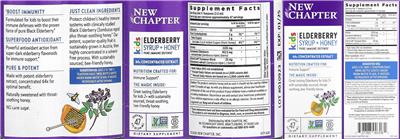
Boost Immunity Formulated for kids to boost their immune defenses with the proven force of pure black elderberry. Superfood Antioxidant Powerful antioxidant action from super-dark elderberry flavonoids for immune support. Pure & Potent Made with potent elderberry extract, concentrated 64x for optimal benefit. Naturally sweetened with throat-soothing honey.
Formulated for kids to boost their immune defenses with the proven force of pure black elderberry.
Just clean ingredients Protect children's healthy immune systems with clinically studied black elderberry (Sambucus nigra) plus throat-smoothing honey.
With sustainably sourced, bee-friendly honey.
The magic inside: Great-tasting Elderberry for kids 2+ with sustainably sourced, throat-soothing, bee-friendly honey
Formulation
No cane sugar
Our potent, superior-quality fruit is sustainably grown in Austria, then highly concentrated in a solvent-free process.
Pure immune defense 64x concentrated extract
Nutrition crafted for: Immune support
Non GMO Project Verified nongmoproject.org
Gluten free; 100% vegetarian; no artificial flavors or colors.
Gluten free; 100% vegetarian; no artificial flavors or colors.
The New Chapter Money-Back Guarantee: We proudly stand behind every product we make. However, if you are not satisfied, please visit www.newchapter.com/guarantee for refund details.
Suggested/Recommended/Usage/Directions
Suggested use: Ages 2-12: Take 1/2 teaspoon daily. Swirl bottle gently under warm water to mix, if needed.
Storage
Refrigerate after opening.
Seals/Symbols
Non GMO Project Verified nongmoproject.org Certified B Corporation
FDA Statement of Identity
Dietary Supplement
Precautions
Caution: This product contains honey and as such it should not be used by children under 12 months of age. As with any dietary supplement, advise your healthcare professional of the use of this product if your children have a medical condition or are taking medication. Keep out of reach of children.
As with any dietary supplement, advise your healthcare professional of the use of this product if your children have a medical condition or are taking medication.
Do not exceed suggested use.
Discontinue use and contact your healthcare professional if your children experience a side effect or an allergic reaction.
FDA Disclaimer Statement
These statements have not been evaluated by the Food and Drug Administration. This product is not intended to diagnose, treat, cure, or prevent any disease.
General Statements
For question or comments call 888-874-4461
Brand IP Statement(s)
Copyright 2020 New Chapter, Inc.
Is this label outdated? Report a formula or label change and our pharmacy team will review it.
Kids Elderberry Syrup + Honey by New Chapter label
The label scan from the NIH Dietary Supplement Label Database. Tap to enlarge.
Label images are published by the NIH Dietary Supplement Label Database for the version of this product on file. Always read your actual product label.
View the full label (PDF)The Ingredients in Kids Elderberry Syrup + Honey by New Chapter
These are the 3 active ingredients this product is made of. Select any to open its full monograph.
Serving size2.5 mL Dosage formLiquid Servings per container47 Amounts shown are per serving.
Most supplement products combine several ingredients, and a medication can interact with the product through any one of them. Each ingredient below shows whether it has known drug interactions.
Honey
Interacts with736 drugs
Honey is a natural food with some real, modest evidence for easing coughs and helping certain wounds, especially when special medical-grade or Manuka...
Honey monograph & interactionsEuropean Elderberry Concentrate
ElderCraft
Other (inactive) ingredients: Water. These complete the product’s ingredient list but are not active constituents.
Kids Elderberry Syrup + Honey by New Chapter Drug Interactions
HelloPharmacist Interaction Report
Kids Elderberry Syrup + Honey by New Chapter contains honey, which has documented interactions with medications.
The most serious is with phenytoin (Dilantin), an anti-seizure drug: honey may increase how much of this medication your body absorbs, potentially raising its levels to unsafe amounts. This interaction is based on animal research and hasn't been seen in humans yet, but it's worth knowing.
Read the full breakdown — every affected drug type, severity by severity
Honey may also affect drugs broken down by your liver's CYP3A4 enzyme system — a wide group of medications. The research here is mixed: some studies suggest honey can speed up how your liver clears these drugs, while others found no effect.
Additionally, honey might slightly increase bleeding risk if you're taking blood thinners (anticoagulants) or antiplatelet drugs like aspirin, though the evidence is mostly from lab and animal work.
We couldn't check the European Elderberry Concentrate or ElderCraft ingredients — we hold no data for them. Altogether, these interactions span 726 individual medications.
Before you start this syrup, run a quick check of any medications your child takes using the search tool on this page.
Check your own medications below · Editorial policy · How we use AI
Want to check YOUR meds against Kids Elderberry Syrup + Honey?
Ask about interactions with your drugs in plain English — “Can I take it with lisinopril?” — and we find you the answer in seconds, ingredient by ingredient.
Go to the checkerIngredients driving the most interactions
Individual Drug Interactions
The ingredients in Kids Elderberry Syrup + Honey interact with 736 drugs. Click any drug to see the details.
1 of the 3 ingredients in Kids Elderberry Syrup + Honey interact with drugs. Each result below shows which ingredient is responsible. Honey
FosphenytoinCerebyx
How Fosphenytoin interacts with Kids Elderberry Syrup + Honey — through 1 ingredient. Tap an ingredient for the detail:
HoneyPhenytoin (dilantin) Moderate
Interaction Summary
Theoretically, honey might increase levels of phenytoin.
Read the full Honey + Fosphenytoin interactionFosphenytoin SodiumSesquient
How Fosphenytoin Sodium interacts with Kids Elderberry Syrup + Honey — through 1 ingredient. Tap an ingredient for the detail:
HoneyPhenytoin (dilantin) Moderate
Interaction Summary
Theoretically, honey might increase levels of phenytoin.
Read the full Honey + Fosphenytoin Sodium interactionMephenytoinMesantoin
How Mephenytoin interacts with Kids Elderberry Syrup + Honey — through 1 ingredient. Tap an ingredient for the detail:
HoneyPhenytoin (dilantin) Moderate
Interaction Summary
Theoretically, honey might increase levels of phenytoin.
Read the full Honey + Mephenytoin interactionPhenobarbital, PhenytoinDilantin with PB
How Phenobarbital, Phenytoin interacts with Kids Elderberry Syrup + Honey — through 1 ingredient. Tap an ingredient for the detail:
HoneyPhenytoin (dilantin) Moderate
Interaction Summary
Theoretically, honey might increase levels of phenytoin.
Read the full Honey + Phenobarbital, Phenytoin interactionPhenytoinDi-Phen, Dilantin, Dilantin Infatabs, Dilantin injection, Dilantin Kapseals, Phenytek
How Phenytoin interacts with Kids Elderberry Syrup + Honey — through 1 ingredient. Tap an ingredient for the detail:
HoneyPhenytoin (dilantin) Moderate
Interaction Summary
Theoretically, honey might increase levels of phenytoin.
Read the full Honey + Phenytoin interactionAdo-trastuzumab EmtansineKadcyla
How Ado-trastuzumab Emtansine interacts with Kids Elderberry Syrup + Honey — through 1 ingredient. Tap an ingredient for the detail:
HoneyCytochrome P450 3a4 (cyp3a4) Substrates Minor
Interaction Summary
Theoretically, honey might decrease levels of drugs metabolized by CYP3A4, but research is conflicting.
Read the full Honey + Ado-trastuzumab Emtansine interactionAbciximabReoPro
How Abciximab interacts with Kids Elderberry Syrup + Honey — through 1 ingredient. Tap an ingredient for the detail:
HoneyAnticoagulant/antiplatelet Drugs Minor
Interaction Summary
Theoretically, honey may increase the risk of bleeding when used with anticoagulant or antiplatelet drugs.
Read the full Honey + Abciximab interactionAbemaciclibVerzenio
How Abemaciclib interacts with Kids Elderberry Syrup + Honey — through 1 ingredient. Tap an ingredient for the detail:
HoneyCytochrome P450 3a4 (cyp3a4) Substrates Minor
Interaction Summary
Theoretically, honey might decrease levels of drugs metabolized by CYP3A4, but research is conflicting.
Read the full Honey + Abemaciclib interactionAbiraterone
How Abiraterone interacts with Kids Elderberry Syrup + Honey — through 1 ingredient. Tap an ingredient for the detail:
HoneyCytochrome P450 3a4 (cyp3a4) Substrates Minor
Interaction Summary
Theoretically, honey might decrease levels of drugs metabolized by CYP3A4, but research is conflicting.
Read the full Honey + Abiraterone interactionAbiraterone AcetateYonsa, Zytiga
How Abiraterone Acetate interacts with Kids Elderberry Syrup + Honey — through 1 ingredient. Tap an ingredient for the detail:
HoneyCytochrome P450 3a4 (cyp3a4) Substrates Minor
Interaction Summary
Theoretically, honey might decrease levels of drugs metabolized by CYP3A4, but research is conflicting.
Read the full Honey + Abiraterone Acetate interactionAbrocitinibCibinqo
How Abrocitinib interacts with Kids Elderberry Syrup + Honey — through 1 ingredient. Tap an ingredient for the detail:
HoneyAnticoagulant/antiplatelet Drugs Minor
Interaction Summary
Theoretically, honey may increase the risk of bleeding when used with anticoagulant or antiplatelet drugs.
Read the full Honey + Abrocitinib interactionAcalabrutinibCalquence
How Acalabrutinib interacts with Kids Elderberry Syrup + Honey — through 1 ingredient. Tap an ingredient for the detail:
HoneyCytochrome P450 3a4 (cyp3a4) Substrates Minor
Interaction Summary
Theoretically, honey might decrease levels of drugs metabolized by CYP3A4, but research is conflicting.
Read the full Honey + Acalabrutinib interactionAcenocoumarolSintrom
How Acenocoumarol interacts with Kids Elderberry Syrup + Honey — through 1 ingredient. Tap an ingredient for the detail:
HoneyAnticoagulant/antiplatelet Drugs Minor
Interaction Summary
Theoretically, honey may increase the risk of bleeding when used with anticoagulant or antiplatelet drugs.
Read the full Honey + Acenocoumarol interactionAcetaminophen, AspirinGemnisyn
How Acetaminophen, Aspirin interacts with Kids Elderberry Syrup + Honey — through 1 ingredient. Tap an ingredient for the detail:
HoneyAnticoagulant/antiplatelet Drugs Minor
Interaction Summary
Theoretically, honey may increase the risk of bleeding when used with anticoagulant or antiplatelet drugs.
Read the full Honey + Acetaminophen, Aspirin interactionAcetaminophen, Aspirin, CaffeineExcedrin, Excedrin Extra Strength, Excedrin Migraine
How Acetaminophen, Aspirin, Caffeine interacts with Kids Elderberry Syrup + Honey — through 1 ingredient. Tap an ingredient for the detail:
HoneyAnticoagulant/antiplatelet Drugs, Cytochrome P450 3a4 (cyp3a4) Substrates Minor
Interaction Summary
Theoretically, honey may increase the risk of bleeding when used with anticoagulant or antiplatelet drugs.
Read the full Honey + Acetaminophen, Aspirin, Caffeine interactionAcetaminophen, Butalbital, CaffeineEsgic, Esgic Plus, Fiogesic, Fioricet, Repan, Tecnal +1 more
How Acetaminophen, Butalbital, Caffeine interacts with Kids Elderberry Syrup + Honey — through 1 ingredient. Tap an ingredient for the detail:
HoneyCytochrome P450 3a4 (cyp3a4) Substrates Minor
Interaction Summary
Theoretically, honey might decrease levels of drugs metabolized by CYP3A4, but research is conflicting.
Read the full Honey + Acetaminophen, Butalbital, Caffeine interactionAcetaminophen, Butalbital, Caffeine, CodeineEsgic with Codeine, Fioricet w/ Codeine
How Acetaminophen, Butalbital, Caffeine, Codeine interacts with Kids Elderberry Syrup + Honey — through 1 ingredient. Tap an ingredient for the detail:
HoneyCytochrome P450 3a4 (cyp3a4) Substrates Minor
Interaction Summary
Theoretically, honey might decrease levels of drugs metabolized by CYP3A4, but research is conflicting.
Read the full Honey + Acetaminophen, Butalbital, Caffeine, Codeine interactionAcetaminophen, Caffeine, Chlorpheniramine, Hydrocodone, PhenylephrineHycomine Compound
How Acetaminophen, Caffeine, Chlorpheniramine, Hydrocodone, Phenylephrine interacts with Kids Elderberry Syrup + Honey — through 1 ingredient. Tap an ingredient for the detail:
HoneyCytochrome P450 3a4 (cyp3a4) Substrates Minor
Interaction Summary
Theoretically, honey might decrease levels of drugs metabolized by CYP3A4, but research is conflicting.
Read the full Honey + Acetaminophen, Caffeine, Chlorpheniramine, Hydrocodone, Phenylephrine interactionAcetaminophen, Caffeine, CodeineGesic C15, Gesic C30, Gesic C8, Lenoltec 1, Lenoltec 2, Lenoltec 3 +1 more
How Acetaminophen, Caffeine, Codeine interacts with Kids Elderberry Syrup + Honey — through 1 ingredient. Tap an ingredient for the detail:
HoneyCytochrome P450 3a4 (cyp3a4) Substrates Minor
Interaction Summary
Theoretically, honey might decrease levels of drugs metabolized by CYP3A4, but research is conflicting.
Read the full Honey + Acetaminophen, Caffeine, Codeine interactionAcetaminophen, Caffeine, Codeine, SalicylamideCodalan No.1, Codalan No.2, Codalan No.3
How Acetaminophen, Caffeine, Codeine, Salicylamide interacts with Kids Elderberry Syrup + Honey — through 1 ingredient. Tap an ingredient for the detail:
HoneyCytochrome P450 3a4 (cyp3a4) Substrates Minor
Interaction Summary
Theoretically, honey might decrease levels of drugs metabolized by CYP3A4, but research is conflicting.
Read the full Honey + Acetaminophen, Caffeine, Codeine, Salicylamide interactionAcetaminophen, Caffeine, DihydrocodeineDHC Plus, Panlor DC, Panlor SS
How Acetaminophen, Caffeine, Dihydrocodeine interacts with Kids Elderberry Syrup + Honey — through 1 ingredient. Tap an ingredient for the detail:
HoneyCytochrome P450 3a4 (cyp3a4) Substrates Minor
Interaction Summary
Theoretically, honey might decrease levels of drugs metabolized by CYP3A4, but research is conflicting.
Read the full Honey + Acetaminophen, Caffeine, Dihydrocodeine interactionAcetaminophen, Caffeine, IsomethepteneMigralam
How Acetaminophen, Caffeine, Isometheptene interacts with Kids Elderberry Syrup + Honey — through 1 ingredient. Tap an ingredient for the detail:
HoneyCytochrome P450 3a4 (cyp3a4) Substrates Minor
Interaction Summary
Theoretically, honey might decrease levels of drugs metabolized by CYP3A4, but research is conflicting.
Read the full Honey + Acetaminophen, Caffeine, Isometheptene interactionAcetaminophen, Caffeine, PyrilamineMidol Max Strength Menstrual
How Acetaminophen, Caffeine, Pyrilamine interacts with Kids Elderberry Syrup + Honey — through 1 ingredient. Tap an ingredient for the detail:
HoneyCytochrome P450 3a4 (cyp3a4) Substrates Minor
Interaction Summary
Theoretically, honey might decrease levels of drugs metabolized by CYP3A4, but research is conflicting.
Read the full Honey + Acetaminophen, Caffeine, Pyrilamine interactionAcetaminophen, Chlorpheniramine Maleate, Dextromethorphan HbrVicks Formula 44M Cough, Cold & Flu Relief
How Acetaminophen, Chlorpheniramine Maleate, Dextromethorphan Hbr interacts with Kids Elderberry Syrup + Honey — through 1 ingredient. Tap an ingredient for the detail:
HoneyCytochrome P450 3a4 (cyp3a4) Substrates Minor
Interaction Summary
Theoretically, honey might decrease levels of drugs metabolized by CYP3A4, but research is conflicting.
Read the full Honey + Acetaminophen, Chlorpheniramine Maleate, Dextromethorphan Hbr interactionAcetaminophen, Chlorpheniramine, Codeine, PhenylephrineColrex
How Acetaminophen, Chlorpheniramine, Codeine, Phenylephrine interacts with Kids Elderberry Syrup + Honey — through 1 ingredient. Tap an ingredient for the detail:
HoneyCytochrome P450 3a4 (cyp3a4) Substrates Minor
Interaction Summary
Theoretically, honey might decrease levels of drugs metabolized by CYP3A4, but research is conflicting.
Read the full Honey + Acetaminophen, Chlorpheniramine, Codeine, Phenylephrine interactionAcetaminophen, Chlorpheniramine, DextromethorphanCoricidin II Extra Strength Cold and Flu
How Acetaminophen, Chlorpheniramine, Dextromethorphan interacts with Kids Elderberry Syrup + Honey — through 1 ingredient. Tap an ingredient for the detail:
HoneyCytochrome P450 3a4 (cyp3a4) Substrates Minor
Interaction Summary
Theoretically, honey might decrease levels of drugs metabolized by CYP3A4, but research is conflicting.
Read the full Honey + Acetaminophen, Chlorpheniramine, Dextromethorphan interactionAcetaminophen, Chlorpheniramine, Dextromethorphan HydrobromideCoricidin HBP Maximum Strength Flu
How Acetaminophen, Chlorpheniramine, Dextromethorphan Hydrobromide interacts with Kids Elderberry Syrup + Honey — through 1 ingredient. Tap an ingredient for the detail:
HoneyCytochrome P450 3a4 (cyp3a4) Substrates Minor
Interaction Summary
Theoretically, honey might decrease levels of drugs metabolized by CYP3A4, but research is conflicting.
Read the full Honey + Acetaminophen, Chlorpheniramine, Dextromethorphan Hydrobromide interactionAcetaminophen, Chlorpheniramine, Dextromethorphan, PhenylpropanolamineMulti Symptom Cold Relief
How Acetaminophen, Chlorpheniramine, Dextromethorphan, Phenylpropanolamine interacts with Kids Elderberry Syrup + Honey — through 1 ingredient. Tap an ingredient for the detail:
HoneyCytochrome P450 3a4 (cyp3a4) Substrates Minor
Interaction Summary
Theoretically, honey might decrease levels of drugs metabolized by CYP3A4, but research is conflicting.
Read the full Honey + Acetaminophen, Chlorpheniramine, Dextromethorphan, Phenylpropanolamine interactionAcetaminophen, Chlorpheniramine, Dextromethorphan, PseudoephedrineChildren's Tylenol Cold Plus Cough, Tylenol Cold Ex Strength
How Acetaminophen, Chlorpheniramine, Dextromethorphan, Pseudoephedrine interacts with Kids Elderberry Syrup + Honey — through 1 ingredient. Tap an ingredient for the detail:
HoneyCytochrome P450 3a4 (cyp3a4) Substrates Minor
Interaction Summary
Theoretically, honey might decrease levels of drugs metabolized by CYP3A4, but research is conflicting.
Read the full Honey + Acetaminophen, Chlorpheniramine, Dextromethorphan, Pseudoephedrine interactionAcetaminophen, Chlorpheniramine, Guaifenesin, Phenylephrine, SalicylamideRhinogesic GG
How Acetaminophen, Chlorpheniramine, Guaifenesin, Phenylephrine, Salicylamide interacts with Kids Elderberry Syrup + Honey — through 1 ingredient. Tap an ingredient for the detail:
HoneyCytochrome P450 3a4 (cyp3a4) Substrates Minor
Interaction Summary
Theoretically, honey might decrease levels of drugs metabolized by CYP3A4, but research is conflicting.
Read the full Honey + Acetaminophen, Chlorpheniramine, Guaifenesin, Phenylephrine, Salicylamide interactionEach ingredient & the kinds of drugs it affects
For each ingredient in Kids Elderberry Syrup + Honey with known interactions, here are the types of medications it can affect. Open any type for the detail — or search your exact drug in the checker above.
Honey
Phenytoin (Dilantin)
Theoretically, honey might increase levels of phenytoin.
In an animal model, the rate and extent of absorption of phenytoin was increased by honey. This effect has not been reported in humans.
Anticoagulant/Antiplatelet Drugs
Theoretically, honey may increase the risk of bleeding when used with anticoagulant or antiplatelet drugs.
In vitro, honey inhibits platelet aggregation and increases the time to clotting. Furthermore, animal research suggests that feeding mice large doses of honey for 12 days increases bleeding time when compared with no intervention. However, these effects have not been reported in humans.
Cytochrome P450 3A4 (Cyp3A4) Substrates
Theoretically, honey might decrease levels of drugs metabolized by CYP3A4, but research is conflicting.
Some clinical research shows that honey induces CYP3A4. However, other clinical studies found no effect on CYP3A4 activity. Different honey preparations may have different effects on CYP3A4.
Brand information
Manufacturer and brand details for Kids Elderberry Syrup + Honey, from the product label.
New Chapter
See all New Chapter products- Name
- New Chapter, Inc.
- Street Address
- 90 Technology Drive
- City
- Brattleboro
- State
- VT
- ZipCode
- 05301
- Phone Number
- 888-874-4461
- Web Address
- www.newchapter.com
Kids Elderberry Syrup + Honey by New Chapter: Common Questions
Does Kids Elderberry Syrup + Honey by New Chapter interact with any medications?
How can one product interact with so many drugs?
Where does this information come from?
Can I give this to my baby under 1 year old?
What side effects should I watch for?
Does it really help with coughs?
Is this safe if my child is on medication?
Should I choose pasteurized or raw honey?
Written and reviewed by the HelloPharmacist editorial staff. Our editorial policy
Not sure if Kids Elderberry Syrup + Honey is safe with your meds?
Our pharmacists answer your medication & supplement questions — free.
Label information is sourced from the NIH Dietary Supplement Label Database and reflects the product version on file; always read your actual product label. This page is for education only and is not a substitute for professional medical advice. Confirm with your pharmacist or doctor before combining supplements and medications.
The Full Monographs Behind Kids Elderberry Syrup + Honey’s Ingredients
Every ingredient we hold a full HelloPharmacist monograph for — uses, evidence, safety, and the complete interaction list.
Sources & How We Checked
Kids Elderberry Syrup + Honey's label data comes from the NIH Dietary Supplement Label Database; the ingredient interaction data is from the Natural Medicines database, reviewed by our pharmacists.
- NIH Dietary Supplement Label Database (DSLD) — The official product label on file for this supplement.
- Natural Medicines (Therapeutic Research Center) — Evidence-graded clinical reference behind the ingredient interaction data.
Content is written and reviewed by licensed HelloPharmacist pharmacists. See our data sources and editorial standards for how this information is built and checked.
The 40 references behind this product’s interaction data
Every citation that drives the interaction findings for this product’s ingredients, from the evidence-graded Natural Medicines (TRC Healthcare) database. Open an ingredient to browse its citations — links open the study on PubMed or the publisher’s site.
Honey 40 references
- The Review of Natural Products by Facts and Comparisons. St. Louis, MO: Wolters Kluwer Co., 1999.
- Leung AY, Foster S. Encyclopedia of Common Natural Ingredients Used in Food, Drugs and Cosmetics. 2nd ed. New York, NY: John Wiley & Sons, 1996.
- Bose B. Honey or sugar in treatment of infected wounds? Lancet 1982;1:963. PubMed
- Ozhan H, Akdemir R, Yazici M, et al. Cardiac emergencies caused by honey ingestion: a single centre experience. Emerg Med J 2004;21:742-4. PubMed
- Centers for Disease Control. Botulism in the Unites Sates, 1899-1996. Handbook for epidemiologists, clinicians, and laboratory workers, 1998. Available online: http://www.cdc.gov/ncidod/dbmd/diseaseinfo/botulism.PDF.
- Simon A, Traynor K, Santos K, et al. Medical honey for wound care - still the 'latest resort'? Evid Based Complement Alternat Med 2009;6:165-73. PubMed
- Gethin G, Cowman S. Case series of use of Manuka honey in leg ulceration. Int Wound J 2005;2:10-15. PubMed
- Ingle R, Levin J, Polinder K. Wound healing with honey - a randomised controlled trial. S Afr Med J 2006;96:831-5.
- Johnson DW, van Eps C, Mudge DW, et al. Randomized, controlled trial of topical exit-site application of honey (Medihoney) versus mupirocin for the prevention of catheter-associated infections in hemodialysis patients. J Am Soc Nephrol 2005;16:1456-62. PubMed
- Sukriti and Garg, S. K. Influence of honey on the pharmacokinetics of phenytoin in rabbits. Ind J Pharmacol 2002;34(147).
- Jung, A. and Ottosson, J. [Infantile botulism caused by honey]. Ugeskr Laeger 2001;163(2):169.
- Gunduz, A., Turedi, S., Uzun, H., and Topbas, M. Mad honey poisoning. Am J Emerg.Med 2006;24(5):595-598.
- van der Vorst, M. M., Jamal, W., Rotimi, V. O., and Moosa, A. Infant botulism due to consumption of contaminated commercially prepared honey. First report from the Arabian Gulf States. Med Princ.Pract. 2006;15(6):456-458. PubMed
- Tushar, T., Vinod, T., Rajan, S., Shashindran, C., and Adithan, C. Effect of honey on CYP3A4, CYP2D6 and CYP2C19 enzyme activity in healthy human volunteers. Basic Clin Pharmacol Toxicol 2007;100(4):269-272. PubMed
- Nilforoushzadeh, M. A., Jaffary, F., Moradi, S., Derakhshan, R., and Haftbaradaran, E. Effect of topical honey application along with intralesional injection of glucantime in the treatment of cutaneous leishmaniasis. BMC Complement Altern Med 2007;7:13. PubMed
- Koca, I. and Koca, A. F. Poisoning by mad honey: a brief review. Food Chem Toxicol 2007;45(8):1315-1318. PubMed
- Akinci, S., Arslan, U., Karakurt, K., and Cengel, A. An unusual presentation of mad honey poisoning: acute myocardial infarction. Int J Cardiol 2008;129(2):e56-e58. PubMed
- Yildirim, N., Aydin, M., Cam, F., and Celik, O. Clinical presentation of non-ST-segment elevation myocardial infarction in the course of intoxication with mad honey. Am J Emerg Med 2008;26(1):108.e-2. PubMed
- Shrestha, P., Vaidya, R., and Sherpa, K. Mad honey poisoning: a rare case report of seven cases. Nepal Med Coll J 2009;11(3):212-213.
- Fetzner, L., Burhenne, J., Weiss, J., Völker, M., Unger, M., Mikus, G., and Haefeli, W. E. Daily honey consumption does not change CYP3A activity in humans. J Clin Pharmacol 2011;51(8):1223-1232. PubMed
- Thamboo, A., Thamboo, A., Philpott, C., Javer, A., and Clark, A. Single-blind study of manuka honey in allergic fungal rhinosinusitis. J Otolaryngol Head Neck Surg 2011;40(3):238-243.
- Ahmed, A., Khan, R. A., Azim, M. K., Saeed, S. A., Mesaik, M. A., Ahmed, S., and Imran, I. Effect of natural honey on human platelets and blood coagulation proteins. Pak.J Pharm Sci 2011;24(3):389-397.
- Yarlioglues, M., Akpek, M., Ardic, I., Elcik, D., Sahin, O., and Kaya, M. G. Mad-honey sexual activity and acute inferior myocardial infarctions in a married couple. Tex.Heart Inst.J 2011;38(5):577-580.
- Biberoglu, S., Biberoglu, K., and Komsuoglu, B. Mad honey. JAMA 4-1-1988;259(13):1943.
- Biberoglu, K., Biberoglu, S., and Komsuoglu, B. Transient Wolff-Parkinson-White syndrome during honey intoxication. Isr.J.Med.Sci. 1988;24(4-5):253-254.
- Gössinger, H., Hruby, K., Pohl, A., Davogg, S., Sutterlütti, G., and Mathis, G. [Poisoning with andromedotoxin-containing honey]. Dtsch Med Wochenschr 1983;108(41):1555-1558.
- Fenicia, L., Ferrini, A. M., Aureli, P., and Pocecco, M. A case of infant botulism associated with honey feeding in Italy. Eur J Epidemiol 1993;9(6):671-673. PubMed
- Sutlupinar, N., Mat, A., and Satganoglu, Y. Poisoning by toxic honey in Turkey. Arch.Toxicol. 1993;67(2):148-150. PubMed
- von Malottki, K. and Wiechmann, H. W. [Acute life-threatening bradycardia: food poisoning by Turkish wild honey]. Dtsch.Med.Wochenschr. 7-26-1996;121(30):936-938.
- Abdulla CO, Ayubi A, Zulfiquer F, Santhanam G, Ahmed MA, Deeb J. Infant botulism following honey ingestion. BMJ Case Rep. 2012 Sep 7;2012.
- Johnson DW, Badve SV, Pascoe EM, Beller E, Cass A, Clark C, de Zoysa J, Isbel NM, McTaggart S, Morrish AT, Playford EG, Scaria A, Snelling P, Vergara LA, Hawley CM; HONEYPOT Study Collaborative Group. Antibacterial honey for the prevention of peritoneal-d
- Matos D, Serrano P, Menezes Brandão F. A case of allergic contact dermatitis caused by propolis-enriched honey. Contact Dermatitis. 2015 Jan;72(1):59-60. PubMed
- Oduwole O, Meremikwu MM, Oyo-Ita A, Udoh EE. Honey for acute cough in children. Cochrane Database Syst Rev. 2014 Dec 23;12:CD007094. PubMed
- Vezir E, Kaya A, Toyran M, Azkur D, Dibek Misirlioglu E, Kocabas CN. Anaphylaxis/angioedema caused by honey ingestion. Allergy Asthma Proc. 2014 Jan-Feb;35(1):71-4. PubMed
- Wang YT, Qi Y, Tang FY, et al. The effect of cupping therapy for low back pain: A meta-analysis based on existing randomized controlled trials. J Back Musculoskelet Rehabil. 2017;30(6):1187-1195. PubMed
- Oduwole O, Udoh EE, Oyo-Ita A, Meremikwu MM. Honey for acute cough in children. Cochrane Database Syst Rev. 2018;4:CD007094. PubMed
- Wong D, Albietz JM, Tran H, et al. Treatment of contact lens related dry eye with antibacterial honey. Cont Lens Anterior Eye. 2017;40(6):389-393. PubMed
- Martina SJ, Ramar LAP, Silaban MRI, Luthfi M, Govindan PAP. Antiplatelet Effectivity between Aspirin with Honey on Cardiovascular Disease Based on Bleeding Time Taken on Mice. Open Access Maced J Med Sci. 2019 Oct 14;7(20):3416-3420. PubMed
- Jhawar N, Gonzalez-Estrada A. Honey-induced anaphylaxis in an adult. QJM 2022;115(5):325-326. PubMed
- Di Costanzo M, De Paulis N, Peveri S, Montagni M, Berni Canani R, Biasucci G. Anaphylaxis caused by artisanal honey in a child: a case report. J Med Case Rep 2021;15(1):235. PubMed
Parts of this content are provided by the Therapeutic Research Center, LLC.
DISCLAIMER: Currently this does not check for drug-drug interactions. This is not an all-inclusive comprehensive list of potential interactions and is for informational purposes only. Not all interactions are known or well-reported in the scientific literature, and new interactions are continually being reported. Input is needed from a qualified healthcare provider including a pharmacist before starting any therapy. Application of clinical judgment is necessary.
© 2021 Therapeutic Research Center, LLC