
L-Phenylalanine 500 mg Ingredients & Drug Interactions
by NOW
What is this page for?
First and foremost: checking L-Phenylalanine 500 mg against your medications. The heart of this page is the interaction checker and the full interaction report — how this product’s ingredients may interact with prescription and over-the-counter medicines you may be taking.
Around that, we add a pharmacist’s high-level view of the product as a whole — what’s inside, the evidence for its stated use, how transparent the label is, and what safety data exists — so you can see the full picture in one place. It’s educational information from our licensed clinical databases and the clinical staff at HelloPharmacist — not medical advice — and we don’t sell or endorse products. Our editorial policy
L-Phenylalanine 500 mg is a dietary supplement by NOW with 1 active ingredient. Its ingredients are commonly taken for depression and mood, skin condition vitiligo, pain conditions.Based on those ingredients, 16 medications have a known interaction with it, the most serious rated major. The ingredients most likely to interact are L-Phenylalanine. Use the checker below to test your specific medication, or read the full HelloPharmacist Interaction Report.
Check Your Meds Against L-Phenylalanine 500 mg by NOW
Ask about any prescription or over-the-counter medication and we check it for interactions with L-Phenylalanine 500 mg by NOW — and tell you which ingredient is responsible.
AI summaries are generated from our interaction database for education only — always confirm with your pharmacist. How we use AI
Ask the Pharmacist
A licensed pharmacist will answer your question by email — free, usually within 24 hours.
Got it — thank you!
A licensed pharmacist will answer within 24 hours. Keep an eye on your email (worth checking spam, just in case).
HelloPharmacist Scorecard of L-Phenylalanine 500 mg by NOW
Our pharmacy team’s full take, with four database checks built into the cards below — a summary of what is known, not a grade of the product itself.
What’s inside
Full disclosure
This product contains one active ingredient: L-phenylalanine 500 mg per capsule. L-phenylalanine is an amino acid your body uses to make neurotransmitters and other proteins.
The capsule also contains hypromellose, an inactive ingredient that helps hold the capsule together.
Does it work?
Not established
The evidence for L-phenylalanine is mixed. It's possibly effective for vitiligo, a skin condition marked by loss of pigment.
For ADHD, the data suggests it's possibly ineffective. For alcohol use disorder and multiple sclerosis, we don't have enough reliable evidence to know whether it works.
How safe is it?
Well-documented data
L-Phenylalanine is generally well tolerated at typical doses. Common side effects include anxiety, constipation, headache, heartburn, insomnia, nausea, and sedation — though not everyone experiences them.
It's important to know: do not take this supplement if you have phenylketonuria (PKU), a genetic condition where your body can't process phenylalanine properly, because it could build up to dangerous levels. For pregnancy and breastfeeding: the safety data advises against supplement doses during pregnancy and while breastfeeding.
If you're pregnant, planning to become pregnant, or nursing, talk with your doctor or pharmacist before taking this product.
Meds to double-check
Major interaction found
Before you start, double-check with your doctor or pharmacist if you take levodopa (Parkinson's disease), baclofen (muscle relaxer), or monoamine oxidase inhibitors or MAOIs (older antidepressants). These carry Major or Moderate interactions that could affect how your medications work.
The bottom line
Scorecard at a glanceFully disclosed formula with no established evidence rating for its marketed use. Major medication interactions have been identified, and safety information is well characterized.
L-Phenylalanine may be worth considering if you're exploring options for vitiligo and want an amino acid supplement. However, it's a must-check if you take Parkinson's medications, muscle relaxers, or older antidepressants — those interactions can be serious.
Talk with your doctor or pharmacist about whether this product is right for you and your medications.
Educational only — not medical advice; always confirm with your pharmacist. Our editorial policy · How we use AI
Assessment coverage: 1 of 1 active ingredient matched to our full ingredient reviews (monographs). Based on the product label dated Jun 20, 2024.
This Scorecard evaluates available label information, ingredient evidence, and known medication-safety considerations. It does not independently verify product identity, purity, potency, contamination, or manufacturing quality. How these ratings are computed
General information
Key facts about L-Phenylalanine 500 mg, straight from the product label.
| Brand | NOW |
|---|---|
| Barcode (UPC) | 733739001320 |
| Net contents | 120 Veg Capsule(s) |
| Market status | On market |
| Date entered into DSLD | Jun 20, 2024 |
| DSLD ID | 314453 |
| Product type | Amino Acid/protein |
| Supplement form | Capsule |
| Dietary claims / uses | Nutrient, All Other, Structure/Function |
| Intended target group(s) | Vegan, Vegetarian, Adult (18 - 50 Years), Kosher, Gluten Free, Dairy Free |
Everything in this section is reproduced from the manufacturer’s own product label — it’s the label speaking, not HelloPharmacist. We show it so you can see exactly what the maker states; we don’t verify or endorse those statements.
Supplement Facts
The label details for L-Phenylalanine 500 mg by NOW, sourced from the NIH Dietary Supplement Label Database.
Tap any ingredient to jump to its full detail below.
These statements are the manufacturer’s wording, reproduced from the product label — the label is saying it, not HelloPharmacist. We don’t verify or endorse them.
Suggested/Recommended/Usage/Directions
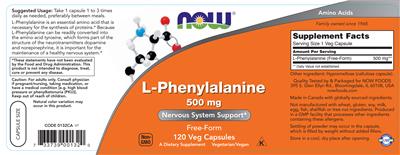
Suggested Usage: Take 1 capsule 1 to 3 times daily as needed, preferably between meals.
Formula
L-Phenylalanine is an essential amino acid that is necessary for the synthesis of proteins. Because L-Phenylalanine can be readily converted into the amino acid tyrosine, which forms part of the structure of the neurotransmitters dopamine and norepinephrine, it is important for the maintenance of a healthy nervous system.
Triangle K (Kosher)
FDA Disclaimer Statement
These statements have not been evaluated by the Food and Drug Administration. This product is not intended to diagnose, treat, cure or prevent any disease.
Precautions
Caution: For adults only.
Consult physician if pregnant/nursing, taking medication, or have a medical condition [e.g. high blood pressure or phenylketonuria (PKU)].
Keep out of reach of children.
Not manufactured with wheat, gluten, soy, milk, egg, fish, shellfish or tree nut ingredients. Produced in a GMP facility that processes other ingredients containing these allergens.
Formulation
Natural color variation may occur in this product.
Nervous System Support Free-Form
Vegetarian/Vegan
Non-GMO
Not manufactured with wheat, gluten, soy, milk, egg, fish, shellfish or tree nut ingredients. Settling of powder may occur in the capsule, which is filled by weight without added fillers.
Made in Canada with globally sourced ingredients. Settling of powder may occur in the capsule, which is filled by weight without added fillers.
FDA Statement of Identity
A Dietary Supplement
General Statements
Amino Acids Family owned since 1968.
Storage
Store in a cool, dry place after opening.
Seals/Symbols
GMP QUALITY ASSURED Triangle K (Kosher)
Is this label outdated? Report a formula or label change and our pharmacy team will review it.
L-Phenylalanine 500 mg by NOW label
The label scan from the NIH Dietary Supplement Label Database. Tap to enlarge.
Label images are published by the NIH Dietary Supplement Label Database for the version of this product on file. Always read your actual product label.
View the full label (PDF)The Ingredients in L-Phenylalanine 500 mg by NOW
This is the 1 active ingredient this product is made of. Select it to open its full monograph.
Serving size1 Veg Capsule(s) Dosage formCapsule Servings per container120 Amounts shown are per serving.
L-Phenylalanine
Interacts with16 drugs
Phenylalanine is an essential amino acid the body uses to make brain chemicals like dopamine and norepinephrine. Some people take it for mood, vitilig...
L-Phenylalanine monograph & interactionsOther (inactive) ingredients: Hypromellose. These complete the product’s ingredient list but are not active constituents.
L-Phenylalanine 500 mg by NOW Drug Interactions
HelloPharmacist Interaction Report
NOW's L-Phenylalanine 500 mg can interact with several medications, most notably through its effect on levodopa, a Parkinson's drug.
Phenylalanine competes with levodopa for entry into the brain, which can reduce levodopa levels and worsen tremor, rigidity, and the on-off fluctuations that Parkinson's patients experience — this is a Major interaction. Altogether, these interactions span 16 individual medications.
Read the full breakdown — every affected drug type, severity by severity
You'll also want to check if you take baclofen, a muscle relaxer. Phenylalanine and baclofen use the same intestinal absorption pathway, so phenylalanine can lower how much baclofen your body absorbs and reduce how well it works (Moderate severity).
If you're on a monoamine oxidase inhibitor (MAOI) — older antidepressants like pargyline — there's a Moderate risk of a dangerous spike in blood pressure. Phenylalanine breaks down into tyrosine, which can accumulate and trigger a hypertensive crisis when combined with these medications.
Use the medication checker on this page to verify your exact prescriptions before you start.
Check your own medications below · Editorial policy · How we use AI
Want to check YOUR meds against L-Phenylalanine 500 mg?
Ask about interactions with your drugs in plain English — “Can I take it with lisinopril?” — and we find you the answer in seconds, ingredient by ingredient.
Go to the checkerIngredients driving the most interactions
Individual Drug Interactions
The ingredients in L-Phenylalanine 500 mg interact with 16 drugs. Click any drug to see the details.
1 of the 1 ingredient in L-Phenylalanine 500 mg interact with drugs. Each result below shows which ingredient is responsible. L-Phenylalanine
Benserazide, LevodopaMadopar, Prolopa
How Benserazide, Levodopa interacts with L-Phenylalanine 500 mg — through 1 ingredient. Tap an ingredient for the detail:
L-phenylalanineLevodopa Major
Interaction Summary
Phenylalanine, especially in high doses, can reduce the effectiveness of levodopa.
Read the full L-phenylalanine + Benserazide, Levodopa interactionCarbidopa, LevodopaDhivy, Rytary, Sinemet, Sinemet CR
How Carbidopa, Levodopa interacts with L-Phenylalanine 500 mg — through 1 ingredient. Tap an ingredient for the detail:
L-phenylalanineLevodopa Major
Interaction Summary
Phenylalanine, especially in high doses, can reduce the effectiveness of levodopa.
Read the full L-phenylalanine + Carbidopa, Levodopa interactionCarbidopa, Levodopa, EntacaponeStalevo
How Carbidopa, Levodopa, Entacapone interacts with L-Phenylalanine 500 mg — through 1 ingredient. Tap an ingredient for the detail:
L-phenylalanineLevodopa Major
Interaction Summary
Phenylalanine, especially in high doses, can reduce the effectiveness of levodopa.
Read the full L-phenylalanine + Carbidopa, Levodopa, Entacapone interactionLevodopaInbrija, Larodopa
How Levodopa interacts with L-Phenylalanine 500 mg — through 1 ingredient. Tap an ingredient for the detail:
L-phenylalanineLevodopa Major
Interaction Summary
Phenylalanine, especially in high doses, can reduce the effectiveness of levodopa.
Read the full L-phenylalanine + Levodopa interactionLevodopa, CarbidopaDuodopa
How Levodopa, Carbidopa interacts with L-Phenylalanine 500 mg — through 1 ingredient. Tap an ingredient for the detail:
L-phenylalanineLevodopa Major
Interaction Summary
Phenylalanine, especially in high doses, can reduce the effectiveness of levodopa.
Read the full L-phenylalanine + Levodopa, Carbidopa interactionEach ingredient & the kinds of drugs it affects
For each ingredient in L-Phenylalanine 500 mg with known interactions, here are the types of medications it can affect. Open any type for the detail — or search your exact drug in the checker above.
L-Phenylalanine
Levodopa
Phenylalanine, especially in high doses, can reduce the effectiveness of levodopa.
Phenylalanine competes with levodopa for carrier-mediated transport into the brain. The resulting reduction in levels of levodopa in the brain can exacerbate tremor, rigidity, and the "on-off" phenomenon in patients with Parkinson disease.
Baclofen
Concomitant intake of phenylalanine may reduce the intestinal absorption of baclofen.
Phenylalanine and baclofen share the same intestinal carrier for absorption; phenylalanine competitively inhibits the absorption of baclofen, reducing its plasma levels.
Monoamine Oxidase Inhibitors (Maois)
Theoretically, concomitant use of L-phenylalanine and non-selective MAOIs might increase the risk of hypertensive crisis.
L-phenylalanine is metabolized to tyrosine. Some evidence suggests that L-phenylalanine, given with the non-selective MAOI pargyline, might prevent the elimination of tyramine, increasing the risk of hypertensive crisis. However, this was not reported in a small number of patients when using L-phenylalanine with the partially selective MAO-B inhibitor, selegiline.
Brand information
Manufacturer and brand details for L-Phenylalanine 500 mg, from the product label.
NOW
See all NOW products- Name
- NOW FOODS
- Street Address
- 395 S. Glen Ellyn Rd.
- City
- Bloomingdale
- State
- IL
- ZipCode
- 60108
- Web Address
- nowfoods.com
L-Phenylalanine 500 mg by NOW: Common Questions
Does L-Phenylalanine 500 mg by NOW interact with any medications?
How can one product interact with so many drugs?
Where does this information come from?
Can I take L-Phenylalanine if I'm pregnant or breastfeeding?
What are the most common side effects?
What is L-Phenylalanine used for in this supplement?
I have PKU — can I take this?
Is this supplement effective for ADHD?
Written and reviewed by the HelloPharmacist editorial staff. Our editorial policy
Not sure if L-Phenylalanine 500 mg is safe with your meds?
Our pharmacists answer your medication & supplement questions — free.
Label information is sourced from the NIH Dietary Supplement Label Database and reflects the product version on file; always read your actual product label. This page is for education only and is not a substitute for professional medical advice. Confirm with your pharmacist or doctor before combining supplements and medications.
The Full Monographs Behind L-Phenylalanine 500 mg’s Ingredients
Every ingredient we hold a full HelloPharmacist monograph for — uses, evidence, safety, and the complete interaction list.
Sources & How We Checked
L-Phenylalanine 500 mg's label data comes from the NIH Dietary Supplement Label Database; the ingredient interaction data is from the Natural Medicines database, reviewed by our pharmacists.
- NIH Dietary Supplement Label Database (DSLD) — The official product label on file for this supplement.
- Natural Medicines (Therapeutic Research Center) — Evidence-graded clinical reference behind the ingredient interaction data.
Content is written and reviewed by licensed HelloPharmacist pharmacists. See our data sources and editorial standards for how this information is built and checked.
The 23 references behind this product’s interaction data
Every citation that drives the interaction findings for this product’s ingredients, from the evidence-graded Natural Medicines (TRC Healthcare) database. Open an ingredient to browse its citations — links open the study on PubMed or the publisher’s site.
Phenylalanine 23 references
- Rouse B, Azen C, Koch R, et al. Maternal phenylketonuria collaborative Study (MPKUCS) offspring: facial anomalies, malformations, and early neurological sequelae. Am J Med Genet 1997;69:89-95. DOI
- Sturtevant FM. Use of aspartame in pregnancy. Int J Fertil 1985;30:85-7.
- Silkaitis RP, Mosnaim AD. Pathways linking L-phenylalanine and 2-phenylethylamine with p-tyramine in rabbit brain. Brain Res 1976;114:105-15.
- Lehmann WD, Theobald N, Fischer R, Heinrich HC. Stereospecificity of phenylalanine plasma kinetics and hydroxylation in man following oral application of a stable isotope-labelled pseudo-racemic mixture of L- and D-phenylalanine. Clin Chim Acta 1983;128 PubMed
- Mosnik DM, Spring B, Rogers K, Baruah S. Tardive dyskinesia exacerbated after ingestion of phenylalanine by schizophrenic patients. Neuropsychopharmacology 1997;16:136-46. PubMed
- Siddiqui AH, Stolk LM, Bhaggoe R, et al. L-phenylalanine and UVA irradiation in the treatment of vitiligo. Dermatology 1994;88:215-8. PubMed
- Birkmayer W, Riederer P, Linauer W, Knoll J. L-deprenyl plus L-phenylalanine in the treatment of depression. J Neural Transm 1984;59:81-7. PubMed
- Nutt JG, Woodward WR, Hammerstad JP, et al. The "on-off" phenomenon in Parkinson's disease. Relation to levodopa absorption and transport. N Engl J Med 1984;310:483-8. PubMed
- Baruzzi A, Contin M, Riva R, et al. Influence of meal ingestion time on pharmacokinetics of orally administered levodopa in parkinsonian patients. Clin Neuropharmacol 1987;10:527-37. PubMed
- Juncos JL, Fabbrini G, Mouradian MM, et al. Dietary influences on the antiparkinsonian response to levodopa. Arch Neurol 1987;44:1003-5. PubMed
- Eriksson T, Granerus AK, Linde A, et al. "On-off" phenomenon in Parkinson's disease: relationship between dopa and other large neutral amino acids in plasma. Neurology 1988;38:1245-8. PubMed
- Baker GB, Bornstein RA, Rouget AC, et al. Phenylethylaminergic mechanisms in attention-deficit disorder. Biol Psychiatry 1991;29:15-22.. PubMed
- Wood DR, Reimherr FW, Wender PH. Treatment of attention deficit disorder with DL-phenylalanine. Psychiatry Res 1985;16:21-6.. PubMed
- Food and Nutrition Board, Institute of Medicine. Dietary Reference Intakes for Energy, Carbohydrate, Fiber, Fat, Fatty Acids, Cholesterol, Protein, and Amino Acids (Macronutrients). Washington, DC: National Academy Press, 2002. Available at: http://www.n
- Cederbaum S. Phenylketonuria: an update. Curr Opin Pediatr 2002;14:702-6. PubMed
- Cejudo-Ferragud, E., Nacher, A., Polache, A., Cercos-Fortea, T., Merino, M., and Casabo, V. G. Evidence of competitive inhibition for the intestinal absorption of baclofen by phenylalanine. Int J of Pharm (Amsterdam) 1996;132:63-69. DOI
- Fischer, E., Heller, B., Nachon, M., and Spatz, H. Therapy of depression by phenylalanine. Preliminary note. Arzneimittelforschung. 1975;25(1):132.
- Beckmann, H., Strauss, M. A., and Ludolph, E. Dl-phenylalanine in depressed patients: an open study. J.Neural Transm. 1977;41(2-3):123-134. PubMed
- Sabelli, H. C., Fawcett, J., Gusovsky, F., Javaid, J. I., Wynn, P., Edwards, J., Jeffriess, H., and Kravitz, H. Clinical studies on the phenylethylamine hypothesis of affective disorder: urine and blood phenylacetic acid and phenylalanine dietary supplem
- Cotzias, G. C., Van Woert, M. H., and Schiffer, L. M. Aromatic amino acids and modification of parkinsonism. N Engl.J Med 2-16-1967;276(7):374-379. PubMed
- Kravitz, H. M., Sabelli, H. C., and Fawcett, J. Dietary supplements of phenylalanine and other amino acid precursors of brain neuroamines in the treatment of depressive disorders. J Am Osteopath.Assoc 1984;84(1 Suppl):119-123. DOI
- Mann, J., Peselow, E. D., Snyderman, S., and Gershon, S. D-phenylalanine in endogenous depression. Am.J.Psychiatry 1980;137(12):1611-1612. PubMed
- Katoulis AC, Alevizou A, Bozi E, et al. A randomized, double-blind, vehicle-controlled study of a preparation containing undecylenoyl phenylalanine 2% in the treatment of solar lentigines. Clin Exp Dermatol 2010;35(5):473-6. PubMed
Parts of this content are provided by the Therapeutic Research Center, LLC.
DISCLAIMER: Currently this does not check for drug-drug interactions. This is not an all-inclusive comprehensive list of potential interactions and is for informational purposes only. Not all interactions are known or well-reported in the scientific literature, and new interactions are continually being reported. Input is needed from a qualified healthcare provider including a pharmacist before starting any therapy. Application of clinical judgment is necessary.
© 2021 Therapeutic Research Center, LLC