
Lithium Orotate Ingredients & Drug Interactions
What is this page for?
First and foremost: checking Lithium Orotate against your medications. The heart of this page is the interaction checker and the full interaction report — how this product’s ingredients may interact with prescription and over-the-counter medicines you may be taking.
Around that, we add a pharmacist’s high-level view of the product as a whole — what’s inside, the evidence for its stated use, how transparent the label is, and what safety data exists — so you can see the full picture in one place. It’s educational information from our licensed clinical databases and the clinical staff at HelloPharmacist — not medical advice — and we don’t sell or endorse products. Our editorial policy
Lithium Orotate is a dietary supplement by Global Healing with 1 active ingredient. Its ingredients are commonly taken for mood support, bipolar disorder (prescription), healthy mental function.Based on those ingredients, 515 medications have a known interaction with it, the most serious rated major. The ingredients most likely to interact are Lithium. Use the checker below to test your specific medication, or read the full HelloPharmacist Interaction Report.
Check Your Meds Against Lithium Orotate by Global Healing
Ask about any prescription or over-the-counter medication and we check it for interactions with Lithium Orotate by Global Healing — and tell you which ingredient is responsible.
AI summaries are generated from our interaction database for education only — always confirm with your pharmacist. How we use AI
Ask the Pharmacist
A licensed pharmacist will answer your question by email — free, usually within 24 hours.
Got it — thank you!
A licensed pharmacist will answer within 24 hours. Keep an eye on your email (worth checking spam, just in case).
HelloPharmacist Scorecard of Lithium Orotate by Global Healing
Our pharmacy team’s full take, with four database checks built into the cards below — a summary of what is known, not a grade of the product itself.
What’s inside
Full disclosure
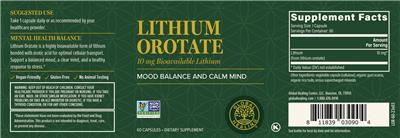
Global Healing's Lithium Orotate is a single-ingredient supplement: lithium in orotate form, paired with inactive ingredients (cellulose, gum acacia, rice, and a proprietary mineral blend). Lithium is a naturally occurring mineral and element.
In prescription form it's used to treat mood disorders; in supplement form the dose and clinical purpose differ.
Does it work?
Not established
The evidence we hold does not establish effectiveness for the conditions listed — alcohol use disorder, Alzheimer's disease, ALS, and anorexia nervosa are all rated as having insufficient reliable evidence to rate in our data. If you're considering this for a specific health concern, talk with your pharmacist or doctor about what the current evidence actually shows.
How safe is it?
Well-documented data
Prescription lithium is generally well tolerated when monitored, but it has a narrow safety margin and requires blood tests to prevent toxicity. The supplement form is not well studied, so we don't know how smaller doses change the risk.
Lithium crosses the placenta and has been linked to birth defects — safety data advises against it in pregnancy unless a doctor directs and monitors you. It also passes into breast milk and may affect an infant, so the same caution applies to breastfeeding.
Common side effects of lithium include tremor, fatigue, muscle weakness, weight gain, increased thirst and urination, gastrointestinal upset, and skin issues like acne or psoriasis. Abruptly stopping lithium can trigger a return of mood symptoms, so it should be tapered gradually over at least two weeks.
Meds to double-check
Major interaction found
Before taking Lithium Orotate, check with your pharmacist or doctor if you use serotonergic drugs (antidepressants like SSRIs), diuretics or water pills, NSAIDs, blood pressure medications (ACE inhibitors or calcium channel blockers), antipsychotics, muscle relaxants, or seizure medications. These carry documented Major or Moderate interactions with lithium.
The bottom line
Scorecard at a glanceFully disclosed formula with no established evidence rating for its marketed use. Major medication interactions have been identified, and safety information is well characterized.
Lithium Orotate is a single-mineral supplement with significant interactions across many common medications, especially blood pressure drugs, diuretics, NSAIDs, and antidepressants. If you take any prescription medication — particularly anything for mood, blood pressure, or seizures — you need to check with your pharmacist or doctor before starting this.
Lithium has a narrow therapeutic window; even though this is a lower-dose supplement form, the safety risks are real.
Educational only — not medical advice; always confirm with your pharmacist. Our editorial policy · How we use AI
Assessment coverage: 1 of 1 active ingredient matched to our full ingredient reviews (monographs). Based on the product label dated Jun 25, 2025.
This Scorecard evaluates available label information, ingredient evidence, and known medication-safety considerations. It does not independently verify product identity, purity, potency, contamination, or manufacturing quality. How these ratings are computed
General information
Key facts about Lithium Orotate, straight from the product label.
| Brand | Global Healing |
|---|---|
| Barcode (UPC) | 811839030904 |
| Net contents | 60 Capsule(s) |
| Market status | On market |
| Date entered into DSLD | Jun 25, 2025 |
| DSLD ID | 330753 |
| Product type | Mineral |
| Supplement form | Capsule |
| Dietary claims / uses | All Other, Structure/Function |
| Intended target group(s) | Vegan, Vegetarian, Adult (18 - 50 Years), Kosher, Gluten Free, Dairy Free |
Everything in this section is reproduced from the manufacturer’s own product label — it’s the label speaking, not HelloPharmacist. We show it so you can see exactly what the maker states; we don’t verify or endorse those statements.
Supplement Facts
The label details for Lithium Orotate by Global Healing, sourced from the NIH Dietary Supplement Label Database.
Supplement Facts
| Ingredient | Amount | % DV |
|---|---|---|
| Lithium | 10 mg | -- |
Other ingredients: Cellulose, Gum Acacia, Rice, Ormus Supercharged Minerals
Tap any ingredient to jump to its full detail below.
These statements are the manufacturer’s wording, reproduced from the product label — the label is saying it, not HelloPharmacist. We don’t verify or endorse them.
Suggested/Recommended/Usage/Directions
Suggested use Take 1 capsule daily or as recommended by your healthcare provider.
Formulation
Mental Health Balance Lithium Orotate is a highly bioavailable form of lithium bonded with orotic acid for optimal cellular transport. Support a balanced mood, a clear mind, and a healthy response to stress. No animal testing
Vegan-Friendly
Gluten-free
Mood balance and calm mind
Non GMO Project Verified nongmoproject.org
Precautions
Warning: Keep out of reach of children.
Consult your healthcare provider if you are pregnant or nursing; if you take an SSRI, MAOI, or other similar medication; if you have kidney problems or take an ace inhibitor or diuretic; if you have a thyroid condition; or for any other concerns.
FDA Disclaimer Statement
These statements have not been evaluated by the Food and Drug Administration. This product is not intended to diagnose, treat, cure, or prevent any disease.
Formula
10 mg Bioavailable Lithium
OK (Kosher)
Seals/Symbols
Non GMO Project Verified nongmoproject.org
OK (Kosher)
FDA Statement of Identity
Dietary Supplement
Is this label outdated? Report a formula or label change and our pharmacy team will review it.
Lithium Orotate by Global Healing label
The label scan from the NIH Dietary Supplement Label Database. Tap to enlarge.
Label images are published by the NIH Dietary Supplement Label Database for the version of this product on file. Always read your actual product label.
View the full label (PDF)The Ingredients in Lithium Orotate by Global Healing
This is the 1 active ingredient this product is made of. Select it to open its full monograph.
Serving size1 Capsule(s) Dosage formCapsule Servings per container60 Amounts shown are per serving.
Lithium
Interacts with515 drugs
Lithium is a naturally occurring metal that, in prescription form (lithium carbonate or citrate), is an FDA-approved, well-proven treatment for bipola...
Lithium monograph & interactionsOther (inactive) ingredients: Cellulose, Gum Acacia, Rice, Ormus Supercharged Minerals. These complete the product’s ingredient list but are not active constituents.
Lithium Orotate by Global Healing Drug Interactions
HelloPharmacist Interaction Report
Global Healing's Lithium Orotate contains lithium, which interacts with a number of medication types.
The most serious concern is with serotonergic drugs (like SSRIs and other antidepressants) — taking lithium with these can theoretically both mask and increase the risk of serotonin syndrome, a potentially life-threatening condition marked by agitation, confusion, rapid heartbeat, and high fever.
Read the full breakdown — every affected drug type, severity by severity
Lithium also carries Major-severity interactions with diuretics (water pills, including thiazides and loop diuretics), which can reduce how your kidneys clear lithium and raise it to unsafe levels. Moderate-severity interactions exist with skeletal muscle relaxants, NSAIDs (like ibuprofen and naproxen), antipsychotics, blood pressure medications (ACE inhibitors and calcium channel blockers), and seizure medications (anticonvulsants) — all of which either increase lithium levels, prolong muscle relaxation, or raise the risk of neurological problems.
Although lithium is a prescription medication at higher doses and requires blood monitoring, these interaction risks theoretically apply to supplement doses as well, though the lower amount in a supplement may reduce some effects. Altogether, these interactions span 514 individual medications.
Check your exact medications with the tool on this page before starting.
Check your own medications below · Editorial policy · How we use AI
Want to check YOUR meds against Lithium Orotate?
Ask about interactions with your drugs in plain English — “Can I take it with lisinopril?” — and we find you the answer in seconds, ingredient by ingredient.
Go to the checkerIngredients driving the most interactions
Individual Drug Interactions
The ingredients in Lithium Orotate interact with 515 drugs. Click any drug to see the details.
1 of the 1 ingredient in Lithium Orotate interact with drugs. Each result below shows which ingredient is responsible. Lithium
BuspironeBuSpar
How Buspirone interacts with Lithium Orotate — through 1 ingredient. Tap an ingredient for the detail:
LithiumSerotonergic Drugs Major
Interaction Summary
Theoretically, taking lithium supplements with serotonergic drugs might both mask and increase the risk of serotonin syndrome.
Read the full Lithium + Buspirone interactionCaffeine, Potassium Salicylate, SalicylamideTrim-Elim
How Caffeine, Potassium Salicylate, Salicylamide interacts with Lithium Orotate — through 1 ingredient. Tap an ingredient for the detail:
LithiumMethylxanthines, Diuretic Drugs Major
Interaction Summary
Theoretically, taking lithium supplements with methylxanthines might decrease lithium levels.
Read the full Lithium + Caffeine, Potassium Salicylate, Salicylamide interactionCandesartan Cilexetil, HydrochlorothiazideAtacand HCT
How Candesartan Cilexetil, Hydrochlorothiazide interacts with Lithium Orotate — through 1 ingredient. Tap an ingredient for the detail:
LithiumDiuretic Drugs Major
Interaction Summary
Theoretically, taking lithium supplements with loop diuretics might increase lithium levels and adverse effects.
Read the full Lithium + Candesartan Cilexetil, Hydrochlorothiazide interactionCaptopril, HydrochlorothiazideAcezide, Capozide
How Captopril, Hydrochlorothiazide interacts with Lithium Orotate — through 1 ingredient. Tap an ingredient for the detail:
LithiumAce Inhibitors (aceis), Diuretic Drugs Major
Interaction Summary
Theoretically, taking lithium supplements with ACEIs might increase levels and adverse effects of lithium.
Read the full Lithium + Captopril, Hydrochlorothiazide interactionCarbamazepineCarbatrol, Carnexiv, Equetro, Tegretol, Tegretol XR
How Carbamazepine interacts with Lithium Orotate — through 1 ingredient. Tap an ingredient for the detail:
LithiumSerotonergic Drugs, Anticonvulsants Major
Interaction Summary
Theoretically, taking lithium supplements with serotonergic drugs might both mask and increase the risk of serotonin syndrome.
Read the full Lithium + Carbamazepine interactionCarbetapentane Tannate, Chlorpheniramine TannateTussi-12
How Carbetapentane Tannate, Chlorpheniramine Tannate interacts with Lithium Orotate — through 1 ingredient. Tap an ingredient for the detail:
LithiumSerotonergic Drugs Major
Interaction Summary
Theoretically, taking lithium supplements with serotonergic drugs might both mask and increase the risk of serotonin syndrome.
Read the full Lithium + Carbetapentane Tannate, Chlorpheniramine Tannate interactionCarbetapentane Tannate, Chlorpheniramine Tannate, Ephedrine Tannate, Phenylephrine TannateQuadratuss, Ry Tuss, Rynatuss, Tri Tannate Plus
How Carbetapentane Tannate, Chlorpheniramine Tannate, Ephedrine Tannate, Phenylephrine Tannate interacts with Lithium Orotate — through 1 ingredient. Tap an ingredient for the detail:
LithiumSerotonergic Drugs Major
Interaction Summary
Theoretically, taking lithium supplements with serotonergic drugs might both mask and increase the risk of serotonin syndrome.
Read the full Lithium + Carbetapentane Tannate, Chlorpheniramine Tannate, Ephedrine Tannate, Phenylephrine Tannate interactionCarbetapentane, Chlorpheniramine, PhenylephrineRicotuss
How Carbetapentane, Chlorpheniramine, Phenylephrine interacts with Lithium Orotate — through 1 ingredient. Tap an ingredient for the detail:
LithiumSerotonergic Drugs Major
Interaction Summary
Theoretically, taking lithium supplements with serotonergic drugs might both mask and increase the risk of serotonin syndrome.
Read the full Lithium + Carbetapentane, Chlorpheniramine, Phenylephrine interactionCarbetapentane, Chlorpheniramine, Phenylephrine, Phenylpropanolamine, Potassium GuaiacolsulfonateCophene-X
How Carbetapentane, Chlorpheniramine, Phenylephrine, Phenylpropanolamine, Potassium Guaiacolsulfonate interacts with Lithium Orotate — through 1 ingredient. Tap an ingredient for the detail:
LithiumSerotonergic Drugs Major
Interaction Summary
Theoretically, taking lithium supplements with serotonergic drugs might both mask and increase the risk of serotonin syndrome.
Read the full Lithium + Carbetapentane, Chlorpheniramine, Phenylephrine, Phenylpropanolamine, Potassium Guaiacolsulfonate interactionCelecoxib, TramadolSeglentis
How Celecoxib, Tramadol interacts with Lithium Orotate — through 1 ingredient. Tap an ingredient for the detail:
LithiumNonsteroidal Anti-inflammatory Drugs (nsaids), Serotonergic Drugs Major
Interaction Summary
Theoretically, taking lithium supplements with NSAIDs might increase lithium levels and adverse effects.
Read the full Lithium + Celecoxib, Tramadol interactionChlorothiazideDiuril
How Chlorothiazide interacts with Lithium Orotate — through 1 ingredient. Tap an ingredient for the detail:
LithiumDiuretic Drugs Major
Interaction Summary
Theoretically, taking lithium supplements with loop diuretics might increase lithium levels and adverse effects.
Read the full Lithium + Chlorothiazide interactionChlorothiazide, MethyldopaAldochlor, Aldoclor 150, Aldoclor 250
How Chlorothiazide, Methyldopa interacts with Lithium Orotate — through 1 ingredient. Tap an ingredient for the detail:
LithiumDiuretic Drugs, Methyldopa (aldomet) Major
Interaction Summary
Theoretically, taking lithium supplements with loop diuretics might increase lithium levels and adverse effects.
Read the full Lithium + Chlorothiazide, Methyldopa interactionChlorothiazide, ReserpineDiupres
How Chlorothiazide, Reserpine interacts with Lithium Orotate — through 1 ingredient. Tap an ingredient for the detail:
LithiumDiuretic Drugs Major
Interaction Summary
Theoretically, taking lithium supplements with loop diuretics might increase lithium levels and adverse effects.
Read the full Lithium + Chlorothiazide, Reserpine interactionChlorpheniramineChlor-Trimeton, Teldrin
How Chlorpheniramine interacts with Lithium Orotate — through 1 ingredient. Tap an ingredient for the detail:
LithiumSerotonergic Drugs Major
Interaction Summary
Theoretically, taking lithium supplements with serotonergic drugs might both mask and increase the risk of serotonin syndrome.
Read the full Lithium + Chlorpheniramine interactionChlorpheniramine Maleate, Dextromethorphan HydrobromideCoricidin HBP Cough & Cold, Coricidin II Cough & Cold, Pediatric Vicks Formula 44m Cough & Cold Relief
How Chlorpheniramine Maleate, Dextromethorphan Hydrobromide interacts with Lithium Orotate — through 1 ingredient. Tap an ingredient for the detail:
LithiumSerotonergic Drugs Major
Interaction Summary
Theoretically, taking lithium supplements with serotonergic drugs might both mask and increase the risk of serotonin syndrome.
Read the full Lithium + Chlorpheniramine Maleate, Dextromethorphan Hydrobromide interactionChlorpheniramine Maleate, Hydrocodone BitartrateVituz
How Chlorpheniramine Maleate, Hydrocodone Bitartrate interacts with Lithium Orotate — through 1 ingredient. Tap an ingredient for the detail:
LithiumSerotonergic Drugs Major
Interaction Summary
Theoretically, taking lithium supplements with serotonergic drugs might both mask and increase the risk of serotonin syndrome.
Read the full Lithium + Chlorpheniramine Maleate, Hydrocodone Bitartrate interactionChlorpheniramine Polistirex, Codeine PolistirexTuzistra XR
How Chlorpheniramine Polistirex, Codeine Polistirex interacts with Lithium Orotate — through 1 ingredient. Tap an ingredient for the detail:
LithiumSerotonergic Drugs Major
Interaction Summary
Theoretically, taking lithium supplements with serotonergic drugs might both mask and increase the risk of serotonin syndrome.
Read the full Lithium + Chlorpheniramine Polistirex, Codeine Polistirex interactionChlorpheniramine Tannate, Phenylephrine TannateRicobid
How Chlorpheniramine Tannate, Phenylephrine Tannate interacts with Lithium Orotate — through 1 ingredient. Tap an ingredient for the detail:
LithiumSerotonergic Drugs Major
Interaction Summary
Theoretically, taking lithium supplements with serotonergic drugs might both mask and increase the risk of serotonin syndrome.
Read the full Lithium + Chlorpheniramine Tannate, Phenylephrine Tannate interactionChlorpheniramine Tannate, Phenylephrine Tannate, Pyrilamine TannateHistatan, R Tannamine, R-Tannate, Rhinatate, Tri Tannate, Triotann +1 more
How Chlorpheniramine Tannate, Phenylephrine Tannate, Pyrilamine Tannate interacts with Lithium Orotate — through 1 ingredient. Tap an ingredient for the detail:
LithiumSerotonergic Drugs Major
Interaction Summary
Theoretically, taking lithium supplements with serotonergic drugs might both mask and increase the risk of serotonin syndrome.
Read the full Lithium + Chlorpheniramine Tannate, Phenylephrine Tannate, Pyrilamine Tannate interactionChlorpheniramine, Hydrocodone, PseudoephedrineTussend
How Chlorpheniramine, Hydrocodone, Pseudoephedrine interacts with Lithium Orotate — through 1 ingredient. Tap an ingredient for the detail:
LithiumSerotonergic Drugs Major
Interaction Summary
Theoretically, taking lithium supplements with serotonergic drugs might both mask and increase the risk of serotonin syndrome.
Read the full Lithium + Chlorpheniramine, Hydrocodone, Pseudoephedrine interactionChlorpheniramine, MethscopolamineAllerx
How Chlorpheniramine, Methscopolamine interacts with Lithium Orotate — through 1 ingredient. Tap an ingredient for the detail:
LithiumSerotonergic Drugs Major
Interaction Summary
Theoretically, taking lithium supplements with serotonergic drugs might both mask and increase the risk of serotonin syndrome.
Read the full Lithium + Chlorpheniramine, Methscopolamine interactionChlorpheniramine, Methscopolamine, PhenylephrineAH Chew, DA, DA II, Dallergy, Dallergy ER, Dura Vent DA +9 more
How Chlorpheniramine, Methscopolamine, Phenylephrine interacts with Lithium Orotate — through 1 ingredient. Tap an ingredient for the detail:
LithiumSerotonergic Drugs Major
Interaction Summary
Theoretically, taking lithium supplements with serotonergic drugs might both mask and increase the risk of serotonin syndrome.
Read the full Lithium + Chlorpheniramine, Methscopolamine, Phenylephrine interactionChlorpheniramine, Methscopolamine, PhenylpropanolaminePannaz
How Chlorpheniramine, Methscopolamine, Phenylpropanolamine interacts with Lithium Orotate — through 1 ingredient. Tap an ingredient for the detail:
LithiumSerotonergic Drugs Major
Interaction Summary
Theoretically, taking lithium supplements with serotonergic drugs might both mask and increase the risk of serotonin syndrome.
Read the full Lithium + Chlorpheniramine, Methscopolamine, Phenylpropanolamine interactionChlorpheniramine, Methscopolamine, PseudoephedrineMescolor, Rescon-Mx, Xiral
How Chlorpheniramine, Methscopolamine, Pseudoephedrine interacts with Lithium Orotate — through 1 ingredient. Tap an ingredient for the detail:
LithiumSerotonergic Drugs Major
Interaction Summary
Theoretically, taking lithium supplements with serotonergic drugs might both mask and increase the risk of serotonin syndrome.
Read the full Lithium + Chlorpheniramine, Methscopolamine, Pseudoephedrine interactionChlorpheniramine, Phenindamine, PhenylpropanolamineNolamine
How Chlorpheniramine, Phenindamine, Phenylpropanolamine interacts with Lithium Orotate — through 1 ingredient. Tap an ingredient for the detail:
LithiumSerotonergic Drugs Major
Interaction Summary
Theoretically, taking lithium supplements with serotonergic drugs might both mask and increase the risk of serotonin syndrome.
Read the full Lithium + Chlorpheniramine, Phenindamine, Phenylpropanolamine interactionChlorpheniramine, PhenylephrineDallergy JR, Ed A Hist, Histatab Plus, Rynatan
How Chlorpheniramine, Phenylephrine interacts with Lithium Orotate — through 1 ingredient. Tap an ingredient for the detail:
LithiumSerotonergic Drugs Major
Interaction Summary
Theoretically, taking lithium supplements with serotonergic drugs might both mask and increase the risk of serotonin syndrome.
Read the full Lithium + Chlorpheniramine, Phenylephrine interactionChlorpheniramine, Phenylephrine, PhenylpropanolamineRutuss
How Chlorpheniramine, Phenylephrine, Phenylpropanolamine interacts with Lithium Orotate — through 1 ingredient. Tap an ingredient for the detail:
LithiumSerotonergic Drugs Major
Interaction Summary
Theoretically, taking lithium supplements with serotonergic drugs might both mask and increase the risk of serotonin syndrome.
Read the full Lithium + Chlorpheniramine, Phenylephrine, Phenylpropanolamine interactionChlorpheniramine, Phenylephrine, Phenylpropanolamine, PhenyltoloxamineDe Con, Decongest, Naldecon, Nalspan SR, Tri Phen Mine Sr, Uni Decon +1 more
How Chlorpheniramine, Phenylephrine, Phenylpropanolamine, Phenyltoloxamine interacts with Lithium Orotate — through 1 ingredient. Tap an ingredient for the detail:
LithiumSerotonergic Drugs Major
Interaction Summary
Theoretically, taking lithium supplements with serotonergic drugs might both mask and increase the risk of serotonin syndrome.
Read the full Lithium + Chlorpheniramine, Phenylephrine, Phenylpropanolamine, Phenyltoloxamine interactionChlorpheniramine, Phenylephrine, Phenylpropanolamine, PyrilamineHistalet Forte, Poly Hist Forte, Vanex Forte
How Chlorpheniramine, Phenylephrine, Phenylpropanolamine, Pyrilamine interacts with Lithium Orotate — through 1 ingredient. Tap an ingredient for the detail:
LithiumSerotonergic Drugs Major
Interaction Summary
Theoretically, taking lithium supplements with serotonergic drugs might both mask and increase the risk of serotonin syndrome.
Read the full Lithium + Chlorpheniramine, Phenylephrine, Phenylpropanolamine, Pyrilamine interactionChlorpheniramine, Phenylephrine, PhenyltoloxamineCom Time, Comhist, Comhist LA, Linhist LA, Q Hist LA
How Chlorpheniramine, Phenylephrine, Phenyltoloxamine interacts with Lithium Orotate — through 1 ingredient. Tap an ingredient for the detail:
LithiumSerotonergic Drugs Major
Interaction Summary
Theoretically, taking lithium supplements with serotonergic drugs might both mask and increase the risk of serotonin syndrome.
Read the full Lithium + Chlorpheniramine, Phenylephrine, Phenyltoloxamine interactionEach ingredient & the kinds of drugs it affects
For each ingredient in Lithium Orotate with known interactions, here are the types of medications it can affect. Open any type for the detail — or search your exact drug in the checker above.
Lithium
Diuretic Drugs
Theoretically, taking lithium supplements with loop diuretics might increase lithium levels and adverse effects.
Thiazide diuretics and loop diuretics might reduce lithium excretion, particularly in sodium-restricted patients. If lithium is clinically indicated and other treatment options are unavailable or inadequate in patients using diuretics, lithium treatment can be initiated with extreme caution. Serum lithium should be measured frequently and the doses used should be the lowest dose ordinarily tolerated. It is unclear if this interaction would be clinically significant with the smaller doses found in lithium supplements.
Serotonergic Drugs
Theoretically, taking lithium supplements with serotonergic drugs might both mask and increase the risk of serotonin syndrome.
In a case report, a 67-year-old female with depression and bipolar disorder using lithium in combination with selective serotonin reuptake inhibitors (SSRIs) and other medications developed serotonin syndrome with symptoms of deep tendon hyperreflexia, muscle rigidity, tremor, and hyperthermia. However, agitation, one classical symptom of serotonin syndrome, was lacking. This was thought to be due to masking by lithium toxicity. Lithium can increase serotonin levels, thus, combining serotonergic drugs with lithium might increase the risk of serotonergic side effects including serotonin syndrome and cerebral vasoconstrictive disorders. It is unclear if this interaction would occur with the smaller doses found in lithium supplements.
Ace Inhibitors (Aceis)
Theoretically, taking lithium supplements with ACEIs might increase levels and adverse effects of lithium.
Concomitant administration of ACEIs with lithium may increase lithium concentrations. It is unclear if this interaction would be clinically significant with the smaller doses found in lithium supplements.
Anticonvulsants
Theoretically, taking lithium supplements with anticonvulsants might increase the risk of neurotoxicity.
Drugs such as carbamazepine and phenytoin seem to increase the risk of neurotoxicity. It is unclear if this interaction would occur with the smaller doses found in lithium supplements.
Antipsychotic Drugs
Theoretically, taking lithium supplements with antipsychotic drugs might increase the risk of encephalopathic syndrome.
Encephalopathic syndrome has been reported in multiple patients taking prescription lithium and antipsychotics concomitantly. Symptoms have included weakness and lethargy, fever, confusion, and extrapyramidal symptoms. In some patients, resulting brain damage was irreversible. Although there is no established causal relationship between these symptoms and the combination of lithium and antipsychotic medications, there is a theoretical relationship. It is unclear if this interaction would occur with the smaller doses found in lithium supplements.
Calcium Channel Blockers
Theoretically, taking lithium supplements with calcium channel blockers might reduce lithium levels and might also increase the risk of certain adverse effects.
Calcium channel blockers might reduce lithium concentrations. Monitor lithium levels with concurrent use. Calcium channel blockers might also increase the adverse neurological and gastrointestinal adverse effects of lithium. It is unclear if these interactions would occur with the smaller doses found in lithium supplements.
Methyldopa (Aldomet)
Theoretically, taking lithium supplements with methyldopa might increase the risk of lithium toxicity.
Concurrent use of methyldopa with lithium increases the risk of lithium toxicity. It is unclear if this interaction would be clinically significant with the smaller doses found in lithium supplements.
Methylxanthines
Theoretically, taking lithium supplements with methylxanthines might decrease lithium levels.
Xanthines such as aminophylline, caffeine, and theophylline (Theo-Dur, Theo-24, others) might increase the clearance of lithium. It is unclear if this interaction would be clinically significant with the smaller doses found in lithium supplements.
Nonsteroidal Anti-Inflammatory Drugs (Nsaids)
Theoretically, taking lithium supplements with NSAIDs might increase lithium levels and adverse effects.
NSAIDs can decrease the renal clearance of lithium and increase lithium levels. It is unclear if this interaction would be clinically significant with the smaller doses found in lithium supplements.
Phenothiazines
Theoretically, taking lithium supplements with phenothiazines might decrease the levels and clinical effects of phenothiazines.
Concomitant use of lithium with phenothiazines might reduce lithium concentrations. Lithium might also reduce phenothiazine concentrations, making the pharmacokinetic effect unpredictable. It is unclear if these interactions would occur with the smaller doses found in lithium supplements.
Skeletal Muscle Relaxants
Theoretically, taking lithium supplements with skeletal muscle relaxants might prolong neuromuscular blockade.
Lithium might prolong neuromuscular blockade. It is unclear if this interaction would occur with the smaller doses found in lithium supplements.
Brand information
Manufacturer and brand details for Lithium Orotate, from the product label.
Global Healing
See all Global Healing products- Name
- Global Healing Center, LLC.
- City
- Houston
- State
- TX
- ZipCode
- 77055
- Phone Number
- 1.800.476.0016
- Web Address
- globalhealing.com
Lithium Orotate by Global Healing: Common Questions
Does Lithium Orotate by Global Healing interact with any medications?
How can one product interact with so many drugs?
Where does this information come from?
Can I take this if I'm on an antidepressant?
What if I take a water pill for blood pressure?
Is this safe to take while pregnant or breastfeeding?
What are the side effects I should watch for?
Will this work for bipolar disorder or depression?
If I stop taking this, do I need to taper it off?
Written and reviewed by the HelloPharmacist editorial staff. Our editorial policy
Not sure if Lithium Orotate is safe with your meds?
Our pharmacists answer your medication & supplement questions — free.
Label information is sourced from the NIH Dietary Supplement Label Database and reflects the product version on file; always read your actual product label. This page is for education only and is not a substitute for professional medical advice. Confirm with your pharmacist or doctor before combining supplements and medications.
The Full Monographs Behind Lithium Orotate’s Ingredients
Every ingredient we hold a full HelloPharmacist monograph for — uses, evidence, safety, and the complete interaction list.
Sources & How We Checked
Lithium Orotate's label data comes from the NIH Dietary Supplement Label Database; the ingredient interaction data is from the Natural Medicines database, reviewed by our pharmacists.
- NIH Dietary Supplement Label Database (DSLD) — The official product label on file for this supplement.
- Natural Medicines (Therapeutic Research Center) — Evidence-graded clinical reference behind the ingredient interaction data.
Content is written and reviewed by licensed HelloPharmacist pharmacists. See our data sources and editorial standards for how this information is built and checked.
The 26 references behind this product’s interaction data
Every citation that drives the interaction findings for this product’s ingredients, from the evidence-graded Natural Medicines (TRC Healthcare) database. Open an ingredient to browse its citations — links open the study on PubMed or the publisher’s site.
Lithium 26 references
- Martindale W. Martindale the Extra Pharmacopoeia. Pharmaceutical Press, 1999.
- McEvoy GK, ed. AHFS Drug Information. Bethesda, MD: American Society of Health-System Pharmacists, 1998.
- Perlis RH, Sachs GS, Lafer B, et al. Effect of abrupt change from standard to low serum levels of lithium: a reanalysis of double-blind lithium maintenance data. Am J Psychiatry 2002;159:1155-9.. PubMed
- Pinelli JM, Symington AJ, Cunningham KA, Paes BA. Case report and review of the perinatal implications of maternal lithium use. Am J Obstet Gynecol 2002;187:245-9.. PubMed
- Sawagashira R, Sasagawa Y, Matsukura M, Takamaru Y. Case of myxedema coma induced by lithium carbonate in a patient with schizophrenia. Psychiatry Clin Neurosci. 2018;72(2):131. PubMed
- Foulser P, Abbasi Y, Mathilakath A, Nilforooshan R. Do not treat the numbers: lithium toxicity. BMJ Case Rep. 2017;2017. pii: bcr-2017-220079. PubMed
- https://www.accessdata.fda.gov/drugsatfda_docs/label/2011/017812s028,018421s027lbl.pdf. Accessed Nov. 21, 2018
- Fornaro M, Maritan E, Ferranti R, et al. Lithium Exposure During Pregnancy and the Postpartum Period: A Systematic Review and Meta-Analysis of Safety and Efficacy Outcomes. Am J Psychiatry. 2020;177(1):76-92. DOI
- Rauf A, Gul S, Nasir M, Arif U, Oyenuga M. A Rare Case of Lithium-induced Partial Nephrogenic Diabetes Insipidus. Cureus. 2020;12(4):e7877. PubMed
- Hanna RM, Hasnain H, Sangalang MD, et al. Three Patients with Lithium-Associated Hyperparathyroidism: Literature Review Regarding Medical and Surgical Management. Case Rep Nephrol Dial. 2019;9(2):108-118. PubMed
- Rana P, Alba Aponte P, Babar G. An Adolescent Female with Bipolar Disorder Presenting with Lithium-Induced Hyperthyroidism. Case Rep Endocrinol. 2020;2020:1283464. PubMed
- Nwabufor PC, Omoniyi ON, Oyibo SO. A Case of Lithium-Associated Hypocalciuric Hypercalcemia. Cureus. 2020;12(9):e10606. PubMed
- Landa E, Wagner S, Makkar A, Liu A, Jung D. An atypical presentation of serotonin syndrome. Cureus. 2021;13(2):e13377. PubMed
- Benjelloun R, Motaib I, Otheman Y. Lithium-associated hypercalcemia presenting with neuropsychiatric manifestations in a patient with bipolar disorder. Case Rep Psychiatry. 2020;2020:6630838. PubMed
- Nombora O, Samico A, Venâncio Â. Lithium-Induced Dysgeusia and Hyposmia: A Case Report and a Literature Review. Clin Neuropharmacol 2023;46(1):31-33. PubMed
- Zhang P, Gandhi H, Kassis N. Lithium-induced nephropathy; One medication with multiple side effects: a case report. BMC Nephrol 2022;23(1):309. PubMed
- Kawada T. Lithium use and the risk of chronic kidney disease. Basic Clin Pharmacol Toxicol 2023;132(4):295-296. PubMed
- Yang Q, Cheng X, Su Z, Sun L, Li M. Electroconvulsive therapy combined with lithium developed reversible pure anomic aphasia: a case report. BMC Psychiatry 2022;22(1):663. PubMed
- Itoh M, Fukuya Y, Endo C, et al. Lithium carbonate-induced Stevens-Johnson syndrome: the first case report. Int J Dermatol 2023;62(3):e165-e167. PubMed
- Ono R, Nishiguchi S, Kitagawa I. Lithium intoxication-associated mild encephalitis/encephalopathy with a reversible splenial lesion: A case report. Bipolar Disord 2022;24(5):551-552. PubMed
- Li JJ, Tan S, Kawashita T, Tagle CA, Farmand F. Central Diabetes Insipidus in the Background of Lithium Use: Consider Central Causes Despite Nephrogenic as the Most Common. Am J Case Rep 2023;24:e939034. PubMed
- Yamada Y, Fujiwara M, Tsujino S, et al. Late-Onset Neutropenia With Clozapine Associated With Lithium Carbonate-Related Hyperthyroidism: A Case Report. J Clin Psychopharmacol 2023;43(1):76-77. PubMed
- Bocchetta A, Ambrosiani L, Sanna F, et al. Renal function at follow-up in a cohort of patients who had shown reduced glomerular filtration rate during long-term treatment with lithium. J Nephrol 2023;36(4):1079-1081. PubMed
- Sarangi A, Javed S, Paul T, Amor W. Lithium-Induced Sinoatrial Node Dysfunction. Cureus 2021;13(7):e16778. PubMed
- Aydin D, Tural Hesapcioglu S, Ceylan MF. Oropharyngeal Dysphagia as a Clinical Presentation of Lithium Intoxication: A Case Report. J Am Acad Child Adolesc Psychiatry 2021;60(12):1443-1445. PubMed
- Sogawa R, Tobita S, Monji A, et al. Deep Vein Thrombosis after Lithium Toxicity: A Report of Two Cases and Literature Review. Case Rep Psychiatry 2021;2021:9934037. PubMed
Parts of this content are provided by the Therapeutic Research Center, LLC.
DISCLAIMER: Currently this does not check for drug-drug interactions. This is not an all-inclusive comprehensive list of potential interactions and is for informational purposes only. Not all interactions are known or well-reported in the scientific literature, and new interactions are continually being reported. Input is needed from a qualified healthcare provider including a pharmacist before starting any therapy. Application of clinical judgment is necessary.
© 2021 Therapeutic Research Center, LLC