
Natural Mullein-X Cough Syrup Ingredients & Drug Interactions
What is this page for?
First and foremost: checking Natural Mullein-X Cough Syrup against your medications. The heart of this page is the interaction checker and the full interaction report — how this product’s ingredients may interact with prescription and over-the-counter medicines you may be taking.
Around that, we add a pharmacist’s high-level view of the product as a whole — what’s inside, the evidence for its stated use, how transparent the label is, and what safety data exists — so you can see the full picture in one place. It’s educational information from our licensed clinical databases and the clinical staff at HelloPharmacist — not medical advice — and we don’t sell or endorse products. Our editorial policy
Natural Mullein-X Cough Syrup is a dietary supplement by Nature's Answer with 8 active ingredients. Its ingredients are commonly taken for cough and sore throat, wound and burn care, soothing minor skin irritation.Based on those ingredients, 2,146 medications have a known interaction with it, the most serious rated moderate. The ingredients most likely to interact are Marshmallow root extract, Plantain Leaf Extract, Honey, Pure. Use the checker below to test your specific medication, or read the full HelloPharmacist Interaction Report.
Check Your Meds Against Natural Mullein-X Cough Syrup by Nature's Answer
Ask about any prescription or over-the-counter medication and we check it for interactions with Natural Mullein-X Cough Syrup by Nature's Answer — and tell you which ingredient is responsible.
AI summaries are generated from our interaction database for education only — always confirm with your pharmacist. How we use AI
Ask the Pharmacist
A licensed pharmacist will answer your question by email — free, usually within 24 hours.
Got it — thank you!
A licensed pharmacist will answer within 24 hours. Keep an eye on your email (worth checking spam, just in case).
HelloPharmacist Scorecard of Natural Mullein-X Cough Syrup by Nature's Answer
Our pharmacy team’s full take, with four database checks built into the cards below — a summary of what is known, not a grade of the product itself.
What’s inside
Low disclosure
Natural Mullein-X Cough Syrup contains 8 ingredients, of which 6 are herbal extracts: Plantain Leaf, Elecampane Root, Marshmallow Root, Nettle Leaf, Mullein Leaf, and English Ivy Leaf — plus Honey and Horehound Whole Herb. Mullein and marshmallow have long been used in traditional cough remedies, while honey is documented to possibly help cough and sore throat (oral mucositis).
The syrup is formulated in a liquid base with glycerin, purified water, natural peppermint flavor, and Quik-Sorb as inactive ingredients.
Does it work?
Moderate evidence
Evidence for most ingredients in this syrup is not well established. Honey does show Possibly Effective ratings for cough, cold sores, sore throat, burns, and dry eye.
For the other herbal extracts — Mullein, Nettle, Elecampane, Marshmallow, English Ivy, and Plantain — we hold Insufficient Reliable Evidence To Rate them for cough or related respiratory conditions. Nettle alone carries a Possibly Effective rating for diabetes, but that's outside this product's intended use.
If you're looking for a cough remedy, the honey component has the most clinical backing; the other ingredients are traditional but not yet proven by research.
How safe is it?
Well-documented data
Honey in this product is generally safe for adults and children over 1 year old. However, several herbal extracts carry pregnancy and breastfeeding warnings.
Elecampane Root and Mullein Leaf are not well studied and are best avoided during pregnancy and breastfeeding. Nettle Leaf is rated Likely Unsafe in pregnancy due to traditional concerns about the uterus; safety during breastfeeding is not established.
Marshmallow and English Ivy lack enough safety data for pregnancy and breastfeeding, so avoidance is advised until you've talked with your doctor or pharmacist. Common side effects from these herbs are mild — constipation, diarrhea, stomach upset, or nausea — but allergic reactions are possible, especially in people sensitive to plants in the daisy family (ragweed, chrysanthemums, daisies) or to bee products.
Meds to double-check
Moderate interaction found
Check your medications if you take blood thinners (anticoagulants like warfarin), diabetes medications, lithium, diuretics (water pills), seizure drugs (especially phenytoin), CNS depressants (sedatives), or any drug your liver metabolizes heavily — particularly those processed through CYP2C19, CYP2D6, CYP2C8, or CYP3A4 enzymes. The herbal blend may affect how these drugs work or how much builds up in your system.
The bottom line
Scorecard at a glanceFormula with limited ingredient disclosure with some supporting evidence for its stated purpose. Moderate medication interactions have been identified, and safety information is well characterized.
This is a traditional herbal cough syrup where honey has the most clinical evidence. If you take any blood thinners, diabetes drugs, lithium, diuretics, seizure medications, or drugs metabolized by your liver, check your specific medications on this page before use.
Pregnant or breastfeeding people should talk with their pharmacist first. It's generally well tolerated for short-term use in others.
Educational only — not medical advice; always confirm with your pharmacist. Our editorial policy · How we use AI
Assessment coverage: 8 of 8 active ingredients matched to our full ingredient reviews (monographs). Based on the product label dated Apr 24, 2025.
This Scorecard evaluates available label information, ingredient evidence, and known medication-safety considerations. It does not independently verify product identity, purity, potency, contamination, or manufacturing quality. How these ratings are computed
General information
Key facts about Natural Mullein-X Cough Syrup, straight from the product label.
| Brand | Nature's Answer |
|---|---|
| Barcode (UPC) | 083000262531 |
| Net contents | 4 Fluid Ounce(s); 120 mL |
| Market status | On market |
| Date entered into DSLD | Apr 24, 2025 |
| DSLD ID | 326739 |
| Product type | Other Combinations |
| Supplement form | Liquid |
| Dietary claims / uses | All Other, Structure/Function |
| Intended target group(s) | Children 4 or More Years of Age, Adult (18 - 50 Years), Gluten Free, Children more than 1 but less than 4 |
Everything in this section is reproduced from the manufacturer’s own product label — it’s the label speaking, not HelloPharmacist. We show it so you can see exactly what the maker states; we don’t verify or endorse those statements.
Supplement Facts
The label details for Natural Mullein-X Cough Syrup by Nature's Answer, sourced from the NIH Dietary Supplement Label Database.
Supplement Facts
| Ingredient | Amount | % DV |
|---|---|---|
| Calories | 20 Calorie(s) | -- |
| Total Carbohydrates | 4 Gram(s) | 1% |
| Added Sugars | 2 Gram(s) | 4% |
| Total Sugars | 2 Gram(s) | -- |
| Plantain Leaf Extract | 0 NP | -- |
| Elecampane Root Extract | 0 NP | -- |
| Marshmallow root extract | 0 NP | -- |
| Nettle leaf extract | 0 NP | -- |
| Mullein Leaf Extract | 0 NP | -- |
| Honey, Pure | 2000 mg | -- |
| Horehound Whole Herb Extract | 0 NP | -- |
| English Ivy Leaf Extract | 25 mg | -- |
| Mullein-X Cough Syrup Proprietary Extract Blend | 2500 mg | -- |
Other ingredients: Glycerin, Water, Purified, Peppermint Flavor, Natural, Quik-Sorb
Tap any ingredient to jump to its full detail below.
These statements are the manufacturer’s wording, reproduced from the product label — the label is saying it, not HelloPharmacist. We don’t verify or endorse them.
Formulation
Non GMO Gluten free Alcohol free Drug free
Non drowsy
With Quik-Sorb Multi-system Soothes coughs & helps clear mucus For coughs associated with hoarseness, dry throat, and irritants. Supports upper respiratory health
Suggested/Recommended/Usage/Directions
Shake well before use.
Suggested use: As a dietary supplement: For daily maintenance: Children ages 6 to 12 take (2.5 mL) 1/2 teaspoon daily with 8 oz of water. Adults and children over 12 years old take (5 mL) 1 teaspoon daily with 8 oz of water. For intensive use: Children ages 6-12 take (2.5 mL) 1/2 teaspoon twice daily 12 hours apart. Adults and children over 12 years old take (5 mL) 1 teaspoon twice daily 12 hours apart.
Storage
This product contains honey, refrigeration is not required. Keep tightly sealed in a cool, dry place.
Precautions
Honey warning: this product contains honey, which should not be given to infants or any child under 1 year old. Individuals who are allergic to bees or bee products should avoid using this product.
Honey warning: this product contains honey, which should not be given to infants or any child under 1 year old. Warning: Keep out of reach of children.
Do not use if safety seal is damaged or missing.
If you are pregnant, nursing, taking any medications, planning any medical procedure or having any medical condition, consult with your healthcare practitioner before use.
Contains: Bee Product
FDA Disclaimer Statement
These statements have not been evaluated by the Food and Drug Administration. This product is not intended to diagnose, treat, cure, or prevent any disease.
General Statements
For product information, call (800)439-2324
Brand IP Statement(s)
Quik-Sorb is a registered trademark of Bio-Botanica Inc. Copyright 2022 Nature's Answer Nature's Answer Since 1972
FDA Statement of Identity
Dietary Supplement
Is this label outdated? Report a formula or label change and our pharmacy team will review it.
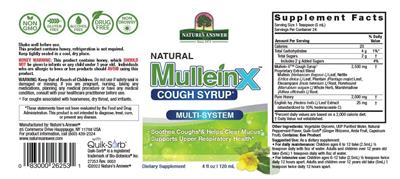
Natural Mullein-X Cough Syrup by Nature's Answer label
The label scan from the NIH Dietary Supplement Label Database. Tap to enlarge.
Label images are published by the NIH Dietary Supplement Label Database for the version of this product on file. Always read your actual product label.
View the full label (PDF)The Ingredients in Natural Mullein-X Cough Syrup by Nature's Answer
These are the 8 active ingredients this product is made of. Select any to open its full monograph.
Serving size2.5 mL Dosage formLiquid Servings per container24 Amounts shown are per serving.
Most supplement products combine several ingredients, and a medication can interact with the product through any one of them. Each ingredient below shows whether it has known drug interactions.
Honey, Pure
Interacts with738 drugs
Honey is a natural food with some real, modest evidence for easing coughs and helping certain wounds, especially when special medical-grade or Manuka...
Honey, Pure monograph & interactionsEnglish Ivy Leaf Extract
Interacts with281 drugs
English ivy leaf extract is most commonly used in cough and cold syrups to help loosen mucus and ease coughing, and it is a popular ingredient in many...
English Ivy Leaf Extract monograph & interactionsMullein-X Cough Syrup Proprietary Extract Blend
Other (inactive) ingredients: Glycerin, Water, Purified, Peppermint Flavor, Natural, Quik-Sorb. These complete the product’s ingredient list but are not active constituents.
Natural Mullein-X Cough Syrup by Nature's Answer Drug Interactions
HelloPharmacist Interaction Report
Natural Mullein-X Cough Syrup by Nature's Answer contains several herbal extracts with documented interactions to medications.
The most serious concern is English Ivy Leaf Extract, which may increase blood levels of drugs metabolized by three liver enzymes (CYP2C19, CYP2D6, and CYP2C8) — a Moderate severity risk that has not been observed in humans but is supported by lab research.
Read the full breakdown — every affected drug type, severity by severity
Nettle Leaf Extract poses Moderate interactions with blood sugar medications (antidiabetes drugs), water pills (diuretics), lithium, and warfarin (Coumadin). Elecampane Root Extract may cause additive sedation with CNS depressants (Moderate).
Marshmallow Root Extract interacts with lithium (Moderate) and may reduce absorption of oral medications (Minor); honey adds a Moderate concern with phenytoin (Dilantin) and Minor concerns with blood thinners and certain CYP3A4-metabolized drugs. Mullein Leaf Extract carries a Minor interaction with blood thinners.
We could not check Plantain Leaf Extract or Horehound Whole Herb Extract — no interaction data is held for these ingredients. Altogether, these interactions span 2,123 individual medications.
Before starting this product, use the search tool on this page to check your exact prescriptions.
Check your own medications below · Editorial policy · How we use AI
Want to check YOUR meds against Natural Mullein-X Cough Syrup?
Ask about interactions with your drugs in plain English — “Can I take it with lisinopril?” — and we find you the answer in seconds, ingredient by ingredient.
Go to the checkerIngredients driving the most interactions
Individual Drug Interactions
The ingredients in Natural Mullein-X Cough Syrup interact with 2,146 drugs. Click any drug to see the details.
8 of the 8 ingredients in Natural Mullein-X Cough Syrup interact with drugs. Each result below shows which ingredient is responsible. Marshmallow root extract Plantain Leaf Extract Honey, Pure English Ivy Leaf Extract Horehound Whole Herb Extract Elecampane Root Extract Nettle leaf extract Mullein Leaf Extract
AbrocitinibCibinqo
How Abrocitinib interacts with Natural Mullein-X Cough Syrup — through 5 ingredients. Tap an ingredient for the detail:
English Ivy Leaf ExtractCytochrome P450 2c19 (cyp2c19) Substrates Moderate
Interaction Summary
Theoretically, English ivy might increase the levels of drugs metabolized by CYP2C19.
Read the full English Ivy Leaf Extract + Abrocitinib interactionMarshmallow Root ExtractOral Drugs, Anticoagulant/antiplatelet Drugs Minor
Interaction Summary
Theoretically, mucilage in marshmallow might impair absorption of oral drugs.
Read the full Marshmallow Root Extract + Abrocitinib interactionMullein Leaf ExtractAnticoagulant/antiplatelet Drugs Minor
Interaction Summary
Lab tests on extracts from different parts of common and dense-flowered mullein plants show that they do have some blood-thinning effects, as they increase the time it takes for blood to clot.
Read the full Mullein Leaf Extract + Abrocitinib interactionPlantain Leaf ExtractOral Drugs Minor
Interaction Summary
Theoretically, psyllium might increase, decrease, or have no effect on the absorption of oral drugs.
Read the full Plantain Leaf Extract + Abrocitinib interactionHoney, PureAnticoagulant/antiplatelet Drugs Minor
Interaction Summary
Theoretically, honey may increase the risk of bleeding when used with anticoagulant or antiplatelet drugs.
Read the full Honey, Pure + Abrocitinib interactionAcarboseGlucobay, Prandase, Precose
How Acarbose interacts with Natural Mullein-X Cough Syrup — through 4 ingredients. Tap an ingredient for the detail:
Nettle Leaf ExtractAntidiabetes Drugs Moderate
Interaction Summary
Theoretically, stinging nettle might have additive effects with antidiabetes drugs.
Read the full Nettle Leaf Extract + Acarbose interactionHorehound Whole Herb ExtractAntidiabetes Drugs Moderate
Interaction Summary
Evidence from animal research suggests that white horehound might lower blood glucose.
Read the full Horehound Whole Herb Extract + Acarbose interactionMarshmallow Root ExtractOral Drugs Minor
Interaction Summary
Theoretically, mucilage in marshmallow might impair absorption of oral drugs.
Read the full Marshmallow Root Extract + Acarbose interactionPlantain Leaf ExtractOral Drugs Minor
Interaction Summary
Theoretically, psyllium might increase, decrease, or have no effect on the absorption of oral drugs.
Read the full Plantain Leaf Extract + Acarbose interactionAcebutololRhotral, Sectral
How Acebutolol interacts with Natural Mullein-X Cough Syrup — through 3 ingredients. Tap an ingredient for the detail:
Horehound Whole Herb ExtractAntihypertensive Drugs Moderate
Interaction Summary
Evidence from animal research suggests that taking white horehound extract lowers blood pressure.
Read the full Horehound Whole Herb Extract + Acebutolol interactionPlantain Leaf ExtractOral Drugs Minor
Interaction Summary
Theoretically, psyllium might increase, decrease, or have no effect on the absorption of oral drugs.
Read the full Plantain Leaf Extract + Acebutolol interactionMarshmallow Root ExtractOral Drugs Minor
Interaction Summary
Theoretically, mucilage in marshmallow might impair absorption of oral drugs.
Read the full Marshmallow Root Extract + Acebutolol interactionAcepromazineAtravet
How Acepromazine interacts with Natural Mullein-X Cough Syrup — through 3 ingredients. Tap an ingredient for the detail:
Elecampane Root ExtractCns Depressants Moderate
Interaction Summary
Theoretically, elecampane may cause additive sedative effects when taken with CNS depressants.
Read the full Elecampane Root Extract + Acepromazine interactionPlantain Leaf ExtractOral Drugs Minor
Interaction Summary
Theoretically, psyllium might increase, decrease, or have no effect on the absorption of oral drugs.
Read the full Plantain Leaf Extract + Acepromazine interactionMarshmallow Root ExtractOral Drugs Minor
Interaction Summary
Theoretically, mucilage in marshmallow might impair absorption of oral drugs.
Read the full Marshmallow Root Extract + Acepromazine interactionAcetaminophen, Butalbital, Caffeine, CodeineEsgic with Codeine, Fioricet w/ Codeine
How Acetaminophen, Butalbital, Caffeine, Codeine interacts with Natural Mullein-X Cough Syrup — through 5 ingredients. Tap an ingredient for the detail:
Elecampane Root ExtractCns Depressants Moderate
Interaction Summary
Theoretically, elecampane may cause additive sedative effects when taken with CNS depressants.
Read the full Elecampane Root Extract + Acetaminophen, Butalbital, Caffeine, Codeine interactionEnglish Ivy Leaf ExtractCytochrome P450 2d6 (cyp2d6) Substrates Moderate
Interaction Summary
Theoretically, English ivy might increase the levels of drugs metabolized by CYP2D6.
Read the full English Ivy Leaf Extract + Acetaminophen, Butalbital, Caffeine, Codeine interactionPlantain Leaf ExtractOral Drugs Minor
Interaction Summary
Theoretically, psyllium might increase, decrease, or have no effect on the absorption of oral drugs.
Read the full Plantain Leaf Extract + Acetaminophen, Butalbital, Caffeine, Codeine interactionMarshmallow Root ExtractOral Drugs Minor
Interaction Summary
Theoretically, mucilage in marshmallow might impair absorption of oral drugs.
Read the full Marshmallow Root Extract + Acetaminophen, Butalbital, Caffeine, Codeine interactionHoney, PureCytochrome P450 3a4 (cyp3a4) Substrates Minor
Interaction Summary
Theoretically, honey might decrease levels of drugs metabolized by CYP3A4, but research is conflicting.
Read the full Honey, Pure + Acetaminophen, Butalbital, Caffeine, Codeine interactionAcetaminophen, Butalbital, CodeineBancap w/ Codeine
How Acetaminophen, Butalbital, Codeine interacts with Natural Mullein-X Cough Syrup — through 4 ingredients. Tap an ingredient for the detail:
English Ivy Leaf ExtractCytochrome P450 2d6 (cyp2d6) Substrates Moderate
Interaction Summary
Theoretically, English ivy might increase the levels of drugs metabolized by CYP2D6.
Read the full English Ivy Leaf Extract + Acetaminophen, Butalbital, Codeine interactionElecampane Root ExtractCns Depressants Moderate
Interaction Summary
Theoretically, elecampane may cause additive sedative effects when taken with CNS depressants.
Read the full Elecampane Root Extract + Acetaminophen, Butalbital, Codeine interactionPlantain Leaf ExtractOral Drugs Minor
Interaction Summary
Theoretically, psyllium might increase, decrease, or have no effect on the absorption of oral drugs.
Read the full Plantain Leaf Extract + Acetaminophen, Butalbital, Codeine interactionMarshmallow Root ExtractOral Drugs Minor
Interaction Summary
Theoretically, mucilage in marshmallow might impair absorption of oral drugs.
Read the full Marshmallow Root Extract + Acetaminophen, Butalbital, Codeine interactionAcetaminophen, Butalbital, Codeine PhosphatePhrenilin #3
How Acetaminophen, Butalbital, Codeine Phosphate interacts with Natural Mullein-X Cough Syrup — through 4 ingredients. Tap an ingredient for the detail:
English Ivy Leaf ExtractCytochrome P450 2d6 (cyp2d6) Substrates Moderate
Interaction Summary
Theoretically, English ivy might increase the levels of drugs metabolized by CYP2D6.
Read the full English Ivy Leaf Extract + Acetaminophen, Butalbital, Codeine Phosphate interactionElecampane Root ExtractCns Depressants Moderate
Interaction Summary
Theoretically, elecampane may cause additive sedative effects when taken with CNS depressants.
Read the full Elecampane Root Extract + Acetaminophen, Butalbital, Codeine Phosphate interactionMarshmallow Root ExtractOral Drugs Minor
Interaction Summary
Theoretically, mucilage in marshmallow might impair absorption of oral drugs.
Read the full Marshmallow Root Extract + Acetaminophen, Butalbital, Codeine Phosphate interactionPlantain Leaf ExtractOral Drugs Minor
Interaction Summary
Theoretically, psyllium might increase, decrease, or have no effect on the absorption of oral drugs.
Read the full Plantain Leaf Extract + Acetaminophen, Butalbital, Codeine Phosphate interactionAcetaminophen, Caffeine, Chlorpheniramine, Hydrocodone, PhenylephrineHycomine Compound
How Acetaminophen, Caffeine, Chlorpheniramine, Hydrocodone, Phenylephrine interacts with Natural Mullein-X Cough Syrup — through 5 ingredients. Tap an ingredient for the detail:
Elecampane Root ExtractCns Depressants Moderate
Interaction Summary
Theoretically, elecampane may cause additive sedative effects when taken with CNS depressants.
Read the full Elecampane Root Extract + Acetaminophen, Caffeine, Chlorpheniramine, Hydrocodone, Phenylephrine interactionEnglish Ivy Leaf ExtractCytochrome P450 2d6 (cyp2d6) Substrates Moderate
Interaction Summary
Theoretically, English ivy might increase the levels of drugs metabolized by CYP2D6.
Read the full English Ivy Leaf Extract + Acetaminophen, Caffeine, Chlorpheniramine, Hydrocodone, Phenylephrine interactionPlantain Leaf ExtractOral Drugs Minor
Interaction Summary
Theoretically, psyllium might increase, decrease, or have no effect on the absorption of oral drugs.
Read the full Plantain Leaf Extract + Acetaminophen, Caffeine, Chlorpheniramine, Hydrocodone, Phenylephrine interactionMarshmallow Root ExtractOral Drugs Minor
Interaction Summary
Theoretically, mucilage in marshmallow might impair absorption of oral drugs.
Read the full Marshmallow Root Extract + Acetaminophen, Caffeine, Chlorpheniramine, Hydrocodone, Phenylephrine interactionHoney, PureCytochrome P450 3a4 (cyp3a4) Substrates Minor
Interaction Summary
Theoretically, honey might decrease levels of drugs metabolized by CYP3A4, but research is conflicting.
Read the full Honey, Pure + Acetaminophen, Caffeine, Chlorpheniramine, Hydrocodone, Phenylephrine interactionAcetaminophen, Caffeine, CodeineGesic C15, Gesic C30, Gesic C8, Lenoltec 1, Lenoltec 2, Lenoltec 3 +1 more
How Acetaminophen, Caffeine, Codeine interacts with Natural Mullein-X Cough Syrup — through 5 ingredients. Tap an ingredient for the detail:
English Ivy Leaf ExtractCytochrome P450 2d6 (cyp2d6) Substrates Moderate
Interaction Summary
Theoretically, English ivy might increase the levels of drugs metabolized by CYP2D6.
Read the full English Ivy Leaf Extract + Acetaminophen, Caffeine, Codeine interactionElecampane Root ExtractCns Depressants Moderate
Interaction Summary
Theoretically, elecampane may cause additive sedative effects when taken with CNS depressants.
Read the full Elecampane Root Extract + Acetaminophen, Caffeine, Codeine interactionHoney, PureCytochrome P450 3a4 (cyp3a4) Substrates Minor
Interaction Summary
Theoretically, honey might decrease levels of drugs metabolized by CYP3A4, but research is conflicting.
Read the full Honey, Pure + Acetaminophen, Caffeine, Codeine interactionPlantain Leaf ExtractOral Drugs Minor
Interaction Summary
Theoretically, psyllium might increase, decrease, or have no effect on the absorption of oral drugs.
Read the full Plantain Leaf Extract + Acetaminophen, Caffeine, Codeine interactionMarshmallow Root ExtractOral Drugs Minor
Interaction Summary
Theoretically, mucilage in marshmallow might impair absorption of oral drugs.
Read the full Marshmallow Root Extract + Acetaminophen, Caffeine, Codeine interactionAcetaminophen, Caffeine, Codeine, SalicylamideCodalan No.1, Codalan No.2, Codalan No.3
How Acetaminophen, Caffeine, Codeine, Salicylamide interacts with Natural Mullein-X Cough Syrup — through 5 ingredients. Tap an ingredient for the detail:
English Ivy Leaf ExtractCytochrome P450 2d6 (cyp2d6) Substrates Moderate
Interaction Summary
Theoretically, English ivy might increase the levels of drugs metabolized by CYP2D6.
Read the full English Ivy Leaf Extract + Acetaminophen, Caffeine, Codeine, Salicylamide interactionElecampane Root ExtractCns Depressants Moderate
Interaction Summary
Theoretically, elecampane may cause additive sedative effects when taken with CNS depressants.
Read the full Elecampane Root Extract + Acetaminophen, Caffeine, Codeine, Salicylamide interactionMarshmallow Root ExtractOral Drugs Minor
Interaction Summary
Theoretically, mucilage in marshmallow might impair absorption of oral drugs.
Read the full Marshmallow Root Extract + Acetaminophen, Caffeine, Codeine, Salicylamide interactionHoney, PureCytochrome P450 3a4 (cyp3a4) Substrates Minor
Interaction Summary
Theoretically, honey might decrease levels of drugs metabolized by CYP3A4, but research is conflicting.
Read the full Honey, Pure + Acetaminophen, Caffeine, Codeine, Salicylamide interactionPlantain Leaf ExtractOral Drugs Minor
Interaction Summary
Theoretically, psyllium might increase, decrease, or have no effect on the absorption of oral drugs.
Read the full Plantain Leaf Extract + Acetaminophen, Caffeine, Codeine, Salicylamide interactionAcetaminophen, Caffeine, DihydrocodeineDHC Plus, Panlor DC, Panlor SS
How Acetaminophen, Caffeine, Dihydrocodeine interacts with Natural Mullein-X Cough Syrup — through 5 ingredients. Tap an ingredient for the detail:
Elecampane Root ExtractCns Depressants Moderate
Interaction Summary
Theoretically, elecampane may cause additive sedative effects when taken with CNS depressants.
Read the full Elecampane Root Extract + Acetaminophen, Caffeine, Dihydrocodeine interactionEnglish Ivy Leaf ExtractCytochrome P450 2d6 (cyp2d6) Substrates Moderate
Interaction Summary
Theoretically, English ivy might increase the levels of drugs metabolized by CYP2D6.
Read the full English Ivy Leaf Extract + Acetaminophen, Caffeine, Dihydrocodeine interactionPlantain Leaf ExtractOral Drugs Minor
Interaction Summary
Theoretically, psyllium might increase, decrease, or have no effect on the absorption of oral drugs.
Read the full Plantain Leaf Extract + Acetaminophen, Caffeine, Dihydrocodeine interactionMarshmallow Root ExtractOral Drugs Minor
Interaction Summary
Theoretically, mucilage in marshmallow might impair absorption of oral drugs.
Read the full Marshmallow Root Extract + Acetaminophen, Caffeine, Dihydrocodeine interactionHoney, PureCytochrome P450 3a4 (cyp3a4) Substrates Minor
Interaction Summary
Theoretically, honey might decrease levels of drugs metabolized by CYP3A4, but research is conflicting.
Read the full Honey, Pure + Acetaminophen, Caffeine, Dihydrocodeine interactionAcetaminophen, Caffeine, PyrilamineMidol Max Strength Menstrual
How Acetaminophen, Caffeine, Pyrilamine interacts with Natural Mullein-X Cough Syrup — through 4 ingredients. Tap an ingredient for the detail:
Nettle Leaf ExtractDiuretic Drugs Moderate
Interaction Summary
Theoretically, combining stinging nettle with diuretic drugs may have additive effects.
Read the full Nettle Leaf Extract + Acetaminophen, Caffeine, Pyrilamine interactionMarshmallow Root ExtractOral Drugs Minor
Interaction Summary
Theoretically, mucilage in marshmallow might impair absorption of oral drugs.
Read the full Marshmallow Root Extract + Acetaminophen, Caffeine, Pyrilamine interactionHoney, PureCytochrome P450 3a4 (cyp3a4) Substrates Minor
Interaction Summary
Theoretically, honey might decrease levels of drugs metabolized by CYP3A4, but research is conflicting.
Read the full Honey, Pure + Acetaminophen, Caffeine, Pyrilamine interactionPlantain Leaf ExtractOral Drugs Minor
Interaction Summary
Theoretically, psyllium might increase, decrease, or have no effect on the absorption of oral drugs.
Read the full Plantain Leaf Extract + Acetaminophen, Caffeine, Pyrilamine interactionAcetaminophen, Chlorpheniramine Maleate, Dextromethorphan HbrVicks Formula 44M Cough, Cold & Flu Relief
How Acetaminophen, Chlorpheniramine Maleate, Dextromethorphan Hbr interacts with Natural Mullein-X Cough Syrup — through 4 ingredients. Tap an ingredient for the detail:
English Ivy Leaf ExtractCytochrome P450 2d6 (cyp2d6) Substrates Moderate
Interaction Summary
Theoretically, English ivy might increase the levels of drugs metabolized by CYP2D6.
Read the full English Ivy Leaf Extract + Acetaminophen, Chlorpheniramine Maleate, Dextromethorphan Hbr interactionHoney, PureCytochrome P450 3a4 (cyp3a4) Substrates Minor
Interaction Summary
Theoretically, honey might decrease levels of drugs metabolized by CYP3A4, but research is conflicting.
Read the full Honey, Pure + Acetaminophen, Chlorpheniramine Maleate, Dextromethorphan Hbr interactionMarshmallow Root ExtractOral Drugs Minor
Interaction Summary
Theoretically, mucilage in marshmallow might impair absorption of oral drugs.
Read the full Marshmallow Root Extract + Acetaminophen, Chlorpheniramine Maleate, Dextromethorphan Hbr interactionPlantain Leaf ExtractOral Drugs Minor
Interaction Summary
Theoretically, psyllium might increase, decrease, or have no effect on the absorption of oral drugs.
Read the full Plantain Leaf Extract + Acetaminophen, Chlorpheniramine Maleate, Dextromethorphan Hbr interactionAcetaminophen, Chlorpheniramine, Codeine, PhenylephrineColrex
How Acetaminophen, Chlorpheniramine, Codeine, Phenylephrine interacts with Natural Mullein-X Cough Syrup — through 5 ingredients. Tap an ingredient for the detail:
English Ivy Leaf ExtractCytochrome P450 2d6 (cyp2d6) Substrates Moderate
Interaction Summary
Theoretically, English ivy might increase the levels of drugs metabolized by CYP2D6.
Read the full English Ivy Leaf Extract + Acetaminophen, Chlorpheniramine, Codeine, Phenylephrine interactionElecampane Root ExtractCns Depressants Moderate
Interaction Summary
Theoretically, elecampane may cause additive sedative effects when taken with CNS depressants.
Read the full Elecampane Root Extract + Acetaminophen, Chlorpheniramine, Codeine, Phenylephrine interactionHoney, PureCytochrome P450 3a4 (cyp3a4) Substrates Minor
Interaction Summary
Theoretically, honey might decrease levels of drugs metabolized by CYP3A4, but research is conflicting.
Read the full Honey, Pure + Acetaminophen, Chlorpheniramine, Codeine, Phenylephrine interactionMarshmallow Root ExtractOral Drugs Minor
Interaction Summary
Theoretically, mucilage in marshmallow might impair absorption of oral drugs.
Read the full Marshmallow Root Extract + Acetaminophen, Chlorpheniramine, Codeine, Phenylephrine interactionPlantain Leaf ExtractOral Drugs Minor
Interaction Summary
Theoretically, psyllium might increase, decrease, or have no effect on the absorption of oral drugs.
Read the full Plantain Leaf Extract + Acetaminophen, Chlorpheniramine, Codeine, Phenylephrine interactionAcetaminophen, Chlorpheniramine, DextromethorphanCoricidin II Extra Strength Cold and Flu
How Acetaminophen, Chlorpheniramine, Dextromethorphan interacts with Natural Mullein-X Cough Syrup — through 4 ingredients. Tap an ingredient for the detail:
English Ivy Leaf ExtractCytochrome P450 2d6 (cyp2d6) Substrates Moderate
Interaction Summary
Theoretically, English ivy might increase the levels of drugs metabolized by CYP2D6.
Read the full English Ivy Leaf Extract + Acetaminophen, Chlorpheniramine, Dextromethorphan interactionHoney, PureCytochrome P450 3a4 (cyp3a4) Substrates Minor
Interaction Summary
Theoretically, honey might decrease levels of drugs metabolized by CYP3A4, but research is conflicting.
Read the full Honey, Pure + Acetaminophen, Chlorpheniramine, Dextromethorphan interactionPlantain Leaf ExtractOral Drugs Minor
Interaction Summary
Theoretically, psyllium might increase, decrease, or have no effect on the absorption of oral drugs.
Read the full Plantain Leaf Extract + Acetaminophen, Chlorpheniramine, Dextromethorphan interactionMarshmallow Root ExtractOral Drugs Minor
Interaction Summary
Theoretically, mucilage in marshmallow might impair absorption of oral drugs.
Read the full Marshmallow Root Extract + Acetaminophen, Chlorpheniramine, Dextromethorphan interactionAcetaminophen, Chlorpheniramine, Dextromethorphan HydrobromideCoricidin HBP Maximum Strength Flu
How Acetaminophen, Chlorpheniramine, Dextromethorphan Hydrobromide interacts with Natural Mullein-X Cough Syrup — through 4 ingredients. Tap an ingredient for the detail:
English Ivy Leaf ExtractCytochrome P450 2d6 (cyp2d6) Substrates Moderate
Interaction Summary
Theoretically, English ivy might increase the levels of drugs metabolized by CYP2D6.
Read the full English Ivy Leaf Extract + Acetaminophen, Chlorpheniramine, Dextromethorphan Hydrobromide interactionMarshmallow Root ExtractOral Drugs Minor
Interaction Summary
Theoretically, mucilage in marshmallow might impair absorption of oral drugs.
Read the full Marshmallow Root Extract + Acetaminophen, Chlorpheniramine, Dextromethorphan Hydrobromide interactionHoney, PureCytochrome P450 3a4 (cyp3a4) Substrates Minor
Interaction Summary
Theoretically, honey might decrease levels of drugs metabolized by CYP3A4, but research is conflicting.
Read the full Honey, Pure + Acetaminophen, Chlorpheniramine, Dextromethorphan Hydrobromide interactionPlantain Leaf ExtractOral Drugs Minor
Interaction Summary
Theoretically, psyllium might increase, decrease, or have no effect on the absorption of oral drugs.
Read the full Plantain Leaf Extract + Acetaminophen, Chlorpheniramine, Dextromethorphan Hydrobromide interactionAcetaminophen, Chlorpheniramine, Dextromethorphan, PhenylpropanolamineMulti Symptom Cold Relief
How Acetaminophen, Chlorpheniramine, Dextromethorphan, Phenylpropanolamine interacts with Natural Mullein-X Cough Syrup — through 4 ingredients. Tap an ingredient for the detail:
English Ivy Leaf ExtractCytochrome P450 2d6 (cyp2d6) Substrates Moderate
Interaction Summary
Theoretically, English ivy might increase the levels of drugs metabolized by CYP2D6.
Read the full English Ivy Leaf Extract + Acetaminophen, Chlorpheniramine, Dextromethorphan, Phenylpropanolamine interactionHoney, PureCytochrome P450 3a4 (cyp3a4) Substrates Minor
Interaction Summary
Theoretically, honey might decrease levels of drugs metabolized by CYP3A4, but research is conflicting.
Read the full Honey, Pure + Acetaminophen, Chlorpheniramine, Dextromethorphan, Phenylpropanolamine interactionPlantain Leaf ExtractOral Drugs Minor
Interaction Summary
Theoretically, psyllium might increase, decrease, or have no effect on the absorption of oral drugs.
Read the full Plantain Leaf Extract + Acetaminophen, Chlorpheniramine, Dextromethorphan, Phenylpropanolamine interactionMarshmallow Root ExtractOral Drugs Minor
Interaction Summary
Theoretically, mucilage in marshmallow might impair absorption of oral drugs.
Read the full Marshmallow Root Extract + Acetaminophen, Chlorpheniramine, Dextromethorphan, Phenylpropanolamine interactionAcetaminophen, Chlorpheniramine, Dextromethorphan, PseudoephedrineChildren's Tylenol Cold Plus Cough, Tylenol Cold Ex Strength
How Acetaminophen, Chlorpheniramine, Dextromethorphan, Pseudoephedrine interacts with Natural Mullein-X Cough Syrup — through 4 ingredients. Tap an ingredient for the detail:
English Ivy Leaf ExtractCytochrome P450 2d6 (cyp2d6) Substrates Moderate
Interaction Summary
Theoretically, English ivy might increase the levels of drugs metabolized by CYP2D6.
Read the full English Ivy Leaf Extract + Acetaminophen, Chlorpheniramine, Dextromethorphan, Pseudoephedrine interactionMarshmallow Root ExtractOral Drugs Minor
Interaction Summary
Theoretically, mucilage in marshmallow might impair absorption of oral drugs.
Read the full Marshmallow Root Extract + Acetaminophen, Chlorpheniramine, Dextromethorphan, Pseudoephedrine interactionHoney, PureCytochrome P450 3a4 (cyp3a4) Substrates Minor
Interaction Summary
Theoretically, honey might decrease levels of drugs metabolized by CYP3A4, but research is conflicting.
Read the full Honey, Pure + Acetaminophen, Chlorpheniramine, Dextromethorphan, Pseudoephedrine interactionPlantain Leaf ExtractOral Drugs Minor
Interaction Summary
Theoretically, psyllium might increase, decrease, or have no effect on the absorption of oral drugs.
Read the full Plantain Leaf Extract + Acetaminophen, Chlorpheniramine, Dextromethorphan, Pseudoephedrine interactionAcetaminophen, Chlorpheniramine, Phenylpropanolamine, OpiumHista-Derfule
How Acetaminophen, Chlorpheniramine, Phenylpropanolamine, Opium interacts with Natural Mullein-X Cough Syrup — through 4 ingredients. Tap an ingredient for the detail:
Elecampane Root ExtractCns Depressants Moderate
Interaction Summary
Theoretically, elecampane may cause additive sedative effects when taken with CNS depressants.
Read the full Elecampane Root Extract + Acetaminophen, Chlorpheniramine, Phenylpropanolamine, Opium interactionHoney, PureCytochrome P450 3a4 (cyp3a4) Substrates Minor
Interaction Summary
Theoretically, honey might decrease levels of drugs metabolized by CYP3A4, but research is conflicting.
Read the full Honey, Pure + Acetaminophen, Chlorpheniramine, Phenylpropanolamine, Opium interactionPlantain Leaf ExtractOral Drugs Minor
Interaction Summary
Theoretically, psyllium might increase, decrease, or have no effect on the absorption of oral drugs.
Read the full Plantain Leaf Extract + Acetaminophen, Chlorpheniramine, Phenylpropanolamine, Opium interactionMarshmallow Root ExtractOral Drugs Minor
Interaction Summary
Theoretically, mucilage in marshmallow might impair absorption of oral drugs.
Read the full Marshmallow Root Extract + Acetaminophen, Chlorpheniramine, Phenylpropanolamine, Opium interactionAcetaminophen, Chlorzoxazone, CodeineAcetazone Forte C8, Parafon Forte C8
How Acetaminophen, Chlorzoxazone, Codeine interacts with Natural Mullein-X Cough Syrup — through 4 ingredients. Tap an ingredient for the detail:
English Ivy Leaf ExtractCytochrome P450 2d6 (cyp2d6) Substrates Moderate
Interaction Summary
Theoretically, English ivy might increase the levels of drugs metabolized by CYP2D6.
Read the full English Ivy Leaf Extract + Acetaminophen, Chlorzoxazone, Codeine interactionElecampane Root ExtractCns Depressants Moderate
Interaction Summary
Theoretically, elecampane may cause additive sedative effects when taken with CNS depressants.
Read the full Elecampane Root Extract + Acetaminophen, Chlorzoxazone, Codeine interactionMarshmallow Root ExtractOral Drugs Minor
Interaction Summary
Theoretically, mucilage in marshmallow might impair absorption of oral drugs.
Read the full Marshmallow Root Extract + Acetaminophen, Chlorzoxazone, Codeine interactionPlantain Leaf ExtractOral Drugs Minor
Interaction Summary
Theoretically, psyllium might increase, decrease, or have no effect on the absorption of oral drugs.
Read the full Plantain Leaf Extract + Acetaminophen, Chlorzoxazone, Codeine interactionAcetaminophen, CodeineTylenol No.3, Tylenol w/ Codeine
How Acetaminophen, Codeine interacts with Natural Mullein-X Cough Syrup — through 4 ingredients. Tap an ingredient for the detail:
Elecampane Root ExtractCns Depressants Moderate
Interaction Summary
Theoretically, elecampane may cause additive sedative effects when taken with CNS depressants.
Read the full Elecampane Root Extract + Acetaminophen, Codeine interactionEnglish Ivy Leaf ExtractCytochrome P450 2d6 (cyp2d6) Substrates Moderate
Interaction Summary
Theoretically, English ivy might increase the levels of drugs metabolized by CYP2D6.
Read the full English Ivy Leaf Extract + Acetaminophen, Codeine interactionPlantain Leaf ExtractOral Drugs Minor
Interaction Summary
Theoretically, psyllium might increase, decrease, or have no effect on the absorption of oral drugs.
Read the full Plantain Leaf Extract + Acetaminophen, Codeine interactionMarshmallow Root ExtractOral Drugs Minor
Interaction Summary
Theoretically, mucilage in marshmallow might impair absorption of oral drugs.
Read the full Marshmallow Root Extract + Acetaminophen, Codeine interactionAcetaminophen, Codeine, DoxylamineMersyndol
How Acetaminophen, Codeine, Doxylamine interacts with Natural Mullein-X Cough Syrup — through 4 ingredients. Tap an ingredient for the detail:
English Ivy Leaf ExtractCytochrome P450 2d6 (cyp2d6) Substrates Moderate
Interaction Summary
Theoretically, English ivy might increase the levels of drugs metabolized by CYP2D6.
Read the full English Ivy Leaf Extract + Acetaminophen, Codeine, Doxylamine interactionElecampane Root ExtractCns Depressants Moderate
Interaction Summary
Theoretically, elecampane may cause additive sedative effects when taken with CNS depressants.
Read the full Elecampane Root Extract + Acetaminophen, Codeine, Doxylamine interactionPlantain Leaf ExtractOral Drugs Minor
Interaction Summary
Theoretically, psyllium might increase, decrease, or have no effect on the absorption of oral drugs.
Read the full Plantain Leaf Extract + Acetaminophen, Codeine, Doxylamine interactionMarshmallow Root ExtractOral Drugs Minor
Interaction Summary
Theoretically, mucilage in marshmallow might impair absorption of oral drugs.
Read the full Marshmallow Root Extract + Acetaminophen, Codeine, Doxylamine interactionAcetaminophen, Codeine, MethocarbamolAcetaminophen, Codeine, Methocarbamol, Robaxacet 8
How Acetaminophen, Codeine, Methocarbamol interacts with Natural Mullein-X Cough Syrup — through 4 ingredients. Tap an ingredient for the detail:
English Ivy Leaf ExtractCytochrome P450 2d6 (cyp2d6) Substrates Moderate
Interaction Summary
Theoretically, English ivy might increase the levels of drugs metabolized by CYP2D6.
Read the full English Ivy Leaf Extract + Acetaminophen, Codeine, Methocarbamol interactionElecampane Root ExtractCns Depressants Moderate
Interaction Summary
Theoretically, elecampane may cause additive sedative effects when taken with CNS depressants.
Read the full Elecampane Root Extract + Acetaminophen, Codeine, Methocarbamol interactionMarshmallow Root ExtractOral Drugs Minor
Interaction Summary
Theoretically, mucilage in marshmallow might impair absorption of oral drugs.
Read the full Marshmallow Root Extract + Acetaminophen, Codeine, Methocarbamol interactionPlantain Leaf ExtractOral Drugs Minor
Interaction Summary
Theoretically, psyllium might increase, decrease, or have no effect on the absorption of oral drugs.
Read the full Plantain Leaf Extract + Acetaminophen, Codeine, Methocarbamol interactionAcetaminophen, DextromethorphanTylenol Cough Ex Strength
How Acetaminophen, Dextromethorphan interacts with Natural Mullein-X Cough Syrup — through 4 ingredients. Tap an ingredient for the detail:
English Ivy Leaf ExtractCytochrome P450 2d6 (cyp2d6) Substrates Moderate
Interaction Summary
Theoretically, English ivy might increase the levels of drugs metabolized by CYP2D6.
Read the full English Ivy Leaf Extract + Acetaminophen, Dextromethorphan interactionMarshmallow Root ExtractOral Drugs Minor
Interaction Summary
Theoretically, mucilage in marshmallow might impair absorption of oral drugs.
Read the full Marshmallow Root Extract + Acetaminophen, Dextromethorphan interactionPlantain Leaf ExtractOral Drugs Minor
Interaction Summary
Theoretically, psyllium might increase, decrease, or have no effect on the absorption of oral drugs.
Read the full Plantain Leaf Extract + Acetaminophen, Dextromethorphan interactionHoney, PureCytochrome P450 3a4 (cyp3a4) Substrates Minor
Interaction Summary
Theoretically, honey might decrease levels of drugs metabolized by CYP3A4, but research is conflicting.
Read the full Honey, Pure + Acetaminophen, Dextromethorphan interactionAcetaminophen, Dextromethorphan, Doxylamine, PseudoephedrineVicks NyQuil
How Acetaminophen, Dextromethorphan, Doxylamine, Pseudoephedrine interacts with Natural Mullein-X Cough Syrup — through 4 ingredients. Tap an ingredient for the detail:
English Ivy Leaf ExtractCytochrome P450 2d6 (cyp2d6) Substrates Moderate
Interaction Summary
Theoretically, English ivy might increase the levels of drugs metabolized by CYP2D6.
Read the full English Ivy Leaf Extract + Acetaminophen, Dextromethorphan, Doxylamine, Pseudoephedrine interactionPlantain Leaf ExtractOral Drugs Minor
Interaction Summary
Theoretically, psyllium might increase, decrease, or have no effect on the absorption of oral drugs.
Read the full Plantain Leaf Extract + Acetaminophen, Dextromethorphan, Doxylamine, Pseudoephedrine interactionHoney, PureCytochrome P450 3a4 (cyp3a4) Substrates Minor
Interaction Summary
Theoretically, honey might decrease levels of drugs metabolized by CYP3A4, but research is conflicting.
Read the full Honey, Pure + Acetaminophen, Dextromethorphan, Doxylamine, Pseudoephedrine interactionMarshmallow Root ExtractOral Drugs Minor
Interaction Summary
Theoretically, mucilage in marshmallow might impair absorption of oral drugs.
Read the full Marshmallow Root Extract + Acetaminophen, Dextromethorphan, Doxylamine, Pseudoephedrine interactionAcetaminophen, Dextromethorphan, Guaifenesin, PhenylephrineConar-A
How Acetaminophen, Dextromethorphan, Guaifenesin, Phenylephrine interacts with Natural Mullein-X Cough Syrup — through 4 ingredients. Tap an ingredient for the detail:
English Ivy Leaf ExtractCytochrome P450 2d6 (cyp2d6) Substrates Moderate
Interaction Summary
Theoretically, English ivy might increase the levels of drugs metabolized by CYP2D6.
Read the full English Ivy Leaf Extract + Acetaminophen, Dextromethorphan, Guaifenesin, Phenylephrine interactionMarshmallow Root ExtractOral Drugs Minor
Interaction Summary
Theoretically, mucilage in marshmallow might impair absorption of oral drugs.
Read the full Marshmallow Root Extract + Acetaminophen, Dextromethorphan, Guaifenesin, Phenylephrine interactionHoney, PureCytochrome P450 3a4 (cyp3a4) Substrates Minor
Interaction Summary
Theoretically, honey might decrease levels of drugs metabolized by CYP3A4, but research is conflicting.
Read the full Honey, Pure + Acetaminophen, Dextromethorphan, Guaifenesin, Phenylephrine interactionPlantain Leaf ExtractOral Drugs Minor
Interaction Summary
Theoretically, psyllium might increase, decrease, or have no effect on the absorption of oral drugs.
Read the full Plantain Leaf Extract + Acetaminophen, Dextromethorphan, Guaifenesin, Phenylephrine interactionAcetaminophen, Dextromethorphan, Guaifenesin, PhenylpropanolamineAnatuss
How Acetaminophen, Dextromethorphan, Guaifenesin, Phenylpropanolamine interacts with Natural Mullein-X Cough Syrup — through 4 ingredients. Tap an ingredient for the detail:
English Ivy Leaf ExtractCytochrome P450 2d6 (cyp2d6) Substrates Moderate
Interaction Summary
Theoretically, English ivy might increase the levels of drugs metabolized by CYP2D6.
Read the full English Ivy Leaf Extract + Acetaminophen, Dextromethorphan, Guaifenesin, Phenylpropanolamine interactionPlantain Leaf ExtractOral Drugs Minor
Interaction Summary
Theoretically, psyllium might increase, decrease, or have no effect on the absorption of oral drugs.
Read the full Plantain Leaf Extract + Acetaminophen, Dextromethorphan, Guaifenesin, Phenylpropanolamine interactionHoney, PureCytochrome P450 3a4 (cyp3a4) Substrates Minor
Interaction Summary
Theoretically, honey might decrease levels of drugs metabolized by CYP3A4, but research is conflicting.
Read the full Honey, Pure + Acetaminophen, Dextromethorphan, Guaifenesin, Phenylpropanolamine interactionMarshmallow Root ExtractOral Drugs Minor
Interaction Summary
Theoretically, mucilage in marshmallow might impair absorption of oral drugs.
Read the full Marshmallow Root Extract + Acetaminophen, Dextromethorphan, Guaifenesin, Phenylpropanolamine interactionAcetaminophen, Dextromethorphan, Guaifenesin, PseudoephedrineRobitussin Cold, Severe Cold, Suphedrine Cold/Cough
How Acetaminophen, Dextromethorphan, Guaifenesin, Pseudoephedrine interacts with Natural Mullein-X Cough Syrup — through 4 ingredients. Tap an ingredient for the detail:
English Ivy Leaf ExtractCytochrome P450 2d6 (cyp2d6) Substrates Moderate
Interaction Summary
Theoretically, English ivy might increase the levels of drugs metabolized by CYP2D6.
Read the full English Ivy Leaf Extract + Acetaminophen, Dextromethorphan, Guaifenesin, Pseudoephedrine interactionMarshmallow Root ExtractOral Drugs Minor
Interaction Summary
Theoretically, mucilage in marshmallow might impair absorption of oral drugs.
Read the full Marshmallow Root Extract + Acetaminophen, Dextromethorphan, Guaifenesin, Pseudoephedrine interactionHoney, PureCytochrome P450 3a4 (cyp3a4) Substrates Minor
Interaction Summary
Theoretically, honey might decrease levels of drugs metabolized by CYP3A4, but research is conflicting.
Read the full Honey, Pure + Acetaminophen, Dextromethorphan, Guaifenesin, Pseudoephedrine interactionPlantain Leaf ExtractOral Drugs Minor
Interaction Summary
Theoretically, psyllium might increase, decrease, or have no effect on the absorption of oral drugs.
Read the full Plantain Leaf Extract + Acetaminophen, Dextromethorphan, Guaifenesin, Pseudoephedrine interactionAcetaminophen, Dextromethorphan, Phenylpropanolamine, PyrilamineTheracaps
How Acetaminophen, Dextromethorphan, Phenylpropanolamine, Pyrilamine interacts with Natural Mullein-X Cough Syrup — through 4 ingredients. Tap an ingredient for the detail:
English Ivy Leaf ExtractCytochrome P450 2d6 (cyp2d6) Substrates Moderate
Interaction Summary
Theoretically, English ivy might increase the levels of drugs metabolized by CYP2D6.
Read the full English Ivy Leaf Extract + Acetaminophen, Dextromethorphan, Phenylpropanolamine, Pyrilamine interactionPlantain Leaf ExtractOral Drugs Minor
Interaction Summary
Theoretically, psyllium might increase, decrease, or have no effect on the absorption of oral drugs.
Read the full Plantain Leaf Extract + Acetaminophen, Dextromethorphan, Phenylpropanolamine, Pyrilamine interactionHoney, PureCytochrome P450 3a4 (cyp3a4) Substrates Minor
Interaction Summary
Theoretically, honey might decrease levels of drugs metabolized by CYP3A4, but research is conflicting.
Read the full Honey, Pure + Acetaminophen, Dextromethorphan, Phenylpropanolamine, Pyrilamine interactionMarshmallow Root ExtractOral Drugs Minor
Interaction Summary
Theoretically, mucilage in marshmallow might impair absorption of oral drugs.
Read the full Marshmallow Root Extract + Acetaminophen, Dextromethorphan, Phenylpropanolamine, Pyrilamine interactionAcetaminophen, Dextromethorphan, PseudoephedrineAlka-Seltzer PLUS Flu Liquid Gels, Non Aspirin Cold Caps, Tylenol Cold, Tylenol Flu Daytime Ex Strength, Tylenol Flu Ex Strength
How Acetaminophen, Dextromethorphan, Pseudoephedrine interacts with Natural Mullein-X Cough Syrup — through 4 ingredients. Tap an ingredient for the detail:
English Ivy Leaf ExtractCytochrome P450 2d6 (cyp2d6) Substrates Moderate
Interaction Summary
Theoretically, English ivy might increase the levels of drugs metabolized by CYP2D6.
Read the full English Ivy Leaf Extract + Acetaminophen, Dextromethorphan, Pseudoephedrine interactionMarshmallow Root ExtractOral Drugs Minor
Interaction Summary
Theoretically, mucilage in marshmallow might impair absorption of oral drugs.
Read the full Marshmallow Root Extract + Acetaminophen, Dextromethorphan, Pseudoephedrine interactionHoney, PureCytochrome P450 3a4 (cyp3a4) Substrates Minor
Interaction Summary
Theoretically, honey might decrease levels of drugs metabolized by CYP3A4, but research is conflicting.
Read the full Honey, Pure + Acetaminophen, Dextromethorphan, Pseudoephedrine interactionPlantain Leaf ExtractOral Drugs Minor
Interaction Summary
Theoretically, psyllium might increase, decrease, or have no effect on the absorption of oral drugs.
Read the full Plantain Leaf Extract + Acetaminophen, Dextromethorphan, Pseudoephedrine interactionEach ingredient & the kinds of drugs it affects
For each ingredient in Natural Mullein-X Cough Syrup with known interactions, here are the types of medications they can affect. Open any type for the detail — or search your exact drug in the checker above.
Marshmallow root extract
Lithium
Theoretically, due to potential diuretic effects, marshmallow might reduce excretion and increase levels of lithium.
Marshmallow is thought to have diuretic properties. To avoid lithium toxicity, the dose of lithium might need to be decreased when used with marshmallow.
Anticoagulant/Antiplatelet Drugs
Theoretically, marshmallow flower might have antiplatelet effects.
Animal research suggests that marshmallow flower extract has antiplatelet effects. However, the root and leaf of marshmallow, not the flower, are the plant parts most commonly found in dietary supplements. Theoretically, use of marshmallow flower with anticoagulant/antiplatelet drugs can have additive effects, and might increase the risk for bleeding in some patients.
Oral Drugs
Theoretically, mucilage in marshmallow might impair absorption of oral drugs.
Marshmallow contains mucilage which can affect oral drug absorption. To avoid changes in absorption, take marshmallow 30-60 minutes after oral medications.
Plantain Leaf Extract
Carbamazepine (Tegretol)
Theoretically, black psyllium might reduce the effects of carbamazepine and increase the risk for convulsions.
Theoretically, black psyllium might reduce carbamazepine absorption. A preliminary study using blond psyllium reported decreased carbamazepine bioavailability due to binding of the drug to psyllium, as well as reduction of available fluid in the gut for dissolution of the drug. This interaction may also occur with black psyllium.
Lithium
Theoretically, taking black psyllium at the same time as lithium might reduce lithium absorption.
The fiber in black psyllium might reduce lithium absorption and plasma levels. Some case reports describe a reduction in plasma lithium levels with concomitant administration of blond psyllium. This was reversed when psyllium was stopped. This interaction may also occur with black psyllium.
Metformin (Glucophage)
Theoretically, black psyllium might increase the therapeutic and adverse effects of metformin.
Animal research shows that concurrent consumption of blond psyllium with metformin slows and increases the absorption of metformin. This interaction may also occur with black psyllium. To avoid changes in absorption, take psyllium 30-60 minutes after metformin.
Olanzapine (Zyprexa)
Theoretically, taking black psyllium at the same time as olanzapine might reduce olanzapine absorption.
The fiber in black psyllium might decrease the absorption of olanzapine. A single case report describes a reduction in the effectiveness of olanzapine when it was concomitantly administered with an unspecified type of psyllium 3 grams orally twice daily. This effect was reversed when psyllium was stopped.
Digoxin (Lanoxin)
Theoretically, taking black psyllium at the same time as digoxin might reduce digoxin absorption and decrease digoxin levels.
Psyllium might bind digoxin in the gut. However, some clinical evidence suggests that psyllium does not impact digoxin absorption.
Ethinyl Estradiol
Theoretically, taking black psyllium at the same time as ethinyl estradiol might alter levels of estradiol.
Concurrent use of blond psyllium with ethinyl estradiol results in a slight increase in the extent of ethinyl estradiol absorption and a slower rate of absorption. This is unlikely to be clinically significant.
Oral Drugs
Theoretically, psyllium might increase, decrease, or have no effect on the absorption of oral drugs.
Psyllium seems to have variable effects on drug absorption. To avoid changes in absorption, take psyllium 30-60 minutes after oral medications. Animal research shows that blond psyllium delays and increases the absorption of metformin and ethinyl estradiol. Case reports and animal research suggest that blond psyllium might reduce absorption of lithium, digoxin, olanzapine, and carbamazepine. Finally, some pharmacokinetic studies show that psyllium does not affect the absorption of levothyroxine or warfarin. Although many of these studies evaluated blond psyllium, the fiber content in black psyllium may have similar effects.
Honey, Pure
Phenytoin (Dilantin)
Theoretically, honey might increase levels of phenytoin.
In an animal model, the rate and extent of absorption of phenytoin was increased by honey. This effect has not been reported in humans.
Anticoagulant/Antiplatelet Drugs
Theoretically, honey may increase the risk of bleeding when used with anticoagulant or antiplatelet drugs.
In vitro, honey inhibits platelet aggregation and increases the time to clotting. Furthermore, animal research suggests that feeding mice large doses of honey for 12 days increases bleeding time when compared with no intervention. However, these effects have not been reported in humans.
Cytochrome P450 3A4 (Cyp3A4) Substrates
Theoretically, honey might decrease levels of drugs metabolized by CYP3A4, but research is conflicting.
Some clinical research shows that honey induces CYP3A4. However, other clinical studies found no effect on CYP3A4 activity. Different honey preparations may have different effects on CYP3A4.
English Ivy Leaf Extract
Cytochrome P450 2C19 (Cyp2C19) Substrates
Theoretically, English ivy might increase the levels of drugs metabolized by CYP2C19.
In vitro research shows that English ivy inhibits CYP2C19 enzymes. So far, this interaction has not been reported in humans.
Cytochrome P450 2C8 (Cyp2C8) Substrates
Theoretically, English ivy might increase the levels of drugs metabolized by CYP2C8.
In vitro research shows that English ivy inhibits CYP2C8 enzymes. So far, this interaction has not been reported in humans.
Cytochrome P450 2D6 (Cyp2D6) Substrates
Theoretically, English ivy might increase the levels of drugs metabolized by CYP2D6.
In vitro research shows that English ivy inhibits CYP2D6 enzymes. So far, this interaction has not been reported in humans.
Horehound Whole Herb Extract
Antidiabetes Drugs
Evidence from animal research suggests that white horehound might lower blood glucose. However, preliminary clinical research suggests that white horehound only slightly lowers blood glucose when taken in combination with antidiabetic agents, suggesting that the effect may not be clinically significant. Until more is known, use with caution. Theoretically, white horehound may have additive effects when used by patients taking antidiabetic drugs. The dose of diabetes medications might need to be adjusted. Some antidiabetes drugs include glimepiride (Amaryl), glyburide (DiaBeta, Glynase PresTab, Micronase), insulin, metformin (Glucophage), pioglitazone (Actos), rosiglitazone (Avandia), and others.
Antihypertensive Drugs
Evidence from animal research suggests that taking white horehound extract lowers blood pressure. Theoretically, taking white horehound with antihypertensive drugs might enhance therapeutic effects and increase the risk of hypotension. Some antihypertensive drugs include captopril (Capoten), enalapril (Vasotec), losartan (Cozaar), valsartan (Diovan), diltiazem (Cardizem), Amlodipine (Norvasc), hydrochlorothiazide (HydroDiuril), furosemide (Lasix), and many others.
Elecampane Root Extract
Cns Depressants
Theoretically, elecampane may cause additive sedative effects when taken with CNS depressants.
Elecampane might have sedative effects.
Nettle leaf extract
Antidiabetes Drugs
Theoretically, stinging nettle might have additive effects with antidiabetes drugs.
Clinical research shows that stinging nettle might decrease blood glucose levels in patients with diabetes.
Diuretic Drugs
Theoretically, combining stinging nettle with diuretic drugs may have additive effects.
Animal research suggests that the above ground parts and roots of stinging nettle may have a diuretic effect.
Lithium
Theoretically, stinging nettle might reduce excretion and increase levels of lithium.
Animal research suggests that stinging nettle has diuretic and natriuretic properties, which could alter the excretion of lithium. The dose of lithium might need to be decreased.
Warfarin (Coumadin)
There is some concern that stinging nettle might decrease the effects of anticoagulant drugs such as warfarin.
Stinging nettle contains a significant amount of vitamin K. When taken in large quantities, this might interfere with the activity of warfarin.
Mullein Leaf Extract
Anticoagulant/Antiplatelet Drugs
Lab tests on extracts from different parts of common and dense-flowered mullein plants show that they do have some blood-thinning effects, as they increase the time it takes for blood to clot. This is likely due to at least one of the known constituents of muellein, triterpenoid saponins. However, the effects appear to be mild and results have been inconsistent. Extracts from different plant parts have been show to have varying anticoagulant strengths, with water-based ones being more potent than alcohol-based extracts.
Brand information
Manufacturer and brand details for Natural Mullein-X Cough Syrup, from the product label.
Nature's Answer
See all Nature's Answer products- Name
- Nature's Answer
- Street Address
- 85 Commerce Drive
- City
- Hauppauge
- State
- NY
- ZipCode
- 11788
- Phone Number
- (800) 439-2324
- Web Address
- www.naturesanswer.com
Natural Mullein-X Cough Syrup by Nature's Answer: Common Questions
Does Natural Mullein-X Cough Syrup by Nature's Answer interact with any medications?
How can one product interact with so many drugs?
Where does this information come from?
Can I take this while I'm pregnant?
Is this safe to give to my child?
Will this actually help my cough?
What's in this syrup besides the herbs?
Can I take this if I'm allergic to ragweed or daisies?
Will this interact with my antacid or allergy medication?
Written and reviewed by the HelloPharmacist editorial staff. Our editorial policy
Not sure if Natural Mullein-X Cough Syrup is safe with your meds?
Our pharmacists answer your medication & supplement questions — free.
Label information is sourced from the NIH Dietary Supplement Label Database and reflects the product version on file; always read your actual product label. This page is for education only and is not a substitute for professional medical advice. Confirm with your pharmacist or doctor before combining supplements and medications.
The Full Monographs Behind Natural Mullein-X Cough Syrup’s Ingredients
Every ingredient we hold a full HelloPharmacist monograph for — uses, evidence, safety, and the complete interaction list.
Honey
Interacts with 738 drugsHoney is a natural food with some real, modest evidence for easing coughs and helping certain wounds, especially when special medical-grade or Manuka honey is used. It is generally safe for...
Read the full Honey monograph → Herb & supplement monographEnglish Ivy
Interacts with 281 drugsEnglish ivy leaf extract is most commonly used in cough and cold syrups to help loosen mucus and ease coughing, and it is a popular ingredient in many European herbal products. Some research...
Read the full English Ivy monograph → Herb & supplement monographBlack Psyllium
Interacts with 2,025 drugsBlack psyllium is a soluble-fiber supplement made from the seeds of a Plantago plant, used mostly to ease constipation and support digestive health. It is best known and most studied for rel...
Read the full Black Psyllium monograph → Herb & supplement monographElecampane
Interacts with 248 drugsElecampane is a traditional herb used mainly for coughs and other respiratory complaints, and as a bitter for digestion. Modern human evidence is very limited, so it should be seen as a folk...
Read the full Elecampane monograph → Herb & supplement monographMarshmallow
Interacts with 2,040 drugsMarshmallow root is a traditional herb rich in soothing, gel-like fibers called mucilage, which is why it has long been used for coughs, sore throats, and stomach irritation. Evidence for th...
Read the full Marshmallow monograph → Herb & supplement monographStinging Nettle
Interacts with 164 drugsStinging nettle is a common plant used as food and in traditional medicine, most often for prostate symptoms, allergies, and joint pain. The evidence is mixed and mostly preliminary, so it i...
Read the full Stinging Nettle monograph → Herb & supplement monographMullein
Interacts with 122 drugsMullein is a traditional herbal remedy most often used as a tea or syrup to soothe coughs, sore throats, and respiratory irritation. High-quality human studies are lacking, so its benefits a...
Read the full Mullein monograph → Herb & supplement monographWhite Horehound
Interacts with 258 drugsWhite horehound is a traditional bitter herb used mainly for coughs, sore throats, and mild digestive complaints, and it is a common flavoring in old-fashioned cough drops. Solid human evide...
Read the full White Horehound monograph →Sources & How We Checked
Natural Mullein-X Cough Syrup's label data comes from the NIH Dietary Supplement Label Database; the ingredient interaction data is from the Natural Medicines database, reviewed by our pharmacists.
- NIH Dietary Supplement Label Database (DSLD) — The official product label on file for this supplement.
- Natural Medicines (Therapeutic Research Center) — Evidence-graded clinical reference behind the ingredient interaction data.
Content is written and reviewed by licensed HelloPharmacist pharmacists. See our data sources and editorial standards for how this information is built and checked.
The 114 references behind this product’s interaction data
Every citation that drives the interaction findings for this product’s ingredients, from the evidence-graded Natural Medicines (TRC Healthcare) database. Open an ingredient to browse its citations — links open the study on PubMed or the publisher’s site.
Black Psyllium 18 references
- McGuffin M, Hobbs C, Upton R, Goldberg A, eds. American Herbal Products Association's Botanical Safety Handbook. Boca Raton, FL: CRC Press, LLC 1997.
- Gruenwald J, Brendler T, Jaenicke C. PDR for Herbal Medicines. 1st ed. Montvale, NJ: Medical Economics Company, Inc., 1998.
- Covington TR, et al. Handbook of Nonprescription Drugs. 11th ed. Washington, DC: American Pharmaceutical Association, 1996.
- Etman M. Effect of a bulk forming laxative on the bioavailablility of carbamazepine in man. Drug Dev Ind Pharm 1995;21:1901-6.
- Perlman BB. Interaction between lithium salts and ispaghula husk. Lancet 1990;335:416.
- Vaswani SK, Hamilton RG, Valentine MD, Adkinson NF. Psyllium laxative-induced anaphylaxis, asthma, and rhinitis. Allergy 1996;51:266-8. PubMed
- Lantner RR, Espiritu BR, Zumerchik P, Tobin MC. Anaphylaxis following ingestion of a psyllium-containing cereal. JAMA 1990;264:2534-6. DOI
- Kaplan MJ. Anaphylactic reaction to "Heartwise." N Engl J Med 1990;323:1072-3. DOI
- Nordstrom M, Melander A, Robertsson E, Steen B. Influence of wheat bran and of a bulk-forming ispaghula cathartic on the bioavailability of digoxin in geriatric in-patients. Drug Nutr Interact 1987;5:67-9..
- Robinson DS, Benjamin DM, McCormack JJ. Interaction of warfarin and nonsystemic gastrointestinal drugs. Clin Pharmacol Ther 1971;12:491-5. PubMed
- Garcia JJ, Fernandez N, Diez MJ, et al. Influence of two dietary fibers in the oral bioavailability and other pharmacokinetic parameters of ethinyloestradiol. Contraception 2000;62:253-7. PubMed
- Fernandez N, Lopez C, Díez R, et al. Drug interactions with the dietary fiber Plantago ovata husk. Expert Opin Drug Metab Toxicol 2012;8(11):1377-86.
- Semen plantaginis in: WHO Monographs on Selected Medicinal Plants, volume 1. World Health Organization, Geneva, 1999. Available at http://apps.who.int/medicinedocs/en/d/Js2200e/. Accessed November 26, 1026.
- Code of Federal Regulations, Title 21 (21CFR 101.17). Food labeling warning, notice, and safe handling statements. Available at www.ecfr.gov/cgi-bin/text-idx?SID=20f647d3b74161501f46564b915b4048&mc=true&node=se21.2.101_117&rgn=div8. Accessed December 3, 2
- Code of Federal Regulations, Title 21 (21CFR 201.319). Specific labeling requirements - water-soluble gums, hydrophilic gums, and hydrophilic mucilloids. Available at www.accessdata.fda.gov/scripts/cdrh/cfdocs/cfcfr/CFRSearch.cfm?fr=201.319. Accessed Dece
- Diez R, Garcia JJ, Diez MJ, Sierra M, Sahagun AM, Fernandez N. Influence of Plantago ovata husk (dietary fiber) on the bioavailability and other pharmacokinetic parameters of metformin in diabetic rabbits. BMC Complement Altern Med. 2017 Jun 7;17(1):298. PubMed
- Chiu AC, Sherman SI. Effects of pharmacological fiber supplements on levothyroxine absorption. Thyroid. 1998;8(8):667-71. PubMed
- Merrick C, Madden CA, Capurso NA. A Case of Blunted Orally Disintegrating Olanzapine Effect Due to Coadministered Psyllium. J Clin Psychiatry 2021;82(2):20cr13633. PubMed
Elecampane 5 references
- Newall CA, Anderson LA, Philpson JD. Herbal Medicine: A Guide for Healthcare Professionals. London, UK: The Pharmaceutical Press, 1996.
- McGuffin M, Hobbs C, Upton R, Goldberg A, eds. American Herbal Products Association's Botanical Safety Handbook. Boca Raton, FL: CRC Press, LLC 1997.
- Lamminpaa A, Estlander T, Jolanki R, Kanerva L. Occupational allergic contact dermatitis caused by decorative plants. Contact Dermatitis 1996;34:330-5. PubMed
- Pazzaglia, M., Venturo, N., Borda, G., and Tosti, A. Contact dermatitis due to a massage liniment containing Inula helenium extract. Contact Dermatitis 1995;33(4):267.
- Aalto-Korte, K., Alanko, K., Kuuliala, O., and Jolanki, R. Late reactions in patch tests: a 4-year review from a clinic of occupational dermatology. Contact Dermatitis 2007;56(2):81-86. PubMed
Marshmallow 5 references
- Monographs on the medicinal uses of plant drugs. Exeter, UK: European Scientific Co-op Phytother, 1997.
- Leung AY, Foster S. Encyclopedia of Common Natural Ingredients Used in Food, Drugs and Cosmetics. 2nd ed. New York, NY: John Wiley & Sons, 1996.
- McGuffin M, Hobbs C, Upton R, Goldberg A, eds. American Herbal Products Association's Botanical Safety Handbook. Boca Raton, FL: CRC Press, LLC 1997.
- Brinker F. Herb Contraindications and Drug Interactions. 2nd ed. Sandy, OR: Eclectic Medical Publications, 1998.
- Hage-Sleiman R, Mroueh M, Daher CF. Pharmacological evaluation of aqueous extract of Althaea officinalis flower grown in Lebanon. Pharm Biol 2011;49(3):327-33.
Stinging Nettle 23 references
- Monographs on the medicinal uses of plant drugs. Exeter, UK: European Scientific Co-op Phytother, 1997.
- Newall CA, Anderson LA, Philpson JD. Herbal Medicine: A Guide for Healthcare Professionals. London, UK: The Pharmaceutical Press, 1996.
- The Review of Natural Products by Facts and Comparisons. St. Louis, MO: Wolters Kluwer Co., 1999.
- Schulz V, Hansel R, Tyler VE. Rational Phytotherapy: A Physician's Guide to Herbal Medicine. Terry C. Telger, transl. 3rd ed. Berlin, GER: Springer, 1998.
- Leung AY, Foster S. Encyclopedia of Common Natural Ingredients Used in Food, Drugs and Cosmetics. 2nd ed. New York, NY: John Wiley & Sons, 1996.
- Brinker F. Herb Contraindications and Drug Interactions. 2nd ed. Sandy, OR: Eclectic Medical Publications, 1998.
- Mittman P. Randomized, double-blind study of freeze-dried Urtica dioica in the treatment of allergic rhinitis. Planta Med 1990;56:44-7.
- Vontobel HP, Herzog R, Rutishauser G, Kres H. [Results of a double-blind study on the effectiveness of ERU (extractum radicis Urticae) capsules in conservative treatment of benign prostatic hyperplasia]. (Abstract). Urologe A 1985;24:49-51.
- Randall C, Randall H, Dobbs F, et al. Randomized controlled trial of nettle sting for treatment of base-of-thumb pain. J R Soc Med 2000;93:305-9. PubMed
- Caliskaner Z, Karaayvaz M, Ozturk S. Misuse of a herb: stinging nettle (Urtica urens) induced severe tongue oedema. Complement Ther Med 2004;12:57-8. PubMed
- Krzeski, T., Kazon, M., Borkowski, A., Witeska, A., and Kuczera, J. Combined extracts of Urtica dioica and Pygeum africanum in the treatment of benign prostatic hyperplasia: double-blind comparison of two doses. Clin Ther 1993;15(6):1011-1020.
- Randall, C., Meethan, K., Randall, H., and Dobbs, F. Nettle sting of Urtica dioica for joint pain--an exploratory study of this complementary therapy. Complement Ther Med 1999;7(3):126-131. PubMed
- Tahri, A., Yamani, S., Legssyer, A., Aziz, M., Mekhfi, H., Bnouham, M., and Ziyyat, A. Acute diuretic, natriuretic and hypotensive effects of a continuous perfusion of aqueous extract of Urtica dioica in the rat. J Ethnopharmacol 2000;73(1-2):95-100. PubMed
- Sahin, M., Yilmaz, H., Gursoy, A., Demirel, A. N., Tutuncu, N. B., and Guvener, N. D. Gynaecomastia in a man and hyperoestrogenism in a woman due to ingestion of nettle (Urtica dioica). N.Z.Med.J. 2007;120(1265):U2803.
- Randall, C., Dickens, A., White, A., Sanders, H., Fox, M., and Campbell, J. Nettle sting for chronic knee pain: a randomised controlled pilot study. Complement Ther.Med. 2008;16(2):66-72. PubMed
- Rayburn, K., Fleischbein, E., Song, J., Allen, B., Kundert, M., Leiter, C., and Bush, T. Stinging nettle cream for osteoarthritis. Altern.Ther.Health Med. 2009;15(4):60-61.
- Oliver, F., Amon, E. U., Breathnach, A., Francis, D. M., Sarathchandra, P., Black, A. K., and Greaves, M. W. Contact urticaria due to the common stinging nettle (Urtica dioica)-- histological, ultrastructural and pharmacological studies. Clin Exp Dermato PubMed
- Kulze, A. and Greaves, M. Contact urticaria caused by stinging nettles. Br.J Dermatol. 1988;119(2):269-270. PubMed
- Patten G. Medicinal plant review: Urtica. Aust J Med Herbalism 1993;5(1):5-13.
- Maor D, Little M. Skin contact with a stinging tree requiring intensive care unit admission. Contact Dermatitis. 2017 Nov;77(5):335-37. PubMed
- Easton L, Vaid S, Nagel AK, Venci JV, Fortuna RJ. Stinging Nettle (Urtica dioica): An Unusual Case of Galactorrhea. Am J Case Rep 2021;22:e933999. PubMed
- Niazi B, Ahmed K, Ahmed M, Ali S, Song K, Elias S. Drug-Induced Liver Injury from Herbal Liver Detoxification Tea. Case Rep Gastroenterol 2022;16(3):612-617. PubMed
- Nnamani I, Tolu-Akinnawo O, Dufera RR, Akintunde A, Maliakkal B. Tinospora cordifolia (Guduchi/Giloy)-Induced Liver Injury: A Case Review. Cureus 2023;15(5):e39793. PubMed
Mullein 2 references
- Castro AI, Carmona JB, Gonzales FG, Nestar OB. Occupational airborne dermatitis from gordolobo (Verbascum densiflorum). Contact Dermatitis 2006;55(5):301.
- Flores Echaiz C, Al Ali A, Cao AQ, Sasseville D. Simultaneous contact dermatitis caused by Asteraceae and Verbascum thapsus. Contact Dermatitis 2017;76(5):316-8.
Honey 40 references
- The Review of Natural Products by Facts and Comparisons. St. Louis, MO: Wolters Kluwer Co., 1999.
- Leung AY, Foster S. Encyclopedia of Common Natural Ingredients Used in Food, Drugs and Cosmetics. 2nd ed. New York, NY: John Wiley & Sons, 1996.
- Bose B. Honey or sugar in treatment of infected wounds? Lancet 1982;1:963. PubMed
- Ozhan H, Akdemir R, Yazici M, et al. Cardiac emergencies caused by honey ingestion: a single centre experience. Emerg Med J 2004;21:742-4. PubMed
- Centers for Disease Control. Botulism in the Unites Sates, 1899-1996. Handbook for epidemiologists, clinicians, and laboratory workers, 1998. Available online: http://www.cdc.gov/ncidod/dbmd/diseaseinfo/botulism.PDF.
- Simon A, Traynor K, Santos K, et al. Medical honey for wound care - still the 'latest resort'? Evid Based Complement Alternat Med 2009;6:165-73. PubMed
- Gethin G, Cowman S. Case series of use of Manuka honey in leg ulceration. Int Wound J 2005;2:10-15. PubMed
- Ingle R, Levin J, Polinder K. Wound healing with honey - a randomised controlled trial. S Afr Med J 2006;96:831-5.
- Johnson DW, van Eps C, Mudge DW, et al. Randomized, controlled trial of topical exit-site application of honey (Medihoney) versus mupirocin for the prevention of catheter-associated infections in hemodialysis patients. J Am Soc Nephrol 2005;16:1456-62. PubMed
- Sukriti and Garg, S. K. Influence of honey on the pharmacokinetics of phenytoin in rabbits. Ind J Pharmacol 2002;34(147).
- Jung, A. and Ottosson, J. [Infantile botulism caused by honey]. Ugeskr Laeger 2001;163(2):169.
- Gunduz, A., Turedi, S., Uzun, H., and Topbas, M. Mad honey poisoning. Am J Emerg.Med 2006;24(5):595-598.
- van der Vorst, M. M., Jamal, W., Rotimi, V. O., and Moosa, A. Infant botulism due to consumption of contaminated commercially prepared honey. First report from the Arabian Gulf States. Med Princ.Pract. 2006;15(6):456-458. PubMed
- Tushar, T., Vinod, T., Rajan, S., Shashindran, C., and Adithan, C. Effect of honey on CYP3A4, CYP2D6 and CYP2C19 enzyme activity in healthy human volunteers. Basic Clin Pharmacol Toxicol 2007;100(4):269-272. PubMed
- Nilforoushzadeh, M. A., Jaffary, F., Moradi, S., Derakhshan, R., and Haftbaradaran, E. Effect of topical honey application along with intralesional injection of glucantime in the treatment of cutaneous leishmaniasis. BMC Complement Altern Med 2007;7:13. PubMed
- Koca, I. and Koca, A. F. Poisoning by mad honey: a brief review. Food Chem Toxicol 2007;45(8):1315-1318. PubMed
- Akinci, S., Arslan, U., Karakurt, K., and Cengel, A. An unusual presentation of mad honey poisoning: acute myocardial infarction. Int J Cardiol 2008;129(2):e56-e58. PubMed
- Yildirim, N., Aydin, M., Cam, F., and Celik, O. Clinical presentation of non-ST-segment elevation myocardial infarction in the course of intoxication with mad honey. Am J Emerg Med 2008;26(1):108.e-2. PubMed
- Shrestha, P., Vaidya, R., and Sherpa, K. Mad honey poisoning: a rare case report of seven cases. Nepal Med Coll J 2009;11(3):212-213.
- Fetzner, L., Burhenne, J., Weiss, J., Völker, M., Unger, M., Mikus, G., and Haefeli, W. E. Daily honey consumption does not change CYP3A activity in humans. J Clin Pharmacol 2011;51(8):1223-1232. PubMed
- Thamboo, A., Thamboo, A., Philpott, C., Javer, A., and Clark, A. Single-blind study of manuka honey in allergic fungal rhinosinusitis. J Otolaryngol Head Neck Surg 2011;40(3):238-243.
- Ahmed, A., Khan, R. A., Azim, M. K., Saeed, S. A., Mesaik, M. A., Ahmed, S., and Imran, I. Effect of natural honey on human platelets and blood coagulation proteins. Pak.J Pharm Sci 2011;24(3):389-397.
- Yarlioglues, M., Akpek, M., Ardic, I., Elcik, D., Sahin, O., and Kaya, M. G. Mad-honey sexual activity and acute inferior myocardial infarctions in a married couple. Tex.Heart Inst.J 2011;38(5):577-580.
- Biberoglu, S., Biberoglu, K., and Komsuoglu, B. Mad honey. JAMA 4-1-1988;259(13):1943.
- Biberoglu, K., Biberoglu, S., and Komsuoglu, B. Transient Wolff-Parkinson-White syndrome during honey intoxication. Isr.J.Med.Sci. 1988;24(4-5):253-254.
- Gössinger, H., Hruby, K., Pohl, A., Davogg, S., Sutterlütti, G., and Mathis, G. [Poisoning with andromedotoxin-containing honey]. Dtsch Med Wochenschr 1983;108(41):1555-1558.
- Fenicia, L., Ferrini, A. M., Aureli, P., and Pocecco, M. A case of infant botulism associated with honey feeding in Italy. Eur J Epidemiol 1993;9(6):671-673. PubMed
- Sutlupinar, N., Mat, A., and Satganoglu, Y. Poisoning by toxic honey in Turkey. Arch.Toxicol. 1993;67(2):148-150. PubMed
- von Malottki, K. and Wiechmann, H. W. [Acute life-threatening bradycardia: food poisoning by Turkish wild honey]. Dtsch.Med.Wochenschr. 7-26-1996;121(30):936-938.
- Abdulla CO, Ayubi A, Zulfiquer F, Santhanam G, Ahmed MA, Deeb J. Infant botulism following honey ingestion. BMJ Case Rep. 2012 Sep 7;2012.
- Johnson DW, Badve SV, Pascoe EM, Beller E, Cass A, Clark C, de Zoysa J, Isbel NM, McTaggart S, Morrish AT, Playford EG, Scaria A, Snelling P, Vergara LA, Hawley CM; HONEYPOT Study Collaborative Group. Antibacterial honey for the prevention of peritoneal-d
- Matos D, Serrano P, Menezes Brandão F. A case of allergic contact dermatitis caused by propolis-enriched honey. Contact Dermatitis. 2015 Jan;72(1):59-60. PubMed
- Oduwole O, Meremikwu MM, Oyo-Ita A, Udoh EE. Honey for acute cough in children. Cochrane Database Syst Rev. 2014 Dec 23;12:CD007094. PubMed
- Vezir E, Kaya A, Toyran M, Azkur D, Dibek Misirlioglu E, Kocabas CN. Anaphylaxis/angioedema caused by honey ingestion. Allergy Asthma Proc. 2014 Jan-Feb;35(1):71-4. PubMed
- Wang YT, Qi Y, Tang FY, et al. The effect of cupping therapy for low back pain: A meta-analysis based on existing randomized controlled trials. J Back Musculoskelet Rehabil. 2017;30(6):1187-1195. PubMed
- Oduwole O, Udoh EE, Oyo-Ita A, Meremikwu MM. Honey for acute cough in children. Cochrane Database Syst Rev. 2018;4:CD007094. PubMed
- Wong D, Albietz JM, Tran H, et al. Treatment of contact lens related dry eye with antibacterial honey. Cont Lens Anterior Eye. 2017;40(6):389-393. PubMed
- Martina SJ, Ramar LAP, Silaban MRI, Luthfi M, Govindan PAP. Antiplatelet Effectivity between Aspirin with Honey on Cardiovascular Disease Based on Bleeding Time Taken on Mice. Open Access Maced J Med Sci. 2019 Oct 14;7(20):3416-3420. PubMed
- Jhawar N, Gonzalez-Estrada A. Honey-induced anaphylaxis in an adult. QJM 2022;115(5):325-326. PubMed
- Di Costanzo M, De Paulis N, Peveri S, Montagni M, Berni Canani R, Biasucci G. Anaphylaxis caused by artisanal honey in a child: a case report. J Med Case Rep 2021;15(1):235. PubMed
White Horehound 8 references
- Newall CA, Anderson LA, Philpson JD. Herbal Medicine: A Guide for Healthcare Professionals. London, UK: The Pharmaceutical Press, 1996.
- McGuffin M, Hobbs C, Upton R, Goldberg A, eds. American Herbal Products Association's Botanical Safety Handbook. Boca Raton, FL: CRC Press, LLC 1997.
- Brinker F. Herb Contraindications and Drug Interactions. 2nd ed. Sandy, OR: Eclectic Medical Publications, 1998.
- Roman, Ramos R., Alarcon-Aguilar, F., Lara-Lemus, A., and Flores-Saenz, J. L. Hypoglycemic effect of plants used in Mexico as antidiabetics. Arch.Med.Res 1992;23:59-64.
- Novaes AP, Rossi C, Poffo C, et al. Preliminary evaluation of the hypoglycemic effect of some Brazilian medicinal plants. Therapie. 2001;56(4):427-30.
- El Bardai, S., Lyoussi, B., Wibo, M., and Morel, N. Pharmacological evidence of hypotensive activity of Marrubium vulgare and Foeniculum vulgare in spontaneously hypertensive rat. Clin Exp Hypertens. 2001;23(4):329-343.
- El Bardai, S., Lyoussi, B., Wibo, M., and Morel, N. Comparative study of the antihypertensive activity of Marrubium vulgare and of the dihydropyridine calcium antagonist amlodipine in spontaneously hypertensive rat. Clin Exp Hypertens. 2004;26(6):465-474 PubMed
- Herrera-Arellano, A., Aguilar-Santamaria, L., Garcia-Hernandez, B., Nicasio-Torres, P., and Tortoriello, J. Clinical trial of Cecropia obtusifolia and Marrubium vulgare leaf extracts on blood glucose and serum lipids in type 2 diabetics. Phytomedicine 200 PubMed
English Ivy 13 references
- Schulz V, Hansel R, Tyler VE. Rational Phytotherapy: A Physician's Guide to Herbal Medicine. Terry C. Telger, transl. 3rd ed. Berlin, GER: Springer, 1998.
- Fazio S, Pouso J, Dolinsky D, et al. Tolerance, safety and efficacy of Hedera helix extract in inflammatory bronchial diseases under clinical practice conditions: a prospective, open, multicentre postmarketing study in 9657 patients. Phytomedicine 2009;16 PubMed
- García M, Fernández E, Navarro JA, et al. Allergic contact dermatitis from Hedera helix L. Contact Dermatitis 1995;33(2):133-4.
- Hausen BM, Brohan J, Konig WA, et al. Allergic and irritant contact dermatitis from falcarinol and didehydrofalcarinol in common ivy (Hedera helix L.). Contact Dermatitis 1987;17(1):1-9.
- Mitchell, J. C. Allergic contact dermatitis from Hedera helix and Brassaia actinophylla (Araliaceae). Contact Dermatitis 1981;7(3):158-159.
- Boyle J, Harman RM. Contact dermatitis to Hedera helix (common ivy). Contact Dermatitis 1985;12(2):111-112. PubMed
- Yesudian PD, Franks A. Contact dermatitis from Hedera helix in a husband and wife. Contact Dermatitis 2002;46(2):125-126.
- Bregnbak D, Menné T, Johansen JD. Airborne contact dermatitis caused by common ivy (Hedera helix L. ssp. helix). Contact Dermatitis. 2015;72(4):243-4.
- Jones JM, White IR, White JM, McFadden JP. Allergic contact dermatitis to English ivy (Hedera helix)--a case series. Contact Dermatitis. 2009 Mar;60(3):179-80.
- Lurquin E, Swinnen I, Goossens A. Allergic contact dermatitis caused by Hedera helix arborescens and not by Hedera helix L. Contact Dermatitis. 2012;66(6):352-3.
- Paulsen E, Christensen LP, Andersen KE. Dermatitis from common ivy (Hedera helix L. subsp. helix) in Europe: past, present, and future. Contact Dermatitis. 2010;62(4):201-9.
- Rehman SU, Kim IS, Choi MS, Kim SH, Zhang Y, Yoo HH. Time-dependent Inhibition of CYP2C8 and CYP2C19 by Hedera helix Extracts, A Traditional Respiratory Herbal Medicine. Molecules. 2017;22(7). PubMed
- Kruttschnitt E, Wegener T, Zahner C, Henzen-Bücking S. Assessment of the Efficacy and Safety of Ivy Leaf (Hedera helix) Cough Syrup Compared with Acetylcysteine in Adults and Children with Acute Bronchitis. Evid Based Complement Alternat Med. 2020 May 4;2
Parts of this content are provided by the Therapeutic Research Center, LLC.
DISCLAIMER: Currently this does not check for drug-drug interactions. This is not an all-inclusive comprehensive list of potential interactions and is for informational purposes only. Not all interactions are known or well-reported in the scientific literature, and new interactions are continually being reported. Input is needed from a qualified healthcare provider including a pharmacist before starting any therapy. Application of clinical judgment is necessary.
© 2021 Therapeutic Research Center, LLC