
Osha Root Rocky Mountain Throat Syrup Ingredients & Drug Interactions
by Herbs Etc.
What is this page for?
First and foremost: checking Osha Root Rocky Mountain Throat Syrup against your medications. The heart of this page is the interaction checker and the full interaction report — how this product’s ingredients may interact with prescription and over-the-counter medicines you may be taking.
Around that, we add a pharmacist’s high-level view of the product as a whole — what’s inside, the evidence for its stated use, how transparent the label is, and what safety data exists — so you can see the full picture in one place. It’s educational information from our licensed clinical databases and the clinical staff at HelloPharmacist — not medical advice — and we don’t sell or endorse products. Our editorial policy
Osha Root Rocky Mountain Throat Syrup is a dietary supplement by Herbs Etc. with 1 active ingredient. Its ingredients are commonly taken for cough and sore throat, respiratory infections and colds, immune support.Based on those ingredients, 717 medications have a known interaction with it, the most serious rated moderate. Use the checker below to test your specific medication, or read the full HelloPharmacist Interaction Report.
Check Your Meds Against Osha Root Rocky Mountain Throat Syrup by Herbs Etc.
Ask about any prescription or over-the-counter medication and we check it for interactions with Osha Root Rocky Mountain Throat Syrup by Herbs Etc. — and tell you which ingredient is responsible.
AI summaries are generated from our interaction database for education only — always confirm with your pharmacist. How we use AI
Ask the Pharmacist
A licensed pharmacist will answer your question by email — free, usually within 24 hours.
Got it — thank you!
A licensed pharmacist will answer within 24 hours. Keep an eye on your email (worth checking spam, just in case).
HelloPharmacist Scorecard of Osha Root Rocky Mountain Throat Syrup by Herbs Etc.
Our pharmacy team’s full take, with four database checks built into the cards below — a summary of what is known, not a grade of the product itself.
What’s inside
Low disclosure
This is a 5-ingredient liquid syrup. The active components are a proprietary blend containing Osha root extract, plus individual extracts of White Pine bark, Wild Cherry bark, Spikenard root, Balsam Poplar bud, and Bloodroot root.
The liquid base includes sugar cane juice, purified water, glycerine, and alcohol as inactive ingredients to preserve and deliver the herbal extracts.
Does it work?
Not established
The evidence for this syrup's effectiveness is not established in the data we hold. Wild Cherry has insufficient reliable evidence for bronchitis, common cold, and cough.
Spikenard root extract shows insufficient evidence for asthma and common cold. Bloodroot is possibly effective for dental plaque and gingivitis, but that's a dental use, not a throat or respiratory one.
For the product's intended throat-support purpose, we don't have effectiveness ratings that apply.
How safe is it?
Well-documented data
This product carries several safety red flags you should know about. Wild Cherry bark contains cyanide-forming compounds and is generally considered safe only in the small amounts found in commercial cough products — large doses can cause cyanide toxicity, which can be serious or fatal.
Spikenard root extract is not well studied in modern research and should be used cautiously and short-term only. Bloodroot root extract is potentially toxic and corrosive and is not recommended for self-treatment; the product carries risks of nausea, vomiting, and central nervous system depression at higher doses, and topical contact can cause severe skin damage and scarring.
During pregnancy, Wild Cherry is rated likely unsafe, and Spikenard is possibly unsafe. Bloodroot is rated likely unsafe in pregnancy.
While breastfeeding, the safety data advises against all three: Wild Cherry, Spikenard, and Bloodroot. If you're pregnant or breastfeeding, talk with your doctor or pharmacist about whether this product is appropriate for you.
Meds to double-check
Moderate interaction found
Check with your doctor or pharmacist before using this syrup if you take any medications metabolized by the liver enzyme CYP3A4, such as lovastatin or ketoconazole (Moderate severity). Also double-check if you take diuretic drugs like furosemide or hydrochlorothiazide (Minor severity).
No interactions are documented for the other ingredients we could check.
The bottom line
Scorecard at a glanceFormula with limited ingredient disclosure with no established evidence rating for its marketed use. Moderate medication interactions have been identified, and safety information is well characterized.
This syrup combines several herbal extracts with limited evidence of effectiveness and some notable safety concerns, particularly around bloodroot's toxicity and wild cherry's cyanide content at higher doses. If you take medications — especially ones broken down by your liver (like cholesterol drugs or antifungals) or diuretics — check your exact medications with the tool on this page before using it.
Pregnant or breastfeeding people should talk with their doctor or pharmacist first, as the safety data does not support use during these times.
Educational only — not medical advice; always confirm with your pharmacist. Our editorial policy · How we use AI
Assessment coverage: 3 of 5 active ingredients matched to our full ingredient reviews (monographs). Based on the product label dated Jan 23, 2025.
This Scorecard evaluates available label information, ingredient evidence, and known medication-safety considerations. It does not independently verify product identity, purity, potency, contamination, or manufacturing quality. How these ratings are computed
General information
Key facts about Osha Root Rocky Mountain Throat Syrup, straight from the product label.
| Brand | Herbs Etc. |
|---|---|
| Net contents | 4 Fluid Ounce(s); 118 mL |
| Market status | On market |
| Date entered into DSLD | Jan 23, 2025 |
| DSLD ID | 320874 |
| Product type | Botanical |
| Supplement form | Liquid |
| Dietary claims / uses | All Other, Structure/Function |
| Intended target group(s) | Children 4 or More Years of Age, Vegan, Vegetarian, Adult (18 - 50 Years), Women (not pregnant or lactating), Gluten Free |
Everything in this section is reproduced from the manufacturer’s own product label — it’s the label speaking, not HelloPharmacist. We show it so you can see exactly what the maker states; we don’t verify or endorse those statements.
Supplement Facts
The label details for Osha Root Rocky Mountain Throat Syrup by Herbs Etc., sourced from the NIH Dietary Supplement Label Database.
Supplement Facts
| Ingredient | Amount | % DV |
|---|---|---|
| Calories | 10 Calorie(s) | -- |
| Total Carbohydrates | 3 Gram(s) | 1% |
| Added Sugars | 3 Gram(s) | 6% |
| Total Sugars | 3 Gram(s) | -- |
| Proprietary Extract Blend | 5 mL | -- |
| Osha root extract | 0 NP | -- |
| White Pine bark extract | 0 NP | -- |
| Wild Cherry bark extract | 0 NP | -- |
| Spikenard root extract | 0 NP | -- |
| Balsam Poplar Bud Extract | 0 NP | -- |
| Bloodroot Root Extract | 0 NP | -- |
Other ingredients: Sugar Cane Juice, Evaporated, Water, Purified, Glycerine, Alcohol
Tap any ingredient to jump to its full detail below.
These statements are the manufacturer’s wording, reproduced from the product label — the label is saying it, not HelloPharmacist. We don’t verify or endorse them.
Formulation
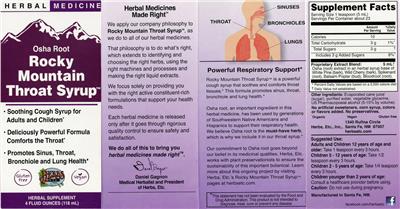
Herbal medicine Soothing cough syrup for adults and children Deliciously powerful formula comforts the throat Promotes sinus, throat, bronchiole and lung health
Gluten free
Vegan
Sinuses Throat Bronchioles Lungs Powerful respiratory support Rocky Mountain Throat Syrup is a powerful cough syrup that soothes and comforts throat tissues. This formula promotes sinus, throat, bronchiole and lung health.
No artificial sweeteners, corn syrup, colors or flavors added. No preservatives. Gluten free
Vegan
Manufactured in Santa Fe, NM.
Seals/Symbols
Vegan
FDA Statement of Identity
Herbal Supplement
Brand IP Statement(s)
Herbal Medicines Made Right We do all of this to bring you herbal medicines made right. Daniel Gagnon Medical herbalist and president of Herbs, Etc.
General Statements
We apply our company philosophy to Rocky Mountain Throat Syrup, as we do to all of our herbal medicines. That philosophy is to do what's right, which extends to identifying and choosing the right herbs, using the right machines and processes and making the right liquid extracts. We focus solely on providing you with the right active constituent-rich formulations that support your health needs. Each herbal medicine is released only after it goes through rigorous quality control to ensure safety and satisfaction.
Facebook.com/herbsetc
Formula
Osha root, an important ingredient in this herbal medicine, has been used by generations of Southwestern Native Americans and Hispanics to support their respiratory health. We believe Osha root is the must-have herb, which is why we include it in our throat syrup. Our commitment to Osha root goes beyond our belief in its medicinal qualities. Herbs, Etc. works with plant preservationists to ensure the sustainability of this important botanical. Learn more about this ongoing project by visiting Herbs, Etc.'s Rocky Mountain Throat Syrup pages at herbsetc.com.
Soothing cough syrup for adults and children
FDA Disclaimer Statement
This statement has not been evaluated by the Food and Drug Administration. This product is not intended to diagnose, treat, cure or prevent disease.
Suggested/Recommended/Usage/Directions
Suggested use: Adults and children 12 years of age and older: Take 1 teaspoon every 3 hours. Children 5-12 years of age: Take 1/2 teaspoon every 3 hours. Children 2-5 years of age: Take 1/4 teaspoon every 3 hours.
Precautions
Children younger than 2 years of age: Consult a healthcare provider before using.
Caution: Do not use during pregnancy.
Is this label outdated? Report a formula or label change and our pharmacy team will review it.
Osha Root Rocky Mountain Throat Syrup by Herbs Etc. label
The label scan from the NIH Dietary Supplement Label Database. Tap to enlarge.
Label images are published by the NIH Dietary Supplement Label Database for the version of this product on file. Always read your actual product label.
View the full label (PDF)The Ingredients in Osha Root Rocky Mountain Throat Syrup by Herbs Etc.
This is the 1 active ingredient this product is made of. Select it to open its full monograph.
Serving size5 mL Dosage formLiquid Servings per container23 Amounts shown are per serving.
Proprietary Extract Blend
Other (inactive) ingredients: Sugar Cane Juice, Evaporated, Water, Purified, Glycerine, Alcohol. These complete the product’s ingredient list but are not active constituents.
Osha Root Rocky Mountain Throat Syrup by Herbs Etc. Drug Interactions
HelloPharmacist Interaction Report
Osha Root Rocky Mountain Throat Syrup by Herbs Etc. does interact with medications, chiefly through its Wild Cherry bark extract and Spikenard root extract content.
The most serious concern is Wild Cherry's potential to raise levels of drugs broken down by a liver enzyme called CYP3A4 (cytochrome P450 3A4), which is a Moderate severity interaction. This hasn't been reported in actual human use yet, but in lab studies Wild Cherry inhibits this enzyme, so drugs like lovastatin and certain antifungals metabolized this way could theoretically build up in your system.
Read the full breakdown — every affected drug type, severity by severity
Spikenard root extract carries a Minor interaction with diuretic drugs (water pills). Spikenard is believed to increase sweating, which could enhance the fluid-loss effect of diuretics and potentially throw off your electrolyte balance if you're taking one of these medications.
We could not check White Pine bark extract or Balsam Poplar Bud Extract — we hold no interaction data for them. Bloodroot Root Extract was checked and shows no documented interactions in our data, though it does carry separate safety concerns you should know about (see the safety section below).
Altogether, these interactions span 718 individual medications. Use the search tool on this page to check your exact medications before starting this syrup.
Check your own medications below · Editorial policy · How we use AI
Want to check YOUR meds against Osha Root Rocky Mountain Throat Syrup?
Ask about interactions with your drugs in plain English — “Can I take it with lisinopril?” — and we find you the answer in seconds, ingredient by ingredient.
Go to the checkerIngredients driving the most interactions
Individual Drug Interactions
The ingredients in Osha Root Rocky Mountain Throat Syrup interact with 717 drugs. Click any drug to see the details.
0 of the 1 ingredient in Osha Root Rocky Mountain Throat Syrup interact with drugs. Each result below shows which ingredient is responsible.
Ado-trastuzumab EmtansineKadcyla
How Ado-trastuzumab Emtansine interacts with Osha Root Rocky Mountain Throat Syrup — through 1 ingredient. Tap an ingredient for the detail:
Wild Cherry Bark ExtractCytochrome P450 3a4 (cyp3a4) Substrates Moderate
Interaction Summary
In vitro research suggests that wild cherry can inhibit cytochrome P450 3A4 (CYP3A4) enzymes.
Read the full Wild Cherry Bark Extract + Ado-trastuzumab Emtansine interactionAbemaciclibVerzenio
How Abemaciclib interacts with Osha Root Rocky Mountain Throat Syrup — through 1 ingredient. Tap an ingredient for the detail:
Wild Cherry Bark ExtractCytochrome P450 3a4 (cyp3a4) Substrates Moderate
Interaction Summary
In vitro research suggests that wild cherry can inhibit cytochrome P450 3A4 (CYP3A4) enzymes.
Read the full Wild Cherry Bark Extract + Abemaciclib interactionAbiraterone
How Abiraterone interacts with Osha Root Rocky Mountain Throat Syrup — through 1 ingredient. Tap an ingredient for the detail:
Wild Cherry Bark ExtractCytochrome P450 3a4 (cyp3a4) Substrates Moderate
Interaction Summary
In vitro research suggests that wild cherry can inhibit cytochrome P450 3A4 (CYP3A4) enzymes.
Read the full Wild Cherry Bark Extract + Abiraterone interactionAbiraterone AcetateYonsa, Zytiga
How Abiraterone Acetate interacts with Osha Root Rocky Mountain Throat Syrup — through 1 ingredient. Tap an ingredient for the detail:
Wild Cherry Bark ExtractCytochrome P450 3a4 (cyp3a4) Substrates Moderate
Interaction Summary
In vitro research suggests that wild cherry can inhibit cytochrome P450 3A4 (CYP3A4) enzymes.
Read the full Wild Cherry Bark Extract + Abiraterone Acetate interactionAcalabrutinibCalquence
How Acalabrutinib interacts with Osha Root Rocky Mountain Throat Syrup — through 1 ingredient. Tap an ingredient for the detail:
Wild Cherry Bark ExtractCytochrome P450 3a4 (cyp3a4) Substrates Moderate
Interaction Summary
In vitro research suggests that wild cherry can inhibit cytochrome P450 3A4 (CYP3A4) enzymes.
Read the full Wild Cherry Bark Extract + Acalabrutinib interactionAcetaminophen, Aspirin, CaffeineExcedrin, Excedrin Extra Strength, Excedrin Migraine
How Acetaminophen, Aspirin, Caffeine interacts with Osha Root Rocky Mountain Throat Syrup — through 1 ingredient. Tap an ingredient for the detail:
Wild Cherry Bark ExtractCytochrome P450 3a4 (cyp3a4) Substrates Moderate
Interaction Summary
In vitro research suggests that wild cherry can inhibit cytochrome P450 3A4 (CYP3A4) enzymes.
Read the full Wild Cherry Bark Extract + Acetaminophen, Aspirin, Caffeine interactionAcetaminophen, Butalbital, CaffeineEsgic, Esgic Plus, Fiogesic, Fioricet, Repan, Tecnal +1 more
How Acetaminophen, Butalbital, Caffeine interacts with Osha Root Rocky Mountain Throat Syrup — through 1 ingredient. Tap an ingredient for the detail:
Wild Cherry Bark ExtractCytochrome P450 3a4 (cyp3a4) Substrates Moderate
Interaction Summary
In vitro research suggests that wild cherry can inhibit cytochrome P450 3A4 (CYP3A4) enzymes.
Read the full Wild Cherry Bark Extract + Acetaminophen, Butalbital, Caffeine interactionAcetaminophen, Butalbital, Caffeine, CodeineEsgic with Codeine, Fioricet w/ Codeine
How Acetaminophen, Butalbital, Caffeine, Codeine interacts with Osha Root Rocky Mountain Throat Syrup — through 1 ingredient. Tap an ingredient for the detail:
Wild Cherry Bark ExtractCytochrome P450 3a4 (cyp3a4) Substrates Moderate
Interaction Summary
In vitro research suggests that wild cherry can inhibit cytochrome P450 3A4 (CYP3A4) enzymes.
Read the full Wild Cherry Bark Extract + Acetaminophen, Butalbital, Caffeine, Codeine interactionAcetaminophen, Caffeine, Chlorpheniramine, Hydrocodone, PhenylephrineHycomine Compound
How Acetaminophen, Caffeine, Chlorpheniramine, Hydrocodone, Phenylephrine interacts with Osha Root Rocky Mountain Throat Syrup — through 1 ingredient. Tap an ingredient for the detail:
Wild Cherry Bark ExtractCytochrome P450 3a4 (cyp3a4) Substrates Moderate
Interaction Summary
In vitro research suggests that wild cherry can inhibit cytochrome P450 3A4 (CYP3A4) enzymes.
Read the full Wild Cherry Bark Extract + Acetaminophen, Caffeine, Chlorpheniramine, Hydrocodone, Phenylephrine interactionAcetaminophen, Caffeine, CodeineGesic C15, Gesic C30, Gesic C8, Lenoltec 1, Lenoltec 2, Lenoltec 3 +1 more
How Acetaminophen, Caffeine, Codeine interacts with Osha Root Rocky Mountain Throat Syrup — through 1 ingredient. Tap an ingredient for the detail:
Wild Cherry Bark ExtractCytochrome P450 3a4 (cyp3a4) Substrates Moderate
Interaction Summary
In vitro research suggests that wild cherry can inhibit cytochrome P450 3A4 (CYP3A4) enzymes.
Read the full Wild Cherry Bark Extract + Acetaminophen, Caffeine, Codeine interactionAcetaminophen, Caffeine, Codeine, SalicylamideCodalan No.1, Codalan No.2, Codalan No.3
How Acetaminophen, Caffeine, Codeine, Salicylamide interacts with Osha Root Rocky Mountain Throat Syrup — through 1 ingredient. Tap an ingredient for the detail:
Wild Cherry Bark ExtractCytochrome P450 3a4 (cyp3a4) Substrates Moderate
Interaction Summary
In vitro research suggests that wild cherry can inhibit cytochrome P450 3A4 (CYP3A4) enzymes.
Read the full Wild Cherry Bark Extract + Acetaminophen, Caffeine, Codeine, Salicylamide interactionAcetaminophen, Caffeine, DihydrocodeineDHC Plus, Panlor DC, Panlor SS
How Acetaminophen, Caffeine, Dihydrocodeine interacts with Osha Root Rocky Mountain Throat Syrup — through 1 ingredient. Tap an ingredient for the detail:
Wild Cherry Bark ExtractCytochrome P450 3a4 (cyp3a4) Substrates Moderate
Interaction Summary
In vitro research suggests that wild cherry can inhibit cytochrome P450 3A4 (CYP3A4) enzymes.
Read the full Wild Cherry Bark Extract + Acetaminophen, Caffeine, Dihydrocodeine interactionAcetaminophen, Caffeine, IsomethepteneMigralam
How Acetaminophen, Caffeine, Isometheptene interacts with Osha Root Rocky Mountain Throat Syrup — through 1 ingredient. Tap an ingredient for the detail:
Wild Cherry Bark ExtractCytochrome P450 3a4 (cyp3a4) Substrates Moderate
Interaction Summary
In vitro research suggests that wild cherry can inhibit cytochrome P450 3A4 (CYP3A4) enzymes.
Read the full Wild Cherry Bark Extract + Acetaminophen, Caffeine, Isometheptene interactionAcetaminophen, Caffeine, PyrilamineMidol Max Strength Menstrual
How Acetaminophen, Caffeine, Pyrilamine interacts with Osha Root Rocky Mountain Throat Syrup — through 2 ingredients. Tap an ingredient for the detail:
Wild Cherry Bark ExtractCytochrome P450 3a4 (cyp3a4) Substrates Moderate
Interaction Summary
In vitro research suggests that wild cherry can inhibit cytochrome P450 3A4 (CYP3A4) enzymes.
Read the full Wild Cherry Bark Extract + Acetaminophen, Caffeine, Pyrilamine interactionSpikenard Root ExtractDiuretic Drugs Minor
Interaction Summary
American spikenard is purported to have diaphoretic properties.
Read the full Spikenard Root Extract + Acetaminophen, Caffeine, Pyrilamine interactionAcetaminophen, Chlorpheniramine Maleate, Dextromethorphan HbrVicks Formula 44M Cough, Cold & Flu Relief
How Acetaminophen, Chlorpheniramine Maleate, Dextromethorphan Hbr interacts with Osha Root Rocky Mountain Throat Syrup — through 1 ingredient. Tap an ingredient for the detail:
Wild Cherry Bark ExtractCytochrome P450 3a4 (cyp3a4) Substrates Moderate
Interaction Summary
In vitro research suggests that wild cherry can inhibit cytochrome P450 3A4 (CYP3A4) enzymes.
Read the full Wild Cherry Bark Extract + Acetaminophen, Chlorpheniramine Maleate, Dextromethorphan Hbr interactionAcetaminophen, Chlorpheniramine, Codeine, PhenylephrineColrex
How Acetaminophen, Chlorpheniramine, Codeine, Phenylephrine interacts with Osha Root Rocky Mountain Throat Syrup — through 1 ingredient. Tap an ingredient for the detail:
Wild Cherry Bark ExtractCytochrome P450 3a4 (cyp3a4) Substrates Moderate
Interaction Summary
In vitro research suggests that wild cherry can inhibit cytochrome P450 3A4 (CYP3A4) enzymes.
Read the full Wild Cherry Bark Extract + Acetaminophen, Chlorpheniramine, Codeine, Phenylephrine interactionAcetaminophen, Chlorpheniramine, DextromethorphanCoricidin II Extra Strength Cold and Flu
How Acetaminophen, Chlorpheniramine, Dextromethorphan interacts with Osha Root Rocky Mountain Throat Syrup — through 1 ingredient. Tap an ingredient for the detail:
Wild Cherry Bark ExtractCytochrome P450 3a4 (cyp3a4) Substrates Moderate
Interaction Summary
In vitro research suggests that wild cherry can inhibit cytochrome P450 3A4 (CYP3A4) enzymes.
Read the full Wild Cherry Bark Extract + Acetaminophen, Chlorpheniramine, Dextromethorphan interactionAcetaminophen, Chlorpheniramine, Dextromethorphan HydrobromideCoricidin HBP Maximum Strength Flu
How Acetaminophen, Chlorpheniramine, Dextromethorphan Hydrobromide interacts with Osha Root Rocky Mountain Throat Syrup — through 1 ingredient. Tap an ingredient for the detail:
Wild Cherry Bark ExtractCytochrome P450 3a4 (cyp3a4) Substrates Moderate
Interaction Summary
In vitro research suggests that wild cherry can inhibit cytochrome P450 3A4 (CYP3A4) enzymes.
Read the full Wild Cherry Bark Extract + Acetaminophen, Chlorpheniramine, Dextromethorphan Hydrobromide interactionAcetaminophen, Chlorpheniramine, Dextromethorphan, PhenylpropanolamineMulti Symptom Cold Relief
How Acetaminophen, Chlorpheniramine, Dextromethorphan, Phenylpropanolamine interacts with Osha Root Rocky Mountain Throat Syrup — through 1 ingredient. Tap an ingredient for the detail:
Wild Cherry Bark ExtractCytochrome P450 3a4 (cyp3a4) Substrates Moderate
Interaction Summary
In vitro research suggests that wild cherry can inhibit cytochrome P450 3A4 (CYP3A4) enzymes.
Read the full Wild Cherry Bark Extract + Acetaminophen, Chlorpheniramine, Dextromethorphan, Phenylpropanolamine interactionAcetaminophen, Chlorpheniramine, Dextromethorphan, PseudoephedrineChildren's Tylenol Cold Plus Cough, Tylenol Cold Ex Strength
How Acetaminophen, Chlorpheniramine, Dextromethorphan, Pseudoephedrine interacts with Osha Root Rocky Mountain Throat Syrup — through 1 ingredient. Tap an ingredient for the detail:
Wild Cherry Bark ExtractCytochrome P450 3a4 (cyp3a4) Substrates Moderate
Interaction Summary
In vitro research suggests that wild cherry can inhibit cytochrome P450 3A4 (CYP3A4) enzymes.
Read the full Wild Cherry Bark Extract + Acetaminophen, Chlorpheniramine, Dextromethorphan, Pseudoephedrine interactionAcetaminophen, Chlorpheniramine, Guaifenesin, Phenylephrine, SalicylamideRhinogesic GG
How Acetaminophen, Chlorpheniramine, Guaifenesin, Phenylephrine, Salicylamide interacts with Osha Root Rocky Mountain Throat Syrup — through 1 ingredient. Tap an ingredient for the detail:
Wild Cherry Bark ExtractCytochrome P450 3a4 (cyp3a4) Substrates Moderate
Interaction Summary
In vitro research suggests that wild cherry can inhibit cytochrome P450 3A4 (CYP3A4) enzymes.
Read the full Wild Cherry Bark Extract + Acetaminophen, Chlorpheniramine, Guaifenesin, Phenylephrine, Salicylamide interactionAcetaminophen, Chlorpheniramine, PhenylephrineAlka-Seltzer PLUS, Histex SR, Protid
How Acetaminophen, Chlorpheniramine, Phenylephrine interacts with Osha Root Rocky Mountain Throat Syrup — through 1 ingredient. Tap an ingredient for the detail:
Wild Cherry Bark ExtractCytochrome P450 3a4 (cyp3a4) Substrates Moderate
Interaction Summary
In vitro research suggests that wild cherry can inhibit cytochrome P450 3A4 (CYP3A4) enzymes.
Read the full Wild Cherry Bark Extract + Acetaminophen, Chlorpheniramine, Phenylephrine interactionAcetaminophen, Chlorpheniramine, Phenylephrine, SalicylamideRhinogesic, Rhinogesic JR
How Acetaminophen, Chlorpheniramine, Phenylephrine, Salicylamide interacts with Osha Root Rocky Mountain Throat Syrup — through 1 ingredient. Tap an ingredient for the detail:
Wild Cherry Bark ExtractCytochrome P450 3a4 (cyp3a4) Substrates Moderate
Interaction Summary
In vitro research suggests that wild cherry can inhibit cytochrome P450 3A4 (CYP3A4) enzymes.
Read the full Wild Cherry Bark Extract + Acetaminophen, Chlorpheniramine, Phenylephrine, Salicylamide interactionAcetaminophen, Chlorpheniramine, PhenylpropanolamineAlumadrine, Conex, Sinadrin Max Strength, Sinulin
How Acetaminophen, Chlorpheniramine, Phenylpropanolamine interacts with Osha Root Rocky Mountain Throat Syrup — through 1 ingredient. Tap an ingredient for the detail:
Wild Cherry Bark ExtractCytochrome P450 3a4 (cyp3a4) Substrates Moderate
Interaction Summary
In vitro research suggests that wild cherry can inhibit cytochrome P450 3A4 (CYP3A4) enzymes.
Read the full Wild Cherry Bark Extract + Acetaminophen, Chlorpheniramine, Phenylpropanolamine interactionAcetaminophen, Chlorpheniramine, Phenylpropanolamine, OpiumHista-Derfule
How Acetaminophen, Chlorpheniramine, Phenylpropanolamine, Opium interacts with Osha Root Rocky Mountain Throat Syrup — through 1 ingredient. Tap an ingredient for the detail:
Wild Cherry Bark ExtractCytochrome P450 3a4 (cyp3a4) Substrates Moderate
Interaction Summary
In vitro research suggests that wild cherry can inhibit cytochrome P450 3A4 (CYP3A4) enzymes.
Read the full Wild Cherry Bark Extract + Acetaminophen, Chlorpheniramine, Phenylpropanolamine, Opium interactionAcetaminophen, Chlorpheniramine, Phenylpropanolamine, PhenyltoloxamineNorel Plus
How Acetaminophen, Chlorpheniramine, Phenylpropanolamine, Phenyltoloxamine interacts with Osha Root Rocky Mountain Throat Syrup — through 1 ingredient. Tap an ingredient for the detail:
Wild Cherry Bark ExtractCytochrome P450 3a4 (cyp3a4) Substrates Moderate
Interaction Summary
In vitro research suggests that wild cherry can inhibit cytochrome P450 3A4 (CYP3A4) enzymes.
Read the full Wild Cherry Bark Extract + Acetaminophen, Chlorpheniramine, Phenylpropanolamine, Phenyltoloxamine interactionAcetaminophen, Chlorpheniramine, PseudoephedrineAlka-Seltzer PLUS Liquid Gels, Children's Tylenol Cold, Codimal, Comtrex, Extra Strength Tylenol Allergy Sinus, Lorsin +3 more
How Acetaminophen, Chlorpheniramine, Pseudoephedrine interacts with Osha Root Rocky Mountain Throat Syrup — through 1 ingredient. Tap an ingredient for the detail:
Wild Cherry Bark ExtractCytochrome P450 3a4 (cyp3a4) Substrates Moderate
Interaction Summary
In vitro research suggests that wild cherry can inhibit cytochrome P450 3A4 (CYP3A4) enzymes.
Read the full Wild Cherry Bark Extract + Acetaminophen, Chlorpheniramine, Pseudoephedrine interactionAcetaminophen, DextromethorphanTylenol Cough Ex Strength
How Acetaminophen, Dextromethorphan interacts with Osha Root Rocky Mountain Throat Syrup — through 1 ingredient. Tap an ingredient for the detail:
Wild Cherry Bark ExtractCytochrome P450 3a4 (cyp3a4) Substrates Moderate
Interaction Summary
In vitro research suggests that wild cherry can inhibit cytochrome P450 3A4 (CYP3A4) enzymes.
Read the full Wild Cherry Bark Extract + Acetaminophen, Dextromethorphan interactionAcetaminophen, Dextromethorphan, Doxylamine, PseudoephedrineVicks NyQuil
How Acetaminophen, Dextromethorphan, Doxylamine, Pseudoephedrine interacts with Osha Root Rocky Mountain Throat Syrup — through 1 ingredient. Tap an ingredient for the detail:
Wild Cherry Bark ExtractCytochrome P450 3a4 (cyp3a4) Substrates Moderate
Interaction Summary
In vitro research suggests that wild cherry can inhibit cytochrome P450 3A4 (CYP3A4) enzymes.
Read the full Wild Cherry Bark Extract + Acetaminophen, Dextromethorphan, Doxylamine, Pseudoephedrine interactionAcetaminophen, Dextromethorphan, Guaifenesin, PhenylephrineConar-A
How Acetaminophen, Dextromethorphan, Guaifenesin, Phenylephrine interacts with Osha Root Rocky Mountain Throat Syrup — through 1 ingredient. Tap an ingredient for the detail:
Wild Cherry Bark ExtractCytochrome P450 3a4 (cyp3a4) Substrates Moderate
Interaction Summary
In vitro research suggests that wild cherry can inhibit cytochrome P450 3A4 (CYP3A4) enzymes.
Read the full Wild Cherry Bark Extract + Acetaminophen, Dextromethorphan, Guaifenesin, Phenylephrine interactionEach ingredient & the kinds of drugs it affects
For each ingredient in Osha Root Rocky Mountain Throat Syrup with known interactions, here are the types of medications it can affect. Open any type for the detail — or search your exact drug in the checker above.
Brand information
Manufacturer and brand details for Osha Root Rocky Mountain Throat Syrup, from the product label.
Herbs Etc.
- Name
- Herbs, Etc., Inc.
- Street Address
- 1340 Rufina Circle
- City
- Santa Fe
- State
- NM
- ZipCode
- 87507
- Web Address
- www.herbsetc.com
Osha Root Rocky Mountain Throat Syrup by Herbs Etc.: Common Questions
Does Osha Root Rocky Mountain Throat Syrup by Herbs Etc. interact with any medications?
How can one product interact with so many drugs?
Where does this information come from?
Can I use this if I take a statin or blood pressure medication?
Is this safe for a sore throat or cough?
Can I use this while pregnant or breastfeeding?
What's bloodroot doing in a throat syrup?
Are there any fillers or artificial ingredients?
What's spikenard root for?
Written and reviewed by the HelloPharmacist editorial staff. Our editorial policy
Not sure if Osha Root Rocky Mountain Throat Syrup is safe with your meds?
Our pharmacists answer your medication & supplement questions — free.
Label information is sourced from the NIH Dietary Supplement Label Database and reflects the product version on file; always read your actual product label. This page is for education only and is not a substitute for professional medical advice. Confirm with your pharmacist or doctor before combining supplements and medications.
The Full Monographs Behind Osha Root Rocky Mountain Throat Syrup’s Ingredients
Every ingredient we hold a full HelloPharmacist monograph for — uses, evidence, safety, and the complete interaction list.
Sources & How We Checked
Osha Root Rocky Mountain Throat Syrup's label data comes from the NIH Dietary Supplement Label Database; the ingredient interaction data is from the Natural Medicines database, reviewed by our pharmacists.
- NIH Dietary Supplement Label Database (DSLD) — The official product label on file for this supplement.
- Natural Medicines (Therapeutic Research Center) — Evidence-graded clinical reference behind the ingredient interaction data.
Content is written and reviewed by licensed HelloPharmacist pharmacists. See our data sources and editorial standards for how this information is built and checked.
The 21 references behind this product’s interaction data
Every citation that drives the interaction findings for this product’s ingredients, from the evidence-graded Natural Medicines (TRC Healthcare) database. Open an ingredient to browse its citations — links open the study on PubMed or the publisher’s site.
Osha 2 references
- McGuffin M, Hobbs C, Upton R, Goldberg A, eds. American Herbal Products Association's Botanical Safety Handbook. Boca Raton, FL: CRC Press, LLC 1997.
- Brinker F. Herb Contraindications and Drug Interactions. 2nd ed. Sandy, OR: Eclectic Medical Publications, 1998.
Wild Cherry 4 references
- Gruenwald J, Brendler T, Jaenicke C. PDR for Herbal Medicines. 1st ed. Montvale, NJ: Medical Economics Company, Inc., 1998.
- Brinker F. Herb Contraindications and Drug Interactions. 2nd ed. Sandy, OR: Eclectic Medical Publications, 1998.
- Budzinski JW, Foster BC, Vandenhoek S, Arnason JT. An in vitro evaluation of human cytochrome P450 3A4 inhibition by selected commercial herbal extracts and tinctures. Phytomedicine 2000;7:273-82. PubMed
- Pentore, R., Venneri, A., and Nichelli, P. Accidental choke-cherry poisoning: early symptoms and neurological sequelae of an unusual case of cyanide intoxication. Ital.J Neurol.Sci. 1996;17(3):233-235. PubMed
American Spikenard 1 reference
- McGuffin M, Hobbs C, Upton R, Goldberg A, eds. American Herbal Products Association's Botanical Safety Handbook. Boca Raton, FL: CRC Press, LLC 1997.
Bloodroot 14 references
- Newall CA, Anderson LA, Philpson JD. Herbal Medicine: A Guide for Healthcare Professionals. London, UK: The Pharmaceutical Press, 1996.
- The Review of Natural Products by Facts and Comparisons. St. Louis, MO: Wolters Kluwer Co., 1999.
- McGuffin M, Hobbs C, Upton R, Goldberg A, eds. American Herbal Products Association's Botanical Safety Handbook. Boca Raton, FL: CRC Press, LLC 1997.
- Brinker F. Herb Contraindications and Drug Interactions. 2nd ed. Sandy, OR: Eclectic Medical Publications, 1998.
- Eversole, L. R., Eversole, G. M., and Kopcik, J. Sanguinaria-associated oral leukoplakia: comparison with other benign and dysplastic leukoplakic lesions. Oral Surg.Oral Med.Oral Pathol.Oral Radiol.Endod. 2000;89(4):455-464. PubMed
- Allen, C. L., Loudon, J., and Mascarenhas, A. K. Sanguinaria-related leukoplakia: epidemiologic and clinicopathologic features of a recently described entity. Gen.Dent. 2001;49(6):608-614.
- Kuftinec, M. M., Mueller-Joseph, L. J., and Kopczyk, R. A. Sanguinaria toothpaste and oral rinse regimen clinical efficacy in short- and long-term trials. J.Can.Dent.Assoc. 1990;56(7 Suppl):31-33.
- Frankos, V. H., Brusick, D. J., Johnson, E. M., Maibach, H. I., Munro, I., Squire, R. A., and Weil, C. S. Safety of Sanguinaria extract as used in commercial toothpaste and oral rinse products. J.Can.Dent.Assoc. 1990;56(7 Suppl):41-47.
- Cullinan, M. P., Powell, R. N., Faddy, M. J., and Seymour, G. J. Efficacy of a dentifrice and oral rinse containing sanguinaria extract in conjunction with initial periodontal therapy. Aust.Dent.J. 1997;42(1):47-51. PubMed
- Affleck, A. G. and Varma, S. A case of do-it-yourself Mohs' surgery using bloodroot obtained from the internet. Br.J Dermatol 2007;157(5):1078-1079. PubMed
- Cienki JJ, Zaret L. An Internet misadventure: bloodroot salve toxicity. J Altern Complement Med. 2010;16(10):1125-7. PubMed
- Hou JL, Brewer JD. Black salve and bloodroot extract in dermatologic conditions. Cutis. 2015;95(6):309-11.
- Schilling LM, Saedi N. Bloodroot paste: what dermatologists and patients need to know. Dermatol Surg 2016;42(10):1223-4. PubMed
- Schlichte MJ, Downing CP, Ramirez-Fort M, Gordon R, Tyring S. Bloodroot associated eschar. Dermatol Online J 2014;20(7). DOI
Parts of this content are provided by the Therapeutic Research Center, LLC.
DISCLAIMER: Currently this does not check for drug-drug interactions. This is not an all-inclusive comprehensive list of potential interactions and is for informational purposes only. Not all interactions are known or well-reported in the scientific literature, and new interactions are continually being reported. Input is needed from a qualified healthcare provider including a pharmacist before starting any therapy. Application of clinical judgment is necessary.
© 2021 Therapeutic Research Center, LLC